

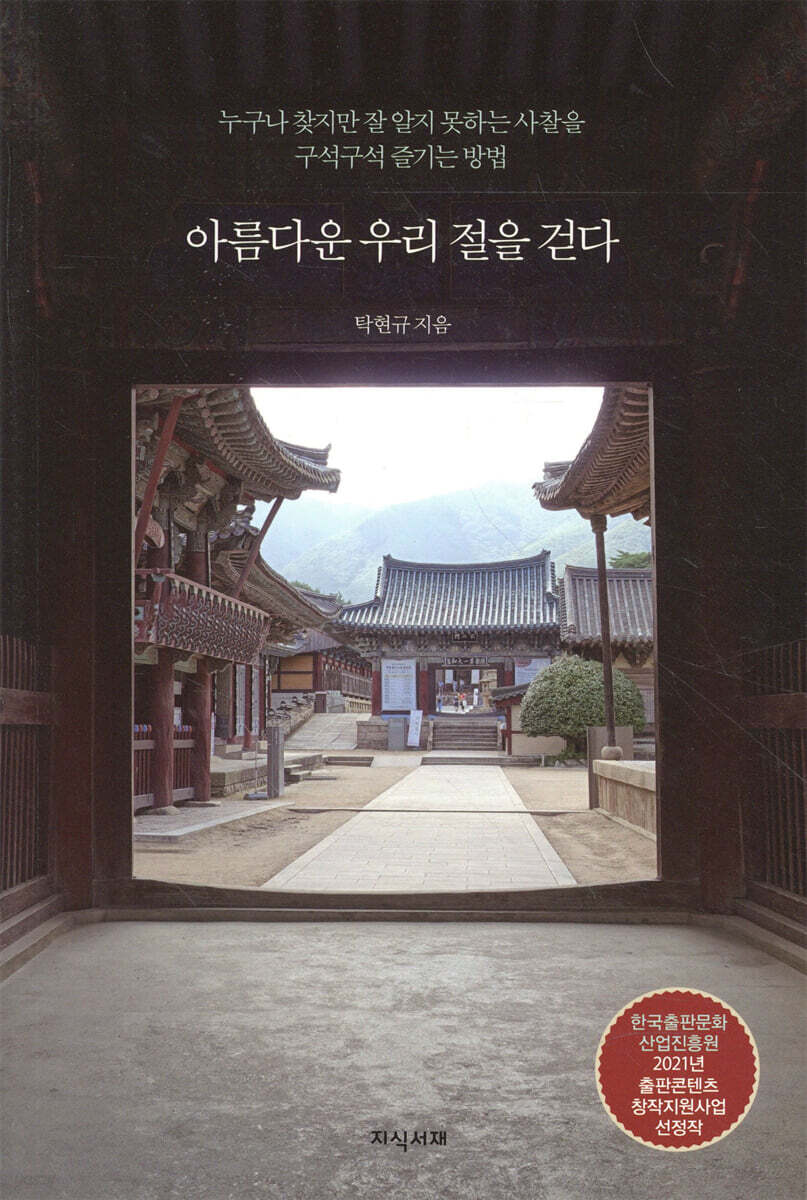
Walking through our beautiful temple
 |
Description
Book Introduction
Selected works for the 2021 Publication Content Creation Support Project of the Korea Publication Industry Promotion Agency The minimum knowledge required to appreciate the beauty of the past in a temple If Europe has cathedrals as must-visit places for travelers, we have temples. Although the temple is a familiar place that everyone visits, it is also an unknown space filled with houses, stone structures, statues, and paintings whose purpose is unknown. There are many books about temples, but they do not adequately answer the questions that travelers have about them. The author of this book, who has become a star lecturer by making our traditional art easy and fun to understand, walks around every corner of the temple, from the main gate to the Sanshin Pavilion, and provides friendly explanations like a tour guide right at your side. This book contains the minimum knowledge necessary to truly appreciate the beauty of the old at the temple. Because it extracts commonalities from different sections and discusses them, you can apply the contents of the book to any section you visit. Whether you are a Buddhist or simply a temple visitor, this book will serve as a valuable guide for everyone. |
- You can preview some of the book's contents.
Preview
index
Appendix 1: Map of the temples and artifacts introduced in the book
Appendix 2: Section layout
Introduction
Chapter 1: Introduction
Rainbow Bridge, a bridge that crosses from one hill to another
Chapter 2: Three Doors to the World of Enlightenment
Iljumun, the gate to the world of Buddha
Geumgangmun, the gate guarded by two Geumgangsa Temple officials
Cheonwangmun, the gate guarded by the four heavenly kings
Chapter 3: The Temple Yard
Lu (loft), a two-story house with a great view
Stone lanterns, stone lanterns that illuminate the Buddha's teachings
Stone pagoda, a stone tomb containing the Buddha's relics
Chapter 4: The House Where the Buddha Lives
Daeungjeon, the home of the great hero Sakyamuni Buddha
-Seokguram Grotto: India's Yeongchwisan Mountain recreated on Tohamsan Mountain in Gyeongju
-Veongsan Painting: A painting of Sakyamuni Buddha preaching on Vulture Peak
-Gamrotang: A painting of giving sweet dew to a hungry ghost
-Samjangtaeng: A painting of the forces of heaven, earth, and hell together.
-Shinjungtang: A painting of the gods of heaven and earth sitting together
-Gwaebultaeng: a large painting hung high in the temple yard
- Avalokitesvara Mural: A painting on the back wall of the main hall
Palsangjeon, a house depicting the life of Buddha in eight panels
Daegwangmyeongjeon, the home of Vairocana Buddha, the embodiment of the Buddha's dharma.
Paradise Hall, the home of Amitabha Buddha, the lord of paradise
Yaksajeon, the house where the Yaksa Buddha, who cures illnesses, lives
Chapter 5: The House Where the Bodhisattva Lives
The Hall of the Underworld, a house where sins are judged by the kings of hell
Guanyin Hall, the home of Avalokitesvara Bodhisattva, who relieves suffering in reality
Chapter 6: The House Where the Old Monks Lived
Nahanjeon, the house where the Arhat who has overcome defilements lives
Before the investigation, the house where the teacher's camp is gathered
Chapter 7: A House Encountering Indigenous Beliefs
Sanshin-gak, the house where the mountain god lives
Dokseonggak, a house where adults practice alone
Chilseonggak, the house where the North Star and the Big Dipper live as Buddhas
It comes from Chapter 8, Section 8
Stupa, a monk's stone tomb
Books that helped me
List of illustrations and sources
Appendix 3: Gestures and Postures of the Buddha
Appendix 2: Section layout
Introduction
Chapter 1: Introduction
Rainbow Bridge, a bridge that crosses from one hill to another
Chapter 2: Three Doors to the World of Enlightenment
Iljumun, the gate to the world of Buddha
Geumgangmun, the gate guarded by two Geumgangsa Temple officials
Cheonwangmun, the gate guarded by the four heavenly kings
Chapter 3: The Temple Yard
Lu (loft), a two-story house with a great view
Stone lanterns, stone lanterns that illuminate the Buddha's teachings
Stone pagoda, a stone tomb containing the Buddha's relics
Chapter 4: The House Where the Buddha Lives
Daeungjeon, the home of the great hero Sakyamuni Buddha
-Seokguram Grotto: India's Yeongchwisan Mountain recreated on Tohamsan Mountain in Gyeongju
-Veongsan Painting: A painting of Sakyamuni Buddha preaching on Vulture Peak
-Gamrotang: A painting of giving sweet dew to a hungry ghost
-Samjangtaeng: A painting of the forces of heaven, earth, and hell together.
-Shinjungtang: A painting of the gods of heaven and earth sitting together
-Gwaebultaeng: a large painting hung high in the temple yard
- Avalokitesvara Mural: A painting on the back wall of the main hall
Palsangjeon, a house depicting the life of Buddha in eight panels
Daegwangmyeongjeon, the home of Vairocana Buddha, the embodiment of the Buddha's dharma.
Paradise Hall, the home of Amitabha Buddha, the lord of paradise
Yaksajeon, the house where the Yaksa Buddha, who cures illnesses, lives
Chapter 5: The House Where the Bodhisattva Lives
The Hall of the Underworld, a house where sins are judged by the kings of hell
Guanyin Hall, the home of Avalokitesvara Bodhisattva, who relieves suffering in reality
Chapter 6: The House Where the Old Monks Lived
Nahanjeon, the house where the Arhat who has overcome defilements lives
Before the investigation, the house where the teacher's camp is gathered
Chapter 7: A House Encountering Indigenous Beliefs
Sanshin-gak, the house where the mountain god lives
Dokseonggak, a house where adults practice alone
Chilseonggak, the house where the North Star and the Big Dipper live as Buddhas
It comes from Chapter 8, Section 8
Stupa, a monk's stone tomb
Books that helped me
List of illustrations and sources
Appendix 3: Gestures and Postures of the Buddha
Detailed image

Into the book
I liked the dirt floor.
It was nice even though it was raining and muddy.
I liked the tree house.
It was nice whether it was hot in the summer or cold in the winter.
The red-painted wooden pillars and the black tiled roof were a perfect match.
The houses were all on the first floor, so the back of the house was clearly visible.
When you go inside the house, there are sculptures, paintings, and sometimes music.
And there were those who humbled themselves without saying a word.
All those who brought offerings and placed them before the Buddha were devout.
There are paintings hanging on the walls all around the house, and people walk around the house bowing to all four walls.
And then I put on my shoes and go out, but this time I take them off and go into another house.
Isn't taking off your shoes also a sign of humility?
---From the "Introductory Note"
If you turn your head to the opposite side, you will see the Western Heavenly King, Guangmucheonwang, on the left.
As the name suggests, Gwangmokcheon is a heavenly king who defeats all evil things with his big eyes.
His right hand reached down and gripped the dragon's neck tightly, while his left hand rose and gently held the Yeouiju between his thumb and middle finger.
At this time, the dragon is looking at his stolen Yeouiju with longing eyes.
The dragon was robbed of the Yeouiju, which was like his life, and was helplessly submitted to the Heavenly King of Gwangmok.
This is a warning that even the dragon, the god of the sea, can easily subdue the might of the Heavenly King of Light, and that evil spirits that are inferior to the dragon will not be able to stand up to him.
---From "Cheonwangmun, the gate guarded by the four heavenly kings"
However, the appearance of the Dragon King is different from that of other previous Yongsan paintings, and it is the most unique appearance among the group of rear Buddha paintings at Yongjusa Temple.
Perhaps this Dragon King was modeled after King Jeongjo.
His eyebrows and beard are almost as thick as the Four Heavenly Kings, making him seem like he was modeled after a real person.
When this painting was completed, King Jeongjo was 39 years old, and the face is also around that age.
The appearance of the opposite side further confirms this assumption.
The hairstyle, with the hair made into two large ovals and pulled back, is the hairstyle of royal women.
This is a map that has never existed before.
If so, could this woman be Queen Hyowi, the wife of King Jeongjo?
Since she was one year younger than King Jeongjo, it can be assumed that she was Queen Hyowi, who was 38 years old.
---From "Daeungjeon, the home of the great hero Sakyamuni Buddha"
The name of the fifth section is ‘Practicing Taoism in the Snowy Mountains (Seolsansudo).’
The fastest scene in this painting is the one where the prince, dressed as a hunter in the forest, cuts his own hair with a sword.
This is called 'Golden Sword Hair Falling' and is the first important event that the crown prince experiences after becoming a monk.
In Buddhism, shaving one's head is a sign of giving up one's status, symbolized by the tall turban.
Equality, one of the two major tenets of Buddhism, is embodied in the act of shaving one's head.
The idea that shaving one's head would make everyone equal under a strong caste system was the most remarkable thing that helped Buddhism become a universal religion.
---From "Pal Sang Jeon, a house depicting the Buddha's life in eight paintings"
In Buddhism, there are many Buddhas other than Shakyamuni Buddha.
The idea that there is no place in time and space, past, present, future, east, south, west, north, etc., where there is a Buddha to save sentient beings gave birth to many Buddhas.
In particular, a Buddha who heals sick beings would be the Buddha that they truly desire.
In Buddhism, this is called the Medicine Buddha, the teacher who becomes medicine, and the house where the Medicine Buddha resides as the main deity is called the Medicine Buddha Hall.
The Bhaisajyaguru Hall is rarely placed as the central hall in a temple, and is not found in all temples. It is also less numerous than the Paradise Hall, so the importance of the Bhaisajyaguru Buddha is lower than that of the Amitabha Buddha.
---From "The Pharmacist's Dictionary, The House Where the Medicine Buddha Lives, Who Cures Diseases"
The Bodhisattva Ksitigarbha is the non-poisonous ghost king, and the place where the ghost king lives is hell.
So, because he knows the situation in hell better than anyone else, Ksitigarbha Bodhisattva helps save the beings in hell.
Then, how about calling the ghost king like this?
Local guide from hell.
Because he is the ghost king, he takes the form of a king, which is why the appearances of the Poisonless Ghost King and the King of Hell are similar.
The Poisonous Demon King can sometimes be distinguished from the King of Ten Kings who holds a scepter by holding a wooden box containing scriptures, called a gyeongham, with both hands.
---From "The Book of the Underworld, the House Where Sins Are Judged by the Kings of Hell"
Stone-shaped stupas were built in large numbers in the late Joseon Dynasty as it became customary to build stupas for teachers, and a forest of stupas, called Budorim (浮屠林), was created at each temple.
The Buddhist altar is usually located outside the main gate, so it is the first or last place to worship when entering or leaving the temple.
Isn't this the Buddhist teaching that life and death are not two separate things, spoken in space?
It was nice even though it was raining and muddy.
I liked the tree house.
It was nice whether it was hot in the summer or cold in the winter.
The red-painted wooden pillars and the black tiled roof were a perfect match.
The houses were all on the first floor, so the back of the house was clearly visible.
When you go inside the house, there are sculptures, paintings, and sometimes music.
And there were those who humbled themselves without saying a word.
All those who brought offerings and placed them before the Buddha were devout.
There are paintings hanging on the walls all around the house, and people walk around the house bowing to all four walls.
And then I put on my shoes and go out, but this time I take them off and go into another house.
Isn't taking off your shoes also a sign of humility?
---From the "Introductory Note"
If you turn your head to the opposite side, you will see the Western Heavenly King, Guangmucheonwang, on the left.
As the name suggests, Gwangmokcheon is a heavenly king who defeats all evil things with his big eyes.
His right hand reached down and gripped the dragon's neck tightly, while his left hand rose and gently held the Yeouiju between his thumb and middle finger.
At this time, the dragon is looking at his stolen Yeouiju with longing eyes.
The dragon was robbed of the Yeouiju, which was like his life, and was helplessly submitted to the Heavenly King of Gwangmok.
This is a warning that even the dragon, the god of the sea, can easily subdue the might of the Heavenly King of Light, and that evil spirits that are inferior to the dragon will not be able to stand up to him.
---From "Cheonwangmun, the gate guarded by the four heavenly kings"
However, the appearance of the Dragon King is different from that of other previous Yongsan paintings, and it is the most unique appearance among the group of rear Buddha paintings at Yongjusa Temple.
Perhaps this Dragon King was modeled after King Jeongjo.
His eyebrows and beard are almost as thick as the Four Heavenly Kings, making him seem like he was modeled after a real person.
When this painting was completed, King Jeongjo was 39 years old, and the face is also around that age.
The appearance of the opposite side further confirms this assumption.
The hairstyle, with the hair made into two large ovals and pulled back, is the hairstyle of royal women.
This is a map that has never existed before.
If so, could this woman be Queen Hyowi, the wife of King Jeongjo?
Since she was one year younger than King Jeongjo, it can be assumed that she was Queen Hyowi, who was 38 years old.
---From "Daeungjeon, the home of the great hero Sakyamuni Buddha"
The name of the fifth section is ‘Practicing Taoism in the Snowy Mountains (Seolsansudo).’
The fastest scene in this painting is the one where the prince, dressed as a hunter in the forest, cuts his own hair with a sword.
This is called 'Golden Sword Hair Falling' and is the first important event that the crown prince experiences after becoming a monk.
In Buddhism, shaving one's head is a sign of giving up one's status, symbolized by the tall turban.
Equality, one of the two major tenets of Buddhism, is embodied in the act of shaving one's head.
The idea that shaving one's head would make everyone equal under a strong caste system was the most remarkable thing that helped Buddhism become a universal religion.
---From "Pal Sang Jeon, a house depicting the Buddha's life in eight paintings"
In Buddhism, there are many Buddhas other than Shakyamuni Buddha.
The idea that there is no place in time and space, past, present, future, east, south, west, north, etc., where there is a Buddha to save sentient beings gave birth to many Buddhas.
In particular, a Buddha who heals sick beings would be the Buddha that they truly desire.
In Buddhism, this is called the Medicine Buddha, the teacher who becomes medicine, and the house where the Medicine Buddha resides as the main deity is called the Medicine Buddha Hall.
The Bhaisajyaguru Hall is rarely placed as the central hall in a temple, and is not found in all temples. It is also less numerous than the Paradise Hall, so the importance of the Bhaisajyaguru Buddha is lower than that of the Amitabha Buddha.
---From "The Pharmacist's Dictionary, The House Where the Medicine Buddha Lives, Who Cures Diseases"
The Bodhisattva Ksitigarbha is the non-poisonous ghost king, and the place where the ghost king lives is hell.
So, because he knows the situation in hell better than anyone else, Ksitigarbha Bodhisattva helps save the beings in hell.
Then, how about calling the ghost king like this?
Local guide from hell.
Because he is the ghost king, he takes the form of a king, which is why the appearances of the Poisonless Ghost King and the King of Hell are similar.
The Poisonous Demon King can sometimes be distinguished from the King of Ten Kings who holds a scepter by holding a wooden box containing scriptures, called a gyeongham, with both hands.
---From "The Book of the Underworld, the House Where Sins Are Judged by the Kings of Hell"
Stone-shaped stupas were built in large numbers in the late Joseon Dynasty as it became customary to build stupas for teachers, and a forest of stupas, called Budorim (浮屠林), was created at each temple.
The Buddhist altar is usually located outside the main gate, so it is the first or last place to worship when entering or leaving the temple.
Isn't this the Buddhist teaching that life and death are not two separate things, spoken in space?
---From "Budo, the Monk's Stone Grave"
Publisher's Review
A book for those who wonder why there are so many houses in a temple.
Temples are a common place for people traveling through our country.
However, most people are satisfied with just feeling the quiet atmosphere of the temple or just taking a quick walk around the wide temple grounds.
I returned without being able to satisfy my curiosity about the various houses, pagodas, stone lanterns, statues, and paintings (Tang paintings) that occupy the temple grounds.
Not only travelers but also Buddhists often do not know much about the Buddha and Bodhisattva statues they bow to every time, and they often do not realize the beauty of the Buddhist art they encounter every time.
The author, a former researcher at the Gansong Art Museum who has taught the beauty of our ancient art in an easy and fun way, says this.
“Temple is a treasure trove of traditional art.
Architecture, sculpture, painting, crafts, all of these are found in the temple.
Moreover, within one section, there are objects from the Unified Silla period to the Joseon Dynasty, spanning a thousand years.
This is similar to how the core of Western art is all contained within Western cathedrals and churches.
Therefore, visiting a temple is the best experience to encounter the beauty of the old.”
This book contains the minimum knowledge necessary to truly appreciate the beauty of the old at the temple.
Even though the structure of the sections may seem different, the overall framework is similar.
And although they are similar in the big picture, there are no identical clauses.
This book talks about the commonalities extracted from those differences.
It provides detailed explanations of each part of the temple, from the rainbow bridge and main gate you first see at the temple to the Sanshin Pavilion you stop by at the end.
As an appendix, a ‘map of the temples and relics introduced in the book’ is also included, which is useful for those who go on a temple tour with this book in mind when planning a travel route.
Why we cross the rainbow bridge when entering the temple: Seungseongyo Bridge at Seonamsa Temple in Suncheon
To enter a temple, you often have to cross a rainbow bridge.
Our country's temples are usually located next to valleys.
This is because people live in temples and the most important thing they need is water.
And since the mountain is better to climb along the valley path than along the ridge path, most temples are located on wide open spaces next to the valley.
When the mountain is deep, there is a lot of water, and when there is a lot of water, a large stone bridge must be built, so countless rainbow bridges were built in countless temples.
The meaning of the rainbow bridge does not end with the simple practicality of allowing us to cross the river.
The purpose of Buddhism is to cross from the car to the other side.
The world we live in is the world of the car, and the other world is the world of enlightenment.
Crossing the river from this hill to that hill is liberation and enlightenment.
Thus, the rainbow bridge at the entrance to the temple can be seen as a place to cross from the car to the other side.
Because the rainbow bridge has such symbolic significance, efforts have been made over the years to make the rainbow bridge large and beautiful in each temple.
Among the rainbow bridges of temples in Korea, the most famous is the rainbow bridge of Seonamsa Temple in Suncheon.
In Seonamsa Temple, this bridge is called Seungseongyo (昇仙橋).
It means 'the bridge to the heavenly world'.
If so, then it means that the world of Buddha was also seen as the world of immortals.
This may be because both the temple and the immortal world are located in the mountains.
That is why Buddha is also called Geumseon (Golden Immortal), meaning he is a golden immortal.
The identity of the muscular, burly statues guarding the temple entrance: the Heavenly Kings Gate of Hwaeomsa Temple in Gurye
When you cross the rainbow bridge, you will encounter three doors.
There are temples that have all three gates, Iljumun, Geumgangmun, and Cheonwangmun, while there are temples that only have two gates, excluding Geumgangmun.
If you are a traveler, you may have had a startling experience at the entrance at least once.
Because the Geumgangmun and Cheonwangmun gates are lined with muscular statues looking down at travelers.
The two Vajra Gates are the two Vajra Gates, and the four Heavenly Kings are the four Heavenly Kings.
They prevent evil things from entering the temple.
Geumgangmun is the first checkpoint, and Cheonwangmun is the second checkpoint.
The Four Heavenly Kings are the four heavenly kings who guard the four heavens of the east, south, west, and north, and their enormous size overwhelms travelers.
The large ones reach 5 meters and the small ones exceed 3 meters.
Its size is so large that it fills the entire Cheonwangmun Gate.
Moreover, since the Four Heavenly Kings statues are usually seated on chairs, their size is enormous when you imagine them standing up.
The Four Heavenly Kings are famous for being at Hwaeomsa Temple in Gurye.
The four heavenly kings are located two on the right and two on the left of the passage inside the Heavenly Kings Gate.
Starting from the Eastern Heavenly King on the inner right, they are arranged in clockwise order: the Southern Heavenly King, the Western Heavenly King, and the Northern Heavenly King.
The Four Heavenly Kings statues of the late Joseon Dynasty are distinguished by the objects they hold in their hands.
However, in some temples, the Four Heavenly Kings statues are holding the same objects in their hands and even stand in switched positions, which can cause confusion in distinguishing the Four Heavenly Kings statues.
However, usually, the Heavenly King of the East holds a lute, the Heavenly King of the South holds a frosty sword, the Heavenly King of the West holds a dragon and a wish-fulfilling jewel, and the Heavenly King of the North holds a trident or a pagoda.
Is there a monk holding a teacup inside the stone lantern of Hwaeomsa Temple?: The offering stone lantern of Hwaeomsa Temple in Gurye
Stone lanterns used to light lanterns in the past, but they no longer light up.
Yet, the symbol of the stone lantern still shines brightly.
The invisible light of the stone lantern is the Buddha's words, and has guided sentient beings in this place for a long time.
The oldest item in Buyeo Temple is the stone lantern.
The total height is 3m, and the overall proportions and balance are well-balanced, making it slender and elegant.
The letters on the signboard of ‘Muryangsujeon’ are clearly visible through the lighted window.
The monks who created the signboard for Muryangsujeon must have calculated it so that the signboard would hang perfectly on the building's window.
If the stone lantern at Bulguksa Temple is one of the oldest stone lanterns, the largest stone lantern is at Hwaeomsa Temple.
Hwaeomsa Temple has Gakhwangjeon Hall, the largest wooden building in Korea, which was rebuilt in 1702.
There is no other building in Korea that can match the majesty of Gakhwangjeon, a two-story building with seven bays in the front and five bays on the side.
In front of this Gakhwangjeon Hall, the largest stone lantern in Korea responds to the grandeur of the building.
However, in Hwaeomsa Temple, there is also a small, thin stone lantern that is the complete opposite of the stone lantern in front of Gakhwangjeon Hall.
To see this, you have to climb 108 steps behind Gakhwangjeon.
When you climb all the way up, you will come across a wide open space where a stone lantern and a stone pagoda (a four-lion, three-story stone pagoda) stand side by side.
The biggest difference compared to other stone lanterns is that it has three pillars instead of one.
This was to place a human figure between the pillars.
It is a unique work of art with no similar examples among Korean stone lanterns.
If you look closely at the offering in the stone lantern, you will see that it is a monk with a shaved head and wearing a kasaya.
The right leg is kneeling, the left leg is raised, and the left hand holding the tea cup is placed on the left knee, offering tea toward the pagoda.
So, who is the person to whom the donor offers tea?
Surprisingly, it is the Buddha inside the four-lion, three-story stone pagoda right next to it.
The scene depicts a person offering tea in a stone lantern toward the Buddha in the pagoda.
Profiles of the Seokguram Grotto Sculptures We Didn't Know About: Seokguram Grotto, Gyeongju
Seokguram Grotto, a UNESCO World Heritage Site, is a world-renowned relic.
There is probably no one in our country who does not know Seokguram Grotto.
However, few people know the details of the statues carved into it.
The composition of Seokguram Grotto depicts a scene of Buddha Shakyamuni giving a sermon on Vulture Peak.
In the center of the room is the Sakyamuni Buddha, surrounded by the attendees of the gathering.
The most important people in the Shakyamuni Buddha gathering are the disciples who have become enlightened after hearing the sermons of Shakyamuni Buddha.
Among these 1,250 Arhats, 20 names are listed as representatives, making them the 20th disciples.
The 『Yuma Gyeong』 is a list of these ten disciples.
The ten disciples carved in Seokguram Grotto are based on the Vimalakirti Sutra.
The order of the ten disciples is the order in which they became monks, and this is usually in order of age.
So, starting from the right front of the Shakyamuni Buddha, the 1st to 5th generation disciples stand, and to the left, the 6th to 10th generation disciples stand.
In the Shakyamuni Buddha gathering, the left and right Bodhisattvas (the Bodhisattvas who serve the Buddha on the left and right) are Manjushri Bodhisattva and Samantabhadra Bodhisattva.
Manjushri Bodhisattva held a sutra symbolizing wisdom (a sutra that can be folded into several layers) in his left hand, and Samantabhadra Bodhisattva held a teacup in his right hand.
In front of Manjushri and Samantabhadra sat Brahma and Indra respectively.
Brahma is the god who created the universe in India, and in Buddhism he became the representative among the gods.
Indra lives on the summit of Mount Sumeru, the center of the Buddhist world, and rules over the 32 heavens.
Both Brahma and Indra held dusters in their right hands.
It became an important symbol in Buddhism as an object used by Buddhists in India to remove blood-sucking pests that cling to their bodies during their practice.
In addition to these, the Four Heavenly Kings who protect the Buddha, the two Vajrapani who serve as gatekeepers at the entrance to the Buddha's world, and the Eight Deities (a group of eight gods) who make up the last of the Seokguram Grotto gatherings are introduced in detail.
Painting of offering sweet dew to a hungry ghost: Gamrotang, Seobudojeon, Seonamsa Temple, Suncheon
In the main hall, there is a painting of Yeongsan as a rear Buddha, and paintings are hung on the walls on both sides of the main hall. The painting hanging on the left wall is a painting of Gamno.
Gamrotang is a painting depicting the water and land ritual, which is the representative ritual among the Cheondojae rituals held in temples.
Water and land rites are rites held to help lonely spirits wandering on land and water reach paradise.
In the Gamno-tang, a hungry ghost appears as a representative receiving Gamno (sweet dew given by the Buddha).
In that case, hanging a Gamro-taeng while performing a water-land ritual has the effect of making the invisible demon visible to the human eye, thereby clearly showing the purpose of performing the water-land ritual.
So, Gamrotang is a painting that allows one to understand the water and land ritual at a glance.
In Joseon Buddhism, Cheondojae was considered the most important ritual, so Gamrotaeng continued without interruption for 500 years.
The most outstanding example of the Gamlotang is the Gamlotang at Seobudojeon in Seonamsa Temple.
Two large devils appear as targets for receiving the sweet dew and being reborn in paradise.
There are also groups of small devils who are reaching out to them to share their nectar.
Around them unfold the many tragic scenes of death that occur in human history.
When they meet such an unjust death, they become a ghost.
The Gamro-tang also depicts monks performing the water and land ritual and the attendees who came to watch.
A house where you can see the Buddha's life depicted in paintings: The Palsangtaeng at Yeongsanjeon, Songgwangsa Temple, Suncheon
The first thing to do when studying Buddhism is to study the life of Shakyamuni Buddha, the founder of Buddhism.
However, even if you read many sutras, it is not easy to properly understand the 80 years of Shakyamuni Buddha's life.
At this time, Buddhist art shines.
Studying the life of Buddha through pictures allows even those who cannot read to learn about the life of Buddha.
The Palsang Tank that hangs in the Palsangjeon (or Yeongsanjeon) takes on that role.
The Palsang refers to the 'eight events that occurred in the Buddha's life.'
And the painting that tells this story in eight panels is called the Palsang Painting.
Therefore, Palsangjeon is not only a place of worship, but also a place to study the life of Buddha.
The eight panels of the Palsangtaeng depict eight major events in the Buddha's life, including his descent from Tusita Heaven (Dosannaeui), his birth in Lumbini Garden (Viramgangsaeng), his passing through the four gates (Samunyugwan), his departure from home beyond the city (Yuseongchulga), his cultivation of the Way in the snowy mountains (Seolsansudo), his subjugation of the demon king under a tree (Suhahangma), his transmission of the Dharma in the Deer Park (Deer Park Jeonbeop), and his entry into nirvana in the twin forests (Ssangnimnirvana).
The House of Judgement by the Kings of Hell: The Hall of the Myeongbu at Sinreuksa Temple in Yeoju
The dark government office, the Hall of the Underworld, is where the kings of the afterlife judge the karma they committed while alive.
When we talk about the king of the afterlife, King Yeomra comes to mind, but in the underworld, there are nine other kings besides King Yeomra, and they are called the Ten Kings.
Originally it was Sipwang, but because the pronunciation was not smooth, the 'ㅂ' was removed from 'Sip' and it became Siwang.
There is no temple without a register.
Because the desire to escape the punishment of hell in the afterlife is at the core of Buddhist belief.
The Myungbujeon is located to the right of the Daeungjeon, the most important building in the temple.
The place that represents the Myungbujeon is the Myungbujeon of Sinreuksa Temple.
The master of the underworld is Ksitigarbha Bodhisattva, who postponed becoming a Buddha until there were no living beings left in hell.
A jewel, which is an important item of Ksitigarbha Bodhisattva, is usually placed on the left hand of the Ksitigarbha Bodhisattva statue.
Because hell is a dark place, the light from the jewel brightly illuminates hell.
Standing next to Ksitigarbha Bodhisattva are the two guardian deities, Domyeongjonja and Mudeokgwiwang.
Ksitigarbha Bodhisattva holds the six-ringed sword together with the jewel, but sometimes Venerable Domyeong holds the six-ringed sword instead.
When a person dies, he or she wanders through six realms according to the karma he or she created while alive. This is called the six realms of reincarnation.
It is called a six-ring staff because it has six rings symbolizing the six realms of reincarnation attached to the end of the staff.
It is said that the thick gates of hell can only be opened by knocking with this six-ringed hammer.
The ten kings are seated symmetrically on either side of the altar.
To the right of Ksitigarbha Bodhisattva are the 1st, 3rd, 5th, 7th, and 9th kings, and to the left are the 2nd, 4th, 6th, 8th, and 10th kings.
Next to the King of Hell, there was a judge assisting the King of Hell, wearing a hat and civil servant's attire, holding a scroll.
The scroll contains the details of the sins committed by the sinner, and when the judge presents the scroll to the King of Hell, the King of Hell looks at the details of the sin and passes judgment.
The figure holding a long stick next to the judge is a messenger (commonly known as a grim reaper) who comes down to this world on the orders of the King of Hell to take living beings to the afterlife.
In the Hall of the Underworld, a Jijang tank is hung, and sometimes a Siwang tank is hung as well.
The Ten Kings Painting is a painting that depicts the trial and punishment of the ten kings in hell on ten panels.
The fifth of the Ten Kings paintings housed at the Onyang Folk Museum, the King of Hell painting, depicts a scene of King Yeomna holding a trial.
At the top of the screen, King Yeomra, wearing a square crown, raises his brush to determine the punishment of the sinner.
Around King Yeomra, judges, lions, palace maids, children, and guards stand to protect him.
Below the clouds is a scene from hell, the Great Hell (??, hammer and millstone) where sinners are put into a large mortar and ground with pestles.
Two guards are carrying out the punishment, and on either side of the mortar stand prisoners tied with ropes, trembling as they wait for their turn.
But it is certain that all this suffering will be eradicated by the power of Ksitigarbha Bodhisattva's wishes.
Behind the mortar, Ksitigarbha Bodhisattva is praying for the beings in hell with his hands clasped together.
In the middle of the hell scene, a round ball is placed on a tall wooden pole, and inside the ball, a person holding an axe is seen about to cut off a bull's head.
To the left of the wooden pole, a red-haired prison guard holds the prisoner's hair and makes him look at the beads.
This hair-grabbing criminal is the person in the bead.
In other words, all the evil deeds committed while alive were reflected in the bead.
So this bead is called the Upgyeongdae (業鏡臺), meaning ‘a mirror that reflects karma.’
Thanks to the karma on the register, you can no longer hide the sins you committed in this life and realize your sins.
In that case, we can call Upkyungdae the 'CCTV of Hell'.
The hell scene in Shiwangtang may have served as an ethics textbook in the old days.
The painting reminded living beings that the sins committed while alive cannot be avoided even after death.
#0 Why You Should Go to a Temple Even If You're Not a Buddhist (Author's Note)
#1 Why is there a rainbow bridge at the entrance to the temple?
#2 The identity of the muscular, burly statues at the entrance to the temple
#3 Is there a monk holding a teacup inside the stone lantern of Hwaeomsa Temple?
#4 Is King Jeongjo's face hidden in the temple for Crown Prince Sado?
#5 A picture of giving a single drop of dew to a hungry ghost
#6 In verse 6 there is a house where sins are judged by the kings of hell?
#7 A place where you can see the Buddha's life depicted in paintings
#8 Profiles of the Seokguram Grotto Sculptures We Didn't Know About
#9 The Amazing Secret Hidden in the Suwolgwaneumdo at Heungguk Temple
#10 Where to see the 500 Arhats
#11 The reason why the mountain god statue at Donghaksa Temple in Gyeryongsan Mountain is a woman
#12 Hot places to enjoy the best view in Section
Temples are a common place for people traveling through our country.
However, most people are satisfied with just feeling the quiet atmosphere of the temple or just taking a quick walk around the wide temple grounds.
I returned without being able to satisfy my curiosity about the various houses, pagodas, stone lanterns, statues, and paintings (Tang paintings) that occupy the temple grounds.
Not only travelers but also Buddhists often do not know much about the Buddha and Bodhisattva statues they bow to every time, and they often do not realize the beauty of the Buddhist art they encounter every time.
The author, a former researcher at the Gansong Art Museum who has taught the beauty of our ancient art in an easy and fun way, says this.
“Temple is a treasure trove of traditional art.
Architecture, sculpture, painting, crafts, all of these are found in the temple.
Moreover, within one section, there are objects from the Unified Silla period to the Joseon Dynasty, spanning a thousand years.
This is similar to how the core of Western art is all contained within Western cathedrals and churches.
Therefore, visiting a temple is the best experience to encounter the beauty of the old.”
This book contains the minimum knowledge necessary to truly appreciate the beauty of the old at the temple.
Even though the structure of the sections may seem different, the overall framework is similar.
And although they are similar in the big picture, there are no identical clauses.
This book talks about the commonalities extracted from those differences.
It provides detailed explanations of each part of the temple, from the rainbow bridge and main gate you first see at the temple to the Sanshin Pavilion you stop by at the end.
As an appendix, a ‘map of the temples and relics introduced in the book’ is also included, which is useful for those who go on a temple tour with this book in mind when planning a travel route.
Why we cross the rainbow bridge when entering the temple: Seungseongyo Bridge at Seonamsa Temple in Suncheon
To enter a temple, you often have to cross a rainbow bridge.
Our country's temples are usually located next to valleys.
This is because people live in temples and the most important thing they need is water.
And since the mountain is better to climb along the valley path than along the ridge path, most temples are located on wide open spaces next to the valley.
When the mountain is deep, there is a lot of water, and when there is a lot of water, a large stone bridge must be built, so countless rainbow bridges were built in countless temples.
The meaning of the rainbow bridge does not end with the simple practicality of allowing us to cross the river.
The purpose of Buddhism is to cross from the car to the other side.
The world we live in is the world of the car, and the other world is the world of enlightenment.
Crossing the river from this hill to that hill is liberation and enlightenment.
Thus, the rainbow bridge at the entrance to the temple can be seen as a place to cross from the car to the other side.
Because the rainbow bridge has such symbolic significance, efforts have been made over the years to make the rainbow bridge large and beautiful in each temple.
Among the rainbow bridges of temples in Korea, the most famous is the rainbow bridge of Seonamsa Temple in Suncheon.
In Seonamsa Temple, this bridge is called Seungseongyo (昇仙橋).
It means 'the bridge to the heavenly world'.
If so, then it means that the world of Buddha was also seen as the world of immortals.
This may be because both the temple and the immortal world are located in the mountains.
That is why Buddha is also called Geumseon (Golden Immortal), meaning he is a golden immortal.
The identity of the muscular, burly statues guarding the temple entrance: the Heavenly Kings Gate of Hwaeomsa Temple in Gurye
When you cross the rainbow bridge, you will encounter three doors.
There are temples that have all three gates, Iljumun, Geumgangmun, and Cheonwangmun, while there are temples that only have two gates, excluding Geumgangmun.
If you are a traveler, you may have had a startling experience at the entrance at least once.
Because the Geumgangmun and Cheonwangmun gates are lined with muscular statues looking down at travelers.
The two Vajra Gates are the two Vajra Gates, and the four Heavenly Kings are the four Heavenly Kings.
They prevent evil things from entering the temple.
Geumgangmun is the first checkpoint, and Cheonwangmun is the second checkpoint.
The Four Heavenly Kings are the four heavenly kings who guard the four heavens of the east, south, west, and north, and their enormous size overwhelms travelers.
The large ones reach 5 meters and the small ones exceed 3 meters.
Its size is so large that it fills the entire Cheonwangmun Gate.
Moreover, since the Four Heavenly Kings statues are usually seated on chairs, their size is enormous when you imagine them standing up.
The Four Heavenly Kings are famous for being at Hwaeomsa Temple in Gurye.
The four heavenly kings are located two on the right and two on the left of the passage inside the Heavenly Kings Gate.
Starting from the Eastern Heavenly King on the inner right, they are arranged in clockwise order: the Southern Heavenly King, the Western Heavenly King, and the Northern Heavenly King.
The Four Heavenly Kings statues of the late Joseon Dynasty are distinguished by the objects they hold in their hands.
However, in some temples, the Four Heavenly Kings statues are holding the same objects in their hands and even stand in switched positions, which can cause confusion in distinguishing the Four Heavenly Kings statues.
However, usually, the Heavenly King of the East holds a lute, the Heavenly King of the South holds a frosty sword, the Heavenly King of the West holds a dragon and a wish-fulfilling jewel, and the Heavenly King of the North holds a trident or a pagoda.
Is there a monk holding a teacup inside the stone lantern of Hwaeomsa Temple?: The offering stone lantern of Hwaeomsa Temple in Gurye
Stone lanterns used to light lanterns in the past, but they no longer light up.
Yet, the symbol of the stone lantern still shines brightly.
The invisible light of the stone lantern is the Buddha's words, and has guided sentient beings in this place for a long time.
The oldest item in Buyeo Temple is the stone lantern.
The total height is 3m, and the overall proportions and balance are well-balanced, making it slender and elegant.
The letters on the signboard of ‘Muryangsujeon’ are clearly visible through the lighted window.
The monks who created the signboard for Muryangsujeon must have calculated it so that the signboard would hang perfectly on the building's window.
If the stone lantern at Bulguksa Temple is one of the oldest stone lanterns, the largest stone lantern is at Hwaeomsa Temple.
Hwaeomsa Temple has Gakhwangjeon Hall, the largest wooden building in Korea, which was rebuilt in 1702.
There is no other building in Korea that can match the majesty of Gakhwangjeon, a two-story building with seven bays in the front and five bays on the side.
In front of this Gakhwangjeon Hall, the largest stone lantern in Korea responds to the grandeur of the building.
However, in Hwaeomsa Temple, there is also a small, thin stone lantern that is the complete opposite of the stone lantern in front of Gakhwangjeon Hall.
To see this, you have to climb 108 steps behind Gakhwangjeon.
When you climb all the way up, you will come across a wide open space where a stone lantern and a stone pagoda (a four-lion, three-story stone pagoda) stand side by side.
The biggest difference compared to other stone lanterns is that it has three pillars instead of one.
This was to place a human figure between the pillars.
It is a unique work of art with no similar examples among Korean stone lanterns.
If you look closely at the offering in the stone lantern, you will see that it is a monk with a shaved head and wearing a kasaya.
The right leg is kneeling, the left leg is raised, and the left hand holding the tea cup is placed on the left knee, offering tea toward the pagoda.
So, who is the person to whom the donor offers tea?
Surprisingly, it is the Buddha inside the four-lion, three-story stone pagoda right next to it.
The scene depicts a person offering tea in a stone lantern toward the Buddha in the pagoda.
Profiles of the Seokguram Grotto Sculptures We Didn't Know About: Seokguram Grotto, Gyeongju
Seokguram Grotto, a UNESCO World Heritage Site, is a world-renowned relic.
There is probably no one in our country who does not know Seokguram Grotto.
However, few people know the details of the statues carved into it.
The composition of Seokguram Grotto depicts a scene of Buddha Shakyamuni giving a sermon on Vulture Peak.
In the center of the room is the Sakyamuni Buddha, surrounded by the attendees of the gathering.
The most important people in the Shakyamuni Buddha gathering are the disciples who have become enlightened after hearing the sermons of Shakyamuni Buddha.
Among these 1,250 Arhats, 20 names are listed as representatives, making them the 20th disciples.
The 『Yuma Gyeong』 is a list of these ten disciples.
The ten disciples carved in Seokguram Grotto are based on the Vimalakirti Sutra.
The order of the ten disciples is the order in which they became monks, and this is usually in order of age.
So, starting from the right front of the Shakyamuni Buddha, the 1st to 5th generation disciples stand, and to the left, the 6th to 10th generation disciples stand.
In the Shakyamuni Buddha gathering, the left and right Bodhisattvas (the Bodhisattvas who serve the Buddha on the left and right) are Manjushri Bodhisattva and Samantabhadra Bodhisattva.
Manjushri Bodhisattva held a sutra symbolizing wisdom (a sutra that can be folded into several layers) in his left hand, and Samantabhadra Bodhisattva held a teacup in his right hand.
In front of Manjushri and Samantabhadra sat Brahma and Indra respectively.
Brahma is the god who created the universe in India, and in Buddhism he became the representative among the gods.
Indra lives on the summit of Mount Sumeru, the center of the Buddhist world, and rules over the 32 heavens.
Both Brahma and Indra held dusters in their right hands.
It became an important symbol in Buddhism as an object used by Buddhists in India to remove blood-sucking pests that cling to their bodies during their practice.
In addition to these, the Four Heavenly Kings who protect the Buddha, the two Vajrapani who serve as gatekeepers at the entrance to the Buddha's world, and the Eight Deities (a group of eight gods) who make up the last of the Seokguram Grotto gatherings are introduced in detail.
Painting of offering sweet dew to a hungry ghost: Gamrotang, Seobudojeon, Seonamsa Temple, Suncheon
In the main hall, there is a painting of Yeongsan as a rear Buddha, and paintings are hung on the walls on both sides of the main hall. The painting hanging on the left wall is a painting of Gamno.
Gamrotang is a painting depicting the water and land ritual, which is the representative ritual among the Cheondojae rituals held in temples.
Water and land rites are rites held to help lonely spirits wandering on land and water reach paradise.
In the Gamno-tang, a hungry ghost appears as a representative receiving Gamno (sweet dew given by the Buddha).
In that case, hanging a Gamro-taeng while performing a water-land ritual has the effect of making the invisible demon visible to the human eye, thereby clearly showing the purpose of performing the water-land ritual.
So, Gamrotang is a painting that allows one to understand the water and land ritual at a glance.
In Joseon Buddhism, Cheondojae was considered the most important ritual, so Gamrotaeng continued without interruption for 500 years.
The most outstanding example of the Gamlotang is the Gamlotang at Seobudojeon in Seonamsa Temple.
Two large devils appear as targets for receiving the sweet dew and being reborn in paradise.
There are also groups of small devils who are reaching out to them to share their nectar.
Around them unfold the many tragic scenes of death that occur in human history.
When they meet such an unjust death, they become a ghost.
The Gamro-tang also depicts monks performing the water and land ritual and the attendees who came to watch.
A house where you can see the Buddha's life depicted in paintings: The Palsangtaeng at Yeongsanjeon, Songgwangsa Temple, Suncheon
The first thing to do when studying Buddhism is to study the life of Shakyamuni Buddha, the founder of Buddhism.
However, even if you read many sutras, it is not easy to properly understand the 80 years of Shakyamuni Buddha's life.
At this time, Buddhist art shines.
Studying the life of Buddha through pictures allows even those who cannot read to learn about the life of Buddha.
The Palsang Tank that hangs in the Palsangjeon (or Yeongsanjeon) takes on that role.
The Palsang refers to the 'eight events that occurred in the Buddha's life.'
And the painting that tells this story in eight panels is called the Palsang Painting.
Therefore, Palsangjeon is not only a place of worship, but also a place to study the life of Buddha.
The eight panels of the Palsangtaeng depict eight major events in the Buddha's life, including his descent from Tusita Heaven (Dosannaeui), his birth in Lumbini Garden (Viramgangsaeng), his passing through the four gates (Samunyugwan), his departure from home beyond the city (Yuseongchulga), his cultivation of the Way in the snowy mountains (Seolsansudo), his subjugation of the demon king under a tree (Suhahangma), his transmission of the Dharma in the Deer Park (Deer Park Jeonbeop), and his entry into nirvana in the twin forests (Ssangnimnirvana).
The House of Judgement by the Kings of Hell: The Hall of the Myeongbu at Sinreuksa Temple in Yeoju
The dark government office, the Hall of the Underworld, is where the kings of the afterlife judge the karma they committed while alive.
When we talk about the king of the afterlife, King Yeomra comes to mind, but in the underworld, there are nine other kings besides King Yeomra, and they are called the Ten Kings.
Originally it was Sipwang, but because the pronunciation was not smooth, the 'ㅂ' was removed from 'Sip' and it became Siwang.
There is no temple without a register.
Because the desire to escape the punishment of hell in the afterlife is at the core of Buddhist belief.
The Myungbujeon is located to the right of the Daeungjeon, the most important building in the temple.
The place that represents the Myungbujeon is the Myungbujeon of Sinreuksa Temple.
The master of the underworld is Ksitigarbha Bodhisattva, who postponed becoming a Buddha until there were no living beings left in hell.
A jewel, which is an important item of Ksitigarbha Bodhisattva, is usually placed on the left hand of the Ksitigarbha Bodhisattva statue.
Because hell is a dark place, the light from the jewel brightly illuminates hell.
Standing next to Ksitigarbha Bodhisattva are the two guardian deities, Domyeongjonja and Mudeokgwiwang.
Ksitigarbha Bodhisattva holds the six-ringed sword together with the jewel, but sometimes Venerable Domyeong holds the six-ringed sword instead.
When a person dies, he or she wanders through six realms according to the karma he or she created while alive. This is called the six realms of reincarnation.
It is called a six-ring staff because it has six rings symbolizing the six realms of reincarnation attached to the end of the staff.
It is said that the thick gates of hell can only be opened by knocking with this six-ringed hammer.
The ten kings are seated symmetrically on either side of the altar.
To the right of Ksitigarbha Bodhisattva are the 1st, 3rd, 5th, 7th, and 9th kings, and to the left are the 2nd, 4th, 6th, 8th, and 10th kings.
Next to the King of Hell, there was a judge assisting the King of Hell, wearing a hat and civil servant's attire, holding a scroll.
The scroll contains the details of the sins committed by the sinner, and when the judge presents the scroll to the King of Hell, the King of Hell looks at the details of the sin and passes judgment.
The figure holding a long stick next to the judge is a messenger (commonly known as a grim reaper) who comes down to this world on the orders of the King of Hell to take living beings to the afterlife.
In the Hall of the Underworld, a Jijang tank is hung, and sometimes a Siwang tank is hung as well.
The Ten Kings Painting is a painting that depicts the trial and punishment of the ten kings in hell on ten panels.
The fifth of the Ten Kings paintings housed at the Onyang Folk Museum, the King of Hell painting, depicts a scene of King Yeomna holding a trial.
At the top of the screen, King Yeomra, wearing a square crown, raises his brush to determine the punishment of the sinner.
Around King Yeomra, judges, lions, palace maids, children, and guards stand to protect him.
Below the clouds is a scene from hell, the Great Hell (??, hammer and millstone) where sinners are put into a large mortar and ground with pestles.
Two guards are carrying out the punishment, and on either side of the mortar stand prisoners tied with ropes, trembling as they wait for their turn.
But it is certain that all this suffering will be eradicated by the power of Ksitigarbha Bodhisattva's wishes.
Behind the mortar, Ksitigarbha Bodhisattva is praying for the beings in hell with his hands clasped together.
In the middle of the hell scene, a round ball is placed on a tall wooden pole, and inside the ball, a person holding an axe is seen about to cut off a bull's head.
To the left of the wooden pole, a red-haired prison guard holds the prisoner's hair and makes him look at the beads.
This hair-grabbing criminal is the person in the bead.
In other words, all the evil deeds committed while alive were reflected in the bead.
So this bead is called the Upgyeongdae (業鏡臺), meaning ‘a mirror that reflects karma.’
Thanks to the karma on the register, you can no longer hide the sins you committed in this life and realize your sins.
In that case, we can call Upkyungdae the 'CCTV of Hell'.
The hell scene in Shiwangtang may have served as an ethics textbook in the old days.
The painting reminded living beings that the sins committed while alive cannot be avoided even after death.
#0 Why You Should Go to a Temple Even If You're Not a Buddhist (Author's Note)
#1 Why is there a rainbow bridge at the entrance to the temple?
#2 The identity of the muscular, burly statues at the entrance to the temple
#3 Is there a monk holding a teacup inside the stone lantern of Hwaeomsa Temple?
#4 Is King Jeongjo's face hidden in the temple for Crown Prince Sado?
#5 A picture of giving a single drop of dew to a hungry ghost
#6 In verse 6 there is a house where sins are judged by the kings of hell?
#7 A place where you can see the Buddha's life depicted in paintings
#8 Profiles of the Seokguram Grotto Sculptures We Didn't Know About
#9 The Amazing Secret Hidden in the Suwolgwaneumdo at Heungguk Temple
#10 Where to see the 500 Arhats
#11 The reason why the mountain god statue at Donghaksa Temple in Gyeryongsan Mountain is a woman
#12 Hot places to enjoy the best view in Section
GOODS SPECIFICS
- Publication date: September 27, 2021
- Page count, weight, size: 300 pages | 556g | 152*225*20mm
- ISBN13: 9791190266031
- ISBN10: 1190266032
You may also like
카테고리
korean


korean

![GQ KOREA Mark (Monthly): December [2025]](http://librairie.coreenne.fr/cdn/shop/files/8ef265dbbfbf186523ed75ba7319009d.jpg?v=1765340328&width=3840)


