

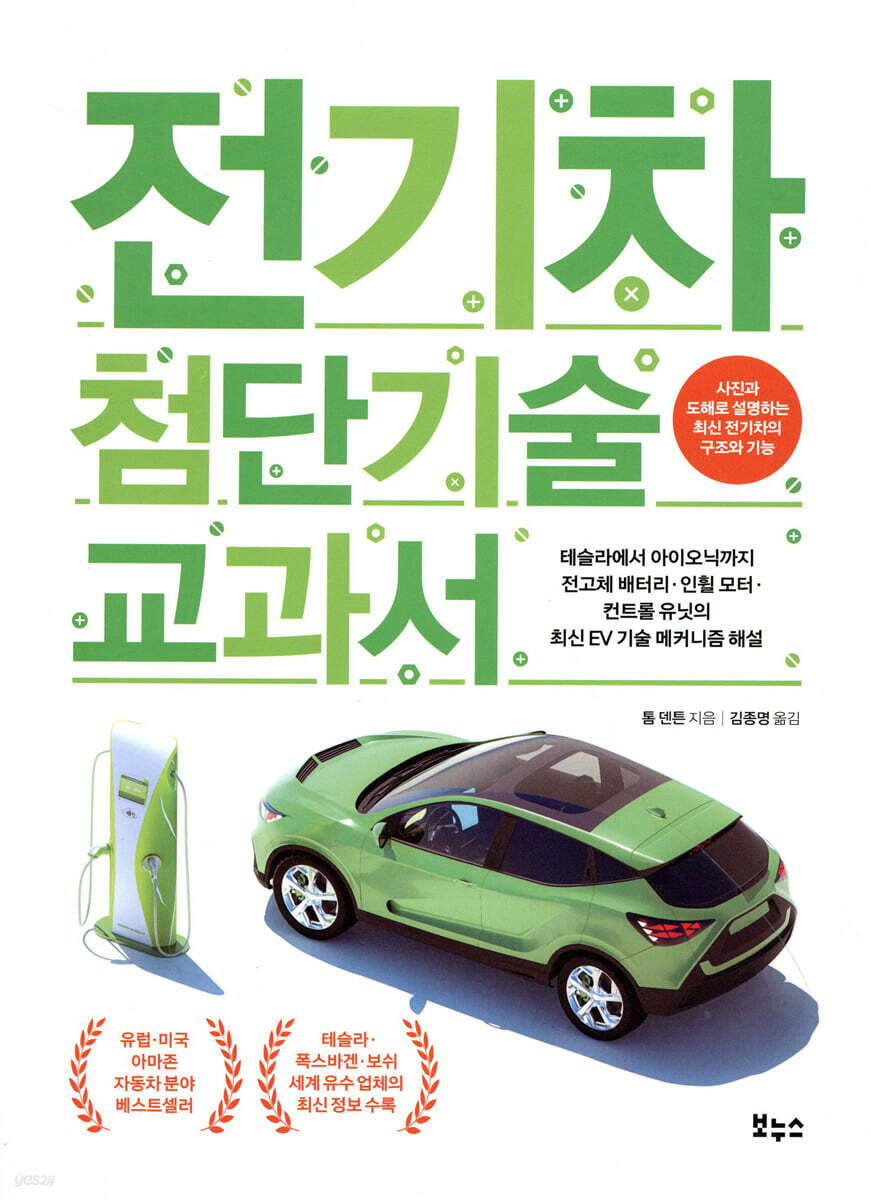
Electric Vehicle Advanced Technology Textbook
 |
Description
Book Introduction
This is a technical textbook that covers everything about electric vehicles.
It explains the history and types of electric vehicles, as well as their structure and operating principles.
Electric vehicles are clearly the future of the automotive industry, but misconceptions and rumors surrounding them still rage.
This is because the level of technical understanding related to electric vehicles is low.
This book provides a detailed explanation of the structure and principles of motors, batteries, and other control systems and components for anyone from beginners to experts who wants to gain a technical understanding of electric vehicles.
It contains a wealth of data and photos from over 80 manufacturers, including Volkswagen, Volvo, and Tesla.
It explains the history and types of electric vehicles, as well as their structure and operating principles.
Electric vehicles are clearly the future of the automotive industry, but misconceptions and rumors surrounding them still rage.
This is because the level of technical understanding related to electric vehicles is low.
This book provides a detailed explanation of the structure and principles of motors, batteries, and other control systems and components for anyone from beginners to experts who wants to gain a technical understanding of electric vehicles.
It contains a wealth of data and photos from over 80 manufacturers, including Volkswagen, Volvo, and Tesla.
- You can preview some of the book's contents.
Preview
index
Preface: Electric Vehicles: The Future Has Already Arrived
Chapter 1 What is an Electric Vehicle?
EV and hybrid vehicles
Types of Electric Vehicles | Electric Vehicle Market Size | Electric Vehicle Driving Experience | History of Electric Vehicles
Cost and exhaust emissions
Electricity Cost Issues│End of Vehicle Life│Reducing Carbon Dioxide Emissions│Exhaust Gases│International Standard Emissions Testing Methods│Environmental Life Cycle Assessment│Intelligent Programming
Myths and Truths About Electric Vehicles
Confusion and Rumors of Changing Times│Electric Cars and Superstitions
Chapter 2: Electrical and Electronic Theory for Understanding Electric Vehicles
Basic Electrical Theory
What is electricity? │ Electrons and common currents │ Effects of current │ Basic physical quantities │ Description of electric circuits │ Conductors, insulators, and semiconductors │ Factors determining the resistance of conductors │ Resistors and circuit networks │ Magnetism and electromagnetic force │ Electromagnetic induction │ Mutual induction │ Basic principles of motors │ Definitions and laws
Learn about electronic components
Types of Electronic Control Devices│Components that Make Up the Circuit
Fundamentals of Integrated Circuits
Chapter 3: Structure of an Electric Vehicle
Layout of an electric vehicle
How to Distinguish Electric Vehicles | Single Motor | Wheel Motor
Layout of a hybrid electric vehicle
What is a Hybrid? │Classification of Hybrid Vehicles │Operating Modes │Composition of Hybrid Power Systems │48V Hybrid Systems │Hybrid Control Systems │Porsche's Hybrid Vehicles │The Efficiency Question
Cables and Components
High-voltage cables | Electric vehicle components | EV system developed by the UN, ECE-R100
Other systems
Heating and Cooling│Thermal Challenges│Liquid Cooling│Heat Pumps│Brakes│Power Steering│DC/DC Converters│Continental's Thermal Management Technology
High voltage safety device
The role of the relay│Pilot line│Crash safety│Insulation resistance
Electric drive system for medium-sized vehicles
Systems that require more power│Examples of components
Chapter 4: Advanced Battery Technology
About the battery in general
Battery mileage│Battery life and recycling│Battery charge level│Battery performance status│Battery types and characteristics│Lead-acid battery│Alkaline battery│Sodium-nickel chloride battery│Sodium-sulfur battery│Lithium-ion battery│Fuel cell│Supercapacitor│Flywheel│Energy density by battery type
Advances in battery technology
The Relationship Between Temperature and Battery Life | Fast-Charging Batteries | Thermal Runaway | Solid-State Batteries | Cloud-Based Battery Management
Chapter 5 Motors and Control Systems
Fundamentals of Motor Skills
Motor Types│Motor Technology Trends
Structure and function of electric motors
Basic principles of AC motors│Asynchronous motors│Synchronous motors: Permanent excitation│DC motors: Series windings│DC motors: Separately excited shunt windings│Motor torque and power characteristics│Electrically commutated motors│Switched resistance motors│Motor efficiency
control system
Rough configuration of the control system│Basic operation│Startup and shutdown│High voltage DC relay│Output control│Pulse width modulation│Sensor│Battery control│Cell balancing│Component cooling
Motor technology advancement and development
Winding shape and insulation│Axial and radial windings
Chapter 6 Advanced Charging Technology
Charging, Standards and Infrastructure
Infrastructure│Charging time│Charging cost│Standardization│Charging method│Charging mode│Communication system│EU system│Charging plug│V2G technology
wireless power transfer
About the state of the art │ Static WPT │ Dynamic WPT │ BMW's wireless charging system
Chapter 7 Tools and Risk Management for Electric Vehicle Work
General safety measures
Two Rules for Safety│On Safety Issues│Professional Registration System│General Safety Guidelines│General Risks and Risk Reduction
Safety precautions related to high voltage
Risk of electric shock | Difference between low and high voltage | Personal protective equipment | High-energy cables and components | AC electric shock | DC electric shock | Protective devices
Safety work process
Hazards When Working on Electric Vehicles | Categories of Electric Vehicle Work | Some Procedures for Safe Work
Risk Management
Initial Diagnosis│Fire Response
Tools and equipment
Intended Use and Instructions for Hand Tools│Test Equipment│Workshop Equipment│High-Voltage Tools│On-Board Diagnostics
Chapter 8 Maintenance, Repair, and Replacement
Before starting work
Precautions for Operators│Technical Information│Power Disconnection
Work in progress
Maintenance Cycle│Repairs Affecting Other Systems│Inspecting High-Voltage Components
Removing and replacing parts
High-voltage components│Battery packs│Low-voltage components
Work completed
Power Resupply│Results, Records, Advice
Roadside emergency assistance
Manufacturer-provided information: Emergency starting, Roadside repairs, Vehicle recovery, Towing, Emergency response, Fire, Battery transport, Pro Assist Hybrid mobile app
Chapter 9 Diagnosis and Repair of Malfunctions and Abnormalities
Before you start
About HEVRA
Insulation test
Real-time data
The Importance of Data Scanning│Real-Time Data Collection
Diagnosis and Repair Cases
High voltage work should be performed by qualified personnel. Air conditioning. Insulation problems in Lexus. PEB repair in Renault Zoe. PEB interior in Renault Continental. Peugeot Ion battery repair. Peugeot Ion charger repair. Turning on the high voltage system. Coolant pump control.
Conclusion
References
Huzhou
Introducing the Automotive Technology Academy
Search
Chapter 1 What is an Electric Vehicle?
EV and hybrid vehicles
Types of Electric Vehicles | Electric Vehicle Market Size | Electric Vehicle Driving Experience | History of Electric Vehicles
Cost and exhaust emissions
Electricity Cost Issues│End of Vehicle Life│Reducing Carbon Dioxide Emissions│Exhaust Gases│International Standard Emissions Testing Methods│Environmental Life Cycle Assessment│Intelligent Programming
Myths and Truths About Electric Vehicles
Confusion and Rumors of Changing Times│Electric Cars and Superstitions
Chapter 2: Electrical and Electronic Theory for Understanding Electric Vehicles
Basic Electrical Theory
What is electricity? │ Electrons and common currents │ Effects of current │ Basic physical quantities │ Description of electric circuits │ Conductors, insulators, and semiconductors │ Factors determining the resistance of conductors │ Resistors and circuit networks │ Magnetism and electromagnetic force │ Electromagnetic induction │ Mutual induction │ Basic principles of motors │ Definitions and laws
Learn about electronic components
Types of Electronic Control Devices│Components that Make Up the Circuit
Fundamentals of Integrated Circuits
Chapter 3: Structure of an Electric Vehicle
Layout of an electric vehicle
How to Distinguish Electric Vehicles | Single Motor | Wheel Motor
Layout of a hybrid electric vehicle
What is a Hybrid? │Classification of Hybrid Vehicles │Operating Modes │Composition of Hybrid Power Systems │48V Hybrid Systems │Hybrid Control Systems │Porsche's Hybrid Vehicles │The Efficiency Question
Cables and Components
High-voltage cables | Electric vehicle components | EV system developed by the UN, ECE-R100
Other systems
Heating and Cooling│Thermal Challenges│Liquid Cooling│Heat Pumps│Brakes│Power Steering│DC/DC Converters│Continental's Thermal Management Technology
High voltage safety device
The role of the relay│Pilot line│Crash safety│Insulation resistance
Electric drive system for medium-sized vehicles
Systems that require more power│Examples of components
Chapter 4: Advanced Battery Technology
About the battery in general
Battery mileage│Battery life and recycling│Battery charge level│Battery performance status│Battery types and characteristics│Lead-acid battery│Alkaline battery│Sodium-nickel chloride battery│Sodium-sulfur battery│Lithium-ion battery│Fuel cell│Supercapacitor│Flywheel│Energy density by battery type
Advances in battery technology
The Relationship Between Temperature and Battery Life | Fast-Charging Batteries | Thermal Runaway | Solid-State Batteries | Cloud-Based Battery Management
Chapter 5 Motors and Control Systems
Fundamentals of Motor Skills
Motor Types│Motor Technology Trends
Structure and function of electric motors
Basic principles of AC motors│Asynchronous motors│Synchronous motors: Permanent excitation│DC motors: Series windings│DC motors: Separately excited shunt windings│Motor torque and power characteristics│Electrically commutated motors│Switched resistance motors│Motor efficiency
control system
Rough configuration of the control system│Basic operation│Startup and shutdown│High voltage DC relay│Output control│Pulse width modulation│Sensor│Battery control│Cell balancing│Component cooling
Motor technology advancement and development
Winding shape and insulation│Axial and radial windings
Chapter 6 Advanced Charging Technology
Charging, Standards and Infrastructure
Infrastructure│Charging time│Charging cost│Standardization│Charging method│Charging mode│Communication system│EU system│Charging plug│V2G technology
wireless power transfer
About the state of the art │ Static WPT │ Dynamic WPT │ BMW's wireless charging system
Chapter 7 Tools and Risk Management for Electric Vehicle Work
General safety measures
Two Rules for Safety│On Safety Issues│Professional Registration System│General Safety Guidelines│General Risks and Risk Reduction
Safety precautions related to high voltage
Risk of electric shock | Difference between low and high voltage | Personal protective equipment | High-energy cables and components | AC electric shock | DC electric shock | Protective devices
Safety work process
Hazards When Working on Electric Vehicles | Categories of Electric Vehicle Work | Some Procedures for Safe Work
Risk Management
Initial Diagnosis│Fire Response
Tools and equipment
Intended Use and Instructions for Hand Tools│Test Equipment│Workshop Equipment│High-Voltage Tools│On-Board Diagnostics
Chapter 8 Maintenance, Repair, and Replacement
Before starting work
Precautions for Operators│Technical Information│Power Disconnection
Work in progress
Maintenance Cycle│Repairs Affecting Other Systems│Inspecting High-Voltage Components
Removing and replacing parts
High-voltage components│Battery packs│Low-voltage components
Work completed
Power Resupply│Results, Records, Advice
Roadside emergency assistance
Manufacturer-provided information: Emergency starting, Roadside repairs, Vehicle recovery, Towing, Emergency response, Fire, Battery transport, Pro Assist Hybrid mobile app
Chapter 9 Diagnosis and Repair of Malfunctions and Abnormalities
Before you start
About HEVRA
Insulation test
Real-time data
The Importance of Data Scanning│Real-Time Data Collection
Diagnosis and Repair Cases
High voltage work should be performed by qualified personnel. Air conditioning. Insulation problems in Lexus. PEB repair in Renault Zoe. PEB interior in Renault Continental. Peugeot Ion battery repair. Peugeot Ion charger repair. Turning on the high voltage system. Coolant pump control.
Conclusion
References
Huzhou
Introducing the Automotive Technology Academy
Search
Detailed image

Publisher's Review
The end of the internal combustion engine is coming!
Explanation of Advanced EV Mechanisms to Understand the Electric Vehicle Era
In July 2021, Mercedes-Benz, a synonym for luxury cars, announced that it would electrify its entire vehicle lineup.
It is an ambitious plan to invest approximately 54 trillion won by 2030.
With several manufacturers, including Ford, Volkswagen, and GM, already declaring their intentions for full electrification, this event serves as yet another reminder that electric vehicles are the future of the automotive industry.
The market is moving one step closer to the era of electric vehicles, and people's interest in electric vehicles is growing by the day.
Although the market is rapidly changing, many people still do not fully understand 'electric vehicles' and are lost in a maze of rumors and misunderstandings.
They say electric cars are premature.
Electric cars are slow, inconvenient to charge, and have short battery life, which ultimately leads to higher maintenance costs, they point out.
Besides this, those who express negative views on electric vehicles cite several reasons.
Is all this really true?
I wonder if I am misunderstanding the flow of the times due to my lack of technical understanding.
Finish your electric car studies with this book.
From the basics to expert knowledge, the beginning and end of electric vehicle explanations.
《Electric Vehicle Advanced Technology Textbook》 dispels people's prejudices and ignorance.
However, it answers people's doubts and questions step by step with technology and principles, not just personal opinions.
Let's start with the problem that electric cars are slow and inconvenient to charge.
The author explains the operating principles of the motors used in electric vehicles and explains how electric vehicles can achieve superior acceleration and speeds exceeding 200 kilometers per hour compared to conventional vehicles.
The motor does not require a transmission due to its structure and can instantly produce up to 100% torque.
《Electric Vehicle Advanced Technology Textbook》provides a knowledge base for understanding the actual performance of electric vehicles by examining each type of motor.
There is also a gap between people's perception and reality, with the inherent limitations of battery performance making charging inconvenient and inevitably increasing maintenance costs.
Of course, manufacturers haven't completely solved the battery problem.
It's not yet possible to drive hundreds of kilometers on a few minutes of charging.
However, battery performance is steadily improving, and the current battery performance is not at a level that causes inconvenience in real life as some people misunderstand.
As of 2021, new electric vehicles have a driving range of around 300 to 400 kilometers, and charging speeds have also increased, so that with rapid charging, it only takes about 20 minutes to fill 80% of the charge.
Moreover, according to this book, future technologies are also developing rapidly.
One of them is WPT (Wireless Power Transfer), a wireless charging technology.
In particular, this book focuses on dynamic WPT, which wirelessly charges batteries while a vehicle is moving, and provides a well-illustrated explanation of the technology's operating principles and structure.
Recently, the Ministry of Science and ICT and Daejeon Metropolitan City conducted a pilot operation of an electric bus with wireless charging capabilities, and one of the technologies applied was dynamic WPT.
Maintenance costs related to battery life are not something to worry too much about either.
As of 2020, the manufacturer guarantees a battery life of at least eight years and a driving range of 160,000 kilometers.
In fact, even batteries that have achieved their guaranteed lifespan and driving range still have usable performance remaining.
And the battery performance of electric vehicles to come will be even better than this, and battery prices will also fall.
The idea that batteries will cost more than internal combustion engine vehicles may be a misconception.
Moreover, the all-solid-state batteries that will be produced in 3-4 years will have a driving range more than twice that of today's batteries, and the charging time will be much shorter.
Sodium-ion or lithium metal batteries are also under development.
By examining the battery structure, technology, and future prospects described in this book, we can see from a technical perspective how leading technologies like all-solid-state batteries can address current shortcomings.
Electric vehicles are a culmination of various technologies.
The true nature of electric vehicles: Understanding their structure and principles
Another thing to note is that this book doesn't just focus on batteries and motors.
Batteries and motors are the heart of electric vehicles, but they aren't everything.
《Electric Vehicle Advanced Technology Textbook》 explains how the main power MCU, converter, IGBT, and chopper circuit work, and examines the components of the battery control system that manages the remaining battery capacity and charge level.
Of course, we also introduce the systems that control other components such as the heating and cooling system, heat pump, brakes, and power steering.
Ultimately, this book will help you understand the overall structure and operating principles of electric vehicles and provide a technical approach to the reality of electric vehicles.
Although perceptions have changed a lot now, there was a time when it was said that electric cars could be easily made with just a battery and a motor.
As this book demonstrates, electric vehicles are more complex than you might think, requiring a variety of precise technologies and components.
The "Electric Vehicle Advanced Technology Textbook" presents several examples related to electric vehicle repair, fault diagnosis, and emergency response.
In the case of internal combustion engine vehicles, even if the vehicle owner does not perform maintenance himself, there are times when he or she should acquire related knowledge for various reasons.
Besides, there are times when I do simple maintenance myself.
The same goes for electric cars.
In the future, electric vehicles will become more popular than ever before, and the number of people interested in learning how to maintain and repair electric vehicles will increase.
Even if you don't do maintenance yourself, knowing about maintenance and repairs will help you solve maintenance problems in a reasonable way.
Tesla, Volkswagen, Bosch, BMW
Contains the latest information from global automakers
No matter how good the content is, if it is difficult to read and understand, it is of no use.
Taking this into account, the textbook on advanced electric vehicle technology aims to provide expert knowledge while also explaining the basics step by step.
Before explaining the technical details, we will cover background information such as types of electric vehicles, current market size, history and driving experience of electric vehicles, and environmental issues.
After this, the structure and technology of electric vehicles are explained in detail, but even then, there are arrangements for beginners.
The electrical and electronic theories necessary for understanding electric vehicles are separately explained to help readers acquire the basic knowledge needed to understand various electronic components, including motors. Furthermore, there are sections throughout the book that explain terminology or summarize key points of the text to aid readers' understanding.
Another advantage is that it includes data provided by over 80 manufacturers, including Tesla, Volkswagen, and BMW.
If the book only contains abstract technical explanations, it can easily become difficult to understand.
This book, compiled in collaboration with over 80 manufacturers, features a wealth of data and photographs, making it a resource that allows even the general public to quickly and easily access expert knowledge.
Questions about electric vehicles
The Bible of EV Knowledge That Will Solve Your Problems
Electric vehicles are clearly the future of the automotive industry and a new growth engine.
However, some people are not sure whether the current change is the right one and a rational choice.
《Electric Vehicle Advanced Technology Textbook》 serves as a compass for those who lack technical understanding and thus cannot understand electric vehicles.
Because it answers people's questions and curiosities surrounding electric vehicles with detailed technical explanations.
Many issues related to electric vehicles, such as why electric vehicles have this structure, why they have these driving characteristics, and why batteries and motors are important, are explained based on technology and principles, not bias or personal opinions.
This book will certainly be a valuable guide for those seeking to properly understand and make rational choices about electric vehicles, which will dominate the future automobile market.
Explanation of Advanced EV Mechanisms to Understand the Electric Vehicle Era
In July 2021, Mercedes-Benz, a synonym for luxury cars, announced that it would electrify its entire vehicle lineup.
It is an ambitious plan to invest approximately 54 trillion won by 2030.
With several manufacturers, including Ford, Volkswagen, and GM, already declaring their intentions for full electrification, this event serves as yet another reminder that electric vehicles are the future of the automotive industry.
The market is moving one step closer to the era of electric vehicles, and people's interest in electric vehicles is growing by the day.
Although the market is rapidly changing, many people still do not fully understand 'electric vehicles' and are lost in a maze of rumors and misunderstandings.
They say electric cars are premature.
Electric cars are slow, inconvenient to charge, and have short battery life, which ultimately leads to higher maintenance costs, they point out.
Besides this, those who express negative views on electric vehicles cite several reasons.
Is all this really true?
I wonder if I am misunderstanding the flow of the times due to my lack of technical understanding.
Finish your electric car studies with this book.
From the basics to expert knowledge, the beginning and end of electric vehicle explanations.
《Electric Vehicle Advanced Technology Textbook》 dispels people's prejudices and ignorance.
However, it answers people's doubts and questions step by step with technology and principles, not just personal opinions.
Let's start with the problem that electric cars are slow and inconvenient to charge.
The author explains the operating principles of the motors used in electric vehicles and explains how electric vehicles can achieve superior acceleration and speeds exceeding 200 kilometers per hour compared to conventional vehicles.
The motor does not require a transmission due to its structure and can instantly produce up to 100% torque.
《Electric Vehicle Advanced Technology Textbook》provides a knowledge base for understanding the actual performance of electric vehicles by examining each type of motor.
There is also a gap between people's perception and reality, with the inherent limitations of battery performance making charging inconvenient and inevitably increasing maintenance costs.
Of course, manufacturers haven't completely solved the battery problem.
It's not yet possible to drive hundreds of kilometers on a few minutes of charging.
However, battery performance is steadily improving, and the current battery performance is not at a level that causes inconvenience in real life as some people misunderstand.
As of 2021, new electric vehicles have a driving range of around 300 to 400 kilometers, and charging speeds have also increased, so that with rapid charging, it only takes about 20 minutes to fill 80% of the charge.
Moreover, according to this book, future technologies are also developing rapidly.
One of them is WPT (Wireless Power Transfer), a wireless charging technology.
In particular, this book focuses on dynamic WPT, which wirelessly charges batteries while a vehicle is moving, and provides a well-illustrated explanation of the technology's operating principles and structure.
Recently, the Ministry of Science and ICT and Daejeon Metropolitan City conducted a pilot operation of an electric bus with wireless charging capabilities, and one of the technologies applied was dynamic WPT.
Maintenance costs related to battery life are not something to worry too much about either.
As of 2020, the manufacturer guarantees a battery life of at least eight years and a driving range of 160,000 kilometers.
In fact, even batteries that have achieved their guaranteed lifespan and driving range still have usable performance remaining.
And the battery performance of electric vehicles to come will be even better than this, and battery prices will also fall.
The idea that batteries will cost more than internal combustion engine vehicles may be a misconception.
Moreover, the all-solid-state batteries that will be produced in 3-4 years will have a driving range more than twice that of today's batteries, and the charging time will be much shorter.
Sodium-ion or lithium metal batteries are also under development.
By examining the battery structure, technology, and future prospects described in this book, we can see from a technical perspective how leading technologies like all-solid-state batteries can address current shortcomings.
Electric vehicles are a culmination of various technologies.
The true nature of electric vehicles: Understanding their structure and principles
Another thing to note is that this book doesn't just focus on batteries and motors.
Batteries and motors are the heart of electric vehicles, but they aren't everything.
《Electric Vehicle Advanced Technology Textbook》 explains how the main power MCU, converter, IGBT, and chopper circuit work, and examines the components of the battery control system that manages the remaining battery capacity and charge level.
Of course, we also introduce the systems that control other components such as the heating and cooling system, heat pump, brakes, and power steering.
Ultimately, this book will help you understand the overall structure and operating principles of electric vehicles and provide a technical approach to the reality of electric vehicles.
Although perceptions have changed a lot now, there was a time when it was said that electric cars could be easily made with just a battery and a motor.
As this book demonstrates, electric vehicles are more complex than you might think, requiring a variety of precise technologies and components.
The "Electric Vehicle Advanced Technology Textbook" presents several examples related to electric vehicle repair, fault diagnosis, and emergency response.
In the case of internal combustion engine vehicles, even if the vehicle owner does not perform maintenance himself, there are times when he or she should acquire related knowledge for various reasons.
Besides, there are times when I do simple maintenance myself.
The same goes for electric cars.
In the future, electric vehicles will become more popular than ever before, and the number of people interested in learning how to maintain and repair electric vehicles will increase.
Even if you don't do maintenance yourself, knowing about maintenance and repairs will help you solve maintenance problems in a reasonable way.
Tesla, Volkswagen, Bosch, BMW
Contains the latest information from global automakers
No matter how good the content is, if it is difficult to read and understand, it is of no use.
Taking this into account, the textbook on advanced electric vehicle technology aims to provide expert knowledge while also explaining the basics step by step.
Before explaining the technical details, we will cover background information such as types of electric vehicles, current market size, history and driving experience of electric vehicles, and environmental issues.
After this, the structure and technology of electric vehicles are explained in detail, but even then, there are arrangements for beginners.
The electrical and electronic theories necessary for understanding electric vehicles are separately explained to help readers acquire the basic knowledge needed to understand various electronic components, including motors. Furthermore, there are sections throughout the book that explain terminology or summarize key points of the text to aid readers' understanding.
Another advantage is that it includes data provided by over 80 manufacturers, including Tesla, Volkswagen, and BMW.
If the book only contains abstract technical explanations, it can easily become difficult to understand.
This book, compiled in collaboration with over 80 manufacturers, features a wealth of data and photographs, making it a resource that allows even the general public to quickly and easily access expert knowledge.
Questions about electric vehicles
The Bible of EV Knowledge That Will Solve Your Problems
Electric vehicles are clearly the future of the automotive industry and a new growth engine.
However, some people are not sure whether the current change is the right one and a rational choice.
《Electric Vehicle Advanced Technology Textbook》 serves as a compass for those who lack technical understanding and thus cannot understand electric vehicles.
Because it answers people's questions and curiosities surrounding electric vehicles with detailed technical explanations.
Many issues related to electric vehicles, such as why electric vehicles have this structure, why they have these driving characteristics, and why batteries and motors are important, are explained based on technology and principles, not bias or personal opinions.
This book will certainly be a valuable guide for those seeking to properly understand and make rational choices about electric vehicles, which will dominate the future automobile market.
GOODS SPECIFICS
- Publication date: September 10, 2021
- Page count, weight, size: 384 pages | 832g | 172*235*20mm
- ISBN13: 9788964945131
- ISBN10: 8964945131
You may also like
카테고리
korean


korean

![ELLE 엘르 스페셜 에디션 A형 : 12월 [2025]](http://librairie.coreenne.fr/cdn/shop/files/b8e27a3de6c9538896439686c6b0e8fb.jpg?v=1766436872&width=3840)


