

Genius' Diet
 |
Description
Book Introduction
“One food protects us from a thousand diseases!”
It improves memory, creativity, and thinking skills and makes the brain young and healthy.
'10 Genius Foods', 'Genius Plan', and 'Genius Recipes' revealed!
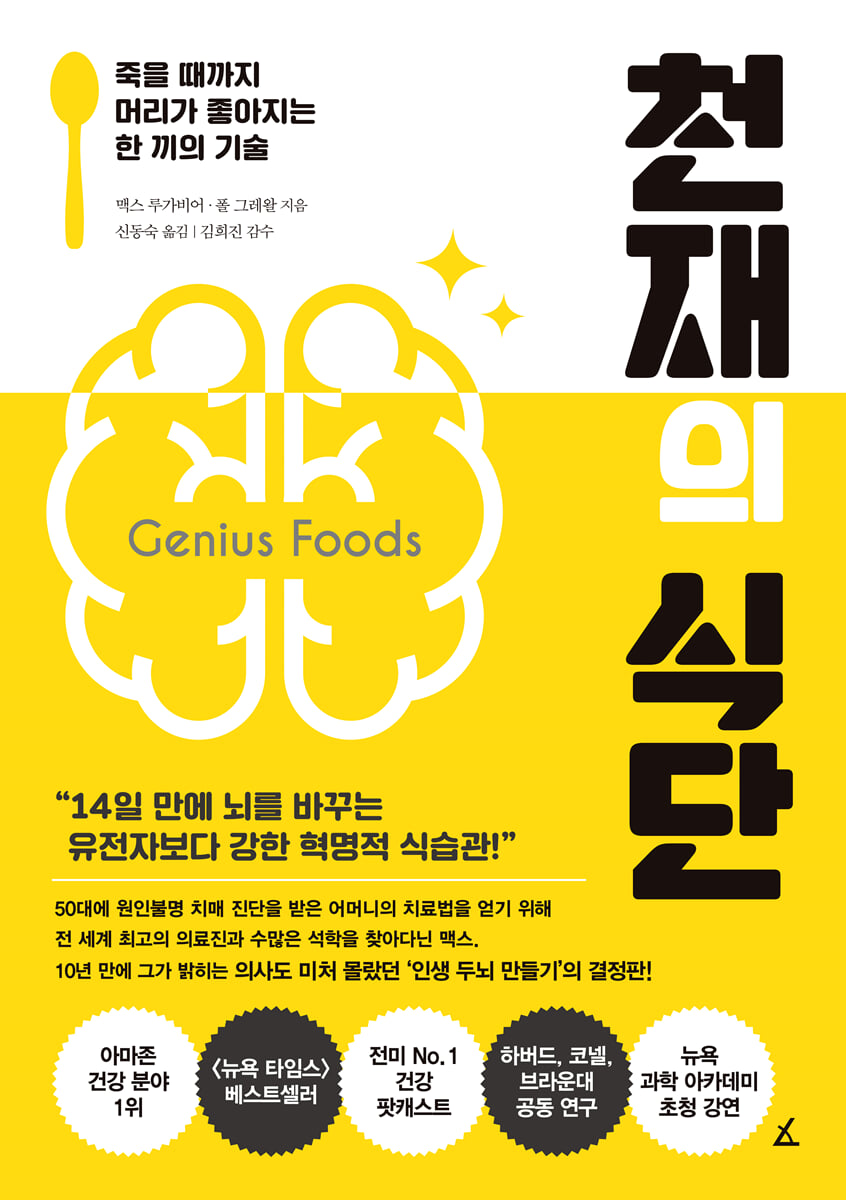
What devastated the author the most after hearing the news that his mother had Alzheimer's disease was that there was no specific prevention or treatment for the disease.
In a dire situation where even doctors seemed to have given up, he traveled around the world to seek out renowned neurologists and scholars, desperately researching what was ruining our brain health and how we could live with a younger, healthier brain.
And after 10 years, he realized that the only answer to maintaining brain health lies in the 'food' we consume every day.
In "The Genius Diet," Max argues that various foods that have become easy, convenient, and cheap to obtain in modern society are harming our brain health.
Excessive sugar intake, genetically modified foods, and various additives reduce physical and mental vitality, while also causing obesity, inflammation, depression, heart disease, and degenerative neurological diseases.
Through this book, he not only corrects misconceptions about food, but also sharply points out how the foods we easily consume in our daily lives can be detrimental to brain health, including Alzheimer's disease.
Furthermore, it reveals 10 "genius foods" that you must consume to keep your brain healthy and vibrant, and introduces practical ways to improve brain health through lifestyle habits, including how to select fresh ingredients and cooking methods that allow you to consume nutrients more deliciously and effectively.
It improves memory, creativity, and thinking skills and makes the brain young and healthy.
'10 Genius Foods', 'Genius Plan', and 'Genius Recipes' revealed!
What devastated the author the most after hearing the news that his mother had Alzheimer's disease was that there was no specific prevention or treatment for the disease.
In a dire situation where even doctors seemed to have given up, he traveled around the world to seek out renowned neurologists and scholars, desperately researching what was ruining our brain health and how we could live with a younger, healthier brain.
And after 10 years, he realized that the only answer to maintaining brain health lies in the 'food' we consume every day.
In "The Genius Diet," Max argues that various foods that have become easy, convenient, and cheap to obtain in modern society are harming our brain health.
Excessive sugar intake, genetically modified foods, and various additives reduce physical and mental vitality, while also causing obesity, inflammation, depression, heart disease, and degenerative neurological diseases.
Through this book, he not only corrects misconceptions about food, but also sharply points out how the foods we easily consume in our daily lives can be detrimental to brain health, including Alzheimer's disease.
Furthermore, it reveals 10 "genius foods" that you must consume to keep your brain healthy and vibrant, and introduces practical ways to improve brain health through lifestyle habits, including how to select fresh ingredients and cooking methods that allow you to consume nutrients more deliciously and effectively.
- You can preview some of the book's contents.
Preview
index
Editor's Note | Brain Health: Food is the Answer!
Enter | What Food Is Your Brain Eating?
Part 1: The Brain is Made of Food
Chapter 1: The Invisible Problem
·Yeah, food was the problem!
The brain grows throughout life.
·You are the one in control
Genius Food 1 Extra Virgin Olive Oil
Chapter 2: Auspicious Fat and Inauspicious Oil
·Double-edged sword, polyunsaturated fat
·Night of the 'Geological Corpses'
·The effects of inflammation on the brain
·Monounsaturated fats, the brain's best friend
·What are stable and good fats?
· Useless fat
Fat is a 'transporter' of nutrients.
Genius Food 2 Avocado
Even though I eat a lot of Chapter 3, I'm always hungry
·High in calories but low in nutrients
·An era overflowing with carbohydrates
· Sticky sugars that stick to proteins
·Added sugar, a headache for the brain
·Fructose, a brain cell destroyer
·Human foie gras
·Terrorists targeting the intestines and brain
The bitter truth about sweet fruit
·The inconvenient truth hidden by food companies
Genius Food 3 Blueberries
Chapter 4: Winter is Coming to Your Brain
Why the Mediterranean Diet is in the Spotlight
·The relationship between carbohydrates and insulin
·When insulin levels rise
·Insulin, the fuel of aging
Carbohydrates that crash-land in the brain
Diabetes in the brain
Misconceptions about blood sugar
·Basic principles for a healthy life
Genius Food 4 Dark Chocolate
Part 2 Everything is Connected
Chapter 5: Healthy Heart, Healthy Brain
·Cholesterol finally cleared of its name
·What is the real culprit behind heart disease?
·No more throwing away egg yolks
·Heart disease starts in the gut?
·Statins, a headache
Genius Food 5 Eggs
Chapter 6: Fueling Your Brain
·Don't feed your brain damaged food.
·If the brain could clean itself
·Emission-free fuel that prevents pollution of our bodies
·The Genius Plan to Change Your Brain
·Turn back your biological clock.
A lifeboat to rescue the aging brain
·Can't we consume ketones through food?
Genius Food 6 Grass-Fed Cattle
Chapter 7: Listening to the Feeling of the Chapter
·Feed your gut bacteria with prebiotics!
·Fountain of Youth
·My immune system is attacking my body?
·When the stomach is comfortable, the brain is happy.
·Amazing tissue, mucosa
Gut bacteria that regulate the brain
·More food for more germs!
·Constipation, don't ignore it
Genius Food 7 Green Leafy Vegetables
Chapter 8: The Brain's Chemical Switchboard
·The yin and yang of neurotransmitters
Optimizing glutamate and GABA
Acetylcholine, a neurotransmitter involved in learning and memory
·Does taking motion sickness pills make you dizzy?
Serotonin, a neurotransmitter that affects mood
·To activate serotonin
· Dopamine, the reward and reinforcement neurotransmitter
·To optimize dopamine
·Norepinephrine, a neurotransmitter related to concentration
How to increase norepinephrine
How to maximize brain function
Genius Food 8 Broccoli
Part 3: Sit in the 'Driver's Seat' of Your Body
Chapter 9: Sacred Sleep and Hormones as Helpers
The brain's nighttime cleaning system, the glymphatic system
·The protagonist who controls our actions
Genius Food 9 Wild Salmon
Chapter 10: The Virtue of Stress, or How to Get Stronger
·The effects of great exercise
·30 minutes slow vs. 20 seconds crazy
·The more you use your body, the better your brain becomes.
·Slower, more intense
·Hot or cold
·Various intermittent fasting methods
·Foods that cause stress
Genius Food 10 Almonds
Chapter 11: The Genius Plan to Change Your Brain
·Clean up the kitchen first!
Foods you should always eat
Foods to eat 'sometimes'
·The 20 Three-Meal Revolution That Saves My Body
Genius Plan Step 1 (Days 1-14): Reorganizing Your Diet
· Genius Plan Step 2 (15 days onwards): Strategically consume carbohydrates
Chapter 12: Smart Recipes and Health Functional Foods That Make Your Brain Dance
Genius Recipe
·A comprehensive list of smart health functional foods
Exit | The choice is yours!
Enter | What Food Is Your Brain Eating?
Part 1: The Brain is Made of Food
Chapter 1: The Invisible Problem
·Yeah, food was the problem!
The brain grows throughout life.
·You are the one in control
Genius Food 1 Extra Virgin Olive Oil
Chapter 2: Auspicious Fat and Inauspicious Oil
·Double-edged sword, polyunsaturated fat
·Night of the 'Geological Corpses'
·The effects of inflammation on the brain
·Monounsaturated fats, the brain's best friend
·What are stable and good fats?
· Useless fat
Fat is a 'transporter' of nutrients.
Genius Food 2 Avocado
Even though I eat a lot of Chapter 3, I'm always hungry
·High in calories but low in nutrients
·An era overflowing with carbohydrates
· Sticky sugars that stick to proteins
·Added sugar, a headache for the brain
·Fructose, a brain cell destroyer
·Human foie gras
·Terrorists targeting the intestines and brain
The bitter truth about sweet fruit
·The inconvenient truth hidden by food companies
Genius Food 3 Blueberries
Chapter 4: Winter is Coming to Your Brain
Why the Mediterranean Diet is in the Spotlight
·The relationship between carbohydrates and insulin
·When insulin levels rise
·Insulin, the fuel of aging
Carbohydrates that crash-land in the brain
Diabetes in the brain
Misconceptions about blood sugar
·Basic principles for a healthy life
Genius Food 4 Dark Chocolate
Part 2 Everything is Connected
Chapter 5: Healthy Heart, Healthy Brain
·Cholesterol finally cleared of its name
·What is the real culprit behind heart disease?
·No more throwing away egg yolks
·Heart disease starts in the gut?
·Statins, a headache
Genius Food 5 Eggs
Chapter 6: Fueling Your Brain
·Don't feed your brain damaged food.
·If the brain could clean itself
·Emission-free fuel that prevents pollution of our bodies
·The Genius Plan to Change Your Brain
·Turn back your biological clock.
A lifeboat to rescue the aging brain
·Can't we consume ketones through food?
Genius Food 6 Grass-Fed Cattle
Chapter 7: Listening to the Feeling of the Chapter
·Feed your gut bacteria with prebiotics!
·Fountain of Youth
·My immune system is attacking my body?
·When the stomach is comfortable, the brain is happy.
·Amazing tissue, mucosa
Gut bacteria that regulate the brain
·More food for more germs!
·Constipation, don't ignore it
Genius Food 7 Green Leafy Vegetables
Chapter 8: The Brain's Chemical Switchboard
·The yin and yang of neurotransmitters
Optimizing glutamate and GABA
Acetylcholine, a neurotransmitter involved in learning and memory
·Does taking motion sickness pills make you dizzy?
Serotonin, a neurotransmitter that affects mood
·To activate serotonin
· Dopamine, the reward and reinforcement neurotransmitter
·To optimize dopamine
·Norepinephrine, a neurotransmitter related to concentration
How to increase norepinephrine
How to maximize brain function
Genius Food 8 Broccoli
Part 3: Sit in the 'Driver's Seat' of Your Body
Chapter 9: Sacred Sleep and Hormones as Helpers
The brain's nighttime cleaning system, the glymphatic system
·The protagonist who controls our actions
Genius Food 9 Wild Salmon
Chapter 10: The Virtue of Stress, or How to Get Stronger
·The effects of great exercise
·30 minutes slow vs. 20 seconds crazy
·The more you use your body, the better your brain becomes.
·Slower, more intense
·Hot or cold
·Various intermittent fasting methods
·Foods that cause stress
Genius Food 10 Almonds
Chapter 11: The Genius Plan to Change Your Brain
·Clean up the kitchen first!
Foods you should always eat
Foods to eat 'sometimes'
·The 20 Three-Meal Revolution That Saves My Body
Genius Plan Step 1 (Days 1-14): Reorganizing Your Diet
· Genius Plan Step 2 (15 days onwards): Strategically consume carbohydrates
Chapter 12: Smart Recipes and Health Functional Foods That Make Your Brain Dance
Genius Recipe
·A comprehensive list of smart health functional foods
Exit | The choice is yours!
Detailed image

Into the book
Even educated people get confused when it comes to nutrition.
Of course.
I just heard that it's better to avoid eggs, but then I turn around and they recommend eggs.
I've heard advice that the best way to lose weight on Mondays is to exercise, but by Tuesday I've also heard that exercise doesn't do much for losing belly fat compared to dieting.
We've been told time and again that whole grains are the cornerstone of a healthy diet, but we don't know if heart disease is caused by not eating enough oatmeal in the morning or by something more harmful.
The Internet and news outlets alike strive to report on new scientific developments, but the content and sensational headlines in most outlets are more focused on driving traffic to their websites than on providing sound information.
Doctors, nutritionists, and even governments are influenced by invisible forces.
In these circumstances, how can we know who and what to trust?
--- p.
36
Intact (fresh) polyunsaturated fats are susceptible to oxidation, but most natural foods naturally contain antioxidants, such as vitamin E, that protect the fats.
However, this is not the case with polyunsaturated fats found in oils that have undergone heat or chemical processing.
The oil extracted in this way is used in the production of various processed foods, and this is one of the main toxins we consume through food.
These oils are sometimes found in foods that we can easily guess whether they are present, such as commercial salad dressings or margarines.
But they're often found in foods we wouldn't expect, like cookies, cakes, granola bars, potato chips, pizza, pasta, bread, and even ice cream.
Breakfast cereals are coated with these oils like a "gloss," and all "roasted" nuts are coated with these fats, unless they explicitly state they are roasted without oil.
Moreover, when we eat at restaurants, we unconsciously consume polyunsaturated fats.
Most restaurants have surprisingly poor storage and hygiene practices, with cans of oil left out in open kitchens for months, and even used oil is reused multiple times.
Foods like French fries, shrimp tempura, and chicken fingers are all vehicles for biochemically altered oils, and the cooking process of these foods creates large quantities of dangerous compounds called aldehydes.
--- p.
65~66
Given the rapid spread of obesity and the enormous amounts of food people around the world routinely throw away, it may seem surprising that modern humans are nutritionally deficient.
Have you ever wondered why so many processed foods claim to be "rich in vitamins"? There are over 50,000 edible plant species on Earth.
During the hunter-gatherer era, humans consumed a variety of special and beneficial nutrients through such plants.
But the food we eat now is compressed into just three types.
Wheat, rice, and corn.
These grains account for 60% of the calories consumed by people worldwide.
These grains are a cheap source of energy, but have very low nutritional value.
From a nutritional standpoint, adding a few tens of dollars' worth of vitamins (usually synthetic) to these foods is like putting lipstick on a pig.
--- pp.
94~95
The average person consumes over 300 grams of carbohydrates a day, most of which comes in the form of refined carbohydrates such as processed foods like commercially available breads and pastries, sugary drinks, and whole-wheat snacks and cookies.
This causes the body to continuously produce insulin.
However, some tissues in the human body (such as nerve cells in the eyes or heart muscles) have evolved to use fat as an energy source, so if they can't get fat to use as an energy source, serious problems arise.
A recently published study found that fat can be used as an energy source for photoreceptors in the eye.
The study, published in the journal Nature Medicine, explains that age-related macular degeneration can occur when photoreceptor cells are not supplied with fatty acids.
Given that insulin inhibits fatty acid secretion, reducing carbohydrate intake (and consequently insulin secretion) would be an important lifestyle change to improve people's health.
--- pp.
133~134
Modern people spend most of their time eating, so they rarely have time to be hungry.
We often eat from the moment we wake up until we go to bed.
However, for most of human history, this eating habit was far from it.
Nowadays, fasting is a deliberately chosen practice, like religious practices or calorie restriction for dieting, but before the advent of agricultural societies, our ancestors frequently fasted to ensure food availability.
Because of this, our brains are designed to adapt well to different situations as we navigate between when our bodies are nourished and when they are deprived of nutrients.
We can create ketones by regularly restricting our food intake.
There are many ways to fast.
The most common fasting method is the '16:8' fasting method, which involves not eating anything for sixteen hours after the last meal, restricting food intake for sixteen hours and eating during the remaining eight hours.
This method can achieve the beneficial effects of fasting, such as reducing insulin and breaking down stored fat.
However, for women, it is recommended to start with a twelve or fourteen-hour fast, rather than a sixteen-hour fast.
This is because the female hormonal system may be more sensitive to signals of nutrient deficiency, which may have negative effects such as lowering fertility.
--- pp.
204~205
Once your body is able to use fat as an energy source, intermittent high-carbohydrate meals may be a very effective way to promote healthy leptin function.
This is because insulin, which is secreted when carbohydrates are consumed, is a powerful leptin stimulator.
And when leptin levels rise sharply, the hypothalamus increases the body's metabolic output.
If you eat a high-carbohydrate meal once a week along with regular exercise, you can increase your energy expenditure, regulate your mood, and effectively lose fat.
Even if you consume only 100 to 150 grams of carbohydrates, you will be able to achieve this nutritional effect.
But let's get rid of the idea that it's okay to consume carbohydrates through junk food.
Also, when you consume carbohydrates intermittently, the foods you eat should be low in fat.
This is because eating high-carbohydrate, high-fat foods temporarily causes insulin resistance.
Additionally, fat may prevent leptin from crossing the blood-brain barrier.
Good carbohydrates for replenishing nutrients include starchy carbohydrates such as rice and potatoes, or fruits with low fructose content such as kiwi, berries, and citrus fruits.
Of course.
I just heard that it's better to avoid eggs, but then I turn around and they recommend eggs.
I've heard advice that the best way to lose weight on Mondays is to exercise, but by Tuesday I've also heard that exercise doesn't do much for losing belly fat compared to dieting.
We've been told time and again that whole grains are the cornerstone of a healthy diet, but we don't know if heart disease is caused by not eating enough oatmeal in the morning or by something more harmful.
The Internet and news outlets alike strive to report on new scientific developments, but the content and sensational headlines in most outlets are more focused on driving traffic to their websites than on providing sound information.
Doctors, nutritionists, and even governments are influenced by invisible forces.
In these circumstances, how can we know who and what to trust?
--- p.
36
Intact (fresh) polyunsaturated fats are susceptible to oxidation, but most natural foods naturally contain antioxidants, such as vitamin E, that protect the fats.
However, this is not the case with polyunsaturated fats found in oils that have undergone heat or chemical processing.
The oil extracted in this way is used in the production of various processed foods, and this is one of the main toxins we consume through food.
These oils are sometimes found in foods that we can easily guess whether they are present, such as commercial salad dressings or margarines.
But they're often found in foods we wouldn't expect, like cookies, cakes, granola bars, potato chips, pizza, pasta, bread, and even ice cream.
Breakfast cereals are coated with these oils like a "gloss," and all "roasted" nuts are coated with these fats, unless they explicitly state they are roasted without oil.
Moreover, when we eat at restaurants, we unconsciously consume polyunsaturated fats.
Most restaurants have surprisingly poor storage and hygiene practices, with cans of oil left out in open kitchens for months, and even used oil is reused multiple times.
Foods like French fries, shrimp tempura, and chicken fingers are all vehicles for biochemically altered oils, and the cooking process of these foods creates large quantities of dangerous compounds called aldehydes.
--- p.
65~66
Given the rapid spread of obesity and the enormous amounts of food people around the world routinely throw away, it may seem surprising that modern humans are nutritionally deficient.
Have you ever wondered why so many processed foods claim to be "rich in vitamins"? There are over 50,000 edible plant species on Earth.
During the hunter-gatherer era, humans consumed a variety of special and beneficial nutrients through such plants.
But the food we eat now is compressed into just three types.
Wheat, rice, and corn.
These grains account for 60% of the calories consumed by people worldwide.
These grains are a cheap source of energy, but have very low nutritional value.
From a nutritional standpoint, adding a few tens of dollars' worth of vitamins (usually synthetic) to these foods is like putting lipstick on a pig.
--- pp.
94~95
The average person consumes over 300 grams of carbohydrates a day, most of which comes in the form of refined carbohydrates such as processed foods like commercially available breads and pastries, sugary drinks, and whole-wheat snacks and cookies.
This causes the body to continuously produce insulin.
However, some tissues in the human body (such as nerve cells in the eyes or heart muscles) have evolved to use fat as an energy source, so if they can't get fat to use as an energy source, serious problems arise.
A recently published study found that fat can be used as an energy source for photoreceptors in the eye.
The study, published in the journal Nature Medicine, explains that age-related macular degeneration can occur when photoreceptor cells are not supplied with fatty acids.
Given that insulin inhibits fatty acid secretion, reducing carbohydrate intake (and consequently insulin secretion) would be an important lifestyle change to improve people's health.
--- pp.
133~134
Modern people spend most of their time eating, so they rarely have time to be hungry.
We often eat from the moment we wake up until we go to bed.
However, for most of human history, this eating habit was far from it.
Nowadays, fasting is a deliberately chosen practice, like religious practices or calorie restriction for dieting, but before the advent of agricultural societies, our ancestors frequently fasted to ensure food availability.
Because of this, our brains are designed to adapt well to different situations as we navigate between when our bodies are nourished and when they are deprived of nutrients.
We can create ketones by regularly restricting our food intake.
There are many ways to fast.
The most common fasting method is the '16:8' fasting method, which involves not eating anything for sixteen hours after the last meal, restricting food intake for sixteen hours and eating during the remaining eight hours.
This method can achieve the beneficial effects of fasting, such as reducing insulin and breaking down stored fat.
However, for women, it is recommended to start with a twelve or fourteen-hour fast, rather than a sixteen-hour fast.
This is because the female hormonal system may be more sensitive to signals of nutrient deficiency, which may have negative effects such as lowering fertility.
--- pp.
204~205
Once your body is able to use fat as an energy source, intermittent high-carbohydrate meals may be a very effective way to promote healthy leptin function.
This is because insulin, which is secreted when carbohydrates are consumed, is a powerful leptin stimulator.
And when leptin levels rise sharply, the hypothalamus increases the body's metabolic output.
If you eat a high-carbohydrate meal once a week along with regular exercise, you can increase your energy expenditure, regulate your mood, and effectively lose fat.
Even if you consume only 100 to 150 grams of carbohydrates, you will be able to achieve this nutritional effect.
But let's get rid of the idea that it's okay to consume carbohydrates through junk food.
Also, when you consume carbohydrates intermittently, the foods you eat should be low in fat.
This is because eating high-carbohydrate, high-fat foods temporarily causes insulin resistance.
Additionally, fat may prevent leptin from crossing the blood-brain barrier.
Good carbohydrates for replenishing nutrients include starchy carbohydrates such as rice and potatoes, or fruits with low fructose content such as kiwi, berries, and citrus fruits.
--- pp.
327~328
327~328
Publisher's Review
“This book will help you regain your mental agility, cope with stress,
Helps overcome brain fog and even dementia.
“Then what more are we waiting for?”
Mehmet Oz, MD, Professor, Columbia University
Has there ever been a time when the desire for a "healthy life" was as strong as it is today? Health-related programs are flooding the market, and new exercise methods and nutritional supplements are sweeping the market like fads.
However, even if you take nutritional supplements that are said to be good and work out at home, your physical health does not improve.
What exactly went wrong?
- Are you feeling more forgetful and your mind is feeling foggy?
- Do you have trouble concentrating and make frequent mistakes at work?
- Are you still tired even after swallowing a handful of nutritional supplements?
- Do you have trouble getting out of bed in the morning?
- Even though you exercise hard, your body swells and your belly fat doesn't go away?
If any of the above five items apply to you, check your dining table right now!
Max Rugabeer, author of "The Genius Diet," which received rave reviews from world-renowned doctors, nutritionists, biologists, and neurologists and immediately became the #1 bestseller in the Amazon health category upon its publication, asserts that "the problem is food."
The bad foods that fill our plates every day accelerate aging, cause inflammation, make us gain weight, and impair cognitive function.
Max Rugabeer, who entered medical school but changed his major to film and psychology and has since made a living as a journalist and host of a popular TV program.
What completely changed his once smooth life was his mother, who was diagnosed with dementia of unknown cause in her 50s.
He believed that Alzheimer's disease was something that only affected older people or those with genetic factors, so he began to research the causes of Alzheimer's disease by visiting the best medical professionals and scholars around the world.
And as I searched for answers one by one to the question, “How can I keep my body and brain functioning healthily?”, I discovered that the best solution to keeping my brain functioning at its best lies in ‘proper eating habits.’
Max, who discovered that the perfect foods that could create the best brain in the past have been replaced by poor-quality foods in modern society, causing inflammation, obesity, depression, and degenerative neurological diseases such as Alzheimer's and Parkinson's, clearly organized the results of 10 years of extensive research with Dr. Paul Grewal, an internist who majored in neuroscience at Johns Hopkins University, into this book, "The Genius Diet."
In this book, he not only meticulously analyzes the effects of food on the brain, but also reveals 10 so-called "genius foods" that are effective in maintaining optimal brain function.
Furthermore, by presenting the 'Genius 4-Week Plan', a lifestyle habit for creating optimal condition, we introduce strong and clear guidelines so that anyone can easily and simply lead a healthy and happy life.
“Invest in the genius diet that will change your life in 2 weeks!”
Max Lugavir, who is also sought after by medical experts
Discover the surprising way to optimize brain health and function.
Through numerous papers and interviews with world-renowned scholars, he analyzed the various harmful ingredients in foods frequently consumed by modern people and the negative impact they have on physical and mental health. He then developed a complete, step-by-step diet plan that can optimize brain health.
It also offers extensive insights into sleep habits, gut health, the immune system, and heart disease, all of which were previously thought to be unrelated to brain health, proving that our bodies are all connected and, based on this, showing that change can be achieved through improvements in overall lifestyle habits, especially diet.
Humans cannot survive without food for even a few days.
Food is what brings about the most direct and immediate changes in our bodies.
The author's journey, which began in search of a cure for her mother with Alzheimer's disease, went beyond simply improving brain function to finding the optimal health solution for a lifetime of health and happiness.
The first thing we need to change is the countless foods that fill our tables!
Brain health is no longer just for the elderly.
We all want to live a healthy and vibrant life.
Among them, I especially recommend this book to students who want to improve their memory and thinking skills, housewives who are responsible for their family's health, and those who are concerned about their parents' brain health.
The engaging and friendly 'Life Brain Building' journey led by Max and Paul will surely change your life and the lives of your family completely in 14 days.
You are truly lucky to have entered Max's revolutionary world of one meal that will make you smarter until you die, more powerful than your genes.
Helps overcome brain fog and even dementia.
“Then what more are we waiting for?”
Mehmet Oz, MD, Professor, Columbia University
Has there ever been a time when the desire for a "healthy life" was as strong as it is today? Health-related programs are flooding the market, and new exercise methods and nutritional supplements are sweeping the market like fads.
However, even if you take nutritional supplements that are said to be good and work out at home, your physical health does not improve.
What exactly went wrong?
- Are you feeling more forgetful and your mind is feeling foggy?
- Do you have trouble concentrating and make frequent mistakes at work?
- Are you still tired even after swallowing a handful of nutritional supplements?
- Do you have trouble getting out of bed in the morning?
- Even though you exercise hard, your body swells and your belly fat doesn't go away?
If any of the above five items apply to you, check your dining table right now!
Max Rugabeer, author of "The Genius Diet," which received rave reviews from world-renowned doctors, nutritionists, biologists, and neurologists and immediately became the #1 bestseller in the Amazon health category upon its publication, asserts that "the problem is food."
The bad foods that fill our plates every day accelerate aging, cause inflammation, make us gain weight, and impair cognitive function.
Max Rugabeer, who entered medical school but changed his major to film and psychology and has since made a living as a journalist and host of a popular TV program.
What completely changed his once smooth life was his mother, who was diagnosed with dementia of unknown cause in her 50s.
He believed that Alzheimer's disease was something that only affected older people or those with genetic factors, so he began to research the causes of Alzheimer's disease by visiting the best medical professionals and scholars around the world.
And as I searched for answers one by one to the question, “How can I keep my body and brain functioning healthily?”, I discovered that the best solution to keeping my brain functioning at its best lies in ‘proper eating habits.’
Max, who discovered that the perfect foods that could create the best brain in the past have been replaced by poor-quality foods in modern society, causing inflammation, obesity, depression, and degenerative neurological diseases such as Alzheimer's and Parkinson's, clearly organized the results of 10 years of extensive research with Dr. Paul Grewal, an internist who majored in neuroscience at Johns Hopkins University, into this book, "The Genius Diet."
In this book, he not only meticulously analyzes the effects of food on the brain, but also reveals 10 so-called "genius foods" that are effective in maintaining optimal brain function.
Furthermore, by presenting the 'Genius 4-Week Plan', a lifestyle habit for creating optimal condition, we introduce strong and clear guidelines so that anyone can easily and simply lead a healthy and happy life.
“Invest in the genius diet that will change your life in 2 weeks!”
Max Lugavir, who is also sought after by medical experts
Discover the surprising way to optimize brain health and function.
Through numerous papers and interviews with world-renowned scholars, he analyzed the various harmful ingredients in foods frequently consumed by modern people and the negative impact they have on physical and mental health. He then developed a complete, step-by-step diet plan that can optimize brain health.
It also offers extensive insights into sleep habits, gut health, the immune system, and heart disease, all of which were previously thought to be unrelated to brain health, proving that our bodies are all connected and, based on this, showing that change can be achieved through improvements in overall lifestyle habits, especially diet.
Humans cannot survive without food for even a few days.
Food is what brings about the most direct and immediate changes in our bodies.
The author's journey, which began in search of a cure for her mother with Alzheimer's disease, went beyond simply improving brain function to finding the optimal health solution for a lifetime of health and happiness.
The first thing we need to change is the countless foods that fill our tables!
Brain health is no longer just for the elderly.
We all want to live a healthy and vibrant life.
Among them, I especially recommend this book to students who want to improve their memory and thinking skills, housewives who are responsible for their family's health, and those who are concerned about their parents' brain health.
The engaging and friendly 'Life Brain Building' journey led by Max and Paul will surely change your life and the lives of your family completely in 14 days.
You are truly lucky to have entered Max's revolutionary world of one meal that will make you smarter until you die, more powerful than your genes.
GOODS SPECIFICS
- Publication date: April 30, 2021
- Page count, weight, size: 467 pages | 612g | 148*210*27mm
- ISBN13: 9791187512516
- ISBN10: 1187512516
You may also like
카테고리
korean


korean

![GQ KOREA Mark (Monthly): December [2025]](http://librairie.coreenne.fr/cdn/shop/files/8ef265dbbfbf186523ed75ba7319009d.jpg?v=1765340328&width=3840)


