

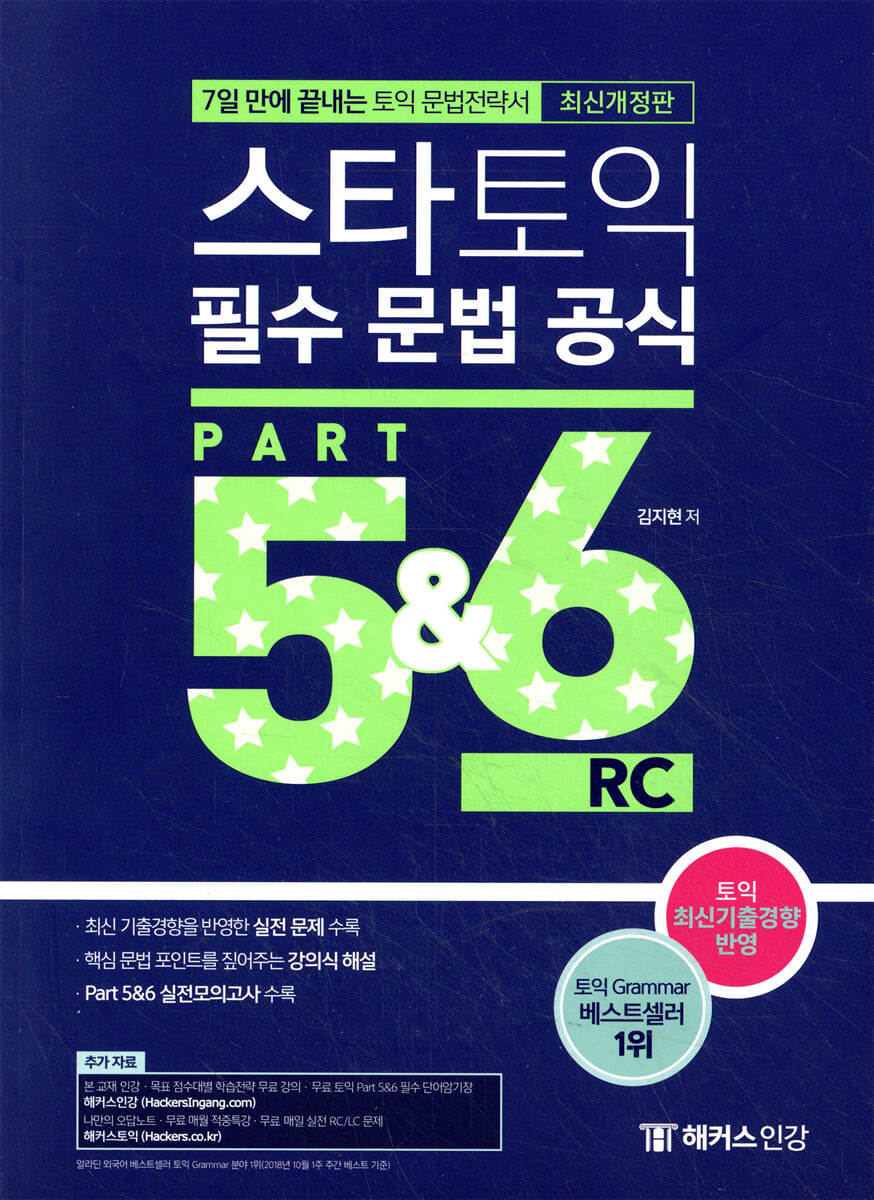
TOEIC Essential Grammar Formulas Part 5 & 6 RC (Reading)
 |
Description
Book Introduction
『Star TOEIC Essential Grammar Formula Part 5&6』 is a TOEIC grammar strategy book that covers the grammar covered in Parts 5&6 in just 7 days. The author, a TOEIC star instructor, provides detailed grammar explanations and includes mock tests for Parts 5 and 6 for final review. |
- You can preview some of the book's contents.
Preview
index
Section 1: Essential Basic Formulas for a TOEIC Score of 600 or Higher
[Sentence Pattern] Subject, Verb, Object, Complement
001 There is followed by a noun subject.
002 The fake subject it is followed by the real subject to-infinitive or that clause.
003 Imperative sentences begin with a verb infinitive.
004 An adjective or a noun can appear in the subject complement position.
005 The infinitive comes after the auxiliary verb.
006 Intransitive verbs do not have objects.
007 A transitive verb is followed by a noun phrase as its object.
008 The verb agrees with the subject.
009 Type 4 verbs have two objects.
010 keep, consider, and find have adjectives in the objective complement position.
011 Allow is a representative 5-form verb that takes the to-infinitive as its object.
012 The passive voice of the 5-form verb is followed by an objective complement.
013 False objects can be used in the 5-form sentence.
[Verb Phrase] Active and Passive Voice, Tense
014 If there is an object, it is active voice, if there is no object, it is passive voice.
015 The passive voice of the 4th type verb is followed by an object.
016 usually is used with the present tense.
017 ago is used with the past tense.
018 For events that occurred further back in time than the past, use the past perfect.
019 The present perfect tense uses have + pp.
020 There are times when you need to understand the tense by looking at the content.
[Verb] to infinitive, gerund
021 Distinguish between verbs that have an infinitive as an object and verbs that have a gerund as an object.
022 There are verbs that take both infinitives and gerunds as objects.
023 There are nouns and adjectives that are used with infinitives.
024 The infinitive can mean purpose, reason, or result.
025 You should know that gerund idioms are grouped expressions.
[Part of speech] Nouns and pronouns
026 There are words whose parts of speech are confusing.
027 Countable and uncountable nouns must be distinguished.
028 Similar person nouns and thing/abstract nouns must be distinguished.
029 There may be a problem of distinguishing between similar noun vocabulary.
030 Compound nouns must be memorized as lump expressions.
031 The demonstrative pronoun that is used instead of a singular noun, and those is used instead of a plural noun.
032 Other can be used before plural countable nouns, and another can be used before singular countable nouns.
033 one's own can modify nouns.
034 Reflexive pronouns can come in the object position.
035 You must memorize the idioms of reflexive pronouns.
036 There are times when you need to understand the use of personal pronouns in context.
[Part of speech] Adjective, adverb, preposition
037 Unlike adverbs, adjectives cannot modify verbs.
038 Similar adjective vocabulary must be distinguished.
039 Quantitative adjectives must be considered in relation to the number of the noun that follows them.
040 You must be able to distinguish between similar adverbial words.
041 Nearly, approximately, etc. are often used as adverbs to modify numbers.
042 so and very are adverbs of emphasis.
043 At, on, and in are used as basic prepositions to indicate time and place.
044 Prepositions of time and prepositions of duration must be used with distinction.
045 Direction and location prepositions must be interpreted carefully.
[Conjunction] Coordinating Conjunction, Correlative Conjunction
046 A subject + verb comes after a conjunction, and a noun phrase comes after a preposition.
047 Correlative conjunctions are a problem of finding a matching pair.
048 and connects words of the same part of speech before and after.
[Special phrase] Comparative
049 The comparative form uses ~er than.
050 much emphasizes the comparative degree.
Official application practice problems
Section 2: Key, Frequently Used Formulas for a TOEIC Score of 700 or Higher
[Verb phrase] Tense, conditional, voice
051 In the case of 'request that subject + _______', the infinitive form is the correct answer.
052 In the case of 'have + object + _______', the answer can be the infinitive or past participle.
053 In the case of 'help + object + _______', the answer can be the verb stem or the to-infinitive.
054 In 'As soon as subject + _______, subject + future tense', present tense is the correct answer.
055 It is written as 'for/in/over the last/past + period, subject + have pp'.
056 'If subject + had pp, subject would have pp' is the past perfect tense of the subjunctive mood.
057 'Should subject + verb infinitive' is a conditional inversion structure with if omitted.
058 Human emotions are expressed in the passive voice.
[Verb] Participle
059 You must be able to distinguish between ‘present participle + noun’ and ‘past participle + noun’.
060 The structure of 'Before + present participle/past participle' is possible.
[Parts of speech] Adjective, adverb, conjunctive adverb, preposition
061 In the case of 'all + (of the) + noun', the number of the verb matches the noun.
062 Adverbs can modify phrases and clauses.
063 A conjunction is an adverb that is not a conjunction.
064 Conjunctive adverbs connect the preceding and following contexts.
065 The preposition to and the to-infinitive must be distinguished.
066 In 'preposition + _______', the answer can be a noun or a gerund.
067 Regarding is used as a preposition.
[Conjunction] Relative pronoun, noun clause conjunction, adverb clause conjunction
068 You must understand the structure of 'relative pronoun nominative/objective + incomplete clause'.
069 The objective relative pronoun can be omitted.
070 Relative adverbs are written in the structure of 'when/how/where/why + complete clause'.
071 The noun clause conjunction that is followed by a complete clause.
072 You must be able to distinguish between 'that + complete clause' and 'what + incomplete clause'.
073 There are nouns and adjectives that are used with that clause.
074 The clause of 'interrogative word + subject + verb' can be used in the subject, object, or complement positions of a sentence.
075 In the question word 'how + _______', an adjective or adverb can be the answer.
076 In 'whether + _______', the to-infinitive can be the answer.
077 You can use the structure 'however + adjective/adverb + subject + verb'.
[Special phrases] Inversion, comparative
078 You can use the inversion structure of 'Hardly/Seldom + verb + subject'.
079 You can use the inversion structure of 'Only + adverb (phrase/clause) + verb + subject'.
There are comparative expressions that do not use 080 than.
Official application practice problems
Section 3: High-Score Formula for TOEIC 800+
[verb phrase]
081 The present tense can indicate the near future.
082 'Be to infinitive' means 'plan to do ~'.
083 'will have + pp' is future perfect tense.
084 The tense of the relative clause does not necessarily match the tense of the main clause.
[Verb/Part of Speech]
085 There is a participle phrase in the form of 'with + noun + participle'.
086 In the case of '_______ + gerund', the correct answer is an adverb, not an adjective.
087 The ing-form noun is not a gerund.
088 In the case of '_______ + adjective + noun', either an adjective or an adverb can be the answer.
089 The adverb otherwise is also used to mean 'otherwise'.
090 In 'given + noun (phrase)', given is a preposition.
[conjunction]
091 You can use the structure 'relative pronoun who + (subject + verb) + verb'.
092 You can use the phrase 'preposition + relative pronoun'.
093 It can be written as 'most of + relative pronoun'.
094 whoever is anyone who.
095 The complex relative pronoun whatever can be used as a conjunction.
096 Prepositions can also connect the preceding and following content.
[Special syntax]
097 In '_______ + do/be + subject', so can be the answer.
098 'pp
You can use the inversion structure of '+ be verb + subject'.
099 You can use the inversion structure of 'Enclosed + subject + find + object'.
For 100 'the superlative + _______', either possible or ever can be the answer.
Official application practice problems
Part 5&6 Practice Exam
Part 5&6 Practice Test 1
Part 5&6 Practice Test 2
Answer and explanation
[Sentence Pattern] Subject, Verb, Object, Complement
001 There is followed by a noun subject.
002 The fake subject it is followed by the real subject to-infinitive or that clause.
003 Imperative sentences begin with a verb infinitive.
004 An adjective or a noun can appear in the subject complement position.
005 The infinitive comes after the auxiliary verb.
006 Intransitive verbs do not have objects.
007 A transitive verb is followed by a noun phrase as its object.
008 The verb agrees with the subject.
009 Type 4 verbs have two objects.
010 keep, consider, and find have adjectives in the objective complement position.
011 Allow is a representative 5-form verb that takes the to-infinitive as its object.
012 The passive voice of the 5-form verb is followed by an objective complement.
013 False objects can be used in the 5-form sentence.
[Verb Phrase] Active and Passive Voice, Tense
014 If there is an object, it is active voice, if there is no object, it is passive voice.
015 The passive voice of the 4th type verb is followed by an object.
016 usually is used with the present tense.
017 ago is used with the past tense.
018 For events that occurred further back in time than the past, use the past perfect.
019 The present perfect tense uses have + pp.
020 There are times when you need to understand the tense by looking at the content.
[Verb] to infinitive, gerund
021 Distinguish between verbs that have an infinitive as an object and verbs that have a gerund as an object.
022 There are verbs that take both infinitives and gerunds as objects.
023 There are nouns and adjectives that are used with infinitives.
024 The infinitive can mean purpose, reason, or result.
025 You should know that gerund idioms are grouped expressions.
[Part of speech] Nouns and pronouns
026 There are words whose parts of speech are confusing.
027 Countable and uncountable nouns must be distinguished.
028 Similar person nouns and thing/abstract nouns must be distinguished.
029 There may be a problem of distinguishing between similar noun vocabulary.
030 Compound nouns must be memorized as lump expressions.
031 The demonstrative pronoun that is used instead of a singular noun, and those is used instead of a plural noun.
032 Other can be used before plural countable nouns, and another can be used before singular countable nouns.
033 one's own can modify nouns.
034 Reflexive pronouns can come in the object position.
035 You must memorize the idioms of reflexive pronouns.
036 There are times when you need to understand the use of personal pronouns in context.
[Part of speech] Adjective, adverb, preposition
037 Unlike adverbs, adjectives cannot modify verbs.
038 Similar adjective vocabulary must be distinguished.
039 Quantitative adjectives must be considered in relation to the number of the noun that follows them.
040 You must be able to distinguish between similar adverbial words.
041 Nearly, approximately, etc. are often used as adverbs to modify numbers.
042 so and very are adverbs of emphasis.
043 At, on, and in are used as basic prepositions to indicate time and place.
044 Prepositions of time and prepositions of duration must be used with distinction.
045 Direction and location prepositions must be interpreted carefully.
[Conjunction] Coordinating Conjunction, Correlative Conjunction
046 A subject + verb comes after a conjunction, and a noun phrase comes after a preposition.
047 Correlative conjunctions are a problem of finding a matching pair.
048 and connects words of the same part of speech before and after.
[Special phrase] Comparative
049 The comparative form uses ~er than.
050 much emphasizes the comparative degree.
Official application practice problems
Section 2: Key, Frequently Used Formulas for a TOEIC Score of 700 or Higher
[Verb phrase] Tense, conditional, voice
051 In the case of 'request that subject + _______', the infinitive form is the correct answer.
052 In the case of 'have + object + _______', the answer can be the infinitive or past participle.
053 In the case of 'help + object + _______', the answer can be the verb stem or the to-infinitive.
054 In 'As soon as subject + _______, subject + future tense', present tense is the correct answer.
055 It is written as 'for/in/over the last/past + period, subject + have pp'.
056 'If subject + had pp, subject would have pp' is the past perfect tense of the subjunctive mood.
057 'Should subject + verb infinitive' is a conditional inversion structure with if omitted.
058 Human emotions are expressed in the passive voice.
[Verb] Participle
059 You must be able to distinguish between ‘present participle + noun’ and ‘past participle + noun’.
060 The structure of 'Before + present participle/past participle' is possible.
[Parts of speech] Adjective, adverb, conjunctive adverb, preposition
061 In the case of 'all + (of the) + noun', the number of the verb matches the noun.
062 Adverbs can modify phrases and clauses.
063 A conjunction is an adverb that is not a conjunction.
064 Conjunctive adverbs connect the preceding and following contexts.
065 The preposition to and the to-infinitive must be distinguished.
066 In 'preposition + _______', the answer can be a noun or a gerund.
067 Regarding is used as a preposition.
[Conjunction] Relative pronoun, noun clause conjunction, adverb clause conjunction
068 You must understand the structure of 'relative pronoun nominative/objective + incomplete clause'.
069 The objective relative pronoun can be omitted.
070 Relative adverbs are written in the structure of 'when/how/where/why + complete clause'.
071 The noun clause conjunction that is followed by a complete clause.
072 You must be able to distinguish between 'that + complete clause' and 'what + incomplete clause'.
073 There are nouns and adjectives that are used with that clause.
074 The clause of 'interrogative word + subject + verb' can be used in the subject, object, or complement positions of a sentence.
075 In the question word 'how + _______', an adjective or adverb can be the answer.
076 In 'whether + _______', the to-infinitive can be the answer.
077 You can use the structure 'however + adjective/adverb + subject + verb'.
[Special phrases] Inversion, comparative
078 You can use the inversion structure of 'Hardly/Seldom + verb + subject'.
079 You can use the inversion structure of 'Only + adverb (phrase/clause) + verb + subject'.
There are comparative expressions that do not use 080 than.
Official application practice problems
Section 3: High-Score Formula for TOEIC 800+
[verb phrase]
081 The present tense can indicate the near future.
082 'Be to infinitive' means 'plan to do ~'.
083 'will have + pp' is future perfect tense.
084 The tense of the relative clause does not necessarily match the tense of the main clause.
[Verb/Part of Speech]
085 There is a participle phrase in the form of 'with + noun + participle'.
086 In the case of '_______ + gerund', the correct answer is an adverb, not an adjective.
087 The ing-form noun is not a gerund.
088 In the case of '_______ + adjective + noun', either an adjective or an adverb can be the answer.
089 The adverb otherwise is also used to mean 'otherwise'.
090 In 'given + noun (phrase)', given is a preposition.
[conjunction]
091 You can use the structure 'relative pronoun who + (subject + verb) + verb'.
092 You can use the phrase 'preposition + relative pronoun'.
093 It can be written as 'most of + relative pronoun'.
094 whoever is anyone who.
095 The complex relative pronoun whatever can be used as a conjunction.
096 Prepositions can also connect the preceding and following content.
[Special syntax]
097 In '_______ + do/be + subject', so can be the answer.
098 'pp
You can use the inversion structure of '+ be verb + subject'.
099 You can use the inversion structure of 'Enclosed + subject + find + object'.
For 100 'the superlative + _______', either possible or ever can be the answer.
Official application practice problems
Part 5&6 Practice Exam
Part 5&6 Practice Test 1
Part 5&6 Practice Test 2
Answer and explanation
Detailed image
.jpg)
Publisher's Review
Hackers, the #1 TOEIC bestseller for 15 consecutive years!
TOEIC Grammar Strategy Book: Complete in 7 Days
With 『StarTOEIC Essential Grammar Formulas Part 5&6』, you can prepare for all grammar points that appear in TOEIC Parts 5&6 and get a perfect score on Parts 5&6.
1.
Perfectly reflecting the latest TOEIC exam trends
2.
A strategy book to finish the grammar questions from Parts 5 and 6 in 7 days.
3.
Includes detailed grammar explanations by the author, a TOEIC star instructor.
4.
Includes Part 5 & 6 practice exams for final preparation.
[Additional Materials]
HackersIngang (HackersIngang.com)
Free lecture on learning strategies by target score, Part 5 & 6 Essential Vocabulary Memorization Book
Hackers English (Hackers.co.kr)
My own error notebook, TOEIC hit prediction special lecture, daily practice RC/LC questions, monthly regular TOEIC answers
[Textbook Features]
1.
Parts 5 & 6 perfectly reflect the latest TOEIC exam types
1) Part 5: Quickly solve the new TOEIC Part 5, which organizes TOEIC grammar into a 'formula that allows you to quickly find the correct answer', reducing the solution time.
2) Part 6: Added a new type of 'selecting sentences appropriate to the context' and provided detailed explanations and grammatical analysis to help you prepare perfectly for the new type.
2.
A textbook that will help you master the grammar covered in TOEIC Parts 5 and 6 in just 7 days.
1) Complete TOEIC grammar in a short period of time without wasting time by organizing only the essential grammar for each target score!
2) Includes a study plan to complete TOEIC Part 5 & 6 essential grammar in 7 days.
3) Includes real-world problems to practice applying the formula and improve practical skills.
3.
A stress-free structure that allows you to complete everything from learning grammar formulas to practicing practical exercises within 2 pages.
4.
Detailed explanations that make it easy to understand key grammar points, as if you were receiving private tutoring.
1) Detailed explanations based on the author's many years of teaching experience and know-how as a TOEIC star instructor.
2) Providing 'Syntax Interpretation and Tips' to help even beginners learn easily.
5.
Hackers TOEIC star instructor, the author, provides free video lectures on learning strategies for each target score.
Achieve your target score in a short period of time through the author's lectures that teach you key learning content and learning methods for each target score range.
6.
Includes 'Part 5 & 6 Practice Tests' for final preparation.
1) Includes two sets of 'Part 5&6 Practice Tests', structured identically to the actual TOEIC exam.
2) After learning all grammar formulas, you can maximize your sense of reality and check your skills by solving the problems.
7.
Additional materials for achieving full marks in Parts 5 and 6 and achieving high TOEIC scores
1) Provides a list of frequently used vocabulary and grouped expressions for TOEIC Parts 5 & 6 (HackersIngang.com) 2) Provides "My Own Wrong Answer Notebook" to address weaknesses and achieve a perfect score on Parts 5 & 6 (Hackers.co.kr)
3) Provides various free learning contents such as TOEIC predicted lectures, daily practice RC/LC problems, and monthly regular TOEIC answers (Hackers.co.kr)
Hackers, the #1 TOEIC bestseller for 15 consecutive years!
[Hackers Language Institute] Kyobo Bookstore's #1 Comprehensive Bestseller in the TOEIC/TOEFL Category (based on annual bestsellers from 2005 to 2019, Hackers TOEIC Vocabulary 7 times/Hackers TOEIC Reading 8 times)
TOEIC Grammar Strategy Book: Complete in 7 Days
With 『StarTOEIC Essential Grammar Formulas Part 5&6』, you can prepare for all grammar points that appear in TOEIC Parts 5&6 and get a perfect score on Parts 5&6.
1.
Perfectly reflecting the latest TOEIC exam trends
2.
A strategy book to finish the grammar questions from Parts 5 and 6 in 7 days.
3.
Includes detailed grammar explanations by the author, a TOEIC star instructor.
4.
Includes Part 5 & 6 practice exams for final preparation.
[Additional Materials]
HackersIngang (HackersIngang.com)
Free lecture on learning strategies by target score, Part 5 & 6 Essential Vocabulary Memorization Book
Hackers English (Hackers.co.kr)
My own error notebook, TOEIC hit prediction special lecture, daily practice RC/LC questions, monthly regular TOEIC answers
[Textbook Features]
1.
Parts 5 & 6 perfectly reflect the latest TOEIC exam types
1) Part 5: Quickly solve the new TOEIC Part 5, which organizes TOEIC grammar into a 'formula that allows you to quickly find the correct answer', reducing the solution time.
2) Part 6: Added a new type of 'selecting sentences appropriate to the context' and provided detailed explanations and grammatical analysis to help you prepare perfectly for the new type.
2.
A textbook that will help you master the grammar covered in TOEIC Parts 5 and 6 in just 7 days.
1) Complete TOEIC grammar in a short period of time without wasting time by organizing only the essential grammar for each target score!
2) Includes a study plan to complete TOEIC Part 5 & 6 essential grammar in 7 days.
3) Includes real-world problems to practice applying the formula and improve practical skills.
3.
A stress-free structure that allows you to complete everything from learning grammar formulas to practicing practical exercises within 2 pages.
4.
Detailed explanations that make it easy to understand key grammar points, as if you were receiving private tutoring.
1) Detailed explanations based on the author's many years of teaching experience and know-how as a TOEIC star instructor.
2) Providing 'Syntax Interpretation and Tips' to help even beginners learn easily.
5.
Hackers TOEIC star instructor, the author, provides free video lectures on learning strategies for each target score.
Achieve your target score in a short period of time through the author's lectures that teach you key learning content and learning methods for each target score range.
6.
Includes 'Part 5 & 6 Practice Tests' for final preparation.
1) Includes two sets of 'Part 5&6 Practice Tests', structured identically to the actual TOEIC exam.
2) After learning all grammar formulas, you can maximize your sense of reality and check your skills by solving the problems.
7.
Additional materials for achieving full marks in Parts 5 and 6 and achieving high TOEIC scores
1) Provides a list of frequently used vocabulary and grouped expressions for TOEIC Parts 5 & 6 (HackersIngang.com) 2) Provides "My Own Wrong Answer Notebook" to address weaknesses and achieve a perfect score on Parts 5 & 6 (Hackers.co.kr)
3) Provides various free learning contents such as TOEIC predicted lectures, daily practice RC/LC problems, and monthly regular TOEIC answers (Hackers.co.kr)
Hackers, the #1 TOEIC bestseller for 15 consecutive years!
[Hackers Language Institute] Kyobo Bookstore's #1 Comprehensive Bestseller in the TOEIC/TOEFL Category (based on annual bestsellers from 2005 to 2019, Hackers TOEIC Vocabulary 7 times/Hackers TOEIC Reading 8 times)
GOODS SPECIFICS
- Date of issue: March 4, 2024
- Page count, weight, size: 271 pages | 571g | 188*257*25mm
- ISBN13: 9788969650702
- ISBN10: 8969650709
You may also like
카테고리
korean


korean

![GQ KOREA Mark (Monthly): December [2025]](http://librairie.coreenne.fr/cdn/shop/files/8ef265dbbfbf186523ed75ba7319009d.jpg?v=1765340328&width=3840)


