

English Grammar Guide by Meaning
 |
Description
Book Introduction
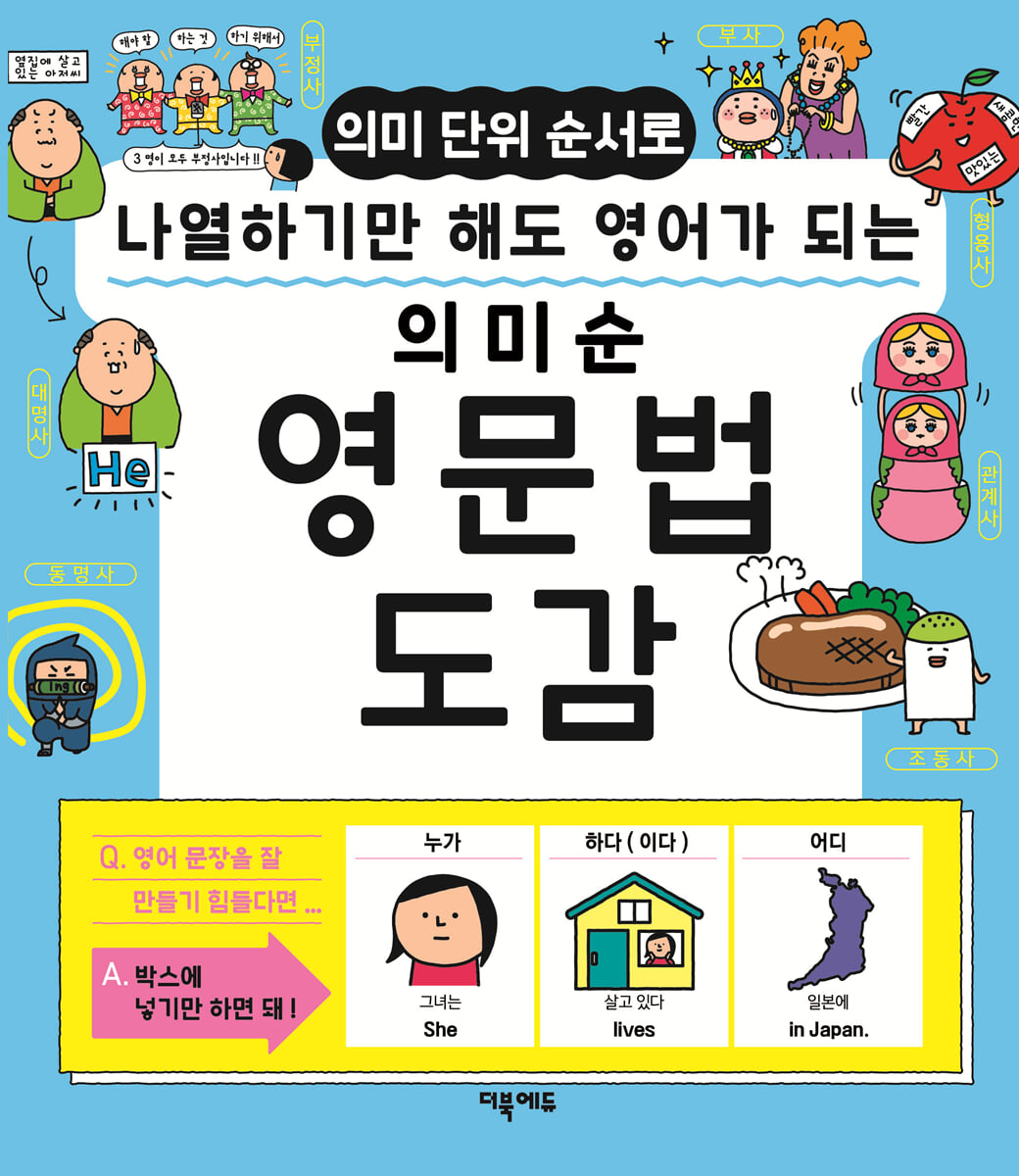
You can visually grasp the entire image of English grammar.
What books should I use to learn English grammar? There has never been a clear answer to this question.
The reason is that most books do not present a complete picture of English grammar.
Existing grammar books simply explain each grammar point, such as 'Chapter 3: Tenses' and 'Chapter 4: Auxiliary Verbs', without mentioning the relationships between grammar points.
If you know the grammar points covered in existing grammar books and can accurately understand and correctly construct English sentences, those grammar points will definitely be somewhere in your English sentences.
So, where does each grammatical point fit within an English sentence? This book aims to provide a comprehensive picture of English grammar, showing where each grammatical point is located within an English sentence and how they are connected.
We have introduced a comprehensive picture of English grammar based on the latest research findings in educational linguistics, and have tried to show the structure of English as easily as possible using illustrations.
Whether you're a current middle or high school student or a working professional, if you've decided to study English again because your English foundation is lacking, I hope this book will help you understand English grammar 'visually' and 'systematically' study it.
I hope this book will help you learn English.
What books should I use to learn English grammar? There has never been a clear answer to this question.
The reason is that most books do not present a complete picture of English grammar.
Existing grammar books simply explain each grammar point, such as 'Chapter 3: Tenses' and 'Chapter 4: Auxiliary Verbs', without mentioning the relationships between grammar points.
If you know the grammar points covered in existing grammar books and can accurately understand and correctly construct English sentences, those grammar points will definitely be somewhere in your English sentences.
So, where does each grammatical point fit within an English sentence? This book aims to provide a comprehensive picture of English grammar, showing where each grammatical point is located within an English sentence and how they are connected.
We have introduced a comprehensive picture of English grammar based on the latest research findings in educational linguistics, and have tried to show the structure of English as easily as possible using illustrations.
Whether you're a current middle or high school student or a working professional, if you've decided to study English again because your English foundation is lacking, I hope this book will help you understand English grammar 'visually' and 'systematically' study it.
I hope this book will help you learn English.
- You can preview some of the book's contents.
Preview
index
Chapter 1: Effective Ways to Learn English Grammar
Why do we say, "We're not good at English"? 010
Understanding English sentence structure by meaning 014
'Meaningful Map' 018, easy to understand at a glance
Chapter 2: Let's Learn Sentence Structure
1st form sentence (SV) 022
Type 2 Sentence (SVC) 026
3-form sentence (SVO) 030
4-Format Sentence (SVOO) 032
5-type sentence (SVOC) 036
There sentence 040
Declarative Sentences (Affirmative and Negative) 044
Interrogative sentence 048
Command 054
Exclamation 056
Understanding English Sentence Structure 060
Short text 062
Chinese 064
Bokmun 066
Chapter 3: Let's Learn Grammar
Verb 070
Basic Tense 076
Auxiliary Verb 080
Progressive 084
Perfect tense 088
Passive voice 094
Infinitive 100
Gerund 106
Part 110
Comparison 114
Affiliate 120
Family Law 128
Speaking 134
Inanimate Subject Phrase 138
Emphasized Phrase 142
Chapter 4: Let's learn more about parts of speech to create sentences.
Noun 148
Pronoun 152
Adjective 158
Adverb 162
Preposition 166
Conjunction 170
Interjection 174
Why do we say, "We're not good at English"? 010
Understanding English sentence structure by meaning 014
'Meaningful Map' 018, easy to understand at a glance
Chapter 2: Let's Learn Sentence Structure
1st form sentence (SV) 022
Type 2 Sentence (SVC) 026
3-form sentence (SVO) 030
4-Format Sentence (SVOO) 032
5-type sentence (SVOC) 036
There sentence 040
Declarative Sentences (Affirmative and Negative) 044
Interrogative sentence 048
Command 054
Exclamation 056
Understanding English Sentence Structure 060
Short text 062
Chinese 064
Bokmun 066
Chapter 3: Let's Learn Grammar
Verb 070
Basic Tense 076
Auxiliary Verb 080
Progressive 084
Perfect tense 088
Passive voice 094
Infinitive 100
Gerund 106
Part 110
Comparison 114
Affiliate 120
Family Law 128
Speaking 134
Inanimate Subject Phrase 138
Emphasized Phrase 142
Chapter 4: Let's learn more about parts of speech to create sentences.
Noun 148
Pronoun 152
Adjective 158
Adverb 162
Preposition 166
Conjunction 170
Interjection 174
Detailed image

Into the book
Knowing why you're doing poorly can help you learn effective study methods.
Most adult English learners started learning English in elementary school, and have studied for 10 years through elementary, middle, and high school, and including college, for a total of 12 to 14 years.
Yet, I can't even open my mouth to speak English, let alone read original English books or communicate with foreigners.
Why do we find English so difficult and so bad?
It's because of the difference between English and Korean.
Here, we'll look at some common mistakes we make and the reasons why we can't speak English well and are bound to be awkward, using examples of mistakes that are often mistaken in English and are "mistakes that don't make sense."
Reason ① Not being aware of the difference in word order
Unlike Korean, English is a language in which the meaning changes depending on word order.
In Korean, the order of the words in “The man ate an apple” can be changed to “The man ate an apple,” or “The man ate an apple.” This still makes sense.
But in English, the sentences end up being completely meaningless.
One mistake that must be avoided when speaking or writing English is word order. English has a different word order from Korean, which makes it difficult for native Korean learners.
Reason ② The subject is often omitted
In Korean, there are often cases where the subject is not stated on purpose.
If the meaning is understood without stating the subject, omit the subject and say something like, “What time will you be back today?” or “I think it’s around 7 o’clock?”
However, English is a language that requires subjects in principle, with some exceptions.
If you apply your Korean sense to English, you may not be able to communicate effectively.
Reason 3: We get caught up in words that don't make sense.
If you translate an English sentence into English without thinking about its meaning, it will end up being an awkward sentence that native speakers don't use.
For example, let's say you're in a coffee shop and you have a conversation like this: "I'd like tea, what would you like to drink?" or "I'd like coffee."
At this time, if you literally change the Korean sentence “I have coffee” into English, the meaning changes.
Most adult English learners started learning English in elementary school, and have studied for 10 years through elementary, middle, and high school, and including college, for a total of 12 to 14 years.
Yet, I can't even open my mouth to speak English, let alone read original English books or communicate with foreigners.
Why do we find English so difficult and so bad?
It's because of the difference between English and Korean.
Here, we'll look at some common mistakes we make and the reasons why we can't speak English well and are bound to be awkward, using examples of mistakes that are often mistaken in English and are "mistakes that don't make sense."
Reason ① Not being aware of the difference in word order
Unlike Korean, English is a language in which the meaning changes depending on word order.
In Korean, the order of the words in “The man ate an apple” can be changed to “The man ate an apple,” or “The man ate an apple.” This still makes sense.
But in English, the sentences end up being completely meaningless.
One mistake that must be avoided when speaking or writing English is word order. English has a different word order from Korean, which makes it difficult for native Korean learners.
Reason ② The subject is often omitted
In Korean, there are often cases where the subject is not stated on purpose.
If the meaning is understood without stating the subject, omit the subject and say something like, “What time will you be back today?” or “I think it’s around 7 o’clock?”
However, English is a language that requires subjects in principle, with some exceptions.
If you apply your Korean sense to English, you may not be able to communicate effectively.
Reason 3: We get caught up in words that don't make sense.
If you translate an English sentence into English without thinking about its meaning, it will end up being an awkward sentence that native speakers don't use.
For example, let's say you're in a coffee shop and you have a conversation like this: "I'd like tea, what would you like to drink?" or "I'd like coffee."
At this time, if you literally change the Korean sentence “I have coffee” into English, the meaning changes.
--- From the text
GOODS SPECIFICS
- Date of issue: March 10, 2023
- Page count, weight, size: 176 pages | 182*210*20mm
- ISBN13: 9791197618550
- ISBN10: 1197618554
You may also like
카테고리
korean


korean

![GQ KOREA Mark (Monthly): December [2025]](http://librairie.coreenne.fr/cdn/shop/files/8ef265dbbfbf186523ed75ba7319009d.jpg?v=1765340328&width=3840)


