

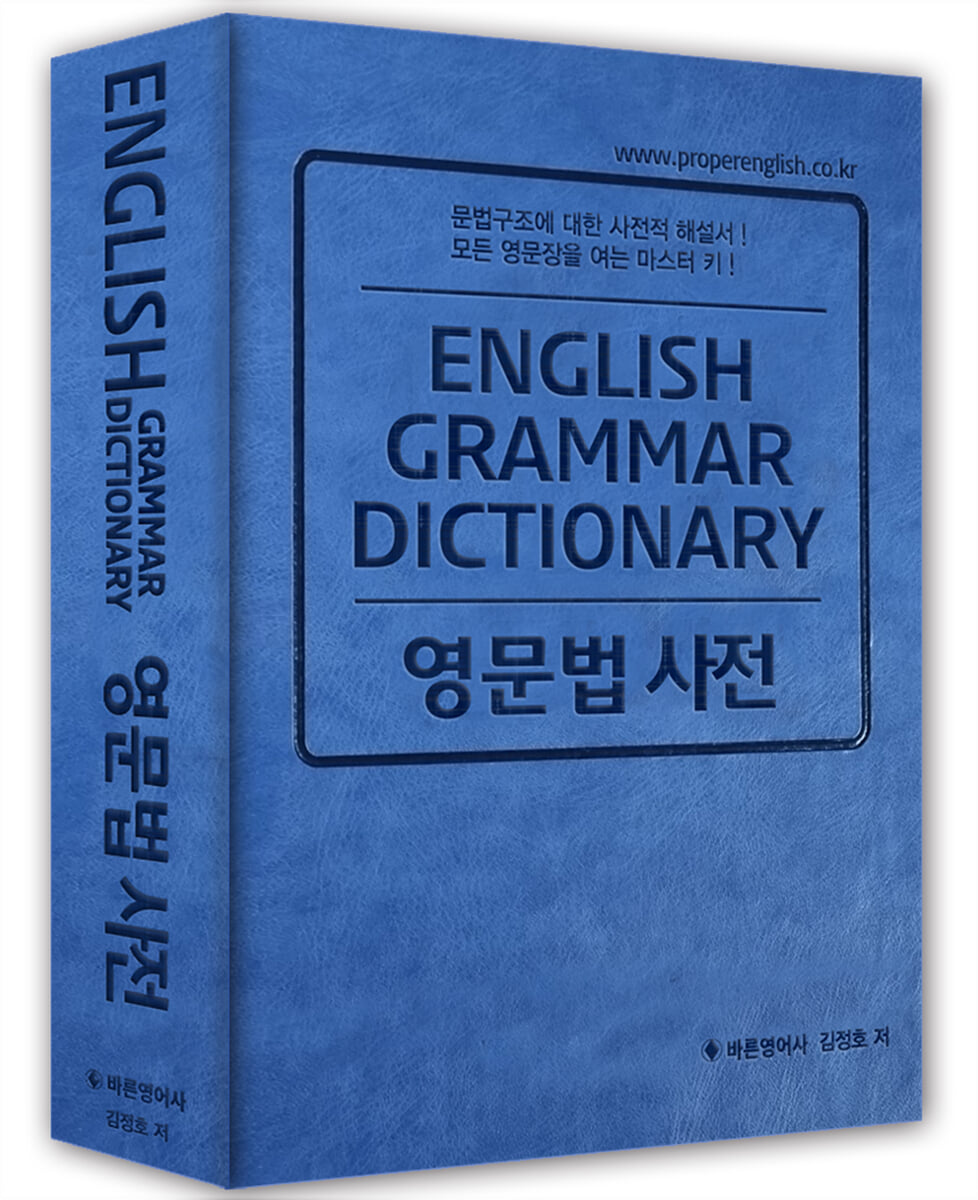
English grammar dictionary
 |
Description
Book Introduction
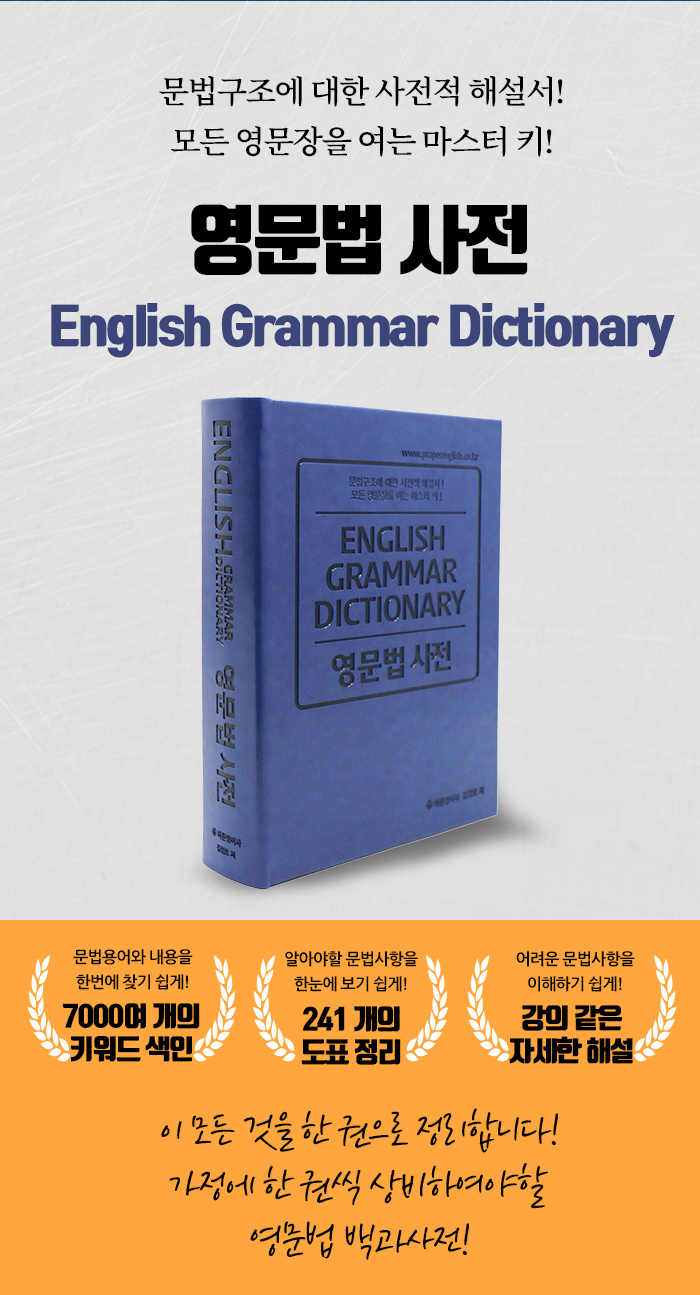
The Best English Learning Method for Koreans I have tried to present and describe an optimal explanation for Koreans to accept English by striking a balance between the “linguistic commonality” of communication and the “functional differences” between the two languages. In particular, the three comparative linguistic characteristics of English—“postpositional modifier,” “pair concept,” and “common use of parts of speech”—are principles that permeate all parts of this book. If you consistently apply the three principles the author presents in each learning section, you will be able to become familiar with English more quickly. |
- You can preview some of the book's contents.
Preview
index
Preface Table of Contents
▣ Preface
▣ Book Structure and Features Table of Contents
▣ Index
Table of Contents
▣ PART 01 - Verb Classification by Sentence Meaning
1.
Intransitive verbs
2.
Link verbs
1) be(is, am, are, was, were, have been, has been, had been)
2) become Ryu
3) Verbs that mean maintaining a state or existence
4) Verbs that imply a roundabout judgment
5) Verbs that emphasize the result of a judgment
6) Five senses verbs
7) Verbs of measurement
8) 2 types by additional complement (pseudo-complement, pseudo-complement, quasi-complement)
3.
Transitive verbs
1) Scope of the object
2) Omission of object
3) Move the object to the subject position and change to passive voice.
4) Three forms of the verb take
5) Transitive verbs that are easily mistaken for taking a preposition
6) Transitive verbs that require careful attention to their meaning
7) Main verbs used in the structure of 'transitive verb + A + preposition + B'
8) Transitive verbs that take reflexive pronouns as their objects
4.
dative verbs
1) Structural features
2) Word order of the object
3) Omission of object
5.
Verbs that can take object complement
1) Five main types of verbs that can use nouns and pronouns as object complements
2) Five main types of verbs that can use adjectives and participles as object complements
3) Verbs that receive (to) VR as an object complement
▣ PART 02 - Nouns
1.
countable nouns
1) Ordinary nouns
2) Collective nouns
3) Mass nouns
2.
uncountable nouns
1) Abstract nouns
2) Material nouns
3) Proper nouns
4) Nouns for phenomena
3.
Individuation of uncountable nouns into countable nouns
1) Counting of abstract nouns
2) Counting of material nouns
3) Countable nouns of proper nouns
4.
plurals of nouns
1) Rules for creating plural forms of countable nouns
2) Irregular plural words
3) Nouns with the same singular and plural form
4) Nouns whose meaning can change when pluralized
5) Plural of compound nouns
6) Multiple numbers, letters, and symbols
7) Symmetrical plural nouns
8) Words ending in -ics
9) Nouns that are plural but treated as singular
10) Plurals whose meaning changes depending on the form
11) Mutual revenge
5.
possessive form of nouns
1) A's B method (A owns B)
2) B of A method
6.
Gender of nouns
1) Masculine nouns
2) Feminine nouns
▣ PART 03 - Pronouns
1.
Pronoun it
1) Subject (formal subject) role
2) Role of the provisional object (formal object)
3) Subject for a specific situation
4) When receiving a specific singular noun mentioned above
5) When accepting a person whose gender or identity has not been confirmed
2.
personal pronouns
1) Nominative personal pronoun
2) Objective personal pronouns
3) Possessive personal adjectives
4) Reflexive pronouns
3.
indefinite pronouns
1) some, any
2) another, other
3) none, no
4) neither, either
5) one, all, every, each, both
4.
demonstrative pronouns
1) this
2) that
3) such
4) so
5) the same
▣ PART 04 - Prepositions
1.
The role of 'preposition + object'
1) Modifying a noun from behind to in front of it
2) Providing additional information such as 'time, place, and method' for verbs
3) Forming transitive phrases with specific verbs
2.
Individual basic meanings and uses of prepositions
1) Additional information related to time
2) Prepositions related to place and direction
3) Prepositions related to cause and reason
4) Purpose, purpose of acquisition, object, pursuit, aim
5) Means, tools
6) Comparison, analogy
7) No concern, no concession
8) Qualifications, similar
9) Prepositions that give specific quantities of differences by
10) Results, limits, and degrees
11) Exceptions
▣ PART 05 - Adjectives
1.
Main adjective endings
2.
The role of adjectives
1) Role of modifying nouns (limiting use)
2) The role of a complement that supplements the subject or object
3) Adjectives used only as descriptive objects
4) Usage of worth
5) Adjectives used only as prepositional modifiers (only used in restrictive usage)
6) Adjectives whose meaning changes depending on whether they are used as a preposition or as a complement
3.
An adjective that follows a preposition, infinitive, or clause
1) Adjective + Preposition
2) Adjective + to infinitive
3) Adjective + that clause
4) it is + adjective + that clause
5) Conversion of the structure 'it is adjective to VR (transitive verb, transitive verb phrase) + object'
4.
Types of adjectives
1) Possessive, indicative, negative, interrogative, and relative adjectives
2) Quantitative adjectives
3) Adjectives of quality and state
5.
Adjective word order
6.
Usage of other adjectives
1) the + adjective
2) Adjectives with frequently confused endings
3) Auxiliary adjectives
▣ PART 06 - Adverbs
1.
Adverb form
1) Adverbs derived from adjectives
2) Main adverbs without -ly
3) When the adjective and adverb have the same form
4) When ‘adverb + ly’ creates a new adverb
5) When there are two adverbs with the same meaning
2.
Use of adverbs
1) Verb modifier
2) Adjective modifier
3) Adverbial Modifier
4) Whole sentence modifier
5) Numeric formulas
6) Modifiers of gerunds, infinitives, and participles
3.
Position of adverbs
4.
Types of adverbs by content
1) Adverb of manner
2) Adverbs of frequency
3) Adverb of degree
4) Adverbs of time
5) Adverb of place
6) Interrogative adverbs
7) Relative adverbs
8) Demonstrative adverbs
9) Conjunction adverb
5.
The order of adverbs when multiple adverbs are used
1) The order of the three representative adverbs
2) Expanded word order of adverb information
3) Law of Proximity
4) Modifying position of adverbial modifiers
5) Adverbs that modify the entire clause are placed at the front of the sentence.
6) When adverbs are used in abbreviated texts
7) Position of the adverb quite
8) Adverbs from prepositions
9) When using the word order of ‘adverb + adjective + article + noun’
6.
Nouns and adverbs indicating time, place, and method
▣ PART 07 - Subject-Verb Agreement
1.
Number agreement of the verb be
2.
Number agreement of regular verbs
1) Shape
2) Main rules
▣ PART 08 - Coordinate Conjunctions
1.
Coordinating conjunctions
1) and
2) but
3) or
4) nor
2.
Coordinate correlative conjunction
1) not only A but also B
2) both A and B
3.
Conjunctions so and for
1) so
2) for
▣ PART 09 - Noun Clauses
1.
Noun clause with conjunction that
1) The structure 'That + S + P ...' is the subject of the entire sentence at the beginning of the sentence.
2) It + P1 + that + S2 + P2
3) be + that + S + P
4) vt + that + S + P
5) vt + IO + that + S + P
6) vt + it + OC + that clause
7) Content noun + that + S + P: that clause in apposition
8) 'That clause' used as the object of the preposition 'in, except, save, but'
2.
Noun clause with the conjunction whether
1) Whether + S2 + P2 ...
+ P1
2) It + P1 + ...
+ if(whether) + S2 + P2
3) be + if(whether) + S + P
4) vt + if(whether) + S + P
5) vt + noun + if(whether) + S + P
6) Preposition + whether + S + P
3.
wh- (S) + P: noun clause derived by wh-
1) wh- (S2) + P2 ...
+ P1
2) It + P1 ...
+ wh- (S2) + P2
3) vt + wh- (S) + P
4) vt + noun + wh- (S) + P
5) be + wh- (S) + P
6) Preposition + wh- (S) + P
▣ PART 10 - Adverb Clauses
1.
Types of adverbial clauses
1) Adverbial clause of time
2) Adverbial clauses of manner and mode
3) Adverbial clause of proportion
4) Adverbial clause of purpose
5) Adverbial clause of result
6) Adverbial clauses of place: where S2 + P2, S1 + P1
7) Adverbial clauses of cause and reason
8) Adverbial clause of degree
9) Adverbial clause of condition
10) Adverbial clause of concession (no relation)
2.
Omitting 'S + be' after the adverbial conjunction
▣ PART 11 - Relative Clauses
1.
relative pronouns
1) Concept
2) The process of creating relative pronouns
3) Types of relative pronouns
4) Interpretation of relative pronouns
5) Deepening relative pronouns
6) Omission of relative pronouns
7) Similar relative pronouns
8) Relative pronoun what
2.
relative adjective
1) what + noun
2) which + noun
3) whose + noun
3.
relative adverb
1) The process of creating relative adverbs
2) Continuous usage and modifier usage
3) Omission of relative adverbs
4) Combinations of prepositions and relative pronouns other than in, at, and on
5) When the antecedent is omitted and the relative adverbial clause is converted into a noun clause
4.
complex relative clauses
1) Compound relative pronouns: whoever, whomever, whichever, whosever, whatever
2) Complex relative adverbs: wherever, whenever, however
3) Complex relative adjectives: whatever + noun, whichever + noun, whosever + noun
▣ PART 12 - Tenses
1.
Form of tense
1) Changes in tense shape through the action verb 'do'
2) Changes in tense shape through the state verb 'know'
2.
Interpretation and application methods for each tense
1) The simple present tense
2) The simple past tense
3) The simple future tense
4) Present continuous tense
5) The past continuous tense
6) The future continuous tense
7) The present perfect tense
8) Present perfect continuous tense
9) The past perfect tense
10) The past perfect continuous tense
11) The future perfect tense
12) The future perfect continuous tense
3.
Tense relationship between main and subordinate clauses
1) When the main clause is in present tense and past tense
2) Subjunctive tense
3) Tense in the obligatory clause
▣ PART 13 - Modals and auxiliaries
1.
Characteristics of auxiliary verbs
1) Form: auxiliary verb + VR, be + ing, be + pp, have pp, have been -ing, have been pp?
2) Duplication of auxiliary verbs
3) Negation of auxiliary verbs
4) Auxiliary verb interrogative sentences
2.
Types of auxiliary verbs
3.
Modal verbs
1) can
2) may
3) must
4) will
5) shall
6) would
7) should
8) need, dare
4.
Auxiliary verbs that express tense or sentence
1) be auxiliary verb
2) auxiliary verbs have, has, had
3) do auxiliary verb
5.
Auxiliary verb phrase
1) may well
2) may as well = had better
3) may(might) as well A as B = would rather A than B
6.
Substitution of auxiliary verbs by infinitives
1) be going to VR: 'I intend to do ~'
2) be able to VR: '~ can be done'
3) have to VR: 'must do'
4) used to VR: 'used to do ~'
5) ought to VR: 'It is natural to do ~'
7.
auxiliary verb + have pp
1) may(might) have pp : 'may have done ~'
2) must have pp: 'must have done ~'
3) cannot have pp : 'there is no way ~ could have been done'
4) should have pp: 'I should have done it, but I regret not doing it'
5) ought to have pp: 'I had to do ~'
6) need not have pp : 'I didn't need to do it, but I did it'
▣ PART 14 - Passive form
1.
If you prefer passive voice
1) When it is difficult to find the subject of the active voice
2) When information about the subject of the active voice is not important
2.
Basic form of passive voice
1) Passive verb form
2) Differences in interpretation between be pp and get pp
3.
Passive voice by form
1) 3 types of passive voice
2) 4 types of passive voice
3) Passive voice in 5 forms: 'S + P + O + O.C' → 'O + be pp + O.C'
4) Passive voice of transitive verb phrases
5) Active voice with 'nobody, nothing, none, neither' as the subject
6) Prepositions after passive voice
7) Passive in the structure of 'transitive verb + object + preposition + object'
8) Interpretation of passive voice that requires attention
9) Passive voice of quasi-verbs (passive voice of infinitives and gerunds)
10) Gerunds that require manual interpretation
11) Verbs that do not take the passive voice even though they take an object
12) Exclusive use as a postposition
▣ PART 15 - Subjunctive Mood
1.
Distinction between simple conditions and counterfactual assumptions using 'if clauses' ('conditional' vs. 'subjunctive mood')
2.
Indicative mood (conditional) by 'if clause'
1) Facts that are possible as of the present
2) Facts that may have occurred in the past
3.
Contrary conditional sentence by 'if clause'
1) Assumption of the opposite fact of ‘the same time as the time of speaking’ and the result of the opposite fact
2) Assuming the opposite of 'facts from the time of speaking' and predicting the opposite result
3) Assumptions that oppose past facts + results that oppose present facts
4) Assumption of future facts that we hope will not occur
5) Inversion of if clause
4.
Other family law cases
1) Subjunctive object clause using the verb wish
2) as if (as though) conditional mood (indicative mood is also possible)
3) It's time + past tense conditional
4) if it were not for A
5) if it had not been for A
6) what if + subject + verb + ?
7) The subjunctive of necessity
8) Abbreviation of if
5.
Conditional sentences in simple form without an 'if clause'
1) a, an, any, another + S + would + VR, have pp
2) Preposition + object, S + would + VR, have pp
3) Indicative + otherwise(or) + S + would + VR, have pp
4) Substitution of 'if clause' by infinitive or gerund
5) Participle phrase + S + would + VR, have pp
6) Context + S + would + VR, have pp
▣ PART 16 - to infinitive
1.
Forms and concepts of infinitives
1) Shape
2) Concept
2.
Interpretation of infinitives by position
1) When used as a subject: located at the beginning of a sentence
2) When used in a subject-subject structure (because the subject is long): located at the end of the sentence
3) When used as a nominative complement: located at the back of some verbs
4) When used as the object of a transitive verb: located after the object (noun) of the transitive verb
5) When used as the object of a transitive verb: located immediately after the transitive verb
6) wh- + to infinitive: used in place of a noun
7) To VR, S + P: 'In order to do ~' (purposeful use)
8) S + P ....
to VR: 'to do ~' (purposeful use)
9) S + P ....
to VR: 'As a result, ~' (consequential usage)
10) Emotional change verb + to VR: Cause of emotional change
11) Noun + to VR: 'Noun to do ~' (postpositional modifier usage)
12) vt + it + OC + to VR: 5-form true object
13) Infinitive used as a basis for reason or judgment
3.
Other uses of infinitives
1) Predicate infinitive
2) Negation of infinitive: not to VR
3) Split infinitive: to + adverb + VR
4) Absolute infinitive
5) The subjunctive role of the infinitive
6) Sentence transition in subject-object structure
7) Pro-infinitive
8) Expression of unrealized wishes or expectations
9) Various meanings of be to VR
10) Subject of the infinitive
11) Infinitive tense
▣ PART 17 - Participles
1.
The concept of participle
2.
Interpretation of participles
1) Intransitive verb + ing: 'doing ~' (progressive action)
2) Intransitive verb + pp: '~han' (completion of action)
3) Transitive verb + ing: 'Making (others) do something' (active progressive)
4) Transitive verb + pp: '~doen (received, suffered)' (passive perfect)
3.
The role of participles
1) Participles used in conjugation of verbs
2) Participles used to modify nouns
3) A nozzle that acts as a bore
4.
Present participle vs. gerund
1) ing + noun
2) be + ing
5.
ing that causes emotions, pp that is caused by emotions
1) ing that triggers emotions
2) pp that are triggered by emotions
6.
quasi-participles
7.
compound participle
1) Adverb-ing: 'doing ~'
2) Adjective-ing: ‘doing something’ (since it is an adjective, it is originally a complement)
3) Noun-ing: 'doing ~'
4) Adverb-pp: '~ done ~'
5) Adjective-pp: ‘~ done ~’ (since it is an adjective, it is originally a complement)
6) Noun-pp: 'done by ~'
7) pp-preposition: '~became'
8.
the + participle
1) Plural common noun: people
2) Singular common noun: specific person, concept
9.
When a participle modifies an adjective
10.
Noun + predicate verb vs. noun + past participle
▣ PART 18 - Participial Construction
1.
The process of creating a participle phrase
2.
Past participle construction omitting being or having been
3.
Participle phrases and conjunctions
4.
Scope of interpretation of participle phrases
1) Reason: as, since, because
2) Concession: though, although, even if
3) Time: while, when, after
4) Condition: if
5) Unit situation: and, as, while
5.
Position of the participle phrase
6.
'being + bore' participle phrase
7.
Participle phrase with the adverb there
8.
Omission of the general subject (S2)
9.
Idioms using participle phrases
▣ PART 19 - Gerund
1.
Form of gerund
2.
The role of gerunds
1) Subject role
2) Acts as a subject complement after the verb be
3) Object of type 3 transitive verb
4) Object of preposition
3.
Gerund vs. Present Participle
4.
Frequently used prepositions and gerund structures
5.
A gerund that is interpreted as passive in active form after a transitive verb
6.
The semantic subject of a gerund
1) When the subject is not written separately for semantic reasons
2) When the semantic subject is written before the gerund
7.
Tense of gerunds
8.
passive gerund
9.
Key idioms using gerunds
10.
Preposition to + ing
▣ PART 20 - Comparative phrases and clauses
1.
Comparison of original grades
1) The principle of creation of original comparison
2) Composition of negative primary comparison
3) Idiomatic expressions using comparison of origins
2.
Comparative comparison
1) The principle of generating comparative comparisons
2) Creating comparative shapes
3) Idiomatic expressions using comparative comparisons
3.
Top-tier comparison
1) Structure in which superlative adjectives are used as nouns
2) Superlative degree of adverb
3) Superlative within the same product
4) The highest level of concessional interpretation
5) Adverbs modifying superlatives
6) Top-level ranking
▣ PART 21 - Inversion, Emphasis, and Omission
1.
Dochi
1) Moon Dochi
2) Inversion of formal elements
2.
stress
1) Emphasis on regular verbs
2) Emphasis on nouns
3) Emphasis of adjectives and adverbs
4) Emphasis on interrogative sentences
5) Emphasis of negative sentences
6) it be + emphasis phrase + that + remaining phrase
3.
omission
1) Omission of 'S + be' following the adverbial conjunction
2) Omission by coordinating conjunctions
3) Omission by 'the + comparative, the + comparative'
4) Omission of wh- + ever concession clause
5) Omission of posting terms
6) Omission by negation or verb
7) Omission of the nominative case of a relative clause with an inserted clause
8) Other idiomatic omissions
▣ PART 22 - Articles
1.
Indefinite article: a, an
1) Usage
2) Indefinite articles used in idioms
2.
Definite article: the
1) Usage
2) Omission of articles
4) Position of articles
▣ PART 23 - Sentence Composition
1.
Declarative or assertive sentence
1) Simple form
2) Perfect tense
3) Progressive
4) Passive
5) Auxiliary verb addition type
6) Mixed
2.
interrogative sentence
1) 'yes, no' type interrogative sentences
2) Interrogative sentences
3) Interrogative sentences with complex structure
4) Alternative question
5) Rhetorical question
6) Tag question
7) Yes and No decision
3.
exclamatory sentence
1) How + adjective + (S + P) !
2) How + adjective + article + noun + (S + P) !
3) How + adverb + (S + P) !
4) How + adverb + adjective + (S) + P
5) What + (a, an) + (adjective) + noun + (S + P) !
4.
optative sentence
5.
imperative sentence
1) Imperative sentences that directly request action from the listener
2) A command that requires a third party to perform an action
7.
In the book (excerpt from the text)
1) Introduction to index and how to use it
▣ Preface
▣ Book Structure and Features Table of Contents
▣ Index
Table of Contents
▣ PART 01 - Verb Classification by Sentence Meaning
1.
Intransitive verbs
2.
Link verbs
1) be(is, am, are, was, were, have been, has been, had been)
2) become Ryu
3) Verbs that mean maintaining a state or existence
4) Verbs that imply a roundabout judgment
5) Verbs that emphasize the result of a judgment
6) Five senses verbs
7) Verbs of measurement
8) 2 types by additional complement (pseudo-complement, pseudo-complement, quasi-complement)
3.
Transitive verbs
1) Scope of the object
2) Omission of object
3) Move the object to the subject position and change to passive voice.
4) Three forms of the verb take
5) Transitive verbs that are easily mistaken for taking a preposition
6) Transitive verbs that require careful attention to their meaning
7) Main verbs used in the structure of 'transitive verb + A + preposition + B'
8) Transitive verbs that take reflexive pronouns as their objects
4.
dative verbs
1) Structural features
2) Word order of the object
3) Omission of object
5.
Verbs that can take object complement
1) Five main types of verbs that can use nouns and pronouns as object complements
2) Five main types of verbs that can use adjectives and participles as object complements
3) Verbs that receive (to) VR as an object complement
▣ PART 02 - Nouns
1.
countable nouns
1) Ordinary nouns
2) Collective nouns
3) Mass nouns
2.
uncountable nouns
1) Abstract nouns
2) Material nouns
3) Proper nouns
4) Nouns for phenomena
3.
Individuation of uncountable nouns into countable nouns
1) Counting of abstract nouns
2) Counting of material nouns
3) Countable nouns of proper nouns
4.
plurals of nouns
1) Rules for creating plural forms of countable nouns
2) Irregular plural words
3) Nouns with the same singular and plural form
4) Nouns whose meaning can change when pluralized
5) Plural of compound nouns
6) Multiple numbers, letters, and symbols
7) Symmetrical plural nouns
8) Words ending in -ics
9) Nouns that are plural but treated as singular
10) Plurals whose meaning changes depending on the form
11) Mutual revenge
5.
possessive form of nouns
1) A's B method (A owns B)
2) B of A method
6.
Gender of nouns
1) Masculine nouns
2) Feminine nouns
▣ PART 03 - Pronouns
1.
Pronoun it
1) Subject (formal subject) role
2) Role of the provisional object (formal object)
3) Subject for a specific situation
4) When receiving a specific singular noun mentioned above
5) When accepting a person whose gender or identity has not been confirmed
2.
personal pronouns
1) Nominative personal pronoun
2) Objective personal pronouns
3) Possessive personal adjectives
4) Reflexive pronouns
3.
indefinite pronouns
1) some, any
2) another, other
3) none, no
4) neither, either
5) one, all, every, each, both
4.
demonstrative pronouns
1) this
2) that
3) such
4) so
5) the same
▣ PART 04 - Prepositions
1.
The role of 'preposition + object'
1) Modifying a noun from behind to in front of it
2) Providing additional information such as 'time, place, and method' for verbs
3) Forming transitive phrases with specific verbs
2.
Individual basic meanings and uses of prepositions
1) Additional information related to time
2) Prepositions related to place and direction
3) Prepositions related to cause and reason
4) Purpose, purpose of acquisition, object, pursuit, aim
5) Means, tools
6) Comparison, analogy
7) No concern, no concession
8) Qualifications, similar
9) Prepositions that give specific quantities of differences by
10) Results, limits, and degrees
11) Exceptions
▣ PART 05 - Adjectives
1.
Main adjective endings
2.
The role of adjectives
1) Role of modifying nouns (limiting use)
2) The role of a complement that supplements the subject or object
3) Adjectives used only as descriptive objects
4) Usage of worth
5) Adjectives used only as prepositional modifiers (only used in restrictive usage)
6) Adjectives whose meaning changes depending on whether they are used as a preposition or as a complement
3.
An adjective that follows a preposition, infinitive, or clause
1) Adjective + Preposition
2) Adjective + to infinitive
3) Adjective + that clause
4) it is + adjective + that clause
5) Conversion of the structure 'it is adjective to VR (transitive verb, transitive verb phrase) + object'
4.
Types of adjectives
1) Possessive, indicative, negative, interrogative, and relative adjectives
2) Quantitative adjectives
3) Adjectives of quality and state
5.
Adjective word order
6.
Usage of other adjectives
1) the + adjective
2) Adjectives with frequently confused endings
3) Auxiliary adjectives
▣ PART 06 - Adverbs
1.
Adverb form
1) Adverbs derived from adjectives
2) Main adverbs without -ly
3) When the adjective and adverb have the same form
4) When ‘adverb + ly’ creates a new adverb
5) When there are two adverbs with the same meaning
2.
Use of adverbs
1) Verb modifier
2) Adjective modifier
3) Adverbial Modifier
4) Whole sentence modifier
5) Numeric formulas
6) Modifiers of gerunds, infinitives, and participles
3.
Position of adverbs
4.
Types of adverbs by content
1) Adverb of manner
2) Adverbs of frequency
3) Adverb of degree
4) Adverbs of time
5) Adverb of place
6) Interrogative adverbs
7) Relative adverbs
8) Demonstrative adverbs
9) Conjunction adverb
5.
The order of adverbs when multiple adverbs are used
1) The order of the three representative adverbs
2) Expanded word order of adverb information
3) Law of Proximity
4) Modifying position of adverbial modifiers
5) Adverbs that modify the entire clause are placed at the front of the sentence.
6) When adverbs are used in abbreviated texts
7) Position of the adverb quite
8) Adverbs from prepositions
9) When using the word order of ‘adverb + adjective + article + noun’
6.
Nouns and adverbs indicating time, place, and method
▣ PART 07 - Subject-Verb Agreement
1.
Number agreement of the verb be
2.
Number agreement of regular verbs
1) Shape
2) Main rules
▣ PART 08 - Coordinate Conjunctions
1.
Coordinating conjunctions
1) and
2) but
3) or
4) nor
2.
Coordinate correlative conjunction
1) not only A but also B
2) both A and B
3.
Conjunctions so and for
1) so
2) for
▣ PART 09 - Noun Clauses
1.
Noun clause with conjunction that
1) The structure 'That + S + P ...' is the subject of the entire sentence at the beginning of the sentence.
2) It + P1 + that + S2 + P2
3) be + that + S + P
4) vt + that + S + P
5) vt + IO + that + S + P
6) vt + it + OC + that clause
7) Content noun + that + S + P: that clause in apposition
8) 'That clause' used as the object of the preposition 'in, except, save, but'
2.
Noun clause with the conjunction whether
1) Whether + S2 + P2 ...
+ P1
2) It + P1 + ...
+ if(whether) + S2 + P2
3) be + if(whether) + S + P
4) vt + if(whether) + S + P
5) vt + noun + if(whether) + S + P
6) Preposition + whether + S + P
3.
wh- (S) + P: noun clause derived by wh-
1) wh- (S2) + P2 ...
+ P1
2) It + P1 ...
+ wh- (S2) + P2
3) vt + wh- (S) + P
4) vt + noun + wh- (S) + P
5) be + wh- (S) + P
6) Preposition + wh- (S) + P
▣ PART 10 - Adverb Clauses
1.
Types of adverbial clauses
1) Adverbial clause of time
2) Adverbial clauses of manner and mode
3) Adverbial clause of proportion
4) Adverbial clause of purpose
5) Adverbial clause of result
6) Adverbial clauses of place: where S2 + P2, S1 + P1
7) Adverbial clauses of cause and reason
8) Adverbial clause of degree
9) Adverbial clause of condition
10) Adverbial clause of concession (no relation)
2.
Omitting 'S + be' after the adverbial conjunction
▣ PART 11 - Relative Clauses
1.
relative pronouns
1) Concept
2) The process of creating relative pronouns
3) Types of relative pronouns
4) Interpretation of relative pronouns
5) Deepening relative pronouns
6) Omission of relative pronouns
7) Similar relative pronouns
8) Relative pronoun what
2.
relative adjective
1) what + noun
2) which + noun
3) whose + noun
3.
relative adverb
1) The process of creating relative adverbs
2) Continuous usage and modifier usage
3) Omission of relative adverbs
4) Combinations of prepositions and relative pronouns other than in, at, and on
5) When the antecedent is omitted and the relative adverbial clause is converted into a noun clause
4.
complex relative clauses
1) Compound relative pronouns: whoever, whomever, whichever, whosever, whatever
2) Complex relative adverbs: wherever, whenever, however
3) Complex relative adjectives: whatever + noun, whichever + noun, whosever + noun
▣ PART 12 - Tenses
1.
Form of tense
1) Changes in tense shape through the action verb 'do'
2) Changes in tense shape through the state verb 'know'
2.
Interpretation and application methods for each tense
1) The simple present tense
2) The simple past tense
3) The simple future tense
4) Present continuous tense
5) The past continuous tense
6) The future continuous tense
7) The present perfect tense
8) Present perfect continuous tense
9) The past perfect tense
10) The past perfect continuous tense
11) The future perfect tense
12) The future perfect continuous tense
3.
Tense relationship between main and subordinate clauses
1) When the main clause is in present tense and past tense
2) Subjunctive tense
3) Tense in the obligatory clause
▣ PART 13 - Modals and auxiliaries
1.
Characteristics of auxiliary verbs
1) Form: auxiliary verb + VR, be + ing, be + pp, have pp, have been -ing, have been pp?
2) Duplication of auxiliary verbs
3) Negation of auxiliary verbs
4) Auxiliary verb interrogative sentences
2.
Types of auxiliary verbs
3.
Modal verbs
1) can
2) may
3) must
4) will
5) shall
6) would
7) should
8) need, dare
4.
Auxiliary verbs that express tense or sentence
1) be auxiliary verb
2) auxiliary verbs have, has, had
3) do auxiliary verb
5.
Auxiliary verb phrase
1) may well
2) may as well = had better
3) may(might) as well A as B = would rather A than B
6.
Substitution of auxiliary verbs by infinitives
1) be going to VR: 'I intend to do ~'
2) be able to VR: '~ can be done'
3) have to VR: 'must do'
4) used to VR: 'used to do ~'
5) ought to VR: 'It is natural to do ~'
7.
auxiliary verb + have pp
1) may(might) have pp : 'may have done ~'
2) must have pp: 'must have done ~'
3) cannot have pp : 'there is no way ~ could have been done'
4) should have pp: 'I should have done it, but I regret not doing it'
5) ought to have pp: 'I had to do ~'
6) need not have pp : 'I didn't need to do it, but I did it'
▣ PART 14 - Passive form
1.
If you prefer passive voice
1) When it is difficult to find the subject of the active voice
2) When information about the subject of the active voice is not important
2.
Basic form of passive voice
1) Passive verb form
2) Differences in interpretation between be pp and get pp
3.
Passive voice by form
1) 3 types of passive voice
2) 4 types of passive voice
3) Passive voice in 5 forms: 'S + P + O + O.C' → 'O + be pp + O.C'
4) Passive voice of transitive verb phrases
5) Active voice with 'nobody, nothing, none, neither' as the subject
6) Prepositions after passive voice
7) Passive in the structure of 'transitive verb + object + preposition + object'
8) Interpretation of passive voice that requires attention
9) Passive voice of quasi-verbs (passive voice of infinitives and gerunds)
10) Gerunds that require manual interpretation
11) Verbs that do not take the passive voice even though they take an object
12) Exclusive use as a postposition
▣ PART 15 - Subjunctive Mood
1.
Distinction between simple conditions and counterfactual assumptions using 'if clauses' ('conditional' vs. 'subjunctive mood')
2.
Indicative mood (conditional) by 'if clause'
1) Facts that are possible as of the present
2) Facts that may have occurred in the past
3.
Contrary conditional sentence by 'if clause'
1) Assumption of the opposite fact of ‘the same time as the time of speaking’ and the result of the opposite fact
2) Assuming the opposite of 'facts from the time of speaking' and predicting the opposite result
3) Assumptions that oppose past facts + results that oppose present facts
4) Assumption of future facts that we hope will not occur
5) Inversion of if clause
4.
Other family law cases
1) Subjunctive object clause using the verb wish
2) as if (as though) conditional mood (indicative mood is also possible)
3) It's time + past tense conditional
4) if it were not for A
5) if it had not been for A
6) what if + subject + verb + ?
7) The subjunctive of necessity
8) Abbreviation of if
5.
Conditional sentences in simple form without an 'if clause'
1) a, an, any, another + S + would + VR, have pp
2) Preposition + object, S + would + VR, have pp
3) Indicative + otherwise(or) + S + would + VR, have pp
4) Substitution of 'if clause' by infinitive or gerund
5) Participle phrase + S + would + VR, have pp
6) Context + S + would + VR, have pp
▣ PART 16 - to infinitive
1.
Forms and concepts of infinitives
1) Shape
2) Concept
2.
Interpretation of infinitives by position
1) When used as a subject: located at the beginning of a sentence
2) When used in a subject-subject structure (because the subject is long): located at the end of the sentence
3) When used as a nominative complement: located at the back of some verbs
4) When used as the object of a transitive verb: located after the object (noun) of the transitive verb
5) When used as the object of a transitive verb: located immediately after the transitive verb
6) wh- + to infinitive: used in place of a noun
7) To VR, S + P: 'In order to do ~' (purposeful use)
8) S + P ....
to VR: 'to do ~' (purposeful use)
9) S + P ....
to VR: 'As a result, ~' (consequential usage)
10) Emotional change verb + to VR: Cause of emotional change
11) Noun + to VR: 'Noun to do ~' (postpositional modifier usage)
12) vt + it + OC + to VR: 5-form true object
13) Infinitive used as a basis for reason or judgment
3.
Other uses of infinitives
1) Predicate infinitive
2) Negation of infinitive: not to VR
3) Split infinitive: to + adverb + VR
4) Absolute infinitive
5) The subjunctive role of the infinitive
6) Sentence transition in subject-object structure
7) Pro-infinitive
8) Expression of unrealized wishes or expectations
9) Various meanings of be to VR
10) Subject of the infinitive
11) Infinitive tense
▣ PART 17 - Participles
1.
The concept of participle
2.
Interpretation of participles
1) Intransitive verb + ing: 'doing ~' (progressive action)
2) Intransitive verb + pp: '~han' (completion of action)
3) Transitive verb + ing: 'Making (others) do something' (active progressive)
4) Transitive verb + pp: '~doen (received, suffered)' (passive perfect)
3.
The role of participles
1) Participles used in conjugation of verbs
2) Participles used to modify nouns
3) A nozzle that acts as a bore
4.
Present participle vs. gerund
1) ing + noun
2) be + ing
5.
ing that causes emotions, pp that is caused by emotions
1) ing that triggers emotions
2) pp that are triggered by emotions
6.
quasi-participles
7.
compound participle
1) Adverb-ing: 'doing ~'
2) Adjective-ing: ‘doing something’ (since it is an adjective, it is originally a complement)
3) Noun-ing: 'doing ~'
4) Adverb-pp: '~ done ~'
5) Adjective-pp: ‘~ done ~’ (since it is an adjective, it is originally a complement)
6) Noun-pp: 'done by ~'
7) pp-preposition: '~became'
8.
the + participle
1) Plural common noun: people
2) Singular common noun: specific person, concept
9.
When a participle modifies an adjective
10.
Noun + predicate verb vs. noun + past participle
▣ PART 18 - Participial Construction
1.
The process of creating a participle phrase
2.
Past participle construction omitting being or having been
3.
Participle phrases and conjunctions
4.
Scope of interpretation of participle phrases
1) Reason: as, since, because
2) Concession: though, although, even if
3) Time: while, when, after
4) Condition: if
5) Unit situation: and, as, while
5.
Position of the participle phrase
6.
'being + bore' participle phrase
7.
Participle phrase with the adverb there
8.
Omission of the general subject (S2)
9.
Idioms using participle phrases
▣ PART 19 - Gerund
1.
Form of gerund
2.
The role of gerunds
1) Subject role
2) Acts as a subject complement after the verb be
3) Object of type 3 transitive verb
4) Object of preposition
3.
Gerund vs. Present Participle
4.
Frequently used prepositions and gerund structures
5.
A gerund that is interpreted as passive in active form after a transitive verb
6.
The semantic subject of a gerund
1) When the subject is not written separately for semantic reasons
2) When the semantic subject is written before the gerund
7.
Tense of gerunds
8.
passive gerund
9.
Key idioms using gerunds
10.
Preposition to + ing
▣ PART 20 - Comparative phrases and clauses
1.
Comparison of original grades
1) The principle of creation of original comparison
2) Composition of negative primary comparison
3) Idiomatic expressions using comparison of origins
2.
Comparative comparison
1) The principle of generating comparative comparisons
2) Creating comparative shapes
3) Idiomatic expressions using comparative comparisons
3.
Top-tier comparison
1) Structure in which superlative adjectives are used as nouns
2) Superlative degree of adverb
3) Superlative within the same product
4) The highest level of concessional interpretation
5) Adverbs modifying superlatives
6) Top-level ranking
▣ PART 21 - Inversion, Emphasis, and Omission
1.
Dochi
1) Moon Dochi
2) Inversion of formal elements
2.
stress
1) Emphasis on regular verbs
2) Emphasis on nouns
3) Emphasis of adjectives and adverbs
4) Emphasis on interrogative sentences
5) Emphasis of negative sentences
6) it be + emphasis phrase + that + remaining phrase
3.
omission
1) Omission of 'S + be' following the adverbial conjunction
2) Omission by coordinating conjunctions
3) Omission by 'the + comparative, the + comparative'
4) Omission of wh- + ever concession clause
5) Omission of posting terms
6) Omission by negation or verb
7) Omission of the nominative case of a relative clause with an inserted clause
8) Other idiomatic omissions
▣ PART 22 - Articles
1.
Indefinite article: a, an
1) Usage
2) Indefinite articles used in idioms
2.
Definite article: the
1) Usage
2) Omission of articles
4) Position of articles
▣ PART 23 - Sentence Composition
1.
Declarative or assertive sentence
1) Simple form
2) Perfect tense
3) Progressive
4) Passive
5) Auxiliary verb addition type
6) Mixed
2.
interrogative sentence
1) 'yes, no' type interrogative sentences
2) Interrogative sentences
3) Interrogative sentences with complex structure
4) Alternative question
5) Rhetorical question
6) Tag question
7) Yes and No decision
3.
exclamatory sentence
1) How + adjective + (S + P) !
2) How + adjective + article + noun + (S + P) !
3) How + adverb + (S + P) !
4) How + adverb + adjective + (S) + P
5) What + (a, an) + (adjective) + noun + (S + P) !
4.
optative sentence
5.
imperative sentence
1) Imperative sentences that directly request action from the listener
2) A command that requires a third party to perform an action
7.
In the book (excerpt from the text)
1) Introduction to index and how to use it
Detailed image
Publisher's Review
What is the ultimate direction for the development of English grammar books explained in Korean?
Learning anything, if the results are commensurate with the effort and time put into it, will double your interest. If you use this as motivation to pursue it further, you will be more likely to become an expert in that field.
Learning English can enrich your life by increasing your ability to understand many other cultures and information from around the world.
The problem, however, is how to ensure the effectiveness of learning.
In learning a language, that is, learning communication through words, the most direct and efficient learning method is to secure an immersive environment.
If you expose yourself to English-speaking people as often as possible and force yourself to communicate as much as possible, the language will be learned naturally.
Indirect immersion situations can also be an alternative. Learning to speak by memorizing and repeating lines from dramas or movies is another learning method that can be chosen without a large financial burden.
What about the field of writing? Writing is a single medium of communication, excluding other auxiliary signals commonly associated with verbal communication, such as gestures, facial expressions, mood, and context.
Therefore, writing is subject to stricter rules than speech, and we call this grammar.
Grammar cannot be arbitrarily changed depending on the mood or situation.
Because if that happens, communication itself becomes impossible.
We study English grammar to read and write properly in English.
However, finding an English grammar book that ideally reflects the 'correlation between Korean and English' is not an easy task, and for this reason, 'Korean-English grammar books', including this one, must be constantly revised and updated to ensure their ultimate effectiveness.
Several books that have been representative English grammar books in Korea for the past half-century are no longer on the bestseller list.
This may be because, compared to recent new books that reflect dazzling editing techniques and emotional design, the format and example content appear conservative.
However, strictly speaking, 'updating examples' is not a very significant achievement unless those examples are in Middle English, which is no longer in use.
We read not only modern literature, but also works dating back to Shakespeare and even works published in the last hundred years or so.
Therefore, the examples in grammar books do not necessarily have to be in line with the trends of the digital age.
If there is one major reason why existing or relatively new grammar books are being ignored, it is likely that it is because of their 'narrative style', which does not satisfactorily suit the purpose of self-study.
Of course, we cannot completely deny the utility of grammar books that consist only of 'brief explanations of grammar terms' or 'lists of memorized terms and reference examples', but they would not have been enough for learners to resolve their own curiosity about grammar terms and achieve acquisition through understanding beyond simple memorization.
I, too, started studying English with those old grammar books, and I always had the same difficulties.
However, the opportunity to realize the true nature of these difficulties and think about solutions came after I had acquired a certain level of understanding of English and began studying English grammar books used in the mainland.
The English grammar books that native speakers study are much more systematic than most English grammar books written in Korean, and they are designed to put considerable effort into their application.
The English textbook has an appropriate ratio of explanations to help with understanding grammar and application practice writing, and it is designed to allow for application practice (worksheets) at the same time, so 'explanation-application-acquisition' is achieved in an integrated manner.
'Korean-English Grammar' is in a relatively disadvantageous position to achieve this.
In the mainland, grammar study is done every day in an immersive environment of English, so the synergy of autonomous and peer-based review is bound to be maximized. However, in Korea, outside of the time spent studying English grammar, there is a limitation in that there is no native language environment to immediately apply and confirm it.
Nonetheless, the 'Korean-English grammar book' needs to break free from the inertia of such excuses.
On the positive side, this means that there is a lot of room for the development of much more suitable English grammar books and study methods than what we have now.
The changes that future improved English grammar books should have are, first and foremost, the subdivision of English grammar areas.
If learners were given the ability to quickly search and accurately confirm specific grammar topics, this would provide convenience and help in resolving their questions.
To achieve this, a detailed description of grammar and an improved table of contents or index must be provided first, and this thesis has attempted to achieve this.
The examples in a grammar book don't necessarily have to be up-to-date.
What's important is the friendly explanation and narrative style of the grammar.
In short, self-study English grammar books for Koreans should be much more 'descriptive' than they are now.
The Best English Learning Method for Koreans
I have tried to present and describe an optimized explanation method that allows Koreans to accept English by striking a balance between the "linguistic commonality" of communication and the "functional differences" between the two languages.
In particular, the three comparative linguistic characteristics of ‘postpositional modifiers’, ‘pair concepts’, and ‘part-of-speech commonality’ explained below are principles that permeate all parts of this book.
If you consistently apply the three principles presented by the author in each learning part, you will be able to understand English more correctly.
1) Korean is a local language, English is a location language
In Korean, the role of a word is determined by the 'tossi' attached to the end of the word.
In the sentence, 'Yi Sun-sin saved Joseon,' the word that implies that 'Yi Sun-sin' is the subject is because 'i' is attached among the nominative particles 'eun, neun, i, ga.'
The reason why ‘Joseon’ is the object of the verb, that is, the object, is because it is attached to the objective particle ‘eul, ureul, ege, rang, wa’.
The reason why '구하다' is a predicate verb is because the content word '구' is attached to the verb '하다'.
At this time, if you say, 'Joseon saved Yi Sun-sin,' the word order remains the same, but the content changes because the word meaning the role has changed.
(Yi Sun-sin saved Joseon ≠ Joseon saved Yi Sun-sin) Korean is a language in which the positions of 'subject, predicate, object, and complement' are not greatly influenced by each other, so even if the positions of the words in the given example sentences are changed, the meaning conveyed is the same as long as the subject does not change.
Therefore, the comparison based on the position of the subject and predicate, which is often cited as a difference between Korean and English, is not actually a proper difference.
This is because in Korean, the position of each word is not a decisive factor in properly expressing the meaning of the word.
'Yi Sun-sin saved Joseon.
= Yi Sun-sin saved Joseon.
= Yi Sun-sin saved Joseon.
= The example sentence 'Yi Sun-sin saved Joseon.' shows that even when the positions of each word are changed without changing the toss in Korean, the meaning remains the same.
In contrast, English is a language in which the role of each word is determined by its 'position' rather than its tone.
In the example sentence, 'Admiral Soon Shin Lee saved The Josun Dynasty.', the word order is such that the predicate verb 'saved' is in the middle, and the first word is the subject and the second word is the object.
The sentence above cannot be written as 'Saved Lee Soon Shin Josun' or 'Saved Josun Soon Shin Lee' (although it is possible in a literary inversion...).
If you say 'Josun saved Soon Shin Lee,' it means 'Joseon saved Yi Sun-sin.'
In this way, in English, unless special inversion is applied, the thing before the predicate verb is the subject, and the thing after the predicate verb is the object of the action or the complement, which is supplementary information about the subject.
Therefore, you should always practice finding the subject, which is the subject of the action, and the object, which is the object of the action, before and after the predicate verb, and you should also actually create many sentences.
2) Korean is a separate word for each part of speech, while English is a common word for each part of speech.
In Korean, the part of speech of every word is determined by the part-of-speech suffix attached to the end of the word.
For example, the word 'love' is used only as a noun, 'to love' is a verb, 'loving' and 'lovingly' are adjectives, and 'lovingly' is an adverb.
Although English also has a preposition that determines the part of speech, many words can function by determining their part of speech based on their position in a sentence.
For example, in English, the word 'love' functions as both a noun and a verb, depending on its position.
'She is my love.
(She is my love)', 'Love makes everything possible.
In sentences like '(Love makes everything possible)', 'love' is a noun that acts as both the subject and the subject complement.
But 'I love her.
(I love her)', 'She loves me.
In the sentence '(she loves me)', 'love' and 'loves' are each used as predicate verbs.
As another example, 'The right to vote was not allowed to women.'
In the sentence, '(the right to vote was not allowed to women)', 'right' is a noun meaning 'right'.
But 'Raise your right hand.
(Raise your right hand)' and 'You can right the wrong course of your life.
In the sentence, '(You can correct the wayward journey of your life)', the word 'right' is used as an adjective meaning 'on the right' and as a transitive verb meaning 'to correct'.
Of course, there are polysemy words in Korean, but it is extremely rare for them to be divided into multiple parts of speech.
‘Recognizing these differences from the beginning’ plays a very important role in understanding English correctly.
3) Korean has prepositional modifiers vs. English has prepositional and postpositional modifiers
In Korean, words that modify nouns are always placed before the noun, but in English, words that modify nouns are placed before or after the noun depending on the type.
Understanding and applying this is a crucial element in actually writing and reading English, so although it is only briefly touched upon in the introduction, it is an area as important as differentiation and integration in mathematics, so it must be studied thoroughly and repeatedly.
In the Korean phrase 'the title of the book he is reading', 'he is reading' modifies 'the book' in the front, and 'of the book he is reading' modifies 'the title' in the front.
However, if we translate this into English, it becomes 'the title of the book (which) he is reading', and in 'the title of the book', 'of the book' modifies 'the title' at the back, and '(which) he is reading' modifies 'the book' at the front again.
The ordering rules of these formulas are an area that will require further study in the future.
Let's look at some more examples.
In the Korean sentence, "The red shoes you're looking for," all the words before the noun "shoes" are words that describe "shoes."
That is, it is the part that functions as an adjective.
If we break it down further, there are three parts that are modifiers: 'what you are looking for', 'red', and 'that'.
If we classify these three types of modifiers by their nature, the first one is a 'modifier in the clause (subject + predicate) format', the second one is a 'general adjective', and the third one is a 'demonstrative adjective'.
However, all three types of modifiers come before the noun 'shoes'.
But in English, this is 'those(the) red shoes (that) you're looking for'.
That is, 'shoes' is placed in the middle, and 'those(the) red' decorates it in front, and 'you're looking for' decorates it in the back.
You can see that there is almost no way to do this in a different order.
In this way, in order to distinguish between words that modify a noun before and after it, you need to have clear knowledge about this part.
We will deal with this by dividing it into prepositional and postpositional expressions.
After you finish studying this section, you will gain tremendous confidence in English.
You will gain the ability to understand high-level original texts because you will be able to create and understand proper decorations beyond the stage of creating short fragments and fragments.
Learning anything, if the results are commensurate with the effort and time put into it, will double your interest. If you use this as motivation to pursue it further, you will be more likely to become an expert in that field.
Learning English can enrich your life by increasing your ability to understand many other cultures and information from around the world.
The problem, however, is how to ensure the effectiveness of learning.
In learning a language, that is, learning communication through words, the most direct and efficient learning method is to secure an immersive environment.
If you expose yourself to English-speaking people as often as possible and force yourself to communicate as much as possible, the language will be learned naturally.
Indirect immersion situations can also be an alternative. Learning to speak by memorizing and repeating lines from dramas or movies is another learning method that can be chosen without a large financial burden.
What about the field of writing? Writing is a single medium of communication, excluding other auxiliary signals commonly associated with verbal communication, such as gestures, facial expressions, mood, and context.
Therefore, writing is subject to stricter rules than speech, and we call this grammar.
Grammar cannot be arbitrarily changed depending on the mood or situation.
Because if that happens, communication itself becomes impossible.
We study English grammar to read and write properly in English.
However, finding an English grammar book that ideally reflects the 'correlation between Korean and English' is not an easy task, and for this reason, 'Korean-English grammar books', including this one, must be constantly revised and updated to ensure their ultimate effectiveness.
Several books that have been representative English grammar books in Korea for the past half-century are no longer on the bestseller list.
This may be because, compared to recent new books that reflect dazzling editing techniques and emotional design, the format and example content appear conservative.
However, strictly speaking, 'updating examples' is not a very significant achievement unless those examples are in Middle English, which is no longer in use.
We read not only modern literature, but also works dating back to Shakespeare and even works published in the last hundred years or so.
Therefore, the examples in grammar books do not necessarily have to be in line with the trends of the digital age.
If there is one major reason why existing or relatively new grammar books are being ignored, it is likely that it is because of their 'narrative style', which does not satisfactorily suit the purpose of self-study.
Of course, we cannot completely deny the utility of grammar books that consist only of 'brief explanations of grammar terms' or 'lists of memorized terms and reference examples', but they would not have been enough for learners to resolve their own curiosity about grammar terms and achieve acquisition through understanding beyond simple memorization.
I, too, started studying English with those old grammar books, and I always had the same difficulties.
However, the opportunity to realize the true nature of these difficulties and think about solutions came after I had acquired a certain level of understanding of English and began studying English grammar books used in the mainland.
The English grammar books that native speakers study are much more systematic than most English grammar books written in Korean, and they are designed to put considerable effort into their application.
The English textbook has an appropriate ratio of explanations to help with understanding grammar and application practice writing, and it is designed to allow for application practice (worksheets) at the same time, so 'explanation-application-acquisition' is achieved in an integrated manner.
'Korean-English Grammar' is in a relatively disadvantageous position to achieve this.
In the mainland, grammar study is done every day in an immersive environment of English, so the synergy of autonomous and peer-based review is bound to be maximized. However, in Korea, outside of the time spent studying English grammar, there is a limitation in that there is no native language environment to immediately apply and confirm it.
Nonetheless, the 'Korean-English grammar book' needs to break free from the inertia of such excuses.
On the positive side, this means that there is a lot of room for the development of much more suitable English grammar books and study methods than what we have now.
The changes that future improved English grammar books should have are, first and foremost, the subdivision of English grammar areas.
If learners were given the ability to quickly search and accurately confirm specific grammar topics, this would provide convenience and help in resolving their questions.
To achieve this, a detailed description of grammar and an improved table of contents or index must be provided first, and this thesis has attempted to achieve this.
The examples in a grammar book don't necessarily have to be up-to-date.
What's important is the friendly explanation and narrative style of the grammar.
In short, self-study English grammar books for Koreans should be much more 'descriptive' than they are now.
The Best English Learning Method for Koreans
I have tried to present and describe an optimized explanation method that allows Koreans to accept English by striking a balance between the "linguistic commonality" of communication and the "functional differences" between the two languages.
In particular, the three comparative linguistic characteristics of ‘postpositional modifiers’, ‘pair concepts’, and ‘part-of-speech commonality’ explained below are principles that permeate all parts of this book.
If you consistently apply the three principles presented by the author in each learning part, you will be able to understand English more correctly.
1) Korean is a local language, English is a location language
In Korean, the role of a word is determined by the 'tossi' attached to the end of the word.
In the sentence, 'Yi Sun-sin saved Joseon,' the word that implies that 'Yi Sun-sin' is the subject is because 'i' is attached among the nominative particles 'eun, neun, i, ga.'
The reason why ‘Joseon’ is the object of the verb, that is, the object, is because it is attached to the objective particle ‘eul, ureul, ege, rang, wa’.
The reason why '구하다' is a predicate verb is because the content word '구' is attached to the verb '하다'.
At this time, if you say, 'Joseon saved Yi Sun-sin,' the word order remains the same, but the content changes because the word meaning the role has changed.
(Yi Sun-sin saved Joseon ≠ Joseon saved Yi Sun-sin) Korean is a language in which the positions of 'subject, predicate, object, and complement' are not greatly influenced by each other, so even if the positions of the words in the given example sentences are changed, the meaning conveyed is the same as long as the subject does not change.
Therefore, the comparison based on the position of the subject and predicate, which is often cited as a difference between Korean and English, is not actually a proper difference.
This is because in Korean, the position of each word is not a decisive factor in properly expressing the meaning of the word.
'Yi Sun-sin saved Joseon.
= Yi Sun-sin saved Joseon.
= Yi Sun-sin saved Joseon.
= The example sentence 'Yi Sun-sin saved Joseon.' shows that even when the positions of each word are changed without changing the toss in Korean, the meaning remains the same.
In contrast, English is a language in which the role of each word is determined by its 'position' rather than its tone.
In the example sentence, 'Admiral Soon Shin Lee saved The Josun Dynasty.', the word order is such that the predicate verb 'saved' is in the middle, and the first word is the subject and the second word is the object.
The sentence above cannot be written as 'Saved Lee Soon Shin Josun' or 'Saved Josun Soon Shin Lee' (although it is possible in a literary inversion...).
If you say 'Josun saved Soon Shin Lee,' it means 'Joseon saved Yi Sun-sin.'
In this way, in English, unless special inversion is applied, the thing before the predicate verb is the subject, and the thing after the predicate verb is the object of the action or the complement, which is supplementary information about the subject.
Therefore, you should always practice finding the subject, which is the subject of the action, and the object, which is the object of the action, before and after the predicate verb, and you should also actually create many sentences.
2) Korean is a separate word for each part of speech, while English is a common word for each part of speech.
In Korean, the part of speech of every word is determined by the part-of-speech suffix attached to the end of the word.
For example, the word 'love' is used only as a noun, 'to love' is a verb, 'loving' and 'lovingly' are adjectives, and 'lovingly' is an adverb.
Although English also has a preposition that determines the part of speech, many words can function by determining their part of speech based on their position in a sentence.
For example, in English, the word 'love' functions as both a noun and a verb, depending on its position.
'She is my love.
(She is my love)', 'Love makes everything possible.
In sentences like '(Love makes everything possible)', 'love' is a noun that acts as both the subject and the subject complement.
But 'I love her.
(I love her)', 'She loves me.
In the sentence '(she loves me)', 'love' and 'loves' are each used as predicate verbs.
As another example, 'The right to vote was not allowed to women.'
In the sentence, '(the right to vote was not allowed to women)', 'right' is a noun meaning 'right'.
But 'Raise your right hand.
(Raise your right hand)' and 'You can right the wrong course of your life.
In the sentence, '(You can correct the wayward journey of your life)', the word 'right' is used as an adjective meaning 'on the right' and as a transitive verb meaning 'to correct'.
Of course, there are polysemy words in Korean, but it is extremely rare for them to be divided into multiple parts of speech.
‘Recognizing these differences from the beginning’ plays a very important role in understanding English correctly.
3) Korean has prepositional modifiers vs. English has prepositional and postpositional modifiers
In Korean, words that modify nouns are always placed before the noun, but in English, words that modify nouns are placed before or after the noun depending on the type.
Understanding and applying this is a crucial element in actually writing and reading English, so although it is only briefly touched upon in the introduction, it is an area as important as differentiation and integration in mathematics, so it must be studied thoroughly and repeatedly.
In the Korean phrase 'the title of the book he is reading', 'he is reading' modifies 'the book' in the front, and 'of the book he is reading' modifies 'the title' in the front.
However, if we translate this into English, it becomes 'the title of the book (which) he is reading', and in 'the title of the book', 'of the book' modifies 'the title' at the back, and '(which) he is reading' modifies 'the book' at the front again.
The ordering rules of these formulas are an area that will require further study in the future.
Let's look at some more examples.
In the Korean sentence, "The red shoes you're looking for," all the words before the noun "shoes" are words that describe "shoes."
That is, it is the part that functions as an adjective.
If we break it down further, there are three parts that are modifiers: 'what you are looking for', 'red', and 'that'.
If we classify these three types of modifiers by their nature, the first one is a 'modifier in the clause (subject + predicate) format', the second one is a 'general adjective', and the third one is a 'demonstrative adjective'.
However, all three types of modifiers come before the noun 'shoes'.
But in English, this is 'those(the) red shoes (that) you're looking for'.
That is, 'shoes' is placed in the middle, and 'those(the) red' decorates it in front, and 'you're looking for' decorates it in the back.
You can see that there is almost no way to do this in a different order.
In this way, in order to distinguish between words that modify a noun before and after it, you need to have clear knowledge about this part.
We will deal with this by dividing it into prepositional and postpositional expressions.
After you finish studying this section, you will gain tremendous confidence in English.
You will gain the ability to understand high-level original texts because you will be able to create and understand proper decorations beyond the stage of creating short fragments and fragments.
GOODS SPECIFICS
- Date of issue: July 1, 2020
- Page count, weight, size: 784 pages | 1,714g | 190*260*45mm
- ISBN13: 9791185719030
- ISBN10: 1185719032
You may also like
카테고리
korean


korean

![GQ KOREA Mark (Monthly): December [2025]](http://librairie.coreenne.fr/cdn/shop/files/8ef265dbbfbf186523ed75ba7319009d.jpg?v=1765340328&width=3840)


