

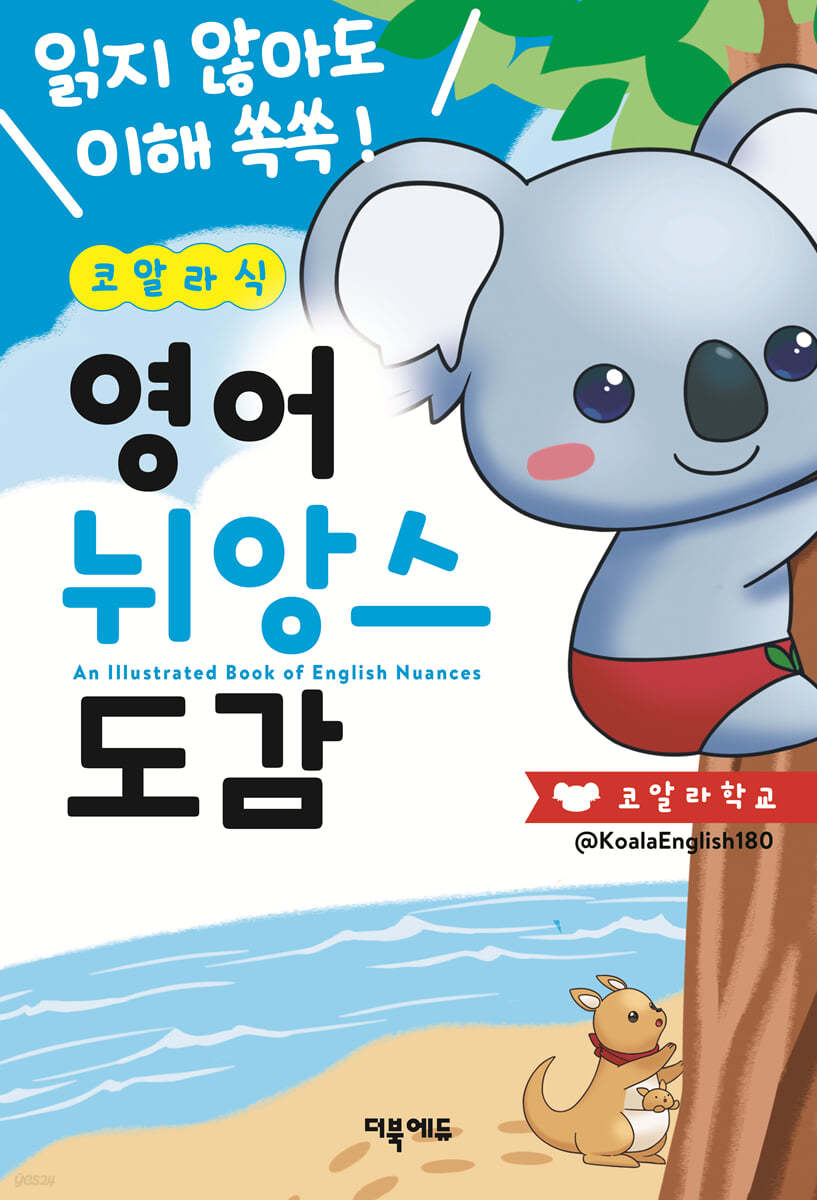
Koala-style English Nuances Guide
 |
Description
Book Introduction
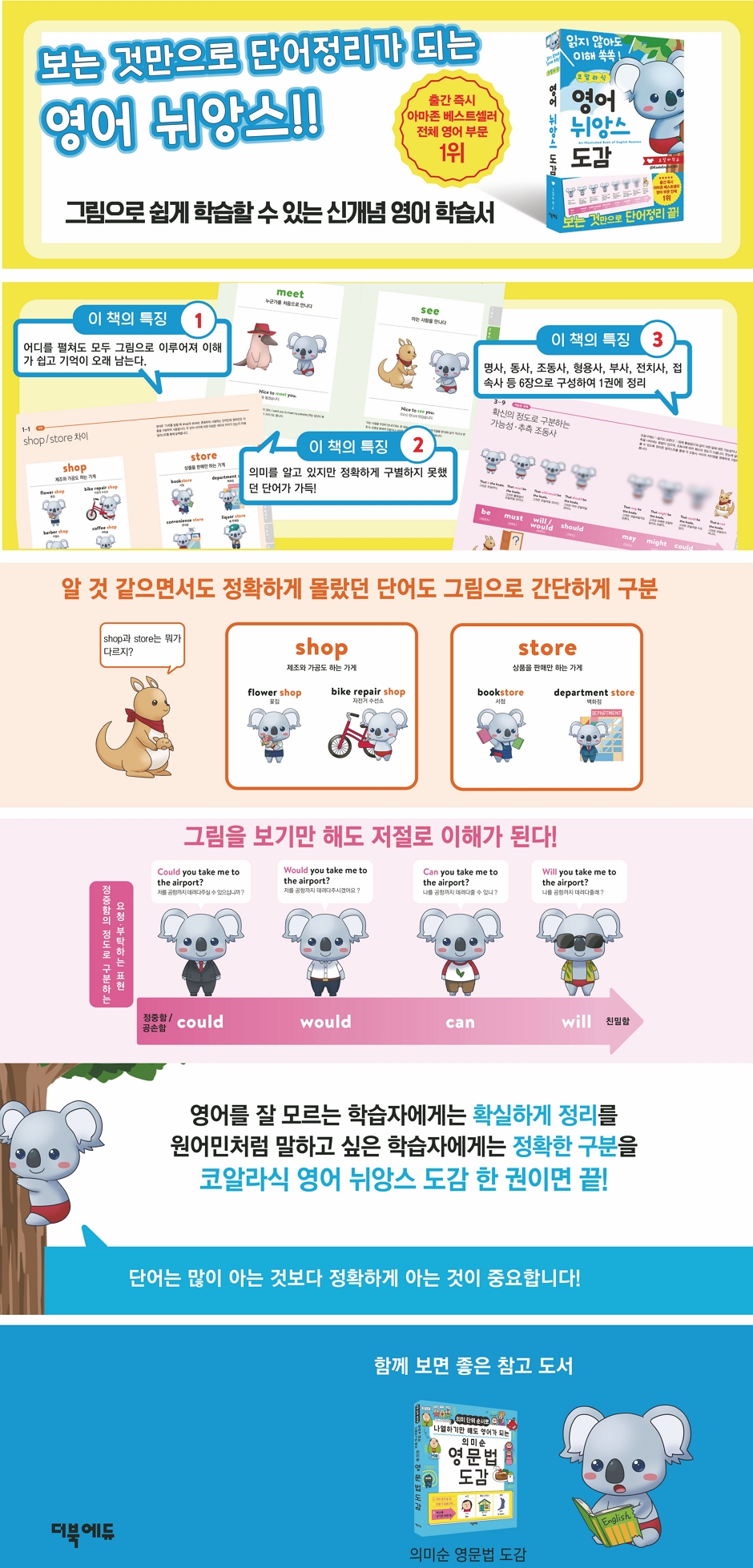
Understand without reading! Organize vocabulary just by looking at it! Just as there are many words in Korean that have the same meaning but different situations or feelings, there are many such words in English as well. For example, both 'believe' and 'trust' are interpreted as 'believe', but it is better to pay attention to what is believed, as 'believe' means to believe (the content of the story), and 'trust' means to believe (the person himself). 'Will' and 'be going to' express the future, but 'will' is used to express a judgment made spontaneously by the speaker. In the case of I'll study English, it means that you suddenly decide on the spot that you will study English. Be going to is an expression that is appropriate to use when you have been mentally prepared for something and have the will to put it into action. In the case of "I'm going to study abroad in Australia," I feel like I've been preparing to study abroad for a long time. Just by looking at the pictures and how the words can be used differently to convey different feelings or expressions, you can organize your vocabulary in one go. |
- You can preview some of the book's contents.
Preview
index
Preface 2
Features of this book 12
Chapter 1 Nouns
1-1 Difference between shop and store 16
1-2 Difference between house/home 18
1-3 Difference between present and gift 20
1-4 〈Game〉 game/match difference 22
1-5 Difference between reservation and appointment 24
1-6 Nouns Denoting Guests26
1-7 Nouns indicating fees and costs 28
Irregular plurals of nouns 1-830
1-9 Nouns that are always used in the plural form 32
1-10 Nouns with Different Meanings in Singular and Plural 34
1-11 Uncountable Nouns 36
1-12 Nouns that can also be used as verbs 38
1-13 Basic Methods of Choosing Articles 40
1-14 Nouns that can be used without an article42
Column Sentences whose meaning changes depending on the presence or absence of an article 44
Column the other/another /the others/others Difference 46
Chapter 2 Verbs
2-1 Differences between speak/say/talk/tell 50
2-2 Difference between hear/listen 52
2-3 Difference between meet/see 54
2-4 〈Go〉 go/come difference 56
2-5 Difference between study/learn 58
2-6 Difference between look/appear/seem 60
2-7 Difference between wear/put on 62
2-8 〈Believe〉 Difference between believe/trust 64
2-9 Difference between push and press 66
2-10 Difference between check and confirm 68
2-11 Difference between select/choose/pick 70
2-12 Difference between look/watch/see 72
2-13 Difference between notice/realize/recognize 74
2-14 Difference between teach/tell/show 76
2-15 Difference between collect/gather/assemble 78
2-16 Difference between take/bring/fetch 80
2-17 Difference between sleep/go to bed/fall asleep 82
2-18 〈Getting up/Sleeping〉 Actions of getting up and sleeping that can be understood through the flow 84
2-19 Differences between make/build/create/produce 86
2-20 〈do/make〉 Idiomatic Expressions 88
2-21 〈make/have/let/get〉 Difference 90
2-22 Difference between lend/rent/borrow 92
2-23 Expressions for 'thinking' that distinguish between different degrees of certainty 94
2-24 Expressions for 'liking' that distinguish between the degree of one's feelings 96
Column 98 English Verbs That Are Wrong When Translated Directly into Korean
Column 6 English Expressions Koreans Often Get Wrong 99
Chapter 3 Auxiliary Verbs
3-1 The meaning and usage of will102
The meaning and usage of would 103
The meaning and usage of 3-2 can104
The meaning and usage of could 105
3-3 Meaning and Usage of May 106
The meaning and usage of might107
The meaning and usage of 3-4 must108
The meaning and usage of should109
3-5 Meaning and Usage of Shall 110
List of Meanings of Auxiliary Verbs 111
3-6 〈~can do〉 can/be able to Difference 112
3-7 〈~will/be going to〉 Difference 114
3-8 Difference between must/have to 116
3-9 Possibility and guess auxiliary verbs that distinguish between degrees of certainty 118
3-10 Obligatory expressions that distinguish between degrees of compulsion 120
3-11 Expressions of request and request that distinguish between different degrees of politeness122
3-12 Expressions for asking permission to distinguish between different degrees of politeness124
Column Polite Speech Using Auxiliary Verbs 126
Column 127 Expressions for "I want to do ~" that differentiate between formal and formal levels
Chapter 4 Adjectives
4-1 Adjectives expressing degree of quantity and quantity 130
4-2 Adjectives expressing 'fast' 132
4-3 Adjectives Denoting Cold and Heat 134
4-4 Adjectives expressing 'good' and 'bad' 136
4-5 Adjectives Describing Taste 138
4-6 Adjectives Expressing 'Cute' and 'Pretty' 140
4-7 Adjectives with Opposite Meanings142
4-8 Adjectives with Stronger Meanings144
4-9 Big/Large Difference 146
4-10 Difference between small/little/tiny 148
4-11 Difference between happy and glad (150)
4-12 Wide/Broad Difference 152
4-13 Right/Correct Difference 154
4-14 Difference between difficult and hard 156
4-15 Quiet/silent Difference 158
4-16 〈sick〉 sick/ill difference 160
4-17 Difference between all/every/each 162
4-18 Difference between all/whole/entire 164
Column 166: Order of listing multiple adjectives
Column 168 Adjectives Koreans Often Get Wrong
Chapter 5 Adverbs
5-1 Adverbs of Frequency 172
5-2 Adverbs expressing the degree of certainty174
5-3 Adverbs of Urgency 176
Adverbs indicating about 5-4 178
Adverbs indicating distance 5-5180
5-6 Adverbs indicating order182
5-7 〈also〉 also/too/as well Difference 184
5-8 〈very, very〉 so/very/such difference 186
5-9 〈approximately〉 around/about/approximately difference 188
5-10 〈Recently〉 recently/lately/nowadays Difference 190
5-11 sometime/sometime/sometimes difference192
5-12 both/either/neither difference 194
English sentences with different meanings depending on column position196
Column 197 Korean Expressions That Foreigners Find Difficult
Chapter 6 Prepositions and Conjunctions
6-1 Preposition Image ① 200
6-2 Preposition Image ② 202
6-3 Preposition Image ③ 204
6-4 Differences between at/on/in indicating time and place 206
6-5 On/In Difference 208 Distinguished by Vehicle
6-6 Difference between to/for 〈~에, ~으로〉 210
6-7 Difference between by/with 212
6-8 〈~까지〉 by/until difference 214
6-9 Difference between/among 216
6-10 During/While Difference 218
6-11 Difference between in time and on time 220
6-12 Difference between in front of/in the front of 222
6-13 Difference between "as far as" and "as long as" 224
6-14 〈At the end〉/In the end difference 226
6-15 Difference between "to me" and "for me": 228
6-16 〈Raw Materials/Materials〉 Difference between be made of/be made into/be made from 230
6-17 Conjunctions indicating cause and reason 232
6-18 Conjunctions indicating inverse connection 234
Column 236 English Expressions You Can Use in Directions Situations
Useful expressions to know
Unit expressions that can be understood at a glance 240
Counting Methods 241
Learning to Count with Prefixes 242
Expression 243 indicating 'X hours Y minutes before/after'
244 Words Expressing Various Emotions and States
246 words indicating family and relatives
247 English abbreviations commonly used among friends
248 English Etymologies to Remember
Index 250
Features of this book 12
Chapter 1 Nouns
1-1 Difference between shop and store 16
1-2 Difference between house/home 18
1-3 Difference between present and gift 20
1-4 〈Game〉 game/match difference 22
1-5 Difference between reservation and appointment 24
1-6 Nouns Denoting Guests26
1-7 Nouns indicating fees and costs 28
Irregular plurals of nouns 1-830
1-9 Nouns that are always used in the plural form 32
1-10 Nouns with Different Meanings in Singular and Plural 34
1-11 Uncountable Nouns 36
1-12 Nouns that can also be used as verbs 38
1-13 Basic Methods of Choosing Articles 40
1-14 Nouns that can be used without an article42
Column Sentences whose meaning changes depending on the presence or absence of an article 44
Column the other/another /the others/others Difference 46
Chapter 2 Verbs
2-1 Differences between speak/say/talk/tell 50
2-2 Difference between hear/listen 52
2-3 Difference between meet/see 54
2-4 〈Go〉 go/come difference 56
2-5 Difference between study/learn 58
2-6 Difference between look/appear/seem 60
2-7 Difference between wear/put on 62
2-8 〈Believe〉 Difference between believe/trust 64
2-9 Difference between push and press 66
2-10 Difference between check and confirm 68
2-11 Difference between select/choose/pick 70
2-12 Difference between look/watch/see 72
2-13 Difference between notice/realize/recognize 74
2-14 Difference between teach/tell/show 76
2-15 Difference between collect/gather/assemble 78
2-16 Difference between take/bring/fetch 80
2-17 Difference between sleep/go to bed/fall asleep 82
2-18 〈Getting up/Sleeping〉 Actions of getting up and sleeping that can be understood through the flow 84
2-19 Differences between make/build/create/produce 86
2-20 〈do/make〉 Idiomatic Expressions 88
2-21 〈make/have/let/get〉 Difference 90
2-22 Difference between lend/rent/borrow 92
2-23 Expressions for 'thinking' that distinguish between different degrees of certainty 94
2-24 Expressions for 'liking' that distinguish between the degree of one's feelings 96
Column 98 English Verbs That Are Wrong When Translated Directly into Korean
Column 6 English Expressions Koreans Often Get Wrong 99
Chapter 3 Auxiliary Verbs
3-1 The meaning and usage of will102
The meaning and usage of would 103
The meaning and usage of 3-2 can104
The meaning and usage of could 105
3-3 Meaning and Usage of May 106
The meaning and usage of might107
The meaning and usage of 3-4 must108
The meaning and usage of should109
3-5 Meaning and Usage of Shall 110
List of Meanings of Auxiliary Verbs 111
3-6 〈~can do〉 can/be able to Difference 112
3-7 〈~will/be going to〉 Difference 114
3-8 Difference between must/have to 116
3-9 Possibility and guess auxiliary verbs that distinguish between degrees of certainty 118
3-10 Obligatory expressions that distinguish between degrees of compulsion 120
3-11 Expressions of request and request that distinguish between different degrees of politeness122
3-12 Expressions for asking permission to distinguish between different degrees of politeness124
Column Polite Speech Using Auxiliary Verbs 126
Column 127 Expressions for "I want to do ~" that differentiate between formal and formal levels
Chapter 4 Adjectives
4-1 Adjectives expressing degree of quantity and quantity 130
4-2 Adjectives expressing 'fast' 132
4-3 Adjectives Denoting Cold and Heat 134
4-4 Adjectives expressing 'good' and 'bad' 136
4-5 Adjectives Describing Taste 138
4-6 Adjectives Expressing 'Cute' and 'Pretty' 140
4-7 Adjectives with Opposite Meanings142
4-8 Adjectives with Stronger Meanings144
4-9 Big/Large Difference 146
4-10 Difference between small/little/tiny 148
4-11 Difference between happy and glad (150)
4-12 Wide/Broad Difference 152
4-13 Right/Correct Difference 154
4-14 Difference between difficult and hard 156
4-15 Quiet/silent Difference 158
4-16 〈sick〉 sick/ill difference 160
4-17 Difference between all/every/each 162
4-18 Difference between all/whole/entire 164
Column 166: Order of listing multiple adjectives
Column 168 Adjectives Koreans Often Get Wrong
Chapter 5 Adverbs
5-1 Adverbs of Frequency 172
5-2 Adverbs expressing the degree of certainty174
5-3 Adverbs of Urgency 176
Adverbs indicating about 5-4 178
Adverbs indicating distance 5-5180
5-6 Adverbs indicating order182
5-7 〈also〉 also/too/as well Difference 184
5-8 〈very, very〉 so/very/such difference 186
5-9 〈approximately〉 around/about/approximately difference 188
5-10 〈Recently〉 recently/lately/nowadays Difference 190
5-11 sometime/sometime/sometimes difference192
5-12 both/either/neither difference 194
English sentences with different meanings depending on column position196
Column 197 Korean Expressions That Foreigners Find Difficult
Chapter 6 Prepositions and Conjunctions
6-1 Preposition Image ① 200
6-2 Preposition Image ② 202
6-3 Preposition Image ③ 204
6-4 Differences between at/on/in indicating time and place 206
6-5 On/In Difference 208 Distinguished by Vehicle
6-6 Difference between to/for 〈~에, ~으로〉 210
6-7 Difference between by/with 212
6-8 〈~까지〉 by/until difference 214
6-9 Difference between/among 216
6-10 During/While Difference 218
6-11 Difference between in time and on time 220
6-12 Difference between in front of/in the front of 222
6-13 Difference between "as far as" and "as long as" 224
6-14 〈At the end〉/In the end difference 226
6-15 Difference between "to me" and "for me": 228
6-16 〈Raw Materials/Materials〉 Difference between be made of/be made into/be made from 230
6-17 Conjunctions indicating cause and reason 232
6-18 Conjunctions indicating inverse connection 234
Column 236 English Expressions You Can Use in Directions Situations
Useful expressions to know
Unit expressions that can be understood at a glance 240
Counting Methods 241
Learning to Count with Prefixes 242
Expression 243 indicating 'X hours Y minutes before/after'
244 Words Expressing Various Emotions and States
246 words indicating family and relatives
247 English abbreviations commonly used among friends
248 English Etymologies to Remember
Index 250
Detailed image
GOODS SPECIFICS
- Date of issue: February 28, 2023
- Page count, weight, size: 256 pages | 390g | 128*188*18mm
- ISBN13: 9791197618543
- ISBN10: 1197618546
You may also like
카테고리
korean


korean

![GQ KOREA Mark (Monthly): December [2025]](http://librairie.coreenne.fr/cdn/shop/files/8ef265dbbfbf186523ed75ba7319009d.jpg?v=1765340328&width=3840)


