

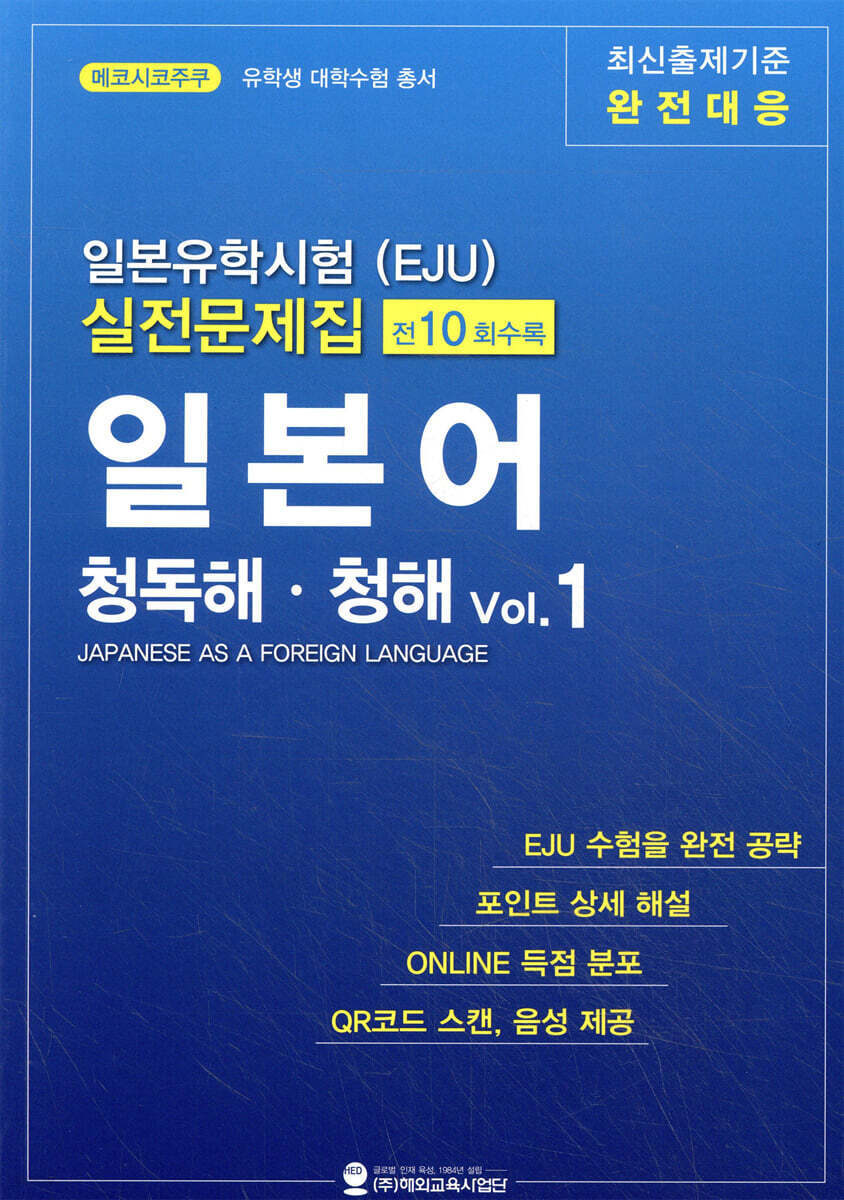
Japanese Language Reading and Listening Comprehension Vol. 1: Examination for Japanese University Admission for International Students (EJU) Practice Questions
 |
Description
Book Introduction
It was written based on the content of past Japanese study abroad exams, and each subject is composed of content very similar to past questions.
We are also keeping a close eye on trends in the difficulty level and scope of the exams, and are adapting to trends that change slightly each year.
Additionally, the commentary clearly states the main points of the problem, making it easy to identify areas where you feel you lack knowledge or are likely to make mistakes.
In order to improve your listening skills, which are necessary for listening comprehension, it is recommended to regularly watch Japanese news or educational broadcasts at a certain quality and quantity.
Additionally, it is effective to read introductory books for each academic field to become familiar with academic terminology and explanations.
We are also keeping a close eye on trends in the difficulty level and scope of the exams, and are adapting to trends that change slightly each year.
Additionally, the commentary clearly states the main points of the problem, making it easy to identify areas where you feel you lack knowledge or are likely to make mistakes.
In order to improve your listening skills, which are necessary for listening comprehension, it is recommended to regularly watch Japanese news or educational broadcasts at a certain quality and quantity.
Additionally, it is effective to read introductory books for each academic field to become familiar with academic terminology and explanations.
index
003 Preface
004 About this book
006 Check the score distribution
009 1st Practice Problem
025 2nd Practice Problem
041 Third Practice Problem
057 4th Practice Problem
073 5th Practice Problem
089 6th Practice Problem
105 7th Practice Problem
121 8th Practice Problem
137 9th Practice Problem
153 10th Practice Problem
169 scripts
286 Answer Sheet
287 Answer
004 About this book
006 Check the score distribution
009 1st Practice Problem
025 2nd Practice Problem
041 Third Practice Problem
057 4th Practice Problem
073 5th Practice Problem
089 6th Practice Problem
105 7th Practice Problem
121 8th Practice Problem
137 9th Practice Problem
153 10th Practice Problem
169 scripts
286 Answer Sheet
287 Answer
Publisher's Review
This book was written based on the content of past Japanese study abroad exams, and each subject is composed of content very similar to past questions.
We are also keeping a close eye on trends in the difficulty level and scope of the exams, and are adapting to the trends that change slightly each year.
Additionally, the commentary clearly outlines the key points of the problem, making it easy to identify areas where you feel you lack knowledge or are prone to making mistakes.
When studying, get used to the mark sheet format and try to solve the problems you got wrong repeatedly.
Rather than simply memorizing, it is recommended to refer to the explanation and understand the meaning of the answer by asking yourself, “Why is this the answer?”
I sincerely hope that all of you who have read this book will achieve high scores on the actual exam and realize your dream of entering the university of your choice.
〈Features and Uses of This Book〉
Students who have acquired this book will likely be aiming to enter a top-tier university in Japan and will be taking the Examination for Japanese University Admission for International Students as their first step.
How can I get a high score on the exam? What should I study? This "Practice Problem Book" provides the answers.
This book contains 10 sets of practice questions and answers, written based on trends in the Japanese University Admission Test.
It's okay to solve them little by little, but if possible, it's better to solve them as if they were an actual exam and to experience listening to them continuously without stopping.
To get a high score on the actual test, it is absolutely necessary to listen to the voice with a high level of concentration.
A moment of laxity can lead to a loss.
And, once you've solved everything, it's important to self-score to recognize the difference between your current level and your actual test level.
Additionally, you can compare your scores with other test takers on the webpage accessible via QR code, so please use it to check your own learning progress.
Below is an analysis of the Japanese Study Abroad Examination's "Listening and Reading" and "Listening Comprehension" sections, along with study advice for each.
I hope that you will become immersed in the practice problems and have the mindset to study for the exam.
Japanese Study Abroad Examination "Listening and Reading" and "Listening"
【Question】
1.
Do you accurately understand the content of lectures, presentations, and counseling on learning and life?
2.
Do you understand what you hear and make it concrete or abstract?
3.
Can you understand what you heard and guess what happens next based on that understanding?
※Since listening comprehension involves visual information such as diagrams and text, as well as audio, it is necessary to think about the relationship between these two.
For this, only the voice is given.
【Sentences to be tested】
Lectures, lectures, exercises, study, and student life counseling, etc., things you will hear when you enter university.
And there are two types of speaking: solo speaking and conversational speaking.
The specific contents of the lecture, etc. are as follows.
Humanities: psychology, education, culture, etc.
Social Sciences: Marketing theories, consumer behavior and corporate management, local autonomy, safety in daily life, etc.
Natural science: science and technology, ecology of animals and plants, experiments, etc.
And "interdisciplinary" topics, which are in the middle of these fields, are also frequently asked.
For example, the story about AI is a story about the advancement of science and technology, and it is also related to the story of social transformation and human life.
Advice
Read carefully
In listening comprehension, the content you hear is louder than in listening comprehension, and the content is also more advanced. You can understand it by comparing or contrasting it with visual information such as diagrams and text.
Since the questionnaire also provides four choices as visual information in advance, you can take notes while listening to the audio or mark an X on things that you think are different in advance, and if you move your hand immediately, you will be less hesitant about answering when you hear the entire audio.
Unlike listening comprehension, there are many problems in listening comprehension that use the method of elimination to find the answer.
However, for test takers who are not accustomed to reading comprehension, it is very difficult to find the correct answer by using both visual and auditory senses.
To increase your score in reading comprehension, the amount of practice is absolutely essential.
The listening and reading section of the Japanese University Admission Test is a somewhat special area, so it is necessary to practice it consciously and repeatedly.
To do so, please be sure to use this book.
Cheonghae
Cheonghae does not provide any text information.
High concentration is required because even the slightest distraction can cause you to miss what you're hearing and lose track of the content.
When the sound starts, you need to first make sure you understand the fire and the survey.
The survey is designed so that it is difficult to derive answers without listening to the entire text.
So, you have to listen carefully to the whole thing, but especially when you hear phrases like “It’s a big deal,” “It’s important,” “It’s not that bad,” “It’s not that bad,” “It’s all over,” “It’s all over,” you have to keep in mind that they are very closely related to the correct answer.
Just listening can cause your memory to become blurred, so it is a good idea to use methods such as taking notes, just like listening.
Finally, let me add some things to keep in mind.
In order to improve your listening skills, which are necessary for listening comprehension, it is recommended that you watch a certain amount of Japanese news or educational broadcasts on a regular basis.
Additionally, it is effective to read introductory books for each academic field to become familiar with academic terminology and explanations.
We are also keeping a close eye on trends in the difficulty level and scope of the exams, and are adapting to the trends that change slightly each year.
Additionally, the commentary clearly outlines the key points of the problem, making it easy to identify areas where you feel you lack knowledge or are prone to making mistakes.
When studying, get used to the mark sheet format and try to solve the problems you got wrong repeatedly.
Rather than simply memorizing, it is recommended to refer to the explanation and understand the meaning of the answer by asking yourself, “Why is this the answer?”
I sincerely hope that all of you who have read this book will achieve high scores on the actual exam and realize your dream of entering the university of your choice.
〈Features and Uses of This Book〉
Students who have acquired this book will likely be aiming to enter a top-tier university in Japan and will be taking the Examination for Japanese University Admission for International Students as their first step.
How can I get a high score on the exam? What should I study? This "Practice Problem Book" provides the answers.
This book contains 10 sets of practice questions and answers, written based on trends in the Japanese University Admission Test.
It's okay to solve them little by little, but if possible, it's better to solve them as if they were an actual exam and to experience listening to them continuously without stopping.
To get a high score on the actual test, it is absolutely necessary to listen to the voice with a high level of concentration.
A moment of laxity can lead to a loss.
And, once you've solved everything, it's important to self-score to recognize the difference between your current level and your actual test level.
Additionally, you can compare your scores with other test takers on the webpage accessible via QR code, so please use it to check your own learning progress.
Below is an analysis of the Japanese Study Abroad Examination's "Listening and Reading" and "Listening Comprehension" sections, along with study advice for each.
I hope that you will become immersed in the practice problems and have the mindset to study for the exam.
Japanese Study Abroad Examination "Listening and Reading" and "Listening"
【Question】
1.
Do you accurately understand the content of lectures, presentations, and counseling on learning and life?
2.
Do you understand what you hear and make it concrete or abstract?
3.
Can you understand what you heard and guess what happens next based on that understanding?
※Since listening comprehension involves visual information such as diagrams and text, as well as audio, it is necessary to think about the relationship between these two.
For this, only the voice is given.
【Sentences to be tested】
Lectures, lectures, exercises, study, and student life counseling, etc., things you will hear when you enter university.
And there are two types of speaking: solo speaking and conversational speaking.
The specific contents of the lecture, etc. are as follows.
Humanities: psychology, education, culture, etc.
Social Sciences: Marketing theories, consumer behavior and corporate management, local autonomy, safety in daily life, etc.
Natural science: science and technology, ecology of animals and plants, experiments, etc.
And "interdisciplinary" topics, which are in the middle of these fields, are also frequently asked.
For example, the story about AI is a story about the advancement of science and technology, and it is also related to the story of social transformation and human life.
Advice
Read carefully
In listening comprehension, the content you hear is louder than in listening comprehension, and the content is also more advanced. You can understand it by comparing or contrasting it with visual information such as diagrams and text.
Since the questionnaire also provides four choices as visual information in advance, you can take notes while listening to the audio or mark an X on things that you think are different in advance, and if you move your hand immediately, you will be less hesitant about answering when you hear the entire audio.
Unlike listening comprehension, there are many problems in listening comprehension that use the method of elimination to find the answer.
However, for test takers who are not accustomed to reading comprehension, it is very difficult to find the correct answer by using both visual and auditory senses.
To increase your score in reading comprehension, the amount of practice is absolutely essential.
The listening and reading section of the Japanese University Admission Test is a somewhat special area, so it is necessary to practice it consciously and repeatedly.
To do so, please be sure to use this book.
Cheonghae
Cheonghae does not provide any text information.
High concentration is required because even the slightest distraction can cause you to miss what you're hearing and lose track of the content.
When the sound starts, you need to first make sure you understand the fire and the survey.
The survey is designed so that it is difficult to derive answers without listening to the entire text.
So, you have to listen carefully to the whole thing, but especially when you hear phrases like “It’s a big deal,” “It’s important,” “It’s not that bad,” “It’s not that bad,” “It’s all over,” “It’s all over,” you have to keep in mind that they are very closely related to the correct answer.
Just listening can cause your memory to become blurred, so it is a good idea to use methods such as taking notes, just like listening.
Finally, let me add some things to keep in mind.
In order to improve your listening skills, which are necessary for listening comprehension, it is recommended that you watch a certain amount of Japanese news or educational broadcasts on a regular basis.
Additionally, it is effective to read introductory books for each academic field to become familiar with academic terminology and explanations.
GOODS SPECIFICS
- Publication date: November 20, 2019
- Page count, weight, size: 296 pages | 185*257*20mm
- ISBN13: 9791185979366
- ISBN10: 1185979360
You may also like
카테고리
korean


korean

![GQ KOREA Mark (Monthly): December [2025]](http://librairie.coreenne.fr/cdn/shop/files/8ef265dbbfbf186523ed75ba7319009d.jpg?v=1765340328&width=3840)


