

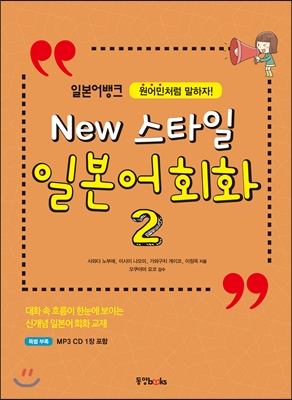
New Style Japanese Conversation 2
 |
Description
Book Introduction
This is how Japanese people write! The flow of conversation is shown, making it easy to understand. The step-by-step learning allows you to practice free conversation step by step, and the review checklist allows you to check your skills.
- You can preview some of the book's contents.
Preview
index
preface
Structure of this book
index
Learning Structure Table
Character introduction
UNIT 01 What is it? Can I borrow it?
UNIT 02 今(いま)、ちょっといい? Do you have time now?
UNIT 03 It is a girl with big eyes.
UNIT 04 Which one is better?
UNIT 05 見(み)ていただけませんか. Would you like to take a look?
UNIT 06 ちょっと?(おし)えてもらえる? Won't you tell me a little bit?
UNIT 01-06 Review check sheet
UNIT 07 It's nice weather today too.
UNIT 08 まず曲(きょく)を決(き)めよう。 First, let's decide on a song.
UNIT 09 Where is it?
UNIT 10 I don't think I can go to class.
UNIT 11 What is it? Why don’t you go watch baseball?
UNIT 12 Korean?
UNIT 07-12 Review check sheet
supplement
Drill answer example
Abbreviations frequently used in conversation
How do you say this in Japanese?
Situation setting cards for roleplay missions
Structure of this book
index
Learning Structure Table
Character introduction
UNIT 01 What is it? Can I borrow it?
UNIT 02 今(いま)、ちょっといい? Do you have time now?
UNIT 03 It is a girl with big eyes.
UNIT 04 Which one is better?
UNIT 05 見(み)ていただけませんか. Would you like to take a look?
UNIT 06 ちょっと?(おし)えてもらえる? Won't you tell me a little bit?
UNIT 01-06 Review check sheet
UNIT 07 It's nice weather today too.
UNIT 08 まず曲(きょく)を決(き)めよう。 First, let's decide on a song.
UNIT 09 Where is it?
UNIT 10 I don't think I can go to class.
UNIT 11 What is it? Why don’t you go watch baseball?
UNIT 12 Korean?
UNIT 07-12 Review check sheet
supplement
Drill answer example
Abbreviations frequently used in conversation
How do you say this in Japanese?
Situation setting cards for roleplay missions
Publisher's Review
① Let's think about it: Recall your own experiences and arouse interest in the topic by talking to each other about questions related to the topic.
② Conversation 1, 2: Model conversations on the topic.
To avoid burdening learning, each lesson's conversations are organized into 8 to 12 turns.
③ Quick review!: We've compiled some hints to help you review your beginner studies.
④ Check expression and sentence patterns: Expressions and sentence patterns necessary for conversation are provided with examples.
⑤ Pay attention here!: We have organized language forms that will be helpful for conversation if you know them.
⑥ Drill: These are practice problems to learn and confirm the expressions and sentence patterns of learning items required for communication.
⑦ Flowchart: By visualizing the flow of conversation in a flowchart, you can have a conversation while being conscious of the content and order of what you say.
⑧ Role Play: Use the expressions learned in each lesson to practice conversation in stages through situations similar to real-life communication (Mission 1, 2, 3) by changing roles.
Depending on the subject, related vocabulary and expressions are provided.
⑨ Lots of Japanese Plus: Information about Japanese culture and language related to science is introduced in Korean.
⑩ Review Check Sheet: A check sheet has been prepared for each of the 6 lessons so that you can review or self-evaluate.
The checklist is designed to be reviewed at least twice to allow for practice before the midterm and final exams.
⑪ Appendix: Includes ‘Examples of correct answers for drills’, ‘Situation setting cards’ used in roleplay, etc.
▶ Lecture materials can be downloaded from the ‘MP3 & Data Room’ on the Dongyang Books website (www.dongyangbooks.com).
▶ 1 MP3 CD with voice recording
② Conversation 1, 2: Model conversations on the topic.
To avoid burdening learning, each lesson's conversations are organized into 8 to 12 turns.
③ Quick review!: We've compiled some hints to help you review your beginner studies.
④ Check expression and sentence patterns: Expressions and sentence patterns necessary for conversation are provided with examples.
⑤ Pay attention here!: We have organized language forms that will be helpful for conversation if you know them.
⑥ Drill: These are practice problems to learn and confirm the expressions and sentence patterns of learning items required for communication.
⑦ Flowchart: By visualizing the flow of conversation in a flowchart, you can have a conversation while being conscious of the content and order of what you say.
⑧ Role Play: Use the expressions learned in each lesson to practice conversation in stages through situations similar to real-life communication (Mission 1, 2, 3) by changing roles.
Depending on the subject, related vocabulary and expressions are provided.
⑨ Lots of Japanese Plus: Information about Japanese culture and language related to science is introduced in Korean.
⑩ Review Check Sheet: A check sheet has been prepared for each of the 6 lessons so that you can review or self-evaluate.
The checklist is designed to be reviewed at least twice to allow for practice before the midterm and final exams.
⑪ Appendix: Includes ‘Examples of correct answers for drills’, ‘Situation setting cards’ used in roleplay, etc.
▶ Lecture materials can be downloaded from the ‘MP3 & Data Room’ on the Dongyang Books website (www.dongyangbooks.com).
▶ 1 MP3 CD with voice recording
GOODS SPECIFICS
- Date of issue: November 15, 2015
- Page count, weight, size: 208 pages | 495g | 188*257*20mm
- ISBN13: 9791157031573
- ISBN10: 1157031579
You may also like
카테고리
korean


korean

![GQ KOREA Mark (Monthly): December [2025]](http://librairie.coreenne.fr/cdn/shop/files/8ef265dbbfbf186523ed75ba7319009d.jpg?v=1765340328&width=3840)


