

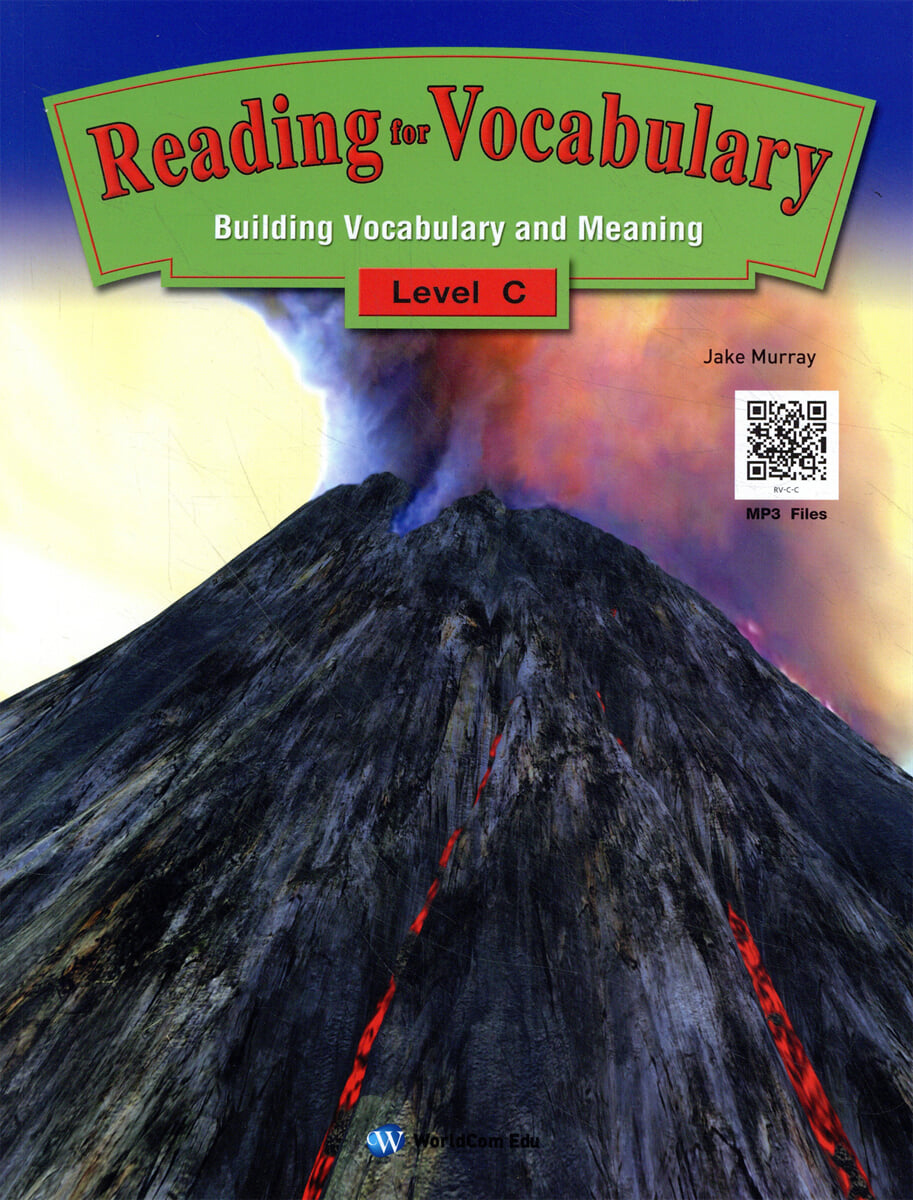
Reading for Vocabulary Level C
 |
Description
Book Introduction
The Reading for Vocabulary series is a reading textbook for upper elementary and lower middle school students who have completed the basic English learning process.
We have designed this course to meet the needs of students who want to advance beyond the basic level by using textbook-level texts currently used in the American curriculum.
The texts are composed of interesting topics from various fields to stimulate students' interest and to help them naturally understand the meaning and usage of vocabulary while reading the texts.
In each lesson, you can check your understanding of vocabulary and the entire text through various types of problem-solving.
We have designed this course to meet the needs of students who want to advance beyond the basic level by using textbook-level texts currently used in the American curriculum.
The texts are composed of interesting topics from various fields to stimulate students' interest and to help them naturally understand the meaning and usage of vocabulary while reading the texts.
In each lesson, you can check your understanding of vocabulary and the entire text through various types of problem-solving.
index
Unit 1 Amazing Animals
Lesson 1 In a Land before Time (Science)
Lesson 2 Smart as a Chimp (Social Studies)
Lesson 3 What's after Seven? (Math)
Review
Unit 2 Dynamic Earth
Lesson 4 Fire under the Earth (Science)
Lesson 5 Never a Warm Day (Social Studies)
Lesson 6 Fossil Fuels (Health)
Review
Unit 3 Sound
Lesson 7 Do You Hear That? (Science)
Lesson 8 Too Cool (Social Studies)
Lesson 9 Bravo! Encore! (Fine Arts)
Review
Unit 4 Robots
Lesson 10 Worker of the Year (Science)
Lesson 11 Early Robots (Social Studies)
Lesson 12 Robot Actors (Entertainment)
Review
Unit 5 Imaginary Characters
Lesson 13 Computer Movies (Science)
Lesson 14 Mighty Paul Bunyan (Social Studies)
Lesson 15 Along Came a Mouse (Entertainment)
Review
Lesson 1 In a Land before Time (Science)
Lesson 2 Smart as a Chimp (Social Studies)
Lesson 3 What's after Seven? (Math)
Review
Unit 2 Dynamic Earth
Lesson 4 Fire under the Earth (Science)
Lesson 5 Never a Warm Day (Social Studies)
Lesson 6 Fossil Fuels (Health)
Review
Unit 3 Sound
Lesson 7 Do You Hear That? (Science)
Lesson 8 Too Cool (Social Studies)
Lesson 9 Bravo! Encore! (Fine Arts)
Review
Unit 4 Robots
Lesson 10 Worker of the Year (Science)
Lesson 11 Early Robots (Social Studies)
Lesson 12 Robot Actors (Entertainment)
Review
Unit 5 Imaginary Characters
Lesson 13 Computer Movies (Science)
Lesson 14 Mighty Paul Bunyan (Social Studies)
Lesson 15 Along Came a Mouse (Entertainment)
Review
Publisher's Review
characteristic
1.
Fun and informative texts make class time more enjoyable.
It includes interesting English texts on a variety of topics, including science, humanities, society, and art, so that you can acquire a wide range of information and knowledge while learning English.
2.
Let's approach one topic from multiple perspectives.
For each topic, 2-3 area-specific texts are provided according to level, allowing students to think three-dimensionally about a topic.
For example, by studying the topic of 'Human Body', three different texts are provided: 'The Mystery of Bones (Science),' 'The World's Tallest Man (Social Studies),' and 'Maintaining Health (Health),' enabling students to develop a variety of understandings and interests about the topic.
3.
English vocabulary is understood naturally
By reading English texts and naturally understanding the meaning of vocabulary, we aim to enable students to understand the meaning of the entire context, rather than simply memorizing the meaning of vocabulary.
4.
Make sure to internalize what you've learned.
By solving exercise problems in various forms, such as fill-in-the-blank and crossword puzzles, over three pages, you can solidify the vocabulary you have learned.
Additionally, comprehension problems were used to check the level of understanding of the content of the text learned.
Fun and informative texts make class time more enjoyable.
It includes interesting English texts on a variety of topics, including science, humanities, society, and art, so that you can acquire a wide range of information and knowledge while learning English.
2.
Let's approach one topic from multiple perspectives.
For each topic, 2-3 area-specific texts are provided according to level, allowing students to think three-dimensionally about a topic.
For example, by studying the topic of 'Human Body', three different texts are provided: 'The Mystery of Bones (Science),' 'The World's Tallest Man (Social Studies),' and 'Maintaining Health (Health),' enabling students to develop a variety of understandings and interests about the topic.
3.
English vocabulary is understood naturally
By reading English texts and naturally understanding the meaning of vocabulary, we aim to enable students to understand the meaning of the entire context, rather than simply memorizing the meaning of vocabulary.
4.
Make sure to internalize what you've learned.
By solving exercise problems in various forms, such as fill-in-the-blank and crossword puzzles, over three pages, you can solidify the vocabulary you have learned.
Additionally, comprehension problems were used to check the level of understanding of the content of the text learned.
GOODS SPECIFICS
- Date of issue: January 5, 2010
- Page count, weight, size: 136 pages | 258g | 210*275*20mm
- ISBN13: 9788961981972
- ISBN10: 8961981978
You may also like
카테고리
korean


korean

![GQ KOREA Mark (Monthly): December [2025]](http://librairie.coreenne.fr/cdn/shop/files/8ef265dbbfbf186523ed75ba7319009d.jpg?v=1765340328&width=3840)


