

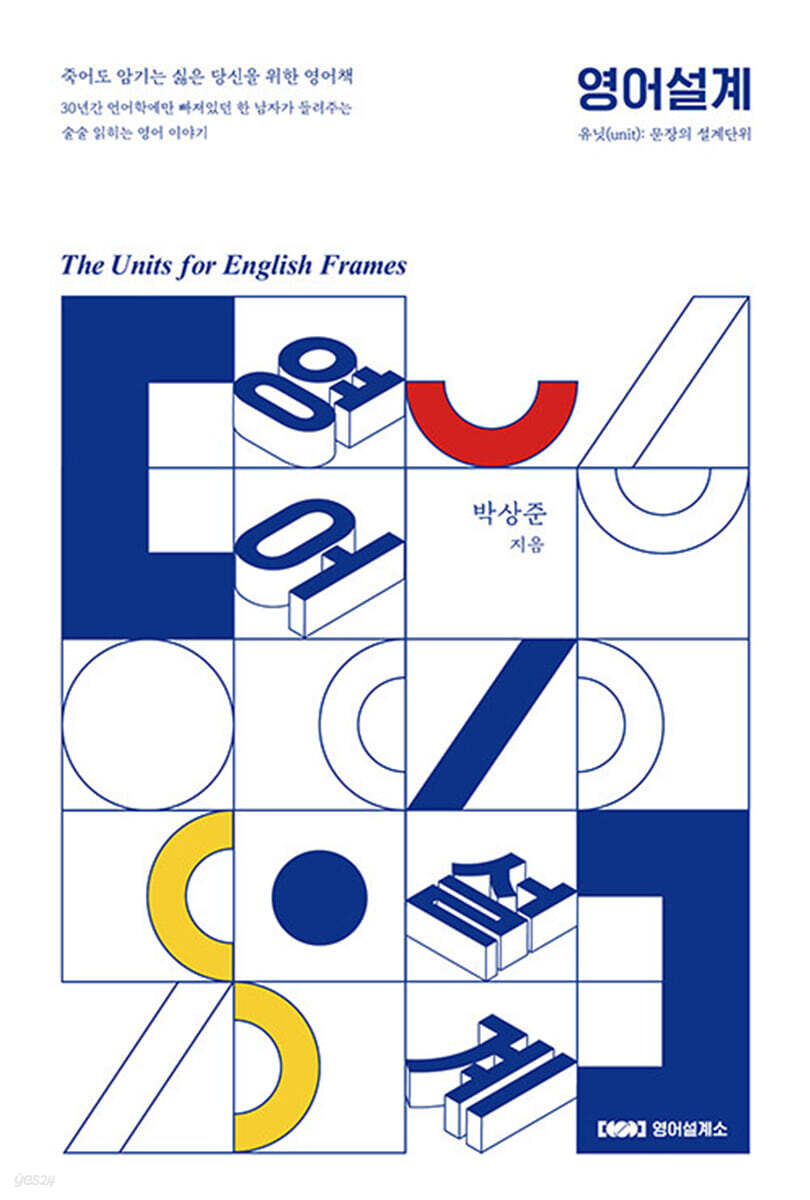
English design
 |
Description
Book Introduction
“The reason our English is not improving and remains half-baked is because of dead letters, that is, letters to unknown recipients.
“Although countless letters came in, there was no way to organize them systematically, so the data was just thrown away, and there was no information to retrieve when it was time to speak or write.” The virtue of ‘English Design: Unit’ is that although it is professional content that has been applied to the field through 30 years of research in modern linguistics, it is not difficult at all and can be read easily by the general public.
It will be a clear blueprint for English, especially for learners who have studied English for a long time but have not been able to grasp the essence of the language, and for teachers who want to break away from outdated English teaching methods.
While there have been many books criticizing English learning methods or presenting fragmentary grammar knowledge, none have comprehensively shown how the English language fundamentally originated and evolved, and why it has such a unique design structure and rhythm, making it particularly interesting and logical.
The argument of this book can be summarized in three points.
『(1) The machine called English didn't work because of poor design!』 Even though we have a huge amount of data from over 14 years of elementary, middle, high school, and college, the reason our English information doesn't accumulate is because of a flaw in the English design that makes input impossible.
Now we must break this dreadful vicious cycle of having to study grammar/reading/writing/speaking separately.
『(2) Parts of speech and the five sentence types cannot be the units of English design!』 The 18th century parts of speech grammar and the Japanese system of five sentence types that is over 100 years old do not have the foundation of phrases and clauses, so they cannot build a house called a sentence step by step, and above all, they cannot show the process of sentence expansion.
Because of this ineffectiveness, the claim that "grammar is useless" has become widespread, and our English education has fallen into the trap of overly subjective chunking and mechanical memorization of expressions.
『(3) Modern linguistics is powerful, but it is too specialized and extensive, and it needs to be integrated into a single step/system that we need!』 Modern linguistics has the explanatory power to address the weaknesses of the existing system, but it is too specialized to be applied in actual educational settings.
Moreover, more than anything, we as Koreans have the difficult task of integrating the four fields of syntax/cognitive linguistics/English diachrony (history)/corpus linguistics (frequency) as one necessary step in internalizing the completely different language called English.
The author has been obsessed with this problem for the past 30 years, and after going through a transitional period of 'interpretation theory' and 'paragraph theory', he finally found a solution called 'unit' and 'rhythm' in the history of English language development and in the field.
'Unit' is a blueprint that helps overcome the limitations of outdated part-of-speech grammar/Japanese grammar without resistance by connecting grammatical terms and concepts that were scattered like fragments.
Through the coordinates of 'location' and 'form' of primary and secondary information, we will explain why the old system was bound to be flawed and present a new, organizationally feasible foundation design.
“Although countless letters came in, there was no way to organize them systematically, so the data was just thrown away, and there was no information to retrieve when it was time to speak or write.” The virtue of ‘English Design: Unit’ is that although it is professional content that has been applied to the field through 30 years of research in modern linguistics, it is not difficult at all and can be read easily by the general public.
It will be a clear blueprint for English, especially for learners who have studied English for a long time but have not been able to grasp the essence of the language, and for teachers who want to break away from outdated English teaching methods.
While there have been many books criticizing English learning methods or presenting fragmentary grammar knowledge, none have comprehensively shown how the English language fundamentally originated and evolved, and why it has such a unique design structure and rhythm, making it particularly interesting and logical.
The argument of this book can be summarized in three points.
『(1) The machine called English didn't work because of poor design!』 Even though we have a huge amount of data from over 14 years of elementary, middle, high school, and college, the reason our English information doesn't accumulate is because of a flaw in the English design that makes input impossible.
Now we must break this dreadful vicious cycle of having to study grammar/reading/writing/speaking separately.
『(2) Parts of speech and the five sentence types cannot be the units of English design!』 The 18th century parts of speech grammar and the Japanese system of five sentence types that is over 100 years old do not have the foundation of phrases and clauses, so they cannot build a house called a sentence step by step, and above all, they cannot show the process of sentence expansion.
Because of this ineffectiveness, the claim that "grammar is useless" has become widespread, and our English education has fallen into the trap of overly subjective chunking and mechanical memorization of expressions.
『(3) Modern linguistics is powerful, but it is too specialized and extensive, and it needs to be integrated into a single step/system that we need!』 Modern linguistics has the explanatory power to address the weaknesses of the existing system, but it is too specialized to be applied in actual educational settings.
Moreover, more than anything, we as Koreans have the difficult task of integrating the four fields of syntax/cognitive linguistics/English diachrony (history)/corpus linguistics (frequency) as one necessary step in internalizing the completely different language called English.
The author has been obsessed with this problem for the past 30 years, and after going through a transitional period of 'interpretation theory' and 'paragraph theory', he finally found a solution called 'unit' and 'rhythm' in the history of English language development and in the field.
'Unit' is a blueprint that helps overcome the limitations of outdated part-of-speech grammar/Japanese grammar without resistance by connecting grammatical terms and concepts that were scattered like fragments.
Through the coordinates of 'location' and 'form' of primary and secondary information, we will explain why the old system was bound to be flawed and present a new, organizationally feasible foundation design.
- You can preview some of the book's contents.
Preview
index
Introduction
Unit 01: The Need for Organization and Design: "The English Machine Didn't Work Because of Poor Design"
[01] "Why Can't I?", The Endless Path of English Pilgrimage: The Root Cause of Lack of English Knowledge
[02] What is organization?: A blueprint that can contain all information
[03] Korean Puzzle Game: Fragmented Learning Without Blueprints
[04] From one perspective to N perspectives: Let’s build one house in three ways!
Unit 02: Position, the Basis of Design: Modern English is 'Positional'
[01] Old English is 'inflectional': everything is bent
[02] Modern English is a 'positional language': abandoning inflection and choosing position.
[03] ‘Location’ determines the part of speech: “sky is a verb?”
Unit 03: Unit, the unit of design: “The eight parts of speech and five sentence types cannot be design units.”
[01] Korean is connected, but English is split: What is the difference between 'to a cat' and 'to a cat'?
[02] The design unit of English is not the '8 parts of speech': the 8 parts of speech are too flimsy a net.
[03] Three Strange Lego Boxes: 8 Parts of Speech/5 Sentence Forms/The Limits of Modern Linguistics
[04] The design unit of English is 'unit': 8 parts of speech/5 sentence types/Overcoming the limitations of modern linguistics
Unit 04: Overall Design: Small Unit & Large Unit: Solutions for 8 Parts of Speech & Solutions for 5 Sentence Formats
[01] Primary information & Secondary information: Wire → Frame → Clay
[02] Rhythm of English: “A unique rhythm is created when the first and second notes are combined.”
[03] Basic Sentences: Every English sentence is one of five basic sentences.
[04] Small Unit: 40 Lego Blocks 8 Parts of Speech Solution
[05] Large Unit: 9 sets of sentences, 5 types of solutions
[06] ‘Section’, the flower of English design: Is it a design that can expand ‘Section’ step by step?
Unit 05: Blueprint (1) Determiner + Prepositional Modifier + Noun: Two membranes surrounding the noun
[01] The noun is surrounded by two membranes: “parasitic on the noun”
[02] The core of a ‘noun’ is ‘individuality’: Egg is uncountable?
[03] Determiners reveal the individuality of nouns: Why we need to learn a number of earthquakes as a set
[04] Article Algorithm: The Key to Articles is ‘Confirmation’
[05] Demonstrative/Possessive: The core of the demonstrative is ‘proximity’/the possessive is one unit
[06] Quantifier: A determiner directly related to the individuality of a noun
[07] Prepositional modifier: Adds information to a noun
Unit 06: Blueprint (2) Pronoun: 'Determiner + prepositional modifier + noun' is received as one word.
[01] Why is a ‘pronoun’ important?: If the pronoun is weak, the ‘determiner + prepositional modifier + noun’ set collapses.
[02] Personal pronoun/demonstrative noun: Refers to a person/thing
[03] Indefinite pronoun: The ‘quantifier’ must be captured before the ‘quantifier’ can be seen.
Unit 07: Blueprint (3) Auxiliary Verb Elements: Seasoning for Verbs
[01] The auxiliary verb element is a membrane surrounding the verb: “to parasitize on the verb”
[02] Tense: When did the incident occur?
[03] Auxiliary verb: How strongly do you speak?
[04] Completion/Progress: Observe the relevance/temporality of the event.
[05] Tae: Change the subject
[06] Subjunctive mood: The subjunctive mood has been converted to an auxiliary verb.
Unit 08: Blueprint (4) Basic Sentences: The Skeleton of English Sentences
[01] 'Auxiliary verb element + verb' unit: large unit be, V, be Ved
[02] Basic Sentence 1: A be B (A is B)
[03] Adjective: A be B from B
[04] Basic Sentence 2: AVB (A does B)
[05] Basic Sentence 3: B be Ved (B becomes ㅡ)
[06] Basic Sentence 4: A be/There be A (There is A)
[07] Basic Sentence 5: AV (A does ㅡ)
[08] Transmissive verb: The structure of the transmissive verb is AVB
Unit 09: Blueprint (5) Secondary Information (Adverb): Words that are attached in a secondary way
[01] 'Adverb', a natural born second-in-command: closest to verbs
[02] Adverbs at the end of a sentence: The position of the primary information takes precedence.
Unit 10: Blueprint (6) Secondary Information (Prepositional Phrase): The most active secondary information
[01] 'Primary information + secondary information (prepositional phrase)': "To act like the tongue in the mouth"
[02] The central concept of basic prepositions: central concept → time → society → culture → psychology → abstraction
[03] Basic Prepositions: Conjunctions and Parentheses
[04] Strong connection: Image connection between primary and secondary information
[05] Prepositional phrase at the end of a sentence: The location of the primary information takes precedence.
[06] Prepositional Adverbs: Distinguish between prepositional adverbs and prepositions.
[07] Intermediate Prepositions: Find the nucleus in parentheses
Unit 11: Blueprint (7) Secondary Information (Section: Combination/Compression) Sentences are combined or compressed into nouns/forms/verbs/phrases.
[01] Ingredients for making kimbap: Things needed to roll kimbap
[02] The four stages of the section: Combine → Compress → Delete → Move
[03] Combination/compression of relative clauses: antecedent noun + relative clause (secondary information)
[04] Combination/compression of supplementary clauses: Secondary combination of information that becomes content after abstract nouns/adjectives
[05] Combination of noun clauses: 'THAT clause/WH clause' is combined before and after the verb.
[06] Compression of noun clauses: Clauses combined in the noun position are compressed into ‘TO clause/ING clause’.
[07] Combination/compression of adverbial clauses: ‘Clauses’ are combined and compressed before and after a sentence.
[08] Combining and compressing clauses: “Set coordinates for all clauses!”
Unit 12: Blueprint (8) Secondary Information (Section: Delete/Move) High Frequency Locations & Fat Noun Clauses
[01] Deletion of a section: Deletion occurs at a high frequency location.
[02] Movement of the clause: Movement occurs when it is fat/when it is put forward as a topic.
Americas
References
Reviews
Unit 01: The Need for Organization and Design: "The English Machine Didn't Work Because of Poor Design"
[01] "Why Can't I?", The Endless Path of English Pilgrimage: The Root Cause of Lack of English Knowledge
[02] What is organization?: A blueprint that can contain all information
[03] Korean Puzzle Game: Fragmented Learning Without Blueprints
[04] From one perspective to N perspectives: Let’s build one house in three ways!
Unit 02: Position, the Basis of Design: Modern English is 'Positional'
[01] Old English is 'inflectional': everything is bent
[02] Modern English is a 'positional language': abandoning inflection and choosing position.
[03] ‘Location’ determines the part of speech: “sky is a verb?”
Unit 03: Unit, the unit of design: “The eight parts of speech and five sentence types cannot be design units.”
[01] Korean is connected, but English is split: What is the difference between 'to a cat' and 'to a cat'?
[02] The design unit of English is not the '8 parts of speech': the 8 parts of speech are too flimsy a net.
[03] Three Strange Lego Boxes: 8 Parts of Speech/5 Sentence Forms/The Limits of Modern Linguistics
[04] The design unit of English is 'unit': 8 parts of speech/5 sentence types/Overcoming the limitations of modern linguistics
Unit 04: Overall Design: Small Unit & Large Unit: Solutions for 8 Parts of Speech & Solutions for 5 Sentence Formats
[01] Primary information & Secondary information: Wire → Frame → Clay
[02] Rhythm of English: “A unique rhythm is created when the first and second notes are combined.”
[03] Basic Sentences: Every English sentence is one of five basic sentences.
[04] Small Unit: 40 Lego Blocks 8 Parts of Speech Solution
[05] Large Unit: 9 sets of sentences, 5 types of solutions
[06] ‘Section’, the flower of English design: Is it a design that can expand ‘Section’ step by step?
Unit 05: Blueprint (1) Determiner + Prepositional Modifier + Noun: Two membranes surrounding the noun
[01] The noun is surrounded by two membranes: “parasitic on the noun”
[02] The core of a ‘noun’ is ‘individuality’: Egg is uncountable?
[03] Determiners reveal the individuality of nouns: Why we need to learn a number of earthquakes as a set
[04] Article Algorithm: The Key to Articles is ‘Confirmation’
[05] Demonstrative/Possessive: The core of the demonstrative is ‘proximity’/the possessive is one unit
[06] Quantifier: A determiner directly related to the individuality of a noun
[07] Prepositional modifier: Adds information to a noun
Unit 06: Blueprint (2) Pronoun: 'Determiner + prepositional modifier + noun' is received as one word.
[01] Why is a ‘pronoun’ important?: If the pronoun is weak, the ‘determiner + prepositional modifier + noun’ set collapses.
[02] Personal pronoun/demonstrative noun: Refers to a person/thing
[03] Indefinite pronoun: The ‘quantifier’ must be captured before the ‘quantifier’ can be seen.
Unit 07: Blueprint (3) Auxiliary Verb Elements: Seasoning for Verbs
[01] The auxiliary verb element is a membrane surrounding the verb: “to parasitize on the verb”
[02] Tense: When did the incident occur?
[03] Auxiliary verb: How strongly do you speak?
[04] Completion/Progress: Observe the relevance/temporality of the event.
[05] Tae: Change the subject
[06] Subjunctive mood: The subjunctive mood has been converted to an auxiliary verb.
Unit 08: Blueprint (4) Basic Sentences: The Skeleton of English Sentences
[01] 'Auxiliary verb element + verb' unit: large unit be, V, be Ved
[02] Basic Sentence 1: A be B (A is B)
[03] Adjective: A be B from B
[04] Basic Sentence 2: AVB (A does B)
[05] Basic Sentence 3: B be Ved (B becomes ㅡ)
[06] Basic Sentence 4: A be/There be A (There is A)
[07] Basic Sentence 5: AV (A does ㅡ)
[08] Transmissive verb: The structure of the transmissive verb is AVB
Unit 09: Blueprint (5) Secondary Information (Adverb): Words that are attached in a secondary way
[01] 'Adverb', a natural born second-in-command: closest to verbs
[02] Adverbs at the end of a sentence: The position of the primary information takes precedence.
Unit 10: Blueprint (6) Secondary Information (Prepositional Phrase): The most active secondary information
[01] 'Primary information + secondary information (prepositional phrase)': "To act like the tongue in the mouth"
[02] The central concept of basic prepositions: central concept → time → society → culture → psychology → abstraction
[03] Basic Prepositions: Conjunctions and Parentheses
[04] Strong connection: Image connection between primary and secondary information
[05] Prepositional phrase at the end of a sentence: The location of the primary information takes precedence.
[06] Prepositional Adverbs: Distinguish between prepositional adverbs and prepositions.
[07] Intermediate Prepositions: Find the nucleus in parentheses
Unit 11: Blueprint (7) Secondary Information (Section: Combination/Compression) Sentences are combined or compressed into nouns/forms/verbs/phrases.
[01] Ingredients for making kimbap: Things needed to roll kimbap
[02] The four stages of the section: Combine → Compress → Delete → Move
[03] Combination/compression of relative clauses: antecedent noun + relative clause (secondary information)
[04] Combination/compression of supplementary clauses: Secondary combination of information that becomes content after abstract nouns/adjectives
[05] Combination of noun clauses: 'THAT clause/WH clause' is combined before and after the verb.
[06] Compression of noun clauses: Clauses combined in the noun position are compressed into ‘TO clause/ING clause’.
[07] Combination/compression of adverbial clauses: ‘Clauses’ are combined and compressed before and after a sentence.
[08] Combining and compressing clauses: “Set coordinates for all clauses!”
Unit 12: Blueprint (8) Secondary Information (Section: Delete/Move) High Frequency Locations & Fat Noun Clauses
[01] Deletion of a section: Deletion occurs at a high frequency location.
[02] Movement of the clause: Movement occurs when it is fat/when it is put forward as a topic.
Americas
References
Reviews
Detailed image

Into the book
"The Lost Decade: Why Doesn't My English Feel Like It's Growin'?"
'Why doesn't my English feel like it's building up?' Everyone has probably asked themselves this question at least once.
Anyone born in Korea has to study English for a long time, whether they want to or not.
In middle and high school, we spend so much time studying for the English section of the school exams and the college entrance exam, and once we enter college, we all become obsessed with TOEIC, TOEFL, and TEPS as if it were a promise.
However, even though I have studied English for over 14 years, from elementary school to high school and college, and have been receiving a tremendous amount of data consistently, strangely, my English skills remain stagnant and do not advance beyond a certain level.
'I can read but my grammar is weak', 'I can listen but I can't write', 'I can speak but I can't read original texts', etc. It ends up as a strange half-assed English where 'grammar/reading/writing/listening/speaking' are all separate.
Eventually, English becomes a burden to all of us, and at some point we start to wonder, "Why can't I do this?" and from then on, we start to try all kinds of English study methods.
I start over with the most basic conversational English or grammar books, read along with 500 sentences on YouTube, and download scripts from Netflix and do shadowing.
But it's hard to persevere and keep going until the end, and I keep feeling like I'm wandering around in vain.
Above all, there is no feeling of accumulation, no feeling of studying increasing, no feeling of English data being accumulated.
--- p.20
The Evolution of English: Hoofed Mammals Dive Into the Water
It may be hard to believe that whales were originally four-legged land animals similar to giraffes, deer, cows, and hippos (in fact, whales belong to the order Artiodactyla, or even-hoofed mammals).
English has also evolved as rapidly as a whale.
Beginning in the 5th century, Old English experienced tremendous environmental changes and challenges over the next 1,000 years.
As they adopted Roman Catholicism, lost territory to various barbarians, and even became a Norman colony, they were directly influenced by Latin (Old Roman), Scandinavian (Old Norse), Norman French, and French.
Additionally, the commercial necessity of trading with peoples of various languages forced linguistic changes in English.
Beginning in late Old English, it experienced not only the phonetic changes that became common in the Middle Ages, but also the Great Vowel Shift, a major change in pronunciation that lasted from the late Middle Ages to Modern English due to the clash of dialects and the influence of foreign words.
As a result, English abandoned complex inflections like German and instead opted for a rapid evolution that fixed the order of speech and developed prepositions.
An animal that belonged to the hooved mammal group abandoned land and boldly jumped into the sea, evolving into a completely different creature.
--- p.48
"Korean is attached ('to a cat') vs. English is split ('to a cat')."
There is probably no Korean who thinks that it is necessary to analyze the Korean expression 'to the cat'.
We all know that it is a combination of two morphemes (the smallest units of speech that have meaning): 'cat' and '--에'.
But for foreigners learning Korean, things are different.
You might think of 'Goyang', a place name in Gyeonggi Province (in fact, the mascot of Goyang City is 'Goyang Cat'), and you might think of 'ee' as 'teeth', 'tooth'.
In Korean, since '--e' and '--ge' are each used as particles, it is confusing whether 'e' and 'ge' should be separated or 'ege' should be considered as one.
You could even think of '이에게' as a single particle combining the particle '이' and the particle '에게'.
A language like ours that has multiple morphemes already combined is called a synthetic language.
To learn a compound language, foreigners must develop the ability to break down already combined words into multiple morphemes.
But the exact opposite happens when we learn English.
English is a 'positional language' and each morpheme (the smallest unit of speech with meaning) is a word.
Therefore, in contrast to synthetic words with attached morphemes, positional words are also called analytic languages, or isolating languages because each word is independent/isolated without being inflected.
The Korean word 'to a cat' can be written in English as to a cat, at the cats, or for cat.
If a foreigner wants to understand the Korean expression 'to a cat', they have to interpret 'cat' and 'to' separately, but if we are learning English, we have to interpret it by combining three or two words into one, such as (to a cat), (at the cats), (for cat).
That is, English is fragmented and must be combined to understand the meaning.
--- p.60
Efficiency and Optimization: Master English Grammar with Units
What we need is a simple blueprint that can anchor any English sentence, no matter how complex.
The basis of this English design is 'location', and the assembly unit of the English sentences used in this design is 'unit'.
That is, English is a language that assembles units according to fixed positions, and without these design units, we cannot systematically connect grammatical concepts.
Units are the most powerful theories in modern linguistics, the needle and thread that will overcome the fragmentation of the existing five parts of speech and sentence structures and connect them into a coherent whole.
We will complete the story of the English language by combining these units in the optimal order.
Only by following this process of sentence assembly will the separate grammatical episodes scattered throughout our minds be connected to form a cohesive story.
When all this assembly is complete, the whole thing must be seamless, with no parts being wasted.
'Why doesn't my English feel like it's building up?' Everyone has probably asked themselves this question at least once.
Anyone born in Korea has to study English for a long time, whether they want to or not.
In middle and high school, we spend so much time studying for the English section of the school exams and the college entrance exam, and once we enter college, we all become obsessed with TOEIC, TOEFL, and TEPS as if it were a promise.
However, even though I have studied English for over 14 years, from elementary school to high school and college, and have been receiving a tremendous amount of data consistently, strangely, my English skills remain stagnant and do not advance beyond a certain level.
'I can read but my grammar is weak', 'I can listen but I can't write', 'I can speak but I can't read original texts', etc. It ends up as a strange half-assed English where 'grammar/reading/writing/listening/speaking' are all separate.
Eventually, English becomes a burden to all of us, and at some point we start to wonder, "Why can't I do this?" and from then on, we start to try all kinds of English study methods.
I start over with the most basic conversational English or grammar books, read along with 500 sentences on YouTube, and download scripts from Netflix and do shadowing.
But it's hard to persevere and keep going until the end, and I keep feeling like I'm wandering around in vain.
Above all, there is no feeling of accumulation, no feeling of studying increasing, no feeling of English data being accumulated.
--- p.20
The Evolution of English: Hoofed Mammals Dive Into the Water
It may be hard to believe that whales were originally four-legged land animals similar to giraffes, deer, cows, and hippos (in fact, whales belong to the order Artiodactyla, or even-hoofed mammals).
English has also evolved as rapidly as a whale.
Beginning in the 5th century, Old English experienced tremendous environmental changes and challenges over the next 1,000 years.
As they adopted Roman Catholicism, lost territory to various barbarians, and even became a Norman colony, they were directly influenced by Latin (Old Roman), Scandinavian (Old Norse), Norman French, and French.
Additionally, the commercial necessity of trading with peoples of various languages forced linguistic changes in English.
Beginning in late Old English, it experienced not only the phonetic changes that became common in the Middle Ages, but also the Great Vowel Shift, a major change in pronunciation that lasted from the late Middle Ages to Modern English due to the clash of dialects and the influence of foreign words.
As a result, English abandoned complex inflections like German and instead opted for a rapid evolution that fixed the order of speech and developed prepositions.
An animal that belonged to the hooved mammal group abandoned land and boldly jumped into the sea, evolving into a completely different creature.
--- p.48
"Korean is attached ('to a cat') vs. English is split ('to a cat')."
There is probably no Korean who thinks that it is necessary to analyze the Korean expression 'to the cat'.
We all know that it is a combination of two morphemes (the smallest units of speech that have meaning): 'cat' and '--에'.
But for foreigners learning Korean, things are different.
You might think of 'Goyang', a place name in Gyeonggi Province (in fact, the mascot of Goyang City is 'Goyang Cat'), and you might think of 'ee' as 'teeth', 'tooth'.
In Korean, since '--e' and '--ge' are each used as particles, it is confusing whether 'e' and 'ge' should be separated or 'ege' should be considered as one.
You could even think of '이에게' as a single particle combining the particle '이' and the particle '에게'.
A language like ours that has multiple morphemes already combined is called a synthetic language.
To learn a compound language, foreigners must develop the ability to break down already combined words into multiple morphemes.
But the exact opposite happens when we learn English.
English is a 'positional language' and each morpheme (the smallest unit of speech with meaning) is a word.
Therefore, in contrast to synthetic words with attached morphemes, positional words are also called analytic languages, or isolating languages because each word is independent/isolated without being inflected.
The Korean word 'to a cat' can be written in English as to a cat, at the cats, or for cat.
If a foreigner wants to understand the Korean expression 'to a cat', they have to interpret 'cat' and 'to' separately, but if we are learning English, we have to interpret it by combining three or two words into one, such as (to a cat), (at the cats), (for cat).
That is, English is fragmented and must be combined to understand the meaning.
--- p.60
Efficiency and Optimization: Master English Grammar with Units
What we need is a simple blueprint that can anchor any English sentence, no matter how complex.
The basis of this English design is 'location', and the assembly unit of the English sentences used in this design is 'unit'.
That is, English is a language that assembles units according to fixed positions, and without these design units, we cannot systematically connect grammatical concepts.
Units are the most powerful theories in modern linguistics, the needle and thread that will overcome the fragmentation of the existing five parts of speech and sentence structures and connect them into a coherent whole.
We will complete the story of the English language by combining these units in the optimal order.
Only by following this process of sentence assembly will the separate grammatical episodes scattered throughout our minds be connected to form a cohesive story.
When all this assembly is complete, the whole thing must be seamless, with no parts being wasted.
--- p.87
Publisher's Review
"I hate memorization even if I die": A textbook written by a master with 30 years of experience who instantly masters the English language itself.
Whether voluntarily or involuntarily, we've all been forced to study English for a long time. Like the "expanding universe" or the "origin of life," we've all probably wondered at least once: "How did the English language evolve, and what are the differences between it and our own language that make it so difficult to accept?"
'English Design' is a clear and delightful answer to these questions from the author, who has been pursuing a single path in linguistics for the past 30 years.
Just like a hooved mammal that jumped into the sea and became a whale, it logically and easily explains how the 5C English, which was an inflectional language, evolved drastically into a positional language over the course of a thousand years, what should be the basis when designing the English language, and what the design mechanism of English is that the 'parts of speech' and '5 sentence structures' could not solve until now.
There have been countless books on English grammar and English learning, but none have addressed the fundamental problems and questions about the English language as clearly and thoroughly as "English Design."
Above all, the overall picture of the English language is drawn and its operating principles become visible.
I would like to recommend 'English Design' to the countless victims of the Japanese-style English education system who have studied English for a very long time but still feel resentful about it, and to teachers in the field who are always disappointed by the lack of organized content.
The beauty of this book is that it is based on rigorous theory, yet it is written in a fluid manner with amusing metaphors and a smooth story.
It's not difficult at all, so I highly recommend it to students who are tired of rote memorization and 'grammar for grammar's sake'.
“The English machine didn’t work because of poor design”: A book that finally completely overcomes the “Japanese grammar” that has dominated English education in Korea for the past 100 years.
The shameful truth that we all know but have kept hidden for so long is that the Japanese grammar of Hosoe Itsugi, which has dominated our English education for over 100 years, has been used.
This old, shabby, ghost-like system has, over time, become a strange, undisputed canon, and is the basis of almost every English textbook/reference book still in print.
A quick YouTube search will reveal thousands of pieces of content on parts of speech grammar and sentence structure, and it's still a core topic that most English teachers in Korea teach without any criticism or doubt.
However, linguists have different opinions ('The 5 sentence structures have had a significant impact on our country's school grammar, but their complexity and inefficiency have made students fear English grammar and, further, English itself [Park Han-gi]').
This is because there are many sentences that cannot be classified into the five sentence types, there is no concept of phrase and clause, and there is no distinction between primary and secondary information, so it has become ‘grammar for grammar’ or ‘grotesque grammar for excuses.’
Although countless books have attacked the flaws and inefficiencies of this Japanese system, no one has come up with a credible alternative to this antiquated house.
Now, with the 'English design', we have a reasonable blueprint to completely replace Japanese grammar for the first time in 100 years.
'English Design' will be a clear milestone in English education, as it is the first to break away from Japanese grammar.
English? The most terrifying product, causing the entire nation to waste 14 years and ultimately leading to self-destruction!
English is a scary commodity that constantly brings about feelings of inferiority in us.
I've been studying English for over 14 years, from elementary school to high school and college, and during that time, I've been receiving a ton of data consistently. But strangely, my English skills remain stagnant and don't advance beyond a certain level.
'I can read but my grammar is weak', 'I can listen but I can't write', 'I can speak but I can't read original texts', etc. It ends up as a strange half-assed English where 'grammar/reading/writing/listening/speaking' are all separate.
'It's because of the effort.
'Study harder' Many English study methods say things like, 'Let's put on American dramas while we sleep at night' or 'Once we pass a certain threshold, our English will suddenly start to improve.'
This is our illusion about quantity.
But the real problem was in the 'sheet music', that is, the blueprint.
We are all poor victims of fragmented English learning without a blueprint.
Anyone who reads 'English Design' will understand why we mistakenly thought we were studying English by playing meaningless 'Korean puzzle games' on crappy music scores.
I feel like I've been hit in the head with a big hammer.
The author possesses an incredible skill in accurately pointing out problems with a sharp blade and deriving solutions from the English language itself.
Modern linguistics is so vast and specialized that it's difficult for even amateurs to even begin: English Design opens the genre of "applied linguistics for Koreans."
Noam Chomsky has consistently pursued universal grammar from 'phrase-structure grammar → standard theory → extended standard theory → dominant bond theory → principle and mediating variable theory → minimalist program'.
Although within Chomsky's framework, the development and depth of lexical-functional grammar (LFG), core-centered phrase structure grammar (HPSG), and functional grammar, which opposed this trend, are also noteworthy.
In addition, cognitive grammar, which blossomed after breaking away from Chomsky's framework and meeting cognitive science, corpus linguistics, which opened a new era of 'linguistics and statistics' through computer programs, and diachronic linguistics (the history of English development), which gained momentum through the development of syntax, are also major cornerstones of modern linguistics.
For 30 years, the author has embarked on an adventure to find the optimal theory by extracting the most useful from these four major trends, applying them in the field, and observing the responses.
He put the "Interpretation Theory" and "Paragraph Theory" series, which had been so well-received that they were like breaking a porcelain vessel, out of print, and returned to the field, overturning the foundations and repeating 11 years of rigorous experiments and verification.
However, his English design series, which was completed with 30 years of experience, contains the essence of modern linguistics, but is not difficult at all, flows naturally like water, and is extremely logical.
It can be said with certainty that English Design is a book that has truly opened a new genre called 'applied linguistics for Koreans.'
Whether voluntarily or involuntarily, we've all been forced to study English for a long time. Like the "expanding universe" or the "origin of life," we've all probably wondered at least once: "How did the English language evolve, and what are the differences between it and our own language that make it so difficult to accept?"
'English Design' is a clear and delightful answer to these questions from the author, who has been pursuing a single path in linguistics for the past 30 years.
Just like a hooved mammal that jumped into the sea and became a whale, it logically and easily explains how the 5C English, which was an inflectional language, evolved drastically into a positional language over the course of a thousand years, what should be the basis when designing the English language, and what the design mechanism of English is that the 'parts of speech' and '5 sentence structures' could not solve until now.
There have been countless books on English grammar and English learning, but none have addressed the fundamental problems and questions about the English language as clearly and thoroughly as "English Design."
Above all, the overall picture of the English language is drawn and its operating principles become visible.
I would like to recommend 'English Design' to the countless victims of the Japanese-style English education system who have studied English for a very long time but still feel resentful about it, and to teachers in the field who are always disappointed by the lack of organized content.
The beauty of this book is that it is based on rigorous theory, yet it is written in a fluid manner with amusing metaphors and a smooth story.
It's not difficult at all, so I highly recommend it to students who are tired of rote memorization and 'grammar for grammar's sake'.
“The English machine didn’t work because of poor design”: A book that finally completely overcomes the “Japanese grammar” that has dominated English education in Korea for the past 100 years.
The shameful truth that we all know but have kept hidden for so long is that the Japanese grammar of Hosoe Itsugi, which has dominated our English education for over 100 years, has been used.
This old, shabby, ghost-like system has, over time, become a strange, undisputed canon, and is the basis of almost every English textbook/reference book still in print.
A quick YouTube search will reveal thousands of pieces of content on parts of speech grammar and sentence structure, and it's still a core topic that most English teachers in Korea teach without any criticism or doubt.
However, linguists have different opinions ('The 5 sentence structures have had a significant impact on our country's school grammar, but their complexity and inefficiency have made students fear English grammar and, further, English itself [Park Han-gi]').
This is because there are many sentences that cannot be classified into the five sentence types, there is no concept of phrase and clause, and there is no distinction between primary and secondary information, so it has become ‘grammar for grammar’ or ‘grotesque grammar for excuses.’
Although countless books have attacked the flaws and inefficiencies of this Japanese system, no one has come up with a credible alternative to this antiquated house.
Now, with the 'English design', we have a reasonable blueprint to completely replace Japanese grammar for the first time in 100 years.
'English Design' will be a clear milestone in English education, as it is the first to break away from Japanese grammar.
English? The most terrifying product, causing the entire nation to waste 14 years and ultimately leading to self-destruction!
English is a scary commodity that constantly brings about feelings of inferiority in us.
I've been studying English for over 14 years, from elementary school to high school and college, and during that time, I've been receiving a ton of data consistently. But strangely, my English skills remain stagnant and don't advance beyond a certain level.
'I can read but my grammar is weak', 'I can listen but I can't write', 'I can speak but I can't read original texts', etc. It ends up as a strange half-assed English where 'grammar/reading/writing/listening/speaking' are all separate.
'It's because of the effort.
'Study harder' Many English study methods say things like, 'Let's put on American dramas while we sleep at night' or 'Once we pass a certain threshold, our English will suddenly start to improve.'
This is our illusion about quantity.
But the real problem was in the 'sheet music', that is, the blueprint.
We are all poor victims of fragmented English learning without a blueprint.
Anyone who reads 'English Design' will understand why we mistakenly thought we were studying English by playing meaningless 'Korean puzzle games' on crappy music scores.
I feel like I've been hit in the head with a big hammer.
The author possesses an incredible skill in accurately pointing out problems with a sharp blade and deriving solutions from the English language itself.
Modern linguistics is so vast and specialized that it's difficult for even amateurs to even begin: English Design opens the genre of "applied linguistics for Koreans."
Noam Chomsky has consistently pursued universal grammar from 'phrase-structure grammar → standard theory → extended standard theory → dominant bond theory → principle and mediating variable theory → minimalist program'.
Although within Chomsky's framework, the development and depth of lexical-functional grammar (LFG), core-centered phrase structure grammar (HPSG), and functional grammar, which opposed this trend, are also noteworthy.
In addition, cognitive grammar, which blossomed after breaking away from Chomsky's framework and meeting cognitive science, corpus linguistics, which opened a new era of 'linguistics and statistics' through computer programs, and diachronic linguistics (the history of English development), which gained momentum through the development of syntax, are also major cornerstones of modern linguistics.
For 30 years, the author has embarked on an adventure to find the optimal theory by extracting the most useful from these four major trends, applying them in the field, and observing the responses.
He put the "Interpretation Theory" and "Paragraph Theory" series, which had been so well-received that they were like breaking a porcelain vessel, out of print, and returned to the field, overturning the foundations and repeating 11 years of rigorous experiments and verification.
However, his English design series, which was completed with 30 years of experience, contains the essence of modern linguistics, but is not difficult at all, flows naturally like water, and is extremely logical.
It can be said with certainty that English Design is a book that has truly opened a new genre called 'applied linguistics for Koreans.'
GOODS SPECIFICS
- Date of issue: July 24, 2023
- Page count, weight, size: 426 pages | 152*225*30mm
- ISBN13: 9788994617220
- ISBN10: 8994617221
You may also like
카테고리
korean


korean

![ELLE 엘르 스페셜 에디션 A형 : 12월 [2025]](http://librairie.coreenne.fr/cdn/shop/files/b8e27a3de6c9538896439686c6b0e8fb.jpg?v=1766436872&width=3840)


