

If you know the radicals, you can see the Chinese characters.
 |
Description
Book Introduction
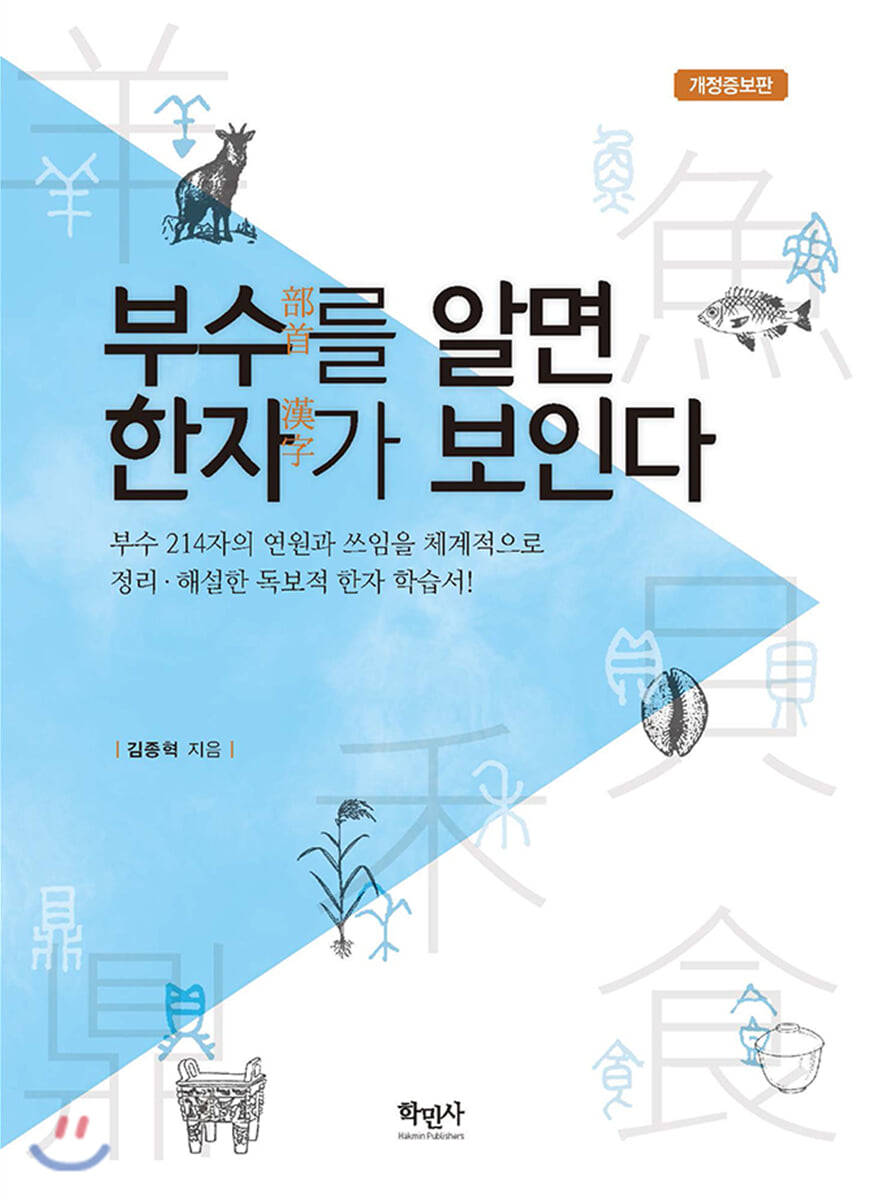
The origin and usage of the 214 radicals are systematically organized and explained. An unrivaled Chinese character learning book! Published in 1996, 『Know the Radicals, Then You Can See the Chinese Characters』 was the first research book in Korea to systematically organize the origins and usage of 214 Chinese character radicals. At the time, when only rote learning and reading-based Chinese character education books existed, it contributed greatly to making learning Chinese characters easy and fun through the radical character patterns that form the basis of Chinese character formation. The revised and expanded edition of 『Knowing the Radicals Reveals the Chinese Characters』 contains the author's research on teaching the radicals of Chinese characters in the classroom, having focused solely on Chinese characters for over 30 years. In the revised and expanded edition, the humanistic origins and implications of Chinese character radicals were significantly supplemented through authoritative texts on character studies such as the 『Seomunhaeja』. In addition, by including a variety of photos, drawings, and ancient character shapes related to the shape or meaning of each Chinese character, we have organized it in an interesting way so that readers do not lose interest in repetitive explanations. |
- You can preview some of the book's contents.
Preview
index
At the beginning of the book
To the revised and expanded edition
Note
The evolution of Chinese characters
Names according to subsidiary position
A classic on the principles of Chinese character creation and radical arrangement
1 stroke
001 One thing 002? Will you break through? 003? Sparks
004 ? A star that will make a noise 005 乙(?) Bird 006 ? A hook
2 strokes
007 二 Two two 008 ? Pig's head (two) 009 Person(?) Person
010 ? A good person 011 Enter 012 入 Eight arms
013 ? Far 014 ? Cover 015 ? Ice
016 ? Anseok chest 017 ? Mouth opening feeling 018 刀(?) knife
019 力 力 力 020 ? Rice bag 021 匕 dagger rain
022 ? Box room 023 ? Hide Hye 024 十 Ten
025 Fortune 026 ?(?) Ministry of War 027 ? Hill Han (Eom)
028 ? Sasa sa 029 And again
3 strokes
030 口 entrance 031 ? above 032 土 soil
033 士 Scholar 034 ? To come back 035 ? To walk slowly
036 Evening Dinner 037 Big Big 038 Woman Woman
039 子 son 040 ? house 041 寸 joint village
042 Small Small Cow 043 Lame King 044 Corpse
045 ?? Left hand left 046 Mountain hill mountain 047 ? (river) ant waist (heaven)
048 Craftsman 049 Self Body 050 Towel
051 Shield 052 ? Small 053 ? House Mom
054 ? A person who walks a long distance 055 ? A person who holds hands 056 ? A person who is ready to take a stake
057 Bow 058 ?(?) Pig's head 059 ? Truck three
060? Pretend to celebrate
4 strokes
061 心(?·?) heart 062 戈 spear and 063 戶 jige ho
064 Hand(?) Hand number 065 Support 066 ?(?) Seven fortunes
067 文 文 068 斗 2 words 069 斤 3 axe 斤
070 方 Mo 方 071 无 No 072 日 Day
073 He said, 074 Moon, month, month 075 Wood, tree, wood
076 欠 yawn 077 stop 078 ?(?) bone bulge egg
079 ? Can be 080 毋 081 比 082 比 083 毋 084 毋 085 毋 086 毋 087 毋 088 毋 089 ...
082 Hair 083 Clan 084 ? Energy
085 Water (?·?) Water 086 Fire(?) Fire 087 Claw(?) Nail
088 Father 089 Line Fortune-telling Effect 090 ? Piece of paper
091 Piece Piece 092 Tooth Wisdom Tooth Ah 093 Ox Cow
094 Dog(?) Dog
5 strokes
095 玄 Sword 096 Jade (?) Bead Jade 097 Melon Cucumber
098 瓦 瓦 099 甘 100 生 生
101 Use Use 102 Field Field 103 Separate(?) Foot
104 ? Sick evening 105 ? Walking feet 106 白 White white
107 皮 leather skin 108 皿 bowl name 109 目 eye neck
110 矛 spear 111 矢 arrow 112 石 stone stone
113 示(?) Violent 114 ? Animal footprints 115 禾 Rice flower
116 穴 hole blood 117 立 establishment
6 strokes
118 Bamboo(?) bamboo 119 Rice 120 ? Real
121 缶 General Bu 122 ?(?) Net 123 羊 Sheep Sheep
124 Feather 125 Old (?) Older 126 Er To continue the story
127 ? Plow thunder 128 Ear ear 129 Luo brush rate
130 Meat (Month) Meat 131 Subject 132 Self Self
133 至 to do this 134 臼 to do something 135 舌 to do something
136 舛 to be crooked 137 舟 to be a boat 138 艮 to stop
139 Color Light Color 140 Grass(?) Grass 141 ? Tiger's pattern Ho
142 ? Bug 143 Blood 144 Line (hang)
145 Clothes(?) 146 ? Cover
7 strokes
147 見 to see 148 角 each horn 149 言 words
150 Valley 151 Bean 152 Pork Pork
153 ? A legless bug 154 Shell 貝 A clam shell 155 Red
156 走 Run away 157 足 (?) Foot 158 身 Body
159 車 cart (car) 160 辛 spicy sour 161 辰 star (god)
162 ?(?) Slowly go 163 Town (?) County 164 酉 Chicken Yu
165 ? Discernment 166 里 Village Lee
8 strokes
167 Gold 168 Long (?) Long length 169 Gate Gate
170 阜(?) Hill 171 ? Crazy Day (this) 172 ? New Chu
173 Rain Rain 174 Blue Blue 175 Non Not Rain
9 strokes
176 面 面 177 革 178 韋 179 韋 178 韋 179 面 179 革 ...
179 ? Chives 180 Sound Sound 181 Page Head Blood
182 Wind 183 Flying Rain 184 Food
185 首 Number of heads 186 香 Fragrance Fragrance
10 strokes
187 Horse 188 Bone 189 High
190 ? A sign that your hair will fall down 191 ? A sign that you will fight 192 ? A sign that you will fight
193 ? Pot power (strength) 194 Ghost ghost ear
11 strokes
195 Fish 魚 Fish 196 Bird 鳥 Bird 197 Salt Field
198 Deer 199 Barley 200 Hemp
12 strokes
201 黃 Hwang 202 黍 Millet 203 黑 Black
204 ? To sew
13 strokes
205 ? Frog 206 Ding Cauldron Jeong 207 Drum Buk Go
208 Rat
14 strokes
209 Nose 210 Ti To be neat and tidy
15 strokes
211 teeth
16 strokes
212 Dragon 龍 Yong 龍 213 Turtle Ears (Gu·Gyun)
17 strokes
214 ? Flute medicine
List of radicals by stroke count
References
Search by radical 214 sound
To the revised and expanded edition
Note
The evolution of Chinese characters
Names according to subsidiary position
A classic on the principles of Chinese character creation and radical arrangement
1 stroke
001 One thing 002? Will you break through? 003? Sparks
004 ? A star that will make a noise 005 乙(?) Bird 006 ? A hook
2 strokes
007 二 Two two 008 ? Pig's head (two) 009 Person(?) Person
010 ? A good person 011 Enter 012 入 Eight arms
013 ? Far 014 ? Cover 015 ? Ice
016 ? Anseok chest 017 ? Mouth opening feeling 018 刀(?) knife
019 力 力 力 020 ? Rice bag 021 匕 dagger rain
022 ? Box room 023 ? Hide Hye 024 十 Ten
025 Fortune 026 ?(?) Ministry of War 027 ? Hill Han (Eom)
028 ? Sasa sa 029 And again
3 strokes
030 口 entrance 031 ? above 032 土 soil
033 士 Scholar 034 ? To come back 035 ? To walk slowly
036 Evening Dinner 037 Big Big 038 Woman Woman
039 子 son 040 ? house 041 寸 joint village
042 Small Small Cow 043 Lame King 044 Corpse
045 ?? Left hand left 046 Mountain hill mountain 047 ? (river) ant waist (heaven)
048 Craftsman 049 Self Body 050 Towel
051 Shield 052 ? Small 053 ? House Mom
054 ? A person who walks a long distance 055 ? A person who holds hands 056 ? A person who is ready to take a stake
057 Bow 058 ?(?) Pig's head 059 ? Truck three
060? Pretend to celebrate
4 strokes
061 心(?·?) heart 062 戈 spear and 063 戶 jige ho
064 Hand(?) Hand number 065 Support 066 ?(?) Seven fortunes
067 文 文 068 斗 2 words 069 斤 3 axe 斤
070 方 Mo 方 071 无 No 072 日 Day
073 He said, 074 Moon, month, month 075 Wood, tree, wood
076 欠 yawn 077 stop 078 ?(?) bone bulge egg
079 ? Can be 080 毋 081 比 082 比 083 毋 084 毋 085 毋 086 毋 087 毋 088 毋 089 ...
082 Hair 083 Clan 084 ? Energy
085 Water (?·?) Water 086 Fire(?) Fire 087 Claw(?) Nail
088 Father 089 Line Fortune-telling Effect 090 ? Piece of paper
091 Piece Piece 092 Tooth Wisdom Tooth Ah 093 Ox Cow
094 Dog(?) Dog
5 strokes
095 玄 Sword 096 Jade (?) Bead Jade 097 Melon Cucumber
098 瓦 瓦 099 甘 100 生 生
101 Use Use 102 Field Field 103 Separate(?) Foot
104 ? Sick evening 105 ? Walking feet 106 白 White white
107 皮 leather skin 108 皿 bowl name 109 目 eye neck
110 矛 spear 111 矢 arrow 112 石 stone stone
113 示(?) Violent 114 ? Animal footprints 115 禾 Rice flower
116 穴 hole blood 117 立 establishment
6 strokes
118 Bamboo(?) bamboo 119 Rice 120 ? Real
121 缶 General Bu 122 ?(?) Net 123 羊 Sheep Sheep
124 Feather 125 Old (?) Older 126 Er To continue the story
127 ? Plow thunder 128 Ear ear 129 Luo brush rate
130 Meat (Month) Meat 131 Subject 132 Self Self
133 至 to do this 134 臼 to do something 135 舌 to do something
136 舛 to be crooked 137 舟 to be a boat 138 艮 to stop
139 Color Light Color 140 Grass(?) Grass 141 ? Tiger's pattern Ho
142 ? Bug 143 Blood 144 Line (hang)
145 Clothes(?) 146 ? Cover
7 strokes
147 見 to see 148 角 each horn 149 言 words
150 Valley 151 Bean 152 Pork Pork
153 ? A legless bug 154 Shell 貝 A clam shell 155 Red
156 走 Run away 157 足 (?) Foot 158 身 Body
159 車 cart (car) 160 辛 spicy sour 161 辰 star (god)
162 ?(?) Slowly go 163 Town (?) County 164 酉 Chicken Yu
165 ? Discernment 166 里 Village Lee
8 strokes
167 Gold 168 Long (?) Long length 169 Gate Gate
170 阜(?) Hill 171 ? Crazy Day (this) 172 ? New Chu
173 Rain Rain 174 Blue Blue 175 Non Not Rain
9 strokes
176 面 面 177 革 178 韋 179 韋 178 韋 179 面 179 革 ...
179 ? Chives 180 Sound Sound 181 Page Head Blood
182 Wind 183 Flying Rain 184 Food
185 首 Number of heads 186 香 Fragrance Fragrance
10 strokes
187 Horse 188 Bone 189 High
190 ? A sign that your hair will fall down 191 ? A sign that you will fight 192 ? A sign that you will fight
193 ? Pot power (strength) 194 Ghost ghost ear
11 strokes
195 Fish 魚 Fish 196 Bird 鳥 Bird 197 Salt Field
198 Deer 199 Barley 200 Hemp
12 strokes
201 黃 Hwang 202 黍 Millet 203 黑 Black
204 ? To sew
13 strokes
205 ? Frog 206 Ding Cauldron Jeong 207 Drum Buk Go
208 Rat
14 strokes
209 Nose 210 Ti To be neat and tidy
15 strokes
211 teeth
16 strokes
212 Dragon 龍 Yong 龍 213 Turtle Ears (Gu·Gyun)
17 strokes
214 ? Flute medicine
List of radicals by stroke count
References
Search by radical 214 sound
Publisher's Review
Systematically explain the origin and usage of the 214 radicals
A unique Chinese character study book that organizes and explains everything!
To learn Chinese characters easily, you need to know their radicals.
The Chinese character classification system is a scientific system that classifies each and every tens of thousands of Chinese characters based on the relevance of their fonts, and reflects the cosmological view and philosophical aspects of each Chinese character.
Radicals usually play a significant role in understanding the entire Chinese character by acting as a part of meaning that influences the meaning.
Moreover, anyone who speaks Korean, our language, must learn and understand it.
This is because most of the Chinese characters in the Korean vocabulary are composed of radicals.
In this way, breaking down is necessary not only for Chinese character education but also for Korean language education.
Published in 1996, 『Know the Radicals, Then You Can See the Chinese Characters』 was the first research book in Korea to systematically organize the origins and usage of 214 Chinese character radicals. At the time, when only rote learning and reading-based Chinese character education books existed, it contributed greatly to making learning Chinese characters easy and fun through the radical character patterns that form the basis of Chinese character formation.
As this was the first volume of the book, there was a lack of existing books to reference, and at the time, it was the period before and after the establishment of formal diplomatic relations with China, so it was difficult to purchase materials related to philology. However, after seeing that later scholars were using it as a resource for studying radicals, the author decided to publish a revised and expanded edition with the thought that it should be of accurate and meaningful help.
This revised and expanded edition of "Knowing the Radicals Reveals the Chinese Characters" contains the author's research on teaching the radicals of Chinese characters in the classroom, having focused solely on Chinese characters for over 30 years.
In the revised and expanded edition, the humanistic origins and implications of Chinese character radicals were significantly supplemented through authoritative texts on character studies such as the 『Seomunhaeja』.
In addition, by including a variety of photos, drawings, and ancient character shapes related to the shape or meaning of each Chinese character, we have organized it in an interesting way so that readers do not lose interest in repetitive explanations.
●To the revised and expanded edition
It has been about 25 years since the first edition of this book came out.
I started writing it in 1991 and, after many twists and turns, published it at the end of 1996. Until then, even for those interested in Chinese characters or classical Chinese, it was not a subject of much interest, and there were no proper books on the subject.
This book is the first research book in Korea to systematically organize the origins and uses of 214 syllables.
As this was the first volume of the book, there were no existing books to reference, and since it was the period before and after the establishment of formal diplomatic relations with China, it was difficult to acquire materials related to philology that would be helpful in writing the book.
As I was writing under such circumstances, I realized that there were some shortcomings in the content, and moreover, seeing that it was being used as a resource for future scholars to study the annals, I decided to publish a revised edition with the thought that I should make it more accurate and meaningful.
Since the publication of this book, there has been a growing interest in the importance and necessity of subsidiary characters, and if you look at the titles of Chinese character books published on the market these days, you will notice that there are quite a few books that emphasize the title of subsidiary characters.
However, there are still many people who consider radicals to be mere accessories to Chinese characters.
Radicals play a major role in systematically organizing numerous Chinese characters, and are usually letters of the same form that serve as a part of meaning that influences the meaning.
For example, in the characters 癌 [cancer], 疫 [epidemic], 疹 [measles], 痘 [smallpox], and 癩 [leprosy], the common character ? [illness] is the disruptive character.
Therefore, if we know that the radical ? (night) is derived from the image of a person lying sick in bed, we can infer that all Chinese characters with that shape attached are related to illness.
Moreover, fragments play a big role in understanding the entire Chinese character.
Among the words that Koreans use frequently in their daily lives today, the Chinese character with the most complex stroke count is probably the character 鬱 [ul], meaning "depressed" or 憂鬱 [ul], meaning "worried".
The character 鬱 (ul) is a Chinese character made up of two characters 木 (tree), 缶 (general), ? (cover), ? (window), and ? (truck). All of them are made up of radicals.
Therefore, in order to properly understand the character 鬱 (ul), you must know the five radicals that make up its character.
Moreover, it is necessary for anyone who speaks Korean, our language, to learn and understand the consonants.
As has always been argued in the educational field, the starting point of all learning is knowing the characters, and the Chinese characters that make up most of the Korean vocabulary are all made up of radicals.
In fact, it is more necessary for Korean language education than for Chinese character education.
This book first explained the three elements of Chinese characters - shape, consonant, and meaning - about radicals that are helpful to Chinese characters and the Korean language, and then added a survey of Chinese characters and humanities content to reinforce it academically.
In addition, we added more related photos and pictures and used many ancient characters to help understand the radicals.
This is based on the research conducted by the author, who has focused solely on Chinese characters for over 30 years, to properly teach radicals in the educational field.
The father who had been a source of strength for him had left him, and the child he had when he was over forty was now a high school student.
Even in the midst of all this, I have been studying Chinese characters like an independence fighter, but all I have left are a few books.
I would like to express my gratitude to the publishers who helped me put a new spin on this most comforting of books.
In the summer of 2020
Kim Jong-hyuk
A unique Chinese character study book that organizes and explains everything!
To learn Chinese characters easily, you need to know their radicals.
The Chinese character classification system is a scientific system that classifies each and every tens of thousands of Chinese characters based on the relevance of their fonts, and reflects the cosmological view and philosophical aspects of each Chinese character.
Radicals usually play a significant role in understanding the entire Chinese character by acting as a part of meaning that influences the meaning.
Moreover, anyone who speaks Korean, our language, must learn and understand it.
This is because most of the Chinese characters in the Korean vocabulary are composed of radicals.
In this way, breaking down is necessary not only for Chinese character education but also for Korean language education.
Published in 1996, 『Know the Radicals, Then You Can See the Chinese Characters』 was the first research book in Korea to systematically organize the origins and usage of 214 Chinese character radicals. At the time, when only rote learning and reading-based Chinese character education books existed, it contributed greatly to making learning Chinese characters easy and fun through the radical character patterns that form the basis of Chinese character formation.
As this was the first volume of the book, there was a lack of existing books to reference, and at the time, it was the period before and after the establishment of formal diplomatic relations with China, so it was difficult to purchase materials related to philology. However, after seeing that later scholars were using it as a resource for studying radicals, the author decided to publish a revised and expanded edition with the thought that it should be of accurate and meaningful help.
This revised and expanded edition of "Knowing the Radicals Reveals the Chinese Characters" contains the author's research on teaching the radicals of Chinese characters in the classroom, having focused solely on Chinese characters for over 30 years.
In the revised and expanded edition, the humanistic origins and implications of Chinese character radicals were significantly supplemented through authoritative texts on character studies such as the 『Seomunhaeja』.
In addition, by including a variety of photos, drawings, and ancient character shapes related to the shape or meaning of each Chinese character, we have organized it in an interesting way so that readers do not lose interest in repetitive explanations.
●To the revised and expanded edition
It has been about 25 years since the first edition of this book came out.
I started writing it in 1991 and, after many twists and turns, published it at the end of 1996. Until then, even for those interested in Chinese characters or classical Chinese, it was not a subject of much interest, and there were no proper books on the subject.
This book is the first research book in Korea to systematically organize the origins and uses of 214 syllables.
As this was the first volume of the book, there were no existing books to reference, and since it was the period before and after the establishment of formal diplomatic relations with China, it was difficult to acquire materials related to philology that would be helpful in writing the book.
As I was writing under such circumstances, I realized that there were some shortcomings in the content, and moreover, seeing that it was being used as a resource for future scholars to study the annals, I decided to publish a revised edition with the thought that I should make it more accurate and meaningful.
Since the publication of this book, there has been a growing interest in the importance and necessity of subsidiary characters, and if you look at the titles of Chinese character books published on the market these days, you will notice that there are quite a few books that emphasize the title of subsidiary characters.
However, there are still many people who consider radicals to be mere accessories to Chinese characters.
Radicals play a major role in systematically organizing numerous Chinese characters, and are usually letters of the same form that serve as a part of meaning that influences the meaning.
For example, in the characters 癌 [cancer], 疫 [epidemic], 疹 [measles], 痘 [smallpox], and 癩 [leprosy], the common character ? [illness] is the disruptive character.
Therefore, if we know that the radical ? (night) is derived from the image of a person lying sick in bed, we can infer that all Chinese characters with that shape attached are related to illness.
Moreover, fragments play a big role in understanding the entire Chinese character.
Among the words that Koreans use frequently in their daily lives today, the Chinese character with the most complex stroke count is probably the character 鬱 [ul], meaning "depressed" or 憂鬱 [ul], meaning "worried".
The character 鬱 (ul) is a Chinese character made up of two characters 木 (tree), 缶 (general), ? (cover), ? (window), and ? (truck). All of them are made up of radicals.
Therefore, in order to properly understand the character 鬱 (ul), you must know the five radicals that make up its character.
Moreover, it is necessary for anyone who speaks Korean, our language, to learn and understand the consonants.
As has always been argued in the educational field, the starting point of all learning is knowing the characters, and the Chinese characters that make up most of the Korean vocabulary are all made up of radicals.
In fact, it is more necessary for Korean language education than for Chinese character education.
This book first explained the three elements of Chinese characters - shape, consonant, and meaning - about radicals that are helpful to Chinese characters and the Korean language, and then added a survey of Chinese characters and humanities content to reinforce it academically.
In addition, we added more related photos and pictures and used many ancient characters to help understand the radicals.
This is based on the research conducted by the author, who has focused solely on Chinese characters for over 30 years, to properly teach radicals in the educational field.
The father who had been a source of strength for him had left him, and the child he had when he was over forty was now a high school student.
Even in the midst of all this, I have been studying Chinese characters like an independence fighter, but all I have left are a few books.
I would like to express my gratitude to the publishers who helped me put a new spin on this most comforting of books.
In the summer of 2020
Kim Jong-hyuk
GOODS SPECIFICS
- Date of issue: September 25, 2020
- Page count, weight, size: 392 pages | 714g | 173*235*25mm
- ISBN13: 9788971932599
- ISBN10: 8971932597
You may also like
카테고리
korean


korean

![GQ KOREA Mark (Monthly): December [2025]](http://librairie.coreenne.fr/cdn/shop/files/8ef265dbbfbf186523ed75ba7319009d.jpg?v=1765340328&width=3840)


