

The Power of Reading English Books
 |
Description
Book Introduction
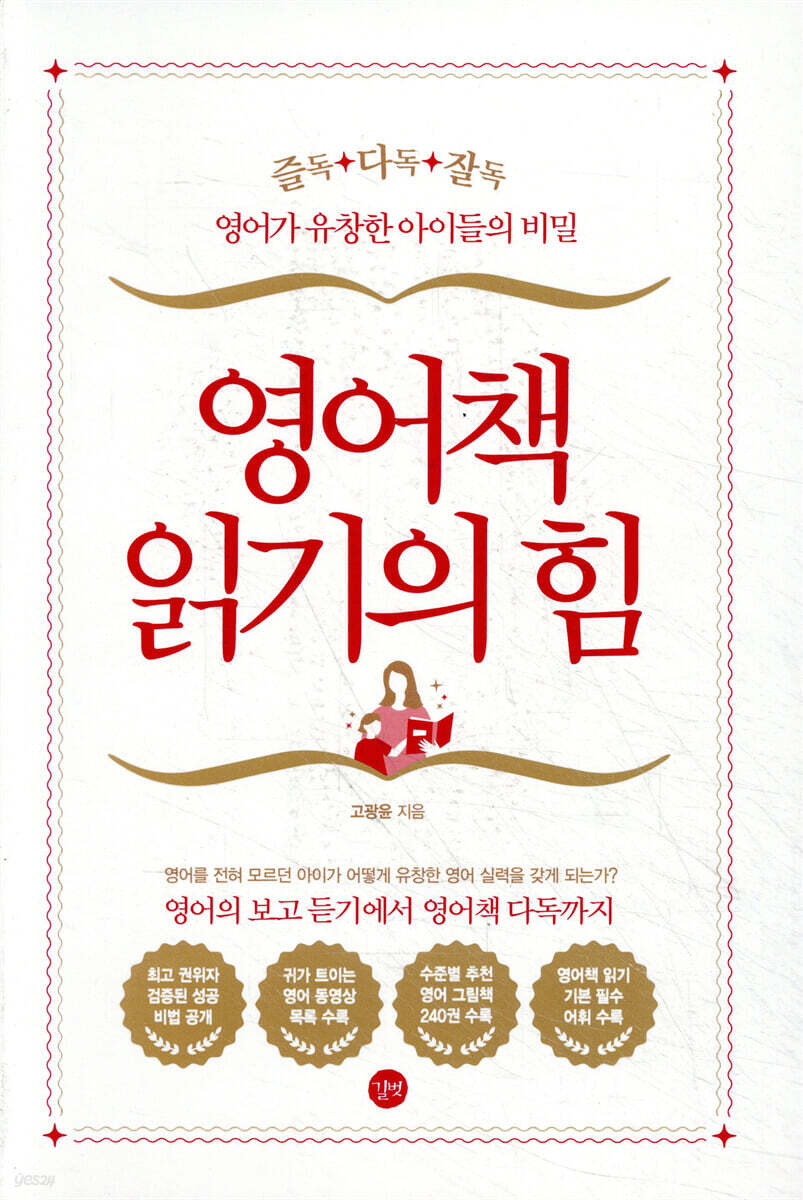
Without going abroad or receiving special private education The only book that contains the only way to raise your child as an English prodigy! The world's leading authority on English reading reveals proven secrets to success. This book contains the proven English learning methods of Professor Ko Gwang-yoon, who, as a teacher of English teachers, taught English education to children, spread the importance of reading English books, and raised all four of his children as English prodigies. The author says that the only secret to our children developing fluent English skills is to enjoy, read a lot, and read English books well. By simply practicing the methods in this book one by one, mothers and children can have fun and learn English every day, naturally, without having to live abroad or pay expensive private tutoring, even without innate language talent. |
- You can preview some of the book's contents.
Preview
index
Prologue Why Read English Books?
Chapter 1 | The Best Way to Solve Your Child's English Problems
01.
What is the secret?
02.
So what's really good about reading books?
03.
Why do I have to read English books?
04.
My child hates reading books.
Chapter 2 | It All Begins in the Ears
01.
Real English reading begins with your ears.
02.
Why is “listening first” not properly practiced?
03.
Reading: The Best Way to Open Your Eyes and Ears to English
04.
Watching Videos: The Best Way to See and Hear English
05.
My child only wants to watch TV or movies. What should I do?
06.
How can a child who knows no English at all learn to listen and understand English?
07.
English phonics: If you enjoy it, it will be solved naturally.
08.
How should I choose English videos?
09.
Top 15 Recommended English Video Series
10.
I regret listening to it in passing and listening intently.
11.
If you can't just listen to it or concentrate on it, then what am I supposed to do?
Chapter 3 | Reading English Books: This is How to Do It
01.
The Real Effects of Reading English Books
02.
When is a good time to start reading English books?
03.
Is it possible to read English books to a child who doesn't know English?
04.
Tips for Reading English Books: Reading Pictures
05.
Tips for Reading English Books: Reading Aloud
06.
Wouldn't a child be disappointed if an incompetent mother or father reads to them?
07.
Won't mom and dad's poor pronunciation ruin their child's English pronunciation?
08.
I'm still worried about my pronunciation. What should I do?
09.
A common mom and dad's secret to improving their English skills: Becoming a karaoke singer.
10.
How to Improve Your English Skills: Becoming an English Master
11.
What should I do with words my child doesn't know?
12.
My child just wants to read books. Aren't post-reading activities important?
13.
Ten Post-Reading Activities That Are Easy and Really Helpful for Reading English Books
14.
I don't think my child likes being read to in English. What could be the problem?
Chapter 4 | The Truth About English Phonics Learning, and How to Learn It
01.
The real role of phonics
02.
I studied phonics, so why can't I read English books properly?
03.
Is it really necessary to study phonics?
04.
Four Principles for Successful Phonics Learning
05.
There is a desirable order to learning phonics.
06.
English phonics is a tricky subject with many rules and exceptions. How should we teach it?
07.
Top 3 Recommended Phoenix Rules
08.
My child has trouble blending, is there a good way?
09.
There are so many phonics textbooks and workbooks out there. How do I choose?
Chapter 5 | English Vocabulary: How to Study It
01.
What is a first-hand vocabulary? Why is it important?
02.
How many words are there in a vocabulary at first glance?
03.
How does Fry's sight vocabulary differ from Dolch's sight vocabulary?
04.
Which list of first-look vocabulary is best?
05.
So what words do you need to know right now?
06.
How many words do I need to know to read a step-by-step book?
07.
How should I study vocabulary at first glance?
08.
The effectiveness, problems, and solutions of learning with flashcards
09.
A very special trick for using flashcards
10.
I'm good at reading out loud and know a lot of vocabulary, but my reading isn't improving.
Chapter 6 | Criteria and Tips for Choosing the Right English Book for Your Child
01.
Two Key Criteria for Choosing the Right English Book
02.
Choosing English Books to Read to Your Child
03.
Choosing English books for your child to read independently
04.
The first tip for choosing the right English book for your level: The Five-Finger Rule
05.
The second tip for choosing the right English book for your level: The 98% Rule
06.
Understanding the toxicity formula properly
07.
Wouldn't a slightly more difficult book be more effective for learning?
08.
Wouldn't a book that can be read only with phonics be too boring?
09.
What should I do if I choose a book that is too easy or too difficult?
10.
I want to know more about the winners (USA)
11.
I want to know more about the winners (UK edition)
12.
How to use the winning entry
13.
There are so many award-winning entries, can't you just pick out the really good ones?
14.
240 carefully selected English picture books at different levels for your children.
Chapter 7 | The Secret to Successful Reading and Extensive Reading in English
01.
How to Know If You're Ready to Read On Your Own
02.
Tips to help you read English books on your own
03.
The best way to make reading together and reading alone easy and enjoyable
04.
What should I do when my child makes a mistake or doesn't understand something?
05.
You're saying we should use contextual clues? What exactly are you asking us to do?
06.
Which is better: reading out loud or reading with your eyes?
07.
Which is better: repeating the same book or reading a new book?
08.
When I ask, it seems like there are a lot of words I don't know. Isn't that a problem?
09.
Four Keyword Keyword to Make Reading English Books More Exciting
10.
Our family's special library usage secret
11.
How to Offer Rewards That Really Help You Read English Books
12.
Five Must-Follow Reading Principles for Fluent English Reading
Epilogue Do you still think lack of enthusiasm is the problem?
supplement
01. Recommended TV animated series
02.
Dolch's list of sight words
03.
Fry's list of vocabulary words
04.
Essential Vocabulary List (268 words)
05.
Step-by-step reading book essential vocabulary (779 words)
06.
104 Best English Picture Books, Award-Winning and Institution-Recommended
07.
240 Recommended English Picture Books
Explanation of Key Terms
References
Chapter 1 | The Best Way to Solve Your Child's English Problems
01.
What is the secret?
02.
So what's really good about reading books?
03.
Why do I have to read English books?
04.
My child hates reading books.
Chapter 2 | It All Begins in the Ears
01.
Real English reading begins with your ears.
02.
Why is “listening first” not properly practiced?
03.
Reading: The Best Way to Open Your Eyes and Ears to English
04.
Watching Videos: The Best Way to See and Hear English
05.
My child only wants to watch TV or movies. What should I do?
06.
How can a child who knows no English at all learn to listen and understand English?
07.
English phonics: If you enjoy it, it will be solved naturally.
08.
How should I choose English videos?
09.
Top 15 Recommended English Video Series
10.
I regret listening to it in passing and listening intently.
11.
If you can't just listen to it or concentrate on it, then what am I supposed to do?
Chapter 3 | Reading English Books: This is How to Do It
01.
The Real Effects of Reading English Books
02.
When is a good time to start reading English books?
03.
Is it possible to read English books to a child who doesn't know English?
04.
Tips for Reading English Books: Reading Pictures
05.
Tips for Reading English Books: Reading Aloud
06.
Wouldn't a child be disappointed if an incompetent mother or father reads to them?
07.
Won't mom and dad's poor pronunciation ruin their child's English pronunciation?
08.
I'm still worried about my pronunciation. What should I do?
09.
A common mom and dad's secret to improving their English skills: Becoming a karaoke singer.
10.
How to Improve Your English Skills: Becoming an English Master
11.
What should I do with words my child doesn't know?
12.
My child just wants to read books. Aren't post-reading activities important?
13.
Ten Post-Reading Activities That Are Easy and Really Helpful for Reading English Books
14.
I don't think my child likes being read to in English. What could be the problem?
Chapter 4 | The Truth About English Phonics Learning, and How to Learn It
01.
The real role of phonics
02.
I studied phonics, so why can't I read English books properly?
03.
Is it really necessary to study phonics?
04.
Four Principles for Successful Phonics Learning
05.
There is a desirable order to learning phonics.
06.
English phonics is a tricky subject with many rules and exceptions. How should we teach it?
07.
Top 3 Recommended Phoenix Rules
08.
My child has trouble blending, is there a good way?
09.
There are so many phonics textbooks and workbooks out there. How do I choose?
Chapter 5 | English Vocabulary: How to Study It
01.
What is a first-hand vocabulary? Why is it important?
02.
How many words are there in a vocabulary at first glance?
03.
How does Fry's sight vocabulary differ from Dolch's sight vocabulary?
04.
Which list of first-look vocabulary is best?
05.
So what words do you need to know right now?
06.
How many words do I need to know to read a step-by-step book?
07.
How should I study vocabulary at first glance?
08.
The effectiveness, problems, and solutions of learning with flashcards
09.
A very special trick for using flashcards
10.
I'm good at reading out loud and know a lot of vocabulary, but my reading isn't improving.
Chapter 6 | Criteria and Tips for Choosing the Right English Book for Your Child
01.
Two Key Criteria for Choosing the Right English Book
02.
Choosing English Books to Read to Your Child
03.
Choosing English books for your child to read independently
04.
The first tip for choosing the right English book for your level: The Five-Finger Rule
05.
The second tip for choosing the right English book for your level: The 98% Rule
06.
Understanding the toxicity formula properly
07.
Wouldn't a slightly more difficult book be more effective for learning?
08.
Wouldn't a book that can be read only with phonics be too boring?
09.
What should I do if I choose a book that is too easy or too difficult?
10.
I want to know more about the winners (USA)
11.
I want to know more about the winners (UK edition)
12.
How to use the winning entry
13.
There are so many award-winning entries, can't you just pick out the really good ones?
14.
240 carefully selected English picture books at different levels for your children.
Chapter 7 | The Secret to Successful Reading and Extensive Reading in English
01.
How to Know If You're Ready to Read On Your Own
02.
Tips to help you read English books on your own
03.
The best way to make reading together and reading alone easy and enjoyable
04.
What should I do when my child makes a mistake or doesn't understand something?
05.
You're saying we should use contextual clues? What exactly are you asking us to do?
06.
Which is better: reading out loud or reading with your eyes?
07.
Which is better: repeating the same book or reading a new book?
08.
When I ask, it seems like there are a lot of words I don't know. Isn't that a problem?
09.
Four Keyword Keyword to Make Reading English Books More Exciting
10.
Our family's special library usage secret
11.
How to Offer Rewards That Really Help You Read English Books
12.
Five Must-Follow Reading Principles for Fluent English Reading
Epilogue Do you still think lack of enthusiasm is the problem?
supplement
01. Recommended TV animated series
02.
Dolch's list of sight words
03.
Fry's list of vocabulary words
04.
Essential Vocabulary List (268 words)
05.
Step-by-step reading book essential vocabulary (779 words)
06.
104 Best English Picture Books, Award-Winning and Institution-Recommended
07.
240 Recommended English Picture Books
Explanation of Key Terms
References
Detailed image

Into the book
Seven Reasons Why Reading English Books Is the Best Way to Learn English
First, reading English books is the most realistic way to get sufficient input in our environment.
To become fluent in English, you first need to accumulate enough input to overflow.
Otherwise, you won't be able to speak, write, read, or listen properly.
However, it is very difficult to have enough opportunities to encounter English in our daily lives.
The solution to this situation is definitely reading English books.
If you pick an interesting English book and keep reading it, it will only be a matter of time before your input overflows.
Moreover, reading requires twice as much input as listening in the same amount of time.
Therefore, reading English books is also the most economical way to study to save time.
--- From the "Prologue"
Real English reading begins with your ears.
This means that if you truly want your child to become fluent in English through reading English books, you must start with listening, no matter how urgent it may be.
If you feel like you're behind compared to other children, you may feel impatient and be tempted to tackle too many things at once.
It is natural to feel frustrated and worried that you will fall behind in competition with other children because it takes time and seems slow to learn listening properly.
But, in the end, doing it right, starting with listening, is the way to get there the fastest and furthest.
This is also the only way I have found to solve English problems through experience.
--- p.
45
The Real Effects of Reading English Books
If you read English books to your children consistently, even if only a little, focusing on English picture books, they will develop the ability to hear and distinguish English sounds.
In addition, the ability to recognize phonemes and phonics, which is the relationship between letters and sounds, can be acquired naturally and incidentally to a large extent, thereby solidifying the foundation of literacy.
(…) As you repeatedly encounter English vocabulary and sentences in English picture books, you will gradually come to understand how each vocabulary is used and what meaning it has through the context and situation descriptions provided by the interesting story and pictures.
You will open your eyes to English expressions without having to learn English grammar rules separately.
--- p.
94~95
How should I study vocabulary at first glance?
First of all, because the vocabulary is so high-frequency and takes up a very large portion of the text, even though the number is small, if you learn it properly, it is a word that is very helpful in developing reading fluency.
(…) Currently widely used vocabulary lists contain between 150 and 1,000 words.
Some of these words can be read using the phonics rules, while others are difficult to decipher because they do not follow the rules.
However, regardless of whether it is regular or not, you should study all first-hand vocabulary so that you can recognize it immediately when you see it.
(…) Above all, it is much more effective to continue reading many English books consistently.
--- p.
238~239
The first tip for choosing the right English book for your level: The Five-Finger Rule
First, a simple and easy way is to use “The Five Finger Rule.”
This is a widely known and actually frequently used method in the UK and the US. By applying this rule, you can easily determine whether a given English book is at an appropriate reading level for your child.
As you can quickly see by searching the Internet, the five-finger rule is explained slightly differently on each site.
But the general way is this:
First, open the English book you want to read anywhere.
Then, clench your fist and read the text on the open page from the beginning, extending your fingers one by one whenever you come across a word that your child does not know.
After reading a page like that, check how many fingers are spread out.
--- p.
272~273
240 carefully selected English picture books at different levels for your children.
So I thought about it really hard and prepared for a long time.
To provide a list of English picture books suitable for our children.
The English picture books introduced here were selected based on the following three criteria, although they were also carefully selected by referring to lists of famous award-winning works and recommended books in the UK and the US.
First, among the English picture books I have read and read to myself, I think the books my children would like and that there are no language issues.
Second, we sought to gather as much information as possible from field experts who have been reading English picture books to children and teaching English picture books and storytelling to the general public in the field of English education for children in Korea for a long time.
Third, we tested the book in English storytelling classes for a large number of children and examined whether it was a book that children would enjoy.
A total of 240 English picture books were selected using these criteria and methods.
First, reading English books is the most realistic way to get sufficient input in our environment.
To become fluent in English, you first need to accumulate enough input to overflow.
Otherwise, you won't be able to speak, write, read, or listen properly.
However, it is very difficult to have enough opportunities to encounter English in our daily lives.
The solution to this situation is definitely reading English books.
If you pick an interesting English book and keep reading it, it will only be a matter of time before your input overflows.
Moreover, reading requires twice as much input as listening in the same amount of time.
Therefore, reading English books is also the most economical way to study to save time.
--- From the "Prologue"
Real English reading begins with your ears.
This means that if you truly want your child to become fluent in English through reading English books, you must start with listening, no matter how urgent it may be.
If you feel like you're behind compared to other children, you may feel impatient and be tempted to tackle too many things at once.
It is natural to feel frustrated and worried that you will fall behind in competition with other children because it takes time and seems slow to learn listening properly.
But, in the end, doing it right, starting with listening, is the way to get there the fastest and furthest.
This is also the only way I have found to solve English problems through experience.
--- p.
45
The Real Effects of Reading English Books
If you read English books to your children consistently, even if only a little, focusing on English picture books, they will develop the ability to hear and distinguish English sounds.
In addition, the ability to recognize phonemes and phonics, which is the relationship between letters and sounds, can be acquired naturally and incidentally to a large extent, thereby solidifying the foundation of literacy.
(…) As you repeatedly encounter English vocabulary and sentences in English picture books, you will gradually come to understand how each vocabulary is used and what meaning it has through the context and situation descriptions provided by the interesting story and pictures.
You will open your eyes to English expressions without having to learn English grammar rules separately.
--- p.
94~95
How should I study vocabulary at first glance?
First of all, because the vocabulary is so high-frequency and takes up a very large portion of the text, even though the number is small, if you learn it properly, it is a word that is very helpful in developing reading fluency.
(…) Currently widely used vocabulary lists contain between 150 and 1,000 words.
Some of these words can be read using the phonics rules, while others are difficult to decipher because they do not follow the rules.
However, regardless of whether it is regular or not, you should study all first-hand vocabulary so that you can recognize it immediately when you see it.
(…) Above all, it is much more effective to continue reading many English books consistently.
--- p.
238~239
The first tip for choosing the right English book for your level: The Five-Finger Rule
First, a simple and easy way is to use “The Five Finger Rule.”
This is a widely known and actually frequently used method in the UK and the US. By applying this rule, you can easily determine whether a given English book is at an appropriate reading level for your child.
As you can quickly see by searching the Internet, the five-finger rule is explained slightly differently on each site.
But the general way is this:
First, open the English book you want to read anywhere.
Then, clench your fist and read the text on the open page from the beginning, extending your fingers one by one whenever you come across a word that your child does not know.
After reading a page like that, check how many fingers are spread out.
--- p.
272~273
240 carefully selected English picture books at different levels for your children.
So I thought about it really hard and prepared for a long time.
To provide a list of English picture books suitable for our children.
The English picture books introduced here were selected based on the following three criteria, although they were also carefully selected by referring to lists of famous award-winning works and recommended books in the UK and the US.
First, among the English picture books I have read and read to myself, I think the books my children would like and that there are no language issues.
Second, we sought to gather as much information as possible from field experts who have been reading English picture books to children and teaching English picture books and storytelling to the general public in the field of English education for children in Korea for a long time.
Third, we tested the book in English storytelling classes for a large number of children and examined whether it was a book that children would enjoy.
A total of 240 English picture books were selected using these criteria and methods.
--- p.
321~323
321~323
Publisher's Review
Without going abroad or receiving special private education
The only book that contains the only way to raise your child as an English prodigy!
The world's leading authority on English reading reveals proven secrets to success.
This book contains the proven English learning methods of Professor Ko Gwang-yoon, who, as a teacher of English teachers, taught children English education and spread the importance of reading English books, and raised all four of his children as English prodigies.
The author says that the only secret to our children developing fluent English skills is to enjoy, read a lot, and read English books well.
By simply practicing the methods in this book one by one, mothers and children can enjoy and learn English every day, naturally, without having to live abroad or pay for expensive private tutoring, even without innate language talent.
This book clearly points out the problems of English education for children in Korea, which causes them to not be able to speak properly even after learning English for a long time and to hate English. It also provides mothers with a foolproof method of how to read English books with their children, and makes them approach English as reading books rather than studying, and further, makes them enjoy it as play.
Do you really want your child to be fluent in English? If you truly desire that, this is your top priority as a parent.
“Provide the child with the right environment and support so that he or she can see and hear enough English and have a flood of high-quality English input in his or her head.” To do this, we must first and foremost help the child discover the joy of reading English books.
Reading English books should be enjoyable so that students want to read more and more diligently.
In this way, if you like something, you will read more, if you read more, you will read better, and if you read better, you will like it more, so you will read more. This should create a virtuous cycle of reading enjoyment, reading a lot, and reading well.
This book kindly explains, as if giving a lecture, based on real-life experiences, why reading English books is the only way, how to help children realize the joy of reading English books, what preparations are needed to actually read English books, how to choose the right English books for our children, how to start and progress with reading English books, and how to deal with problems that arise during the long journey of reading English books.
Above all, as a father of four, the author himself has personally proven the effectiveness of reading English books while having fun and playing with his children. Therefore, he recommends this book to parents who are tired of trying various motherly English education methods and to anyone who wants to know an effective way to make English fun for their children.
Why is reading English books to our children not just the best way, but the only way?
First, reading English books is the most realistic way to get sufficient English input in our environment.
Above all, reading requires twice as much input as listening in the same amount of time.
Second, it allows us to actually use English.
Third, it is a method suitable for anyone regardless of skill level, from absolute beginners to true experts.
Fourth, the speed can be adjusted to suit each person.
Fifth, the best way to become truly good at anything is to enjoy it, and anyone can read English books according to their own interests.
Sixth, repetition is essential for fluent English. If you immerse yourself in an interesting English book and enjoy reading, the necessary repetition will happen naturally without getting bored.
Finally, reading English books is the best investment for a child's intellectual development and emotional stability.
A list of engaging English videos perfect for your child's ears, plus 240 recommended English picture books by level.
Everyone knows that listening to English is important.
Yet, why is it so difficult to put "sufficient listening first" into practice in real life? This book suggests moving beyond the sometimes painful, often tedious, routine of casual listening and focused listening, to enjoying and enjoying listening.
To this end, we have included a list of 'English videos that will help your child learn English' that our children like the most and that many parents have actually found effective.
In addition, we have read the books ourselves, gathered as much feedback as possible from experts who have been teaching English education for children in Korea for a long time, and used them in English storytelling classes for many children, and reviewed whether the books are books that children enjoy enough to select and include 240 English picture books at different levels.
Includes essential vocabulary for reading English books, extracted from a vast database.
Sight words are literally 'words that can be recognized at a glance.'
It is very useful for children to read English books because it is used frequently.
It is said that the words in the most famous sight word lists, Fry words and Dolch words, account for 50 to 90 percent of children's English books.
This book combines the Dolch and Fry lists and adds the latest corpus research to present a new list of 268 essential vocabulary words to make English reading for children a little easier.
Also, rather than presenting vocabulary words selected from English books for English-speaking children, it presents 779 essential vocabulary words selected from 28 beginner level English books from the Oxford Bookworms Library, which are step-by-step reading books that many Korean children actually read.
Contents and structure of this book
This book is largely divided into seven parts.
Chapter 1 begins the discussion by exploring why, despite all the effort, English proficiency remains stagnant and what the best approach is to address this issue in our common reality.
Chapters 2 and 3 lay the foundation for building English skills and laying the groundwork for reading English books.
Chapter 2 explains how to proceed with seeing and listening, which can be said to be the beginning of all English, and Chapter 3 looks at specific tips for reading English books to children and how to solve problems that arise during the process.
Chapters 4 and 5 cover the process of learning and preparing to read English.
Chapter 4 examines the truth and falsehood of phonics learning, which involves deciphering letters to read words, and explains the correct principles and methods for teaching phonics to our children. Chapter 5 introduces English words and word learning methods that children must know first to begin reading English books.
Finally, Chapters 6 and 7 explain the selection of English books and the process of reading them in earnest.
In Chapter 6, we will look at the criteria and tips for choosing the right English book, and in Chapter 7, we will look at the process of moving beyond reading with mom or dad or reading together to reading alone, and the method and wisdom of extensive reading to choose an English book you like and read it without hesitation.
The only book that contains the only way to raise your child as an English prodigy!
The world's leading authority on English reading reveals proven secrets to success.
This book contains the proven English learning methods of Professor Ko Gwang-yoon, who, as a teacher of English teachers, taught children English education and spread the importance of reading English books, and raised all four of his children as English prodigies.
The author says that the only secret to our children developing fluent English skills is to enjoy, read a lot, and read English books well.
By simply practicing the methods in this book one by one, mothers and children can enjoy and learn English every day, naturally, without having to live abroad or pay for expensive private tutoring, even without innate language talent.
This book clearly points out the problems of English education for children in Korea, which causes them to not be able to speak properly even after learning English for a long time and to hate English. It also provides mothers with a foolproof method of how to read English books with their children, and makes them approach English as reading books rather than studying, and further, makes them enjoy it as play.
Do you really want your child to be fluent in English? If you truly desire that, this is your top priority as a parent.
“Provide the child with the right environment and support so that he or she can see and hear enough English and have a flood of high-quality English input in his or her head.” To do this, we must first and foremost help the child discover the joy of reading English books.
Reading English books should be enjoyable so that students want to read more and more diligently.
In this way, if you like something, you will read more, if you read more, you will read better, and if you read better, you will like it more, so you will read more. This should create a virtuous cycle of reading enjoyment, reading a lot, and reading well.
This book kindly explains, as if giving a lecture, based on real-life experiences, why reading English books is the only way, how to help children realize the joy of reading English books, what preparations are needed to actually read English books, how to choose the right English books for our children, how to start and progress with reading English books, and how to deal with problems that arise during the long journey of reading English books.
Above all, as a father of four, the author himself has personally proven the effectiveness of reading English books while having fun and playing with his children. Therefore, he recommends this book to parents who are tired of trying various motherly English education methods and to anyone who wants to know an effective way to make English fun for their children.
Why is reading English books to our children not just the best way, but the only way?
First, reading English books is the most realistic way to get sufficient English input in our environment.
Above all, reading requires twice as much input as listening in the same amount of time.
Second, it allows us to actually use English.
Third, it is a method suitable for anyone regardless of skill level, from absolute beginners to true experts.
Fourth, the speed can be adjusted to suit each person.
Fifth, the best way to become truly good at anything is to enjoy it, and anyone can read English books according to their own interests.
Sixth, repetition is essential for fluent English. If you immerse yourself in an interesting English book and enjoy reading, the necessary repetition will happen naturally without getting bored.
Finally, reading English books is the best investment for a child's intellectual development and emotional stability.
A list of engaging English videos perfect for your child's ears, plus 240 recommended English picture books by level.
Everyone knows that listening to English is important.
Yet, why is it so difficult to put "sufficient listening first" into practice in real life? This book suggests moving beyond the sometimes painful, often tedious, routine of casual listening and focused listening, to enjoying and enjoying listening.
To this end, we have included a list of 'English videos that will help your child learn English' that our children like the most and that many parents have actually found effective.
In addition, we have read the books ourselves, gathered as much feedback as possible from experts who have been teaching English education for children in Korea for a long time, and used them in English storytelling classes for many children, and reviewed whether the books are books that children enjoy enough to select and include 240 English picture books at different levels.
Includes essential vocabulary for reading English books, extracted from a vast database.
Sight words are literally 'words that can be recognized at a glance.'
It is very useful for children to read English books because it is used frequently.
It is said that the words in the most famous sight word lists, Fry words and Dolch words, account for 50 to 90 percent of children's English books.
This book combines the Dolch and Fry lists and adds the latest corpus research to present a new list of 268 essential vocabulary words to make English reading for children a little easier.
Also, rather than presenting vocabulary words selected from English books for English-speaking children, it presents 779 essential vocabulary words selected from 28 beginner level English books from the Oxford Bookworms Library, which are step-by-step reading books that many Korean children actually read.
Contents and structure of this book
This book is largely divided into seven parts.
Chapter 1 begins the discussion by exploring why, despite all the effort, English proficiency remains stagnant and what the best approach is to address this issue in our common reality.
Chapters 2 and 3 lay the foundation for building English skills and laying the groundwork for reading English books.
Chapter 2 explains how to proceed with seeing and listening, which can be said to be the beginning of all English, and Chapter 3 looks at specific tips for reading English books to children and how to solve problems that arise during the process.
Chapters 4 and 5 cover the process of learning and preparing to read English.
Chapter 4 examines the truth and falsehood of phonics learning, which involves deciphering letters to read words, and explains the correct principles and methods for teaching phonics to our children. Chapter 5 introduces English words and word learning methods that children must know first to begin reading English books.
Finally, Chapters 6 and 7 explain the selection of English books and the process of reading them in earnest.
In Chapter 6, we will look at the criteria and tips for choosing the right English book, and in Chapter 7, we will look at the process of moving beyond reading with mom or dad or reading together to reading alone, and the method and wisdom of extensive reading to choose an English book you like and read it without hesitation.
GOODS SPECIFICS
- Date of issue: February 5, 2020
- Page count, weight, size: 512 pages | 924g | 153*224*35mm
- ISBN13: 9791165210427
- ISBN10: 1165210428
- KC Certification: Certification Type: Conformity Confirmation
You may also like
카테고리
korean


korean

![GQ KOREA Mark (Monthly): December [2025]](http://librairie.coreenne.fr/cdn/shop/files/8ef265dbbfbf186523ed75ba7319009d.jpg?v=1765340328&width=3840)


