

Mindfulness Play
 |
Description
Book Introduction
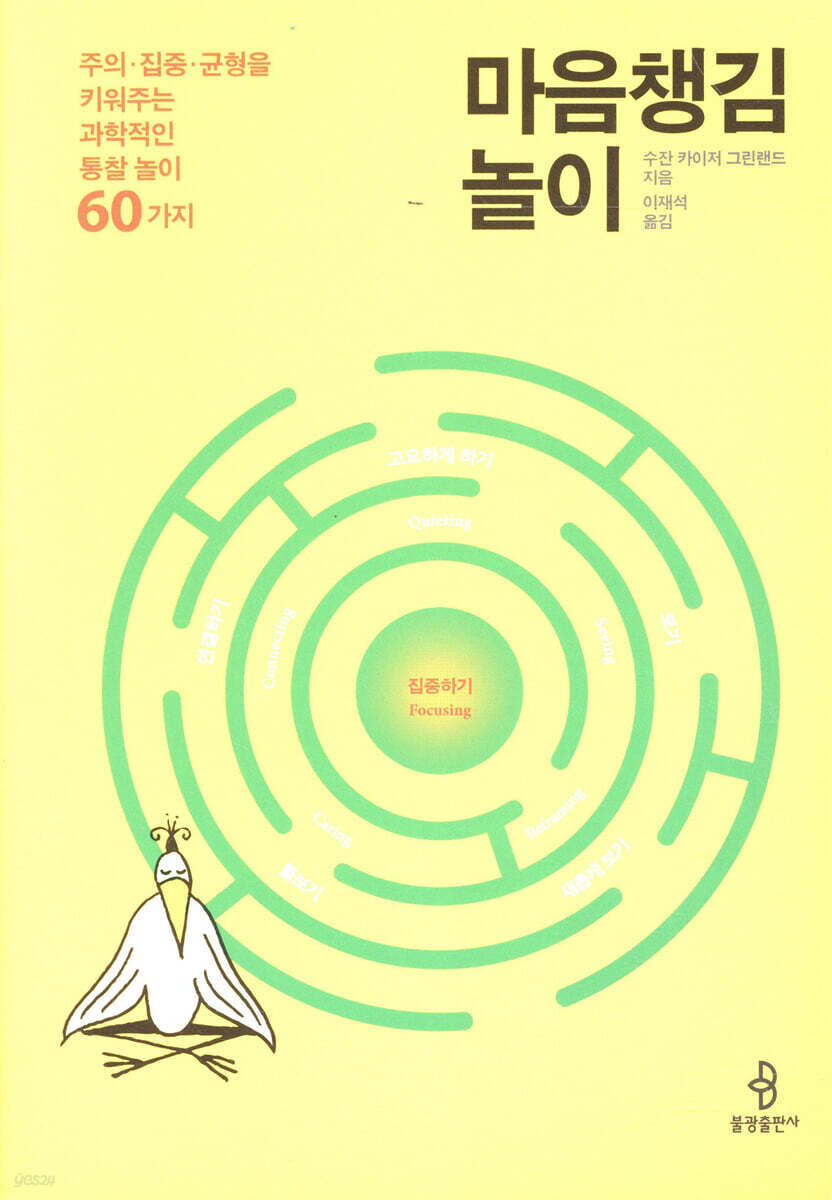
Susan K., a pioneer in children's meditation play programs. Greenland's comprehensive meditation play guide! A practical children's meditation playbook, the first of its kind in Korea! Mindfulness play is a great way for children to develop the ability to focus, regulate their emotions, and respond calmly and warmly to any situation. The 60 activities introduced in this book utilize readily available tools such as breathing, picture books, our bodies, pinwheels, a cup of water, wind, and stars, leading us to practice mindfulness in our daily lives in an easy and fun way. This fun playbook is for kids, but parents can make a difference in their children's lives simply by learning and practicing it first. Because what children see and learn from their parents remains in their hearts forever. |
- You can preview some of the book's contents.
Preview
index
Entering
Feel the play 1 step
Part 1: Keeping Calm
Chapter 1: Breathing Intentionally
Play 2: Focus on your exhalation
Play 3: Zipper Up
Play 4: Breathing with a Pinwheel
Chapter 2: Creating an Anchor to Anchore Attention
Play 5: Shaking the Body
Play 6: Observing the Snowball
Game 7: Tasting an Imaginary Lemon
View Part 2 and See New
Chapter 3: Viewing with an Open Mind
Play 8 Mystery Box
Play 9 Big Picture
Play 10 Duck! Rabbit!
Game 11: Pointing with the Little Finger
Chapter 4: Gratitude Practice
Game 12 Thank the Farmer
Play 13 Gratitude Necklace
Play 14 Three Good Things
Play 15 It's Okay
Chapter 5: Awareness of the Present Moment
Play 16: Waiting Mindfully
Play 17 One Bite at a Time
Focus on Part 3
Chapter 6 Mindful Breathing
Game 18: Observing Inhalation and Exhalation
Play 19: Lullaby
Play 20 Breath Counting
Play 21 Tick tock
Chapter 7: Gathering the Cautions in One Place
Game 22: Drop the Monkey
Play 23: Choosing an Anchor for My Breath
Play 24 Fading Sound
Play 25: Walk Slowly and Silently
Play 26 Balloon Arm
Play 27 Slow like a sloth
Chapter 8: Visualizing a Peaceful Mind
Play 28 Imaginary Hug
Play 29 Sending Good Winds
Play 30 Lullaby with a Good Wind
Play 31 A Good Wish for the Inconvenient
Play 32 Kindness at every step
Chapter 9: Stepping Outside Your Head and Looking
Play 33 Mind, Body, Let's Go!
Play 34 Special Star
Play 35 Butterfly Body Scan
Play 36 Mira's Play
Part 4: Caring
Chapter 10: Asking "Is It Helpful for Me?"
Play 37 Helpful?
Play 38 Stop for a moment and feel your breath.
Play 39 Mindfulness Reminder
Game 40: Melting Ice
Play 41 Awareness Scale
Play 42 “What did you hear?”
Chapter 11: Evenly Spreading Attention
Play 43 Finger Lasso
Play 44 Bobblehead Doll
Play 45 Star View
Play 46 Stay and Observe
Connect Part 5
Chapter 12: Open Mind, Seeing Through a Magnified Lens
Play 47 My Own Soap Bubbles
Play 48 Pass the Cup
Play 49 Hello Play
Play 50 Rewind
Play 51 Three Doors
Play 52 This is not a box
Play 53 Picture in Picture
Chapter 13: The Path to Freedom
Play 54 Wind for the World
Play 55 Five Whys
Play 56 Three Things in Common
Play 57 Surfing
Play 58 Passing the Beat
Play 59 Pink Bubbles
Play 50 But I'm still lucky
Going out
Tips for Leading Mindful Play
FAQ: Mindfulness and Meditation
FAQ: How to Get Started with Mindful Play with Children
FAQ: How to Conduct Mindfulness Play
FAQ: How to overcome obstacles
Acknowledgements
Topic table
Translator's Note
supplement
Feel the play 1 step
Part 1: Keeping Calm
Chapter 1: Breathing Intentionally
Play 2: Focus on your exhalation
Play 3: Zipper Up
Play 4: Breathing with a Pinwheel
Chapter 2: Creating an Anchor to Anchore Attention
Play 5: Shaking the Body
Play 6: Observing the Snowball
Game 7: Tasting an Imaginary Lemon
View Part 2 and See New
Chapter 3: Viewing with an Open Mind
Play 8 Mystery Box
Play 9 Big Picture
Play 10 Duck! Rabbit!
Game 11: Pointing with the Little Finger
Chapter 4: Gratitude Practice
Game 12 Thank the Farmer
Play 13 Gratitude Necklace
Play 14 Three Good Things
Play 15 It's Okay
Chapter 5: Awareness of the Present Moment
Play 16: Waiting Mindfully
Play 17 One Bite at a Time
Focus on Part 3
Chapter 6 Mindful Breathing
Game 18: Observing Inhalation and Exhalation
Play 19: Lullaby
Play 20 Breath Counting
Play 21 Tick tock
Chapter 7: Gathering the Cautions in One Place
Game 22: Drop the Monkey
Play 23: Choosing an Anchor for My Breath
Play 24 Fading Sound
Play 25: Walk Slowly and Silently
Play 26 Balloon Arm
Play 27 Slow like a sloth
Chapter 8: Visualizing a Peaceful Mind
Play 28 Imaginary Hug
Play 29 Sending Good Winds
Play 30 Lullaby with a Good Wind
Play 31 A Good Wish for the Inconvenient
Play 32 Kindness at every step
Chapter 9: Stepping Outside Your Head and Looking
Play 33 Mind, Body, Let's Go!
Play 34 Special Star
Play 35 Butterfly Body Scan
Play 36 Mira's Play
Part 4: Caring
Chapter 10: Asking "Is It Helpful for Me?"
Play 37 Helpful?
Play 38 Stop for a moment and feel your breath.
Play 39 Mindfulness Reminder
Game 40: Melting Ice
Play 41 Awareness Scale
Play 42 “What did you hear?”
Chapter 11: Evenly Spreading Attention
Play 43 Finger Lasso
Play 44 Bobblehead Doll
Play 45 Star View
Play 46 Stay and Observe
Connect Part 5
Chapter 12: Open Mind, Seeing Through a Magnified Lens
Play 47 My Own Soap Bubbles
Play 48 Pass the Cup
Play 49 Hello Play
Play 50 Rewind
Play 51 Three Doors
Play 52 This is not a box
Play 53 Picture in Picture
Chapter 13: The Path to Freedom
Play 54 Wind for the World
Play 55 Five Whys
Play 56 Three Things in Common
Play 57 Surfing
Play 58 Passing the Beat
Play 59 Pink Bubbles
Play 50 But I'm still lucky
Going out
Tips for Leading Mindful Play
FAQ: Mindfulness and Meditation
FAQ: How to Get Started with Mindful Play with Children
FAQ: How to Conduct Mindfulness Play
FAQ: How to overcome obstacles
Acknowledgements
Topic table
Translator's Note
supplement
Detailed image
Into the book
Children desperately need help coping with levels of stress and intense emotions that they find difficult to tolerate.
Mindfulness-based calming tools provide surprisingly immediate relief from the intense emotions that can overwhelm children: anger, surprise, embarrassment, fear, frustration.
When children develop the confidence that they can withstand intense emotions, they will not be intimidated when fearful emotions arise.
--- p.
27
Children often tell me that they don't know how to deal with stress and intense emotions.
At times like this, I think of what Christopher Robin said to his friend Winnie the Pooh.
“You are braver, stronger, and wiser than you think.” But even after sitting on the meditation cushion, I was overcome by strong emotions.
It's a common occurrence.
If children and teens could shift their attention from what's bothering them and focus on what they're feeling in the moment, they could change the situation.
--- p.
28
Children are often taught that in order to solve a problem, they must think deeply about it.
However, when you're stressed or anxious, constantly worrying and ruminating about what's happening can actually intensify your body's stress response.
There's a secret to putting the brakes on an overly sensitive stress response.
It's about noticing the moments when anxious thoughts and feelings arise, the moments when your child's body signals that negative emotions are starting to take over.
ah.
When you notice moments like "I'm feeling bad right now," "I'm getting angry," etc., you can relax your body and gently focus your attention on a simple neutral object (something that doesn't evoke any emotions or thoughts, such as good or bad), as if dropping an anchor.
--- p.
38
The snow particles inside the snowball symbolize the stress and intense emotions we feel.
When you shake the snowball, the white snow particles swirl and the liquid becomes cloudy.
Then, if you leave the snowball alone, the snow particles will settle and gradually become clear.
Through this, children visually experience moving from a state of calm and clarity to a state of being overwhelmed by stress and then back to a state of feeling calm again.
The 'Snowball Observation' game helps us understand what is happening in our bodies and minds by relating it to visual experiences.
--- p.
45
When children and teens can become comfortable with the fact that they don't have all the answers yet, they can transform the negative feelings that often accompany not knowing into positive ones.
If children let go of the need to have an immediate answer, they can respond more calmly to whatever happens.
Mindfulness-based calming tools provide surprisingly immediate relief from the intense emotions that can overwhelm children: anger, surprise, embarrassment, fear, frustration.
When children develop the confidence that they can withstand intense emotions, they will not be intimidated when fearful emotions arise.
--- p.
27
Children often tell me that they don't know how to deal with stress and intense emotions.
At times like this, I think of what Christopher Robin said to his friend Winnie the Pooh.
“You are braver, stronger, and wiser than you think.” But even after sitting on the meditation cushion, I was overcome by strong emotions.
It's a common occurrence.
If children and teens could shift their attention from what's bothering them and focus on what they're feeling in the moment, they could change the situation.
--- p.
28
Children are often taught that in order to solve a problem, they must think deeply about it.
However, when you're stressed or anxious, constantly worrying and ruminating about what's happening can actually intensify your body's stress response.
There's a secret to putting the brakes on an overly sensitive stress response.
It's about noticing the moments when anxious thoughts and feelings arise, the moments when your child's body signals that negative emotions are starting to take over.
ah.
When you notice moments like "I'm feeling bad right now," "I'm getting angry," etc., you can relax your body and gently focus your attention on a simple neutral object (something that doesn't evoke any emotions or thoughts, such as good or bad), as if dropping an anchor.
--- p.
38
The snow particles inside the snowball symbolize the stress and intense emotions we feel.
When you shake the snowball, the white snow particles swirl and the liquid becomes cloudy.
Then, if you leave the snowball alone, the snow particles will settle and gradually become clear.
Through this, children visually experience moving from a state of calm and clarity to a state of being overwhelmed by stress and then back to a state of feeling calm again.
The 'Snowball Observation' game helps us understand what is happening in our bodies and minds by relating it to visual experiences.
--- p.
45
When children and teens can become comfortable with the fact that they don't have all the answers yet, they can transform the negative feelings that often accompany not knowing into positive ones.
If children let go of the need to have an immediate answer, they can respond more calmly to whatever happens.
--- p.
57
57
Publisher's Review
Can Children and Adolescents Meditate?
Overcoming Prejudices About Meditation
"Hmm… I understand meditation is good, but can children who can't sit still for even a moment really meditate? The intention is good, but will it actually be effective?"
This is a common misconception about meditation.
Susan Kaiser's book shatters that stereotype.
The author, who was a lawyer but has been passionate about researching children's meditation programs based on personal experience, has completed an easy and fun play meditation book based on a wealth of data and information.
The book's scientific meditation play credibility was enhanced through field experience in Los Angeles public schools and advice and consultation from renowned psychologists, doctors, educators, and Tibetan monks.
Mindfulness (meditation) is already a useful tool used by many people in the West to care for their lives with wisdom and compassion in their daily lives.
Although it is widely used by artists, sports figures, businesspeople, students, and clergy, children and adolescents in particular tend to be excluded.
This was because of the stereotype that meditation was about sitting still and that children could not do it.
But children just can't stand sitting around and 'doing nothing'.
Meditation gives us new thoughts (wisdom) and allows us to look at ourselves and the world from a different perspective.
Discovering new things! This isn't something curious children dislike, it's their favorite thing.
In fact, the author has witnessed children adapt amazingly well and even transform their daily lives through the meditation play he developed in the educational field.
Breath, a glass of water, a piece of ice, a star, the wind
Easy and fun game to play
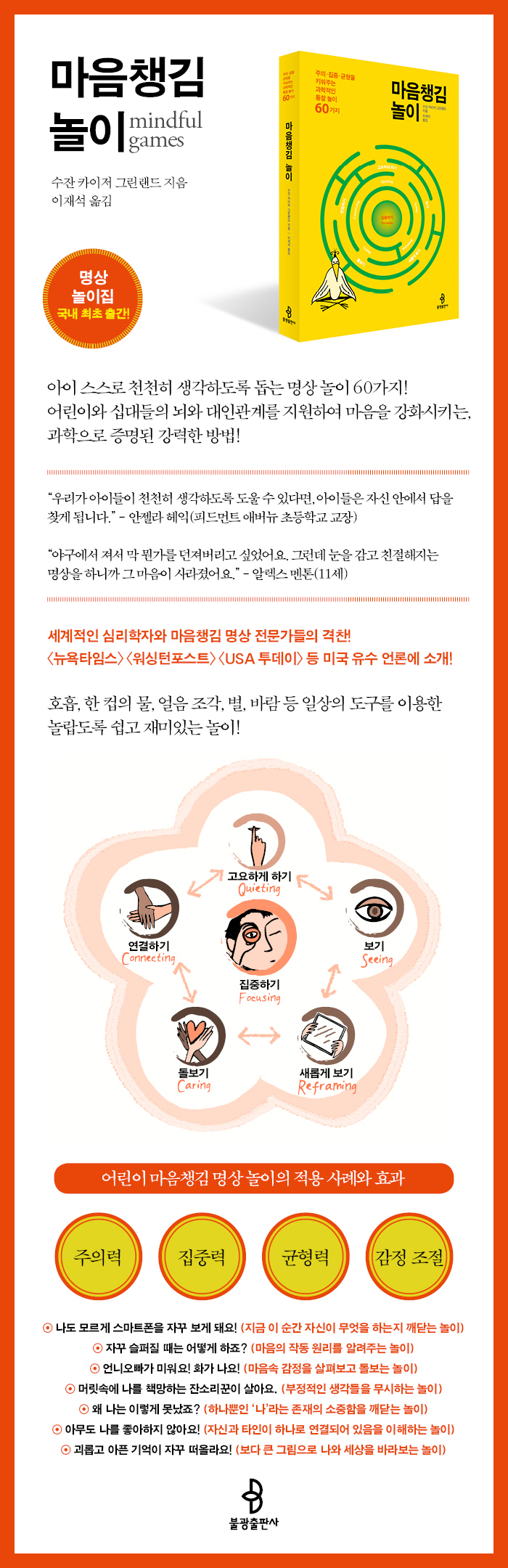
Developing 6 Life Skills
Mindfulness play is a great way for children to develop the ability to focus, regulate their emotions, and respond calmly and warmly to any situation.
This book, Mindful Games, focuses on six of these life skills.
There are six of them: Focusing, Quieting, Seeing, Reframing, Caring, and Connecting.
When you focus your attention on your present moment experience (the feeling of your breathing, the sounds around you, etc.), your mind becomes quiet.
→ When your mind becomes calm, you create a space in your head where you can see what is happening now more clearly.
→ When you become aware of what is happening in your body and mind, you can use the bodily sensations (such as “I’m feeling restless right now” or “my heart is pounding”) as signals to stop and reflect rather than immediately expressing them in words or actions.
→ Through this process, the so-called 'automatic reactivity', which is the immediate response to one's bodily sensations with words and actions, is reduced, and this allows one to become more clearly aware of what is happening inside and outside of oneself.
It is about being able to respond to the situations you find yourself in with wisdom, compassion, generosity, and flexibility.
→ If children can see that all moments are connected and that they cause and condition each other like a web, the qualities of the mind to care and connect will naturally flow out.
The greatest gift parents can give their children is
It is the ability to control one's own mind.
This book allows you to experience six life skills through 60 games.
The tools used in the play are things that can be easily encountered around us, such as breathing, picture books, our bodies, pinwheels, a cup of water, wind, and stars.
These familiar tools make practicing mindfulness in everyday life easy and fun.
Ultimately, what the author wants to teach children through mindfulness and meditation is the 'path to freedom.'
It is not a path about 'victory, achievement, and showing off.'
Not losing your vitality in any situation (all the difficulties you face while growing up).
And at any moment in life—even in each breath and each step—you learn to discover mystery and joy.
Perhaps the greatest gift parents and caregivers can give their children during these precious and crucial years of life—childhood and adolescence—is the ability to view themselves and the world with warmth.
『Mindfulness Play』 will be a good guide to developing that ability.
Overcoming Prejudices About Meditation
"Hmm… I understand meditation is good, but can children who can't sit still for even a moment really meditate? The intention is good, but will it actually be effective?"
This is a common misconception about meditation.
Susan Kaiser's book shatters that stereotype.
The author, who was a lawyer but has been passionate about researching children's meditation programs based on personal experience, has completed an easy and fun play meditation book based on a wealth of data and information.
The book's scientific meditation play credibility was enhanced through field experience in Los Angeles public schools and advice and consultation from renowned psychologists, doctors, educators, and Tibetan monks.
Mindfulness (meditation) is already a useful tool used by many people in the West to care for their lives with wisdom and compassion in their daily lives.
Although it is widely used by artists, sports figures, businesspeople, students, and clergy, children and adolescents in particular tend to be excluded.
This was because of the stereotype that meditation was about sitting still and that children could not do it.
But children just can't stand sitting around and 'doing nothing'.
Meditation gives us new thoughts (wisdom) and allows us to look at ourselves and the world from a different perspective.
Discovering new things! This isn't something curious children dislike, it's their favorite thing.
In fact, the author has witnessed children adapt amazingly well and even transform their daily lives through the meditation play he developed in the educational field.
Breath, a glass of water, a piece of ice, a star, the wind
Easy and fun game to play
Developing 6 Life Skills
Mindfulness play is a great way for children to develop the ability to focus, regulate their emotions, and respond calmly and warmly to any situation.
This book, Mindful Games, focuses on six of these life skills.
There are six of them: Focusing, Quieting, Seeing, Reframing, Caring, and Connecting.
When you focus your attention on your present moment experience (the feeling of your breathing, the sounds around you, etc.), your mind becomes quiet.
→ When your mind becomes calm, you create a space in your head where you can see what is happening now more clearly.
→ When you become aware of what is happening in your body and mind, you can use the bodily sensations (such as “I’m feeling restless right now” or “my heart is pounding”) as signals to stop and reflect rather than immediately expressing them in words or actions.
→ Through this process, the so-called 'automatic reactivity', which is the immediate response to one's bodily sensations with words and actions, is reduced, and this allows one to become more clearly aware of what is happening inside and outside of oneself.
It is about being able to respond to the situations you find yourself in with wisdom, compassion, generosity, and flexibility.
→ If children can see that all moments are connected and that they cause and condition each other like a web, the qualities of the mind to care and connect will naturally flow out.
The greatest gift parents can give their children is
It is the ability to control one's own mind.
This book allows you to experience six life skills through 60 games.
The tools used in the play are things that can be easily encountered around us, such as breathing, picture books, our bodies, pinwheels, a cup of water, wind, and stars.
These familiar tools make practicing mindfulness in everyday life easy and fun.
Ultimately, what the author wants to teach children through mindfulness and meditation is the 'path to freedom.'
It is not a path about 'victory, achievement, and showing off.'
Not losing your vitality in any situation (all the difficulties you face while growing up).
And at any moment in life—even in each breath and each step—you learn to discover mystery and joy.
Perhaps the greatest gift parents and caregivers can give their children during these precious and crucial years of life—childhood and adolescence—is the ability to view themselves and the world with warmth.
『Mindfulness Play』 will be a good guide to developing that ability.
GOODS SPECIFICS
- Date of publication: October 15, 2018
- Page count, weight, size: 275 pages | 396g | 150*210*17mm
- ISBN13: 9788974794743
- ISBN10: 8974794748
You may also like
카테고리
korean


korean

![GQ KOREA Mark (Monthly): December [2025]](http://librairie.coreenne.fr/cdn/shop/files/8ef265dbbfbf186523ed75ba7319009d.jpg?v=1765340328&width=3840)


