

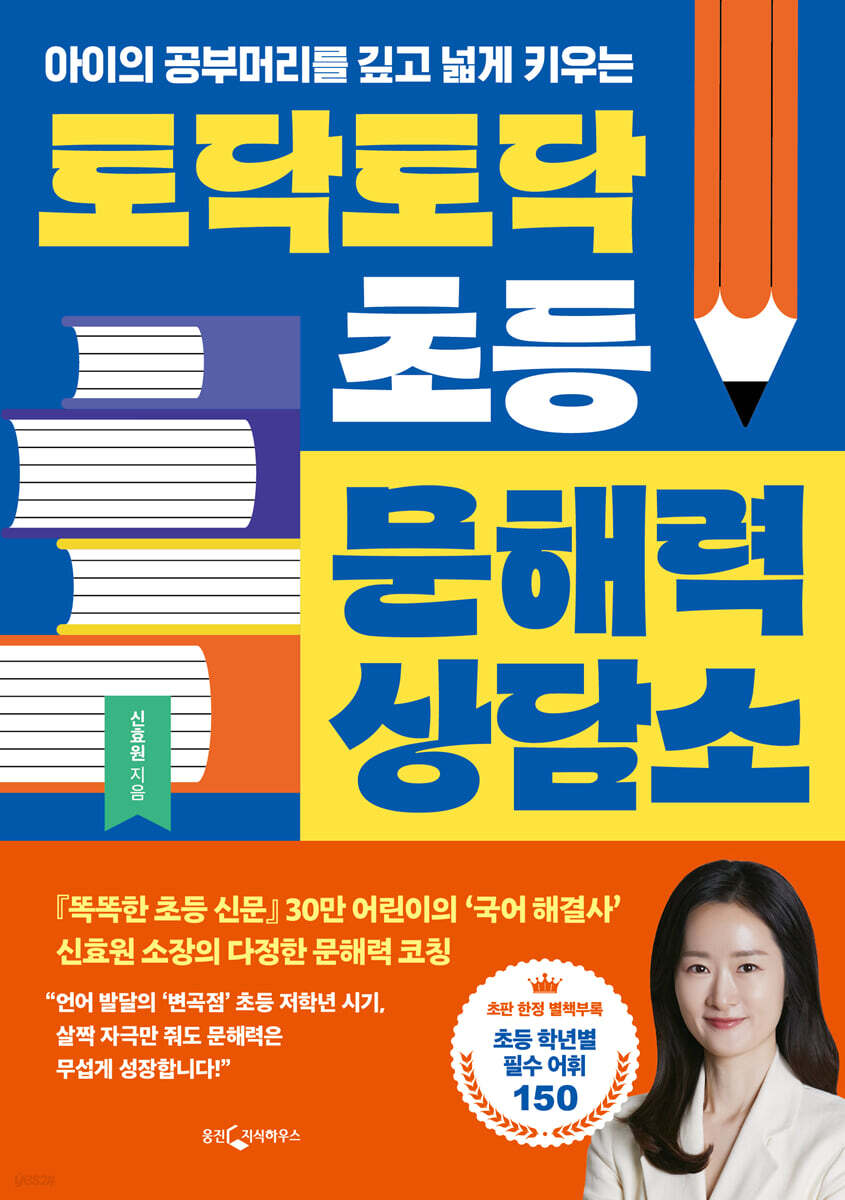
Todak Todak Elementary Literacy Counseling Center
 |
Description
Book Introduction
"Smart Elementary Newspaper": A "Korean Language Solver" for 300,000 Children
Director Shin Hyo-won's compassionate and clear literacy coaching
Vocabulary, reading skills, writing and speaking, Chinese characters…
The 6th year of elementary school is a critical period for literacy development.
How to Develop Lifelong Language Skills
“You need to read a lot to improve your literacy and study well.” This is something that parents have heard countless times these days.
Looking at it this way, it seems like improving literacy isn't that difficult.
But unfortunately, reality often flows differently.
One day, out of the blue, a child will not even look at a book, and although parents were proud of having their children read a lot, they are devastated when they see that their child's literacy skills are riddled with holes now that they are in the upper grades.
"They say reading a lot improves literacy, right? But why can't I even understand the problem? What should I do in this situation?"
Shin Hyo-won, director of the Children's Language Research Institute, who has been trusted as a "literacy mentor for 300,000 elementary school readers" by publishing numerous books including the "Smart Elementary Newspaper" series, a must-read for elementary school students, wrote "Todak Todak Elementary Literacy Counseling Center" after thinking about the numerous questions about literacy that parents ask at lecture halls.
This book contains detailed learning methods and guides that evenly develop the five Korean language skills of vocabulary, reading, writing, speaking, and Chinese characters, including the principles of literacy that must be known during elementary school, the "golden time" for language development. It will serve as a loving guide for children on their journey to read and write to their heart's content and develop their study skills.
Director Shin Hyo-won's compassionate and clear literacy coaching
Vocabulary, reading skills, writing and speaking, Chinese characters…
The 6th year of elementary school is a critical period for literacy development.
How to Develop Lifelong Language Skills
“You need to read a lot to improve your literacy and study well.” This is something that parents have heard countless times these days.
Looking at it this way, it seems like improving literacy isn't that difficult.
But unfortunately, reality often flows differently.
One day, out of the blue, a child will not even look at a book, and although parents were proud of having their children read a lot, they are devastated when they see that their child's literacy skills are riddled with holes now that they are in the upper grades.
"They say reading a lot improves literacy, right? But why can't I even understand the problem? What should I do in this situation?"
Shin Hyo-won, director of the Children's Language Research Institute, who has been trusted as a "literacy mentor for 300,000 elementary school readers" by publishing numerous books including the "Smart Elementary Newspaper" series, a must-read for elementary school students, wrote "Todak Todak Elementary Literacy Counseling Center" after thinking about the numerous questions about literacy that parents ask at lecture halls.
This book contains detailed learning methods and guides that evenly develop the five Korean language skills of vocabulary, reading, writing, speaking, and Chinese characters, including the principles of literacy that must be known during elementary school, the "golden time" for language development. It will serve as a loving guide for children on their journey to read and write to their heart's content and develop their study skills.
- You can preview some of the book's contents.
Preview
index
Introduction | Will reading a lot of books automatically improve literacy?
PART 1.
Principles of Elementary Literacy That Parents Must Know
The first condition of literacy: 'reading fluency'
As students advance in grade level, their reading habits must also change.
The power of 'reading while asking questions' is 100 times more powerful than reading alone.
The power to use it exactly when needed is true vocabulary.
Vocabulary sensitivity cannot be developed by reading books alone.
Writing, a neglected skill, is crucial for improving literacy.
The Hidden Weapon of Literate Children: Speaking with Context
[Before school, I wonder about this!]
PART 2.
Lower Elementary School: Laying the Foundation for Lifelong Language Skills
A turning point in language development: age nine
The amount of vocabulary you learn from ○○ is 10 times that of reading a book.
If you are a child who closes a book because of a word you don't know,
How to Start Learning Tricky Abstract Words
Do you know the unexpected reason why you hate reading?
Discovering Hidden Reading Abilities with "Reader Identity"
Parents' words that stimulate their children's desire to read
Too many choices are poisoning your reading skills.
Educational comics should be avoided for children ages 8 to 10.
Underlining is a great way to keep what you read in your head.
Start your 'deep reading' with six questions.
Excessive post-reading activities tire out children.
The power of one sentence starting at age eight
Why We Need to Move Away from Simple Associative Writing
10-Minute Daily Writing Practice That Produces "Coherent" Writing
A child who hates writing needs this kind of response.
The true meaning hidden in neat handwriting
Are there differences in writing depending on gender?
[Elementary School Grades 1-3, I'm curious about this!]
PART 3.
Upper Elementary School: Developing Literacy and Broadening Your Study Ability
Why do children who read a lot have poor vocabulary?
How to Use the Word Expansion Tool and Dictionary Properly
Learning complex Chinese vocabulary, slowly and smoothly
How to Reconnect with Books in Upper Elementary School
Small 'reading growth' builds literacy.
If your child asks why he or she should read books,
'Speech Bubble': Evoking Endless Thoughts
Creating a tight "reading net" that connects the pieces of knowledge in your head
During a busy semester, read 'short, thick, and frequent' for 10 minutes a day.
The practice of reading without giving up, reading one book at a time.
Boys vs. Girls: Different Reading Styles for Interest
If you're in 4th grade, stop writing meaningless things.
Practice writing solid sentences starting with connective endings
It may seem trivial, but it's really important to use conjunctions correctly.
Repeating the same expressions: how to fix it
An essential part of upper-grade writing: organizing content according to structure.
The secret to a child's reading and writing skills: Creating a "mind map."
Parents Who Only Read vs. Parents Who Share Their Hearts
[Elementary School 4th-6th Graders, I'm curious about this!]
PART 4.
A list of books suitable for your child's personality
Why You Should Read "Relevant" Books Instead of Recommended Books
Before school, this book at this time
Elementary school grades 1-3, this book for this time
Elementary school grades 4-6, this book for this time
References
PART 1.
Principles of Elementary Literacy That Parents Must Know
The first condition of literacy: 'reading fluency'
As students advance in grade level, their reading habits must also change.
The power of 'reading while asking questions' is 100 times more powerful than reading alone.
The power to use it exactly when needed is true vocabulary.
Vocabulary sensitivity cannot be developed by reading books alone.
Writing, a neglected skill, is crucial for improving literacy.
The Hidden Weapon of Literate Children: Speaking with Context
[Before school, I wonder about this!]
PART 2.
Lower Elementary School: Laying the Foundation for Lifelong Language Skills
A turning point in language development: age nine
The amount of vocabulary you learn from ○○ is 10 times that of reading a book.
If you are a child who closes a book because of a word you don't know,
How to Start Learning Tricky Abstract Words
Do you know the unexpected reason why you hate reading?
Discovering Hidden Reading Abilities with "Reader Identity"
Parents' words that stimulate their children's desire to read
Too many choices are poisoning your reading skills.
Educational comics should be avoided for children ages 8 to 10.
Underlining is a great way to keep what you read in your head.
Start your 'deep reading' with six questions.
Excessive post-reading activities tire out children.
The power of one sentence starting at age eight
Why We Need to Move Away from Simple Associative Writing
10-Minute Daily Writing Practice That Produces "Coherent" Writing
A child who hates writing needs this kind of response.
The true meaning hidden in neat handwriting
Are there differences in writing depending on gender?
[Elementary School Grades 1-3, I'm curious about this!]
PART 3.
Upper Elementary School: Developing Literacy and Broadening Your Study Ability
Why do children who read a lot have poor vocabulary?
How to Use the Word Expansion Tool and Dictionary Properly
Learning complex Chinese vocabulary, slowly and smoothly
How to Reconnect with Books in Upper Elementary School
Small 'reading growth' builds literacy.
If your child asks why he or she should read books,
'Speech Bubble': Evoking Endless Thoughts
Creating a tight "reading net" that connects the pieces of knowledge in your head
During a busy semester, read 'short, thick, and frequent' for 10 minutes a day.
The practice of reading without giving up, reading one book at a time.
Boys vs. Girls: Different Reading Styles for Interest
If you're in 4th grade, stop writing meaningless things.
Practice writing solid sentences starting with connective endings
It may seem trivial, but it's really important to use conjunctions correctly.
Repeating the same expressions: how to fix it
An essential part of upper-grade writing: organizing content according to structure.
The secret to a child's reading and writing skills: Creating a "mind map."
Parents Who Only Read vs. Parents Who Share Their Hearts
[Elementary School 4th-6th Graders, I'm curious about this!]
PART 4.
A list of books suitable for your child's personality
Why You Should Read "Relevant" Books Instead of Recommended Books
Before school, this book at this time
Elementary school grades 1-3, this book for this time
Elementary school grades 4-6, this book for this time
References
Detailed image

Into the book
But unfortunately, reality often flows differently.
There are children who show no interest in books at all, and there are days when a child who used to read well suddenly stops looking at a book, and even though you were proud of making your child read a lot, you are faced with the fact that your child's vocabulary and literacy skills are ridiculously low as he or she enters the upper grades.
"They say reading a lot improves literacy? They say grades go up? I've diligently read only the recommended books, so why can't I even understand the material? What should I do? Should I take my child to the library more often? Should I sit them down and read a page at a time?" These are the questions I hear most frequently from parents I meet at lectures.
They say that 'literacy = grades', and that if you read a lot of books, literacy will naturally improve, so they did that, but if it seems like their child's literacy is actually getting worse, parents can't help but feel anxious.
--- From "Introductory Remarks"
At least from the third grade, you should start practicing writing a piece with a certain structure.
Children who reported poor literacy despite extensive writing were likely stuck in simple associative writing.
Writing is hard and boring, so it's easy to think that you have to write freely and with 'interest' to be able to write even one sentence, but middle school and older children don't find it very fun to use their imaginations without logic.
Even lower grades can surprisingly perform writing tasks at a high level of development, so writing that goes beyond simple associative writing is essential.
--- From "Writing, which is often overlooked, is crucial for improving literacy"
It is certainly important to know a lot of abstract words, but that doesn't mean you can just memorize them like English words.
Because it is neither fun nor meaningful, it does not stay in your memory for long.
So how should you start studying abstract language? Here, I'll share a method for studying abstract language that can be done consistently, from elementary to high school, whenever you have time.
The list of abstract words on the left is a list of abstract words that appear in first grade elementary school textbooks, categorized by difficulty.
From now on, we will guide you to learn the presented abstract words through the abstract word quiz, fill-in-the-blank, vocabulary mind map, and metaphor.
--- From "Learning Difficult Abstract Languages: Here's How to Start"
'I guess the book isn't interesting.'
'I need to find an interesting book.'
'Everyone says this book is fun to read, but my child doesn't read it.'
"Can I not read it like this? I feel like I should read something."
'You read educational comics? It's better than not reading anything, right?
Let's read this at least.'
These thoughts are probably running wild in your parents' heads.
We usually assume that once we learn Hangul, we won't have much trouble reading books.
For this reason, the reason why children do not read books is often attributed to ‘interest’ or ‘reading habits.’
However, the reason why children do not want to read books is not because they are ‘not fun’ but because they are ‘difficult to read’.
Difficult to read means 'not understood'.
Even though I know Korean, why is it so difficult to understand the content of a book? Let's examine two factors that directly impact reading comprehension and explore solutions.
--- From "Do you know the unexpected reason why you hate reading?"
So, if it's truly an educational comic, is it okay to read a lot of it? Can I let my children read it whenever they want? Every time I give a lecture, I get a barrage of questions about educational comics, and most of them are concerned that their children are completely absorbed in them.
I always advise that we make it clear to children that reading educational comics is not reading.
Along with this, I often tell children who only read educational comics that they should be regulated to read for a set amount of time, like a game.
It's best to hold off on introducing educational comics until your child feels more comfortable with written language, around the age of 8 to 10, a critical point in language development.
If you get used to educational comics before you even begin to think, "Oh, reading books isn't that hard," you won't be able to naturally become familiar with the text.
--- From "Educational comics should be avoided for children aged 8 to 10"
How can we cultivate the habit of deep reading, examining every nook and cranny of a book as if taking an X-ray? The key is questioning.
You need to subtly let them know that you should read the book while asking these questions.
Readers who have not learned to ask questions simply follow the text.
Reading that you just accept with an 'I see' doesn't leave a deep mark on your mind.
Ask your child one or two of the questions on the right to help them expand their thinking as they read.
This question can be applied to all grades, from elementary to high school.
--- From "Starting to Read Deeply with Six Questions"
Q.
Is it true that reading from cover to cover or from beginning to end is the only way to improve literacy?
Surprisingly, many parents ask this question.
Is it okay to read another book before finishing the one I'm currently reading? If I don't read the whole thing, won't I be able to improve my literacy skills? There's no set answer.
Everyone has different situations and ways of reading books, so it's impossible to say for sure that 'this is right and that is wrong.'
You can read it all, or you can stop reading this book and start reading that book.
I just wish we didn't force children to read it all.
There is also the pressure that once you start reading a book, you must finish it.
If parents set a daily reading volume, regardless of whether the content is continuous or not, and make children read it over several months according to their wishes, children will feel burdened even to start reading.
Even if you read it all the way through, you'll probably just skim through the scenes and fill up the reading quota.
There are children who show no interest in books at all, and there are days when a child who used to read well suddenly stops looking at a book, and even though you were proud of making your child read a lot, you are faced with the fact that your child's vocabulary and literacy skills are ridiculously low as he or she enters the upper grades.
"They say reading a lot improves literacy? They say grades go up? I've diligently read only the recommended books, so why can't I even understand the material? What should I do? Should I take my child to the library more often? Should I sit them down and read a page at a time?" These are the questions I hear most frequently from parents I meet at lectures.
They say that 'literacy = grades', and that if you read a lot of books, literacy will naturally improve, so they did that, but if it seems like their child's literacy is actually getting worse, parents can't help but feel anxious.
--- From "Introductory Remarks"
At least from the third grade, you should start practicing writing a piece with a certain structure.
Children who reported poor literacy despite extensive writing were likely stuck in simple associative writing.
Writing is hard and boring, so it's easy to think that you have to write freely and with 'interest' to be able to write even one sentence, but middle school and older children don't find it very fun to use their imaginations without logic.
Even lower grades can surprisingly perform writing tasks at a high level of development, so writing that goes beyond simple associative writing is essential.
--- From "Writing, which is often overlooked, is crucial for improving literacy"
It is certainly important to know a lot of abstract words, but that doesn't mean you can just memorize them like English words.
Because it is neither fun nor meaningful, it does not stay in your memory for long.
So how should you start studying abstract language? Here, I'll share a method for studying abstract language that can be done consistently, from elementary to high school, whenever you have time.
The list of abstract words on the left is a list of abstract words that appear in first grade elementary school textbooks, categorized by difficulty.
From now on, we will guide you to learn the presented abstract words through the abstract word quiz, fill-in-the-blank, vocabulary mind map, and metaphor.
--- From "Learning Difficult Abstract Languages: Here's How to Start"
'I guess the book isn't interesting.'
'I need to find an interesting book.'
'Everyone says this book is fun to read, but my child doesn't read it.'
"Can I not read it like this? I feel like I should read something."
'You read educational comics? It's better than not reading anything, right?
Let's read this at least.'
These thoughts are probably running wild in your parents' heads.
We usually assume that once we learn Hangul, we won't have much trouble reading books.
For this reason, the reason why children do not read books is often attributed to ‘interest’ or ‘reading habits.’
However, the reason why children do not want to read books is not because they are ‘not fun’ but because they are ‘difficult to read’.
Difficult to read means 'not understood'.
Even though I know Korean, why is it so difficult to understand the content of a book? Let's examine two factors that directly impact reading comprehension and explore solutions.
--- From "Do you know the unexpected reason why you hate reading?"
So, if it's truly an educational comic, is it okay to read a lot of it? Can I let my children read it whenever they want? Every time I give a lecture, I get a barrage of questions about educational comics, and most of them are concerned that their children are completely absorbed in them.
I always advise that we make it clear to children that reading educational comics is not reading.
Along with this, I often tell children who only read educational comics that they should be regulated to read for a set amount of time, like a game.
It's best to hold off on introducing educational comics until your child feels more comfortable with written language, around the age of 8 to 10, a critical point in language development.
If you get used to educational comics before you even begin to think, "Oh, reading books isn't that hard," you won't be able to naturally become familiar with the text.
--- From "Educational comics should be avoided for children aged 8 to 10"
How can we cultivate the habit of deep reading, examining every nook and cranny of a book as if taking an X-ray? The key is questioning.
You need to subtly let them know that you should read the book while asking these questions.
Readers who have not learned to ask questions simply follow the text.
Reading that you just accept with an 'I see' doesn't leave a deep mark on your mind.
Ask your child one or two of the questions on the right to help them expand their thinking as they read.
This question can be applied to all grades, from elementary to high school.
--- From "Starting to Read Deeply with Six Questions"
Q.
Is it true that reading from cover to cover or from beginning to end is the only way to improve literacy?
Surprisingly, many parents ask this question.
Is it okay to read another book before finishing the one I'm currently reading? If I don't read the whole thing, won't I be able to improve my literacy skills? There's no set answer.
Everyone has different situations and ways of reading books, so it's impossible to say for sure that 'this is right and that is wrong.'
You can read it all, or you can stop reading this book and start reading that book.
I just wish we didn't force children to read it all.
There is also the pressure that once you start reading a book, you must finish it.
If parents set a daily reading volume, regardless of whether the content is continuous or not, and make children read it over several months according to their wishes, children will feel burdened even to start reading.
Even if you read it all the way through, you'll probably just skim through the scenes and fill up the reading quota.
--- From "Elementary School 4th to 6th Graders, I'm curious about this!"
Publisher's Review
“Will literacy develop naturally if we read a lot of books?”
The more parents are 'all-in' on reading,
Essential Principles of Elementary Literacy
"I've been reading diligently since I was little, so why can't I even understand the questions?" "They say reading a lot improves literacy, right? But why is my vocabulary so poor?"
This is the question that Shin Hyo-won, the director of the Children's Language Research Institute and author of the best-selling book "Smart Elementary Newspaper" and known as a "literacy mentor" among elementary school mothers, receives most frequently during her lectures.
Contrary to popular belief, literacy skills do not automatically improve simply by reading books. This is because literacy is a comprehensive language ability that is developed through the balanced interaction of reading, writing, speaking, and listening.
The process of listening, understanding, and then speaking stimulates cognitive thinking processes, which influence reading and writing.
Therefore, if a child usually speaks slurredly, it is likely that his or her overall literacy skills will also be low.
In other words, literacy is something that can only be clearly demonstrated when a child's overall language ability is developed evenly, not just in a specific area.
Another thing to remember is that literacy skills develop in different ways depending on the child's temperament and environment, and at each moment as the child grows.
This is understandable, considering that children can change their temperament more than ten times as they grow, but most parents mistakenly assume that once a child develops literacy habits, they will last forever.
"Todak Todak Elementary Literacy Counseling Center" clearly points out misconceptions and misunderstandings about literacy, while also providing kind advice to anxious and confused parents by presenting the seven principles of literacy that children must know during elementary school.
“The 6th year of elementary school is the ‘golden time’ for language development.
“With just a little stimulation, literacy skills can grow dramatically!”
Vocabulary, reading, writing, speaking, Chinese characters,
A clear prescription for literacy that evenly develops the five national language skills.
The sixth year of elementary school is a 'turning point' in language development and is effectively the last opportunity, so it is no exaggeration to say that the foundation of a child's language is formed during this time.
This book is packed with literacy prescriptions that evenly develop the 'five Korean language skills' - vocabulary, reading, writing, speaking, and Chinese characters - during the crucial elementary school period.
First, we introduce various methods for learning and storing vocabulary, such as vocabulary mind maps, fill-in-the-blanks, and abstract word quizzes, for elementary school students who are laying the foundation for lifelong language skills.
In addition, reading strategies that bring out hidden reading comprehension skills, highly effective post-reading activities, and 10-minute daily writing training that produces coherent writing are presented with detailed examples and activity guides.
Meanwhile, for older students, where literacy is linked to academic ability, a more advanced learning method is suggested.
These include strategies for expanding one's vocabulary, slowly learning the 6,000-character vocabulary, and getting closer to books again during the exciting period of adolescence.
In addition, it contains detailed reading guides for each situation, such as 'Reading briefly and boldly for 10 minutes a day' and 'Reading a book with long breaths', as well as tips for storing and connecting information in the head to create a tight 'reading net', and text structuring exercises essential for writing in higher grades.
In addition, we have compiled 13 questions about literacy that parents frequently ask during offline lectures so that you can refer to them when guiding your children.
By following the specific learning methods contained throughout the book, parents' hearts will feel much lighter and their children's literacy skills will be firmly established.
“Rather than recommending books tailored to the level of the child next door,
“Please let my child read ‘appropriate books’ that suit his or her personality!”
From preschool to upper elementary school,
Includes a list of 245 books suitable for each stage and type.
For parents who want to choose good books for their children, 'must-read' books selected by experts or specific organizations are an important reference.
But looking at the list of recommended books lined up so proudly, I feel a sense of discomfort.
Even if you just glance at the title, it seems like the level is so high that it feels like our child won't be able to even touch it.
In fact, recommended books are often based on the personal judgment of the person selecting them rather than the children's tendencies or interests.
For this reason, Director Shin Hyo-won recommends that elementary school students read “appropriate books” instead of recommended books.
Rather than receiving a badge of honor for having read a certain book, the most important thing is to build positive experiences with books by reading books that match your level, inclination, and interests, asking questions, and sharing your thoughts.
This book introduces 245 books that are good to read by type and situation, from preschool to upper elementary school.
Let's choose the right book for our children now and give them the most enjoyable reading experience in the world, such as 'Books for children who wander while reading', 'Good books to challenge when starting to read independently', 'Good books to get answers from children who always say they don't know', 'Good books to read lightly for 10 minutes a day and get them thinking'.
Before you know it, your child's literacy skills will shine brightly as they grow.
The more parents are 'all-in' on reading,
Essential Principles of Elementary Literacy
"I've been reading diligently since I was little, so why can't I even understand the questions?" "They say reading a lot improves literacy, right? But why is my vocabulary so poor?"
This is the question that Shin Hyo-won, the director of the Children's Language Research Institute and author of the best-selling book "Smart Elementary Newspaper" and known as a "literacy mentor" among elementary school mothers, receives most frequently during her lectures.
Contrary to popular belief, literacy skills do not automatically improve simply by reading books. This is because literacy is a comprehensive language ability that is developed through the balanced interaction of reading, writing, speaking, and listening.
The process of listening, understanding, and then speaking stimulates cognitive thinking processes, which influence reading and writing.
Therefore, if a child usually speaks slurredly, it is likely that his or her overall literacy skills will also be low.
In other words, literacy is something that can only be clearly demonstrated when a child's overall language ability is developed evenly, not just in a specific area.
Another thing to remember is that literacy skills develop in different ways depending on the child's temperament and environment, and at each moment as the child grows.
This is understandable, considering that children can change their temperament more than ten times as they grow, but most parents mistakenly assume that once a child develops literacy habits, they will last forever.
"Todak Todak Elementary Literacy Counseling Center" clearly points out misconceptions and misunderstandings about literacy, while also providing kind advice to anxious and confused parents by presenting the seven principles of literacy that children must know during elementary school.
“The 6th year of elementary school is the ‘golden time’ for language development.
“With just a little stimulation, literacy skills can grow dramatically!”
Vocabulary, reading, writing, speaking, Chinese characters,
A clear prescription for literacy that evenly develops the five national language skills.
The sixth year of elementary school is a 'turning point' in language development and is effectively the last opportunity, so it is no exaggeration to say that the foundation of a child's language is formed during this time.
This book is packed with literacy prescriptions that evenly develop the 'five Korean language skills' - vocabulary, reading, writing, speaking, and Chinese characters - during the crucial elementary school period.
First, we introduce various methods for learning and storing vocabulary, such as vocabulary mind maps, fill-in-the-blanks, and abstract word quizzes, for elementary school students who are laying the foundation for lifelong language skills.
In addition, reading strategies that bring out hidden reading comprehension skills, highly effective post-reading activities, and 10-minute daily writing training that produces coherent writing are presented with detailed examples and activity guides.
Meanwhile, for older students, where literacy is linked to academic ability, a more advanced learning method is suggested.
These include strategies for expanding one's vocabulary, slowly learning the 6,000-character vocabulary, and getting closer to books again during the exciting period of adolescence.
In addition, it contains detailed reading guides for each situation, such as 'Reading briefly and boldly for 10 minutes a day' and 'Reading a book with long breaths', as well as tips for storing and connecting information in the head to create a tight 'reading net', and text structuring exercises essential for writing in higher grades.
In addition, we have compiled 13 questions about literacy that parents frequently ask during offline lectures so that you can refer to them when guiding your children.
By following the specific learning methods contained throughout the book, parents' hearts will feel much lighter and their children's literacy skills will be firmly established.
“Rather than recommending books tailored to the level of the child next door,
“Please let my child read ‘appropriate books’ that suit his or her personality!”
From preschool to upper elementary school,
Includes a list of 245 books suitable for each stage and type.
For parents who want to choose good books for their children, 'must-read' books selected by experts or specific organizations are an important reference.
But looking at the list of recommended books lined up so proudly, I feel a sense of discomfort.
Even if you just glance at the title, it seems like the level is so high that it feels like our child won't be able to even touch it.
In fact, recommended books are often based on the personal judgment of the person selecting them rather than the children's tendencies or interests.
For this reason, Director Shin Hyo-won recommends that elementary school students read “appropriate books” instead of recommended books.
Rather than receiving a badge of honor for having read a certain book, the most important thing is to build positive experiences with books by reading books that match your level, inclination, and interests, asking questions, and sharing your thoughts.
This book introduces 245 books that are good to read by type and situation, from preschool to upper elementary school.
Let's choose the right book for our children now and give them the most enjoyable reading experience in the world, such as 'Books for children who wander while reading', 'Good books to challenge when starting to read independently', 'Good books to get answers from children who always say they don't know', 'Good books to read lightly for 10 minutes a day and get them thinking'.
Before you know it, your child's literacy skills will shine brightly as they grow.
GOODS SPECIFICS
- Date of issue: November 7, 2025
- Page count, weight, size: 320 pages | 690g | 148*210*15mm
- ISBN13: 9788901298160
- ISBN10: 8901298163
You may also like
카테고리
korean


korean

![ELLE 엘르 스페셜 에디션 A형 : 12월 [2025]](http://librairie.coreenne.fr/cdn/shop/files/b8e27a3de6c9538896439686c6b0e8fb.jpg?v=1766436872&width=3840)


