

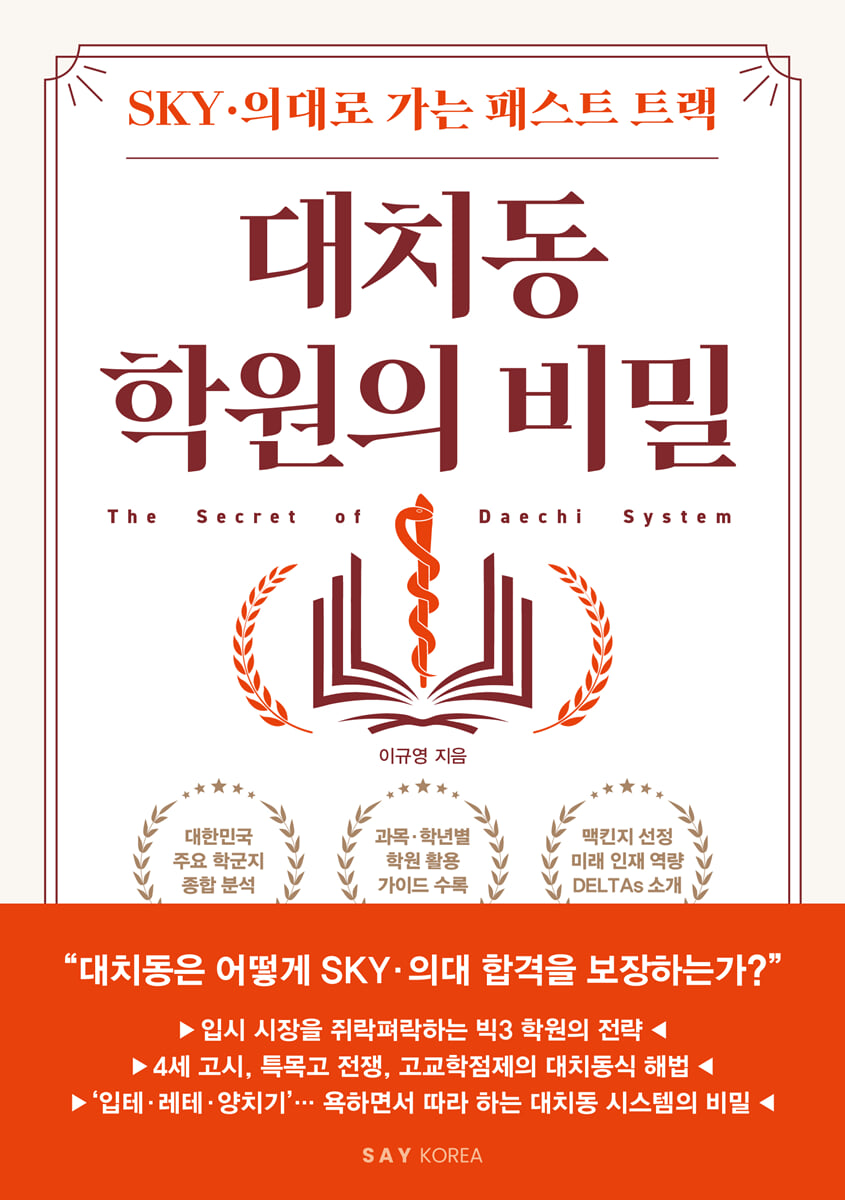
The Secret of Daechi-dong Academy
 |
Description
Book Introduction
The pinnacle of the system for training students to pass the entrance exams to prestigious universities and medical schools,
The first book to dissect everything about the Daechi-dong academy district!
The first thing parents considering studying abroad in Daechi-dong should read is the Daechi-dong academy user manual.
Daechi-dong is not just the name of a neighborhood in Seoul.
Daechi-dong has become the mecca of private education in Korea, and more than that, it has become synonymous with private education itself.
Daechi-dong has long played a leading role in setting the direction and trends of private education in Korea.
Daechi-dong surpasses all other regions in terms of the granular diversity of educational services, including content, the intensity and speed of innovation, the reach of services, the expertise of instructors, the vertical integration and nationwide network of large academies, strategies for responding to changes in the education system, accumulated data on high school and college entrance exams, and the information network of parents.
So how did Daechi-dong become the brain and heart of private education? What processes led to the formation of the Daechi-dong system that makes this possible, how does it currently function, and how will it evolve in the future? A book has been published that provides clear answers to these questions.
The author, Lee Kyu-young, graduated from Seoul National University's Department of Business Administration and studied quantitative management and marketing at the same university's graduate school. He worked as a consultant at the LG Economic Research Institute in the securities and education sectors before entering the academy industry, where he has been an instructor for over 20 years in areas such as Daechi-dong, Banpo-dong, and Mapo-gu.
"The Secret of Daechi-dong Academy" is a book that analyzes the Daechi-dong academy district based on the author's experience in various areas, including Daechi-dong, as a strategy manager, academy operator, and instructor, as well as his knowledge of management and economics.
This book clearly analyzes the context in which Daechi-dong has emerged as the front line of the Korean college entrance exam system and a mecca of private education from the past to the present, the system of Daechi-dong academies that produce the best college entrance exam results by meeting the expectations of top students and their parents, and the virtuous cycle that attracts daily instructors and top students.
In Korea's fiercest college entrance exam battleground, the unique strategies employed by each academy to not only survive but also rise to prominence can be a valuable source of insight for anyone, even those not directly involved in the academy industry.
This book also includes an introduction to major academies for students and parents, as well as a guide to using academies in Daechi-dong.
It includes a list of recommended academies by subject and grade, a roadmap, tips for selecting the right academy for your child, an analysis of major school districts in Korea, and even McKinsey & Company's "Future Talent Competency DELTAs," which major prestigious universities are recently benchmarking as a standard for evaluating incoming students.
Joining the Daechi-dong academy system for college entrance requires a significant investment, both tangible and intangible.
This book will be of great help in deciding whether to invest or not.
The first book to dissect everything about the Daechi-dong academy district!
The first thing parents considering studying abroad in Daechi-dong should read is the Daechi-dong academy user manual.
Daechi-dong is not just the name of a neighborhood in Seoul.
Daechi-dong has become the mecca of private education in Korea, and more than that, it has become synonymous with private education itself.
Daechi-dong has long played a leading role in setting the direction and trends of private education in Korea.
Daechi-dong surpasses all other regions in terms of the granular diversity of educational services, including content, the intensity and speed of innovation, the reach of services, the expertise of instructors, the vertical integration and nationwide network of large academies, strategies for responding to changes in the education system, accumulated data on high school and college entrance exams, and the information network of parents.
So how did Daechi-dong become the brain and heart of private education? What processes led to the formation of the Daechi-dong system that makes this possible, how does it currently function, and how will it evolve in the future? A book has been published that provides clear answers to these questions.
The author, Lee Kyu-young, graduated from Seoul National University's Department of Business Administration and studied quantitative management and marketing at the same university's graduate school. He worked as a consultant at the LG Economic Research Institute in the securities and education sectors before entering the academy industry, where he has been an instructor for over 20 years in areas such as Daechi-dong, Banpo-dong, and Mapo-gu.
"The Secret of Daechi-dong Academy" is a book that analyzes the Daechi-dong academy district based on the author's experience in various areas, including Daechi-dong, as a strategy manager, academy operator, and instructor, as well as his knowledge of management and economics.
This book clearly analyzes the context in which Daechi-dong has emerged as the front line of the Korean college entrance exam system and a mecca of private education from the past to the present, the system of Daechi-dong academies that produce the best college entrance exam results by meeting the expectations of top students and their parents, and the virtuous cycle that attracts daily instructors and top students.
In Korea's fiercest college entrance exam battleground, the unique strategies employed by each academy to not only survive but also rise to prominence can be a valuable source of insight for anyone, even those not directly involved in the academy industry.
This book also includes an introduction to major academies for students and parents, as well as a guide to using academies in Daechi-dong.
It includes a list of recommended academies by subject and grade, a roadmap, tips for selecting the right academy for your child, an analysis of major school districts in Korea, and even McKinsey & Company's "Future Talent Competency DELTAs," which major prestigious universities are recently benchmarking as a standard for evaluating incoming students.
Joining the Daechi-dong academy system for college entrance requires a significant investment, both tangible and intangible.
This book will be of great help in deciding whether to invest or not.
- You can preview some of the book's contents.
Preview
index
Recommendation
introduction.
When dissected into a system, Daechidong appears.
Before entering.
Comprehensive analysis and ranking of major school districts in South Korea
CHAPTER 1.
Daechi-dong Academy Street: Daechi, the Mecca of Elite Education, Now
The Red Queen's Country, Daechi Street
Dr. Frankenstein, who led the golden age of talent
Picasso's "Bull" and the Thinking Bull
The Korean word for "bull," Giparang Literature Institute
A Paradigm Shift: Hyper-Personalization and AI Instructors
Daechi-dong content that transcends spatial limitations
CHAPTER 2.
Daechi-dong System: Everything You Need to Know About the Daechi-dong System
Climb the impossible mountain
The purpose of the system: algorithms and selfish genes
Daechi-dong Solution: Parents' Anxiety Relief
Input Control: Cooking is Half the Battle
Feedback loop of balance and reinforcement
The system is not perfect
Beyond the trap of understanding addiction
Will the Daechi-dong system work elsewhere?
CHAPTER 3.
Daechi-dong Report: Tolls on the Road to Success
SKY Factory Evolves into Medical Gate
Is the 4-Year-Old Civil Service Examination Child Abuse or a Strategic Choice?
We will tailor it to your desired talent profile.
The Shepherd Boys Who Cried Wolf
The Reality of Daechi-dong International Students
CHAPTER 4.
Daechi-dong Economics: Making the Best Choices with Limited Resources
Capitalist restaurants, Daechi-dong
The Matthew Effect and the Three-Way Strategy
The Positioning War at Daechi-dong Academy
Hidden Champion: Kangso Academy's Survival Strategy
Superstar Economics: Qualifications of a Daily Instructor
Daechi-dong Academy Street, at the center of value transfer
How can Daechi-dong parents become private education experts?
Medical School Gravity: A Rational Race to Economic Gains
CHAPTER 5.
The Daechi-dong Story: The Birth of the Nine-Headed Hydra
The brutal history of extinction and evolution
Pioneers of Daechi-dong
The Constitutional Court's ruling that ushered in the golden age of Daechi-dong
The War History of Specialized High Schools: The High School Credit System and the Crazy Chicken
Is EBS really a wolf?
The War of the Infinite: The Archetype and Bibimbap
The government's coding of the CSAT and Daechi-dong's CSAT hacking
The Paradox of English Education Policy in Daechi-dong
Conclusion.
The Keys to Becoming a Leader of the Future: DELTAs and the Comprehensive Student Assessment
supplement.
Daechi-dong Utilization Guide for Students and Parents
How to choose the right academy for your child
Daechi-dong's detailed roadmap
Guide to Choosing an Academy by Subject for Elementary, Middle, and High School
How to Use Your Daily Instructor 200%
Parents' Role Guide
Survival Guide for Students
References
introduction.
When dissected into a system, Daechidong appears.
Before entering.
Comprehensive analysis and ranking of major school districts in South Korea
CHAPTER 1.
Daechi-dong Academy Street: Daechi, the Mecca of Elite Education, Now
The Red Queen's Country, Daechi Street
Dr. Frankenstein, who led the golden age of talent
Picasso's "Bull" and the Thinking Bull
The Korean word for "bull," Giparang Literature Institute
A Paradigm Shift: Hyper-Personalization and AI Instructors
Daechi-dong content that transcends spatial limitations
CHAPTER 2.
Daechi-dong System: Everything You Need to Know About the Daechi-dong System
Climb the impossible mountain
The purpose of the system: algorithms and selfish genes
Daechi-dong Solution: Parents' Anxiety Relief
Input Control: Cooking is Half the Battle
Feedback loop of balance and reinforcement
The system is not perfect
Beyond the trap of understanding addiction
Will the Daechi-dong system work elsewhere?
CHAPTER 3.
Daechi-dong Report: Tolls on the Road to Success
SKY Factory Evolves into Medical Gate
Is the 4-Year-Old Civil Service Examination Child Abuse or a Strategic Choice?
We will tailor it to your desired talent profile.
The Shepherd Boys Who Cried Wolf
The Reality of Daechi-dong International Students
CHAPTER 4.
Daechi-dong Economics: Making the Best Choices with Limited Resources
Capitalist restaurants, Daechi-dong
The Matthew Effect and the Three-Way Strategy
The Positioning War at Daechi-dong Academy
Hidden Champion: Kangso Academy's Survival Strategy
Superstar Economics: Qualifications of a Daily Instructor
Daechi-dong Academy Street, at the center of value transfer
How can Daechi-dong parents become private education experts?
Medical School Gravity: A Rational Race to Economic Gains
CHAPTER 5.
The Daechi-dong Story: The Birth of the Nine-Headed Hydra
The brutal history of extinction and evolution
Pioneers of Daechi-dong
The Constitutional Court's ruling that ushered in the golden age of Daechi-dong
The War History of Specialized High Schools: The High School Credit System and the Crazy Chicken
Is EBS really a wolf?
The War of the Infinite: The Archetype and Bibimbap
The government's coding of the CSAT and Daechi-dong's CSAT hacking
The Paradox of English Education Policy in Daechi-dong
Conclusion.
The Keys to Becoming a Leader of the Future: DELTAs and the Comprehensive Student Assessment
supplement.
Daechi-dong Utilization Guide for Students and Parents
How to choose the right academy for your child
Daechi-dong's detailed roadmap
Guide to Choosing an Academy by Subject for Elementary, Middle, and High School
How to Use Your Daily Instructor 200%
Parents' Role Guide
Survival Guide for Students
References
Detailed image

Into the book
When asked, "What is the purpose of the healthcare system?" the answer is usually, "To make patients healthy."
But the real purpose of the medical system is to 'provide treatment that is needed immediately.'
Health is just a byproduct of treatment.
…the purpose of the judicial system is not to ‘deliver justice.’
The real purpose of the judicial system is simply to 'logically determine the right and wrong in front of us.'
Because the elements of a crime are determined according to existing laws and procedures, results that do not conform to common sense and justice can easily occur.
The system neither behaves as the participants want it to nor produces what the participants want it to produce.
The system operates according to its own purpose and produces what is consistent with that purpose.
--- pp.15~16
The Thinking Bull system places training rather than the transfer of knowledge as its essential goal.
It is the training of the ‘thinking habit’.
All students admitted to Thinking Bull are faced with advanced problems appropriate to their level.
Students must solve problems before learning and write down every word written on the board without missing a single word.
Questions are rarely allowed.
You have to solve it on your own using the concepts and thinking methods you learned in class.
If you can't finish it at school, you have to do it at home.
Additionally, various penalty points and points are awarded based on quick tests, level tests, missions, assignments, written tests, attitude, etc., and rewards and punishments are stipulated accordingly.
…it is a process carefully designed for the sole purpose of training oneself in the habit of asking questions and finding answers for oneself, that is, of asking oneself questions and finding answers for oneself.
--- p.54
At Daechi-dong's prestigious high schools, even top students find it difficult to secure excellent grades due to intense competition for grades.
Therefore, even if you are strong in preparing for the CSAT, there is a high possibility that you will be disadvantaged in your school grades.
Parents of middle school students who have confirmed this have started sending their children to less competitive schools outside of the district to secure high grades and supplement their preparation for the college entrance exam through Daechi-dong academies.
In other words, parents in Daechi-dong are not giving up the quality of education Daechi-dong provides, but are using a new strategy of relocating to gain a more advantageous position and consuming Daechi-dong's educational services in a different way.
--- pp.66~67
When you look up at the impossible mountain from below, surprisingly, someone is standing on the top.
It is a wondrous sight to those who look up.
…but I can say for sure.
Most people who stand on the top of the mountain would have reached the summit by walking along the flat path behind the rock face.
A flat path behind the rock face.
That is the 'stepladder' that was briefly mentioned earlier while explaining the talent of the times.
Ladders lower the barrier to entry and make access easier for those who want to reach higher places.
Daechi-dong Academy serves as a stepping stone to climb the impossible mountain.
In our country, there are high peaks like the 14 peaks of the Himalayas, such as 'Yi·Chi·Han·Yak·Su', 'SKY', and 'Seol·Ka·Po', where just entering them can secure a certain level of social status.
And Daechi-dong academies have created a ladder to match the entrance exams of 39 medical schools, 1 medical school, and several prestigious universities and departments.
--- pp.76~77
The monopoly on college entrance exam information plays a major role in Daechi-dong's rise to prominence as a "holy land of private education."
The complex and opaque college admissions process has fueled anxiety among students and parents, and as a result, reliable college admissions information has emerged as a high-value product.
…the problem is that some Daechi-dong academies intentionally promote anxiety and fear among students and parents.
… In fact, this kind of fear marketing works better for people outside of Daechi-dong who are looking into the Daechi-dong system rather than for Daechi-dong residents who are already familiar with the system.
--- pp.89~90
How can Daechi-dong Academy maintain its system? It must implement a powerful balancing feedback loop that eliminates negative elements from the system.
This is why Daechi-dong academies conduct level tests under all sorts of names, such as weekly, monthly, unit-by-unit, quarterly, and semester-by-semester.
On the surface, it's a process that lets parents see where their children are at, but in reality, it's a process of weeding out members who aren't up to par.
--- pp.96~97
If you want to become a hidden champion, it's important to narrowly define your market and become a clear leader in a small pond, rather than being an ordinary fish in a vast ocean.
Investment in proprietary intellectual property, or IP, is also essential.
… Even the current Daechi-dong powerhouse, Sidae Injae, initially grew significantly through a hidden champion strategy of perfectly capturing a clear niche while teaching "Science Exploration II" to top science students.
--- p.168
The magnitude of the economic rent generated by a medical license is clearly revealed in the overwhelming income gap compared to other professions. According to OECD statistics, Korean doctors earn up to seven times the average wage of all workers, the largest gap among OECD member countries.
…when such a huge economic zone exists, people will rush to occupy it.
…The concentration of top talent in medical schools is a perfectly rational choice to capture the enormous economic benefits of medical licenses.
--- p.187
Level tests are a means for academies to evaluate students, but they are also an opportunity for students and parents to evaluate the academy.
The quality of feedback provided after the test is an indicator of the academy's level of management.
A good academy is one that provides a detailed analysis of what concepts you are lacking in which areas, why you are wrong, and how you should improve in the future, rather than one that simply reports your scores and grades.
This feedback is the first concrete data parents can obtain, providing a glimpse into the academy's expertise and level of care for its students.
--- pp.251~252
Signs of extreme stress and burnout should not be ignored.
When you are having a hard time, you should talk honestly to your parents or a trusted adult.
And you should create your own escape route to relieve stress, such as hobbies or exercise that are completely unrelated to studying.
Always remember that your grades or test scores at school are just a measure of where you stand, not your value in life.
But the real purpose of the medical system is to 'provide treatment that is needed immediately.'
Health is just a byproduct of treatment.
…the purpose of the judicial system is not to ‘deliver justice.’
The real purpose of the judicial system is simply to 'logically determine the right and wrong in front of us.'
Because the elements of a crime are determined according to existing laws and procedures, results that do not conform to common sense and justice can easily occur.
The system neither behaves as the participants want it to nor produces what the participants want it to produce.
The system operates according to its own purpose and produces what is consistent with that purpose.
--- pp.15~16
The Thinking Bull system places training rather than the transfer of knowledge as its essential goal.
It is the training of the ‘thinking habit’.
All students admitted to Thinking Bull are faced with advanced problems appropriate to their level.
Students must solve problems before learning and write down every word written on the board without missing a single word.
Questions are rarely allowed.
You have to solve it on your own using the concepts and thinking methods you learned in class.
If you can't finish it at school, you have to do it at home.
Additionally, various penalty points and points are awarded based on quick tests, level tests, missions, assignments, written tests, attitude, etc., and rewards and punishments are stipulated accordingly.
…it is a process carefully designed for the sole purpose of training oneself in the habit of asking questions and finding answers for oneself, that is, of asking oneself questions and finding answers for oneself.
--- p.54
At Daechi-dong's prestigious high schools, even top students find it difficult to secure excellent grades due to intense competition for grades.
Therefore, even if you are strong in preparing for the CSAT, there is a high possibility that you will be disadvantaged in your school grades.
Parents of middle school students who have confirmed this have started sending their children to less competitive schools outside of the district to secure high grades and supplement their preparation for the college entrance exam through Daechi-dong academies.
In other words, parents in Daechi-dong are not giving up the quality of education Daechi-dong provides, but are using a new strategy of relocating to gain a more advantageous position and consuming Daechi-dong's educational services in a different way.
--- pp.66~67
When you look up at the impossible mountain from below, surprisingly, someone is standing on the top.
It is a wondrous sight to those who look up.
…but I can say for sure.
Most people who stand on the top of the mountain would have reached the summit by walking along the flat path behind the rock face.
A flat path behind the rock face.
That is the 'stepladder' that was briefly mentioned earlier while explaining the talent of the times.
Ladders lower the barrier to entry and make access easier for those who want to reach higher places.
Daechi-dong Academy serves as a stepping stone to climb the impossible mountain.
In our country, there are high peaks like the 14 peaks of the Himalayas, such as 'Yi·Chi·Han·Yak·Su', 'SKY', and 'Seol·Ka·Po', where just entering them can secure a certain level of social status.
And Daechi-dong academies have created a ladder to match the entrance exams of 39 medical schools, 1 medical school, and several prestigious universities and departments.
--- pp.76~77
The monopoly on college entrance exam information plays a major role in Daechi-dong's rise to prominence as a "holy land of private education."
The complex and opaque college admissions process has fueled anxiety among students and parents, and as a result, reliable college admissions information has emerged as a high-value product.
…the problem is that some Daechi-dong academies intentionally promote anxiety and fear among students and parents.
… In fact, this kind of fear marketing works better for people outside of Daechi-dong who are looking into the Daechi-dong system rather than for Daechi-dong residents who are already familiar with the system.
--- pp.89~90
How can Daechi-dong Academy maintain its system? It must implement a powerful balancing feedback loop that eliminates negative elements from the system.
This is why Daechi-dong academies conduct level tests under all sorts of names, such as weekly, monthly, unit-by-unit, quarterly, and semester-by-semester.
On the surface, it's a process that lets parents see where their children are at, but in reality, it's a process of weeding out members who aren't up to par.
--- pp.96~97
If you want to become a hidden champion, it's important to narrowly define your market and become a clear leader in a small pond, rather than being an ordinary fish in a vast ocean.
Investment in proprietary intellectual property, or IP, is also essential.
… Even the current Daechi-dong powerhouse, Sidae Injae, initially grew significantly through a hidden champion strategy of perfectly capturing a clear niche while teaching "Science Exploration II" to top science students.
--- p.168
The magnitude of the economic rent generated by a medical license is clearly revealed in the overwhelming income gap compared to other professions. According to OECD statistics, Korean doctors earn up to seven times the average wage of all workers, the largest gap among OECD member countries.
…when such a huge economic zone exists, people will rush to occupy it.
…The concentration of top talent in medical schools is a perfectly rational choice to capture the enormous economic benefits of medical licenses.
--- p.187
Level tests are a means for academies to evaluate students, but they are also an opportunity for students and parents to evaluate the academy.
The quality of feedback provided after the test is an indicator of the academy's level of management.
A good academy is one that provides a detailed analysis of what concepts you are lacking in which areas, why you are wrong, and how you should improve in the future, rather than one that simply reports your scores and grades.
This feedback is the first concrete data parents can obtain, providing a glimpse into the academy's expertise and level of care for its students.
--- pp.251~252
Signs of extreme stress and burnout should not be ignored.
When you are having a hard time, you should talk honestly to your parents or a trusted adult.
And you should create your own escape route to relieve stress, such as hobbies or exercise that are completely unrelated to studying.
Always remember that your grades or test scores at school are just a measure of where you stand, not your value in life.
--- p.292
Publisher's Review
“How does Daechi-dong guarantee admission to SKY and medical schools?”
Talent of the Times, Thinking Bull, Giparang Literature Institute…
The strategy and system chosen by S-Class Academy in Daechi-dong, which dominates the college entrance exam market!
Daechi-dong has always proven its worth with overwhelming performance.
Most of the successful applicants to major medical schools, including Seoul National University College of Medicine, and those who received perfect scores on the CSAT used the Daechi-dong system.
Of the 3,058 medical school students admitted in 2024, only about 1,000 were admitted through regular admissions. The proportion of repeat students reached 80 percent, and most of them are connected to the Daechi-dong system in some way.
Among the top academies in Daechi-dong, there are those called the Big 3.
They are the Talent of the Times, Thinking Bull, and Giparang Literature Institute.
What systems do they each have to achieve outstanding results?
The top academies in Daechi-dong have different specialized subjects and strategies.
However, they all share a commonality: they produce high-quality content in their respective fields, which strongly attracts users such as students, parents, and instructors, and they have strong internal regulations and management systems in place that they must adhere to.
The author explains that although it takes considerable time and effort to get the system in place, once it starts operating stably, it is sure to produce results.
It also explains the strong balance and reinforcement feedback that Daechi-dong academies implement to ensure consistency in results, and which students adapt to the Daechi-dong system and achieve good entrance exam results.
If only the top-tier academies had achieved results, Daechi-dong would not have been called the 'Mecca of private education.'
In Daechi-dong, in addition to the Big 3 academies, numerous academies form a dense ecosystem.
There is a multi-layered, tiered structure in which top-tier academies lead the way and other academies support students so that they do not fall behind. Solutions exist for each subject, period, and goal.
Even if you fall behind in the worst case scenario, there are various ways to reach your goal through other routes.
In this way, Daechi-dong itself is an ecosystem, a self-sustaining system that is built and developed to provide satisfactory results to users.
“Can the Daechi-dong system be replicated in other regions?”
If you plant a tangerine from Gangnam in Gangbuk, it will become a tangerine.
As the Daechi-dong academy district system continues to be successful, attempts to transplant the Daechi-dong system to other regions are continuing.
A representative example is the acceleration of the franchise business of the Big 3 academies.
But would simply transplanting the Daechi-dong academy district system to a local area yield the same success as Daechi-dong? The author is skeptical.
In areas like Daechi-dong, where a culture of focusing on academics and entrance exams has not yet been formed, such as in a city specializing in private academies, it is difficult for the system to take root even if transplanted.
The author argues that asking the question, “Will the Daechi-dong system work in other regions?” cannot lead to productive change, and that finding a system that works begins with answering the question, “What kind of place is this region?”
There is no such thing as a perfect system from the start, and only by developing a new system that is suitable for the local conditions, environment, and people's perceptions and that can be maintained can productive change be created.
Ipte, Lete, 4th grade exam… Is it Hell Gate or a gateway that must be passed through?
Daechi-dong's battle to cope with the ever-changing college entrance exam system
There is something called the 'Matthew Effect'.
This is a concept introduced by American sociologist Robert Merton, and is named after Matthew 25:29, referring to the social phenomenon in which already successful people or groups gain more opportunities to become even more successful, or face increasingly difficult situations if they do not.
This is exactly what happens in Daechi-dong.
Through entrance exams for elementary school students, talented children are selected as "study athletes," and these children grow up receiving intensive training.
Daechi-dong Academy conducts level tests on a regular basis to select children with the potential to survive as athletes.
The children who remain as the finalists continue to enter the top academies on the Daechi-dong academy roadmap and ultimately advance to the top leagues such as medical schools and prestigious universities.
The problem is that kids who don't make it to the top leagues when they're young end up staying in the lower leagues.
This is why parents are sending their toddlers to English kindergartens, and why the age at which children begin learning is getting younger and younger.
Of course, the problems caused by early learning are not trivial.
In fact, the number of health insurance claims for depression and anxiety disorders in children under the age of nine in Gangnam's three districts more than tripled in just four years from 2020 to 2024.
But in a system where early success guarantees future success, early success must be based on strategy, not luck.
That's what they do in Daechi-dong and Gangnam.
“What is the best school district for my child’s college entrance exam?”
From traditional strongholds to emerging new areas
Analysis of key school district locations to help parents make strategic choices
Before embarking on a full-scale analysis of the Daechi-dong academy district system, the author ranked the top 20 major school districts in South Korea, from traditional strongholds to emerging areas.
Scores were assigned based on certain criteria, taking into account infrastructure indices, specialized high school and private high school advancement rates, Seoul National University and medical school acceptance rates, and the hub function of school districts.
Daechi-dong, where the entire street has developed into a city specializing in private academies, is undoubtedly number one.
Next, the author introduces Mokdong, a powerhouse in the West; Junggye-dong, which showcases the pinnacle of cost-effectiveness; Bundang, which offers a balanced mix of living infrastructure and education; Suseong-gu in Daegu, known as the home of the medical school; Songdo, which has emerged as a major school district in a short period of time; and Geumjeong-gu in Busan, which boasts strengths in advancing to specialized and private high schools.
For example, Junggye-dong in Nowon-gu, Seoul, is categorized as a cost-effective school district, as it "provides a strong, high-quality educational environment at a reasonable cost of living." Pyeongchon is evaluated as "suitable for students aiming for elite tracks in humanities and international studies, as it has a specialized pipeline for foreign language high schools."
This will be helpful for parents considering moving to a different school district based on their child's college entrance exam goals and realistic financial circumstances.
“A roadmap for choosing academies by grade and subject: elementary, middle, and high school!”
Analysis of the pros and cons of major academies in Daechi-dong, along with roadmaps by grade and subject.
Introducing the "Future Talent DELTAs" Referenced by Prestigious Universities' Comprehensive Student Admissions Process
In particular, this appendix, 'Daechi-dong Utilization Guide for Students and Parents', contains information that will be helpful to students and parents when actually using the academies mentioned in the analysis of the Daechi-dong academy system.
First, we explain the strengths and weaknesses of various academies in Daechi-dong based on subjects such as Korean, math, science, and English, and the types of students suitable for each academy. We also present an appropriate roadmap for each grade and level of elementary, middle, and high school.
It also covers a wide range of topics, including how to choose the right academy for your child, how to make the most of daily instructors, the role of parents, and a student survival guide.
Another thing to note is the 'DELTAs' proposed by McKinsey & Company.
This stands for "Distinct Elements of Talents," and it identifies the competencies of future talent, each of which will be highlighted in the spotlight. The reason DELTAs are so noteworthy is that major prestigious universities in Korea are adopting evaluation criteria similar to McKinsey's Future Talent Competency Index for their comprehensive student admissions process.
The reason McKinsey and top universities are introducing new talent evaluation metrics is because traditional talent evaluation metrics are no longer effective in the present and future era.
This is something that must be kept in mind not only for academic achievement but also for building a successful life in the long term.
“If you want to know about Daechi-dong, read this book!”
The first book to analyze Daechi-dong from an economic perspective and a guide for Daechi-dong users.
Most of the media coverage and reports on Daechi-dong were concerned about the increasing spending on private education and the educational abuse of children, referred to as the "4-year-old exam."
In the publishing world, there have been attempts to understand Daechi-dong as a melting pot of desires by analyzing it in terms of academic background and real estate.
However, this book is the first to analyze the Daechi-dong academy district system and the users of Daechi-dong from an economic perspective and explain how people's rational judgments are built into a single system.
The author, drawing on his diverse background, provides an in-depth analysis of the Daechi-dong academy system and provides an engaging explanation for the rational balance between supply and demand for private education.
Rather than simply affirming or denying the phenomenon of Daechi-dong being called a "holy land of private education," the author analyzes the phenomenon through the lens of the system, identifies the scope and causes of the problem, and then suggests alternative solutions to address it.
Additionally, while the current Daechi-dong system continues, it provides wisdom for not only Daechi-dong-related members, students and parents, but also academy instructors and academy managers to wisely utilize it.
This book will serve as a valuable guide for all those involved in Daechi-dong and those who will use Daechi-dong services.
Talent of the Times, Thinking Bull, Giparang Literature Institute…
The strategy and system chosen by S-Class Academy in Daechi-dong, which dominates the college entrance exam market!
Daechi-dong has always proven its worth with overwhelming performance.
Most of the successful applicants to major medical schools, including Seoul National University College of Medicine, and those who received perfect scores on the CSAT used the Daechi-dong system.
Of the 3,058 medical school students admitted in 2024, only about 1,000 were admitted through regular admissions. The proportion of repeat students reached 80 percent, and most of them are connected to the Daechi-dong system in some way.
Among the top academies in Daechi-dong, there are those called the Big 3.
They are the Talent of the Times, Thinking Bull, and Giparang Literature Institute.
What systems do they each have to achieve outstanding results?
The top academies in Daechi-dong have different specialized subjects and strategies.
However, they all share a commonality: they produce high-quality content in their respective fields, which strongly attracts users such as students, parents, and instructors, and they have strong internal regulations and management systems in place that they must adhere to.
The author explains that although it takes considerable time and effort to get the system in place, once it starts operating stably, it is sure to produce results.
It also explains the strong balance and reinforcement feedback that Daechi-dong academies implement to ensure consistency in results, and which students adapt to the Daechi-dong system and achieve good entrance exam results.
If only the top-tier academies had achieved results, Daechi-dong would not have been called the 'Mecca of private education.'
In Daechi-dong, in addition to the Big 3 academies, numerous academies form a dense ecosystem.
There is a multi-layered, tiered structure in which top-tier academies lead the way and other academies support students so that they do not fall behind. Solutions exist for each subject, period, and goal.
Even if you fall behind in the worst case scenario, there are various ways to reach your goal through other routes.
In this way, Daechi-dong itself is an ecosystem, a self-sustaining system that is built and developed to provide satisfactory results to users.
“Can the Daechi-dong system be replicated in other regions?”
If you plant a tangerine from Gangnam in Gangbuk, it will become a tangerine.
As the Daechi-dong academy district system continues to be successful, attempts to transplant the Daechi-dong system to other regions are continuing.
A representative example is the acceleration of the franchise business of the Big 3 academies.
But would simply transplanting the Daechi-dong academy district system to a local area yield the same success as Daechi-dong? The author is skeptical.
In areas like Daechi-dong, where a culture of focusing on academics and entrance exams has not yet been formed, such as in a city specializing in private academies, it is difficult for the system to take root even if transplanted.
The author argues that asking the question, “Will the Daechi-dong system work in other regions?” cannot lead to productive change, and that finding a system that works begins with answering the question, “What kind of place is this region?”
There is no such thing as a perfect system from the start, and only by developing a new system that is suitable for the local conditions, environment, and people's perceptions and that can be maintained can productive change be created.
Ipte, Lete, 4th grade exam… Is it Hell Gate or a gateway that must be passed through?
Daechi-dong's battle to cope with the ever-changing college entrance exam system
There is something called the 'Matthew Effect'.
This is a concept introduced by American sociologist Robert Merton, and is named after Matthew 25:29, referring to the social phenomenon in which already successful people or groups gain more opportunities to become even more successful, or face increasingly difficult situations if they do not.
This is exactly what happens in Daechi-dong.
Through entrance exams for elementary school students, talented children are selected as "study athletes," and these children grow up receiving intensive training.
Daechi-dong Academy conducts level tests on a regular basis to select children with the potential to survive as athletes.
The children who remain as the finalists continue to enter the top academies on the Daechi-dong academy roadmap and ultimately advance to the top leagues such as medical schools and prestigious universities.
The problem is that kids who don't make it to the top leagues when they're young end up staying in the lower leagues.
This is why parents are sending their toddlers to English kindergartens, and why the age at which children begin learning is getting younger and younger.
Of course, the problems caused by early learning are not trivial.
In fact, the number of health insurance claims for depression and anxiety disorders in children under the age of nine in Gangnam's three districts more than tripled in just four years from 2020 to 2024.
But in a system where early success guarantees future success, early success must be based on strategy, not luck.
That's what they do in Daechi-dong and Gangnam.
“What is the best school district for my child’s college entrance exam?”
From traditional strongholds to emerging new areas
Analysis of key school district locations to help parents make strategic choices
Before embarking on a full-scale analysis of the Daechi-dong academy district system, the author ranked the top 20 major school districts in South Korea, from traditional strongholds to emerging areas.
Scores were assigned based on certain criteria, taking into account infrastructure indices, specialized high school and private high school advancement rates, Seoul National University and medical school acceptance rates, and the hub function of school districts.
Daechi-dong, where the entire street has developed into a city specializing in private academies, is undoubtedly number one.
Next, the author introduces Mokdong, a powerhouse in the West; Junggye-dong, which showcases the pinnacle of cost-effectiveness; Bundang, which offers a balanced mix of living infrastructure and education; Suseong-gu in Daegu, known as the home of the medical school; Songdo, which has emerged as a major school district in a short period of time; and Geumjeong-gu in Busan, which boasts strengths in advancing to specialized and private high schools.
For example, Junggye-dong in Nowon-gu, Seoul, is categorized as a cost-effective school district, as it "provides a strong, high-quality educational environment at a reasonable cost of living." Pyeongchon is evaluated as "suitable for students aiming for elite tracks in humanities and international studies, as it has a specialized pipeline for foreign language high schools."
This will be helpful for parents considering moving to a different school district based on their child's college entrance exam goals and realistic financial circumstances.
“A roadmap for choosing academies by grade and subject: elementary, middle, and high school!”
Analysis of the pros and cons of major academies in Daechi-dong, along with roadmaps by grade and subject.
Introducing the "Future Talent DELTAs" Referenced by Prestigious Universities' Comprehensive Student Admissions Process
In particular, this appendix, 'Daechi-dong Utilization Guide for Students and Parents', contains information that will be helpful to students and parents when actually using the academies mentioned in the analysis of the Daechi-dong academy system.
First, we explain the strengths and weaknesses of various academies in Daechi-dong based on subjects such as Korean, math, science, and English, and the types of students suitable for each academy. We also present an appropriate roadmap for each grade and level of elementary, middle, and high school.
It also covers a wide range of topics, including how to choose the right academy for your child, how to make the most of daily instructors, the role of parents, and a student survival guide.
Another thing to note is the 'DELTAs' proposed by McKinsey & Company.
This stands for "Distinct Elements of Talents," and it identifies the competencies of future talent, each of which will be highlighted in the spotlight. The reason DELTAs are so noteworthy is that major prestigious universities in Korea are adopting evaluation criteria similar to McKinsey's Future Talent Competency Index for their comprehensive student admissions process.
The reason McKinsey and top universities are introducing new talent evaluation metrics is because traditional talent evaluation metrics are no longer effective in the present and future era.
This is something that must be kept in mind not only for academic achievement but also for building a successful life in the long term.
“If you want to know about Daechi-dong, read this book!”
The first book to analyze Daechi-dong from an economic perspective and a guide for Daechi-dong users.
Most of the media coverage and reports on Daechi-dong were concerned about the increasing spending on private education and the educational abuse of children, referred to as the "4-year-old exam."
In the publishing world, there have been attempts to understand Daechi-dong as a melting pot of desires by analyzing it in terms of academic background and real estate.
However, this book is the first to analyze the Daechi-dong academy district system and the users of Daechi-dong from an economic perspective and explain how people's rational judgments are built into a single system.
The author, drawing on his diverse background, provides an in-depth analysis of the Daechi-dong academy system and provides an engaging explanation for the rational balance between supply and demand for private education.
Rather than simply affirming or denying the phenomenon of Daechi-dong being called a "holy land of private education," the author analyzes the phenomenon through the lens of the system, identifies the scope and causes of the problem, and then suggests alternative solutions to address it.
Additionally, while the current Daechi-dong system continues, it provides wisdom for not only Daechi-dong-related members, students and parents, but also academy instructors and academy managers to wisely utilize it.
This book will serve as a valuable guide for all those involved in Daechi-dong and those who will use Daechi-dong services.
GOODS SPECIFICS
- Date of issue: September 10, 2025
- Page count, weight, size: 296 pages | 148*210*20mm
- ISBN13: 9791193239339
- ISBN10: 1193239338
You may also like
카테고리
korean


korean

![ELLE 엘르 스페셜 에디션 A형 : 12월 [2025]](http://librairie.coreenne.fr/cdn/shop/files/b8e27a3de6c9538896439686c6b0e8fb.jpg?v=1766436872&width=3840)


