

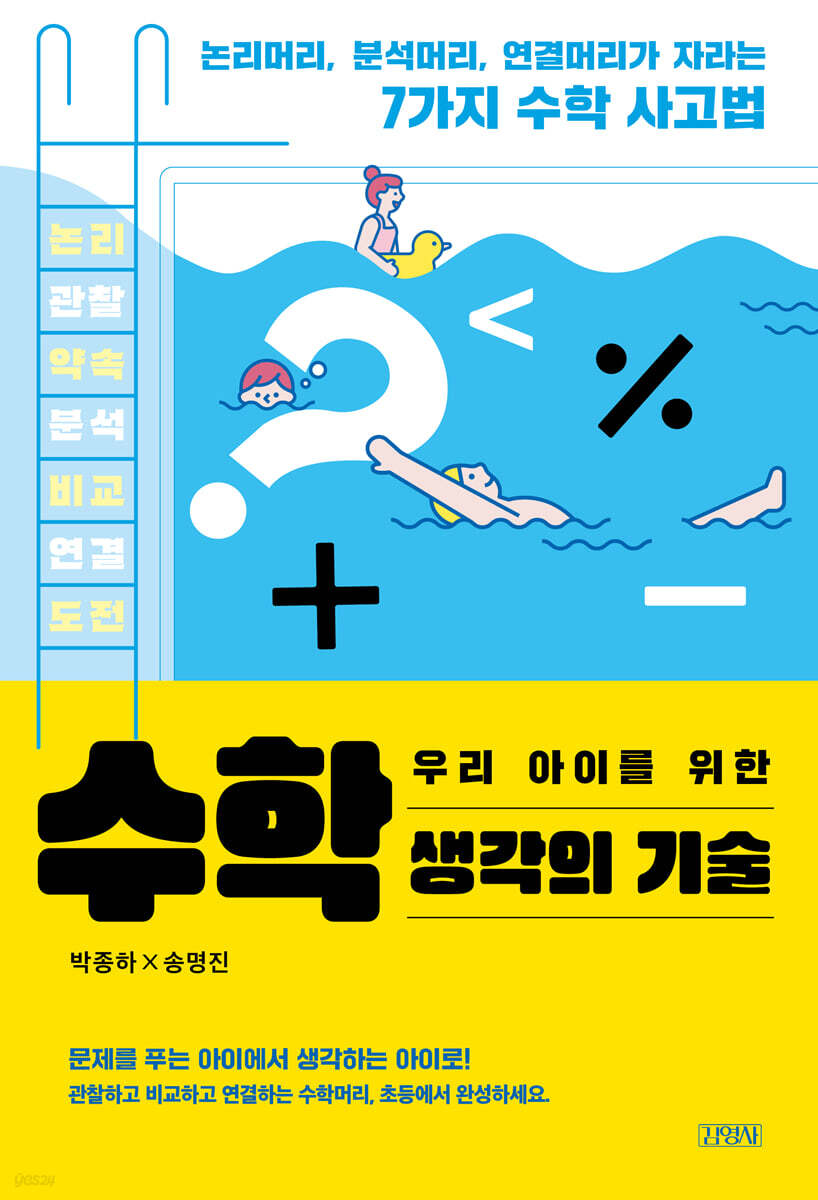
Mathematical Thinking Skills for Our Children
 |
Description
Book Introduction
Elementary Mathematics, the Power of Thinking
From a problem-solving child to a thinking child!
Observe, compare, and connect your math skills, perfected in elementary school.
How should I begin my child's math studies? Before looking for workbooks or reputable academies, we need to assess their mathematical reasoning skills.
This book, "Mathematical Thinking Skills for Our Children," presents specific methods for developing mathematical aptitude through seven thinking methods: logic, observation, promise, analysis, comparison, connection, and challenge. Park Jong-ha, a KAIST graduate and creativity consultant with a Ph.D. in mathematics, and Song Myung-jin, a KAIST-educated mathematics expert, co-wrote this book to help children view mathematics not simply as a subject for problem-solving, but as a tool for developing critical thinking skills.
The two authors prioritize thinking and understanding over calculation and memorization, and have included in one book seven mathematical thinking methods, practical activity sheets for parents, and a step-by-step plan for developing thinking skills.
"Mathematical Thinking Skills for Our Children" provides parents of elementary school students who are anxious about math problems that lack answers with clear learning directions and practical solutions.
From a problem-solving child to a thinking child!
Observe, compare, and connect your math skills, perfected in elementary school.
How should I begin my child's math studies? Before looking for workbooks or reputable academies, we need to assess their mathematical reasoning skills.
This book, "Mathematical Thinking Skills for Our Children," presents specific methods for developing mathematical aptitude through seven thinking methods: logic, observation, promise, analysis, comparison, connection, and challenge. Park Jong-ha, a KAIST graduate and creativity consultant with a Ph.D. in mathematics, and Song Myung-jin, a KAIST-educated mathematics expert, co-wrote this book to help children view mathematics not simply as a subject for problem-solving, but as a tool for developing critical thinking skills.
The two authors prioritize thinking and understanding over calculation and memorization, and have included in one book seven mathematical thinking methods, practical activity sheets for parents, and a step-by-step plan for developing thinking skills.
"Mathematical Thinking Skills for Our Children" provides parents of elementary school students who are anxious about math problems that lack answers with clear learning directions and practical solutions.
- You can preview some of the book's contents.
Preview
index
Prologue: Is math genius innate or something that can be nurtured?
1 Math begins with the question “why” * Developing logical thinking skills
Think based on evidence
Think slowly
Practice Thinking Slowly and Judging ① Riddle
Practice thinking slowly and making decisions ② Finding numbers
Practice Thinking Slowly and Judging ③ Crossing the River
Logic, Mathematics, and Our Lives
2. Look carefully at the problem to see the answer * Develop observation skills
Seeing is knowing
Why is observation important?
Observation Exercise ① Finding the Rule
Observation Practice ② Calendar
Observation Practice ③ Folding and Cutting Colored Paper
Looking with the Heart·55
3 Mathematics is the language of promises * Understanding promises
Mathematics is a language
Mathematics is a promise
Practice Understanding Promises ① Fill in the Blanks
Practice Understanding Promises ② Going Backwards
Practice Identifying Promises ③ Finding Unknowns
Practice Understanding Promises ④ Two-armed Scales and Equations
From the concrete to the abstract
Application of mathematical language
4 Complex problems become easier when divided * Habit of analysis
Think about it one by one
Difficult problems become easier when shared.
Divide and group, classify
Analysis Exercise ① Identifying Multiples of 3
Analysis Practice ② Math Magic
Analysis Practice ③ Sudoku
Find the core
Mathematics is analysis
How to learn the concept of 5 numbers * Compare
Comparison makes numbers
You need a standard to compare.
Comparison of learning at school and in everyday life
Making Math Fun Through Comparison! Everyday Activities
Practice using numbers to compare ① Numbering
Practice using numbers to compare ② Fractions
Practice using numbers to compare ③ ratios and proportions
Create your own standards
6 Power to Expand Your Child's Thinking * Connecting
study skills
Connecting Exercise ① Connecting Numbers and Pictures
Connecting Exercise ② Connecting Concepts
Understanding mathematics
7 Moments When You Build Confidence in Math * Take on the Challenge
Talent, effort, and a growth mindset
Real effort and fake effort
Enjoy challenging problems
Challenging conversations and discussions
Solvable and unsolvable problems
Epilogue: Change This! What It Takes to Raise a Child Who's Truly Good at Math
Appendix: Activities to Develop Mathematical Thinking Skills
1 Math begins with the question “why” * Developing logical thinking skills
Think based on evidence
Think slowly
Practice Thinking Slowly and Judging ① Riddle
Practice thinking slowly and making decisions ② Finding numbers
Practice Thinking Slowly and Judging ③ Crossing the River
Logic, Mathematics, and Our Lives
2. Look carefully at the problem to see the answer * Develop observation skills
Seeing is knowing
Why is observation important?
Observation Exercise ① Finding the Rule
Observation Practice ② Calendar
Observation Practice ③ Folding and Cutting Colored Paper
Looking with the Heart·55
3 Mathematics is the language of promises * Understanding promises
Mathematics is a language
Mathematics is a promise
Practice Understanding Promises ① Fill in the Blanks
Practice Understanding Promises ② Going Backwards
Practice Identifying Promises ③ Finding Unknowns
Practice Understanding Promises ④ Two-armed Scales and Equations
From the concrete to the abstract
Application of mathematical language
4 Complex problems become easier when divided * Habit of analysis
Think about it one by one
Difficult problems become easier when shared.
Divide and group, classify
Analysis Exercise ① Identifying Multiples of 3
Analysis Practice ② Math Magic
Analysis Practice ③ Sudoku
Find the core
Mathematics is analysis
How to learn the concept of 5 numbers * Compare
Comparison makes numbers
You need a standard to compare.
Comparison of learning at school and in everyday life
Making Math Fun Through Comparison! Everyday Activities
Practice using numbers to compare ① Numbering
Practice using numbers to compare ② Fractions
Practice using numbers to compare ③ ratios and proportions
Create your own standards
6 Power to Expand Your Child's Thinking * Connecting
study skills
Connecting Exercise ① Connecting Numbers and Pictures
Connecting Exercise ② Connecting Concepts
Understanding mathematics
7 Moments When You Build Confidence in Math * Take on the Challenge
Talent, effort, and a growth mindset
Real effort and fake effort
Enjoy challenging problems
Challenging conversations and discussions
Solvable and unsolvable problems
Epilogue: Change This! What It Takes to Raise a Child Who's Truly Good at Math
Appendix: Activities to Develop Mathematical Thinking Skills
Detailed image

Into the book
We often say, “I have a talent for studying.”
When we see a child who gets good grades with just a little bit of studying, we say, “He has a talent for studying.”
The same goes for math.
Some children do well in math without difficulty, while others struggle and do not get good grades even though they seem to be working hard.
Some children solve the same problem in a unique way, while others are at a loss when looking at a problem they learned in the past.
When I see things like that, it seems like there really is such a thing as 'math brains'.
Is math talent really something you're born with? Not necessarily.
Our children's lives are shaped by many factors, including genetic influences, environment, daily habits, and effort.
So, rather than asking, “Does my child have a knack for math?” it is much more important to think about, “How can I help my child develop a knack for math?”
--- p.6~7
To develop your math skills, it's best to help you naturally practice thinking on a daily basis.
For example, we often expose them to puzzle problems and logic games.
The goal isn't to quickly guess the answer, but to let them feel the fun of thinking carefully and asking, "Why is this like this?"
--- p.8
When we make an effort, it would be great if the results were immediately proportional to the time we put in.
But the reality is not like that.
The results do not usually go up in a straight line, but rather, they go up slowly like an exponential graph curve and then suddenly increase at some point.
(…)
When we invest in a child, we have expectations.
They say things like, ‘I studied this much, so I’ll get good grades.’ or ‘I go to a math academy, so I’ll get good at math.’
But a child's growth is a curve, not a straight line.
At some point, it is the role of parents to wait for their children to grow up.
--- p.12~13
These days, children are often trained to quickly give the right answer, but they often lack the practice of thinking calmly and making decisions.
But what's really important isn't finding the quick answer, it's the thinking process.
One of the most important study habits is to sit down and think slowly.
As you gain more experience logically examining each issue, your thinking will naturally improve and your overall attitude toward studying will change.
--- p.23
When we say 'math', the first things that come to mind are usually complex calculations or difficult problem solving.
But in reality, when it comes to math problems, the process of thinking about how to solve them is more important than the calculations.
The very beginning is ‘observation’.
To solve a problem well, you must first examine the problem carefully and decide how to approach it.
Looking at a problem like this is observation.
--- p.38
In mathematics, expressing the remainder and quotient when dividing a number as A=B×Q+R is an effective notation learned through various experiences, and it is good to accept this as a mathematical language.
Using the language of mathematics can effectively solve real-world problems, as we have seen in the examples.
When studying mathematics in school, you need to have a solid understanding of mathematical language and practice using it to do well in mathematics.
--- p.84
The real secret to studying well is not just memorizing the results, but understanding the intermediate process.
It's the same with developing ideas.
Rather than just accepting a conclusion, it's important to take a closer look at the process and ask, "How did it get this way?"
In that sense, analysis is a really great thinking tool.
Breaking down a problem into smaller pieces and using logic and observation becomes the key to solving even complex problems smoothly.
--- p.120
There is almost no area in mathematics that is not related to comparison, but the area of measurement is particularly directly related to comparison.
In lower grades, students begin to learn everyday units such as length, time, volume, and weight and begin comparative activities.
In higher grades, we move on to more precise comparisons by connecting them to shapes.
For example, after learning about the characteristics of plane figures in 3rd and 4th grade, students learn about the perimeter and area of plane figures in 5th grade.
After learning about plane figures like this, we learn the definition of a rectangular solid, and in the 6th grade, we learn about the surface area and volume of a rectangular solid.
--- p.125
In July 2022, Professor Heo Jun of our country made international news by winning the Fields Medal, often called the Nobel Prize of mathematics.
Professor Huh became famous for solving several difficult problems in mathematics that had previously been unsolvable, and his main area of research was combinatorics.
What's interesting is that he solved combinatorial problems using methods from another branch of mathematics, algebraic geometry.
We solved the problem by connecting two completely different fields, combinatorics and algebraic geometry.
Although solving difficult problems was a great achievement, his greater recognition was his creation of a new field of mathematics called 'combinatorics + algebraic geometry'.
In this way, mathematics is still connecting different things and creating new things.
--- p.163
Challenges are really important in developing mathematical thinking.
To help children develop a proactive and challenging mindset, we need leadership that doesn't force them, but rather instills in them the feeling that math is fun and enjoyable, and naturally encourages them to take on challenges.
For example, you can create a fun atmosphere and stimulate children's curiosity by saying, "Let's solve fun math puzzles together and become the best detectives!"
--- p.173
A child's math skills begin with attitude and thinking ability, not just problem-solving skills.
It is much more important to develop your thinking and mental strength than to get high scores by getting the right answers.
Be sure to teach your child that mistakes are not failures, but valuable opportunities to learn something new.
If you're afraid of making mistakes, it's hard to grow.
Instill a growth mindset that says, "It's okay to make mistakes!" and convey the positive message that anyone can excel at math with effort.
A parent's warm words will help build a child's confidence and spirit of challenge.
When we see a child who gets good grades with just a little bit of studying, we say, “He has a talent for studying.”
The same goes for math.
Some children do well in math without difficulty, while others struggle and do not get good grades even though they seem to be working hard.
Some children solve the same problem in a unique way, while others are at a loss when looking at a problem they learned in the past.
When I see things like that, it seems like there really is such a thing as 'math brains'.
Is math talent really something you're born with? Not necessarily.
Our children's lives are shaped by many factors, including genetic influences, environment, daily habits, and effort.
So, rather than asking, “Does my child have a knack for math?” it is much more important to think about, “How can I help my child develop a knack for math?”
--- p.6~7
To develop your math skills, it's best to help you naturally practice thinking on a daily basis.
For example, we often expose them to puzzle problems and logic games.
The goal isn't to quickly guess the answer, but to let them feel the fun of thinking carefully and asking, "Why is this like this?"
--- p.8
When we make an effort, it would be great if the results were immediately proportional to the time we put in.
But the reality is not like that.
The results do not usually go up in a straight line, but rather, they go up slowly like an exponential graph curve and then suddenly increase at some point.
(…)
When we invest in a child, we have expectations.
They say things like, ‘I studied this much, so I’ll get good grades.’ or ‘I go to a math academy, so I’ll get good at math.’
But a child's growth is a curve, not a straight line.
At some point, it is the role of parents to wait for their children to grow up.
--- p.12~13
These days, children are often trained to quickly give the right answer, but they often lack the practice of thinking calmly and making decisions.
But what's really important isn't finding the quick answer, it's the thinking process.
One of the most important study habits is to sit down and think slowly.
As you gain more experience logically examining each issue, your thinking will naturally improve and your overall attitude toward studying will change.
--- p.23
When we say 'math', the first things that come to mind are usually complex calculations or difficult problem solving.
But in reality, when it comes to math problems, the process of thinking about how to solve them is more important than the calculations.
The very beginning is ‘observation’.
To solve a problem well, you must first examine the problem carefully and decide how to approach it.
Looking at a problem like this is observation.
--- p.38
In mathematics, expressing the remainder and quotient when dividing a number as A=B×Q+R is an effective notation learned through various experiences, and it is good to accept this as a mathematical language.
Using the language of mathematics can effectively solve real-world problems, as we have seen in the examples.
When studying mathematics in school, you need to have a solid understanding of mathematical language and practice using it to do well in mathematics.
--- p.84
The real secret to studying well is not just memorizing the results, but understanding the intermediate process.
It's the same with developing ideas.
Rather than just accepting a conclusion, it's important to take a closer look at the process and ask, "How did it get this way?"
In that sense, analysis is a really great thinking tool.
Breaking down a problem into smaller pieces and using logic and observation becomes the key to solving even complex problems smoothly.
--- p.120
There is almost no area in mathematics that is not related to comparison, but the area of measurement is particularly directly related to comparison.
In lower grades, students begin to learn everyday units such as length, time, volume, and weight and begin comparative activities.
In higher grades, we move on to more precise comparisons by connecting them to shapes.
For example, after learning about the characteristics of plane figures in 3rd and 4th grade, students learn about the perimeter and area of plane figures in 5th grade.
After learning about plane figures like this, we learn the definition of a rectangular solid, and in the 6th grade, we learn about the surface area and volume of a rectangular solid.
--- p.125
In July 2022, Professor Heo Jun of our country made international news by winning the Fields Medal, often called the Nobel Prize of mathematics.
Professor Huh became famous for solving several difficult problems in mathematics that had previously been unsolvable, and his main area of research was combinatorics.
What's interesting is that he solved combinatorial problems using methods from another branch of mathematics, algebraic geometry.
We solved the problem by connecting two completely different fields, combinatorics and algebraic geometry.
Although solving difficult problems was a great achievement, his greater recognition was his creation of a new field of mathematics called 'combinatorics + algebraic geometry'.
In this way, mathematics is still connecting different things and creating new things.
--- p.163
Challenges are really important in developing mathematical thinking.
To help children develop a proactive and challenging mindset, we need leadership that doesn't force them, but rather instills in them the feeling that math is fun and enjoyable, and naturally encourages them to take on challenges.
For example, you can create a fun atmosphere and stimulate children's curiosity by saying, "Let's solve fun math puzzles together and become the best detectives!"
--- p.173
A child's math skills begin with attitude and thinking ability, not just problem-solving skills.
It is much more important to develop your thinking and mental strength than to get high scores by getting the right answers.
Be sure to teach your child that mistakes are not failures, but valuable opportunities to learn something new.
If you're afraid of making mistakes, it's hard to grow.
Instill a growth mindset that says, "It's okay to make mistakes!" and convey the positive message that anyone can excel at math with effort.
A parent's warm words will help build a child's confidence and spirit of challenge.
--- p.194
Publisher's Review
Elementary Mathematics, the Power of Thinking
From a problem-solving child to a thinking child!
Observe, compare, and connect your math skills, perfected in elementary school.
“I don’t think my child is good at math.”
“I have trouble with elementary school math, so won’t I become a dropout when I get to middle school?”
“I hate math the most. Is there any way to make me like it?”
Math is one of the biggest concerns for both children and parents.
Not knowing how to start studying, they go from one academy to another, buy a bunch of workbooks from the bookstore, and have their children solve them, but all they get in return is a sigh saying, “My child has no math skills.”
So, how should we begin our children's math studies? Before looking for workbooks or reputable academies, we need to assess their mathematical reasoning skills.
This book, "Mathematical Thinking Skills for Our Children" (published by Kim Young Publishing), presents specific methods for developing mathematical aptitude through seven thinking methods: logic, observation, promise, analysis, comparison, connection, and challenge. Park Jong-ha, a KAIST graduate and creativity consultant with a Ph.D. in mathematics, and Song Myung-jin, a KAIST-educated mathematics expert, co-wrote this book to help children view mathematics not simply as a subject for problem-solving, but as a tool for developing critical thinking skills.
The two authors prioritize thinking and understanding over calculation and memorization, and have included in one book seven mathematical thinking methods, practical activity sheets for parents, and a step-by-step plan for developing thinking skills.
"Mathematical Thinking Skills for Our Children" provides clear learning directions and practical solutions to parents of elementary school students who are anxious about math problems that lack answers.
Stop studying just to find the right answer!
Being good at math starts with the ‘method of thinking.’
Children who are good at math are not those who solve a lot of problems, but those who know how to think.
There are clear limitations to studying by simply memorizing formulas and solution processes to find the correct answer.
For example, when given the problem of “add all the numbers from 1 to 100,” most children add the whole numbers from 1 to 100 one by one.
However, it is said that the German mathematician Gauss found the answer right away by thinking of pairs of numbers that add up to 101, such as 1 and 100, and 2 and 99.
This anecdote shows that math can become much easier if you observe the problem carefully and change your mindset.
The authors say that whether it's elementary school math or college entrance exam math, it's difficult to achieve good results without the ability to think.
Therefore, it is important to perfect one's 'math brain' during elementary school.
Logical thinking, the habit of observing problems closely, a perspective that breaks down complex problems, and an understanding of rules.
A 'math brain' can only grow when seven types of thinking are accumulated: the ability to connect learned concepts, learning to accurately understand concepts through comparison, and a challenging spirit to see things through to the end.
Rather than the momentary joy of getting the answer right, the process of understanding why it is the right answer is key to long-term academic achievement and confidence.
Developing your child's math sense and confidence
7 Math Thinking Habits!
Mathematical aptitude is not something you are born with, it is something you develop.
To make children enjoy math and not be afraid of it, thinking habits must be established rather than problem-solving skills.
The seven mathematical thinking habits introduced in this book that must be cultivated during elementary school create a "way of thinking" that serves as the foundation for lifelong learning.
· Develop logical thinking: “Why is this the answer?” Thinking begins with the question, “Why?”
As you solve riddles and quizzes that children love, ask questions like "Why is that?" and engage in conversations, your logical thinking skills will gradually develop.
At this time, we need to practice taking our time and thinking slowly before making decisions.
Find-the-blank puzzles, logic puzzles, and reasoning games are good training tools.
· Develop your observation skills: Hints are always within the problem.
Even if you don't know the formula or concept, if you look at the problem carefully, you will see the answer.
If you observe carefully, you can find clues and rules in the problem.
Activities such as finding patterns, discovering patterns in numbers using a calendar, and inferring shapes by folding and cutting colored paper are good ways to develop observation skills.
· Understanding conventions: Learn the basic rules of mathematics, such as symbols, calculations, order, and the meaning of concepts.
Mathematics is a language that keeps common promises.
The definition of shapes, expression of formulas, and order of arithmetic operations must be followed to obtain the correct answer.
Activities such as finding unknown variables through inverse operations, measuring weight with a balance scale, and solving equations are exercises in understanding and applying rules.
· Habit of analysis: When you break down a complex problem, its structure becomes apparent.
People who are good at problem solving have the analytical skills to simplify complex problems.
This is a method of calculating the area by dividing a shape into pieces or by factoring a large number.
Finding multiples of a number, solving Sudoku puzzles, etc. are also good examples of developing analytical skills.
· Comparison: The concept of numbers, such as big and small, many and few, fast and slow, grows from comparison.
In the lower grades, the basics are laid by comparing everyday units such as length, time, volume, and weight, and in the upper grades, the characteristics of shapes and numbers are compared more precisely.
Activities like spotting fake gold coins, playing fraction games, and problems using ratios and proportions are fun ways to develop comparison skills.
· Connecting: The more you connect, the bigger the math picture becomes.
While it is important to have a good understanding of a single concept, connecting different pieces of knowledge or concepts deepens understanding and makes them more memorable.
Activities that connect numbers to everyday distances or times, or that use numbers and pictures together, create new connections.
· Take on the challenge: The spirit of challenge of “I want to try it too” develops thinking muscles.
A challenging spirit is essential to developing mathematical thinking.
It is important to first make students feel the joy of math rather than forcing them to do it.
Interesting math puzzles or games can inspire children to challenge themselves.
Parents and teachers read and recommend it first
Creating Math Masters for Your Child
The appendix of this book contains a wealth of activities for each issue that you can do with your child at home or at school.
It is designed so that parents and teachers can immediately use it by providing information on the purpose of the activity, materials, methods, examples, and even more advanced activities.
It also includes a learning environment and how to use tools that can naturally develop mathematical thinking skills, as well as 'Ten Commandments for Moms and Dads to Raise Children Who Are Good at Math' that boost children's confidence and spirit of challenge.
Instead of being impatient and thinking, "The kid next door is already doing advanced math," the authors recommend expanding your child's thinking skills little by little, tailored to their growth rate.
The thinking ability that has been steadily developed in this way will gradually increase like an exponential graph, but at some point it will reach an inflection point where it will grow rapidly.
From a problem-solving child to a thinking child!
Observe, compare, and connect your math skills, perfected in elementary school.
“I don’t think my child is good at math.”
“I have trouble with elementary school math, so won’t I become a dropout when I get to middle school?”
“I hate math the most. Is there any way to make me like it?”
Math is one of the biggest concerns for both children and parents.
Not knowing how to start studying, they go from one academy to another, buy a bunch of workbooks from the bookstore, and have their children solve them, but all they get in return is a sigh saying, “My child has no math skills.”
So, how should we begin our children's math studies? Before looking for workbooks or reputable academies, we need to assess their mathematical reasoning skills.
This book, "Mathematical Thinking Skills for Our Children" (published by Kim Young Publishing), presents specific methods for developing mathematical aptitude through seven thinking methods: logic, observation, promise, analysis, comparison, connection, and challenge. Park Jong-ha, a KAIST graduate and creativity consultant with a Ph.D. in mathematics, and Song Myung-jin, a KAIST-educated mathematics expert, co-wrote this book to help children view mathematics not simply as a subject for problem-solving, but as a tool for developing critical thinking skills.
The two authors prioritize thinking and understanding over calculation and memorization, and have included in one book seven mathematical thinking methods, practical activity sheets for parents, and a step-by-step plan for developing thinking skills.
"Mathematical Thinking Skills for Our Children" provides clear learning directions and practical solutions to parents of elementary school students who are anxious about math problems that lack answers.
Stop studying just to find the right answer!
Being good at math starts with the ‘method of thinking.’
Children who are good at math are not those who solve a lot of problems, but those who know how to think.
There are clear limitations to studying by simply memorizing formulas and solution processes to find the correct answer.
For example, when given the problem of “add all the numbers from 1 to 100,” most children add the whole numbers from 1 to 100 one by one.
However, it is said that the German mathematician Gauss found the answer right away by thinking of pairs of numbers that add up to 101, such as 1 and 100, and 2 and 99.
This anecdote shows that math can become much easier if you observe the problem carefully and change your mindset.
The authors say that whether it's elementary school math or college entrance exam math, it's difficult to achieve good results without the ability to think.
Therefore, it is important to perfect one's 'math brain' during elementary school.
Logical thinking, the habit of observing problems closely, a perspective that breaks down complex problems, and an understanding of rules.
A 'math brain' can only grow when seven types of thinking are accumulated: the ability to connect learned concepts, learning to accurately understand concepts through comparison, and a challenging spirit to see things through to the end.
Rather than the momentary joy of getting the answer right, the process of understanding why it is the right answer is key to long-term academic achievement and confidence.
Developing your child's math sense and confidence
7 Math Thinking Habits!
Mathematical aptitude is not something you are born with, it is something you develop.
To make children enjoy math and not be afraid of it, thinking habits must be established rather than problem-solving skills.
The seven mathematical thinking habits introduced in this book that must be cultivated during elementary school create a "way of thinking" that serves as the foundation for lifelong learning.
· Develop logical thinking: “Why is this the answer?” Thinking begins with the question, “Why?”
As you solve riddles and quizzes that children love, ask questions like "Why is that?" and engage in conversations, your logical thinking skills will gradually develop.
At this time, we need to practice taking our time and thinking slowly before making decisions.
Find-the-blank puzzles, logic puzzles, and reasoning games are good training tools.
· Develop your observation skills: Hints are always within the problem.
Even if you don't know the formula or concept, if you look at the problem carefully, you will see the answer.
If you observe carefully, you can find clues and rules in the problem.
Activities such as finding patterns, discovering patterns in numbers using a calendar, and inferring shapes by folding and cutting colored paper are good ways to develop observation skills.
· Understanding conventions: Learn the basic rules of mathematics, such as symbols, calculations, order, and the meaning of concepts.
Mathematics is a language that keeps common promises.
The definition of shapes, expression of formulas, and order of arithmetic operations must be followed to obtain the correct answer.
Activities such as finding unknown variables through inverse operations, measuring weight with a balance scale, and solving equations are exercises in understanding and applying rules.
· Habit of analysis: When you break down a complex problem, its structure becomes apparent.
People who are good at problem solving have the analytical skills to simplify complex problems.
This is a method of calculating the area by dividing a shape into pieces or by factoring a large number.
Finding multiples of a number, solving Sudoku puzzles, etc. are also good examples of developing analytical skills.
· Comparison: The concept of numbers, such as big and small, many and few, fast and slow, grows from comparison.
In the lower grades, the basics are laid by comparing everyday units such as length, time, volume, and weight, and in the upper grades, the characteristics of shapes and numbers are compared more precisely.
Activities like spotting fake gold coins, playing fraction games, and problems using ratios and proportions are fun ways to develop comparison skills.
· Connecting: The more you connect, the bigger the math picture becomes.
While it is important to have a good understanding of a single concept, connecting different pieces of knowledge or concepts deepens understanding and makes them more memorable.
Activities that connect numbers to everyday distances or times, or that use numbers and pictures together, create new connections.
· Take on the challenge: The spirit of challenge of “I want to try it too” develops thinking muscles.
A challenging spirit is essential to developing mathematical thinking.
It is important to first make students feel the joy of math rather than forcing them to do it.
Interesting math puzzles or games can inspire children to challenge themselves.
Parents and teachers read and recommend it first
Creating Math Masters for Your Child
The appendix of this book contains a wealth of activities for each issue that you can do with your child at home or at school.
It is designed so that parents and teachers can immediately use it by providing information on the purpose of the activity, materials, methods, examples, and even more advanced activities.
It also includes a learning environment and how to use tools that can naturally develop mathematical thinking skills, as well as 'Ten Commandments for Moms and Dads to Raise Children Who Are Good at Math' that boost children's confidence and spirit of challenge.
Instead of being impatient and thinking, "The kid next door is already doing advanced math," the authors recommend expanding your child's thinking skills little by little, tailored to their growth rate.
The thinking ability that has been steadily developed in this way will gradually increase like an exponential graph, but at some point it will reach an inflection point where it will grow rapidly.
GOODS SPECIFICS
- Date of issue: August 18, 2025
- Page count, weight, size: 292 pages | 150*220*20mm
- ISBN13: 9791173323126
- ISBN10: 1173323120
You may also like
카테고리
korean


korean

![GQ KOREA Mark (Monthly): December [2025]](http://librairie.coreenne.fr/cdn/shop/files/8ef265dbbfbf186523ed75ba7319009d.jpg?v=1765340328&width=3840)


