

ChatGPT Study Revolution
 |
Description
Book Introduction
Master Korean, English, Math, and Science! Tailored AI study methods for each subject.
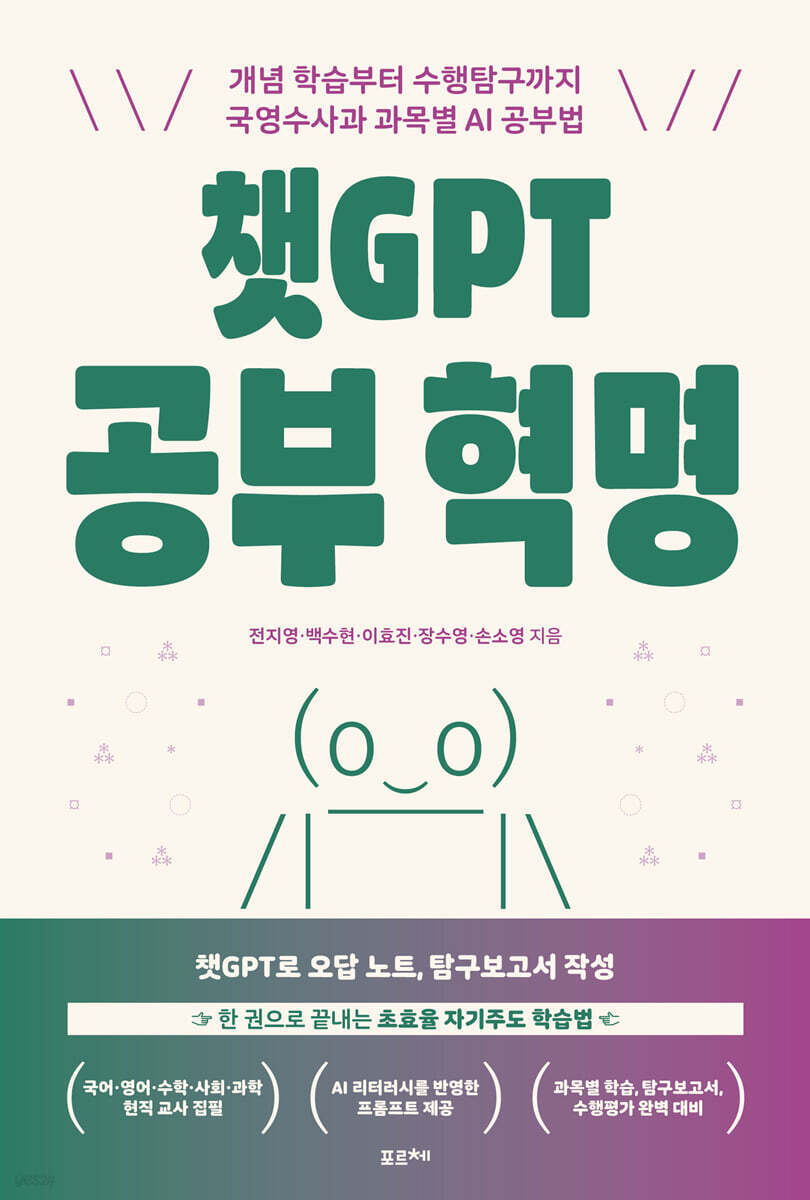
Master all subjects using ChatGPT, taught by current middle and high school teachers!
Many students are already utilizing ChatGPT, but due to the lack of proper guidance, ChatGPT, which has limitless potential and applications, is being used only for information retrieval.
Accordingly, current middle and high school teachers provide detailed information on how ChatGPT can be utilized for individual learners' studies, based on their curriculum and actual teaching experience, for each subject, and guide them through the use of it for concept learning, performance assessment, and even inquiry report writing.
In particular, we introduce ChatGPT, which allows for one-on-one customized study by providing subject-specific prompts so that students can ask questions and apply the answers themselves.
It guides students through concepts, problem solving, and exploration across all subjects, including the core subjects of Korean, English, and Mathematics, as well as social studies and science inquiry subjects. It also suggests formats that can be immediately utilized for subject-specific performance assessments, inquiry reports, and writing assignments.
Korean language suggests ways to expand your thinking skills through questions, from finding points of literary appreciation to reading non-fiction and writing career-related book reviews.
English guides you through how to develop a foreign language sense with AI through customized prompts for reading, grammar, and speaking, and math presents a mathematical thinking training method using AI, from organizing concepts to establishing problem-solving routines and setting inquiry topics, and specifically covers how to explain incorrect problems to ChatGPT to confirm the correct concepts and solution process.
Society guides you through how to use ChatGPT as a learning tool, from organizing textbook concepts to deriving research topics, and presents practical learning methods, from writing news-based articles to writing research reports.
Science covers how to study science with ChatGPT, from textbook-based concept questions, experimental idea generation, and inquiry report design, and provides specific prompt examples from organizing experimental results to structuring inquiry tasks.
Even students who are new to ChatGPT can follow the examples in the book to organize course concepts, prepare for performance assessments, compose research reports, and write career-related essays.
Through the ChatGPT study method, developed by current middle and high school teachers teaching Korean, English, math, social studies, and science, you can learn in line with the shift to assessment methods that require inquiry skills and critical thinking.
Master all subjects using ChatGPT, taught by current middle and high school teachers!
Many students are already utilizing ChatGPT, but due to the lack of proper guidance, ChatGPT, which has limitless potential and applications, is being used only for information retrieval.
Accordingly, current middle and high school teachers provide detailed information on how ChatGPT can be utilized for individual learners' studies, based on their curriculum and actual teaching experience, for each subject, and guide them through the use of it for concept learning, performance assessment, and even inquiry report writing.
In particular, we introduce ChatGPT, which allows for one-on-one customized study by providing subject-specific prompts so that students can ask questions and apply the answers themselves.
It guides students through concepts, problem solving, and exploration across all subjects, including the core subjects of Korean, English, and Mathematics, as well as social studies and science inquiry subjects. It also suggests formats that can be immediately utilized for subject-specific performance assessments, inquiry reports, and writing assignments.
Korean language suggests ways to expand your thinking skills through questions, from finding points of literary appreciation to reading non-fiction and writing career-related book reviews.
English guides you through how to develop a foreign language sense with AI through customized prompts for reading, grammar, and speaking, and math presents a mathematical thinking training method using AI, from organizing concepts to establishing problem-solving routines and setting inquiry topics, and specifically covers how to explain incorrect problems to ChatGPT to confirm the correct concepts and solution process.
Society guides you through how to use ChatGPT as a learning tool, from organizing textbook concepts to deriving research topics, and presents practical learning methods, from writing news-based articles to writing research reports.
Science covers how to study science with ChatGPT, from textbook-based concept questions, experimental idea generation, and inquiry report design, and provides specific prompt examples from organizing experimental results to structuring inquiry tasks.
Even students who are new to ChatGPT can follow the examples in the book to organize course concepts, prepare for performance assessments, compose research reports, and write career-related essays.
Through the ChatGPT study method, developed by current middle and high school teachers teaching Korean, English, math, social studies, and science, you can learn in line with the shift to assessment methods that require inquiry skills and critical thinking.
- You can preview some of the book's contents.
Preview
index
Prologue _4
Chapter 1.
ChatGPT appears
1. The World Changed by AI _10
2.
ChatGPT, Who Are You _14
Chapter 2.
Your first step to studying with ChatGPT
1.
ChatGPT and the Skills We Need _20
2.
What are the benefits of studying with ChatGPT? _27
3.
Changing the Question Changes the Answer - 7 Prompt Strategies _30
4.
ChatGPT Features Perfect for Studying _38
5.
Guide to Using ChatGPT Properly _53
Chapter 3.
Korean: Easy to read and easy to write
1.
Literature: Appreciating and Analyzing Unfamiliar Works Without Feeling _61
2.
Non-fiction: Mastering Reading Skills with the "Tick.I.Yo.Hak" Strategy _91
3.
Writing: Writing Your Own Story with ChatGPT _105
Chapter 4.
English, Transcending Environmental Limitations
1.
Reading: A 5-Step Guide to Reading Comprehension _120
2.
Vocabulary: Everything You Need to Know About Words, From Roots to Conjugation _135
3.
Grammar: Addressing Lack of Grammar Exposure with ChatGPT _151
4.
Writing: The 'STEP' Strategy for English Writing _162
5.
Speaking: Speaking one sentence at a time in voice mode _179
Chapter 5.
Mathematics, Giving Wings to Exploration
1.
Concept: From Understanding Principles to Explanations, Concept Building Routine _191
2.
Problem Solving: From Practice to Understanding and Expansion, Problem Solving Routine _204
3.
Exploration: Finding Your Own Topic Ideas _221
Chapter 6.
Open your eyes to society and the world
1.
Concept Learning: Structuring Concepts with 'Jik.Gong.Yo.Jeong.' _239
2.
Problem Solving: 5 Steps to "SCORE" from Solving to Correcting Incorrect Answers _247
3.
Reading the News: Easy and Deep Reading with ChatGPT _255
4.
Writing Articles: Senior Reporter ChatGPT and Writing Articles _264
5.
Research Report: From Topic Finding to Feedback, Writing a Research Report _277
Chapter 7.
Science, Exploring Through Questions
1.
Concept Learning: A Concept Learning Method that Utilizes 100% of the Textbook _302
2.
Problem Solving: Step-by-Step Solutions for Zero Errors _312
3.
Inquiry Report: Writing a Curriculum-Linked Inquiry Report _320
References _335
Chapter 1.
ChatGPT appears
1. The World Changed by AI _10
2.
ChatGPT, Who Are You _14
Chapter 2.
Your first step to studying with ChatGPT
1.
ChatGPT and the Skills We Need _20
2.
What are the benefits of studying with ChatGPT? _27
3.
Changing the Question Changes the Answer - 7 Prompt Strategies _30
4.
ChatGPT Features Perfect for Studying _38
5.
Guide to Using ChatGPT Properly _53
Chapter 3.
Korean: Easy to read and easy to write
1.
Literature: Appreciating and Analyzing Unfamiliar Works Without Feeling _61
2.
Non-fiction: Mastering Reading Skills with the "Tick.I.Yo.Hak" Strategy _91
3.
Writing: Writing Your Own Story with ChatGPT _105
Chapter 4.
English, Transcending Environmental Limitations
1.
Reading: A 5-Step Guide to Reading Comprehension _120
2.
Vocabulary: Everything You Need to Know About Words, From Roots to Conjugation _135
3.
Grammar: Addressing Lack of Grammar Exposure with ChatGPT _151
4.
Writing: The 'STEP' Strategy for English Writing _162
5.
Speaking: Speaking one sentence at a time in voice mode _179
Chapter 5.
Mathematics, Giving Wings to Exploration
1.
Concept: From Understanding Principles to Explanations, Concept Building Routine _191
2.
Problem Solving: From Practice to Understanding and Expansion, Problem Solving Routine _204
3.
Exploration: Finding Your Own Topic Ideas _221
Chapter 6.
Open your eyes to society and the world
1.
Concept Learning: Structuring Concepts with 'Jik.Gong.Yo.Jeong.' _239
2.
Problem Solving: 5 Steps to "SCORE" from Solving to Correcting Incorrect Answers _247
3.
Reading the News: Easy and Deep Reading with ChatGPT _255
4.
Writing Articles: Senior Reporter ChatGPT and Writing Articles _264
5.
Research Report: From Topic Finding to Feedback, Writing a Research Report _277
Chapter 7.
Science, Exploring Through Questions
1.
Concept Learning: A Concept Learning Method that Utilizes 100% of the Textbook _302
2.
Problem Solving: Step-by-Step Solutions for Zero Errors _312
3.
Inquiry Report: Writing a Curriculum-Linked Inquiry Report _320
References _335
Detailed image

Into the book
ChatGPT is a conversational AI tool that lets you ask questions anytime, anywhere, without having to wait or feel embarrassed.
You can ask questions right away when you get stuck while studying, and if you don't quite understand the answer, you can get an explanation again.
Things that were awkward to ask in front of friends or teachers can now be talked about comfortably in front of ChatGPT.
--- p.4, from "Prologue"
ChatGPT is extremely useful for summarizing long texts and finding information that is not readily available or for finding vast amounts of training data.
Quickly find and provide the reference materials you need, and organize or compare related examples and materials in tables.
We also translate materials written in foreign languages.
Because it saves us time, we can invest more time in other learning activities.
As a result, learning efficiency is greatly improved.
--- p.29, from “What are the benefits of studying with ChatGPT?”
In the case of Korean literary works, even if ChatGPT provides plausible examples, there are cases where the examples do not actually exist or present content that differs from the original.
This is the hallucination problem that we need to be most careful about when using ChatGPT.
These errors occur when ChatGPT, having not yet sufficiently studied Korean literature, creates "plausible sentences" that are not factual.
(…) Therefore, ChatGPT’s answers should always be accepted as ‘one opinion’ rather than ‘the correct answer’.
And it is important to have the habit of double-checking the content through textbooks or the internet, or 'cross-checking'.
--- p.73~74, from “Literature: Appreciating and Analyzing Unfamiliar Works Without Burden”
The English we learn in the classroom is limited, and we don't have many opportunities to experience its real-world application.
However, GPT can be a powerful tool that overcomes these limitations.
Even if you read a single passage, it will analyze it from various angles, provide various methods to easily learn vocabulary and grammar, and help you practice writing and speaking like a Korean-American teacher who is fluent in both Korean and English.
--- p.187, from “Speaking: Speaking by increasing sentences one by one in voice mode”
Second, what is important in an inquiry report is how you thought and investigated.
Architecture students often explore seismic design in their calculus research reports, but most of them only end up conducting research.
Research is not inquiry.
It requires additional expertise, such as directly explaining or calculating the principles of calculus used in earthquake-resistant design, analyzing actual phenomena as a result of research, or solving problems.
And the content of the inquiry must include the mathematical concepts that are currently being learned.
--- p.234, from "Exploration: Finding Your Own Topic Ideas"
② If you receive feedback on each paragraph, you can immediately correct any mistakes in the direction of the writing, which increases the overall level of completion.
By revising each sentence, you can gradually improve your writing skills. It is less burdensome than writing a long piece at once, and you can write with more focus.
--- p.272, from “Writing Articles: Writing Articles with Chat GPT from Senior Reporters”
〈In-depth Learning〉: Ask questions when there is only a one-line explanation in the textbook.
Prompts that ask in-depth questions can also be used as topics for research papers.
5.
They say Iceland is a plate boundary, but are there really other places like it?
6.
Why is the density of oceanic plates greater than that of continental plates?
You can ask questions right away when you get stuck while studying, and if you don't quite understand the answer, you can get an explanation again.
Things that were awkward to ask in front of friends or teachers can now be talked about comfortably in front of ChatGPT.
--- p.4, from "Prologue"
ChatGPT is extremely useful for summarizing long texts and finding information that is not readily available or for finding vast amounts of training data.
Quickly find and provide the reference materials you need, and organize or compare related examples and materials in tables.
We also translate materials written in foreign languages.
Because it saves us time, we can invest more time in other learning activities.
As a result, learning efficiency is greatly improved.
--- p.29, from “What are the benefits of studying with ChatGPT?”
In the case of Korean literary works, even if ChatGPT provides plausible examples, there are cases where the examples do not actually exist or present content that differs from the original.
This is the hallucination problem that we need to be most careful about when using ChatGPT.
These errors occur when ChatGPT, having not yet sufficiently studied Korean literature, creates "plausible sentences" that are not factual.
(…) Therefore, ChatGPT’s answers should always be accepted as ‘one opinion’ rather than ‘the correct answer’.
And it is important to have the habit of double-checking the content through textbooks or the internet, or 'cross-checking'.
--- p.73~74, from “Literature: Appreciating and Analyzing Unfamiliar Works Without Burden”
The English we learn in the classroom is limited, and we don't have many opportunities to experience its real-world application.
However, GPT can be a powerful tool that overcomes these limitations.
Even if you read a single passage, it will analyze it from various angles, provide various methods to easily learn vocabulary and grammar, and help you practice writing and speaking like a Korean-American teacher who is fluent in both Korean and English.
--- p.187, from “Speaking: Speaking by increasing sentences one by one in voice mode”
Second, what is important in an inquiry report is how you thought and investigated.
Architecture students often explore seismic design in their calculus research reports, but most of them only end up conducting research.
Research is not inquiry.
It requires additional expertise, such as directly explaining or calculating the principles of calculus used in earthquake-resistant design, analyzing actual phenomena as a result of research, or solving problems.
And the content of the inquiry must include the mathematical concepts that are currently being learned.
--- p.234, from "Exploration: Finding Your Own Topic Ideas"
② If you receive feedback on each paragraph, you can immediately correct any mistakes in the direction of the writing, which increases the overall level of completion.
By revising each sentence, you can gradually improve your writing skills. It is less burdensome than writing a long piece at once, and you can write with more focus.
--- p.272, from “Writing Articles: Writing Articles with Chat GPT from Senior Reporters”
〈In-depth Learning〉: Ask questions when there is only a one-line explanation in the textbook.
Prompts that ask in-depth questions can also be used as topics for research papers.
5.
They say Iceland is a plate boundary, but are there really other places like it?
6.
Why is the density of oceanic plates greater than that of continental plates?
--- p.311, from “Concept Learning: A Concept Learning Method that Utilizes 100% of the Textbook”
Publisher's Review
The power of asking AI smart questions can change your grades!
A super-smart study method that gets you ahead with smart questions, performance assessments, and research reports.
This book provides students with a clear guide on how to ask questions of AI and how to make the answers their own.
It teaches you how to design questions, analyze responses, and follow up with follow-up questions, creating a self-directed learning experience that is completely different from traditional learning methods.
ChatGPT should be used as a study 'coach' rather than a tool that provides answers.
Soon, students will be able to create their own questions, design their own thought processes through those questions, and use ChatGPT as a learning partner.
In that sense, students can learn how to study with ChatGPT step by step through this book, including how to structure questions, why key keywords are chosen, and expected results.
Let's learn how to think for ourselves and internalize the learning outcomes, so we can study on our own without being led around by AI.
Make ChatGPT your own study teacher with just one prompt.
This book provides the essential guide to moving from AI that receives answers to AI that thinks together.
A personalized learning coach without time or space constraints
Free tuition! 24/7 AI tutoring for self-directed learning.
This book was compiled by current teachers who have been using AI with students in the field, and contains only the information most relevant to the current educational environment.
It contains specific and practical questioning strategies and usage methods so that middle and high school students can study with AI on their own. One of its strengths is that it is based on actual classes and assessments.
Beyond simply listing ChatGPT features, it includes examples closely related to the curriculum, such as Korean literature appreciation, English speaking, math inquiry reports, social news reading, and science experiment reports.
By providing ChatGPT's responses to prompts, follow-up questions, and error correction methods for each subject, students can learn how to actually converse with AI and study.
This book also includes tips for reviewing ChatGPT errors, using AI safely, and developing questions that gradually evolve prompts, helping you develop AI utilization capabilities beyond simple usage.
It also explains why copying ChatGPT answers directly into assignments can be problematic, and provides easy-to-understand explanations of copyright concepts and AI ethics, covering essential knowledge on digital literacy, copyright awareness, and AI ethics. It highlights essential precautions for students studying in the AI era.
In this way, this book is a practical guide for middle and high school students who are feeling overwhelmed by their performance assessments and for parents who want to help their children with self-directed learning.
Above all, it will provide insights to all teachers who want to guide their students on how to use ChatGPT.
A super-smart study method that gets you ahead with smart questions, performance assessments, and research reports.
This book provides students with a clear guide on how to ask questions of AI and how to make the answers their own.
It teaches you how to design questions, analyze responses, and follow up with follow-up questions, creating a self-directed learning experience that is completely different from traditional learning methods.
ChatGPT should be used as a study 'coach' rather than a tool that provides answers.
Soon, students will be able to create their own questions, design their own thought processes through those questions, and use ChatGPT as a learning partner.
In that sense, students can learn how to study with ChatGPT step by step through this book, including how to structure questions, why key keywords are chosen, and expected results.
Let's learn how to think for ourselves and internalize the learning outcomes, so we can study on our own without being led around by AI.
Make ChatGPT your own study teacher with just one prompt.
This book provides the essential guide to moving from AI that receives answers to AI that thinks together.
A personalized learning coach without time or space constraints
Free tuition! 24/7 AI tutoring for self-directed learning.
This book was compiled by current teachers who have been using AI with students in the field, and contains only the information most relevant to the current educational environment.
It contains specific and practical questioning strategies and usage methods so that middle and high school students can study with AI on their own. One of its strengths is that it is based on actual classes and assessments.
Beyond simply listing ChatGPT features, it includes examples closely related to the curriculum, such as Korean literature appreciation, English speaking, math inquiry reports, social news reading, and science experiment reports.
By providing ChatGPT's responses to prompts, follow-up questions, and error correction methods for each subject, students can learn how to actually converse with AI and study.
This book also includes tips for reviewing ChatGPT errors, using AI safely, and developing questions that gradually evolve prompts, helping you develop AI utilization capabilities beyond simple usage.
It also explains why copying ChatGPT answers directly into assignments can be problematic, and provides easy-to-understand explanations of copyright concepts and AI ethics, covering essential knowledge on digital literacy, copyright awareness, and AI ethics. It highlights essential precautions for students studying in the AI era.
In this way, this book is a practical guide for middle and high school students who are feeling overwhelmed by their performance assessments and for parents who want to help their children with self-directed learning.
Above all, it will provide insights to all teachers who want to guide their students on how to use ChatGPT.
GOODS SPECIFICS
- Date of issue: August 13, 2025
- Page count, weight, size: 336 pages | 152*225*30mm
- ISBN13: 9791194634416
- ISBN10: 1194634419
You may also like
카테고리
korean


korean

![GQ KOREA Mark (Monthly): December [2025]](http://librairie.coreenne.fr/cdn/shop/files/8ef265dbbfbf186523ed75ba7319009d.jpg?v=1765340328&width=3840)


