

Child's speech practice
 |
Description
Book Introduction
Vivid insights from a 28-year veteran teacher
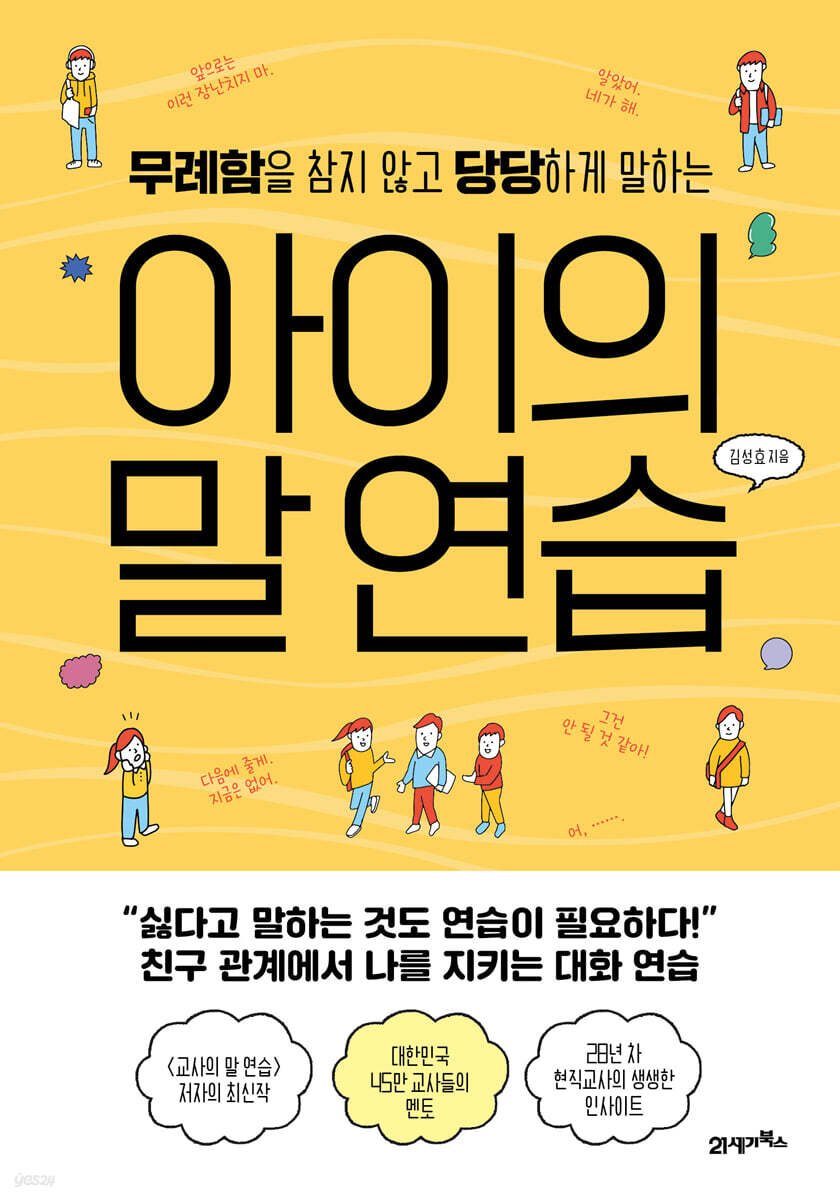
The author, who worked as an elementary school teacher for 28 years, has written books such as “Teacher’s Speech Practice” and “Teacher’s Speech Skills.” This book introduces effective coping methods based on real-life cases experienced by elementary school students.
This coping strategy, practiced with parents, teaches children how to speak up in conflict situations with friends to protect themselves and avoid unnecessary fights.
If you are unable to say anything or express your feelings in an embarrassing situation, it can build up inside you and lead to illness or sudden explosions.
Conversely, responding in an aggressive manner risks being perceived as a child who hurts his friends and causes problems.
Therefore, it is important to speak softly and confidently, drawing a clear line without hurting the other person and maintaining self-esteem.
To achieve this, it is effective to practice consistently by creating various situations at home with your parents.
This book examines various problematic situations and questions that actually arise among children, providing parents with guidance to keep in mind and helping children practice recognizing and expressing their own emotions.
As this way of speaking becomes internalized through repeated practice, children will be able to develop the ability to solve problems on their own.
The author, who worked as an elementary school teacher for 28 years, has written books such as “Teacher’s Speech Practice” and “Teacher’s Speech Skills.” This book introduces effective coping methods based on real-life cases experienced by elementary school students.
This coping strategy, practiced with parents, teaches children how to speak up in conflict situations with friends to protect themselves and avoid unnecessary fights.
If you are unable to say anything or express your feelings in an embarrassing situation, it can build up inside you and lead to illness or sudden explosions.
Conversely, responding in an aggressive manner risks being perceived as a child who hurts his friends and causes problems.
Therefore, it is important to speak softly and confidently, drawing a clear line without hurting the other person and maintaining self-esteem.
To achieve this, it is effective to practice consistently by creating various situations at home with your parents.
This book examines various problematic situations and questions that actually arise among children, providing parents with guidance to keep in mind and helping children practice recognizing and expressing their own emotions.
As this way of speaking becomes internalized through repeated practice, children will be able to develop the ability to solve problems on their own.
- You can preview some of the book's contents.
Preview
index
Prologue · Why did you do that? Why can't you just say no! ·4
01 Three Reactions Children Show in Conflict Situations·17
02 When you're called a nickname you don't want to hear·21
03 How to Make Yourself Speak Confidently in Front of Friends ·27
04 A child who can't say anything at school and is upset when he gets home·32
05 When you keep poking me, saying it's a joke·35
06 When a friend ignores you, saying, "Can't you even do this?" ·42
07 You also need to practice expressing your emotions. 48
08 When taking an item without permission·52
09 When a friend is talking during class·59
10 Good Child Syndrome·65
Teacher Seonghyo's Episode 1: Why the School Violence Committee Wasn't Held That Day·69
11 When doing things your own way in group activities·73
12 When swinging dangerous objects such as knives or scissors·80
13 When a friend is picking on you·85
14 When a Friend Hits You for No Reason·91
15. What are the procedures for reporting school violence?·98
16 When Your Friend Swears·102
17 A child who is shy when giving a presentation·108
18 When you want to play a bad prank together·113
19 My friends don't like me for being a tattletale. 119
20 When you look at someone and whisper in their ear·124
Seonghyo's Episode 2: Speaking with Emphasis · 130
21 I try to be friendly with friends who gossip about me. 133
22 When a friend throws something·137
23 When a friend asks you to buy them a snack·142
24 Strict Parents vs. Permissive Parents·148
25 A friend asking to borrow money·152
26 Friends who don't follow the rules well·159
27 Children Who Can't Say They Don't Want to Play Together · 166
28 Friends Who Send Messaging Messages Late at Night·172
29 I can't say I want to play with you. 175
30 When teasing by imitating actions or words·179
Teacher Seonghyo's Episode 3: What is the School Safety Mutual Aid Association? 186
31 When you are not allowed to play with other friends·190
32 A friend who just passed by in the hallway·193
33 When you just give something away to a friend·198
34 When you tease someone about their appearance·204
Epilogue: How Does That Child Speak So Well? 210
01 Three Reactions Children Show in Conflict Situations·17
02 When you're called a nickname you don't want to hear·21
03 How to Make Yourself Speak Confidently in Front of Friends ·27
04 A child who can't say anything at school and is upset when he gets home·32
05 When you keep poking me, saying it's a joke·35
06 When a friend ignores you, saying, "Can't you even do this?" ·42
07 You also need to practice expressing your emotions. 48
08 When taking an item without permission·52
09 When a friend is talking during class·59
10 Good Child Syndrome·65
Teacher Seonghyo's Episode 1: Why the School Violence Committee Wasn't Held That Day·69
11 When doing things your own way in group activities·73
12 When swinging dangerous objects such as knives or scissors·80
13 When a friend is picking on you·85
14 When a Friend Hits You for No Reason·91
15. What are the procedures for reporting school violence?·98
16 When Your Friend Swears·102
17 A child who is shy when giving a presentation·108
18 When you want to play a bad prank together·113
19 My friends don't like me for being a tattletale. 119
20 When you look at someone and whisper in their ear·124
Seonghyo's Episode 2: Speaking with Emphasis · 130
21 I try to be friendly with friends who gossip about me. 133
22 When a friend throws something·137
23 When a friend asks you to buy them a snack·142
24 Strict Parents vs. Permissive Parents·148
25 A friend asking to borrow money·152
26 Friends who don't follow the rules well·159
27 Children Who Can't Say They Don't Want to Play Together · 166
28 Friends Who Send Messaging Messages Late at Night·172
29 I can't say I want to play with you. 175
30 When teasing by imitating actions or words·179
Teacher Seonghyo's Episode 3: What is the School Safety Mutual Aid Association? 186
31 When you are not allowed to play with other friends·190
32 A friend who just passed by in the hallway·193
33 When you just give something away to a friend·198
34 When you tease someone about their appearance·204
Epilogue: How Does That Child Speak So Well? 210
Detailed image

Into the book
Children aren't only hurt by serious and extreme pranks.
I get hurt by trivial and insignificant things.
It's not that the child is particularly delicate or sensitive; most children are like that.
A child who usually seems so generous starts crying over nothing.
It's always good to keep in mind that adults can be hurt by even the most trivial words, which are hard to fathom.
“Hello, hello, hello Jin.” It’s like it hurts a child named Ahn Young-jin.
--- p.22
If there were no conflict or confrontation in the classroom, wouldn't the child learn nothing? A child who has never experienced uncomfortable situations wouldn't learn how to respond appropriately when conflict arises, or how to say things to avoid hurting others.
I believe that giving children the opportunity to face even somewhat uncomfortable situations with confidence will help them develop the strength to endure adversity on their own.
--- p.34
If you don't learn how to say no properly in elementary school, you won't be able to say these things well even when you're in upper grades.
Words that are not in your mouth do not come out easily, and words that you have never said before cannot suddenly come out one day.
Parents think that this happens because their child is withdrawn, but in my opinion, it seems to be a difference in whether or not the child can express rejection or refusal rather than a difference in personality.
--- p.53
If there is a physical fight, no matter how minor, you should immediately inform the surrounding children and the homeroom teacher and ask them to help.
We should encourage them that asking for help is not something to be ashamed of, but rather an act of courage.
--- p.94
It is actually natural and expected that younger children will sue a lot.
At this age, children have a clear standard of good and evil, such as what psychologists call a good person and that lying is never allowed.
That is why children at this age like traditional fairy tales that clearly show good triumphing over evil, meaning good people are rewarded and bad people are punished.
--- p.120
I believe that teachers need to be able to call out misbehavior in the classroom so they can teach students properly.
It's the same at home.
If parents constantly cover up their child's misbehavior, the child will not learn anything.
If both good and bad behavior are good, how can a child determine for himself what is good and what is bad?
--- p.150
.
If you think of children's relationships as adult relationships, you will end up guiding them by telling them not to play together again.
Unless there is lingering resentment between children or there has been psychological or physical harm that has been repeated for a long time, children can easily make up and play together without any problems.
--- p.167
Even in situations where an apology is required, children often avoid conflict by pretending not to know, muddle-talking, or not speaking clearly enough.
This attitude may make the other child appear easygoing or like they have permission to play pranks.
I get hurt by trivial and insignificant things.
It's not that the child is particularly delicate or sensitive; most children are like that.
A child who usually seems so generous starts crying over nothing.
It's always good to keep in mind that adults can be hurt by even the most trivial words, which are hard to fathom.
“Hello, hello, hello Jin.” It’s like it hurts a child named Ahn Young-jin.
--- p.22
If there were no conflict or confrontation in the classroom, wouldn't the child learn nothing? A child who has never experienced uncomfortable situations wouldn't learn how to respond appropriately when conflict arises, or how to say things to avoid hurting others.
I believe that giving children the opportunity to face even somewhat uncomfortable situations with confidence will help them develop the strength to endure adversity on their own.
--- p.34
If you don't learn how to say no properly in elementary school, you won't be able to say these things well even when you're in upper grades.
Words that are not in your mouth do not come out easily, and words that you have never said before cannot suddenly come out one day.
Parents think that this happens because their child is withdrawn, but in my opinion, it seems to be a difference in whether or not the child can express rejection or refusal rather than a difference in personality.
--- p.53
If there is a physical fight, no matter how minor, you should immediately inform the surrounding children and the homeroom teacher and ask them to help.
We should encourage them that asking for help is not something to be ashamed of, but rather an act of courage.
--- p.94
It is actually natural and expected that younger children will sue a lot.
At this age, children have a clear standard of good and evil, such as what psychologists call a good person and that lying is never allowed.
That is why children at this age like traditional fairy tales that clearly show good triumphing over evil, meaning good people are rewarded and bad people are punished.
--- p.120
I believe that teachers need to be able to call out misbehavior in the classroom so they can teach students properly.
It's the same at home.
If parents constantly cover up their child's misbehavior, the child will not learn anything.
If both good and bad behavior are good, how can a child determine for himself what is good and what is bad?
--- p.150
.
If you think of children's relationships as adult relationships, you will end up guiding them by telling them not to play together again.
Unless there is lingering resentment between children or there has been psychological or physical harm that has been repeated for a long time, children can easily make up and play together without any problems.
--- p.167
Even in situations where an apology is required, children often avoid conflict by pretending not to know, muddle-talking, or not speaking clearly enough.
This attitude may make the other child appear easygoing or like they have permission to play pranks.
--- p.195
Publisher's Review
Practice understanding and expressing emotions with your parents.
Elementary school life is children's first social experience.
Although it is a time full of new joys, children also experience many burdensome or uncomfortable situations.
The younger the elementary school children are, the more sensitive they are in their relationships with their friends, and as a result, their parents are also more likely to become sensitive.
Amidst these conflicts, schools frequently hold 'school violence committees', the number of teachers struggling under pressure from parents increases, and emotional conflicts between parents intensify.
Some people point out that this is because children grow up in overprotection and do not learn manners.
However, the children who are at the center of these conflicts are actually losing the opportunity to solve the problems.
If children can communicate appropriately with friends who call them names, are rude, or talk behind their backs, they can rebuild their relationships while maintaining their self-esteem.
The author emphasizes that for this to happen, it is necessary to practice expressing emotions without hurting them with parents.
Through consistent practice, children can form healthy relationships and develop problem-solving skills.
From the prologue
"Why did you do that? Why can't you just say no?"
As I've emphasized several times while writing this book, speaking is a habit, so if you don't practice regularly, it's difficult to speak properly in embarrassing situations.
Actually, I did that too.
I entered elementary school at the age of seven, and as an October-born child, I was emotionally more immature than my peers.
I cried so often that my nickname was 'crybaby'.
Even if someone teased me or played a prank on me, I would start to cry.
I cried because I didn't know how to react, I cried because it was unfair, and I cried because I was upset.
My friends didn't like me because I cried often, and I would cry again because I felt lonely.
Thanks to these experiences, even after becoming a teacher, I naturally became interested in children who cried before they spoke, children who were smart but froze in front of their friends, children who could solve problems with words but threw their fists first, and children who couldn't even protest when they felt wronged.
And then at some point I realized.
The fact that most of these children are not good at expressing their emotions or have never learned how to deal with conflict situations at home.
It would be great if parents could always be there for their children and talk to them when they feel wronged, upset, or teased by their friends, but realistically, that's not possible.
Ultimately, the most important thing is to practice teaching your child to express his or her emotions and deal with them appropriately.
- Kim Seong-hyo (author)
Elementary school life is children's first social experience.
Although it is a time full of new joys, children also experience many burdensome or uncomfortable situations.
The younger the elementary school children are, the more sensitive they are in their relationships with their friends, and as a result, their parents are also more likely to become sensitive.
Amidst these conflicts, schools frequently hold 'school violence committees', the number of teachers struggling under pressure from parents increases, and emotional conflicts between parents intensify.
Some people point out that this is because children grow up in overprotection and do not learn manners.
However, the children who are at the center of these conflicts are actually losing the opportunity to solve the problems.
If children can communicate appropriately with friends who call them names, are rude, or talk behind their backs, they can rebuild their relationships while maintaining their self-esteem.
The author emphasizes that for this to happen, it is necessary to practice expressing emotions without hurting them with parents.
Through consistent practice, children can form healthy relationships and develop problem-solving skills.
From the prologue
"Why did you do that? Why can't you just say no?"
As I've emphasized several times while writing this book, speaking is a habit, so if you don't practice regularly, it's difficult to speak properly in embarrassing situations.
Actually, I did that too.
I entered elementary school at the age of seven, and as an October-born child, I was emotionally more immature than my peers.
I cried so often that my nickname was 'crybaby'.
Even if someone teased me or played a prank on me, I would start to cry.
I cried because I didn't know how to react, I cried because it was unfair, and I cried because I was upset.
My friends didn't like me because I cried often, and I would cry again because I felt lonely.
Thanks to these experiences, even after becoming a teacher, I naturally became interested in children who cried before they spoke, children who were smart but froze in front of their friends, children who could solve problems with words but threw their fists first, and children who couldn't even protest when they felt wronged.
And then at some point I realized.
The fact that most of these children are not good at expressing their emotions or have never learned how to deal with conflict situations at home.
It would be great if parents could always be there for their children and talk to them when they feel wronged, upset, or teased by their friends, but realistically, that's not possible.
Ultimately, the most important thing is to practice teaching your child to express his or her emotions and deal with them appropriately.
- Kim Seong-hyo (author)
GOODS SPECIFICS
- Date of issue: April 2, 2025
- Page count, weight, size: 214 pages | 430g | 140*200*20mm
- ISBN13: 9791173571961
- ISBN10: 1173571965
You may also like
카테고리
korean


korean

![ELLE 엘르 스페셜 에디션 A형 : 12월 [2025]](http://librairie.coreenne.fr/cdn/shop/files/b8e27a3de6c9538896439686c6b0e8fb.jpg?v=1766436872&width=3840)


