

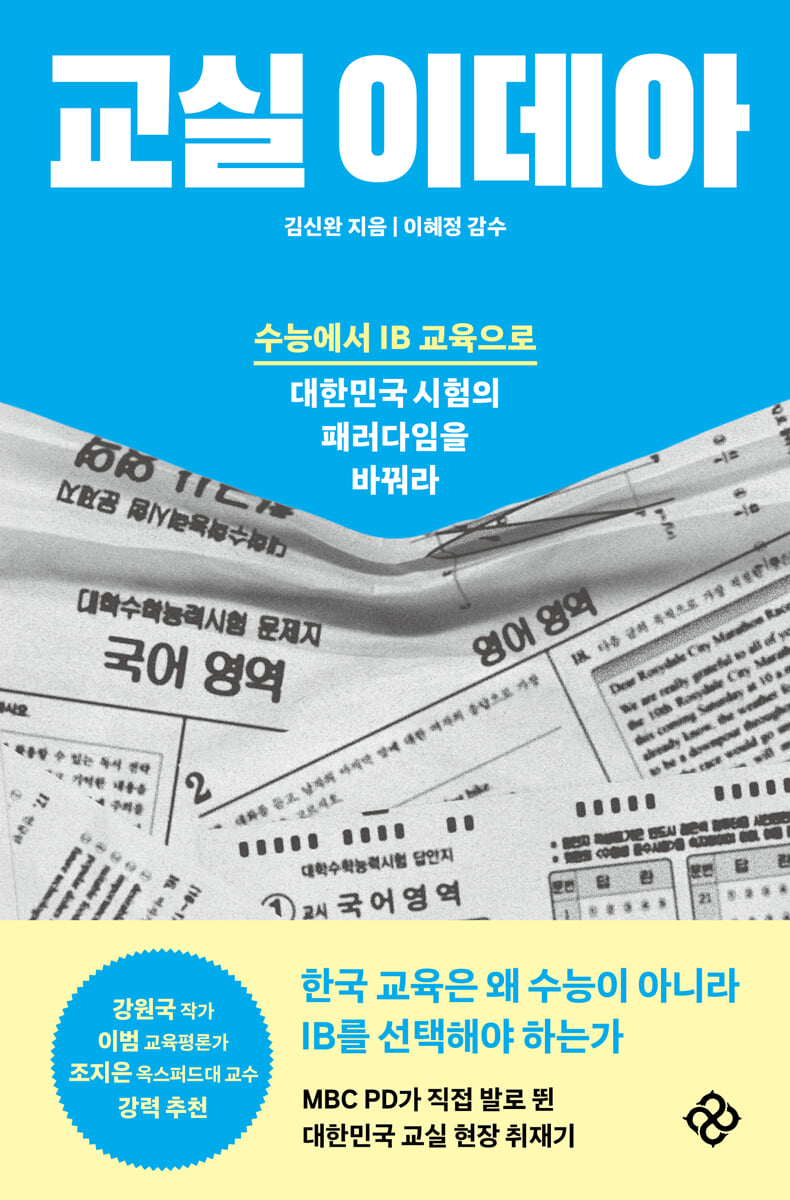
Classroom Idea
 |
Description
Book Introduction
The true face of the college entrance exam is miserable.
Contrary to expectations that there will never be another exam as good as this one, the CSAT is nothing more than a test that is below standard, full of flaws, and should be scrapped.
The CSAT is a test that lacks validity and is not very fair.
In this situation, the education world is undergoing a quiet revolution through the introduction of the IB.
Students will now enter schools built on the IB, and essay-based absolute assessment will become the standard for college admissions and school records.
In this era of great educational transformation, it is time for students, parents, and teachers to change their thinking wisely.
Based on the MBC documentary "Classroom Idea," which aired in three parts in April 2024 and garnered much attention, this book, written by the producer in charge, presents clear reasons and directions for why Korean education should choose the IB rather than the CSAT.
Contrary to expectations that there will never be another exam as good as this one, the CSAT is nothing more than a test that is below standard, full of flaws, and should be scrapped.
The CSAT is a test that lacks validity and is not very fair.
In this situation, the education world is undergoing a quiet revolution through the introduction of the IB.
Students will now enter schools built on the IB, and essay-based absolute assessment will become the standard for college admissions and school records.
In this era of great educational transformation, it is time for students, parents, and teachers to change their thinking wisely.
Based on the MBC documentary "Classroom Idea," which aired in three parts in April 2024 and garnered much attention, this book, written by the producer in charge, presents clear reasons and directions for why Korean education should choose the IB rather than the CSAT.
- You can preview some of the book's contents.
Preview
index
Prologue: Why I'm Talking About IB Now
Note
Chapter 1: The End of the College Scholastic Ability Test Era
Diagnose the College Scholastic Ability Test
The CSAT is an inadequate exam.
The CSAT is an unfair exam.
My grades are more serious
Chapter 2: The Substitution System in a Maze
The worst education policy: relative evaluation
Our education that competes with artificial intelligence
Education Without an Exit and the 2028 College Entrance Exam Reform Plan
Chapter 3: The Escape from Korean Education: The IB
The education paradigm that suits us
A new educational paradigm: IB
IB education witnessed in the field
Chapter 4: IB Curriculum and Assessment System
Basic Structure of the IB Curriculum
IB's assessment system
IB DP Core Subject Curriculum
Chapter 5: The Amazing Changes Brought About by IB
IB's ideal classroom environment
Student Change: As the Test Changes, Students Change
Teachers' Transformation: Reclaiming Teacher Power
Parents' Transformation: Free from Financial Burden
Chapter 6: The IB Enters Korean Public Education
Introduction of the IB program in public education in South Korea
Regional IBs are spreading
IB students' college admissions
Chapter 7: The Era of Paradigm Shift
Epilogue
Note
Chapter 1: The End of the College Scholastic Ability Test Era
Diagnose the College Scholastic Ability Test
The CSAT is an inadequate exam.
The CSAT is an unfair exam.
My grades are more serious
Chapter 2: The Substitution System in a Maze
The worst education policy: relative evaluation
Our education that competes with artificial intelligence
Education Without an Exit and the 2028 College Entrance Exam Reform Plan
Chapter 3: The Escape from Korean Education: The IB
The education paradigm that suits us
A new educational paradigm: IB
IB education witnessed in the field
Chapter 4: IB Curriculum and Assessment System
Basic Structure of the IB Curriculum
IB's assessment system
IB DP Core Subject Curriculum
Chapter 5: The Amazing Changes Brought About by IB
IB's ideal classroom environment
Student Change: As the Test Changes, Students Change
Teachers' Transformation: Reclaiming Teacher Power
Parents' Transformation: Free from Financial Burden
Chapter 6: The IB Enters Korean Public Education
Introduction of the IB program in public education in South Korea
Regional IBs are spreading
IB students' college admissions
Chapter 7: The Era of Paradigm Shift
Epilogue
Detailed image

Into the book
“As this was a large-scale project that began with unraveling the problems of the CSAT and presented a plan for innovation in Korean public education through a new alternative model called the IB, I had many concerns about whether it would be possible to show at a glance the current landscape of Korean education and its future changes.
However, during the broadcast preparation process, I met various experts, and with the help of dedicated teachers, thoughtful parents, and passionate students, I was able to create a documentary that did not stray from the core.
The filming process was a series of shocks.
Moments that broke convention were constantly captured, and I was able to thoroughly examine IB's highly sophisticated system, which I had only heard about in words and writing.
“The process was not only an opportunity for me, as a student, to receive answers to long-held questions about education, but also a moment of profound impact as a documentary director, and as a parent, it was a time to witness where education is headed.”
--- p.10~11
“The most serious problem with relative evaluation is that it is an uneducational system that excessively encourages competition.
This system seriously destroys the inner self of students.
In the CSAT, your friend's grades do not directly affect your own grades.
However, my grades change depending on whether my friend next to me did well or not on the test.
During their first social experiences and the most emotionally sensitive years, students develop a worldview that sees the world as a jungle filled with competition for survival.
In 2018, the Korea Development Institute conducted a survey of 1,000 college students in four countries notorious for their competitive education systems: Korea, China, the United States, and Japan.
When asked how they remember their high school days, they offered the following three examples.
① It is a square where we come together.
② It is a trading market.
③ It is a battlefield where life or death is at stake.
Among these, the percentage of respondents who answered '③ It is a battlefield where life or death is at stake' was 14% in Japan, 40% in the US, and 41% in China, while in Korea it was a whopping 81%.
Eight out of ten people remember their high school years as a battlefield.
Kim Nu-ri, author of “Competitive Education is Barbaric,” said about this, “Koreans are now living as war survivors who barely survived the battlefield.
War survivors inevitably internalize their trauma.
He asked, “How can a society like this become a normal society?”
--- p.67~68
“IB assessment operates on a criterion-oriented absolute evaluation.
Criterion-oriented absolute assessment assigns scores or grades based on achievement level.
Let's take cycling as an example.
While relative evaluation determines your grade based on how well you ride compared to the person next to you, criterion-oriented absolute evaluation provides a standard that matches your cycling ability and assigns a grade based on the corresponding level of achievement.
If everyone can ride a bike well, everyone can become a top class rider.
On the other hand, even if you are the best bike rider in the class, you cannot get the highest grade if your level is not good enough.
In this kind of evaluation environment, there is no need to compare yourself to others.
Just focus on how much you practice to reach your goals.
There's no need to add extra options for differentiation, and no need to worry about falling over early on.
All you have to do is reach your goal.
Absolute evaluation is also implemented in the English section of the CSAT.
However, it is not a criterion-oriented absolute evaluation.
If you score over 90 points in the English section, you will receive a grade 1.
In the 2024 school year, 4.71 percent received a grade 1, and in the 2023 school year, 7.83 percent received a grade 1.
What do these numbers suggest? The 2024 CSAT may have been more difficult, or the English skills of students who took the test that year may have been lacking.
Even if you receive a grade 1, your test score does not guarantee your English level.
This is because it is difficult to apply an ‘absolute’ standard to grading.
However, criterion-oriented absolute evaluation evaluates students' abilities solely based on the scores themselves, without being influenced by the overall level of the students.
For such an evaluation to be made, the criterion must literally have absolute trustworthiness.”
--- p.110~111
“When I interview students, I can sense their special affection for their relationships with their peers.
It is impossible to follow an intense program on your own.
Students helped each other solve many problems.
Students improved their study efficiency by sharing various information, including papers and materials, they found in an online group chat room.
Once the essay draft is ready, we share it with each other and give initial feedback.
Some students created their own problems to test their understanding of the knowledge they had learned, and even compiled them into worksheets to share with other students.
One student at Pyo Seon High School said that when the test included the material he had taught his friends, he was both worried and hopeful that his friends would be able to do well on it.
In this way, if a student is weak in a particular subject or area, IB students have several friends who help them in various ways to help them improve.
The belief that your friends will help you when you are vulnerable brings emotional stability.
During this process, some students said that their friends were like family or brothers, while others said that they were like comrades in arms.”
--- p.211
“Universities are also facing a crisis where if they fail to cultivate talent suited to the changing environment, their very reason for existence will disappear.
They are trying to find talent that was missed through traditional exams, as they feel that the students who entered through spoon-fed education and multiple-choice exams are lacking in ability.
It's an open secret that universities prefer comprehensive admissions over regular admissions.
There is a growing consensus within the academic community that it is not beneficial to maintain the outdated examination system.
The educational authorities who create the college entrance system are also considering new educational reforms.
This is because the current college entrance exam system cannot adapt to the changing environment. We must recognize that the formula for success is changing before it's too late.
Of course, the hiring and college admissions system will not change 180 degrees and academic background will not be nullified in a short period of time.
Change takes time.
But it will definitely be different from now.
The college admissions and employment market will look different depending on your children's age, but you should consider which track to pursue in the long term.
The most important thing for our children is what kind of study will give them lasting growth.
In this era of evolving change, IB can be seen as a symbol of a massive shift in direction, redefining what skills are necessary and what kind of talent is needed.”
--- p.289~290
“One question that kept coming to mind throughout my time making documentaries and writing books was, ‘What is ability?’
Ability refers to knowledge and capabilities that a country or society deems important.
It is variable depending on the times and circumstances and is not easy to measure.
Yet, we tend to absolutize what we see now.
Let's think about the college entrance exam, where a one-point difference can make or break a decision.
Is it right that such subtle differences should cause young students to experience significant social discrimination? I believe that only when we overcome the myth of exams can we truly discuss a society obsessed with academic background.
Some say that dismantling the university hierarchy is paramount to normalizing education, but I believe that first and foremost, we must all agree on the reasons for its dismantling.”
However, during the broadcast preparation process, I met various experts, and with the help of dedicated teachers, thoughtful parents, and passionate students, I was able to create a documentary that did not stray from the core.
The filming process was a series of shocks.
Moments that broke convention were constantly captured, and I was able to thoroughly examine IB's highly sophisticated system, which I had only heard about in words and writing.
“The process was not only an opportunity for me, as a student, to receive answers to long-held questions about education, but also a moment of profound impact as a documentary director, and as a parent, it was a time to witness where education is headed.”
--- p.10~11
“The most serious problem with relative evaluation is that it is an uneducational system that excessively encourages competition.
This system seriously destroys the inner self of students.
In the CSAT, your friend's grades do not directly affect your own grades.
However, my grades change depending on whether my friend next to me did well or not on the test.
During their first social experiences and the most emotionally sensitive years, students develop a worldview that sees the world as a jungle filled with competition for survival.
In 2018, the Korea Development Institute conducted a survey of 1,000 college students in four countries notorious for their competitive education systems: Korea, China, the United States, and Japan.
When asked how they remember their high school days, they offered the following three examples.
① It is a square where we come together.
② It is a trading market.
③ It is a battlefield where life or death is at stake.
Among these, the percentage of respondents who answered '③ It is a battlefield where life or death is at stake' was 14% in Japan, 40% in the US, and 41% in China, while in Korea it was a whopping 81%.
Eight out of ten people remember their high school years as a battlefield.
Kim Nu-ri, author of “Competitive Education is Barbaric,” said about this, “Koreans are now living as war survivors who barely survived the battlefield.
War survivors inevitably internalize their trauma.
He asked, “How can a society like this become a normal society?”
--- p.67~68
“IB assessment operates on a criterion-oriented absolute evaluation.
Criterion-oriented absolute assessment assigns scores or grades based on achievement level.
Let's take cycling as an example.
While relative evaluation determines your grade based on how well you ride compared to the person next to you, criterion-oriented absolute evaluation provides a standard that matches your cycling ability and assigns a grade based on the corresponding level of achievement.
If everyone can ride a bike well, everyone can become a top class rider.
On the other hand, even if you are the best bike rider in the class, you cannot get the highest grade if your level is not good enough.
In this kind of evaluation environment, there is no need to compare yourself to others.
Just focus on how much you practice to reach your goals.
There's no need to add extra options for differentiation, and no need to worry about falling over early on.
All you have to do is reach your goal.
Absolute evaluation is also implemented in the English section of the CSAT.
However, it is not a criterion-oriented absolute evaluation.
If you score over 90 points in the English section, you will receive a grade 1.
In the 2024 school year, 4.71 percent received a grade 1, and in the 2023 school year, 7.83 percent received a grade 1.
What do these numbers suggest? The 2024 CSAT may have been more difficult, or the English skills of students who took the test that year may have been lacking.
Even if you receive a grade 1, your test score does not guarantee your English level.
This is because it is difficult to apply an ‘absolute’ standard to grading.
However, criterion-oriented absolute evaluation evaluates students' abilities solely based on the scores themselves, without being influenced by the overall level of the students.
For such an evaluation to be made, the criterion must literally have absolute trustworthiness.”
--- p.110~111
“When I interview students, I can sense their special affection for their relationships with their peers.
It is impossible to follow an intense program on your own.
Students helped each other solve many problems.
Students improved their study efficiency by sharing various information, including papers and materials, they found in an online group chat room.
Once the essay draft is ready, we share it with each other and give initial feedback.
Some students created their own problems to test their understanding of the knowledge they had learned, and even compiled them into worksheets to share with other students.
One student at Pyo Seon High School said that when the test included the material he had taught his friends, he was both worried and hopeful that his friends would be able to do well on it.
In this way, if a student is weak in a particular subject or area, IB students have several friends who help them in various ways to help them improve.
The belief that your friends will help you when you are vulnerable brings emotional stability.
During this process, some students said that their friends were like family or brothers, while others said that they were like comrades in arms.”
--- p.211
“Universities are also facing a crisis where if they fail to cultivate talent suited to the changing environment, their very reason for existence will disappear.
They are trying to find talent that was missed through traditional exams, as they feel that the students who entered through spoon-fed education and multiple-choice exams are lacking in ability.
It's an open secret that universities prefer comprehensive admissions over regular admissions.
There is a growing consensus within the academic community that it is not beneficial to maintain the outdated examination system.
The educational authorities who create the college entrance system are also considering new educational reforms.
This is because the current college entrance exam system cannot adapt to the changing environment. We must recognize that the formula for success is changing before it's too late.
Of course, the hiring and college admissions system will not change 180 degrees and academic background will not be nullified in a short period of time.
Change takes time.
But it will definitely be different from now.
The college admissions and employment market will look different depending on your children's age, but you should consider which track to pursue in the long term.
The most important thing for our children is what kind of study will give them lasting growth.
In this era of evolving change, IB can be seen as a symbol of a massive shift in direction, redefining what skills are necessary and what kind of talent is needed.”
--- p.289~290
“One question that kept coming to mind throughout my time making documentaries and writing books was, ‘What is ability?’
Ability refers to knowledge and capabilities that a country or society deems important.
It is variable depending on the times and circumstances and is not easy to measure.
Yet, we tend to absolutize what we see now.
Let's think about the college entrance exam, where a one-point difference can make or break a decision.
Is it right that such subtle differences should cause young students to experience significant social discrimination? I believe that only when we overcome the myth of exams can we truly discuss a society obsessed with academic background.
Some say that dismantling the university hierarchy is paramount to normalizing education, but I believe that first and foremost, we must all agree on the reasons for its dismantling.”
--- p.293
Publisher's Review
“Why don’t we change ourselves and just hope others do?”
Shifting the paradigm of Korean exams from the CSAT to IB education
Among developed countries, Korea is the only country that uses objective relative evaluation for both college entrance and school grades.
Objective-based relative grading leads to spoon-fed education, stifles students' creativity, and turns study partners into enemies.
What about the College Scholastic Ability Test (CSAT), introduced in 1994 and considered a significant improvement over its predecessors? As this book examines, the CSAT is an "inadequate test" that fails to adequately assess students' abilities, and is an "unfair test" that produces a large number of so-called "English dropouts" and "study dropouts."
The world has changed and demands different skills.
If the formula for success in the past was memorization, understanding, mastery, and application, then in the advanced society of the 21st century, critical thinking and creativity are emphasized.
It also demands a path to growing and achieving together, and emphasizes collaboration and communication.
These four competencies (4Cs) are the core competencies emphasized by all experts, and they are educational demands that multiple-choice tests and relative assessments cannot meet.
Under this critical awareness, IB education emerged with the adjectives “a turning point for changing Korean education” and “a role model for public education.”
As of 2024, the IB has been distributed to 162 countries, including the United States, the United Kingdom, and Japan, with approximately 8,900 IB-certified programs operating in approximately 5,900 schools.
In Korea, the number of schools participating in the program increased from 33 in 2022 to 472 as of November 2024, and the number is expected to continue to grow.
The IB program is gaining global attention because it prioritizes developing practical skills by eschewing rote learning, fostering multifaceted thinking, and emphasizing real-world connections. As students, parents, teachers, and educators who have experienced the IB program unanimously agree, the shift from objective relative grading (the CSAT) to essay-based absolute grading (IB education) will pave the way for a transformation from an education system that cultivates problem-solving machines and turns friends into enemies to one that fosters open-mindedness, creativity, collaboration, and communication skills.
Interviews with over 50 students, parents, teachers, and educators
MBC PD's on-the-spot reporting on Korean classrooms
As a father of three elementary school children and the director of the documentary “Classroom Idea,” the IB education classroom experience I witnessed was literally “a series of shocks.”
“Moments that broke stereotypes were constantly captured, and I was able to thoroughly examine the IB’s highly refined system, which I had only heard about in words and writing.” The students I met at the IB school, from the top to the bottom, were all full of motivation, and even when the camera got close to capture the discussions or the filming staff moved around, the students’ concentration in class did not waver.
Above all, the students had the habit of listening ingrained in them, and even during long discussions, they did not interrupt hastily when they disagreed with what the other person said, but listened to the other person's story until the end.
It was also easy to witness students teaching and learning from one another. They developed a strong sense of camaraderie and united in their shared commitment to helping one another achieve success in prestigious universities. Teachers, parents, and educators who had previously harbored skepticism about the IB program were astonished by the students' transformation.
The author concludes that this kind of scenery, which is difficult to find in regular schools, is thanks to the IB's unique curriculum and fair evaluation system.
The IB curriculum, which aims for education centered on pluralistic thinking and expression, and the safety devices (seed paper, cross-grading, re-grading system) that ensure the fairness of subjective exams have created a new educational environment, which has not only led to changes in students (studying based on intrinsic motivation, a special affection for relationships with peers, reduction in school violence, etc.), but also to the restoration of teachers' authority and reduction of the burden of private education on parents.
Following the introduction of the IB and its Koreanization in Jeju and Daegu in 2022, provincial and metropolitan offices of education across the country are now rushing to introduce the IB in public education. Interest and enthusiasm are growing even more as students who graduate from IB schools advance to prestigious universities, including Seoul National University.
This book shows that the key to fundamentally resolving the tangled problems of our education system lies in changing the examination system, and that the IB education is the breakthrough.
Readers who have questions about the unfamiliar and new international program called the IB will be able to gain confidence in the value and achievements of IB education through the detailed introduction of the main curriculum in this book, the evaluation system verified through the 'Inter-Scorer Agreement Experiment', and, above all, the interviews with students, teachers, parents, and educational professionals.
We also included practical information (such as the current status and outlook for the expansion of the IB) that readers interested in attending IB schools would like to know, to help them prepare for the new educational environment.
Shifting the paradigm of Korean exams from the CSAT to IB education
Among developed countries, Korea is the only country that uses objective relative evaluation for both college entrance and school grades.
Objective-based relative grading leads to spoon-fed education, stifles students' creativity, and turns study partners into enemies.
What about the College Scholastic Ability Test (CSAT), introduced in 1994 and considered a significant improvement over its predecessors? As this book examines, the CSAT is an "inadequate test" that fails to adequately assess students' abilities, and is an "unfair test" that produces a large number of so-called "English dropouts" and "study dropouts."
The world has changed and demands different skills.
If the formula for success in the past was memorization, understanding, mastery, and application, then in the advanced society of the 21st century, critical thinking and creativity are emphasized.
It also demands a path to growing and achieving together, and emphasizes collaboration and communication.
These four competencies (4Cs) are the core competencies emphasized by all experts, and they are educational demands that multiple-choice tests and relative assessments cannot meet.
Under this critical awareness, IB education emerged with the adjectives “a turning point for changing Korean education” and “a role model for public education.”
As of 2024, the IB has been distributed to 162 countries, including the United States, the United Kingdom, and Japan, with approximately 8,900 IB-certified programs operating in approximately 5,900 schools.
In Korea, the number of schools participating in the program increased from 33 in 2022 to 472 as of November 2024, and the number is expected to continue to grow.
The IB program is gaining global attention because it prioritizes developing practical skills by eschewing rote learning, fostering multifaceted thinking, and emphasizing real-world connections. As students, parents, teachers, and educators who have experienced the IB program unanimously agree, the shift from objective relative grading (the CSAT) to essay-based absolute grading (IB education) will pave the way for a transformation from an education system that cultivates problem-solving machines and turns friends into enemies to one that fosters open-mindedness, creativity, collaboration, and communication skills.
Interviews with over 50 students, parents, teachers, and educators
MBC PD's on-the-spot reporting on Korean classrooms
As a father of three elementary school children and the director of the documentary “Classroom Idea,” the IB education classroom experience I witnessed was literally “a series of shocks.”
“Moments that broke stereotypes were constantly captured, and I was able to thoroughly examine the IB’s highly refined system, which I had only heard about in words and writing.” The students I met at the IB school, from the top to the bottom, were all full of motivation, and even when the camera got close to capture the discussions or the filming staff moved around, the students’ concentration in class did not waver.
Above all, the students had the habit of listening ingrained in them, and even during long discussions, they did not interrupt hastily when they disagreed with what the other person said, but listened to the other person's story until the end.
It was also easy to witness students teaching and learning from one another. They developed a strong sense of camaraderie and united in their shared commitment to helping one another achieve success in prestigious universities. Teachers, parents, and educators who had previously harbored skepticism about the IB program were astonished by the students' transformation.
The author concludes that this kind of scenery, which is difficult to find in regular schools, is thanks to the IB's unique curriculum and fair evaluation system.
The IB curriculum, which aims for education centered on pluralistic thinking and expression, and the safety devices (seed paper, cross-grading, re-grading system) that ensure the fairness of subjective exams have created a new educational environment, which has not only led to changes in students (studying based on intrinsic motivation, a special affection for relationships with peers, reduction in school violence, etc.), but also to the restoration of teachers' authority and reduction of the burden of private education on parents.
Following the introduction of the IB and its Koreanization in Jeju and Daegu in 2022, provincial and metropolitan offices of education across the country are now rushing to introduce the IB in public education. Interest and enthusiasm are growing even more as students who graduate from IB schools advance to prestigious universities, including Seoul National University.
This book shows that the key to fundamentally resolving the tangled problems of our education system lies in changing the examination system, and that the IB education is the breakthrough.
Readers who have questions about the unfamiliar and new international program called the IB will be able to gain confidence in the value and achievements of IB education through the detailed introduction of the main curriculum in this book, the evaluation system verified through the 'Inter-Scorer Agreement Experiment', and, above all, the interviews with students, teachers, parents, and educational professionals.
We also included practical information (such as the current status and outlook for the expansion of the IB) that readers interested in attending IB schools would like to know, to help them prepare for the new educational environment.
GOODS SPECIFICS
- Date of issue: February 25, 2025
- Page count, weight, size: 296 pages | 384g | 135*205*19mm
- ISBN13: 9788932475387
- ISBN10: 8932475385
You may also like
카테고리
korean


korean

![ELLE 엘르 스페셜 에디션 A형 : 12월 [2025]](http://librairie.coreenne.fr/cdn/shop/files/b8e27a3de6c9538896439686c6b0e8fb.jpg?v=1766436872&width=3840)


