

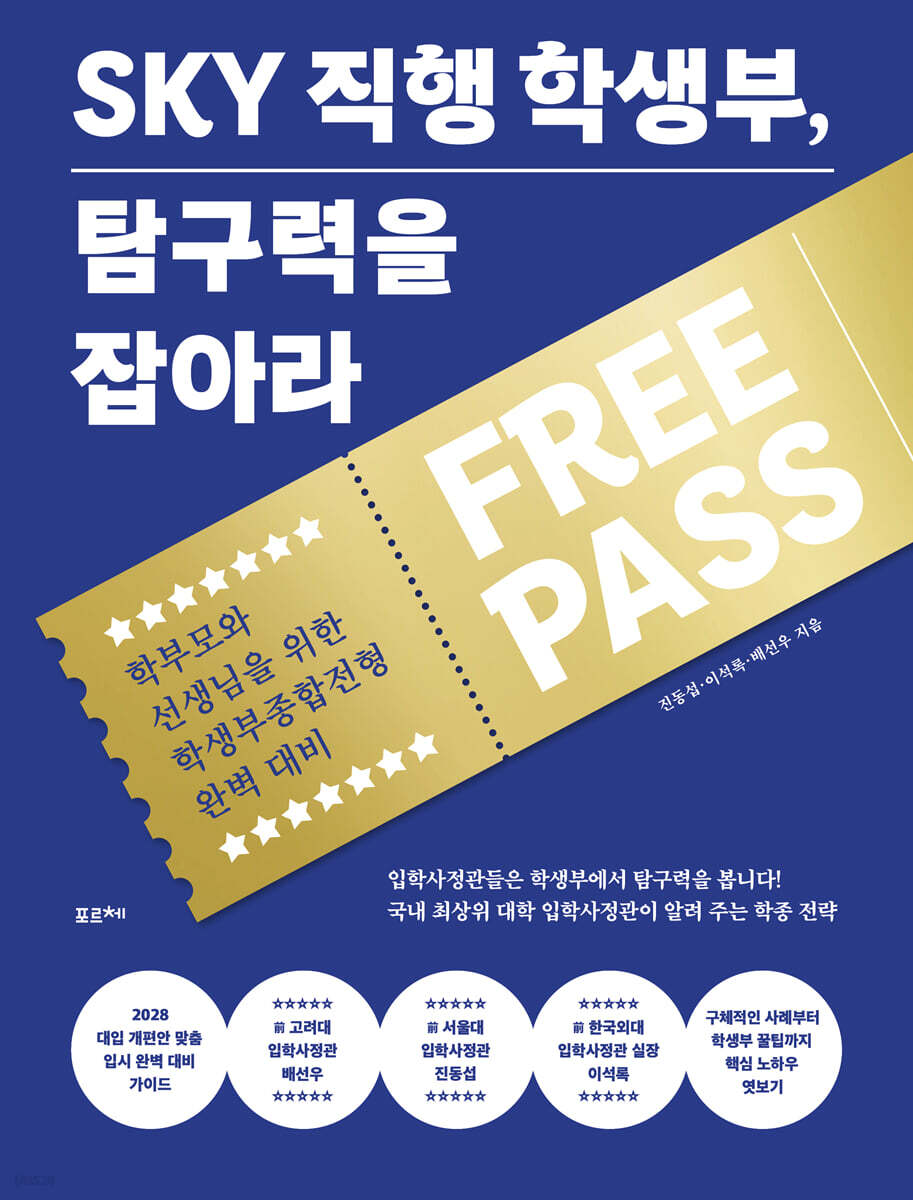
Students who are directly admitted to SKY universities should cultivate their curiosity.
 |
Description
Book Introduction
One-on-one customized student portfolio solution for SKY admission free pass
Student Affairs, the power of inquiry is the answer!
Answers from the student records directly provided by admissions officers at Seoul National University, Korea University, and Hankuk University of Foreign Studies!
A project to strategically fill out and create a student portfolio that will help you succeed in college entrance exams.
《SKY Direct Student Profile, Grab the Power of Inquiry》 is a compilation of information on what kind of student profile universities want, written by three authors: Jin Dong-seop, an admissions officer at Seoul National University; Lee Seok-rok, a representative lecturer in the Korean language section at EBS and the director of the admissions office at Hankuk University of Foreign Studies; and Bae Seon-woo, an admissions officer at Korea University. These three authors are Korea's top education experts and former admissions officers at prestigious universities.
What constitutes a "good" academic record for admissions officers evaluating prospective students? The authors state, "Many students diligently complete assigned assignments and give their best effort in school, but often, simply working hard without a clear direction fails to achieve the desired results."
The student body must set a direction early and prepare step by step.
Even activities that seem plausible often have little effect on student performance evaluations.
This book will help readers understand which areas of their academic record to focus on and how to prepare for college entrance exams, and why admissions officers seek "inquiry skills."
Let's prepare a student portfolio with the admissions officer that can show off your child's true capabilities!
Student Affairs, the power of inquiry is the answer!
Answers from the student records directly provided by admissions officers at Seoul National University, Korea University, and Hankuk University of Foreign Studies!
A project to strategically fill out and create a student portfolio that will help you succeed in college entrance exams.
《SKY Direct Student Profile, Grab the Power of Inquiry》 is a compilation of information on what kind of student profile universities want, written by three authors: Jin Dong-seop, an admissions officer at Seoul National University; Lee Seok-rok, a representative lecturer in the Korean language section at EBS and the director of the admissions office at Hankuk University of Foreign Studies; and Bae Seon-woo, an admissions officer at Korea University. These three authors are Korea's top education experts and former admissions officers at prestigious universities.
What constitutes a "good" academic record for admissions officers evaluating prospective students? The authors state, "Many students diligently complete assigned assignments and give their best effort in school, but often, simply working hard without a clear direction fails to achieve the desired results."
The student body must set a direction early and prepare step by step.
Even activities that seem plausible often have little effect on student performance evaluations.
This book will help readers understand which areas of their academic record to focus on and how to prepare for college entrance exams, and why admissions officers seek "inquiry skills."
Let's prepare a student portfolio with the admissions officer that can show off your child's true capabilities!
- You can preview some of the book's contents.
Preview
index
Prologue: Crossing the Entrance Exam Threshold 4
Chapter 1: 10 Questions and Answers About the Comprehensive Student Record Selection Process from Former Admissions Officers at Major Universities
Changes in School Life Due to the Structure of the College Entrance Examination and the Comprehensive Student Record Selection Process 18
What is the most important factor evaluated in the comprehensive student admissions process?
What is the "Hakjong Learning Method" for preparing for the 2028 college entrance exam reform? 24
What specific activities should I do to get a good grade on my career assessment? 26
What Makes a "Good" School Record? 29
How should I prepare for the high school credit system? 32
2028 College Admissions System: Is It Really Advantageous to Attend Specialized or Autonomous High Schools?
If you wish to advance to medical school or engineering department of a top university, 40
How should I do at school?
I am thinking about going to law school in the future.
What college roadmap do you recommend? 42
When is a good time to decide on a major? 44
Chapter 2: Exploration Determines Admission
The Importance of Inquiry Ability: Examined Through the Comprehensive Student Assessment Manual (48)
Student Comprehensive Evaluation Factor 1: Academic Ability 55
Student Comprehensive Evaluation Factor 2: Career Ability 66
Student Comprehensive Evaluation Factor 3: Community Competency 73
How is the actual evaluation conducted? 77
Grab your power of inquiry! 86
Chapter 3: Assessment Principles and Differentiation Strategies for Subject Areas
How are detailed abilities and special skills assessed? 96
Securing Competitiveness in Classrooms 114
2015 vs.
2022 Revised Curriculum Subject Selection Roadmap 126
Case Study 137: Selecting Subjects by Department
152 Examples of Career Paths by Subject
Differentiation Plan for Detailed Abilities and Special Skills 167
Bearing Fruit Through Career-Linked Reading Activities 191
Chapter 4: Strategically Gain a Competitive Advantage in Non-Curricular Areas!
Specific examples of non-curricular assessments 208
Gain a Competitive Edge in Creative Experiential Activities 225
Why is career exploration necessary? 242
How to Use the Career Exploration Program 244
Career Activities Linked to Life 249
Appendix 255: Design Reference Form for Comprehensive Student Admissions and Self-Directed Learning Admissions
Epilogue: The Future of Education, the Future of College Admissions 263
Reference 274
Chapter 1: 10 Questions and Answers About the Comprehensive Student Record Selection Process from Former Admissions Officers at Major Universities
Changes in School Life Due to the Structure of the College Entrance Examination and the Comprehensive Student Record Selection Process 18
What is the most important factor evaluated in the comprehensive student admissions process?
What is the "Hakjong Learning Method" for preparing for the 2028 college entrance exam reform? 24
What specific activities should I do to get a good grade on my career assessment? 26
What Makes a "Good" School Record? 29
How should I prepare for the high school credit system? 32
2028 College Admissions System: Is It Really Advantageous to Attend Specialized or Autonomous High Schools?
If you wish to advance to medical school or engineering department of a top university, 40
How should I do at school?
I am thinking about going to law school in the future.
What college roadmap do you recommend? 42
When is a good time to decide on a major? 44
Chapter 2: Exploration Determines Admission
The Importance of Inquiry Ability: Examined Through the Comprehensive Student Assessment Manual (48)
Student Comprehensive Evaluation Factor 1: Academic Ability 55
Student Comprehensive Evaluation Factor 2: Career Ability 66
Student Comprehensive Evaluation Factor 3: Community Competency 73
How is the actual evaluation conducted? 77
Grab your power of inquiry! 86
Chapter 3: Assessment Principles and Differentiation Strategies for Subject Areas
How are detailed abilities and special skills assessed? 96
Securing Competitiveness in Classrooms 114
2015 vs.
2022 Revised Curriculum Subject Selection Roadmap 126
Case Study 137: Selecting Subjects by Department
152 Examples of Career Paths by Subject
Differentiation Plan for Detailed Abilities and Special Skills 167
Bearing Fruit Through Career-Linked Reading Activities 191
Chapter 4: Strategically Gain a Competitive Advantage in Non-Curricular Areas!
Specific examples of non-curricular assessments 208
Gain a Competitive Edge in Creative Experiential Activities 225
Why is career exploration necessary? 242
How to Use the Career Exploration Program 244
Career Activities Linked to Life 249
Appendix 255: Design Reference Form for Comprehensive Student Admissions and Self-Directed Learning Admissions
Epilogue: The Future of Education, the Future of College Admissions 263
Reference 274
Detailed image

Into the book
The academic performance-based selection process is a selection process that utilizes academic performance.
The subjects reflected and the calculation method differ for each university.
Especially in the case of admissions that have a minimum academic score requirement, whether or not the minimum score is met has a significant impact on acceptance.
Additionally, some universities conduct additional qualitative evaluations of documents.
---From "Changes in school life due to the structure of the college entrance examination and the comprehensive student record selection process"
Admissions officers utilize all areas of your school record to evaluate your academic, self-development, and community skills.
Academic ability is not evaluated solely based on grades, self-development ability is not evaluated solely based on club names, and community ability is not evaluated solely based on attendance and participation in school volunteer activities. The areas utilized in a single evaluation index are not limited to a few areas.
Therefore, it is most important to faithfully participate in school life so that excellence is demonstrated in all areas of the school record.
---“What is the most important factor evaluated in the comprehensive student selection process?”
Career competency is an evaluation item that aims to verify various activities and experiences in the process of exploring career paths.
Rather than evaluating students based on how well their future aspirations and school records match, students who have explored the fields or fields of interest they have been interested in during their school years in a specific and proactive manner are evaluated highly.
Career competency is evaluated not only on the efforts and achievements in completing courses related to the application recruitment unit (department), but also on career exploration activities and experiences.
---From "Comprehensive Student Evaluation Factor 2: Career Ability"
Let's take a look at how to choose subjects based on your career path and desired department (field) after graduation, focusing on examples.
When designing a curriculum, taking as many career-related subjects as possible is not the only consideration.
You must diligently complete all subject areas, including Korean, English, math, social studies, and science, as well as music, art, physical education, and information, and make good use of all your study time to develop your own abilities.
This is because universities want to evaluate all efforts made by applicants to develop themselves beyond the given curriculum while faithfully participating in the given educational environment.
---From "Cases of Subject Selection by Department"
Each university recommends books by department and age group through its library website and the admissions office's department guidebook.
While it's highly recommended to choose books by following a recommended reading list, a better approach is to visit your local library and browse through the vast collection to find books that best fit your situation and career path.
The following books are ones I chose from my local library, thinking they might be useful to students applying to this program.
We would like to introduce how to explore career paths through reading, using examples from some departments.
---From "Bearing Fruit Through Career-Linked Post-Reading Activities"
Recently, as autonomous activities run by schools themselves have increased, focusing on unique educational activities for each school, there has been an increase in content that clearly reveals individual characteristics.
In particular, class-specific activities such as freely participating in exploratory activities or career activities are becoming more active, and topic-selection activities such as career-related topic exploration and project learning are also actively being carried out.
By focusing on these activities and recording them so that they reveal individualized personal characteristics, you can receive a good evaluation.
Let's look at the following examples of special features of autonomous and self-governing activities.
---From “Specific examples of evaluation of non-curricular areas”
Career exploration, connected to life in this way, becomes a real experience, not something you can only find in books. It also serves as a starting point for expanding social and cultural knowledge and utilizing local resources, in addition to career guidance.
From the students' perspective, they can gain deeper insight into their career paths by applying their interests and passions to real-world settings, and from the admissions officer's perspective, they can expect that the students will grow into talented individuals who contribute to society, rather than just being students who simply study.
The subjects reflected and the calculation method differ for each university.
Especially in the case of admissions that have a minimum academic score requirement, whether or not the minimum score is met has a significant impact on acceptance.
Additionally, some universities conduct additional qualitative evaluations of documents.
---From "Changes in school life due to the structure of the college entrance examination and the comprehensive student record selection process"
Admissions officers utilize all areas of your school record to evaluate your academic, self-development, and community skills.
Academic ability is not evaluated solely based on grades, self-development ability is not evaluated solely based on club names, and community ability is not evaluated solely based on attendance and participation in school volunteer activities. The areas utilized in a single evaluation index are not limited to a few areas.
Therefore, it is most important to faithfully participate in school life so that excellence is demonstrated in all areas of the school record.
---“What is the most important factor evaluated in the comprehensive student selection process?”
Career competency is an evaluation item that aims to verify various activities and experiences in the process of exploring career paths.
Rather than evaluating students based on how well their future aspirations and school records match, students who have explored the fields or fields of interest they have been interested in during their school years in a specific and proactive manner are evaluated highly.
Career competency is evaluated not only on the efforts and achievements in completing courses related to the application recruitment unit (department), but also on career exploration activities and experiences.
---From "Comprehensive Student Evaluation Factor 2: Career Ability"
Let's take a look at how to choose subjects based on your career path and desired department (field) after graduation, focusing on examples.
When designing a curriculum, taking as many career-related subjects as possible is not the only consideration.
You must diligently complete all subject areas, including Korean, English, math, social studies, and science, as well as music, art, physical education, and information, and make good use of all your study time to develop your own abilities.
This is because universities want to evaluate all efforts made by applicants to develop themselves beyond the given curriculum while faithfully participating in the given educational environment.
---From "Cases of Subject Selection by Department"
Each university recommends books by department and age group through its library website and the admissions office's department guidebook.
While it's highly recommended to choose books by following a recommended reading list, a better approach is to visit your local library and browse through the vast collection to find books that best fit your situation and career path.
The following books are ones I chose from my local library, thinking they might be useful to students applying to this program.
We would like to introduce how to explore career paths through reading, using examples from some departments.
---From "Bearing Fruit Through Career-Linked Post-Reading Activities"
Recently, as autonomous activities run by schools themselves have increased, focusing on unique educational activities for each school, there has been an increase in content that clearly reveals individual characteristics.
In particular, class-specific activities such as freely participating in exploratory activities or career activities are becoming more active, and topic-selection activities such as career-related topic exploration and project learning are also actively being carried out.
By focusing on these activities and recording them so that they reveal individualized personal characteristics, you can receive a good evaluation.
Let's look at the following examples of special features of autonomous and self-governing activities.
---From “Specific examples of evaluation of non-curricular areas”
Career exploration, connected to life in this way, becomes a real experience, not something you can only find in books. It also serves as a starting point for expanding social and cultural knowledge and utilizing local resources, in addition to career guidance.
From the students' perspective, they can gain deeper insight into their career paths by applying their interests and passions to real-world settings, and from the admissions officer's perspective, they can expect that the students will grow into talented individuals who contribute to society, rather than just being students who simply study.
---From "Career Activities Linked to Life"
Publisher's Review
College entrance exam reform: What areas should we focus on?
Get straight into SKY with 'real', valuable admissions information from prestigious university admissions officers!
From the 10 questions and answers that parents most frequently ask to admissions officers' key points!
Admissions officers gathered to help parents and teachers who are having a hard time due to the changed college entrance exam system.
The authors have compiled the most frequently asked questions they have heard while working as admissions officers into this book.
The book is full of useful information, including what factors are important to consider in the student affairs department, whether it is truly advantageous to advance to a specialized or autonomous high school, what college entrance roadmap is recommended for each department, and how to prepare for the high school credit system.
The authors are 'real' experts who have reviewed and evaluated the student records of countless students at universities.
As an 'evaluator', I have been looking at the student records, so I know well what kind of student records the university prefers and evaluates favorably.
Although there is no right answer in the student section, there is a shortcut to success in the college entrance exam.
The quality of information has been further enhanced by including the admissions officer's 'points' in the book.
It is recommended that you proceed with reference to the examples of subject selection by department, examples of career paths by subject, and special features.
The authors sincerely hope this book will be of great help to students preparing for the college entrance exam, compiling information to help them "develop an entrance exam strategy from high school to college, and diligently strengthen their research and application skills on their own." If you're curious about how to get directly into SKY universities, this book is the answer.
Attention teachers struggling with college guidance! All the student information in one book!
Typical design reference forms and specific student case studies for increased usability!
If you are a current teacher, you can keep this book on your desk and refer to it for help when guiding students to higher education.
Since major universities in Seoul are already selecting students through a comprehensive student record screening process, it is necessary to prepare for the student record.
Teachers are aware of a lot of information about college admissions, but it can be difficult to know how to apply it to children and provide specific guidance on college admissions.
Although the comprehensive student admissions process requires early preparation, many students often feel at a loss as to what to do when it is too late.
To this end, the book includes specific examples to help you gain a general understanding of the comprehensive student record selection process and guide you through designing your own student record step by step.
The appendix also includes reference forms for designing the comprehensive student selection process and the self-directed learning selection process.
I hope this book can serve as a good mentor to teachers who are guiding students and working hard to prepare them for the college entrance exam.
Get straight into SKY with 'real', valuable admissions information from prestigious university admissions officers!
From the 10 questions and answers that parents most frequently ask to admissions officers' key points!
Admissions officers gathered to help parents and teachers who are having a hard time due to the changed college entrance exam system.
The authors have compiled the most frequently asked questions they have heard while working as admissions officers into this book.
The book is full of useful information, including what factors are important to consider in the student affairs department, whether it is truly advantageous to advance to a specialized or autonomous high school, what college entrance roadmap is recommended for each department, and how to prepare for the high school credit system.
The authors are 'real' experts who have reviewed and evaluated the student records of countless students at universities.
As an 'evaluator', I have been looking at the student records, so I know well what kind of student records the university prefers and evaluates favorably.
Although there is no right answer in the student section, there is a shortcut to success in the college entrance exam.
The quality of information has been further enhanced by including the admissions officer's 'points' in the book.
It is recommended that you proceed with reference to the examples of subject selection by department, examples of career paths by subject, and special features.
The authors sincerely hope this book will be of great help to students preparing for the college entrance exam, compiling information to help them "develop an entrance exam strategy from high school to college, and diligently strengthen their research and application skills on their own." If you're curious about how to get directly into SKY universities, this book is the answer.
Attention teachers struggling with college guidance! All the student information in one book!
Typical design reference forms and specific student case studies for increased usability!
If you are a current teacher, you can keep this book on your desk and refer to it for help when guiding students to higher education.
Since major universities in Seoul are already selecting students through a comprehensive student record screening process, it is necessary to prepare for the student record.
Teachers are aware of a lot of information about college admissions, but it can be difficult to know how to apply it to children and provide specific guidance on college admissions.
Although the comprehensive student admissions process requires early preparation, many students often feel at a loss as to what to do when it is too late.
To this end, the book includes specific examples to help you gain a general understanding of the comprehensive student record selection process and guide you through designing your own student record step by step.
The appendix also includes reference forms for designing the comprehensive student selection process and the self-directed learning selection process.
I hope this book can serve as a good mentor to teachers who are guiding students and working hard to prepare them for the college entrance exam.
GOODS SPECIFICS
- Date of issue: July 3, 2024
- Page count, weight, size: 276 pages | 676g | 188*247*20mm
- ISBN13: 9791193584507
- ISBN10: 1193584507
You may also like
카테고리
korean


korean

![ELLE 엘르 스페셜 에디션 A형 : 12월 [2025]](http://librairie.coreenne.fr/cdn/shop/files/b8e27a3de6c9538896439686c6b0e8fb.jpg?v=1766436872&width=3840)


