

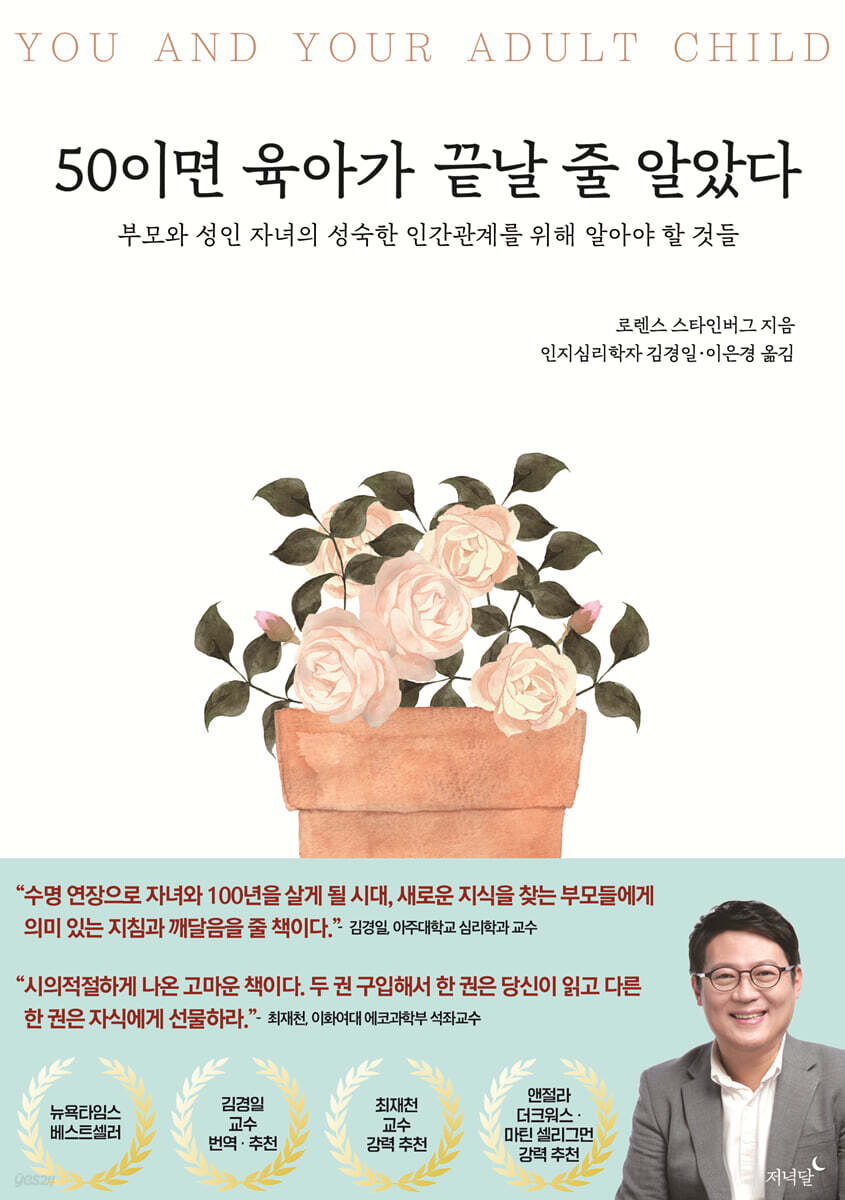
I thought parenting would be over when I turned 50.
 |
Description
Book Introduction
The era of delayed independence,
The time parents and children spend together has increased.
The common parenting tips we've known so far don't work.
What should I do now?
With children who are spending the most important years of their lives, their 20s and 30s
The first comprehensive guide for parents!
“You are a more relaxed parent, a more knowledgeable and capable parent,
This book will help you become a more confident parent.”
According to recent statistics, one in two young people in Korea aged 19 to 34 lives with their parents.
As the employment crisis worsens, people are delaying graduation by taking a leave of absence or going on to graduate school, and it takes longer to find a job and become financially stable, so 'independence' has naturally become a distant dream.
There are even children who have become independent who say they want to come back.
As the economy and environment change, the process of becoming an adult today is delayed to an unprecedented degree compared to when our parents' generation was young.
Unlike in the past when parents thought they had done all they could do once their children became adults, today's parents still have a lot to do.
Parents have a harder time being parents than any other generation because they have to support their children until they get jobs and become financially stable.
'In my time, after graduating from college, I got a job and became independent,' but I feel frustrated when I see my children not being able to do that.
This is because they don't understand how difficult it is for people in their 20s and 30s these days.
Understanding why it takes so long to become an adult and the social, cultural, and economic changes that come with it is the first task of parents of adult children.
As a professor of psychology and neuroscience at Temple University, Lawrence Steinberg has studied adolescent psychological development and offered wise advice to parents for nearly 50 years. In his new book, "Parenting at 50", he provides easy-to-understand and detailed guidance on how the role of parents should change.
He also warns that judging your child's behavior solely based on past standards will only lead to conflict and hurt feelings in both parties.
This book divides eight topics into essential knowledge for parents who want to maintain long-lasting, happy relationships with their adult children, and discusses them with interesting case studies.
Above all, it contains insights and wisdom gained through approximately 50 years of research and case studies.
This book will provide clear and practical help to many parents who are perplexed by the issue of 'relationships between adult children and their parents', a problem we have never considered before.
The time parents and children spend together has increased.
The common parenting tips we've known so far don't work.
What should I do now?
With children who are spending the most important years of their lives, their 20s and 30s
The first comprehensive guide for parents!
“You are a more relaxed parent, a more knowledgeable and capable parent,
This book will help you become a more confident parent.”
According to recent statistics, one in two young people in Korea aged 19 to 34 lives with their parents.
As the employment crisis worsens, people are delaying graduation by taking a leave of absence or going on to graduate school, and it takes longer to find a job and become financially stable, so 'independence' has naturally become a distant dream.
There are even children who have become independent who say they want to come back.
As the economy and environment change, the process of becoming an adult today is delayed to an unprecedented degree compared to when our parents' generation was young.
Unlike in the past when parents thought they had done all they could do once their children became adults, today's parents still have a lot to do.
Parents have a harder time being parents than any other generation because they have to support their children until they get jobs and become financially stable.
'In my time, after graduating from college, I got a job and became independent,' but I feel frustrated when I see my children not being able to do that.
This is because they don't understand how difficult it is for people in their 20s and 30s these days.
Understanding why it takes so long to become an adult and the social, cultural, and economic changes that come with it is the first task of parents of adult children.
As a professor of psychology and neuroscience at Temple University, Lawrence Steinberg has studied adolescent psychological development and offered wise advice to parents for nearly 50 years. In his new book, "Parenting at 50", he provides easy-to-understand and detailed guidance on how the role of parents should change.
He also warns that judging your child's behavior solely based on past standards will only lead to conflict and hurt feelings in both parties.
This book divides eight topics into essential knowledge for parents who want to maintain long-lasting, happy relationships with their adult children, and discusses them with interesting case studies.
Above all, it contains insights and wisdom gained through approximately 50 years of research and case studies.
This book will provide clear and practical help to many parents who are perplexed by the issue of 'relationships between adult children and their parents', a problem we have never considered before.
- You can preview some of the book's contents.
Preview
index
Entering
Chapter 1: The Changing Role of Parents
Times have changed
The role of parents has changed
What are you expecting?
Your child is no longer young
“When I was your age”
Chapter 2: Children and Parents Always Grow Together
A moment when you need to be careful with your words
When you feel sad
So that conflict doesn't become a wound
When you have different opinions with your spouse
Chapter 3: Your Child and Your Mental Health
The 20s are the most anxious time.
Common mental health problems in adults
If you need psychotherapy
Parents' mental health is also important.
If you are worried that your relationship will become distant
Chapter 4: Educational Issues for Adult Children
Is college worth it?
Can I get involved in my child's college life?
A four-year college isn't the only way.
Things to consider when staying during the holidays
Chapter 5: Economic Support
Four Things to Keep in Mind When Providing Financial Support
Your children don't see you as a money grab.
What You Can Do for Your Children When They Buy a Home
Discuss your assets specifically.
Chapter 6 Love and Marriage
Remember that children are also sexual subjects.
About your child's romantic partner
member of the wedding party
How Your Child's Marriage Affects Your Relationship with Your Child
Developing a good relationship with your child's spouse
Conflict between children and couples
Chapter 7 Thrive or Struggle
Is your child struggling?
eternal student
uncertainty about one's job
Still single
If your independent child returns
Chapter 8: The Existence of Grandparents
How to Help New Parents
Advice on parenting
To create a deeper bond with your grandchildren
Chapter 9: Until Now and Forward
Parenting is never-ending
When my child reaches middle age
Acknowledgements
References
Chapter 1: The Changing Role of Parents
Times have changed
The role of parents has changed
What are you expecting?
Your child is no longer young
“When I was your age”
Chapter 2: Children and Parents Always Grow Together
A moment when you need to be careful with your words
When you feel sad
So that conflict doesn't become a wound
When you have different opinions with your spouse
Chapter 3: Your Child and Your Mental Health
The 20s are the most anxious time.
Common mental health problems in adults
If you need psychotherapy
Parents' mental health is also important.
If you are worried that your relationship will become distant
Chapter 4: Educational Issues for Adult Children
Is college worth it?
Can I get involved in my child's college life?
A four-year college isn't the only way.
Things to consider when staying during the holidays
Chapter 5: Economic Support
Four Things to Keep in Mind When Providing Financial Support
Your children don't see you as a money grab.
What You Can Do for Your Children When They Buy a Home
Discuss your assets specifically.
Chapter 6 Love and Marriage
Remember that children are also sexual subjects.
About your child's romantic partner
member of the wedding party
How Your Child's Marriage Affects Your Relationship with Your Child
Developing a good relationship with your child's spouse
Conflict between children and couples
Chapter 7 Thrive or Struggle
Is your child struggling?
eternal student
uncertainty about one's job
Still single
If your independent child returns
Chapter 8: The Existence of Grandparents
How to Help New Parents
Advice on parenting
To create a deeper bond with your grandchildren
Chapter 9: Until Now and Forward
Parenting is never-ending
When my child reaches middle age
Acknowledgements
References
Detailed image
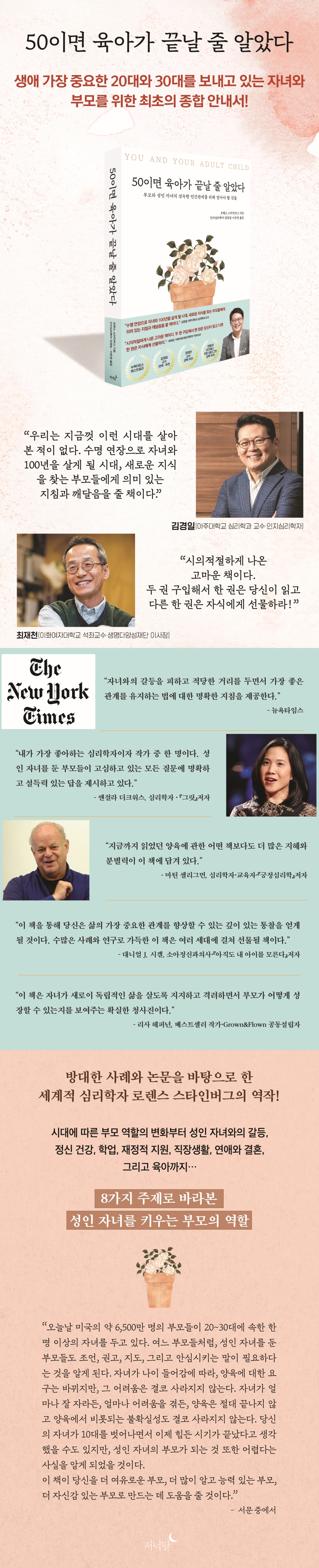
Into the book
Another reason children are reluctant to speak, and one that parents often find difficult to accept, is that children don't think about their parents as much as their parents think about them.
…parents should not be hurt by being the “last to know,” but should be glad that their children have someone else they can confide in and rely on.
That's better.
---From Chapter 1, “The Changing Role of Parents”
When you must speak up, you must speak up clearly.
However, you should not tell your child unless he or she specifically asks for your opinion.
Allowing your child to make mistakes, as long as their choices don't have catastrophic consequences, is more important than proving that you were right.
---From Chapter 2, “Children and Parents Always Grow Together”
If you're experiencing emotional distress because of your relationship with your child, the first step toward alleviating the pain is for the two of you to have an honest and open conversation about your relationship and figure out what you can each do to improve it.
Do your best to listen to your child until he or she has finished speaking without becoming defensive or critical, and ask him or her to listen to you in the same way.
It may take several conversations and weeks to get your relationship back on track.
It is unrealistic to expect things to change overnight.
You have to hold on strong.
---From Chapter 3, “Your Child’s Mental Health”
In fact, almost all parents go through times when they feel distant from their children.
Because children are developing and changing individually, and a person's psychological state can change at any time depending on their relationships with other people.
---From Chapter 3, “Your Child’s Mental Health”
I repeat and emphasize this many times, but you should not judge your child's situation based on your own experience, financial or otherwise.
When you were your child's age, becoming a self-sufficient adult took much less time and money.
---From Chapter 5, ‘Economic Support’
Perhaps one of you and your daughter-in-law (or son-in-law) has wished for a closer relationship than you have now.
However, parents and daughters-in-law (or sons-in-law) should get along well enough to maintain peace.
After enough time has passed, you should accept each other as is and not try to change anything.
---From Chapter 6, “Love and Marriage”
If your child seems to be doing poorly and not succeeding, remember that things are different now than they were when you were their age.
It takes longer for young people to finish school, find a job, start a family, and become financially independent than previous generations.
As I said before, "when I was your age" is not the right way to understand your child's situation.
Parents need more empathy and patience.
…parents should not be hurt by being the “last to know,” but should be glad that their children have someone else they can confide in and rely on.
That's better.
---From Chapter 1, “The Changing Role of Parents”
When you must speak up, you must speak up clearly.
However, you should not tell your child unless he or she specifically asks for your opinion.
Allowing your child to make mistakes, as long as their choices don't have catastrophic consequences, is more important than proving that you were right.
---From Chapter 2, “Children and Parents Always Grow Together”
If you're experiencing emotional distress because of your relationship with your child, the first step toward alleviating the pain is for the two of you to have an honest and open conversation about your relationship and figure out what you can each do to improve it.
Do your best to listen to your child until he or she has finished speaking without becoming defensive or critical, and ask him or her to listen to you in the same way.
It may take several conversations and weeks to get your relationship back on track.
It is unrealistic to expect things to change overnight.
You have to hold on strong.
---From Chapter 3, “Your Child’s Mental Health”
In fact, almost all parents go through times when they feel distant from their children.
Because children are developing and changing individually, and a person's psychological state can change at any time depending on their relationships with other people.
---From Chapter 3, “Your Child’s Mental Health”
I repeat and emphasize this many times, but you should not judge your child's situation based on your own experience, financial or otherwise.
When you were your child's age, becoming a self-sufficient adult took much less time and money.
---From Chapter 5, ‘Economic Support’
Perhaps one of you and your daughter-in-law (or son-in-law) has wished for a closer relationship than you have now.
However, parents and daughters-in-law (or sons-in-law) should get along well enough to maintain peace.
After enough time has passed, you should accept each other as is and not try to change anything.
---From Chapter 6, “Love and Marriage”
If your child seems to be doing poorly and not succeeding, remember that things are different now than they were when you were their age.
It takes longer for young people to finish school, find a job, start a family, and become financially independent than previous generations.
As I said before, "when I was your age" is not the right way to understand your child's situation.
Parents need more empathy and patience.
---From Chapter 7, 'Prosper or Struggle'
Publisher's Review
Even if your child is over twenty or thirty years old
A parent's work never ends.
The era of delayed independence,
Unlike in the past, the time it takes to grow from adolescence to adulthood has increased.
According to recent statistics, one in two young people in Korea aged 19 to 34 lives with their parents.
This is not just a Korean phenomenon; it is a global phenomenon.
The United States, which considered it a virtue to make children independent when they turned 18, is in a similar situation to ours.
In the United States, it is said that half or all of those aged 18 to 29 live with their parents.
Compared to their parents' generation, it takes longer for them to become financially stable due to factors such as more study after college, longer job preparation, and rising student loans and housing costs.
While it took the average American parent's generation eight years to graduate from college and start a family, today's young people are taking more than 50% longer.
Naturally, ‘independence’ became a distant story.
Unlike parents in the past who felt liberated once their children became adults and went to college, parents of adult children today are faced with the task of supporting their children for a longer period of time.
This does not only mean economic support.
We need to pay close attention to the psychology of our children, who are going through the most important years of their lives, their 20s and 30s, and become strong emotional supporters.
Lawrence Steinberg, a professor of psychology and neuroscience at Temple University who has studied adolescent psychological development and written parenting guides for nearly 50 years, has found that the period between adolescence and adulthood is getting longer, saying that the end of puberty is no longer 19, and the onset of adulthood has been delayed from 20 to 25.
Accordingly, the period during which parents must provide psychological and emotional support to their children until they become adults has been delayed by at least five years.
This is the first time in human history that this has happened.
Humanity has never lived in such an era before, and therefore there are no guidelines for it.
As times have changed and there is no data to compare with the past, what role should parents play?
“How have the social and economic changes of the past 40 years affected you as a parent?
Or how to best adapt your expectations, attitudes, and behaviors to today's reality.
Few people talk about what it is.
So, how times have changed and what it means to be a young adult today?
Let's take a look at why we are so different now than when we were younger.”
Never compare yourself to your children.
Society is completely different now than it was 20 years ago.
Lawrence Steinberg, author of the new book "Parenting Was Over at 50," says parents must first understand how society has changed.
'When I was 25, I was employed, and by 30, I had a family and children, so why is my child still living with his or her parents and not settling down?' This is the point of view that we need to change from judging children based on past standards.
He says that we need to first understand how difficult life is for people in their 20s and 30s these days and then look to our children.
“The situation today at twenty, thirty, or even forty is not the same as it was when you were young.
If you want your children to respect you, you must respect them too.”
The author says that this word should never be used, especially when trying to understand the children's generation.
It's 'When I Was Your Age'.
He points out that the circumstances of young people today are so different from when you were a young person that talking to your child or giving advice like "when I was your age" can be a derogatory way of dismissing their achievements.
If you still find it difficult to let go of the comparative mindset, I recommend subtracting at least five years from your child's age and rethinking.
For example, if your child is 35 years old, compare them to when you were 30.
The first task of parents of adult children is to recognize these social changes and strive to understand their children.
Children are companions for 100 years
30 years of parenting + α, the most important long-term relationship in life
Most parents expect that they will be free from parenting responsibilities once their children go to college.
Now that I've done all I can as a parent, I just want my adult children to figure out how to live their own lives.
But if you think about it, even in the past, parents have always been with their children throughout their lives.
There are times when parents need to help or give advice during the process of getting a job, getting married, having children, getting promoted, moving, etc.
However, with the advancement of medical technology, human lifespan is being extended, and the '120-year era' has become a reality.
This means that the time spent with children will be longer.
The relationship between parents and children has also become a very long-term relationship.
After 20 to 30 years of parenting, how to build a comfortable relationship with your adult children has also become a hot topic.
As children grow up, their circumstances and lifestyles change, so must parents.
Advice like, "I did it this way back in my day, so you should do it this way too," is dangerous, useless, and only encourages conflict.
The role of parents and childcare is never-ending.
This may sound hopeless.
However, as the child's circumstances continue to change and grow, the role of parents also needs to grow and work together, or the relationship with the child will inevitably become distant.
"I always emphasize to the audiences who come to my lectures on child education that they should think of their relationship with their children as a '100-year companion.'
It has become a given that parenting is not easy and that the period of parenting has become longer.
In this society, it is not at all strange to joke about long-term relationships that require so-called after-service even after marriage, beyond the 30-year parenting period.
-From the translator's (Professor Kim Kyung-il) words"
Professor Kim Kyung-il, who translated this book, likens children to “companions for 100 years,” and says that the generation of parents who have adult or adolescent children, whether in the U.S. or Korea, has never experienced a generation like this before, and therefore has nowhere to turn to for wisdom and teachings from their predecessors on how to get along well with their adult children for a long time to come.
There is little information on how to support children who are now moving beyond youth and into middle age, and how much distance to maintain as they live to be over 100 years old.
It is not in the Bible, Buddhist scriptures, or the Quran.
In a situation where parents have no choice but to acquire new information and accumulate wisdom and knowledge on their own, Lawrence Steinberg's "I Thought Parenting Was Over at 50" provides meaningful guidance and insight.
To help you navigate these challenging times, the author offers some very specific and practical suggestions.
It uses interesting examples to help you understand how to think and communicate about situations you may encounter with your adult children in the future, such as college admissions, dating, marriage, employment, business, marriage, childbirth, and money issues, and even how to divide the topics into categories.
Through 50 years of research and case studies
A book that offers solutions for adult children and their parents to live happily.
Looking at it through 8 topics
The Role of Parents in Raising Adult Children
“You are a more relaxed parent, a more knowledgeable and capable parent,
This book will help you become a more confident parent.”
In addition to the previously mentioned topics, "I Thought Parenting Would Be Over at 50" explains, with specific examples, eight topics that parents who want to have happy relationships with their adult children must know.
Chapter 1 examines the differences in parenting and the role of parents compared to previous generations. Chapter 2 examines constructive ways to resolve conflicts with adult children. Chapter 3 examines the causes and solutions to the estrangement in the relationship between adult children and their parents.
Chapter 4 discusses potential problems that may arise when your children are students, Chapter 5 offers wise advice on supporting your children financially, Chapter 6 explores issues related to your children's sex life, relationships, and marriage, and Chapter 7 offers tips on how to determine if your children are going through a difficult time and how to help.
Chapter 8 discusses how to support children who are now parents and your role as a grandparent.
Finally, Chapter 9 looks at how relationships might change as children enter their 40s.
Now, whenever you find yourself struggling with your relationship with your adult children, I encourage you to turn to this book, filled with sharp insights and nuanced advice.
After reading "I Thought Parenting Was Over at 50," which contains insights and wisdom gained from nearly 50 years of research and case studies, you will be able to spend happier times with your adult children, wiser and more intelligent than any other parent.
This book will provide clear and practical help to many parents who are perplexed by the issue of 'relationships between adult children and their parents', a problem we have never considered before.
A parent's work never ends.
The era of delayed independence,
Unlike in the past, the time it takes to grow from adolescence to adulthood has increased.
According to recent statistics, one in two young people in Korea aged 19 to 34 lives with their parents.
This is not just a Korean phenomenon; it is a global phenomenon.
The United States, which considered it a virtue to make children independent when they turned 18, is in a similar situation to ours.
In the United States, it is said that half or all of those aged 18 to 29 live with their parents.
Compared to their parents' generation, it takes longer for them to become financially stable due to factors such as more study after college, longer job preparation, and rising student loans and housing costs.
While it took the average American parent's generation eight years to graduate from college and start a family, today's young people are taking more than 50% longer.
Naturally, ‘independence’ became a distant story.
Unlike parents in the past who felt liberated once their children became adults and went to college, parents of adult children today are faced with the task of supporting their children for a longer period of time.
This does not only mean economic support.
We need to pay close attention to the psychology of our children, who are going through the most important years of their lives, their 20s and 30s, and become strong emotional supporters.
Lawrence Steinberg, a professor of psychology and neuroscience at Temple University who has studied adolescent psychological development and written parenting guides for nearly 50 years, has found that the period between adolescence and adulthood is getting longer, saying that the end of puberty is no longer 19, and the onset of adulthood has been delayed from 20 to 25.
Accordingly, the period during which parents must provide psychological and emotional support to their children until they become adults has been delayed by at least five years.
This is the first time in human history that this has happened.
Humanity has never lived in such an era before, and therefore there are no guidelines for it.
As times have changed and there is no data to compare with the past, what role should parents play?
“How have the social and economic changes of the past 40 years affected you as a parent?
Or how to best adapt your expectations, attitudes, and behaviors to today's reality.
Few people talk about what it is.
So, how times have changed and what it means to be a young adult today?
Let's take a look at why we are so different now than when we were younger.”
Never compare yourself to your children.
Society is completely different now than it was 20 years ago.
Lawrence Steinberg, author of the new book "Parenting Was Over at 50," says parents must first understand how society has changed.
'When I was 25, I was employed, and by 30, I had a family and children, so why is my child still living with his or her parents and not settling down?' This is the point of view that we need to change from judging children based on past standards.
He says that we need to first understand how difficult life is for people in their 20s and 30s these days and then look to our children.
“The situation today at twenty, thirty, or even forty is not the same as it was when you were young.
If you want your children to respect you, you must respect them too.”
The author says that this word should never be used, especially when trying to understand the children's generation.
It's 'When I Was Your Age'.
He points out that the circumstances of young people today are so different from when you were a young person that talking to your child or giving advice like "when I was your age" can be a derogatory way of dismissing their achievements.
If you still find it difficult to let go of the comparative mindset, I recommend subtracting at least five years from your child's age and rethinking.
For example, if your child is 35 years old, compare them to when you were 30.
The first task of parents of adult children is to recognize these social changes and strive to understand their children.
Children are companions for 100 years
30 years of parenting + α, the most important long-term relationship in life
Most parents expect that they will be free from parenting responsibilities once their children go to college.
Now that I've done all I can as a parent, I just want my adult children to figure out how to live their own lives.
But if you think about it, even in the past, parents have always been with their children throughout their lives.
There are times when parents need to help or give advice during the process of getting a job, getting married, having children, getting promoted, moving, etc.
However, with the advancement of medical technology, human lifespan is being extended, and the '120-year era' has become a reality.
This means that the time spent with children will be longer.
The relationship between parents and children has also become a very long-term relationship.
After 20 to 30 years of parenting, how to build a comfortable relationship with your adult children has also become a hot topic.
As children grow up, their circumstances and lifestyles change, so must parents.
Advice like, "I did it this way back in my day, so you should do it this way too," is dangerous, useless, and only encourages conflict.
The role of parents and childcare is never-ending.
This may sound hopeless.
However, as the child's circumstances continue to change and grow, the role of parents also needs to grow and work together, or the relationship with the child will inevitably become distant.
"I always emphasize to the audiences who come to my lectures on child education that they should think of their relationship with their children as a '100-year companion.'
It has become a given that parenting is not easy and that the period of parenting has become longer.
In this society, it is not at all strange to joke about long-term relationships that require so-called after-service even after marriage, beyond the 30-year parenting period.
-From the translator's (Professor Kim Kyung-il) words"
Professor Kim Kyung-il, who translated this book, likens children to “companions for 100 years,” and says that the generation of parents who have adult or adolescent children, whether in the U.S. or Korea, has never experienced a generation like this before, and therefore has nowhere to turn to for wisdom and teachings from their predecessors on how to get along well with their adult children for a long time to come.
There is little information on how to support children who are now moving beyond youth and into middle age, and how much distance to maintain as they live to be over 100 years old.
It is not in the Bible, Buddhist scriptures, or the Quran.
In a situation where parents have no choice but to acquire new information and accumulate wisdom and knowledge on their own, Lawrence Steinberg's "I Thought Parenting Was Over at 50" provides meaningful guidance and insight.
To help you navigate these challenging times, the author offers some very specific and practical suggestions.
It uses interesting examples to help you understand how to think and communicate about situations you may encounter with your adult children in the future, such as college admissions, dating, marriage, employment, business, marriage, childbirth, and money issues, and even how to divide the topics into categories.
Through 50 years of research and case studies
A book that offers solutions for adult children and their parents to live happily.
Looking at it through 8 topics
The Role of Parents in Raising Adult Children
“You are a more relaxed parent, a more knowledgeable and capable parent,
This book will help you become a more confident parent.”
In addition to the previously mentioned topics, "I Thought Parenting Would Be Over at 50" explains, with specific examples, eight topics that parents who want to have happy relationships with their adult children must know.
Chapter 1 examines the differences in parenting and the role of parents compared to previous generations. Chapter 2 examines constructive ways to resolve conflicts with adult children. Chapter 3 examines the causes and solutions to the estrangement in the relationship between adult children and their parents.
Chapter 4 discusses potential problems that may arise when your children are students, Chapter 5 offers wise advice on supporting your children financially, Chapter 6 explores issues related to your children's sex life, relationships, and marriage, and Chapter 7 offers tips on how to determine if your children are going through a difficult time and how to help.
Chapter 8 discusses how to support children who are now parents and your role as a grandparent.
Finally, Chapter 9 looks at how relationships might change as children enter their 40s.
Now, whenever you find yourself struggling with your relationship with your adult children, I encourage you to turn to this book, filled with sharp insights and nuanced advice.
After reading "I Thought Parenting Was Over at 50," which contains insights and wisdom gained from nearly 50 years of research and case studies, you will be able to spend happier times with your adult children, wiser and more intelligent than any other parent.
This book will provide clear and practical help to many parents who are perplexed by the issue of 'relationships between adult children and their parents', a problem we have never considered before.
GOODS SPECIFICS
- Date of issue: February 25, 2024
- Page count, weight, size: 368 pages | 506g | 148*210*23mm
- ISBN13: 9791189217242
- ISBN10: 1189217244
You may also like
카테고리
korean


korean

![ELLE 엘르 스페셜 에디션 A형 : 12월 [2025]](http://librairie.coreenne.fr/cdn/shop/files/b8e27a3de6c9538896439686c6b0e8fb.jpg?v=1766436872&width=3840)


