

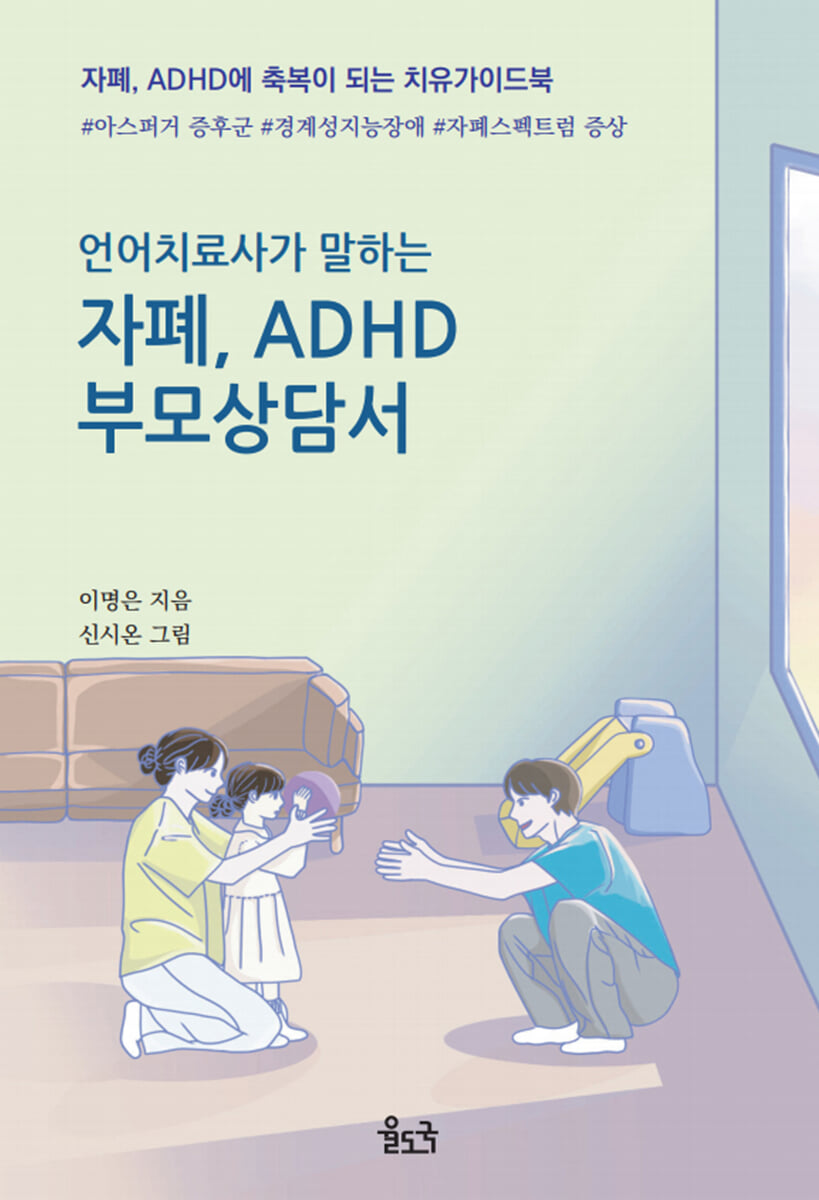
A Speech Therapist's Guide to Parenting Autism and ADHD
 |
Description
Book Introduction
Autism and ADHD Counseling Guide, Written from Field Experience as a Speech Therapist It provides comprehensive guidance on understanding and coping with autism, ADHD, developmental disabilities, and language disorders, including autism diagnosis, school advancement, and even learning. When the author worked as a speech therapist at an integrated development center, he put a lot of thought into how to simultaneously promote play and learning for children with autism. Just because children have low cognitive and intelligence doesn't mean they don't have a heart, I tried to empathize with their hearts and help them learn through play and enjoyment. We developed toys that were not available on the market and also conducted customized classes for children. The class was designed to awaken the brain so that children can 'think' about complex and difficult processes on their own, from a simple and easy approach. Simple yet fun repetition learning is essential not only for children with autism, but also for children with pervasive developmental disorders and ADHD. The author's valuable know-how is included in this book. Diagnosis and treatment of ADHD, Asperger's syndrome, borderline intellectual disability, and autism spectrum disorders. It provides a wealth of real-life examples to help you get a feel for it. Rather than just staying in theory, it provides empathetic information about autism and borderline developmental disorder through storytelling of experiences and cases, and provides specific guidance on play therapy, cognitive behavioral therapy, and speech therapy. The author personally interviews parents of children with autism and ADHD to hear their vivid stories. Includes cognitive play therapy for children with autism through brain-awakening classes. The important thing is that learning should take place not only in the special treatment room but also at home, so we provide guidance on how to do it at home. Autistic children spend an average of one hour with a speech therapist twice a week in a special therapy room. It is only 2 hours out of 168 hours a week, but if learning continues at home and at school, it can have a synergistic effect, reducing the time children spend learning and encouraging self-improvement. It specifically introduces various play-based learning activities that can be easily done at home, such as feeding snacks, pointing games, art games, and car games. Additionally, children who are late to learn to speak can learn at home through oral massage, breathing techniques, and imitating greetings. |
index
Recommendation
prolog
Chapter 1: How is my child?
1.
Does my child have autism?
2.
My child who can't speak (speak)
3. Should I give my child ADHD medication?
4.
Is our special child a servant?
A Resting Page, Interview with Parents - Happy Painter Jongbin Yoon
5.
Language education for children with delayed speech
6.
A child who speaks freely.
Which comes first, the pronunciation or the sentence?
7.
My child is delayed in language development and I would like to get tested for autism.
Chapter 2 Our Child is Different
1.
A child with a keen sense of visual perception and a developmental level of visual pursuit.
2.
A child with a developmental stage, a child with a sensitive auditory perception.
3.
My child cries a lot. What should I do?
4.
Will the stereotyped actions and sounds gradually get better?
5.
My parrot child, when will echolalia disappear?
6.
My child has an IQ of 75 and is having trouble learning.
A Break Page, Interview with Parents - The Story of Yuchan, the Happy Bus Driver
Chapter 3: Easy Homeschooling for Children Taught by Teachers
1.
Oral massage, please do it like this.
2.
‘Speaking’ begins with breathing!
3.
Woof woof! Fine motor skills exercise
4.
Woof woof! Large muscle exercise
5.
Mimicking the 'Bye Bye' greeting
6.
When summer comes, say goodbye to diapers!
7.
I'll help you develop healthy sleeping habits.
Chapter 4: Easy play-based learning for children taught by teachers
1.
Feeding Cookies Game
2.
"Where are the eyes? Here!" Pointing Game
3.
Song and rhythm play, imitating 'Sse Sse Sse'
4.
Playing with dolls, playing house, playing hospital
5.
Matching Animals and Fruits on the Wall
6.
Vroom vroom, car play
7.
Coloring, drawing, and art activities
Chapter 5: Teacher, I have a concern.
1.
Should I go to a regular school or a special school?
2.
Will attending a special treatment center help my child?
3.
This is my first special treatment. What treatment should I start with?
4.
As a parent, teach your children what they can do right away.
5.
Is there a way to develop friendships and social skills?
6.
My Child's Other Side: Aggression and Self-Harm
Resting Page, Interview with Parents
- The story of Taekyung, the number-crunching doctor
Chapter 6: A Word from a Speech Therapist for Special Children
1.
10 Conversations Every Mom Should Remember to Boost Your Child's Self-Esteem
2.
Special sex education for children with developmental, autistic, and ADHD
3.
Types of Parents of Special Needs Children
4.
The ideal type of parent for a special needs child
5.
A warm message for mothers raising children with special needs.
Resting Page, Interview with Parents
Sia, I will light your every step.
Epilogue
prolog
Chapter 1: How is my child?
1.
Does my child have autism?
2.
My child who can't speak (speak)
3. Should I give my child ADHD medication?
4.
Is our special child a servant?
A Resting Page, Interview with Parents - Happy Painter Jongbin Yoon
5.
Language education for children with delayed speech
6.
A child who speaks freely.
Which comes first, the pronunciation or the sentence?
7.
My child is delayed in language development and I would like to get tested for autism.
Chapter 2 Our Child is Different
1.
A child with a keen sense of visual perception and a developmental level of visual pursuit.
2.
A child with a developmental stage, a child with a sensitive auditory perception.
3.
My child cries a lot. What should I do?
4.
Will the stereotyped actions and sounds gradually get better?
5.
My parrot child, when will echolalia disappear?
6.
My child has an IQ of 75 and is having trouble learning.
A Break Page, Interview with Parents - The Story of Yuchan, the Happy Bus Driver
Chapter 3: Easy Homeschooling for Children Taught by Teachers
1.
Oral massage, please do it like this.
2.
‘Speaking’ begins with breathing!
3.
Woof woof! Fine motor skills exercise
4.
Woof woof! Large muscle exercise
5.
Mimicking the 'Bye Bye' greeting
6.
When summer comes, say goodbye to diapers!
7.
I'll help you develop healthy sleeping habits.
Chapter 4: Easy play-based learning for children taught by teachers
1.
Feeding Cookies Game
2.
"Where are the eyes? Here!" Pointing Game
3.
Song and rhythm play, imitating 'Sse Sse Sse'
4.
Playing with dolls, playing house, playing hospital
5.
Matching Animals and Fruits on the Wall
6.
Vroom vroom, car play
7.
Coloring, drawing, and art activities
Chapter 5: Teacher, I have a concern.
1.
Should I go to a regular school or a special school?
2.
Will attending a special treatment center help my child?
3.
This is my first special treatment. What treatment should I start with?
4.
As a parent, teach your children what they can do right away.
5.
Is there a way to develop friendships and social skills?
6.
My Child's Other Side: Aggression and Self-Harm
Resting Page, Interview with Parents
- The story of Taekyung, the number-crunching doctor
Chapter 6: A Word from a Speech Therapist for Special Children
1.
10 Conversations Every Mom Should Remember to Boost Your Child's Self-Esteem
2.
Special sex education for children with developmental, autistic, and ADHD
3.
Types of Parents of Special Needs Children
4.
The ideal type of parent for a special needs child
5.
A warm message for mothers raising children with special needs.
Resting Page, Interview with Parents
Sia, I will light your every step.
Epilogue
Into the book
To determine if you are a Japanese person, check these three things:
First, is it possible to make eye contact with the child?
Second, does your child point to objects?
Third, do you respond to being called?
Autism is said to be a spectrum.
That means the spectrum is very wide.
Of course, developmental delays and autistic tendencies can be greatly improved through classes and learning.
Children with a low gestational age can become verbal after just a few months of classes and can reach the normal developmental range through classes and learning.
So, prompt consultation and special treatment are needed.
Autistic tendencies can change as a child grows, so we can't say that children with borderline traits have autism, but one thing is certain: if special treatment isn't started now, there's a high chance that the child will develop autism.
When I teach with nonverbal (nonverbal) children, I have a rule.
First, listen to the sounds your child makes.
Second, check if you can 'blow' by putting your lips together, such as with a whistle or soap bubbles.
Third, confirm the desire to communicate using verbal expressions.
First, listen to the sounds your child makes.
First, listen to the child come into the classroom and make sounds on his/her own.
We also listen to the sounds you make when you ask your therapist for something.
We also hear the child whining and sometimes crying due to separation anxiety from their caregiver.
And write it down.
In fact, sound contains a lot.
Breathing, vocalization, resonance, and articulation come together to create 'speech'.
· Children whose lip muscles are not developed produce many vowel sounds.
· Children who have a lot of tongue sounds can distinguish between front and back sounds and know which part of the tongue is used.
(Example: A child who uses a lot of legends: alveolar sounds (ㄷ, ㄴ, ㄹ)
Pronounce “let’s go!” as “ttada” and “strawberry” as “ddaldi, ddalni”
A child who uses a lot of velar sounds: velar sounds (ㄱ, ㅋ, ㄲ)
“Candy” is pronounced as “ga-gang,” and “butterfly” is pronounced as “ga-biya.”
· Children with poor breathing and vocalization have small voices.
When the elders of old smiled and said, “You have a nice voice,” when a baby cried, they were praising the child’s vocalization.
Second, check if you can 'blow' by putting your lips together, such as with a whistle or soap bubbles.
There is a muscle in the lips called the orbicularis oculi muscle.
This muscle acts to pursate the lips.
If the orbicularis oculi muscle is not developed, it is difficult to pronounce rounded vowels such as 'oh' and 'oo' by pursing the lips.
It also affects the labial sounds that are pronounced by closing and opening the lips, such as 'ㅁ, ㅂ, ㅍ'.
Also, you need to strengthen your abdomen and take long breaths to make it possible.
This will help you determine if your child's breathing is long or short and if they can purse their lips to blow the flute.
Third, please confirm the need for communication using verbal expressions.
When assessing the borderline nature of autism, the important things to consider are name calling, eye contact, and pointing.
Having these three things means having the sociality to express one's opinions.
Among these, the presence or absence of a sound made by oneself when pointing is important.
"iced coffee"
"mom"
"this"
The need to communicate through language means that the child is realizing his or her own need for interaction and expression with the caregiver.
The lack of communication and weakened interaction, which are the most significant characteristics of children with autism, mean that there is an invisible wall created by the child.
First, is it possible to make eye contact with the child?
Second, does your child point to objects?
Third, do you respond to being called?
Autism is said to be a spectrum.
That means the spectrum is very wide.
Of course, developmental delays and autistic tendencies can be greatly improved through classes and learning.
Children with a low gestational age can become verbal after just a few months of classes and can reach the normal developmental range through classes and learning.
So, prompt consultation and special treatment are needed.
Autistic tendencies can change as a child grows, so we can't say that children with borderline traits have autism, but one thing is certain: if special treatment isn't started now, there's a high chance that the child will develop autism.
When I teach with nonverbal (nonverbal) children, I have a rule.
First, listen to the sounds your child makes.
Second, check if you can 'blow' by putting your lips together, such as with a whistle or soap bubbles.
Third, confirm the desire to communicate using verbal expressions.
First, listen to the sounds your child makes.
First, listen to the child come into the classroom and make sounds on his/her own.
We also listen to the sounds you make when you ask your therapist for something.
We also hear the child whining and sometimes crying due to separation anxiety from their caregiver.
And write it down.
In fact, sound contains a lot.
Breathing, vocalization, resonance, and articulation come together to create 'speech'.
· Children whose lip muscles are not developed produce many vowel sounds.
· Children who have a lot of tongue sounds can distinguish between front and back sounds and know which part of the tongue is used.
(Example: A child who uses a lot of legends: alveolar sounds (ㄷ, ㄴ, ㄹ)
Pronounce “let’s go!” as “ttada” and “strawberry” as “ddaldi, ddalni”
A child who uses a lot of velar sounds: velar sounds (ㄱ, ㅋ, ㄲ)
“Candy” is pronounced as “ga-gang,” and “butterfly” is pronounced as “ga-biya.”
· Children with poor breathing and vocalization have small voices.
When the elders of old smiled and said, “You have a nice voice,” when a baby cried, they were praising the child’s vocalization.
Second, check if you can 'blow' by putting your lips together, such as with a whistle or soap bubbles.
There is a muscle in the lips called the orbicularis oculi muscle.
This muscle acts to pursate the lips.
If the orbicularis oculi muscle is not developed, it is difficult to pronounce rounded vowels such as 'oh' and 'oo' by pursing the lips.
It also affects the labial sounds that are pronounced by closing and opening the lips, such as 'ㅁ, ㅂ, ㅍ'.
Also, you need to strengthen your abdomen and take long breaths to make it possible.
This will help you determine if your child's breathing is long or short and if they can purse their lips to blow the flute.
Third, please confirm the need for communication using verbal expressions.
When assessing the borderline nature of autism, the important things to consider are name calling, eye contact, and pointing.
Having these three things means having the sociality to express one's opinions.
Among these, the presence or absence of a sound made by oneself when pointing is important.
"iced coffee"
"mom"
"this"
The need to communicate through language means that the child is realizing his or her own need for interaction and expression with the caregiver.
The lack of communication and weakened interaction, which are the most significant characteristics of children with autism, mean that there is an invisible wall created by the child.
--- From the text
Publisher's Review
This book was written not only for children with autism, but also for families with children with pervasive developmental disabilities, parents of children with ADHD, therapists who teach those children, teachers who work with children with developmental disabilities in the classroom, and children with autism themselves.
I hope that through this book, we can improve awareness of children with disabilities, help them understand what they were curious about, and make learning and playing easier.
We support families and parents who look into their child's world together and walk hand in hand toward the future.
I hope that through this book, we can improve awareness of children with disabilities, help them understand what they were curious about, and make learning and playing easier.
We support families and parents who look into their child's world together and walk hand in hand toward the future.
GOODS SPECIFICS
- Date of issue: September 15, 2023
- Page count, weight, size: 228 pages | 426g | 152*225*15mm
- ISBN13: 9791192798066
- ISBN10: 1192798066
You may also like
카테고리
korean


korean

![ELLE 엘르 스페셜 에디션 A형 : 12월 [2025]](http://librairie.coreenne.fr/cdn/shop/files/b8e27a3de6c9538896439686c6b0e8fb.jpg?v=1766436872&width=3840)


