

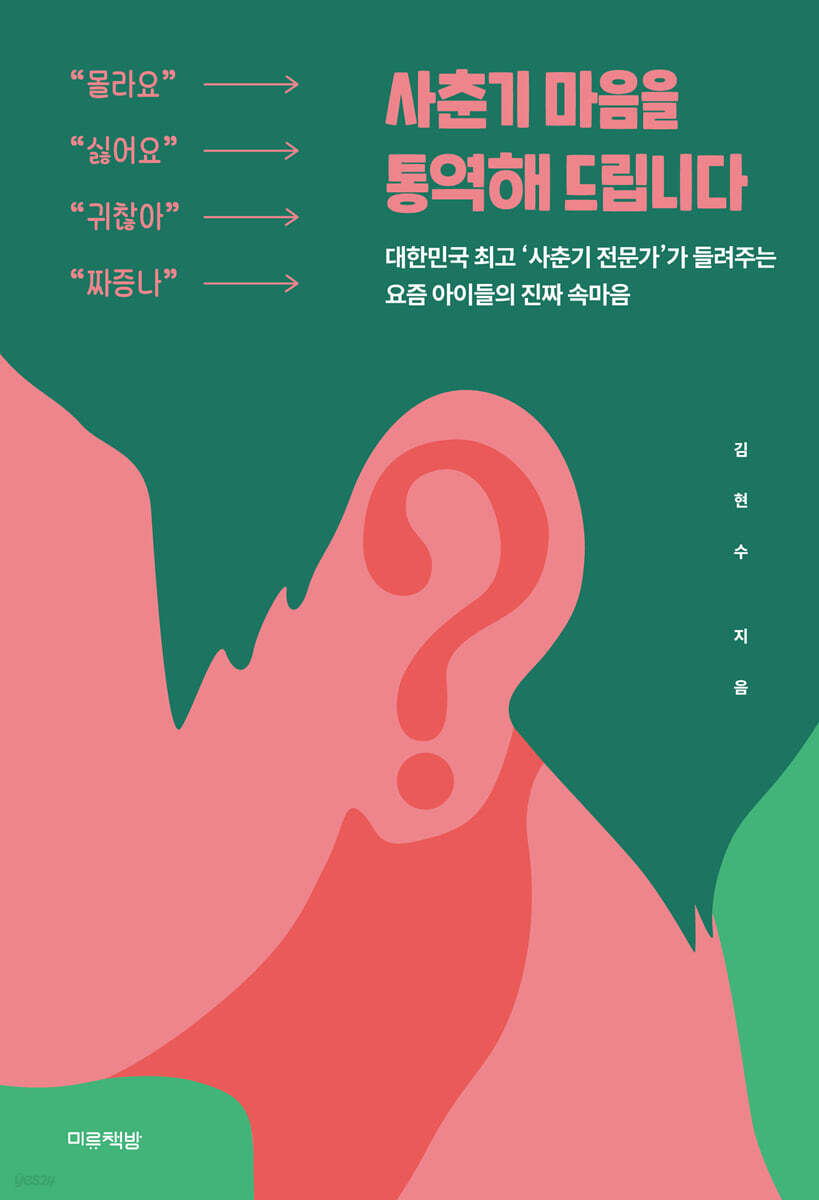
We interpret your adolescent mind.
 |
Description
Book Introduction
Patience is medicine for adolescent children, while impatience is poison.
Parents say they are frustrated when their adolescent children do not respond to conversation, and children say they are tired of talking to their parents.
Why is that? Children are having a harder time going through adolescence than their parents did.
We, society, are making it so.
The burden of being an only child or two children, the hardship of being forced to study, the loneliness of not having an adult to turn to when you need help, the confusion about your body's development, etc.
The best gift parents can give these adolescents is understanding.
Children may feel less angry or lonely if they feel that their parents understand them.
When parents understand their children, they can become more tolerant of them.
You will be able to wait.
For adolescent children, parental patience is medicine, and impatience is poison.
Parents say they are frustrated when their adolescent children do not respond to conversation, and children say they are tired of talking to their parents.
Why is that? Children are having a harder time going through adolescence than their parents did.
We, society, are making it so.
The burden of being an only child or two children, the hardship of being forced to study, the loneliness of not having an adult to turn to when you need help, the confusion about your body's development, etc.
The best gift parents can give these adolescents is understanding.
Children may feel less angry or lonely if they feel that their parents understand them.
When parents understand their children, they can become more tolerant of them.
You will be able to wait.
For adolescent children, parental patience is medicine, and impatience is poison.
- You can preview some of the book's contents.
Preview
index
prolog
To begin the story: When your child reaches puberty, it means the beginning of separation.
Part 1: The Loneliness of a Small Family
The emergence of a new type of human
In an era of low birth rates, being an only child is a huge burden.
"I need a sister or brother to stop KakaoTalk."
One in ten adults suffers from the "Crown Prince Syndrome."
“Did you do it or not?” is the worst way to talk.
“Mom is just my biological mother.”
Practical Psychology: Understanding Your Adolescent Child ①
Tips for becoming a parent like this
Part 2: At home, he's a 'prince', at school, he's an 'extra'
“Don’t you feel confident?”
Why name tags are required at school
Fear that I might not be a good child
Practical Psychology: Understanding Your Adolescent Child ②
Children who will protect the neighborhood, children who will protect the country
"I knew I was going to be Yuna the moment I started skating."
Bluff? The best counterattack is the first strike.
At the crossroads of effort and ability
“When I realized I wasn't a genius, I decided to die.”
The virtue of effort grows in the soil of trust.
Practical Psychology to Help You Understand Your Adolescent Child ③
Differences Between Boys and Girls Coping with Stress
Practical Psychology to Help You Understand Your Adolescents④
Tips for becoming a parent like this
Part 3: My body and my mind are both unfamiliar
50 Best Porn Videos I've Received as a Gift from a Middle School Student
Children are already having sex
The Living Room Revolution Brought About by Body Changes 1
Direct experience is decreasing, screen time is increasing.
Practical Psychology to Help You Understand Your Adolescent Child⑤
“A classroom of 30 people is smaller than my house where only 3 people live!”
'Adolescent Iron Men' adapting to new suits
The source of my body's appeal and confidence
If you forbid it, you want to do it more, and if you understand, you control it.
How can we provide good sex education?
Expressing Your Feelings with Your Body: The Psychology of Self-Harm, Tattoos, and Piercings
Tips for becoming a parent like this
Part 4: The Birth of a Shit Philosopher
A son who lives 'as he pleases' between his father and his mother.
Where did that lovely child go?
Become a critic who exposes parental hypocrisy
Parents should be the emotional trash can for their children.
Good prohibitions and bad prohibitions
Who is crazy, the father or the son?
“I’m doing my ‘best’ right now!”
In an era where "I'll change your phone" is the best motivation
Practical Psychology to Help You Understand Your Adolescent Child⑥
Tips for becoming a parent like this
Part 5: Loneliness When You Have No One to Share Your Heart With
“Mom is responsible, I don’t know!”
Practical Psychology to Help You Understand Your Adolescent Child⑦
Parents trying to steal their children's hearts again
The birth of a new idol
The temptation of a certification shot that's hard to resist
Adolescence is hard to endure without friendship.
A child without friends, a child who is bullied, a child who makes bad friends
Practical Psychology to Help You Understand Your Adolescents⑧
Games and fandom culture that replace friendship
Friends are my second family
The adolescent brain is under construction
Gender differences in brain development
Tips for becoming a parent like this
Part 6: Children Who Don't Want to Do Anything
Why Children Are Lethargic
Practical Psychology to Help You Understand Your Adolescent Child⑨
Tired three years old, the evaluation has already begun
Practical Psychology to Help You Understand Your Adolescent Child⑩
Clueless Parent Syndrome
The rise of Generation Alpha
One thing children wanted to say to their parents!
Practical Psychology to Help You Understand Your Adolescent Child⑪
Parents' inner thoughts
The "Himgeugwan" Conversation Method for Getting Along Well with Children
Practical Psychology to Help You Understand Your Teenage Child⑫
Closing the story: When your child reaches puberty, it means starting a new relationship.
Appendix: Effective and Competent Parenting Skills for Teens
Be a cheerleader, not a coach
Be a parent who is good at negotiating rather than scolding.
What is the CEO conversation method?
What teenagers want to hear
Conversational techniques that make relationships with teenagers difficult
To begin the story: When your child reaches puberty, it means the beginning of separation.
Part 1: The Loneliness of a Small Family
The emergence of a new type of human
In an era of low birth rates, being an only child is a huge burden.
"I need a sister or brother to stop KakaoTalk."
One in ten adults suffers from the "Crown Prince Syndrome."
“Did you do it or not?” is the worst way to talk.
“Mom is just my biological mother.”
Practical Psychology: Understanding Your Adolescent Child ①
Tips for becoming a parent like this
Part 2: At home, he's a 'prince', at school, he's an 'extra'
“Don’t you feel confident?”
Why name tags are required at school
Fear that I might not be a good child
Practical Psychology: Understanding Your Adolescent Child ②
Children who will protect the neighborhood, children who will protect the country
"I knew I was going to be Yuna the moment I started skating."
Bluff? The best counterattack is the first strike.
At the crossroads of effort and ability
“When I realized I wasn't a genius, I decided to die.”
The virtue of effort grows in the soil of trust.
Practical Psychology to Help You Understand Your Adolescent Child ③
Differences Between Boys and Girls Coping with Stress
Practical Psychology to Help You Understand Your Adolescents④
Tips for becoming a parent like this
Part 3: My body and my mind are both unfamiliar
50 Best Porn Videos I've Received as a Gift from a Middle School Student
Children are already having sex
The Living Room Revolution Brought About by Body Changes 1
Direct experience is decreasing, screen time is increasing.
Practical Psychology to Help You Understand Your Adolescent Child⑤
“A classroom of 30 people is smaller than my house where only 3 people live!”
'Adolescent Iron Men' adapting to new suits
The source of my body's appeal and confidence
If you forbid it, you want to do it more, and if you understand, you control it.
How can we provide good sex education?
Expressing Your Feelings with Your Body: The Psychology of Self-Harm, Tattoos, and Piercings
Tips for becoming a parent like this
Part 4: The Birth of a Shit Philosopher
A son who lives 'as he pleases' between his father and his mother.
Where did that lovely child go?
Become a critic who exposes parental hypocrisy
Parents should be the emotional trash can for their children.
Good prohibitions and bad prohibitions
Who is crazy, the father or the son?
“I’m doing my ‘best’ right now!”
In an era where "I'll change your phone" is the best motivation
Practical Psychology to Help You Understand Your Adolescent Child⑥
Tips for becoming a parent like this
Part 5: Loneliness When You Have No One to Share Your Heart With
“Mom is responsible, I don’t know!”
Practical Psychology to Help You Understand Your Adolescent Child⑦
Parents trying to steal their children's hearts again
The birth of a new idol
The temptation of a certification shot that's hard to resist
Adolescence is hard to endure without friendship.
A child without friends, a child who is bullied, a child who makes bad friends
Practical Psychology to Help You Understand Your Adolescents⑧
Games and fandom culture that replace friendship
Friends are my second family
The adolescent brain is under construction
Gender differences in brain development
Tips for becoming a parent like this
Part 6: Children Who Don't Want to Do Anything
Why Children Are Lethargic
Practical Psychology to Help You Understand Your Adolescent Child⑨
Tired three years old, the evaluation has already begun
Practical Psychology to Help You Understand Your Adolescent Child⑩
Clueless Parent Syndrome
The rise of Generation Alpha
One thing children wanted to say to their parents!
Practical Psychology to Help You Understand Your Adolescent Child⑪
Parents' inner thoughts
The "Himgeugwan" Conversation Method for Getting Along Well with Children
Practical Psychology to Help You Understand Your Teenage Child⑫
Closing the story: When your child reaches puberty, it means starting a new relationship.
Appendix: Effective and Competent Parenting Skills for Teens
Be a cheerleader, not a coach
Be a parent who is good at negotiating rather than scolding.
What is the CEO conversation method?
What teenagers want to hear
Conversational techniques that make relationships with teenagers difficult
Into the book
Contrary to parents' belief that their children are growing up in a rich environment with lots of love, children become lonely as they reach adolescence.
The first reason is that I have no or very few siblings.
“I only have one child, so what if he or she has a hard life?”
This is every parent's concern.
“I am the only child I have. What should I do if I can’t make my parents happy?”
This is a concern for all children.
In a society where parents have one or two children, and the only people they can rely on are each other, these worries can become a real problem.
---pp.23-24
“Every time my family gets together, I’m the only one there, so it’s really hard.
They told me to try what I learned and show off my skills, so I did recitals for 10 years.
It's so hard because all these family members look at me, love me, and say that I'm their hope.
It's burdensome and I feel like I have to do well.
There is no freedom in life.
I can't do what I want and I always have to think about my family.
But my maternal and paternal family members seem to think that I only receive a lot of love.
“I too am lonely, tired, burdened, and want to escape from this family.”
---p.32
“This is my biological mother. She gave birth to me, fed me, clothed me, and gave me money to go to school.
This person doesn't know me well.
I don't know what I'm worried about, what I like, or what I want to do.
---p.39
As children enter puberty, they become overwhelmed by their changing bodies and inner changes.
Children's defense mechanisms against such feelings of shyness, awkwardness, and unfamiliarity are diverse, including silence and rebellion.
What is needed to remove this armor of defense is encouragement.
But we scold middle school students who need encouragement.
After being scolded a lot, they tell you to cheer up.
This cannot be said to be giving a disease and then giving medicine.
If this happens, any confidence you had will disappear.
---p.51
Kids these days want to be recognized more than ever before.
It's just disappointing that the teachers don't even know the prince and princess's names.
At home, they're the main characters, at school, they're the extras! This role reversal can be difficult for children.
Can you guess that feeling?
I wish school was a drama series with a rotating cast of kids, but school-produced dramas often feature mostly unchanged main characters throughout the three years.
Kids who go around as extras for three years can't possibly have fun.
---p.55
A common defense mechanism people use when they feel ignored is to deny it or, in fact, exaggerate it.
That is the superficial psychological mechanism of what children call 'pretend to be cool'.
Yelling at them to silence them, telling them to wait and see, creating a rough atmosphere, etc.
This is an atmosphere created not only because children dislike it, but also because they are afraid.
By using as much bluff as possible to avoid the moment, they try to reduce the serious narcissistic damage they receive from words.
And it is also about preemptively creating that kind of atmosphere, that is, making a first move to prevent them from getting close.
Sometimes he is gloomy and grumpy, and other times he shouts and tells people not to worry and goes on and on about how to act. This kind of ups and downs is one of the characteristics of adolescent mood.
But children hate to notice it, and they hate to admit that they are depressed.
---pp.66-67
For our parents' generation, who dreamed of escaping poverty or social mobility, perseverance in achieving their goals may have been a crucial virtue. But for today's generation, whose goals are self-actualization and a fun and happy life, interest and meaning have become crucial values.
Asking people to be patient without helping them discover interest or meaning is not motivating.
In short, I don't understand parents who say they love their children but impose painful tasks on them.
---p.83
They struggle to adapt to their new bodies in many ways, but adults do not give them the opportunity to adapt to their new bodies.
They make us sit in the classroom for long periods of time and just hover around our desks all day.
Some parents feel that the time they spend on physical activities is less important than the time they spend on mental activities.
The more such parents' children dislike using their bodies, the more they use the body of a game avatar instead of their own, and only use their fingers instead of their bodies. As a result, they lose confidence in using their own bodies and become shy or embarrassed children.
---p.111
Most of the unfortunate, smart-aleck parents I've met were socially successful to a certain degree, but their children were either rule-breaking and cheating, or had already committed a number of misdeeds that had caused them major problems at school, or were listless and unmotivated, always concerned with what others thought.
Parents said they could not understand their child's condition at all, and they thought that the child would not be able to communicate with their parents anyway.
Many children also thought, “Our parents are hypocritical.”
---p.233
Children who are always right and flawless and whose parents are always right in everything do not grow up to be as good as the parents expect.
Because parents hold their children to strict moral standards and do not tolerate mistakes, children become desperate to hide their mistakes, which leads to more lies and, out of fear of being scolded, to start talking back to their parents one day.
No child does everything correctly.
Children's hearts build up a sense of both resentment and guilt as they are constantly scolded by their parents who expect them to do everything right.
You will lose confidence.
Since nothing parents say is wrong, children end up hating their parents more and feeling helpless.
The first reason is that I have no or very few siblings.
“I only have one child, so what if he or she has a hard life?”
This is every parent's concern.
“I am the only child I have. What should I do if I can’t make my parents happy?”
This is a concern for all children.
In a society where parents have one or two children, and the only people they can rely on are each other, these worries can become a real problem.
---pp.23-24
“Every time my family gets together, I’m the only one there, so it’s really hard.
They told me to try what I learned and show off my skills, so I did recitals for 10 years.
It's so hard because all these family members look at me, love me, and say that I'm their hope.
It's burdensome and I feel like I have to do well.
There is no freedom in life.
I can't do what I want and I always have to think about my family.
But my maternal and paternal family members seem to think that I only receive a lot of love.
“I too am lonely, tired, burdened, and want to escape from this family.”
---p.32
“This is my biological mother. She gave birth to me, fed me, clothed me, and gave me money to go to school.
This person doesn't know me well.
I don't know what I'm worried about, what I like, or what I want to do.
---p.39
As children enter puberty, they become overwhelmed by their changing bodies and inner changes.
Children's defense mechanisms against such feelings of shyness, awkwardness, and unfamiliarity are diverse, including silence and rebellion.
What is needed to remove this armor of defense is encouragement.
But we scold middle school students who need encouragement.
After being scolded a lot, they tell you to cheer up.
This cannot be said to be giving a disease and then giving medicine.
If this happens, any confidence you had will disappear.
---p.51
Kids these days want to be recognized more than ever before.
It's just disappointing that the teachers don't even know the prince and princess's names.
At home, they're the main characters, at school, they're the extras! This role reversal can be difficult for children.
Can you guess that feeling?
I wish school was a drama series with a rotating cast of kids, but school-produced dramas often feature mostly unchanged main characters throughout the three years.
Kids who go around as extras for three years can't possibly have fun.
---p.55
A common defense mechanism people use when they feel ignored is to deny it or, in fact, exaggerate it.
That is the superficial psychological mechanism of what children call 'pretend to be cool'.
Yelling at them to silence them, telling them to wait and see, creating a rough atmosphere, etc.
This is an atmosphere created not only because children dislike it, but also because they are afraid.
By using as much bluff as possible to avoid the moment, they try to reduce the serious narcissistic damage they receive from words.
And it is also about preemptively creating that kind of atmosphere, that is, making a first move to prevent them from getting close.
Sometimes he is gloomy and grumpy, and other times he shouts and tells people not to worry and goes on and on about how to act. This kind of ups and downs is one of the characteristics of adolescent mood.
But children hate to notice it, and they hate to admit that they are depressed.
---pp.66-67
For our parents' generation, who dreamed of escaping poverty or social mobility, perseverance in achieving their goals may have been a crucial virtue. But for today's generation, whose goals are self-actualization and a fun and happy life, interest and meaning have become crucial values.
Asking people to be patient without helping them discover interest or meaning is not motivating.
In short, I don't understand parents who say they love their children but impose painful tasks on them.
---p.83
They struggle to adapt to their new bodies in many ways, but adults do not give them the opportunity to adapt to their new bodies.
They make us sit in the classroom for long periods of time and just hover around our desks all day.
Some parents feel that the time they spend on physical activities is less important than the time they spend on mental activities.
The more such parents' children dislike using their bodies, the more they use the body of a game avatar instead of their own, and only use their fingers instead of their bodies. As a result, they lose confidence in using their own bodies and become shy or embarrassed children.
---p.111
Most of the unfortunate, smart-aleck parents I've met were socially successful to a certain degree, but their children were either rule-breaking and cheating, or had already committed a number of misdeeds that had caused them major problems at school, or were listless and unmotivated, always concerned with what others thought.
Parents said they could not understand their child's condition at all, and they thought that the child would not be able to communicate with their parents anyway.
Many children also thought, “Our parents are hypocritical.”
---p.233
Children who are always right and flawless and whose parents are always right in everything do not grow up to be as good as the parents expect.
Because parents hold their children to strict moral standards and do not tolerate mistakes, children become desperate to hide their mistakes, which leads to more lies and, out of fear of being scolded, to start talking back to their parents one day.
No child does everything correctly.
Children's hearts build up a sense of both resentment and guilt as they are constantly scolded by their parents who expect them to do everything right.
You will lose confidence.
Since nothing parents say is wrong, children end up hating their parents more and feeling helpless.
---pp.236-237
Publisher's Review
Many parents complain that they feel frustrated when their adolescent children do not respond to conversations.
He doesn't really answer questions, and when he does open his mouth, all he says are "I don't know," "I don't like it," "It's annoying," and "It's annoying."
Even when children are given a lot of love in a rich environment, they become lethargic, have trouble controlling their anger, or seem to have given up on everything and become obsessed with games or idols.
Why on earth is that?
The author, a psychiatrist who interprets adolescence between adolescent children and their parents in the clinic, says, “Conversations with adolescent children are inherently difficult.”
It was hard before, and it's harder now.
This is because children these days are going through a much more difficult adolescence than their parents' generation.
These days, children first of all experience familial loneliness as only children or two children.
As teenagers enter puberty, they begin to develop secrets they can no longer share with their parents, and not having family to share those secrets with can be a huge challenge.
Moreover, in an era of low birth rates, where it is not uncommon for there to be only one child for every ten adults, children are bound to feel a tremendous burden.
Adults think of them as “children who only receive love,” but from the child’s perspective, the parent’s words, “Our only hope is you,” can at times feel like a trap.
Although puberty can occur in the upper grades of elementary school, for most people it begins when they enter middle school.
But middle school is a completely different environment from elementary school.
When children receive their first report card with clear grades, they begin to recognize their place in the class.
At home, you were a “princess” or a “prince,” but in an instant, you became a “nothing special” or a “so-so kid,” so you couldn’t help but feel helpless.
Parents keep pulling out the 'best, proper, hard work' card because they feel their children are not 'doing it properly' or 'working hard'.
But kids hate this card the most.
Children's standards for 'best' and 'highest' are different from those of their parents' generation.
Moreover, unlike the parental generation who sought to escape poverty and achieve social mobility through education, today's children prioritize fun and interest over everything else.
Friends are so important to adolescent children that they can be called a 'second family'.
However, the less parents accept their children and the less communication they have, the more dependent they become on peers.
Especially when it comes to having bad friends, it's no exaggeration to say that more than half of the time it's a reflection of problems with your parents.
Bad friends are ultimately the result of bad parents.
However, if you look around, there are many cases where the parents are truly elite and have achieved a certain level of social success, but their children are not like that.
The author calls these people 'smart parents'.
That is, parents who don't know what they need to do to achieve the changes they truly want, who have difficulty understanding why they are not good parents, or who only understand it in their heads.
Their biggest characteristic is that they are emotionally cold and always overly concerned about right and wrong.
The difficult adolescence for parents does not last forever.
But the wounds in the relationship last a long time.
Therefore, it is necessary to make an effort to understand the minds of adolescent children, which are completely unknown.
Children may feel less angry or lonely if they feel that their parents understand them.
When parents understand their children, they can become more tolerant of them.
You will be able to wait.
For adolescent children, parental patience is medicine, and impatience is poison.
He doesn't really answer questions, and when he does open his mouth, all he says are "I don't know," "I don't like it," "It's annoying," and "It's annoying."
Even when children are given a lot of love in a rich environment, they become lethargic, have trouble controlling their anger, or seem to have given up on everything and become obsessed with games or idols.
Why on earth is that?
The author, a psychiatrist who interprets adolescence between adolescent children and their parents in the clinic, says, “Conversations with adolescent children are inherently difficult.”
It was hard before, and it's harder now.
This is because children these days are going through a much more difficult adolescence than their parents' generation.
These days, children first of all experience familial loneliness as only children or two children.
As teenagers enter puberty, they begin to develop secrets they can no longer share with their parents, and not having family to share those secrets with can be a huge challenge.
Moreover, in an era of low birth rates, where it is not uncommon for there to be only one child for every ten adults, children are bound to feel a tremendous burden.
Adults think of them as “children who only receive love,” but from the child’s perspective, the parent’s words, “Our only hope is you,” can at times feel like a trap.
Although puberty can occur in the upper grades of elementary school, for most people it begins when they enter middle school.
But middle school is a completely different environment from elementary school.
When children receive their first report card with clear grades, they begin to recognize their place in the class.
At home, you were a “princess” or a “prince,” but in an instant, you became a “nothing special” or a “so-so kid,” so you couldn’t help but feel helpless.
Parents keep pulling out the 'best, proper, hard work' card because they feel their children are not 'doing it properly' or 'working hard'.
But kids hate this card the most.
Children's standards for 'best' and 'highest' are different from those of their parents' generation.
Moreover, unlike the parental generation who sought to escape poverty and achieve social mobility through education, today's children prioritize fun and interest over everything else.
Friends are so important to adolescent children that they can be called a 'second family'.
However, the less parents accept their children and the less communication they have, the more dependent they become on peers.
Especially when it comes to having bad friends, it's no exaggeration to say that more than half of the time it's a reflection of problems with your parents.
Bad friends are ultimately the result of bad parents.
However, if you look around, there are many cases where the parents are truly elite and have achieved a certain level of social success, but their children are not like that.
The author calls these people 'smart parents'.
That is, parents who don't know what they need to do to achieve the changes they truly want, who have difficulty understanding why they are not good parents, or who only understand it in their heads.
Their biggest characteristic is that they are emotionally cold and always overly concerned about right and wrong.
The difficult adolescence for parents does not last forever.
But the wounds in the relationship last a long time.
Therefore, it is necessary to make an effort to understand the minds of adolescent children, which are completely unknown.
Children may feel less angry or lonely if they feel that their parents understand them.
When parents understand their children, they can become more tolerant of them.
You will be able to wait.
For adolescent children, parental patience is medicine, and impatience is poison.
GOODS SPECIFICS
- Date of issue: September 8, 2023
- Page count, weight, size: 292 pages | 376g | 140*205*18mm
- ISBN13: 9791188632121
- ISBN10: 1188632124
You may also like
카테고리
korean


korean

![ELLE 엘르 스페셜 에디션 A형 : 12월 [2025]](http://librairie.coreenne.fr/cdn/shop/files/b8e27a3de6c9538896439686c6b0e8fb.jpg?v=1766436872&width=3840)


