

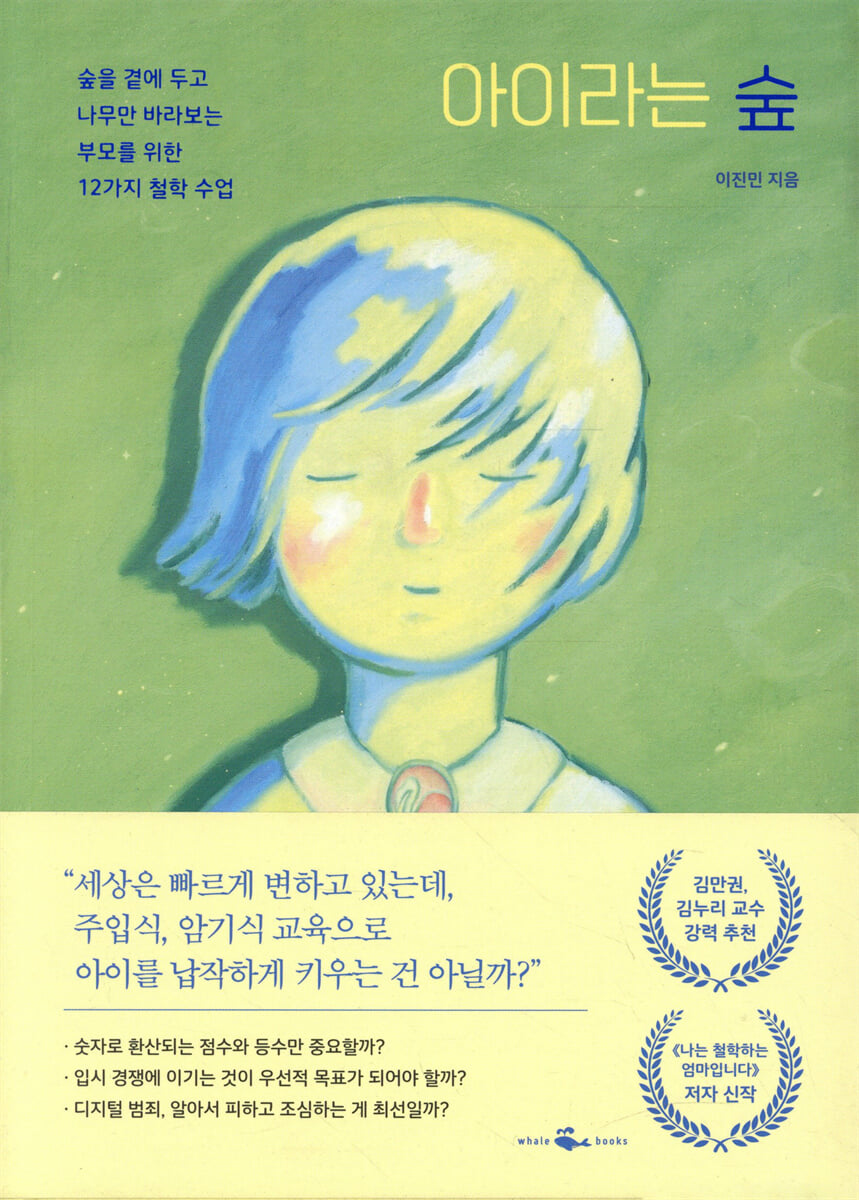
The Forest of Ira
 |
Description
Book Introduction
With the 'Forest of Ira' by my side
To parents who are anxious just looking at the trees
Break away from the flat, rote learning and memorization-based education
12 Philosophy Lessons to Help Your Child Grow Broader and Deeper
★ Strongly recommended by Professors Kim Man-kwon and Kim Nu-ri
★ A new work by author Jinmin Lee, "I am a Philosophical Mother"
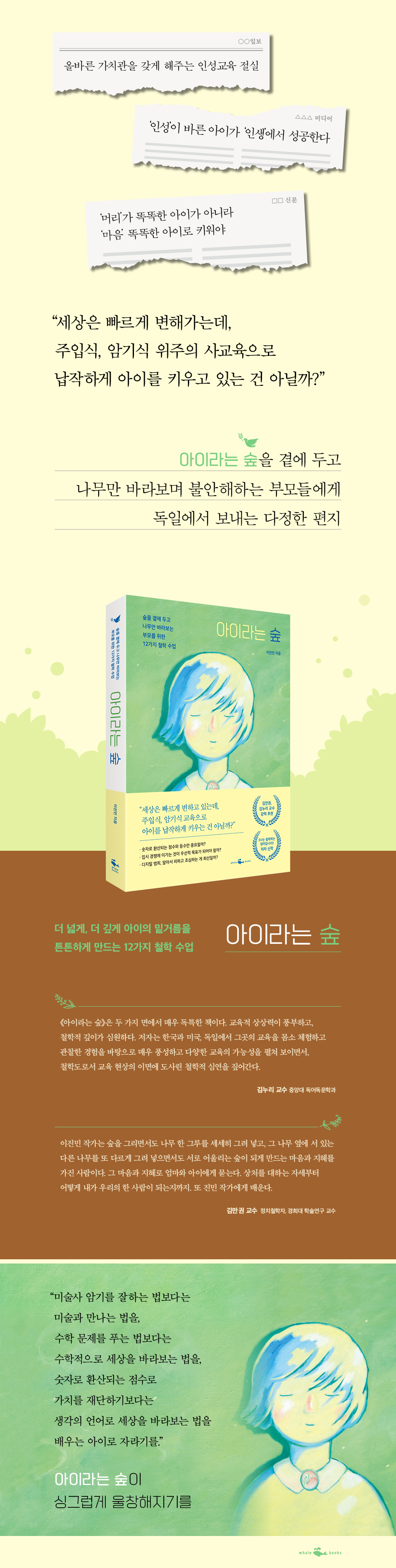
In a rapidly changing world, how should we raise children? The old joke that when you're unsure of how to raise a child, just follow the "mom next door" no longer holds water.
More parenting and educational methods are being introduced to target parents who have lost their way, and the irony of losing their way is repeated among them.
Author Jinmin Lee, who reminded wavering mothers of the importance of philosophy and conviction in “I am a Philosophical Mother,” presents her thoughts and questions on the potentially vague topic of “How should I raise my child?”
"The Forest of Children" invites parents who are at a loss as to how to raise their children in a chaotic world to "look further and think about the basics."
At the same time, it points out what kind of studies are truly necessary for children who will face a difficult world.
Rather than raising children in a sterile environment without any obstacles, we hope that they will grow up willingly falling and getting hurt, and that they should be able to live their entire lives learning and studying, rather than remembering school as a 'prison' and a 'battlefield'.
We also hope that children will grow up to be members of society who know how to love and be loved properly, and we emphasize the importance of economic awareness, sex education, and environmental education.
The author's writing style, which freely moves between Korea and Germany, politics and education, philosophy and classics, and unfolds his thoughts in a comfortable and pleasant style, makes the book a great read.
As befitting an author who is “interested in transforming philosophy into the soft language of everyday life,” he brings philosophy, which can sometimes feel stiff and boring, into the playground, classroom, and kitchen, and bridges the gap with his characteristically witty remarks.
Furthermore, by referencing various experiences in Germany, we gradually expand our perspective to include not only the roles of parents raising children, but also the roles of adults and their responsibilities in society, sharing wisdom that will become nutrients for the "forest called children" around us to become lush and lush.
To parents who are anxious just looking at the trees
Break away from the flat, rote learning and memorization-based education
12 Philosophy Lessons to Help Your Child Grow Broader and Deeper
★ Strongly recommended by Professors Kim Man-kwon and Kim Nu-ri
★ A new work by author Jinmin Lee, "I am a Philosophical Mother"
In a rapidly changing world, how should we raise children? The old joke that when you're unsure of how to raise a child, just follow the "mom next door" no longer holds water.
More parenting and educational methods are being introduced to target parents who have lost their way, and the irony of losing their way is repeated among them.
Author Jinmin Lee, who reminded wavering mothers of the importance of philosophy and conviction in “I am a Philosophical Mother,” presents her thoughts and questions on the potentially vague topic of “How should I raise my child?”
"The Forest of Children" invites parents who are at a loss as to how to raise their children in a chaotic world to "look further and think about the basics."
At the same time, it points out what kind of studies are truly necessary for children who will face a difficult world.
Rather than raising children in a sterile environment without any obstacles, we hope that they will grow up willingly falling and getting hurt, and that they should be able to live their entire lives learning and studying, rather than remembering school as a 'prison' and a 'battlefield'.
We also hope that children will grow up to be members of society who know how to love and be loved properly, and we emphasize the importance of economic awareness, sex education, and environmental education.
The author's writing style, which freely moves between Korea and Germany, politics and education, philosophy and classics, and unfolds his thoughts in a comfortable and pleasant style, makes the book a great read.
As befitting an author who is “interested in transforming philosophy into the soft language of everyday life,” he brings philosophy, which can sometimes feel stiff and boring, into the playground, classroom, and kitchen, and bridges the gap with his characteristically witty remarks.
Furthermore, by referencing various experiences in Germany, we gradually expand our perspective to include not only the roles of parents raising children, but also the roles of adults and their responsibilities in society, sharing wisdom that will become nutrients for the "forest called children" around us to become lush and lush.
- You can preview some of the book's contents.
Preview
index
Opening remarks: May the forest of Ira grow lush and lush
Chapter 1: What Adults Lose and Children Miss
What it means to be hurt: Our attitude toward wounds
Studying: Why, What, and How to Study
Play is: to be able to live my whole life as homo ludens
Chapter 2 I hope children learn this firmly
Growing up with a sense of finance: Learning how to spend money wisely from your grandfather, Aristotle.
If only I had learned how to love properly: There's an education more important than Korean, English, and math.
If you grew up to be a friend of all things, not the lord of all things: May the world you live in still be a green place.
Chapter 3: May the children become wonderful members of our family.
Mom, There Are Thorns in the Sweet Potato: We Stand in the World of Names
Human existence is based on the plural: we who make friends
Society of I, Society of We: You, Positioned in the Coordinates of 'Me and Us'
Chapter 4 Three Things That Will Lift Us Up in a Tough World
Food: Sometimes Food Replaces Language
Humor: the ability to laugh, the ability to make people laugh
Love: Remember the love we shared
Chapter 1: What Adults Lose and Children Miss
What it means to be hurt: Our attitude toward wounds
Studying: Why, What, and How to Study
Play is: to be able to live my whole life as homo ludens
Chapter 2 I hope children learn this firmly
Growing up with a sense of finance: Learning how to spend money wisely from your grandfather, Aristotle.
If only I had learned how to love properly: There's an education more important than Korean, English, and math.
If you grew up to be a friend of all things, not the lord of all things: May the world you live in still be a green place.
Chapter 3: May the children become wonderful members of our family.
Mom, There Are Thorns in the Sweet Potato: We Stand in the World of Names
Human existence is based on the plural: we who make friends
Society of I, Society of We: You, Positioned in the Coordinates of 'Me and Us'
Chapter 4 Three Things That Will Lift Us Up in a Tough World
Food: Sometimes Food Replaces Language
Humor: the ability to laugh, the ability to make people laugh
Love: Remember the love we shared
Detailed image
Into the book
It may be comfortable for children if adults are always there to hold them and lead them, but they lose the opportunity to prove their strength and abilities.
I don't know how far my life force can stretch, how much elasticity I have.
Therefore, the adults' place is one step back.
A place where you can watch your child move forward on his own, fall down, and get back up again.
It is the role of an adult to hold on to someone when it seems too dangerous, and to support them when they are tired and struggling.
--- From "Getting Hurt"
I'm not here to talk about which majors will survive in the future.
That's an area I can never figure out no matter what I do.
Just as smartphones were to my grandmother who passed away when I was three, as in vitro fertilization was to my grandfather who passed away before her, and as YouTubers were to my father who passed away in the early 2000s, the future will bring objects, technologies, and jobs we can't even imagine today.
But there are things that are unimaginable and fundamental to the basics that permeate all skills and professions.
The ability to read, understand and write, the ability to ask questions and converse.
These are skills that are absolutely necessary for any job in the world.
No matter what new products, technologies, or jobs emerge, the importance of these basic skills will never disappear.
Therefore, I believe that we must properly learn how to read, understand, write, ask questions, and converse.
And very seriously too.
--- From "What is Studying"
I'm not sure if children have enough opportunities in the classroom to ask questions and share their thoughts about the concept of money.
Children learn terms like the New Deal and inflation, but they don't learn basic, everyday things like how to write a contract for a fast-food job or how to manage the arrogant brat inside them.
Why on earth isn't this important thing taught?
Not knowing a few English words won't kill you, but not knowing how to manage credit or debt can put your entire life at risk.
We often see "new adults" in their twenties who get credit cards but then run into problems because they don't manage their credit properly.
How heartbreaking it is to see a ridiculously small amount of money snowball into a suffocating shadow cast over what should have been a bright and shining youth.
Rather than just listing the benefits of credit cards, we need to emphasize and inform the reader about the more important aspects of credit, such as how credit is maintained and how it becomes bad.
--- From "I wish I had grown up to be a child with a sense of economics"
German children receive a very frank and honest education on the topic of sex, learning from a very young age the essentials of their age in a step-by-step manner that is closely related to their daily lives.
First of all, since preschool children are often exposed to the birth of younger siblings or cousins, they learn about the differences between boys and girls, the shape of the human body, and the value of life through picture books related to the birth of babies.
If you look at these picture books, you can see that they contain the who, what, why, and how information in a very honest and straightforward manner.
The naked bodies of adults, including body hair, are vividly depicted, and the fertilization process is not just a round meeting of sperm and egg at the cellular level, but it is also frank and straightforward in showing a realistic sexual relationship, which is striking (to be honest, I once opened a picture book at the library and was so shocked that I had to close it).
It feels like it shows things as they are, without vaguely beating around the bush with pretty and cute pictures and children's language.
In our country, this kind of honesty might be considered traumatic for children, but in Germany, it seems that it will have a positive effect.
My position is that we should not keep it a secret for no reason and only stimulate the imagination.
--- From "If I Learned How to Love Properly"
I wish humanity could become friends with all things, rather than the lords of all things.
Wouldn't it change quite a bit just by stepping down from the position you've given yourself, the highest seat on the podium?
I hope we can become humble and realize that we are just specks of dust in the vast universe.
As much as I am kind to the people around me, I hope I can be kind to the animals and plants around me.
I hope my children, who love to climb trees, will be grateful to the trees for offering their bodies like their uncles, and not step on bugs that are scurrying by for no reason.
--- From "I wish I had grown up to be a friend of all things, not the leader of all things"
There may not be a right answer, but there are words that I want to keep in my heart as if they were the right answer.
“Adults should be like streetlights, not traffic lights.” At a meeting to discuss spaces for children, someone described the role adults should play this way.
What if we could be such loving but uninvolved parents?
Of course, parents of young children will often have to act as traffic lights, but as children grow older, what if they could also become streetlights?
Even though it is difficult to overcome the dilemma, let us always stand in the soft light of our children.
I don't know how far my life force can stretch, how much elasticity I have.
Therefore, the adults' place is one step back.
A place where you can watch your child move forward on his own, fall down, and get back up again.
It is the role of an adult to hold on to someone when it seems too dangerous, and to support them when they are tired and struggling.
--- From "Getting Hurt"
I'm not here to talk about which majors will survive in the future.
That's an area I can never figure out no matter what I do.
Just as smartphones were to my grandmother who passed away when I was three, as in vitro fertilization was to my grandfather who passed away before her, and as YouTubers were to my father who passed away in the early 2000s, the future will bring objects, technologies, and jobs we can't even imagine today.
But there are things that are unimaginable and fundamental to the basics that permeate all skills and professions.
The ability to read, understand and write, the ability to ask questions and converse.
These are skills that are absolutely necessary for any job in the world.
No matter what new products, technologies, or jobs emerge, the importance of these basic skills will never disappear.
Therefore, I believe that we must properly learn how to read, understand, write, ask questions, and converse.
And very seriously too.
--- From "What is Studying"
I'm not sure if children have enough opportunities in the classroom to ask questions and share their thoughts about the concept of money.
Children learn terms like the New Deal and inflation, but they don't learn basic, everyday things like how to write a contract for a fast-food job or how to manage the arrogant brat inside them.
Why on earth isn't this important thing taught?
Not knowing a few English words won't kill you, but not knowing how to manage credit or debt can put your entire life at risk.
We often see "new adults" in their twenties who get credit cards but then run into problems because they don't manage their credit properly.
How heartbreaking it is to see a ridiculously small amount of money snowball into a suffocating shadow cast over what should have been a bright and shining youth.
Rather than just listing the benefits of credit cards, we need to emphasize and inform the reader about the more important aspects of credit, such as how credit is maintained and how it becomes bad.
--- From "I wish I had grown up to be a child with a sense of economics"
German children receive a very frank and honest education on the topic of sex, learning from a very young age the essentials of their age in a step-by-step manner that is closely related to their daily lives.
First of all, since preschool children are often exposed to the birth of younger siblings or cousins, they learn about the differences between boys and girls, the shape of the human body, and the value of life through picture books related to the birth of babies.
If you look at these picture books, you can see that they contain the who, what, why, and how information in a very honest and straightforward manner.
The naked bodies of adults, including body hair, are vividly depicted, and the fertilization process is not just a round meeting of sperm and egg at the cellular level, but it is also frank and straightforward in showing a realistic sexual relationship, which is striking (to be honest, I once opened a picture book at the library and was so shocked that I had to close it).
It feels like it shows things as they are, without vaguely beating around the bush with pretty and cute pictures and children's language.
In our country, this kind of honesty might be considered traumatic for children, but in Germany, it seems that it will have a positive effect.
My position is that we should not keep it a secret for no reason and only stimulate the imagination.
--- From "If I Learned How to Love Properly"
I wish humanity could become friends with all things, rather than the lords of all things.
Wouldn't it change quite a bit just by stepping down from the position you've given yourself, the highest seat on the podium?
I hope we can become humble and realize that we are just specks of dust in the vast universe.
As much as I am kind to the people around me, I hope I can be kind to the animals and plants around me.
I hope my children, who love to climb trees, will be grateful to the trees for offering their bodies like their uncles, and not step on bugs that are scurrying by for no reason.
--- From "I wish I had grown up to be a friend of all things, not the leader of all things"
There may not be a right answer, but there are words that I want to keep in my heart as if they were the right answer.
“Adults should be like streetlights, not traffic lights.” At a meeting to discuss spaces for children, someone described the role adults should play this way.
What if we could be such loving but uninvolved parents?
Of course, parents of young children will often have to act as traffic lights, but as children grow older, what if they could also become streetlights?
Even though it is difficult to overcome the dilemma, let us always stand in the soft light of our children.
--- From "I's Society, We's Society"
Publisher's Review
Parents who say, "Don't think about anything right now and just focus on studying."
A society that demands a set correct answer: 'Choose from the following options.'
Korean parents have deep insight into society and
Affectionate advice for helping children grow wider and deeper
France's Le Monde reported that Korean students were "the most unfortunate children in the world."
South Korea is the only country in the world where more than 80% of students remember their high school years as a 'life-or-death battlefield' and where education is called 'hell.'
The author, who majored in political philosophy at Yonsei University, moved to the United States, and then Germany to raise two children while earning a doctorate, draws on his unique background and experiences to examine what Korean adults are losing and what children are missing.
To parents who are afraid of their children's scars, he says, "The scars that children get while playing are proof that they have learned about the world and grown up." Rather than being upset about their children's scars, he broadens the parents' perspective so that they can see their children learning and growing through them.
Going a step further, he says that the role of adults is to examine the invisible wounds of children that are given and received in the increasingly vast online world, rather than the visible scars.
For parents who say, “Don’t think about anything else right now, just focus on studying,” I shift the focus to asking questions that allow them to think, rather than questions with set answers, so that they don’t become adults who are “big in stature” without ever thinking about “who I am, what I like, and what I want.”
In this way, with deep insight into Korean parents and society, we seek ways to help children grow in a broader and deeper way.
"The Forest of Children" is the author's pledge to raise children to learn how to encounter art rather than memorize art history, how to view the world mathematically rather than solving math problems, and ultimately how to view the world through the language of thought rather than judging value by scores that can be converted into numbers. It is also a conversation with parents who live with the same concerns.
“Economic sense, sex education, environmental sensitivity…
I hope the children learn this firmly.”
In an age of discrimination, exclusion, hatred and threats
How to Raise a Child to Be Loved and Embraced
In a world of ever-increasing competition, selfishly fragmented communities, increasingly vicious and sophisticated digital crime, and a climate that makes you wonder how long it will last… Parents raising children in this bleak world are left feeling helpless.
Are my current choices the best for my child's future? What can I do for them, who will live in an age of discrimination, exclusion, hatred, and threats?
“The Forest of Ira” invites us to “see further and think about the basics” in a world that is chaotic.
At the same time, it points out what kind of studies are truly necessary for children who will face a difficult world.
Chapter 1, “What Adults Lose and Children Miss,” looks at the parents who do not allow their children to be hurt, the school system that takes away the fun of studying and only gives them obligations, and the social atmosphere that criminalizes play. It looks at what adults in Korea are losing and children are missing.
Chapter 2, “I hope children learn this much,” lists economic education, sex education, and environmental education as essential education for children to learn.
He emphasizes that economic sense, which allows one to understand the value of money and manage one's household, sex education, which allows one to protect oneself and love oneself properly in a world rife with digital crime, and environmental education, which allows one to regard oneself as a friend of all things, as well as an entity, are more important than Korean, English, and math scores.
Chapter 3, “Let’s Make Children Great Members of Our Society,” covers important aspects of how children grow up to become wonderful members of society.
While choosing words to say to children who will live as members of society among people, I also included words to say to fellow adults who live in this society together.
Chapter 4, “Three Things That Will Get Us Up in a Tough World,” lists food, humor, and love as the three things that will get us up in a difficult world that will constantly challenge us.
There is no one-size-fits-all methodology in this book.
However, if you follow the words written with affection while thinking of parents who are living with the same worries, it will become a directional key that will help you solve the worries that were so anxious and overwhelming.
A society that demands a set correct answer: 'Choose from the following options.'
Korean parents have deep insight into society and
Affectionate advice for helping children grow wider and deeper
France's Le Monde reported that Korean students were "the most unfortunate children in the world."
South Korea is the only country in the world where more than 80% of students remember their high school years as a 'life-or-death battlefield' and where education is called 'hell.'
The author, who majored in political philosophy at Yonsei University, moved to the United States, and then Germany to raise two children while earning a doctorate, draws on his unique background and experiences to examine what Korean adults are losing and what children are missing.
To parents who are afraid of their children's scars, he says, "The scars that children get while playing are proof that they have learned about the world and grown up." Rather than being upset about their children's scars, he broadens the parents' perspective so that they can see their children learning and growing through them.
Going a step further, he says that the role of adults is to examine the invisible wounds of children that are given and received in the increasingly vast online world, rather than the visible scars.
For parents who say, “Don’t think about anything else right now, just focus on studying,” I shift the focus to asking questions that allow them to think, rather than questions with set answers, so that they don’t become adults who are “big in stature” without ever thinking about “who I am, what I like, and what I want.”
In this way, with deep insight into Korean parents and society, we seek ways to help children grow in a broader and deeper way.
"The Forest of Children" is the author's pledge to raise children to learn how to encounter art rather than memorize art history, how to view the world mathematically rather than solving math problems, and ultimately how to view the world through the language of thought rather than judging value by scores that can be converted into numbers. It is also a conversation with parents who live with the same concerns.
“Economic sense, sex education, environmental sensitivity…
I hope the children learn this firmly.”
In an age of discrimination, exclusion, hatred and threats
How to Raise a Child to Be Loved and Embraced
In a world of ever-increasing competition, selfishly fragmented communities, increasingly vicious and sophisticated digital crime, and a climate that makes you wonder how long it will last… Parents raising children in this bleak world are left feeling helpless.
Are my current choices the best for my child's future? What can I do for them, who will live in an age of discrimination, exclusion, hatred, and threats?
“The Forest of Ira” invites us to “see further and think about the basics” in a world that is chaotic.
At the same time, it points out what kind of studies are truly necessary for children who will face a difficult world.
Chapter 1, “What Adults Lose and Children Miss,” looks at the parents who do not allow their children to be hurt, the school system that takes away the fun of studying and only gives them obligations, and the social atmosphere that criminalizes play. It looks at what adults in Korea are losing and children are missing.
Chapter 2, “I hope children learn this much,” lists economic education, sex education, and environmental education as essential education for children to learn.
He emphasizes that economic sense, which allows one to understand the value of money and manage one's household, sex education, which allows one to protect oneself and love oneself properly in a world rife with digital crime, and environmental education, which allows one to regard oneself as a friend of all things, as well as an entity, are more important than Korean, English, and math scores.
Chapter 3, “Let’s Make Children Great Members of Our Society,” covers important aspects of how children grow up to become wonderful members of society.
While choosing words to say to children who will live as members of society among people, I also included words to say to fellow adults who live in this society together.
Chapter 4, “Three Things That Will Get Us Up in a Tough World,” lists food, humor, and love as the three things that will get us up in a difficult world that will constantly challenge us.
There is no one-size-fits-all methodology in this book.
However, if you follow the words written with affection while thinking of parents who are living with the same worries, it will become a directional key that will help you solve the worries that were so anxious and overwhelming.
GOODS SPECIFICS
- Publication date: March 25, 2022
- Page count, weight, size: 328 pages | 484g | 145*210*22mm
- ISBN13: 9791192097145
- ISBN10: 1192097149
You may also like
카테고리
korean


korean

![ELLE 엘르 스페셜 에디션 A형 : 12월 [2025]](http://librairie.coreenne.fr/cdn/shop/files/b8e27a3de6c9538896439686c6b0e8fb.jpg?v=1766436872&width=3840)


