

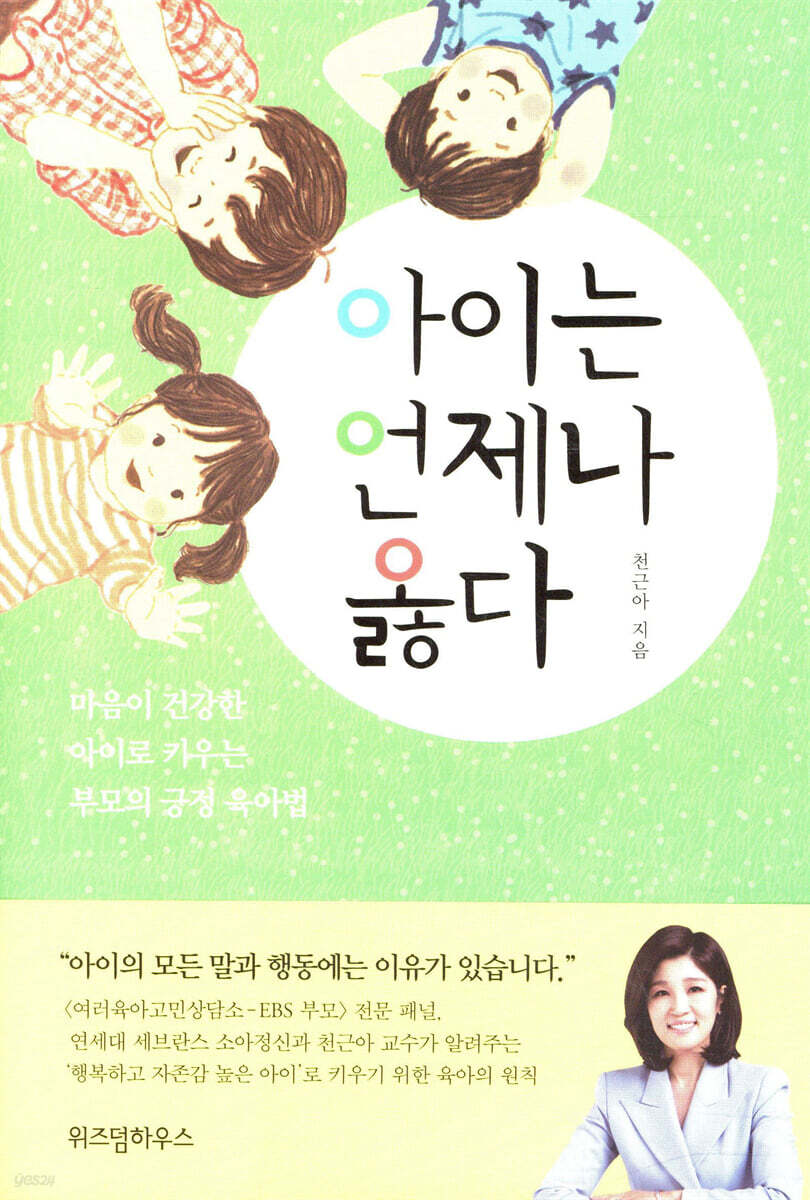
The child is always right
 |
Description
Book Introduction
Professor Chun Geun-ah of the Department of Child Psychiatry at Severance Hospital explains
Three Parenting Principles for Raising Happy, Self-Esteeming Children
A book by Professor Cheon Geun-ah, who has provided consultations to countless children and comforted the hearts of parents as a professional panelist for the "EBS Parents' Counseling Center."
The author provides detailed parenting know-how for raising a child with a healthy mind, and presents specific parenting methods of the three principles of positive parenting: responsiveness, sensitivity, and consistency, to build strong trust with parents, the first interpersonal relationship in a child's life.
Based on my research as a child psychiatrist and my experience as a mother of two, I will provide readers with practical and wise parenting tips.
Three Parenting Principles for Raising Happy, Self-Esteeming Children
A book by Professor Cheon Geun-ah, who has provided consultations to countless children and comforted the hearts of parents as a professional panelist for the "EBS Parents' Counseling Center."
The author provides detailed parenting know-how for raising a child with a healthy mind, and presents specific parenting methods of the three principles of positive parenting: responsiveness, sensitivity, and consistency, to build strong trust with parents, the first interpersonal relationship in a child's life.
Based on my research as a child psychiatrist and my experience as a mother of two, I will provide readers with practical and wise parenting tips.
- You can preview some of the book's contents.
Preview
index
Author's Note: The Signals Children Desperately Send
Part 1.
What children want, what parents want
Parents' reactions change their children's values.
Characteristics of mentally healthy children
Parenting based on innate temperament is important.
How to determine your child's temperament
To raise a child with a big heart
Showing infinite trust in your child
How to Recharge Your Child's Love Battery
Accepting the child's world as it is
Efforts to not tie down the child
When you notice a slight difference
A child doesn't expect anything great.
All I want is for you to be happy
Parents who are both warm and strict
The father's role is very important.
Three Basic Principles of Parenting
Parents' Dos and Don'ts
Part 2.
The First Principle of Positive Parenting: Responsiveness
How to be sensitive and empathetic to your child's signals
Follow your child's own developmental schedule
Accepting yourself as you are
The best way for your child to grow
When should I start sending my child to daycare?
Be sensitive to your child's signals
You are number one to your mom
Fulfilling a child's need for relationships
When your child laughs, laugh along with him.
No worries are pitiful
Please understand my frustration first
When training to wait
Don't panic and stay calm
Why You Should Raise Your Child to Know How to Wait
A message that says 'I understand you'
The difference between discipline and abuse
The first step to communication
How to Be a Pleasant Conversationalist
Take even awkward expressions seriously
Poisonous and medicinal praise
Signs that your child is changing
Children who are good at expressing their emotions are healthy.
Part 3.
The Second Principle of Positive Parenting: Sensitivity
“There is a reason for every child’s behavior.”
There is no such thing as "suddenly one day" in a child's behavior.
Discover your hidden desires
Distinguish between tantrums and anxiety
To avoid missing your child's weak signals
On days when the child's expression is dark
Fill your child's 'story tummy' while eating
Reflect on your own mistakes
An ironic expression of wanting to be loved
What about the child who is angry and won't open the door?
The inner thoughts of a stubborn child
When an older child bullies a younger sibling
You keep calling your child whenever you go out?
Does your child really want a smartphone?
There are other reasons why children become addicted to games.
When disciplining behavior and dress
First, figure out why they lie.
If my child is a perpetrator of school violence
If I have trouble concentrating, could it be attention deficit hyperactivity disorder?
If you can't get along with your peers and are a fourth-dimensional person
If your child repeatedly self-harms
Part 4.
The Third Principle of Positive Parenting: Consistency
“The moment a child realizes that he or she is loved, he or she changes.”
A child whose parents always say they are angry
If you can observe the child objectively
A child who is well loved becomes independent.
The power to get children moving on their own
When negotiating with a child, give them time to think.
The child already knows everything
Skills for Negotiating Wisely with Children
How to teach “no” well
A small way to convey sincerity
Parents should not be the first to become anxious.
You can only change if you know your true self.
Don't feel sorry for the child, even in your heart.
Mistakes are pointed out indirectly rather than directly.
I'll trust you just three times before I nag you.
Rules to follow when scolding a child
Corporal punishment leaves scars on a child's brain.
Childhood trauma has lifelong negative effects.
Strengthening children's resilience
The moment you realize you are loved, things change.
If you want to raise your child to be strong
How to Raise a Child Who Loves Studying
A child who doesn't get motivated to study vs. a child who lacks motivation to study
“Mom, what is your real dream, other than the dream that Dad wants?”
Support your child's dreams
Part 5.
You are a good enough parent
There are no perfect parents or perfect children.
Being a mother is so hard
Accepting the child as he or she is
Children change and evolve on their own.
Parents are people who accept their children's weaknesses.
Help will be gradually reduced, but observation will continue.
We are already good enough parents
Parents need comfort too
Text-based parenting is essential for working parents.
As parents, we must be happy first.
Being someone's mirror
Parents must grow along with their children.
Part 1.
What children want, what parents want
Parents' reactions change their children's values.
Characteristics of mentally healthy children
Parenting based on innate temperament is important.
How to determine your child's temperament
To raise a child with a big heart
Showing infinite trust in your child
How to Recharge Your Child's Love Battery
Accepting the child's world as it is
Efforts to not tie down the child
When you notice a slight difference
A child doesn't expect anything great.
All I want is for you to be happy
Parents who are both warm and strict
The father's role is very important.
Three Basic Principles of Parenting
Parents' Dos and Don'ts
Part 2.
The First Principle of Positive Parenting: Responsiveness
How to be sensitive and empathetic to your child's signals
Follow your child's own developmental schedule
Accepting yourself as you are
The best way for your child to grow
When should I start sending my child to daycare?
Be sensitive to your child's signals
You are number one to your mom
Fulfilling a child's need for relationships
When your child laughs, laugh along with him.
No worries are pitiful
Please understand my frustration first
When training to wait
Don't panic and stay calm
Why You Should Raise Your Child to Know How to Wait
A message that says 'I understand you'
The difference between discipline and abuse
The first step to communication
How to Be a Pleasant Conversationalist
Take even awkward expressions seriously
Poisonous and medicinal praise
Signs that your child is changing
Children who are good at expressing their emotions are healthy.
Part 3.
The Second Principle of Positive Parenting: Sensitivity
“There is a reason for every child’s behavior.”
There is no such thing as "suddenly one day" in a child's behavior.
Discover your hidden desires
Distinguish between tantrums and anxiety
To avoid missing your child's weak signals
On days when the child's expression is dark
Fill your child's 'story tummy' while eating
Reflect on your own mistakes
An ironic expression of wanting to be loved
What about the child who is angry and won't open the door?
The inner thoughts of a stubborn child
When an older child bullies a younger sibling
You keep calling your child whenever you go out?
Does your child really want a smartphone?
There are other reasons why children become addicted to games.
When disciplining behavior and dress
First, figure out why they lie.
If my child is a perpetrator of school violence
If I have trouble concentrating, could it be attention deficit hyperactivity disorder?
If you can't get along with your peers and are a fourth-dimensional person
If your child repeatedly self-harms
Part 4.
The Third Principle of Positive Parenting: Consistency
“The moment a child realizes that he or she is loved, he or she changes.”
A child whose parents always say they are angry
If you can observe the child objectively
A child who is well loved becomes independent.
The power to get children moving on their own
When negotiating with a child, give them time to think.
The child already knows everything
Skills for Negotiating Wisely with Children
How to teach “no” well
A small way to convey sincerity
Parents should not be the first to become anxious.
You can only change if you know your true self.
Don't feel sorry for the child, even in your heart.
Mistakes are pointed out indirectly rather than directly.
I'll trust you just three times before I nag you.
Rules to follow when scolding a child
Corporal punishment leaves scars on a child's brain.
Childhood trauma has lifelong negative effects.
Strengthening children's resilience
The moment you realize you are loved, things change.
If you want to raise your child to be strong
How to Raise a Child Who Loves Studying
A child who doesn't get motivated to study vs. a child who lacks motivation to study
“Mom, what is your real dream, other than the dream that Dad wants?”
Support your child's dreams
Part 5.
You are a good enough parent
There are no perfect parents or perfect children.
Being a mother is so hard
Accepting the child as he or she is
Children change and evolve on their own.
Parents are people who accept their children's weaknesses.
Help will be gradually reduced, but observation will continue.
We are already good enough parents
Parents need comfort too
Text-based parenting is essential for working parents.
As parents, we must be happy first.
Being someone's mirror
Parents must grow along with their children.
Detailed image
.jpg)
Into the book
When a child attacks, it is because he or she is in a corner and has nowhere to run, and is in a state of extreme anxiety.
It is important for parents not to blindly react to their child's anxiety and aggression.
When it comes to aggressive behavior stemming from fear and anxiety, parents should calmly understand and embrace the inner anxiety.
Then the child will quickly calm down and become more relaxed.
If your child is crying and irritable for no particular reason, hug him or her and pat him or her.
--- pp.
57-58
.
Just as small holes are easy to fill, but once a hole grows too big to be easily filled, the same is true for a child's heart.
If parents are quick to notice the slightest cracks and try to fill them in when they appear, they can look forward to seeing their children grow up strong-minded, unshaken by stress, and growing.
--- p.
77
To help your child see you as a good conversationalist, look them in the eye when they talk, listen intently, and ask questions.
This also helps the child's language skills.
Even for toddlers who are not good at speaking in an organized manner, if you respond and ask questions like, “Oh, I see!”, “Aha!”, or “What happened next?”, the child’s desire to express himself/herself will be strengthened, and later, he/she will be able to speak fluently and imaginatively.
--- p.
102
When praising your child, praise their self-restraint and efforts to improve rather than their innate talents.
If a child who is praised for his talent ("You're smart") and a child who is praised for his effort ("You're hard-working") are given a difficult task and an easy task and asked to choose between the two, the child who is praised for his talent will choose the easy task out of fear of failure, while the child who is praised for his effort will boldly take on the difficult task.
How parents praise their children can have such different results.
--- p.
107
Perfect relationship, perfect love, perfect personality, perfect person… … .
Perfection doesn't really exist.
The moment you accept that truth, you feel a little better.
I'm not perfect, and neither can my child.
Don't nag yourself and your child, who you should cherish more than anyone else, about not being perfect.
Don't pressure yourself to be more perfect.
It takes away the peace of mind that allows me and my child to breathe comfortably.
There is nothing more foolish than that.
It is important for parents not to blindly react to their child's anxiety and aggression.
When it comes to aggressive behavior stemming from fear and anxiety, parents should calmly understand and embrace the inner anxiety.
Then the child will quickly calm down and become more relaxed.
If your child is crying and irritable for no particular reason, hug him or her and pat him or her.
--- pp.
57-58
.
Just as small holes are easy to fill, but once a hole grows too big to be easily filled, the same is true for a child's heart.
If parents are quick to notice the slightest cracks and try to fill them in when they appear, they can look forward to seeing their children grow up strong-minded, unshaken by stress, and growing.
--- p.
77
To help your child see you as a good conversationalist, look them in the eye when they talk, listen intently, and ask questions.
This also helps the child's language skills.
Even for toddlers who are not good at speaking in an organized manner, if you respond and ask questions like, “Oh, I see!”, “Aha!”, or “What happened next?”, the child’s desire to express himself/herself will be strengthened, and later, he/she will be able to speak fluently and imaginatively.
--- p.
102
When praising your child, praise their self-restraint and efforts to improve rather than their innate talents.
If a child who is praised for his talent ("You're smart") and a child who is praised for his effort ("You're hard-working") are given a difficult task and an easy task and asked to choose between the two, the child who is praised for his talent will choose the easy task out of fear of failure, while the child who is praised for his effort will boldly take on the difficult task.
How parents praise their children can have such different results.
--- p.
107
Perfect relationship, perfect love, perfect personality, perfect person… … .
Perfection doesn't really exist.
The moment you accept that truth, you feel a little better.
I'm not perfect, and neither can my child.
Don't nag yourself and your child, who you should cherish more than anyone else, about not being perfect.
Don't pressure yourself to be more perfect.
It takes away the peace of mind that allows me and my child to breathe comfortably.
There is nothing more foolish than that.
--- p.
247
247
Publisher's Review
Parents who give faith, children who believe in themselves.
Professor Chun Geun-ah of the Department of Child Psychiatry at Severance Hospital discusses the power of positive parenting.
The revised and expanded edition of 『Children Are Always Right』, written by author Cheon Geun-ah, a child psychiatrist at Yonsei University Severance Hospital and a professional panelist for the EBS Parents Counseling Center, who has treated and counseled countless children and comforted the hearts of parents, has been published by Wisdom House.
First published in 2013, this book has been well-received by many parents for its wise and realistic parenting tips for raising children with healthy minds.
In this new revision of the book, the author not only added theories and cases he has accumulated through research and consultation, but also organized the table of contents more systematically, focusing on the three principles of positive parenting as key keywords.
The author lists 'sensitivity, responsiveness, and consistency' as the three most important principles of positive parenting when raising children.
In order for a child to build stable trust in their parents, they must respond quickly to the child's signals, be sensitive to what the child wants, and treat the child with a consistent attitude that is not swayed by emotions.
Only through a deep trust with parents, the first interpersonal relationship in a child's life, can a child gain confidence in himself and the courage to step out into the world.
“There is a reason for every word and action of a child.”
Look into your child's heart before your child's problem behavior.
There is no such thing as a perfect child, perfect parent, or perfect parenting.
Parents are also human, and as they raise their children, they may experience an explosion of anxiety and anger towards their children.
When a child is stubborn and doesn't keep promises, acts against their wishes, lies, or uses harsh language, parents are left wondering how to deal with their child.
Hitting a child or using physical punishment that instills fear will not only leave an indelible scar on the child's mind, but will also close the door of their heart to their parents.
On the other hand, if parents treat their children without any standards and in a permissive manner, the child will not listen to the parents and will increasingly engage in problematic behavior.
The author of this book says that 'democratic parenting' is important in parenting.
This is different from unconditional acceptance. It involves setting reasonable rules with your child, being tolerant of minor mistakes, but being firm when they cross the line.
Only when this democratic upbringing continues can children not only trust their parents and open their hearts, but also have the courage to grow on their own.
Parents should not bring undue anxiety and worry to their children's problem behaviors or misexpressions.
When dealing with children, it is necessary to have the mindset that 'there is a reason for a child's words and actions' and a firm belief that 'children are always right'.
If you begin communicating with your child based on this respect, your child will grow into a happy and healthy person who knows how to respect not only others but also himself.
Professor Chun Geun-ah of the Department of Child Psychiatry at Severance Hospital discusses the power of positive parenting.
The revised and expanded edition of 『Children Are Always Right』, written by author Cheon Geun-ah, a child psychiatrist at Yonsei University Severance Hospital and a professional panelist for the EBS Parents Counseling Center, who has treated and counseled countless children and comforted the hearts of parents, has been published by Wisdom House.
First published in 2013, this book has been well-received by many parents for its wise and realistic parenting tips for raising children with healthy minds.
In this new revision of the book, the author not only added theories and cases he has accumulated through research and consultation, but also organized the table of contents more systematically, focusing on the three principles of positive parenting as key keywords.
The author lists 'sensitivity, responsiveness, and consistency' as the three most important principles of positive parenting when raising children.
In order for a child to build stable trust in their parents, they must respond quickly to the child's signals, be sensitive to what the child wants, and treat the child with a consistent attitude that is not swayed by emotions.
Only through a deep trust with parents, the first interpersonal relationship in a child's life, can a child gain confidence in himself and the courage to step out into the world.
“There is a reason for every word and action of a child.”
Look into your child's heart before your child's problem behavior.
There is no such thing as a perfect child, perfect parent, or perfect parenting.
Parents are also human, and as they raise their children, they may experience an explosion of anxiety and anger towards their children.
When a child is stubborn and doesn't keep promises, acts against their wishes, lies, or uses harsh language, parents are left wondering how to deal with their child.
Hitting a child or using physical punishment that instills fear will not only leave an indelible scar on the child's mind, but will also close the door of their heart to their parents.
On the other hand, if parents treat their children without any standards and in a permissive manner, the child will not listen to the parents and will increasingly engage in problematic behavior.
The author of this book says that 'democratic parenting' is important in parenting.
This is different from unconditional acceptance. It involves setting reasonable rules with your child, being tolerant of minor mistakes, but being firm when they cross the line.
Only when this democratic upbringing continues can children not only trust their parents and open their hearts, but also have the courage to grow on their own.
Parents should not bring undue anxiety and worry to their children's problem behaviors or misexpressions.
When dealing with children, it is necessary to have the mindset that 'there is a reason for a child's words and actions' and a firm belief that 'children are always right'.
If you begin communicating with your child based on this respect, your child will grow into a happy and healthy person who knows how to respect not only others but also himself.
GOODS SPECIFICS
- Publication date: February 16, 2022
- Page count, weight, size: 272 pages | 390g | 140*200*17mm
- ISBN13: 9791168122307
- ISBN10: 1168122309
You may also like
카테고리
korean


korean

![GQ KOREA Mark (Monthly): December [2025]](http://librairie.coreenne.fr/cdn/shop/files/8ef265dbbfbf186523ed75ba7319009d.jpg?v=1765340328&width=3840)


