

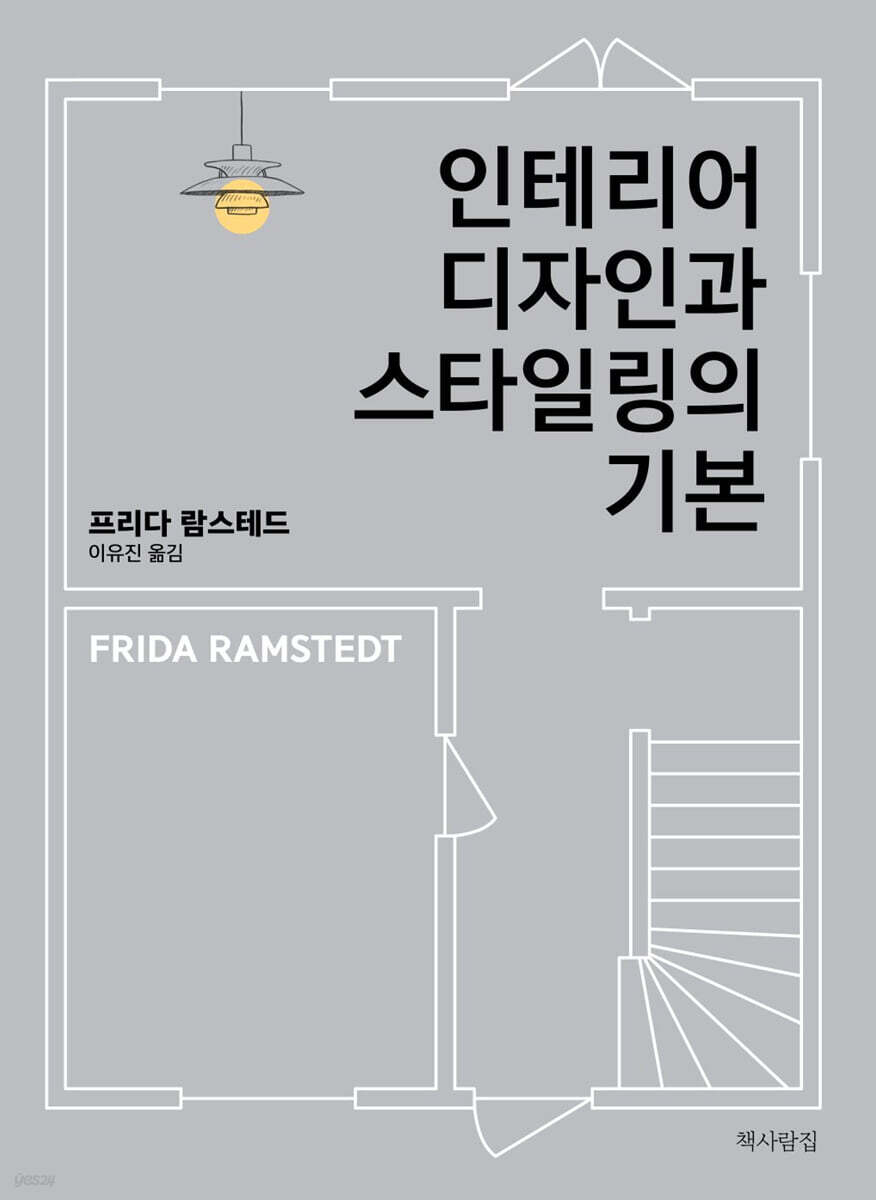
The Basics of Interior Design and Styling
 |
Description
Book Introduction
There's no place better than home!
A comfortable home to learn from Sweden, the country of design.
How to create your own cozy space
Frida Ramstedt, an interior design expert representing Sweden, the country of design, reveals the secrets of a cozy and comfortable space.
It contains everything about space design and home styling that I have learned over 15 years of experience in the field.
Unusually for a practical book, it ranked first on the overall bestseller lists in Sweden, Norway, and Finland, and its copyrights were exported to over 30 countries around the world, including France, the United States, Japan, Spain, the Czech Republic, Portugal, and the Netherlands.
We have compiled not only interior design theories such as space, color scheme, lighting, styling, dimensions, and proportions, but also know-how utilized by experts in the field.
It also provides detailed information on the design of each space, including the entrance, bathroom, kitchen, living room, bedroom, study and study room, and multipurpose room.
It won the ELLE DECO Design Award and the Swedish daily newspaper [Aftonbladet] Big Blog Award.
It is by far the most talked-about interior design book published worldwide recently.
A comfortable home to learn from Sweden, the country of design.
How to create your own cozy space
Frida Ramstedt, an interior design expert representing Sweden, the country of design, reveals the secrets of a cozy and comfortable space.
It contains everything about space design and home styling that I have learned over 15 years of experience in the field.
Unusually for a practical book, it ranked first on the overall bestseller lists in Sweden, Norway, and Finland, and its copyrights were exported to over 30 countries around the world, including France, the United States, Japan, Spain, the Czech Republic, Portugal, and the Netherlands.
We have compiled not only interior design theories such as space, color scheme, lighting, styling, dimensions, and proportions, but also know-how utilized by experts in the field.
It also provides detailed information on the design of each space, including the entrance, bathroom, kitchen, living room, bedroom, study and study room, and multipurpose room.
It won the ELLE DECO Design Award and the Swedish daily newspaper [Aftonbladet] Big Blog Award.
It is by far the most talked-about interior design book published worldwide recently.
- You can preview some of the book's contents.
Preview
index
prolog.
For those who value home above all else
Chapter 1.
Is your home cozy and comfortable?
Who am I at home and what do I do? / Shy or sensitive / How to find what you want / A few questions
Chapter 2.
Principles and laws
Design Mathematics / Focus / The Magic of Lines / Visual Weight / Anchoring Points / Fixing / The Rule of Odd Numbers / Contrast and Juxtaposition / The Feel of Texture and Surface / Symmetry / Wabi-Sabi of Asymmetry and Imbalance / Variations in Size and Proportion / Planned Margins / Consideration of Circular Movement / Isovist / The Principle of 2:8 Storage / Direction
Chapter 3.
A thinking tool for harmony
Gaze and Consecration / Red Thread / Don't Overlook the House's History! / Mixed Styles / Visual Noise / Camera Tricks
Chapter 4.
Color combination
The Challenge of Color / The Basics of Color / What is Color Scheme? / Palette / Encyclopedia of Inspiration and Nature in Art / 60:30:10+B/W Formula / Basic Color Scheme for White or Gray Interior Design / Pitfalls of Color Codes / Choosing Gloss / Conditional Colors / Choosing White / Wallpaper
Chapter 5.
lighting
No light, no comfort! / The 5-7 rule / Disturbing shadows / Indirect or diffused light / Conditions for glare-free lighting / Room and hallway lighting / Variations in height / Natural light / Analysis of color and light / Lighting tricks
Chapter 6.
Styling
Professional finishing touches / Placing props / The right place for still life / Hanging picture frames / Window interior design / Curtains / Window styling by space / Window and plant interior design / Solving noise problems / Tips for overcoming space limitations / Bookcase styling / Sofa and sofa table / Bed styling know-how / The secret to a tidy bed / Plant interior design / Rugs, mats, carpets / How to make the most of rugs / Vases / View blockers / Hiding televisions, speakers, and wires / Kitchen and bathroom upgrades / Interior design with children / Things new parents should know
Chapter 7.
Advice for buying
Fit and comfort / Classic perspective / Design that moves with life / Purchase priorities
Chapter 8.
Dimensions and proportions
Ergonomics for the Home / Paper House Play / Entryway / Bathroom / Kitchen / Dining Table and Dining Room / Living Room / Bedroom / Study and Workroom / Multipurpose Room
Chapter 9.
Planning an Interior Design Project
What is a Mood Board? / How to Create a Mood Board
Epilogue
References
Note
For those who value home above all else
Chapter 1.
Is your home cozy and comfortable?
Who am I at home and what do I do? / Shy or sensitive / How to find what you want / A few questions
Chapter 2.
Principles and laws
Design Mathematics / Focus / The Magic of Lines / Visual Weight / Anchoring Points / Fixing / The Rule of Odd Numbers / Contrast and Juxtaposition / The Feel of Texture and Surface / Symmetry / Wabi-Sabi of Asymmetry and Imbalance / Variations in Size and Proportion / Planned Margins / Consideration of Circular Movement / Isovist / The Principle of 2:8 Storage / Direction
Chapter 3.
A thinking tool for harmony
Gaze and Consecration / Red Thread / Don't Overlook the House's History! / Mixed Styles / Visual Noise / Camera Tricks
Chapter 4.
Color combination
The Challenge of Color / The Basics of Color / What is Color Scheme? / Palette / Encyclopedia of Inspiration and Nature in Art / 60:30:10+B/W Formula / Basic Color Scheme for White or Gray Interior Design / Pitfalls of Color Codes / Choosing Gloss / Conditional Colors / Choosing White / Wallpaper
Chapter 5.
lighting
No light, no comfort! / The 5-7 rule / Disturbing shadows / Indirect or diffused light / Conditions for glare-free lighting / Room and hallway lighting / Variations in height / Natural light / Analysis of color and light / Lighting tricks
Chapter 6.
Styling
Professional finishing touches / Placing props / The right place for still life / Hanging picture frames / Window interior design / Curtains / Window styling by space / Window and plant interior design / Solving noise problems / Tips for overcoming space limitations / Bookcase styling / Sofa and sofa table / Bed styling know-how / The secret to a tidy bed / Plant interior design / Rugs, mats, carpets / How to make the most of rugs / Vases / View blockers / Hiding televisions, speakers, and wires / Kitchen and bathroom upgrades / Interior design with children / Things new parents should know
Chapter 7.
Advice for buying
Fit and comfort / Classic perspective / Design that moves with life / Purchase priorities
Chapter 8.
Dimensions and proportions
Ergonomics for the Home / Paper House Play / Entryway / Bathroom / Kitchen / Dining Table and Dining Room / Living Room / Bedroom / Study and Workroom / Multipurpose Room
Chapter 9.
Planning an Interior Design Project
What is a Mood Board? / How to Create a Mood Board
Epilogue
References
Note
Detailed image

Into the book
When I moved from an old apartment to a newly built terraced house a few years ago, I was faced with just about every interior design problem that could arise in a space that was tidy but devoid of charm.
Although I worked as an interior design professional and had success in styling for famous companies, designing my own space to embrace my life was more difficult than I thought.
Experiencing countless frustrating moments that drained me of energy gave me a new perspective and way of thinking about interior design.
What makes an interior feel cozy, harmonious, and meticulously planned? What secrets lie within a comfortable "home" that warms our souls? I jot down ideas that come to mind in a notebook and captioned the cover "The Fundamentals of Interior Design and Styling."
This note was strictly for the common man.
It was not suitable for industry colleagues or other experts.
Since I started taking notes, I've been able to delve deeper into how professionals navigate the countless and challenging situations they face.
And interior designers and stylists have transformed the 'intuition' and 'insight' they have gained through experience and learning into specific and clear principles and guidelines, expressed in language that everyone can understand.
I hope you'll use this book when you find yourself stuck in your thoughts, thinking, "What should I do?" or when you find yourself searching for a better solution, thinking, "There must be a better way."
The many examples, experiences, and recommendations I'll share from now on will help you go beyond your tastes and preferences.
--- From the "Prologue"
While many tasks in the realm of interior design and styling ultimately aim to create balance, when it comes to 'decoration', it's a different story.
In the world of decoration, odd numbers are usually more interesting.
Some argue that it is due to the brain's desire to pair things up.
Our brains tend to erase the remaining items if they are not of the same number.
And some people say that when three objects are placed together, a natural center is created between the two objects, and that this center is more eye-catching.
Regardless of what is right, odd-numbered layouts are a very common practice among interior designers.
This principle has many applications in photography and architecture.
It can be applied to all problems, from 'how to place furniture' to 'how to assemble props'.
This principle, called the 'Rule of Three', essentially means avoiding even numbers.
So, if you arrange the items in groups of 3, 5, and 7, the composition will become more interesting.
--- From "Odd Rule"
In addition to the number of lighting spots, the appropriate height for diffused and indirect lighting, and functional lighting, interior designers have one more thing to consider.
This is to create a difference in lighting height, so that not all lighting points in the room are placed at the same height.
In a typical home, all lighting except ceiling lights are generally at roughly the same height.
But what makes a home special is that it uses spotlights that can be raised or lowered, and the light can be adjusted up and down.
Point lighting in dark corners can also make a room appear larger than it actually is.
If you don't feel like your home is welcoming when you enter, I'd suggest changing the lighting before anything else.
As mentioned earlier, lighting is a subject that amateurs neglect the most and professionals utilize the most dramatically.
I want you to quickly scan the space you're in, whether it's a room or a living room, to see if there's any light at any height (high, low, or in the middle).
Maybe there are just ceiling lights and table lights.
Here are some examples of lights that can be placed at different heights:
--- From "Variations in Height"
How high should a picture frame be hung? American interior designers and stylists often use the rule of thumb of "57 inches to the center" when hanging frames.
If you hang the frame so that the center of the motif is 145 centimeters above the floor, it will be displayed to the viewer without distortion.
Of course, in rooms with particularly high ceilings or walls in front of sofas with very low backs, the height may be different.
However, it is a great dimension when you need to find the optimal height to hang a picture frame in a regular space.
Let's remember.
145 centimeters!
--- From "Hanging a Frame"
Interior design is fun and exciting, but it can also be challenging.
I've explained the unspoken agreements and principles of interior design in simple terms that anyone can understand.
And added objective numbers to it.
It encompasses laws derived from long experience, the latest theories in architecture and design, and consensus recognized by experts.
We also tried to incorporate ergonomic knowledge.
Interior design is important not only for it to look good, but it must also be comfortable and functional.
You don't have to follow every suggestion in this book.
I just hope I can help you feel a little better at home.
There is no place better than home.
Although I worked as an interior design professional and had success in styling for famous companies, designing my own space to embrace my life was more difficult than I thought.
Experiencing countless frustrating moments that drained me of energy gave me a new perspective and way of thinking about interior design.
What makes an interior feel cozy, harmonious, and meticulously planned? What secrets lie within a comfortable "home" that warms our souls? I jot down ideas that come to mind in a notebook and captioned the cover "The Fundamentals of Interior Design and Styling."
This note was strictly for the common man.
It was not suitable for industry colleagues or other experts.
Since I started taking notes, I've been able to delve deeper into how professionals navigate the countless and challenging situations they face.
And interior designers and stylists have transformed the 'intuition' and 'insight' they have gained through experience and learning into specific and clear principles and guidelines, expressed in language that everyone can understand.
I hope you'll use this book when you find yourself stuck in your thoughts, thinking, "What should I do?" or when you find yourself searching for a better solution, thinking, "There must be a better way."
The many examples, experiences, and recommendations I'll share from now on will help you go beyond your tastes and preferences.
--- From the "Prologue"
While many tasks in the realm of interior design and styling ultimately aim to create balance, when it comes to 'decoration', it's a different story.
In the world of decoration, odd numbers are usually more interesting.
Some argue that it is due to the brain's desire to pair things up.
Our brains tend to erase the remaining items if they are not of the same number.
And some people say that when three objects are placed together, a natural center is created between the two objects, and that this center is more eye-catching.
Regardless of what is right, odd-numbered layouts are a very common practice among interior designers.
This principle has many applications in photography and architecture.
It can be applied to all problems, from 'how to place furniture' to 'how to assemble props'.
This principle, called the 'Rule of Three', essentially means avoiding even numbers.
So, if you arrange the items in groups of 3, 5, and 7, the composition will become more interesting.
--- From "Odd Rule"
In addition to the number of lighting spots, the appropriate height for diffused and indirect lighting, and functional lighting, interior designers have one more thing to consider.
This is to create a difference in lighting height, so that not all lighting points in the room are placed at the same height.
In a typical home, all lighting except ceiling lights are generally at roughly the same height.
But what makes a home special is that it uses spotlights that can be raised or lowered, and the light can be adjusted up and down.
Point lighting in dark corners can also make a room appear larger than it actually is.
If you don't feel like your home is welcoming when you enter, I'd suggest changing the lighting before anything else.
As mentioned earlier, lighting is a subject that amateurs neglect the most and professionals utilize the most dramatically.
I want you to quickly scan the space you're in, whether it's a room or a living room, to see if there's any light at any height (high, low, or in the middle).
Maybe there are just ceiling lights and table lights.
Here are some examples of lights that can be placed at different heights:
--- From "Variations in Height"
How high should a picture frame be hung? American interior designers and stylists often use the rule of thumb of "57 inches to the center" when hanging frames.
If you hang the frame so that the center of the motif is 145 centimeters above the floor, it will be displayed to the viewer without distortion.
Of course, in rooms with particularly high ceilings or walls in front of sofas with very low backs, the height may be different.
However, it is a great dimension when you need to find the optimal height to hang a picture frame in a regular space.
Let's remember.
145 centimeters!
--- From "Hanging a Frame"
Interior design is fun and exciting, but it can also be challenging.
I've explained the unspoken agreements and principles of interior design in simple terms that anyone can understand.
And added objective numbers to it.
It encompasses laws derived from long experience, the latest theories in architecture and design, and consensus recognized by experts.
We also tried to incorporate ergonomic knowledge.
Interior design is important not only for it to look good, but it must also be comfortable and functional.
You don't have to follow every suggestion in this book.
I just hope I can help you feel a little better at home.
There is no place better than home.
--- From "Epilogue"
Publisher's Review
A comfortable home to learn from Sweden, the country of design.
How to create your own cozy space
A bestseller by Frida Ramsted, an interior design expert representing Sweden, the country of design.
We have compiled not only the theories and principles of interior design, including space, color scheme, lighting, styling, dimensions, and proportions, but also the know-how and empirical rules used by experts in the field.
From the simple steps of how to caress sofa cushions to the secrets of furniture arrangement and color combinations, we introduce ways to create a comfortable and cozy space that transcends the shape and size of the space.
It's not enough to just look good!
Interior Design = Understanding Space + Understanding Your Lifestyle
Frida Ramstedt first emphasizes that “interior design = understanding of space + understanding of one’s own lifestyle.”
A house that looks good is not necessarily a comfortable house.
So the book also contains detailed ergonomic knowledge.
It is important for a home to look nice, but above all, it must be comfortable and functional.
And it will first guide you on how to find the interior style you want.
Because no one can tell me what I like.
We will even provide you with detailed tips on how to fill your home with furniture and accessories that will satisfy you for a long time.
A bestseller that swept the world beyond Northern Europe
By far the most talked-about interior design book published worldwide recently.
Unusually for a practical book, it ranked first on the overall bestseller lists in Sweden, Norway, and Finland, and its copyrights were exported to over 30 countries around the world, including France, the United States, Japan, Spain, the Czech Republic, Portugal, and the Netherlands.
It ranked first in the practical and interior design categories on Amazon UK and Amazon Germany, and was a bestseller across Europe, including in France, Italy, Spain, Russia, and the Czech Republic.
It has received praise from readers, including “The best book on interior design,” “An easy-to-read and useful guide,” and “Incredibly detailed!”
It has also been a huge hit in the United States and Canada, and will soon be published in Japan and China.
It is by far the most talked-about interior design book published worldwide recently.
Home: Where I Can Be Myself
Beyond copying other people's interior designs
A guide for readers who want to decorate their own space.
Frida Ramstedt emphasizes that understanding one's own lifestyle, along with an understanding of space, is essential for interior design, and kindly teaches how to discover one's own tastes and visualize them.
This book will help you create a balanced and comfortable home, no matter where you live or what style you prefer.
If you want to learn more about design and want to go beyond copying other people's interior designs and create your own space, this is a book worth reading.
We present the secrets to building the home you want without spending a lot of money or time.
How to create your own cozy space
A bestseller by Frida Ramsted, an interior design expert representing Sweden, the country of design.
We have compiled not only the theories and principles of interior design, including space, color scheme, lighting, styling, dimensions, and proportions, but also the know-how and empirical rules used by experts in the field.
From the simple steps of how to caress sofa cushions to the secrets of furniture arrangement and color combinations, we introduce ways to create a comfortable and cozy space that transcends the shape and size of the space.
It's not enough to just look good!
Interior Design = Understanding Space + Understanding Your Lifestyle
Frida Ramstedt first emphasizes that “interior design = understanding of space + understanding of one’s own lifestyle.”
A house that looks good is not necessarily a comfortable house.
So the book also contains detailed ergonomic knowledge.
It is important for a home to look nice, but above all, it must be comfortable and functional.
And it will first guide you on how to find the interior style you want.
Because no one can tell me what I like.
We will even provide you with detailed tips on how to fill your home with furniture and accessories that will satisfy you for a long time.
A bestseller that swept the world beyond Northern Europe
By far the most talked-about interior design book published worldwide recently.
Unusually for a practical book, it ranked first on the overall bestseller lists in Sweden, Norway, and Finland, and its copyrights were exported to over 30 countries around the world, including France, the United States, Japan, Spain, the Czech Republic, Portugal, and the Netherlands.
It ranked first in the practical and interior design categories on Amazon UK and Amazon Germany, and was a bestseller across Europe, including in France, Italy, Spain, Russia, and the Czech Republic.
It has received praise from readers, including “The best book on interior design,” “An easy-to-read and useful guide,” and “Incredibly detailed!”
It has also been a huge hit in the United States and Canada, and will soon be published in Japan and China.
It is by far the most talked-about interior design book published worldwide recently.
Home: Where I Can Be Myself
Beyond copying other people's interior designs
A guide for readers who want to decorate their own space.
Frida Ramstedt emphasizes that understanding one's own lifestyle, along with an understanding of space, is essential for interior design, and kindly teaches how to discover one's own tastes and visualize them.
This book will help you create a balanced and comfortable home, no matter where you live or what style you prefer.
If you want to learn more about design and want to go beyond copying other people's interior designs and create your own space, this is a book worth reading.
We present the secrets to building the home you want without spending a lot of money or time.
GOODS SPECIFICS
- Date of issue: April 5, 2021
- Page count, weight, size: 300 pages | 444g | 152*210*19mm
- ISBN13: 9791197329500
- ISBN10: 1197329501
You may also like
카테고리
korean


korean

![GQ KOREA Mark (Monthly): December [2025]](http://librairie.coreenne.fr/cdn/shop/files/8ef265dbbfbf186523ed75ba7319009d.jpg?v=1765340328&width=3840)


