

I was angry at you again today
 |
Description
Book Introduction
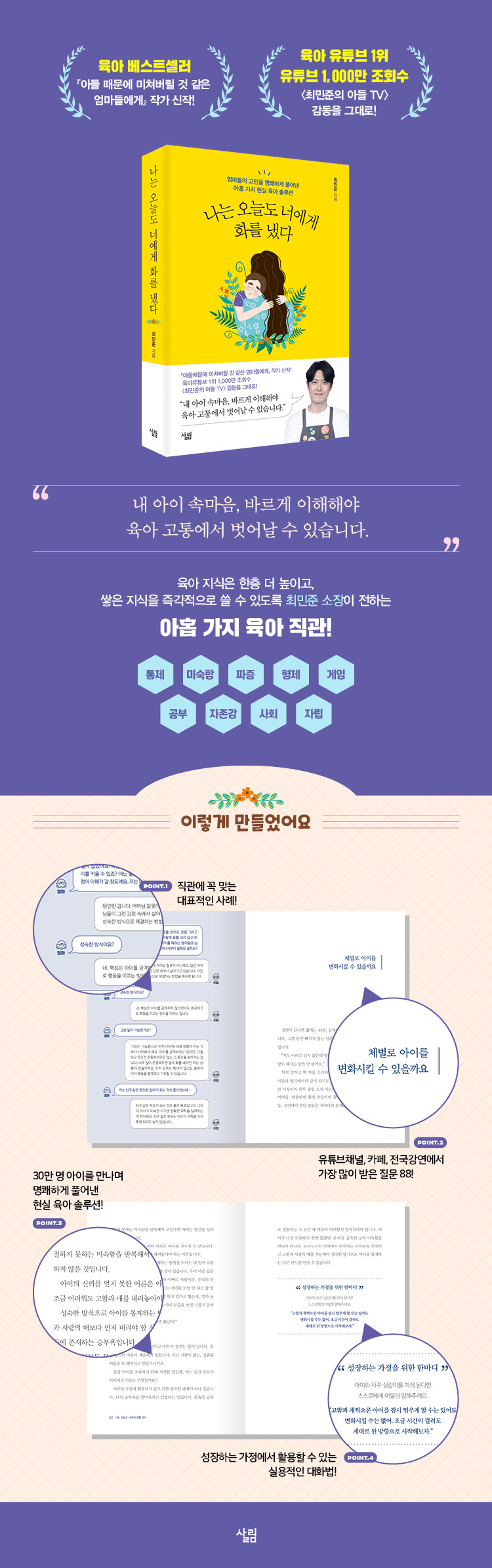
The essence of parenting learned while working with 300,000 children nationwide. “Only by correctly understanding your child’s inner feelings can you escape the pain of parenting.” "I Got Angry at You Today, Too" is the follow-up work of Choi Min-jun, the author of the best-selling book "To Mothers Who Feel Like They're Going Crazy Because of Their Sons" and director of the Son Research Institute, which provides emotional understanding and knowledge about sons. This book helps develop practical parenting intuition by collecting common concerns of 300,000 mothers across the country. It is designed to cultivate intuition in nine areas and also contains wise conversation techniques essential for children and all growing adults. |
- You can preview some of the book's contents.
Preview
index
To adults who expect change in their children through love and respect alone
Chapter 1: Control
“Without attacking the child
“You have to be able to control it.”
Can corporal punishment change a child?
Even if you respect him, he just causes trouble.
They're provoking me with a louder voice outside.
The more you discipline your child, the more he or she will lash out.
It's so hard to break a child's expectations.
He swears and curses at his mom.
My child is sensitive and doesn't let even small things go unnoticed.
Can I subdue a child with force?
I think there's something wrong with my discipline method.
The child is picking a fight by nitpicking.
Chapter 2: Immaturity
“Many of the problems children face are
“Time heals all wounds.”
Every morning I go crazy because of my child.
I wish my son would just stay still for five minutes.
My child keeps biting other children.
I want to fix my child's problem behavior right away.
What should I do if my child is giving me wrong information?
If I read a book, will my child read a book too?
I keep blaming myself when I see my child.
I'm afraid my depression will ruin my child.
I'm so afraid of new places
My child is too honest.
Chapter 3_Annoyance
“Don’t get involved with the child.”
I feel like I'm going crazy every time my child gets upset.
Why won't my child listen to me?
I feel like I'm getting caught up in my child's tantrums too much.
My son only gets absurdly annoyed with me.
When does a mother start to distance herself from her son?
Ignore what mom says and only listen to dad.
Is it too late to establish authority?
It's hard to refuse a child's request.
My child's boredom is unmanageable.
There's so much to teach, but I can't keep up with even one thing.
The child doesn't know what he did wrong.
Chapter 4: Brothers
“Control the environment, not the child.”
The eldest child hates his younger sibling.
Should we discriminate between older and younger siblings?
Without realizing it, I keep loving the second child more.
How can I appease the eldest child who is harassing the second child?
Brothers often fight over who gets more.
I just copy what my brother says.
When brothers fight, is it okay to take one side?
Chapter 5_Game
“Please tell me the real reason why I got addicted to the game.”
I hope my child doesn't play games.
He keeps lying to play games.
I fight with my child every day because of games.
Are there any symptoms before becoming addicted to gaming?
Is there a way to communicate with a child who is addicted to games?
Is there a reason why boys are more prone to addiction to games?
Chapter 6_Study
“Tell me about growth, not grades.”
My child promises to improve his grades but doesn't act on it.
I believe I can change my child.
My son, you are at peace, don't feel anxious.
My son keeps bragging.
My child is threatening to do something that is not suitable for him/her.
Just say you can't do anything new.
My child wants to trade grades.
They demand compensation without even trying
I really resent that my efforts aren't recognized.
Even though I taught him, he insists he didn't learn.
I want to let you know that studying is fun.
My son has no motivation to study.
Chapter 7: Self-Esteem
“Children’s problems start with self-esteem.”
Does my child have a self-esteem problem?
Whenever there's a problem, I blame others.
The child has no passion
I just watch games and videos
The child does not follow the lead.
I'm not satisfied with the lifestyles of my three sons.
I want to know the secret to boosting my son's self-esteem.
The child wants to be noticed.
Is there really one thing you should be good at?
Chapter 8_Society
“Rather than teaching, we need someone who understands our hearts.”
My son seems to be having a particularly hard time adjusting to school life.
I'm thinking about alternative schools because I keep getting criticized by my teacher.
I think my child lacks social skills.
My son asks weird questions every class.
My child laughs too often and loudly to get attention.
The child rebels against the teacher.
Other people say bad things about our child.
The child started lying.
I'm bothered by my child's shortcomings and the stares people have.
Should I always be prepared for ADHD?
I want to give courage to my child who is being bullied.
My child comes in hit every time
Can I interfere with my child's friendships?
Do you want your child to be involved in their friends' problems?
Should I force my introverted son to participate in peer activities?
Chapter 9_Self-reliance
“Ultimately, the goal of education is self-reliance.”
I want to change my slow son.
When should you give your child a choice?
People misunderstand that I am suppressing my child.
My child wants to become a YouTuber. Should I support him?
Wisdom is needed to survive puberty.
My husband passed away, and I'm worried about my child.
Conclusion _ To you who yelled at your child again today
Chapter 1: Control
“Without attacking the child
“You have to be able to control it.”
Can corporal punishment change a child?
Even if you respect him, he just causes trouble.
They're provoking me with a louder voice outside.
The more you discipline your child, the more he or she will lash out.
It's so hard to break a child's expectations.
He swears and curses at his mom.
My child is sensitive and doesn't let even small things go unnoticed.
Can I subdue a child with force?
I think there's something wrong with my discipline method.
The child is picking a fight by nitpicking.
Chapter 2: Immaturity
“Many of the problems children face are
“Time heals all wounds.”
Every morning I go crazy because of my child.
I wish my son would just stay still for five minutes.
My child keeps biting other children.
I want to fix my child's problem behavior right away.
What should I do if my child is giving me wrong information?
If I read a book, will my child read a book too?
I keep blaming myself when I see my child.
I'm afraid my depression will ruin my child.
I'm so afraid of new places
My child is too honest.
Chapter 3_Annoyance
“Don’t get involved with the child.”
I feel like I'm going crazy every time my child gets upset.
Why won't my child listen to me?
I feel like I'm getting caught up in my child's tantrums too much.
My son only gets absurdly annoyed with me.
When does a mother start to distance herself from her son?
Ignore what mom says and only listen to dad.
Is it too late to establish authority?
It's hard to refuse a child's request.
My child's boredom is unmanageable.
There's so much to teach, but I can't keep up with even one thing.
The child doesn't know what he did wrong.
Chapter 4: Brothers
“Control the environment, not the child.”
The eldest child hates his younger sibling.
Should we discriminate between older and younger siblings?
Without realizing it, I keep loving the second child more.
How can I appease the eldest child who is harassing the second child?
Brothers often fight over who gets more.
I just copy what my brother says.
When brothers fight, is it okay to take one side?
Chapter 5_Game
“Please tell me the real reason why I got addicted to the game.”
I hope my child doesn't play games.
He keeps lying to play games.
I fight with my child every day because of games.
Are there any symptoms before becoming addicted to gaming?
Is there a way to communicate with a child who is addicted to games?
Is there a reason why boys are more prone to addiction to games?
Chapter 6_Study
“Tell me about growth, not grades.”
My child promises to improve his grades but doesn't act on it.
I believe I can change my child.
My son, you are at peace, don't feel anxious.
My son keeps bragging.
My child is threatening to do something that is not suitable for him/her.
Just say you can't do anything new.
My child wants to trade grades.
They demand compensation without even trying
I really resent that my efforts aren't recognized.
Even though I taught him, he insists he didn't learn.
I want to let you know that studying is fun.
My son has no motivation to study.
Chapter 7: Self-Esteem
“Children’s problems start with self-esteem.”
Does my child have a self-esteem problem?
Whenever there's a problem, I blame others.
The child has no passion
I just watch games and videos
The child does not follow the lead.
I'm not satisfied with the lifestyles of my three sons.
I want to know the secret to boosting my son's self-esteem.
The child wants to be noticed.
Is there really one thing you should be good at?
Chapter 8_Society
“Rather than teaching, we need someone who understands our hearts.”
My son seems to be having a particularly hard time adjusting to school life.
I'm thinking about alternative schools because I keep getting criticized by my teacher.
I think my child lacks social skills.
My son asks weird questions every class.
My child laughs too often and loudly to get attention.
The child rebels against the teacher.
Other people say bad things about our child.
The child started lying.
I'm bothered by my child's shortcomings and the stares people have.
Should I always be prepared for ADHD?
I want to give courage to my child who is being bullied.
My child comes in hit every time
Can I interfere with my child's friendships?
Do you want your child to be involved in their friends' problems?
Should I force my introverted son to participate in peer activities?
Chapter 9_Self-reliance
“Ultimately, the goal of education is self-reliance.”
I want to change my slow son.
When should you give your child a choice?
People misunderstand that I am suppressing my child.
My child wants to become a YouTuber. Should I support him?
Wisdom is needed to survive puberty.
My husband passed away, and I'm worried about my child.
Conclusion _ To you who yelled at your child again today
Detailed image
Into the book
Children constantly try to test the boundaries of what is acceptable for their behavior, and they engage in risky provocations.
If you give the message of love in a situation where you need to teach the line, the child may grow up without knowing what he or she really needs to learn.
This book is based on field research that we conducted to find out what we were missing.
If you've ever felt that simply accepting your child as they are isn't enough, you've come to the right place with this book.
---From “Entering_ To adults who expect change in children with only love and respect”
When it comes to learning how to discipline your child in a mature way, there are things you must first let go of before yelling and loving spanking.
It is the competitive spirit that exists deep in our hearts.
Mom and Dad are human too, and when we see our children exhibiting behavioral problems that test our patience, we know we shouldn't, but we still feel a competitive spirit.
When I see a child deliberately doing something one more time while looking into his mother's eyes even though I clearly told him not to, I feel determined to make him give in.
“Choi Minjun, stop it! Mom is so angry!”
“I don’t like it! I’m angry too!”
“Come here!”
The match ends with a smash to the child's back.
It's over, but I still feel uneasy.
Because we ended up having another mud fight where no one won.
---From "Can corporal punishment change a child?"
There are things you need to say, like “No” or “That’s not right.” Even if it’s not what your child wants to hear right now, there are things you need to say.
This is what we tell our children so they don't feel unnecessary emotions.
“It’s time to go to bed now.”
“Even if you want to do it now, you have to hold back.”
Adults who feel burdened by this statement say:
“How long are you going to stay up all night?”
“Why aren’t you sleeping and making things difficult for your mom?”
It is important to remember that discipline is not a process of appealing to my emotions and struggles.
Also, the first rule of good discipline is to not let the child feel unnecessary emotions in that situation.
---From "Even if you respect me, I just cause trouble"
Failure is a learning process after three times, and the process of listening to the mother and adapting after three times is enough time for the child to become accustomed to it.
Even if it seems artificial at first, after those three times, the mood between mother and child will have changed.
The key is to create an atmosphere where you feel like you absolutely have to listen to your mother.
---From "I swear and curse at my mom"
So, please be sure to tell your child in advance.
Giving notice is an important respectful discipline technique that simultaneously relieves feelings of injustice and anxiety.
If you give the message of love in a situation where you need to teach the line, the child may grow up without knowing what he or she really needs to learn.
This book is based on field research that we conducted to find out what we were missing.
If you've ever felt that simply accepting your child as they are isn't enough, you've come to the right place with this book.
---From “Entering_ To adults who expect change in children with only love and respect”
When it comes to learning how to discipline your child in a mature way, there are things you must first let go of before yelling and loving spanking.
It is the competitive spirit that exists deep in our hearts.
Mom and Dad are human too, and when we see our children exhibiting behavioral problems that test our patience, we know we shouldn't, but we still feel a competitive spirit.
When I see a child deliberately doing something one more time while looking into his mother's eyes even though I clearly told him not to, I feel determined to make him give in.
“Choi Minjun, stop it! Mom is so angry!”
“I don’t like it! I’m angry too!”
“Come here!”
The match ends with a smash to the child's back.
It's over, but I still feel uneasy.
Because we ended up having another mud fight where no one won.
---From "Can corporal punishment change a child?"
There are things you need to say, like “No” or “That’s not right.” Even if it’s not what your child wants to hear right now, there are things you need to say.
This is what we tell our children so they don't feel unnecessary emotions.
“It’s time to go to bed now.”
“Even if you want to do it now, you have to hold back.”
Adults who feel burdened by this statement say:
“How long are you going to stay up all night?”
“Why aren’t you sleeping and making things difficult for your mom?”
It is important to remember that discipline is not a process of appealing to my emotions and struggles.
Also, the first rule of good discipline is to not let the child feel unnecessary emotions in that situation.
---From "Even if you respect me, I just cause trouble"
Failure is a learning process after three times, and the process of listening to the mother and adapting after three times is enough time for the child to become accustomed to it.
Even if it seems artificial at first, after those three times, the mood between mother and child will have changed.
The key is to create an atmosphere where you feel like you absolutely have to listen to your mother.
---From "I swear and curse at my mom"
So, please be sure to tell your child in advance.
Giving notice is an important respectful discipline technique that simultaneously relieves feelings of injustice and anxiety.
---From "My child is so sensitive that he doesn't just let small things go"
Publisher's Review
We already have enough knowledge about parenting.
Now it's time to develop the intuition that connects reality and knowledge!
Parenting is a constant test of your patience.
This is why parents grow together as their children grow.
Parents are troubled by the countless conflicts they face with their children today.
'Why is he acting like this?' Focus on quickly assessing the situation and handling it.
When there is a conflict with a child, parents get angry and try to unilaterally control the child during the process of resolution, which focuses on the result rather than the cause.
The results are disastrous.
Parents' hearts are filled with guilt and self-reproach.
The situation is no different for first-time parents and those who have already raised children.
Even if you absorb all sorts of parenting information, it's nearly impossible to find a parenting method that fits your lifestyle perfectly. From the age of four, when children begin to assert themselves, to their teenage years, are the parenting challenges that parents and children face truly insurmountable?
The desire to raise a child with only love and respect is slowly fading away, and the dream of becoming a parent who is like a friend must remain a dream.
To address these concerns, Director Choi Min-jun published “I Was Angry at You Today, Too.”
This book contains the overlapping counseling content from the time spent with 300,000 children across the country and the concerns of mothers I met at lectures across the country since the establishment of Jarada.
The goal of this book is to develop the intuition to effectively connect parenting knowledge to reality.
Director Choi Min-jun says this.
“A very effective element in education is the intuition to recognize when a child needs to be respected.
If you've studied a lot about children and still find parenting difficult, you need to have a keen sense of when to restrain your child's behavior and how to control it without negative consequences."
The nine intuitions for realistic parenting contained in this book are 'control, immaturity, irritation, siblings, games, study, self-esteem, society, and independence.'
It contains the author's sincere and earnest wish that all adults in the world who work with children will grow up with a healthy mind without wandering or blaming themselves.
It also includes the teaching methods of author Minjun Choi and Jaradanam Art Research Institute, making it a strong supporter for parents who want to grow with their children.
#1 parenting YouTube channel, 10 million views
The key to practicality and emotion in [Choi Min-jun's Son TV]!
The focus is on developing a sense of when to best utilize the parenting knowledge of "I got angry at you again today."
This book presents a more practical alternative to readers who have developed the wisdom to accept their children's tendencies through the previous work, "To Mothers Who Are Going Crazy Because of Their Sons."
For subscribers to “Choi Min-jun’s Son TV,” the number one parenting YouTube channel, it serves as a key guide that helps connect parenting knowledge and intuition.
Chapter 1: Control teaches you how to effectively control your child without emotionally or physically attacking him.
Chapter 2, Immaturity, deals with the problems children face.
By addressing parenting issues that can be unsettling for parents but naturally resolve as children grow, you will learn about the types of conflicts with children that arise from adult perspectives and prejudices, and how to resolve them.
In Chapter 3, “Irritation,” we develop the wisdom to not be emotionally swayed by our children’s irritation.
We reflect on what it is we as adults must show our children through realistic advice that will help build their parental authority and self-esteem.
"Chapter 4 Brothers" deals with cooperation, division of labor, and responsibility, which are essential for families with eldest, second, and multiple children.
This provides a direction for caregivers to raise their children more wisely by creating a structure in which children can trust and care for each other.
Chapter 5: Games focuses on game addiction and over-immersion.
It reveals the commonalities of children addicted to games, the key points that parents should pay attention to when dealing with children addicted to games, and guides parents and educators to look into the child's self-esteem that they may have overlooked.
In "Chapter 6: Studying," we teach you how to help children believe in themselves and improve their grades.
"Chapter 7: Self-Esteem" helps parents develop the insight necessary to discover and nurture their children's hidden passions and talents.
Chapter 8, Society, offers detailed advice on the special nature of school as a space, the difficulties children face while living in groups, the problems that vary depending on the child's personality, and wise approaches to dealing with adolescence.
Finally, in Chapter 9, “Independence,” parents emphasize that their children will eventually become independent.
The core of parenting is not to make the child grow up the way the parents want, but to treat the child as a human being and lay the foundation for him or her to live as an independent being in society.
What I learned from meeting 300,000 children
Practical conversation techniques to change situations for the better!
“He doesn’t listen to me, but thanks to you, he has changed.” “That’s really strange.
"How do you get your child to open up to you?" "How do you get them to do things they don't want to do with you? What's your secret?" These are the questions Director Choi Min-jun hears most often from mothers since founding Jarada.
He explains that there are magic words that can help you look at the situation from a child's perspective, embrace the child's heart, and open a closed mind.
And I've put that magical know-how into this book.
It helps parents let go of their own parenting philosophies and look at the situation entirely from the child's perspective.
His experience meeting 300,000 children and giving lectures across the country to help them resolve their concerns about parenting is clearly evident.
Practical communication techniques to reduce conflict between parents and children and change situations positively are densely packed into nine chapters and 88 articles.
At the end of each article, there is a tip box tailored to your situation, titled "A Word for a Growing Family."
It contains words that parents and educators should tell themselves and their children.
This conversation goes beyond respecting children as they are, and offers wisdom for communicating effectively with them.
His philosophy that parents who are peaceful yet firm, parents whose words are powerful, raise their children well stands out.
Any reader who hopes that their child will find the right path on his own can apply the words he suggests in practice and grow together with his child.
When you feel like you've hit a wall while raising your child, when knowledge alone can't solve the problem, when you feel like getting angry at your child, open "I Got Angry at You Today, Too."
From children as young as four to those in their teens, from only children to families with multiple children, this is the beginning of wisdom in growing up while respecting each other as family members.
Now it's time to develop the intuition that connects reality and knowledge!
Parenting is a constant test of your patience.
This is why parents grow together as their children grow.
Parents are troubled by the countless conflicts they face with their children today.
'Why is he acting like this?' Focus on quickly assessing the situation and handling it.
When there is a conflict with a child, parents get angry and try to unilaterally control the child during the process of resolution, which focuses on the result rather than the cause.
The results are disastrous.
Parents' hearts are filled with guilt and self-reproach.
The situation is no different for first-time parents and those who have already raised children.
Even if you absorb all sorts of parenting information, it's nearly impossible to find a parenting method that fits your lifestyle perfectly. From the age of four, when children begin to assert themselves, to their teenage years, are the parenting challenges that parents and children face truly insurmountable?
The desire to raise a child with only love and respect is slowly fading away, and the dream of becoming a parent who is like a friend must remain a dream.
To address these concerns, Director Choi Min-jun published “I Was Angry at You Today, Too.”
This book contains the overlapping counseling content from the time spent with 300,000 children across the country and the concerns of mothers I met at lectures across the country since the establishment of Jarada.
The goal of this book is to develop the intuition to effectively connect parenting knowledge to reality.
Director Choi Min-jun says this.
“A very effective element in education is the intuition to recognize when a child needs to be respected.
If you've studied a lot about children and still find parenting difficult, you need to have a keen sense of when to restrain your child's behavior and how to control it without negative consequences."
The nine intuitions for realistic parenting contained in this book are 'control, immaturity, irritation, siblings, games, study, self-esteem, society, and independence.'
It contains the author's sincere and earnest wish that all adults in the world who work with children will grow up with a healthy mind without wandering or blaming themselves.
It also includes the teaching methods of author Minjun Choi and Jaradanam Art Research Institute, making it a strong supporter for parents who want to grow with their children.
#1 parenting YouTube channel, 10 million views
The key to practicality and emotion in [Choi Min-jun's Son TV]!
The focus is on developing a sense of when to best utilize the parenting knowledge of "I got angry at you again today."
This book presents a more practical alternative to readers who have developed the wisdom to accept their children's tendencies through the previous work, "To Mothers Who Are Going Crazy Because of Their Sons."
For subscribers to “Choi Min-jun’s Son TV,” the number one parenting YouTube channel, it serves as a key guide that helps connect parenting knowledge and intuition.
Chapter 1: Control teaches you how to effectively control your child without emotionally or physically attacking him.
Chapter 2, Immaturity, deals with the problems children face.
By addressing parenting issues that can be unsettling for parents but naturally resolve as children grow, you will learn about the types of conflicts with children that arise from adult perspectives and prejudices, and how to resolve them.
In Chapter 3, “Irritation,” we develop the wisdom to not be emotionally swayed by our children’s irritation.
We reflect on what it is we as adults must show our children through realistic advice that will help build their parental authority and self-esteem.
"Chapter 4 Brothers" deals with cooperation, division of labor, and responsibility, which are essential for families with eldest, second, and multiple children.
This provides a direction for caregivers to raise their children more wisely by creating a structure in which children can trust and care for each other.
Chapter 5: Games focuses on game addiction and over-immersion.
It reveals the commonalities of children addicted to games, the key points that parents should pay attention to when dealing with children addicted to games, and guides parents and educators to look into the child's self-esteem that they may have overlooked.
In "Chapter 6: Studying," we teach you how to help children believe in themselves and improve their grades.
"Chapter 7: Self-Esteem" helps parents develop the insight necessary to discover and nurture their children's hidden passions and talents.
Chapter 8, Society, offers detailed advice on the special nature of school as a space, the difficulties children face while living in groups, the problems that vary depending on the child's personality, and wise approaches to dealing with adolescence.
Finally, in Chapter 9, “Independence,” parents emphasize that their children will eventually become independent.
The core of parenting is not to make the child grow up the way the parents want, but to treat the child as a human being and lay the foundation for him or her to live as an independent being in society.
What I learned from meeting 300,000 children
Practical conversation techniques to change situations for the better!
“He doesn’t listen to me, but thanks to you, he has changed.” “That’s really strange.
"How do you get your child to open up to you?" "How do you get them to do things they don't want to do with you? What's your secret?" These are the questions Director Choi Min-jun hears most often from mothers since founding Jarada.
He explains that there are magic words that can help you look at the situation from a child's perspective, embrace the child's heart, and open a closed mind.
And I've put that magical know-how into this book.
It helps parents let go of their own parenting philosophies and look at the situation entirely from the child's perspective.
His experience meeting 300,000 children and giving lectures across the country to help them resolve their concerns about parenting is clearly evident.
Practical communication techniques to reduce conflict between parents and children and change situations positively are densely packed into nine chapters and 88 articles.
At the end of each article, there is a tip box tailored to your situation, titled "A Word for a Growing Family."
It contains words that parents and educators should tell themselves and their children.
This conversation goes beyond respecting children as they are, and offers wisdom for communicating effectively with them.
His philosophy that parents who are peaceful yet firm, parents whose words are powerful, raise their children well stands out.
Any reader who hopes that their child will find the right path on his own can apply the words he suggests in practice and grow together with his child.
When you feel like you've hit a wall while raising your child, when knowledge alone can't solve the problem, when you feel like getting angry at your child, open "I Got Angry at You Today, Too."
From children as young as four to those in their teens, from only children to families with multiple children, this is the beginning of wisdom in growing up while respecting each other as family members.
GOODS SPECIFICS
- Publication date: October 19, 2020
- Page count, weight, size: 368 pages | 472g | 140*205*21mm
- ISBN13: 9788952242433
- ISBN10: 8952242432
You may also like
카테고리
korean


korean

![ELLE 엘르 스페셜 에디션 A형 : 12월 [2025]](http://librairie.coreenne.fr/cdn/shop/files/b8e27a3de6c9538896439686c6b0e8fb.jpg?v=1766436872&width=3840)


