

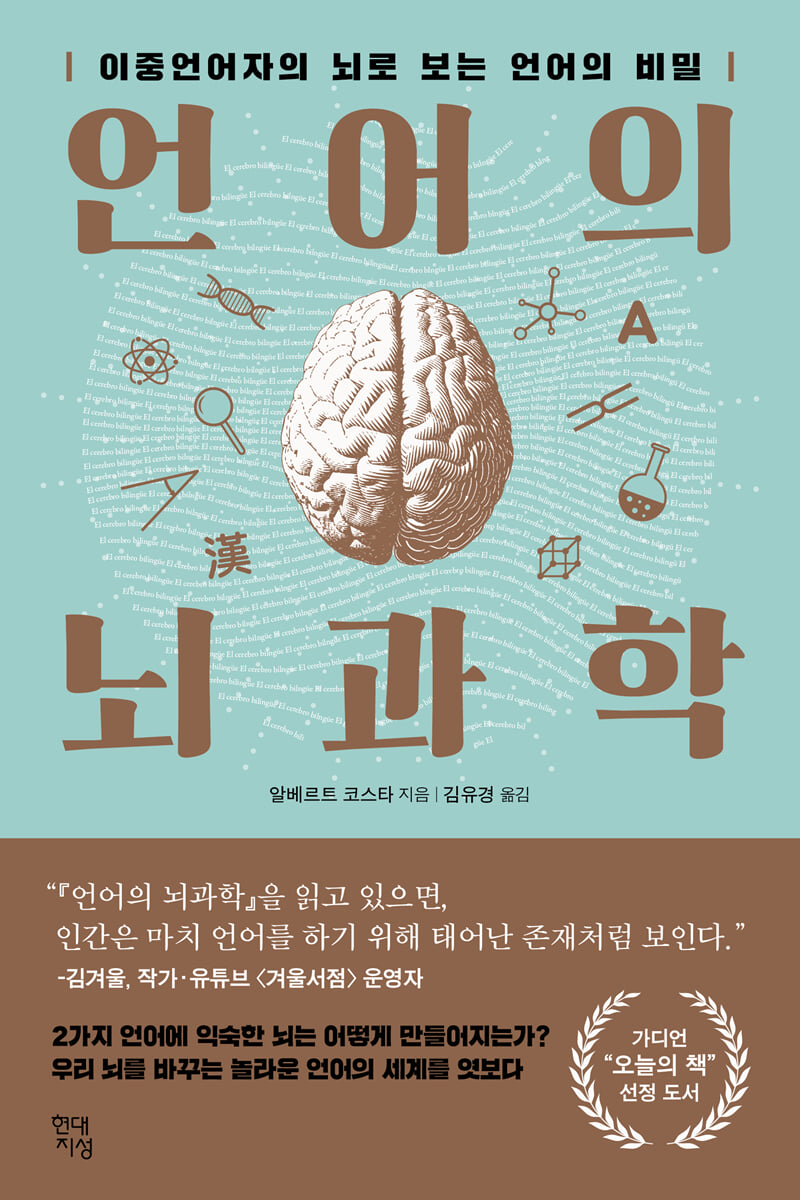
The Neuroscience of Language
 |
Description
Book Introduction
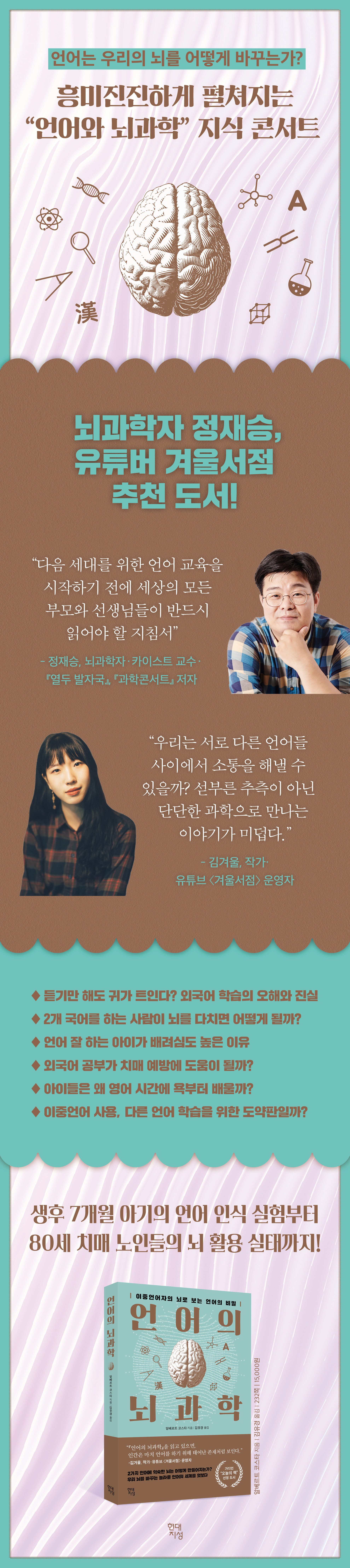
Neuroscientist Jaeseung Jeong recommends YouTuber Winter Bookstore! From language recognition experiments in 7-month-old babies to the actual brain utilization of 80-year-old dementia patients, An exciting knowledge concert on "Language and Brain Science" “How can two languages coexist in one brain?” We live in an age where bilingualism, or even multilingualism, is no longer unusual. But if you think about it, it's strange. How do people speak and use language, and how does the brain store and process information when using two or more languages in daily life? The author, who has led over 20 projects on speech productivity and bilingualism and contributed over 150 articles to prominent scientific journals, has compiled his research into "The Neuroscience of Language." This book uses cutting-edge research to illustrate how language use interacts with cognitive domains such as attention, learning ability, emotion, and decision-making. The author's vivid insights, gained from being born into a bilingual family and raising children in the same environment, combine with knowledge of brain science, psychology, and sociology to guide readers on a consistently fresh and enjoyable journey of knowledge. |
- You can preview some of the book's contents.
Preview
index
prolog
Chapter 1: Children Living in a Bilingual Environment
Chapter 2: How the Bilingual Brain Works
Chapter 3: How Bilingualism Changes the Brain
Chapter 4: Does Bilingualism Slow Aging?
Chapter 5 Decision Making in Bilinguals
Acknowledgements
References
Image source
Chapter 1: Children Living in a Bilingual Environment
Chapter 2: How the Bilingual Brain Works
Chapter 3: How Bilingualism Changes the Brain
Chapter 4: Does Bilingualism Slow Aging?
Chapter 5 Decision Making in Bilinguals
Acknowledgements
References
Image source
Detailed image
Into the book
A six-month-old baby can distinguish between sounds he has never heard before and sounds he has heard before.
The problems that native Chinese speakers have in pronouncing the letters l and r do not appear in babies born into an environment where that language is spoken.
However, babies' ability to recognize sound contrasts declines over time.
…instead of losing this sense of distinction, the baby becomes more acutely aware of the subtle differences between phonemes in the language he or she hears.
This phenomenon is called perceptual narrowing or perceptual adaptation.
--- p.40~53
When looking at language, monolingual babies know more words than bilingual babies.
But if you consider the total number of words—that is, the number of words in both languages combined—baby bilinguals do know more words.
…so you don’t have to worry.
It's not that bilingual babies are slower at acquiring words.
There's just twice as much to learn.
--- p.49~50
“My friend was diagnosed with Alzheimer’s.
“I always spoke Catalan, my second language, so when I get this disease, do I lose my Spanish or my Catalan?”
--- p.68
Have you ever asked someone for directions while walking somewhere recently? If so, you've likely heard answers like this often.
“Cross this first street, turn right, and you’ll come to the second roundabout. Take the third exit, then turn right at the second street!” Well, you might think it was better not to ask.
When you give someone directions in this way, it's possible because they have the entire map in their head.
However, the reason it is complicated for the listener is because they do not have the entire map in their head and have to create a map as they hear the explanation.
Even a small error in your mental map can cause you to turn right instead of left, and you'll immediately get lost.
--- p.125
In 2013, researchers at the Hyderabad Institute of Medical Sciences examined the clinical records of 648 dementia patients and found that 391 of them were bilingual.
Surprisingly, the results were similar to those of the Toronto study.
In other words, bilingualism delayed dementia symptoms by four years.
--- p.173
One reason intuitive methods are on the rise in decision-making is the emotional reactions that arise in certain situations.
In situations where emotional burden is high, we tend to follow our intuition more.
This is especially true when it is difficult to think rationally or pause to reflect on the situation that has unfolded before us.
Avoid making important decisions when you are overly emotional.
Thinking twice can prevent problems.
The method is simple.
Efficiency is improved when we reduce our emotions, control our intuition, and control our bias toward rules of thumb.
If possible, I hope you will think more calmly and keep your thoughts in check.
--- p.197
Slang, insults, and Harry Potter spells spoken in a foreign language don't sound the same as they do in your native language.
Therefore, the emotional response is also less.
The hypotheses to be used going forward are as follows:
“Making decisions in a foreign language can reduce the influence of emotions.” If so, then when making decisions in a foreign language, you tend to follow more logical and careful criteria than in your native language.
The problems that native Chinese speakers have in pronouncing the letters l and r do not appear in babies born into an environment where that language is spoken.
However, babies' ability to recognize sound contrasts declines over time.
…instead of losing this sense of distinction, the baby becomes more acutely aware of the subtle differences between phonemes in the language he or she hears.
This phenomenon is called perceptual narrowing or perceptual adaptation.
--- p.40~53
When looking at language, monolingual babies know more words than bilingual babies.
But if you consider the total number of words—that is, the number of words in both languages combined—baby bilinguals do know more words.
…so you don’t have to worry.
It's not that bilingual babies are slower at acquiring words.
There's just twice as much to learn.
--- p.49~50
“My friend was diagnosed with Alzheimer’s.
“I always spoke Catalan, my second language, so when I get this disease, do I lose my Spanish or my Catalan?”
--- p.68
Have you ever asked someone for directions while walking somewhere recently? If so, you've likely heard answers like this often.
“Cross this first street, turn right, and you’ll come to the second roundabout. Take the third exit, then turn right at the second street!” Well, you might think it was better not to ask.
When you give someone directions in this way, it's possible because they have the entire map in their head.
However, the reason it is complicated for the listener is because they do not have the entire map in their head and have to create a map as they hear the explanation.
Even a small error in your mental map can cause you to turn right instead of left, and you'll immediately get lost.
--- p.125
In 2013, researchers at the Hyderabad Institute of Medical Sciences examined the clinical records of 648 dementia patients and found that 391 of them were bilingual.
Surprisingly, the results were similar to those of the Toronto study.
In other words, bilingualism delayed dementia symptoms by four years.
--- p.173
One reason intuitive methods are on the rise in decision-making is the emotional reactions that arise in certain situations.
In situations where emotional burden is high, we tend to follow our intuition more.
This is especially true when it is difficult to think rationally or pause to reflect on the situation that has unfolded before us.
Avoid making important decisions when you are overly emotional.
Thinking twice can prevent problems.
The method is simple.
Efficiency is improved when we reduce our emotions, control our intuition, and control our bias toward rules of thumb.
If possible, I hope you will think more calmly and keep your thoughts in check.
--- p.197
Slang, insults, and Harry Potter spells spoken in a foreign language don't sound the same as they do in your native language.
Therefore, the emotional response is also less.
The hypotheses to be used going forward are as follows:
“Making decisions in a foreign language can reduce the influence of emotions.” If so, then when making decisions in a foreign language, you tend to follow more logical and careful criteria than in your native language.
--- p.198
Publisher's Review
How does language change our brain?
When you look at babies, it seems like all they do is eat and sleep.
However, numerous studies have shown that babies as young as a few months old are acquiring very sophisticated knowledge about language.
Some studies have shown that even newborns as young as five days old can clearly distinguish between normal speech and abnormal noises.
And babies born into bilingual homes (4-6 months old) can tell which language a speaker is speaking just by watching a video.
Even before children begin to speak, their brains are still processing information they absorb from their surroundings.
From a very young age, the brain and language interact and closely influence each other.
Does learning a foreign language affect your decision-making?
We know that we should not make important decisions in emotional situations.
This is because in situations where emotional burden is high, there is a tendency to follow intuition (i.e., to 'get it together' without considering this or that) rather than reason.
The authors argue that using a foreign language can reduce the emotional impact of making important decisions that require careful and rational judgment.
At first glance, it might seem like attempting to make important decisions using a foreign language with much more limited communication skills would lead to less precise results, but numerous studies by world-renowned scholars have proven this to be true.
This is because foreign languages help rational judgment play its role by minimizing the role of 'emotions' in decision-making.
Nelson Mandela said this while learning Afrikaans, the language of the colonial power that had tormented his people with discriminatory policies for 40 years.
“If you speak a language that the other person can understand, the conversation will reach their head.
“If you speak the other person’s language, the conversation will reach their heart.” Mandela also knew that he could not speak to their heart by insisting on speaking his native language.
Productive language life, smarter with brain science insights
This book comprehensively covers how the brain and language activities, previously considered merely a "black box," interact with each other thanks to advances in scientific tools and research.
Rather than simply describing specific areas of the brain, it uses everyday examples to explain how they interact with cognitive abilities such as attention, learning ability, decision-making, and emotions during language use.
The author, a world-renowned scholar in the field of bilingualism, likens the skill of juggling two languages to that of a contortionist.
Because it takes concentration to focus on one language while having a conversation and control it from mixing with other languages.
It doesn't just happen naturally or on its own.
Scholars say that bilinguals have two languages active 'simultaneously', interfering with each other's language use.
It's not like you can just turn one off and the other on like turning off a switch.
For this reason, there is concern that children growing up in bilingual homes may experience a lot of confusion.
I am concerned that my language development may be delayed or that I may not be able to develop both properly.
But you can rest assured.
Research shows there is no problem.
It might be a little late to start, but you'll do well in both.
#Interesting questions (detailed explanations in the book!)
-How do babies distinguish words they hear for the first time?
-How do babies born into bilingual families learn to speak?
-Why do bilinguals have (relatively) greater empathy than monolinguals?
-What brain region allows bilinguals to continue using two languages?
-How does bilingualism affect the development of various cognitive abilities?
When you look at babies, it seems like all they do is eat and sleep.
However, numerous studies have shown that babies as young as a few months old are acquiring very sophisticated knowledge about language.
Some studies have shown that even newborns as young as five days old can clearly distinguish between normal speech and abnormal noises.
And babies born into bilingual homes (4-6 months old) can tell which language a speaker is speaking just by watching a video.
Even before children begin to speak, their brains are still processing information they absorb from their surroundings.
From a very young age, the brain and language interact and closely influence each other.
Does learning a foreign language affect your decision-making?
We know that we should not make important decisions in emotional situations.
This is because in situations where emotional burden is high, there is a tendency to follow intuition (i.e., to 'get it together' without considering this or that) rather than reason.
The authors argue that using a foreign language can reduce the emotional impact of making important decisions that require careful and rational judgment.
At first glance, it might seem like attempting to make important decisions using a foreign language with much more limited communication skills would lead to less precise results, but numerous studies by world-renowned scholars have proven this to be true.
This is because foreign languages help rational judgment play its role by minimizing the role of 'emotions' in decision-making.
Nelson Mandela said this while learning Afrikaans, the language of the colonial power that had tormented his people with discriminatory policies for 40 years.
“If you speak a language that the other person can understand, the conversation will reach their head.
“If you speak the other person’s language, the conversation will reach their heart.” Mandela also knew that he could not speak to their heart by insisting on speaking his native language.
Productive language life, smarter with brain science insights
This book comprehensively covers how the brain and language activities, previously considered merely a "black box," interact with each other thanks to advances in scientific tools and research.
Rather than simply describing specific areas of the brain, it uses everyday examples to explain how they interact with cognitive abilities such as attention, learning ability, decision-making, and emotions during language use.
The author, a world-renowned scholar in the field of bilingualism, likens the skill of juggling two languages to that of a contortionist.
Because it takes concentration to focus on one language while having a conversation and control it from mixing with other languages.
It doesn't just happen naturally or on its own.
Scholars say that bilinguals have two languages active 'simultaneously', interfering with each other's language use.
It's not like you can just turn one off and the other on like turning off a switch.
For this reason, there is concern that children growing up in bilingual homes may experience a lot of confusion.
I am concerned that my language development may be delayed or that I may not be able to develop both properly.
But you can rest assured.
Research shows there is no problem.
It might be a little late to start, but you'll do well in both.
#Interesting questions (detailed explanations in the book!)
-How do babies distinguish words they hear for the first time?
-How do babies born into bilingual families learn to speak?
-Why do bilinguals have (relatively) greater empathy than monolinguals?
-What brain region allows bilinguals to continue using two languages?
-How does bilingualism affect the development of various cognitive abilities?
GOODS SPECIFICS
- Date of issue: August 14, 2020
- Page count, weight, size: 232 pages | 364g | 150*225*20mm
- ISBN13: 9791190994156
- ISBN10: 1190994151
You may also like
카테고리
korean


korean

![ELLE 엘르 스페셜 에디션 A형 : 12월 [2025]](http://librairie.coreenne.fr/cdn/shop/files/b8e27a3de6c9538896439686c6b0e8fb.jpg?v=1766436872&width=3840)


