

Nonviolent Communication Series - Positive Mind UP Strength Cards
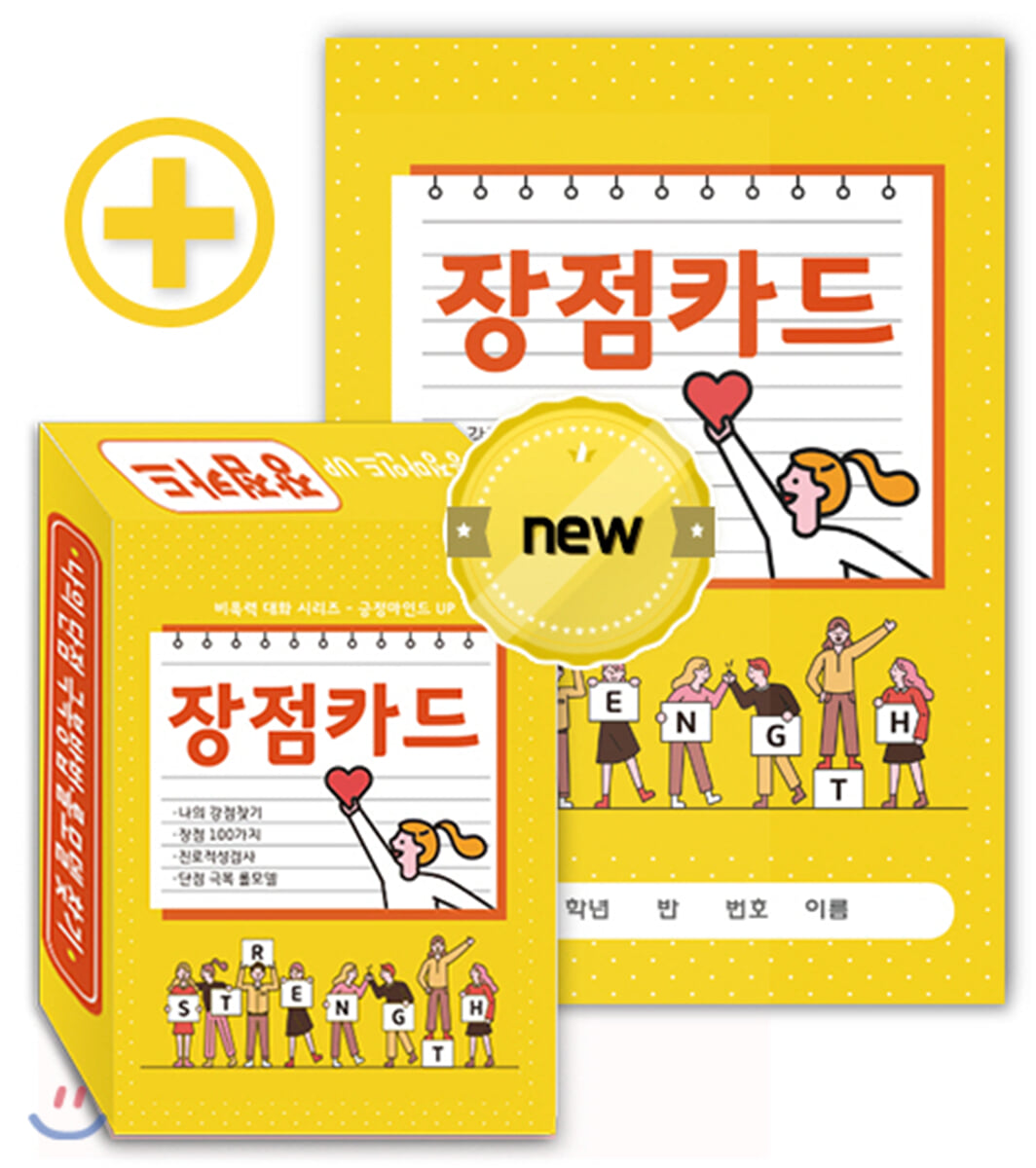 |
Description
Book Introduction
It consists of 84 types of strength cards and worksheets according to 11 categories: 'physical movement, manual dexterity, spatial perception, music, creativity, language, mathematical logic, self-reflection, interpersonal relationships, nature friendliness, and artistic vision.' A study guide (workbook on how to use) is provided so that anyone can easily use it. ※After taking a simple career aptitude test based on the theory of multiple intelligences using the “Strength Card,” look for videos of occupations and role models related to each strength. Here are some examples of how you can develop your strengths and improve your weaknesses in your daily life. |
index
[Advantage Card]
1.
Advantage Card (01-66)
Front: Order, strengths, related occupations, role models, video (QR code)
Back: Photos related to the benefits
Classification: Color-coded by 11 representative multiple intelligences (01-06: physical movement, 07-12: manual dexterity, 13-18: spatial perception, 19-24: music, 25-30: creativity, 31-36: language, 37-42: mathematical logic, 43-48: self-reflection, 49-54: interpersonal relationships, 55-60: nature friendliness, 61-66: artistic vision)
2.
Strength Building Cards (67-77)
3.
Write down 100 of your strengths (78-82)
▶Table of Contents
9-page worksheet to use with [Advantage Card]
Free download materials http://cafe.naver.com/jobcard
1.
What am I good at?
2.
What do I like?
3.
What am I not confident about?
4.
Can a disadvantage become an advantage?
5.
When I hate my flaws
6.
Can I change the world with my talent?
7.
Gifting Game
8.
Advantage Interview Game
9.
Words that give me strength
1.
Advantage Card (01-66)
Front: Order, strengths, related occupations, role models, video (QR code)
Back: Photos related to the benefits
Classification: Color-coded by 11 representative multiple intelligences (01-06: physical movement, 07-12: manual dexterity, 13-18: spatial perception, 19-24: music, 25-30: creativity, 31-36: language, 37-42: mathematical logic, 43-48: self-reflection, 49-54: interpersonal relationships, 55-60: nature friendliness, 61-66: artistic vision)
2.
Strength Building Cards (67-77)
3.
Write down 100 of your strengths (78-82)
▶Table of Contents
9-page worksheet to use with [Advantage Card]
Free download materials http://cafe.naver.com/jobcard
1.
What am I good at?
2.
What do I like?
3.
What am I not confident about?
4.
Can a disadvantage become an advantage?
5.
When I hate my flaws
6.
Can I change the world with my talent?
7.
Gifting Game
8.
Advantage Interview Game
9.
Words that give me strength
Detailed image

Publisher's Review
▶What are the good points of the 〈Positive Mind UP Advantage Card〉?
1.
The card has rounded corners so it's safe.
2.
There are activity sheets so you can use them effectively during class.
3.
It has vivid, real pictures so you can use it even if you don't know the words.
4.
Related occupations and role models are listed on each card.
(Approximately 150 related occupations, 66 role models, 66 video QR codes)
5.
There is a Strength Development Card so you can practice 'the effort I can make'.
6.
There's a card where you can find and write down your 100 strengths.
▶Strength Card Study Sheet
Download the “Activity Sheet PDF File” from the data room at http://cafe.naver.com/jobcard.
▶Is a merit card really necessary?
1.
Everyone can participate.
From high to low learning level students, elementary, middle, high school, college students, adults, and the elderly, everyone can find their strengths/weaknesses by classifying the “Strength Card.”
2.
Participation is high.
Even adults can't think of anything when they try to say, "What am I good at, what am I fond of?"
Because it is conducted through the medium of 〈cards〉, even students and children who have difficulty expressing themselves in words can easily open up and express their feelings.
3.
You don't have to be an expert.
Simply classify the 〈Strength Card〉 into “Good/Average/Bad” and discover “My Strengths and Weaknesses” and fill out the worksheet.
▶Recommended for
-Parents who want to talk with their children
-Local children's center teacher, after-school teacher
-Workbooks for elementary school students and academy teachers
- Elementary, middle, and high school homeroom teachers, ethics, Korean language, career and vocational teachers
- Facilitator for university student study groups, church gatherings, and camps
▶How do I use it?
1.
Card sorting
Classify the 〈Strength Card〉 into “Good/Average/Bad” or “Good/Average/Dislike”.
Just like the Ideal World Cup, rank your strengths and preferences and think carefully about why.
Please refer to pages 1-2 of the study guide.
2.
Role model class
When you feel lost and lack courage, the best way is to find a role model who is similar to you.
Even successful people today were discouraged and despaired because of their shortcomings in childhood. How were they able to love and overcome their shortcomings?
I invite IU, soccer player Messi, Anne of Green Gables, and William Kamkwambay, who appear on pages 3-6 of the <Study Guide>, to the chat room.
3.
Gifting Game
It's great for school violence prevention education programs, gatherings with classmates before the start of a new semester, vacation, or graduation, and for group counseling sessions to open your heart.
Give each other a “strength card” that you both think is the other person’s strength.
Don't forget to keep the "Merit Card" gift you received on page 7 of the study guide.
4.
Advantage Interview Game
After sorting the 〈Strength Cards〉, ask your friends about each other's strengths and weaknesses.
〈Study Sheet〉 8p. Write it with reference to the advantage interview game.
5.
Family Games
Let's play a game with family members to discover each other's strengths.
“I think this is my son’s strength because I’ve seen him do this on a regular basis.” When I discover and acknowledge strengths I didn’t know I had, my self-esteem naturally rises.
▶Curriculum Linkage Table
elementary school
Introducing a 3rd grade Korean language student (Introducing a friend you like)
Korean 5th Grade Conversation and Empathy (Finding and praising the other person's good deeds or strengths)
Moral 6th Grade: My Precious True Dream (Find your strengths, share them with a friend, and make a concrete plan to achieve your dreams)
Middle and high school career paths and occupations
① Forming a positive self-concept (Who am I, what I like, what I'm good at, my characteristics)
② Career design and preparation (How should I decide on my career path? How can I overcome career barriers?)
③ Career planning and preparation (What preparations should I make for my career?)
1.
The card has rounded corners so it's safe.
2.
There are activity sheets so you can use them effectively during class.
3.
It has vivid, real pictures so you can use it even if you don't know the words.
4.
Related occupations and role models are listed on each card.
(Approximately 150 related occupations, 66 role models, 66 video QR codes)
5.
There is a Strength Development Card so you can practice 'the effort I can make'.
6.
There's a card where you can find and write down your 100 strengths.
▶Strength Card Study Sheet
Download the “Activity Sheet PDF File” from the data room at http://cafe.naver.com/jobcard.
▶Is a merit card really necessary?
1.
Everyone can participate.
From high to low learning level students, elementary, middle, high school, college students, adults, and the elderly, everyone can find their strengths/weaknesses by classifying the “Strength Card.”
2.
Participation is high.
Even adults can't think of anything when they try to say, "What am I good at, what am I fond of?"
Because it is conducted through the medium of 〈cards〉, even students and children who have difficulty expressing themselves in words can easily open up and express their feelings.
3.
You don't have to be an expert.
Simply classify the 〈Strength Card〉 into “Good/Average/Bad” and discover “My Strengths and Weaknesses” and fill out the worksheet.
▶Recommended for
-Parents who want to talk with their children
-Local children's center teacher, after-school teacher
-Workbooks for elementary school students and academy teachers
- Elementary, middle, and high school homeroom teachers, ethics, Korean language, career and vocational teachers
- Facilitator for university student study groups, church gatherings, and camps
▶How do I use it?
1.
Card sorting
Classify the 〈Strength Card〉 into “Good/Average/Bad” or “Good/Average/Dislike”.
Just like the Ideal World Cup, rank your strengths and preferences and think carefully about why.
Please refer to pages 1-2 of the study guide.
2.
Role model class
When you feel lost and lack courage, the best way is to find a role model who is similar to you.
Even successful people today were discouraged and despaired because of their shortcomings in childhood. How were they able to love and overcome their shortcomings?
I invite IU, soccer player Messi, Anne of Green Gables, and William Kamkwambay, who appear on pages 3-6 of the <Study Guide>, to the chat room.
3.
Gifting Game
It's great for school violence prevention education programs, gatherings with classmates before the start of a new semester, vacation, or graduation, and for group counseling sessions to open your heart.
Give each other a “strength card” that you both think is the other person’s strength.
Don't forget to keep the "Merit Card" gift you received on page 7 of the study guide.
4.
Advantage Interview Game
After sorting the 〈Strength Cards〉, ask your friends about each other's strengths and weaknesses.
〈Study Sheet〉 8p. Write it with reference to the advantage interview game.
5.
Family Games
Let's play a game with family members to discover each other's strengths.
“I think this is my son’s strength because I’ve seen him do this on a regular basis.” When I discover and acknowledge strengths I didn’t know I had, my self-esteem naturally rises.
▶Curriculum Linkage Table
elementary school
Introducing a 3rd grade Korean language student (Introducing a friend you like)
Korean 5th Grade Conversation and Empathy (Finding and praising the other person's good deeds or strengths)
Moral 6th Grade: My Precious True Dream (Find your strengths, share them with a friend, and make a concrete plan to achieve your dreams)
Middle and high school career paths and occupations
① Forming a positive self-concept (Who am I, what I like, what I'm good at, my characteristics)
② Career design and preparation (How should I decide on my career path? How can I overcome career barriers?)
③ Career planning and preparation (What preparations should I make for my career?)
GOODS SPECIFICS
- Date of issue: August 15, 2019
- Page count, weight, size: 1 page | 128*182*15mm
- ISBN13: 9791155057513
- ISBN10: 1155057511
You may also like
카테고리
korean


korean

![ELLE 엘르 스페셜 에디션 A형 : 12월 [2025]](http://librairie.coreenne.fr/cdn/shop/files/b8e27a3de6c9538896439686c6b0e8fb.jpg?v=1766436872&width=3840)


