

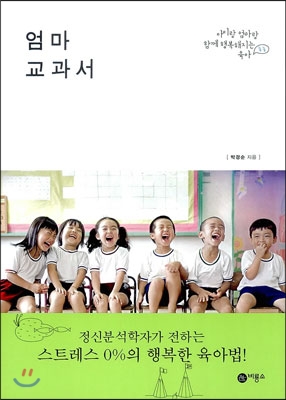
Mom's Textbook
 |
Description
Book Introduction
A psychoanalyst shares her tips for raising happy children with zero stress.
This book was written by the author, a psychological counselor and professor at a specialized graduate school, based on her experience as a working mom raising three children and her academic understanding as a psychoanalyst.
When the author was struggling with the burden of raising three children, the psychoanalytic training she received at an orthodox Freudian institute gave her profound insight.
In this book, the author seeks to provide a deeper understanding of the physical and mental development of infants and toddlers through the theories of leading psychoanalysts, and to help mothers and children communicate personally.
This book was written by the author, a psychological counselor and professor at a specialized graduate school, based on her experience as a working mom raising three children and her academic understanding as a psychoanalyst.
When the author was struggling with the burden of raising three children, the psychoanalytic training she received at an orthodox Freudian institute gave her profound insight.
In this book, the author seeks to provide a deeper understanding of the physical and mental development of infants and toddlers through the theories of leading psychoanalysts, and to help mothers and children communicate personally.
- You can preview some of the book's contents.
Preview
index
prolog
The relationship between parents creates a child.
Ⅰ.
Good children suffer
1. Is there any finger that doesn't hurt when you bite it?
2 Good Child Syndrome
3 When will you grow up?
4. How far should we go in breaking habits?
[The Theory and Life of a Psychoanalyst I] Donald Winnicott: On the Pain of the Good Child
Ⅱ.
Children who live according to their own taste
1 I am the best
2 Devotion without empathy
3. The Seesaw of Discipline and Appropriate Frustration
[The Theory and Life of a Psychoanalyst II] Heinrich Kohut: A Child Growing Up in Empathy
Ⅲ.
Children living in fantasy
Swallow it when it's sweet and spit it out when it's bitter
2 It's because of Mom!
3 The Road to Maturity
4 Filter of the Mind
5 Good and bad children are psychological Siamese twins
6 Aggressive Children
7 How is a child's mind formed?
[The Psychoanalyst's Theory and Life III] Melanie Klein: The Dialectic of Love and Hate
Ⅳ.
For parents
1 Mom, about that tough job
2 The little child in my heart
3 Finding a solution
4 Love Studies - On Love and Hate
5 Parents Growing Up with Their Children
Two children's steps of growth
Ⅰ.
Oral stage: the period when everything is confirmed with the mouth (0-1 years old)
1 I don't want to be alone - contact
2 I hate sleeping alone - sleep
3 I hate being hungry - breastfeeding
4 Not Mom - Shyness
5 Stimulate your brain - Growth
[Mental Development I] Oral Stage
Ⅱ.
Anal stage: When stubbornness begins (ages 1-3)
1. Potty training
2 I hate it!
3 Don't Go Mom - Separation Anxiety
4. There is a mother inside me - object constancy
[Mental Development II] Anal Stage
Ⅲ.
Phallic stage: The period when curiosity about the opposite sex develops (ages 3-5)
1 Language Development - From Action to Thought
2 I am the best
3. Oh, you're different from me? - Awareness of gender differences
The Kind Grandfather and the Fearful Tiger - The Development of the Superego
5 The Role of the Father
Ⅳ.
Latency: When Friends Become Important (Ages 6-11)
1 I want to play
2 My friend
3 I don't like it on top of the desk, I like it under the desk
4 Lying Children
[The Theory and Life of a Psychoanalyst IV] Sigmund Freud: The Founder of Infant Development
[Development of the Mind III] Summary
Three children are all born different.
Ⅰ.
It's innate, like a disposition or constitution
Ⅱ.
The aesthetics of difference
1 A child whose asset is playing
2 A child with a soft heart like cotton
3. A child with excellent intuition
Ⅲ.
A brief understanding of personality types
1. Active extroverted child, quiet introverted child
2. A meticulous and organized child, a flexible and open-minded child
A realistic child who uses the three senses, and an idealistic child who pursues meaning.
4. Rational thinking child, sensitive emotional child
Ⅳ.
Examples of representative personality types
1 SJ (Realistic and meticulous organizer)
2 SP (realistic, flexible, open)
3 NT, NF (Intuitive Thinking, Intuitive Feeling)
[Representative expressions of the four MBTI preference indicators]
Epilogue
index
The relationship between parents creates a child.
Ⅰ.
Good children suffer
1. Is there any finger that doesn't hurt when you bite it?
2 Good Child Syndrome
3 When will you grow up?
4. How far should we go in breaking habits?
[The Theory and Life of a Psychoanalyst I] Donald Winnicott: On the Pain of the Good Child
Ⅱ.
Children who live according to their own taste
1 I am the best
2 Devotion without empathy
3. The Seesaw of Discipline and Appropriate Frustration
[The Theory and Life of a Psychoanalyst II] Heinrich Kohut: A Child Growing Up in Empathy
Ⅲ.
Children living in fantasy
Swallow it when it's sweet and spit it out when it's bitter
2 It's because of Mom!
3 The Road to Maturity
4 Filter of the Mind
5 Good and bad children are psychological Siamese twins
6 Aggressive Children
7 How is a child's mind formed?
[The Psychoanalyst's Theory and Life III] Melanie Klein: The Dialectic of Love and Hate
Ⅳ.
For parents
1 Mom, about that tough job
2 The little child in my heart
3 Finding a solution
4 Love Studies - On Love and Hate
5 Parents Growing Up with Their Children
Two children's steps of growth
Ⅰ.
Oral stage: the period when everything is confirmed with the mouth (0-1 years old)
1 I don't want to be alone - contact
2 I hate sleeping alone - sleep
3 I hate being hungry - breastfeeding
4 Not Mom - Shyness
5 Stimulate your brain - Growth
[Mental Development I] Oral Stage
Ⅱ.
Anal stage: When stubbornness begins (ages 1-3)
1. Potty training
2 I hate it!
3 Don't Go Mom - Separation Anxiety
4. There is a mother inside me - object constancy
[Mental Development II] Anal Stage
Ⅲ.
Phallic stage: The period when curiosity about the opposite sex develops (ages 3-5)
1 Language Development - From Action to Thought
2 I am the best
3. Oh, you're different from me? - Awareness of gender differences
The Kind Grandfather and the Fearful Tiger - The Development of the Superego
5 The Role of the Father
Ⅳ.
Latency: When Friends Become Important (Ages 6-11)
1 I want to play
2 My friend
3 I don't like it on top of the desk, I like it under the desk
4 Lying Children
[The Theory and Life of a Psychoanalyst IV] Sigmund Freud: The Founder of Infant Development
[Development of the Mind III] Summary
Three children are all born different.
Ⅰ.
It's innate, like a disposition or constitution
Ⅱ.
The aesthetics of difference
1 A child whose asset is playing
2 A child with a soft heart like cotton
3. A child with excellent intuition
Ⅲ.
A brief understanding of personality types
1. Active extroverted child, quiet introverted child
2. A meticulous and organized child, a flexible and open-minded child
A realistic child who uses the three senses, and an idealistic child who pursues meaning.
4. Rational thinking child, sensitive emotional child
Ⅳ.
Examples of representative personality types
1 SJ (Realistic and meticulous organizer)
2 SP (realistic, flexible, open)
3 NT, NF (Intuitive Thinking, Intuitive Feeling)
[Representative expressions of the four MBTI preference indicators]
Epilogue
index
Publisher's Review
Stop parenting driven by trends! Find answers in time-tested psychoanalytic theory.
Parenting is always prone to being swayed by provocative keywords that follow trends or trends.
Traditional parenting methods passed down from the past and the know-how of parenting that is said to be '~kadera' are overflowing like a flood, but the overflow of information has made parenting an even more difficult problem.
What is truly the right way to raise children?
This book illuminates the parenting challenges faced by parents today through the theories and perspectives of leading psychoanalysts who have been validated over time.
You may have heard of the 'good kid syndrome', 'narcissism', 'attachment', 'empathy and devotion' once or twice, but the deeper content of these theories may be unfamiliar.
By examining the theories explained in an easily understandable manner and the author's extensive field experience, you will realize that the major theories of psychoanalysts are not mere empty theories unrelated to your child's current problems.
"Mom's Textbook" doesn't try to excite mothers by relieving them of emotional responsibility or providing motivation.
The true intention of this book is to help parents become parents who treat their children properly and according to principles by facing the root of the problem rather than being anxious about the phenomenon that is happening right in front of their eyes.
* The three basic elements of parenting
The author says that by considering the theories taught by the masters who laid the foundations of psychoanalysis, we can understand the basic elements of parenting, such as the 'parent-child relationship' and the 'parenting development process.'
In addition, the book's content was structured to help readers understand the 'child's innate temperament'.
-Motivation is more important than phenomenon: Parent-child relationship
Of course, parenting has a dictionary definition of 'parents raising children,' but no matter how young the child is, all human relationships are reciprocal.
Moreover, the relationship between parents and children is deeper and more durable than any other relationship in the world, and it has a great influence on each other without them knowing it and elicits reactions from the other.
Some behaviors in a child that are difficult to understand may actually be caused by the parents.
For example, a child who is perceived as a "good child" may actually be simply trying to please parents who are not sensitive to his or her needs.
Understanding the underlying motivations behind a child's behavior is more important than trying to manage their problem behavior.
The more you know, the easier it becomes: Parenting Development Process
The author says that there are times when it is normal for a child to throw tantrums and get angry for no reason, and there are times when it is normal for a child to play well alone but then cling to their mother, making her suffer.
If your child is experiencing separation anxiety, the author recommends, based on his own experience, that you take your child directly to your workplace.
It is said that when a child knows where his mother, who disappears before his eyes every day, goes, his anxiety is somewhat reduced.
By understanding the general developmental process of infants and toddlers, you will be able to overcome many small tasks more easily and simply than before.
-Conflicts are reduced when differences are acknowledged: the child's innate temperament
Just as fingerprints are different for each person, each child is born with a different personality.
The problem is that when the temperaments of parents and children are too different, the range of understanding between them is narrow.
The author introduced various tendencies based on the contents of the MBTI personality test.
For example, if FM-style parents are raising intuitive and free-spirited children, they are likely to feel great anxiety and dissatisfaction. However, if they understand their child's personality in advance, they are more likely to discover their child's individuality and potential, as well as their shortcomings.
Only when we understand the inherent differences between parents and children will the scope of conflict be reduced.
* A happy mother raising a happy child
Parenting methods that only burden and burden parents, especially mothers, cannot make mothers happy.
And an unhappy mother can never raise a happy child.
Once the principles are established and the direction is determined, problem solving becomes much simpler.
"Mom's Textbook" will provide the standards and direction for all mothers who must master parenting, something they have never learned before, even in a single class before giving birth to their first child.
Parenting is always prone to being swayed by provocative keywords that follow trends or trends.
Traditional parenting methods passed down from the past and the know-how of parenting that is said to be '~kadera' are overflowing like a flood, but the overflow of information has made parenting an even more difficult problem.
What is truly the right way to raise children?
This book illuminates the parenting challenges faced by parents today through the theories and perspectives of leading psychoanalysts who have been validated over time.
You may have heard of the 'good kid syndrome', 'narcissism', 'attachment', 'empathy and devotion' once or twice, but the deeper content of these theories may be unfamiliar.
By examining the theories explained in an easily understandable manner and the author's extensive field experience, you will realize that the major theories of psychoanalysts are not mere empty theories unrelated to your child's current problems.
"Mom's Textbook" doesn't try to excite mothers by relieving them of emotional responsibility or providing motivation.
The true intention of this book is to help parents become parents who treat their children properly and according to principles by facing the root of the problem rather than being anxious about the phenomenon that is happening right in front of their eyes.
* The three basic elements of parenting
The author says that by considering the theories taught by the masters who laid the foundations of psychoanalysis, we can understand the basic elements of parenting, such as the 'parent-child relationship' and the 'parenting development process.'
In addition, the book's content was structured to help readers understand the 'child's innate temperament'.
-Motivation is more important than phenomenon: Parent-child relationship
Of course, parenting has a dictionary definition of 'parents raising children,' but no matter how young the child is, all human relationships are reciprocal.
Moreover, the relationship between parents and children is deeper and more durable than any other relationship in the world, and it has a great influence on each other without them knowing it and elicits reactions from the other.
Some behaviors in a child that are difficult to understand may actually be caused by the parents.
For example, a child who is perceived as a "good child" may actually be simply trying to please parents who are not sensitive to his or her needs.
Understanding the underlying motivations behind a child's behavior is more important than trying to manage their problem behavior.
The more you know, the easier it becomes: Parenting Development Process
The author says that there are times when it is normal for a child to throw tantrums and get angry for no reason, and there are times when it is normal for a child to play well alone but then cling to their mother, making her suffer.
If your child is experiencing separation anxiety, the author recommends, based on his own experience, that you take your child directly to your workplace.
It is said that when a child knows where his mother, who disappears before his eyes every day, goes, his anxiety is somewhat reduced.
By understanding the general developmental process of infants and toddlers, you will be able to overcome many small tasks more easily and simply than before.
-Conflicts are reduced when differences are acknowledged: the child's innate temperament
Just as fingerprints are different for each person, each child is born with a different personality.
The problem is that when the temperaments of parents and children are too different, the range of understanding between them is narrow.
The author introduced various tendencies based on the contents of the MBTI personality test.
For example, if FM-style parents are raising intuitive and free-spirited children, they are likely to feel great anxiety and dissatisfaction. However, if they understand their child's personality in advance, they are more likely to discover their child's individuality and potential, as well as their shortcomings.
Only when we understand the inherent differences between parents and children will the scope of conflict be reduced.
* A happy mother raising a happy child
Parenting methods that only burden and burden parents, especially mothers, cannot make mothers happy.
And an unhappy mother can never raise a happy child.
Once the principles are established and the direction is determined, problem solving becomes much simpler.
"Mom's Textbook" will provide the standards and direction for all mothers who must master parenting, something they have never learned before, even in a single class before giving birth to their first child.
GOODS SPECIFICS
- Date of publication: June 28, 2012
- Page count, weight, size: 280 pages | 480g | 148*210*20mm
- ISBN13: 9788949190396
- ISBN10: 8949190397
You may also like
카테고리
korean


korean

![GQ KOREA Mark (Monthly): December [2025]](http://librairie.coreenne.fr/cdn/shop/files/8ef265dbbfbf186523ed75ba7319009d.jpg?v=1765340328&width=3840)


