

Baby Whisper
 |
Description
Book Introduction
A very welcome book that will serve as a solid guide for moms and dads who are confused and anxious while raising their first child.
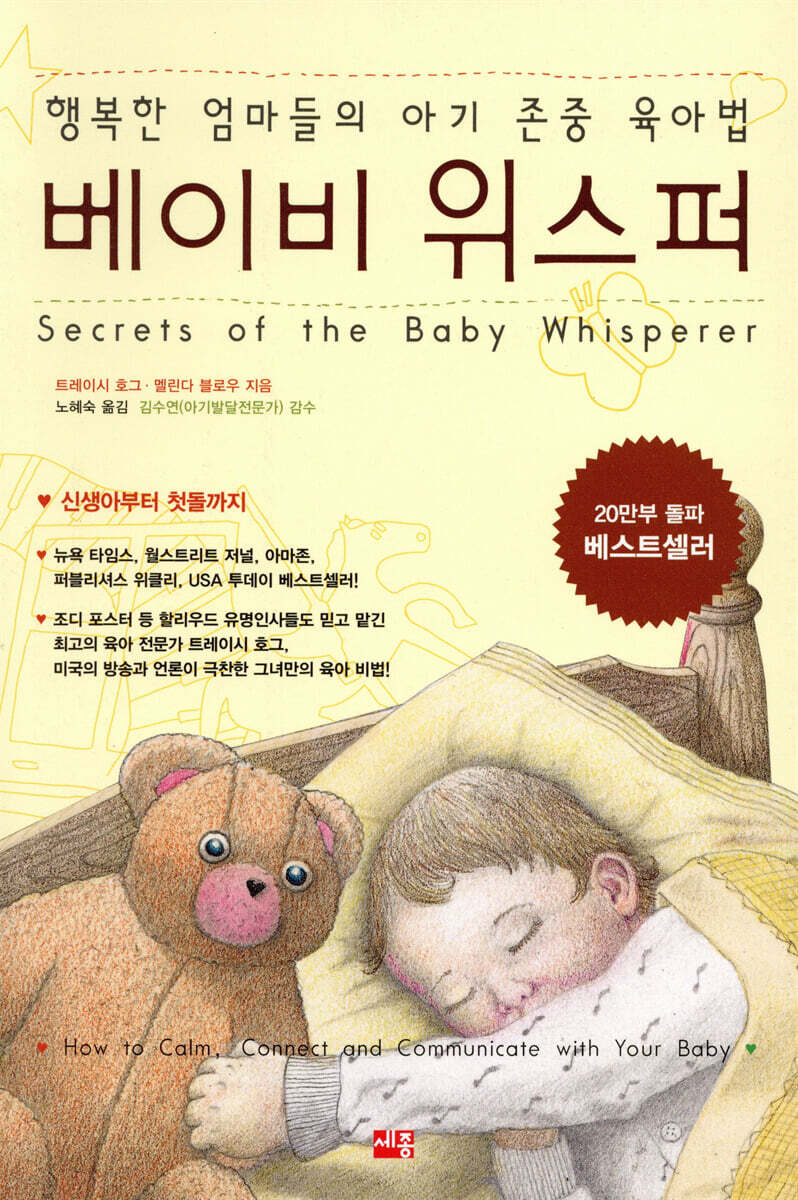
Tracy Hogg, a parenting expert who has cared for over 5,000 babies for over 20 years and is known as the "Baby Whisperer" for her exceptional ability to connect with babies, has poured all of her know-how into this one book.
The word 'baby whisperer' comes from the word 'horse whisperer', which means 'good at handling words', and the secret is to always have a calm and slow attitude when approaching a baby.
The greatest strength of this book is that it does not provide absolute (month-by-month) parenting methods, but rather presents the individual characteristics of babies and the variety of parenting methods, helping new parents deal appropriately with unexpected situations.
Her core message boils down to respecting babies and providing them with a 'consistent and structured routine.'
Her witty remarks about how babies need breastfeeding etiquette will be more reassuring to new parents than to parents who live far away.
Tracy Hogg, a parenting expert who has cared for over 5,000 babies for over 20 years and is known as the "Baby Whisperer" for her exceptional ability to connect with babies, has poured all of her know-how into this one book.
The word 'baby whisperer' comes from the word 'horse whisperer', which means 'good at handling words', and the secret is to always have a calm and slow attitude when approaching a baby.
The greatest strength of this book is that it does not provide absolute (month-by-month) parenting methods, but rather presents the individual characteristics of babies and the variety of parenting methods, helping new parents deal appropriately with unexpected situations.
Her core message boils down to respecting babies and providing them with a 'consistent and structured routine.'
Her witty remarks about how babies need breastfeeding etiquette will be more reassuring to new parents than to parents who live far away.
- You can preview some of the book's contents.
Preview
index
Reviewer's note
Recommendation
Acknowledgements
Prologue: Becoming a Baby Whisperer
1.
Welcome with love
- Happy whispers between baby and mother
2.
Let's raise them comfortably with EASY
- A very easy parenting method that creates happy babies and moms.
3.
Let's slow down with SLOW
- Don't rush, don't be greedy, let's learn baby's language slowly.
4.
E - Breastfeeding
- A wise mother creates a feeding rhythm.
5.
A - Activity
- The most important thing is respect.
6.
S - Sleep
- Watch the baby, but don't interfere.
7.
Y - Mom
- If the mother is happy, the baby is happy too.
8.
How to Deal with Unexpected Special Situations
A wise mother knows how to see far ahead.
9.
3-Day Magic - The ABC Prescription: The Solution to Improvised Parenting
- Moms need a break too.
Epilogue: Advice from the Baby Whisperer
Recommendation
Acknowledgements
Prologue: Becoming a Baby Whisperer
1.
Welcome with love
- Happy whispers between baby and mother
2.
Let's raise them comfortably with EASY
- A very easy parenting method that creates happy babies and moms.
3.
Let's slow down with SLOW
- Don't rush, don't be greedy, let's learn baby's language slowly.
4.
E - Breastfeeding
- A wise mother creates a feeding rhythm.
5.
A - Activity
- The most important thing is respect.
6.
S - Sleep
- Watch the baby, but don't interfere.
7.
Y - Mom
- If the mother is happy, the baby is happy too.
8.
How to Deal with Unexpected Special Situations
A wise mother knows how to see far ahead.
9.
3-Day Magic - The ABC Prescription: The Solution to Improvised Parenting
- Moms need a break too.
Epilogue: Advice from the Baby Whisperer
Into the book
ESAY helps mothers guide their babies while simultaneously understanding their baby's needs.
So, mothers can usually understand their baby's habits and language around 3 months.
It can also help your baby develop good habits right away.
I hope you don't miss the opportunity.
That means thinking about how your family should live, and starting that way from the first day your baby comes home from the hospital.
If you agree with my idea of parenting for the whole family, that is, listening to the baby's needs while simultaneously integrating them into family life, then follow ESAY.
Of course, which method you choose is up to you.
So, mothers can usually understand their baby's habits and language around 3 months.
It can also help your baby develop good habits right away.
I hope you don't miss the opportunity.
That means thinking about how your family should live, and starting that way from the first day your baby comes home from the hospital.
If you agree with my idea of parenting for the whole family, that is, listening to the baby's needs while simultaneously integrating them into family life, then follow ESAY.
Of course, which method you choose is up to you.
--- p.77
Love at first sight?
It's common in movies for people to fall in love the moment they cross paths.
But in reality, it is not common for a man and a woman to meet like that.
The same goes for mother and baby.
Some mothers fall in love right away, but for most it takes some time.
The mother is exhausted, shocked, and scared.
And the hardest thing of all is wanting to be perfect.
But it can't be perfect.
So don't blame yourself.
It may take time to love your baby.
As with adults, true love sprouts as you get to know the other person.
Love at first sight?
It's common in movies for people to fall in love the moment they cross paths.
But in reality, it is not common for a man and a woman to meet like that.
The same goes for mother and baby.
Some mothers fall in love right away, but for most it takes some time.
The mother is exhausted, shocked, and scared.
And the hardest thing of all is wanting to be perfect.
But it can't be perfect.
So don't blame yourself.
It may take time to love your baby.
As with adults, true love sprouts as you get to know the other person.
It's common in movies for people to fall in love the moment they cross paths.
But in reality, it is not common for a man and a woman to meet like that.
The same goes for mother and baby.
Some mothers fall in love right away, but for most it takes some time.
The mother is exhausted, shocked, and scared.
And the hardest thing of all is wanting to be perfect.
But it can't be perfect.
So don't blame yourself.
It may take time to love your baby.
As with adults, true love sprouts as you get to know the other person.
Love at first sight?
It's common in movies for people to fall in love the moment they cross paths.
But in reality, it is not common for a man and a woman to meet like that.
The same goes for mother and baby.
Some mothers fall in love right away, but for most it takes some time.
The mother is exhausted, shocked, and scared.
And the hardest thing of all is wanting to be perfect.
But it can't be perfect.
So don't blame yourself.
It may take time to love your baby.
As with adults, true love sprouts as you get to know the other person.
--- From the text
When it comes to the joys and horrors of becoming a parent for the first time, there is no event in our adult lives that can compare.
Fortunately, it is a joy that continues, but at first it is often gripped by anxiety and fear.
Alan, a 33-year-old graphic designer, vividly remembers the day he brought his wife, Susan, out of the hospital.
Coincidentally, that day was their fourth wedding anniversary.
Susan, a 27-year-old writer, had a safe delivery, and her beautiful blue-eyed baby, Aaron, was easy to care for and didn't cry much.
On the second day, Mom and Dad were excited about leaving the noisy hospital and starting anew as a family.
"I walked towards the hospital room where my wife was, whistling.
Everything seemed perfect.
Just before I went in, Aaron was nursing and sleeping in my wife's arms.
It was just as I imagined.
As we got off the elevator, a nurse helped my wife out in a wheelchair.
I opened the car door and saw that the child seat was not installed.
It took me 30 minutes to install it properly.
Finally, I carefully laid Aaron down in it.
He really looked like an angel.
I helped my wife into the car, thanked the patient nurse, and sat in the driver's seat.
But suddenly, Aaron starts making small noises from the backseat.
It wasn't crying, but it was something I'd never heard in a hospital.
My wife looked at me and I looked at her.
Oh my goodness! What do I do now?
Every parent has that 'what do I do now' moment like Alan.
For some parents, it happens at the hospital, for others it happens in the car on the way home, or as soon as they get home.
There's so much going on - physical and emotional trauma, the reality of having to care for a helpless baby, and so much more.
No one is prepared for such a shock.
Some mothers admit it.
“I read all kinds of books, but I wasn’t prepared,” another mother recalls.
“There were so many things to think about.
I cried a lot too." When it comes to the joys and fears of becoming a parent for the first time, there is probably no event in our adult lives that can compare.
Fortunately, it is a joy that continues, but at first it is often gripped by anxiety and fear.
Alan, a 33-year-old graphic designer, vividly remembers the day he brought his wife, Susan, out of the hospital.
Coincidentally, that day was their fourth wedding anniversary.
Susan, a 27-year-old writer, had a safe delivery, and her beautiful blue-eyed baby, Aaron, was easy to care for and didn't cry much.
On the second day, Mom and Dad were excited about leaving the noisy hospital and starting anew as a family.
"I walked towards the hospital room where my wife was, whistling.
Everything seemed perfect.
Just before I went in, Aaron was nursing and sleeping in my wife's arms.
It was just as I imagined.
As we got off the elevator, a nurse helped my wife out in a wheelchair.
I opened the car door and saw that the child seat was not installed.
It took me 30 minutes to install it properly.
Finally, I carefully laid Aaron down in it.
He really looked like an angel.
I helped my wife into the car, thanked the patient nurse, and sat in the driver's seat.
But suddenly, Aaron starts making small noises from the backseat.
It wasn't crying, but it was something I'd never heard in a hospital.
My wife looked at me and I looked at her.
Oh my goodness! What do I do now?
Every parent has that 'what do I do now' moment like Alan.
For some parents, it happens at the hospital, for others it happens in the car on the way home, or as soon as they get home.
There's so much going on - physical and emotional trauma, the reality of having to care for a helpless baby, and so much more.
No one is prepared for such a shock.
Some mothers admit it.
“I read all kinds of books, but I wasn’t prepared,” another mother recalls.
“There were so many things to think about.
I cried a lot too."
Fortunately, it is a joy that continues, but at first it is often gripped by anxiety and fear.
Alan, a 33-year-old graphic designer, vividly remembers the day he brought his wife, Susan, out of the hospital.
Coincidentally, that day was their fourth wedding anniversary.
Susan, a 27-year-old writer, had a safe delivery, and her beautiful blue-eyed baby, Aaron, was easy to care for and didn't cry much.
On the second day, Mom and Dad were excited about leaving the noisy hospital and starting anew as a family.
"I walked towards the hospital room where my wife was, whistling.
Everything seemed perfect.
Just before I went in, Aaron was nursing and sleeping in my wife's arms.
It was just as I imagined.
As we got off the elevator, a nurse helped my wife out in a wheelchair.
I opened the car door and saw that the child seat was not installed.
It took me 30 minutes to install it properly.
Finally, I carefully laid Aaron down in it.
He really looked like an angel.
I helped my wife into the car, thanked the patient nurse, and sat in the driver's seat.
But suddenly, Aaron starts making small noises from the backseat.
It wasn't crying, but it was something I'd never heard in a hospital.
My wife looked at me and I looked at her.
Oh my goodness! What do I do now?
Every parent has that 'what do I do now' moment like Alan.
For some parents, it happens at the hospital, for others it happens in the car on the way home, or as soon as they get home.
There's so much going on - physical and emotional trauma, the reality of having to care for a helpless baby, and so much more.
No one is prepared for such a shock.
Some mothers admit it.
“I read all kinds of books, but I wasn’t prepared,” another mother recalls.
“There were so many things to think about.
I cried a lot too." When it comes to the joys and fears of becoming a parent for the first time, there is probably no event in our adult lives that can compare.
Fortunately, it is a joy that continues, but at first it is often gripped by anxiety and fear.
Alan, a 33-year-old graphic designer, vividly remembers the day he brought his wife, Susan, out of the hospital.
Coincidentally, that day was their fourth wedding anniversary.
Susan, a 27-year-old writer, had a safe delivery, and her beautiful blue-eyed baby, Aaron, was easy to care for and didn't cry much.
On the second day, Mom and Dad were excited about leaving the noisy hospital and starting anew as a family.
"I walked towards the hospital room where my wife was, whistling.
Everything seemed perfect.
Just before I went in, Aaron was nursing and sleeping in my wife's arms.
It was just as I imagined.
As we got off the elevator, a nurse helped my wife out in a wheelchair.
I opened the car door and saw that the child seat was not installed.
It took me 30 minutes to install it properly.
Finally, I carefully laid Aaron down in it.
He really looked like an angel.
I helped my wife into the car, thanked the patient nurse, and sat in the driver's seat.
But suddenly, Aaron starts making small noises from the backseat.
It wasn't crying, but it was something I'd never heard in a hospital.
My wife looked at me and I looked at her.
Oh my goodness! What do I do now?
Every parent has that 'what do I do now' moment like Alan.
For some parents, it happens at the hospital, for others it happens in the car on the way home, or as soon as they get home.
There's so much going on - physical and emotional trauma, the reality of having to care for a helpless baby, and so much more.
No one is prepared for such a shock.
Some mothers admit it.
“I read all kinds of books, but I wasn’t prepared,” another mother recalls.
“There were so many things to think about.
I cried a lot too."
--- pp.37~38
Let's fix bad habits with the ABC prescription.
A stands for Antecdent, the history of what has been done before.
What has happened to the child so far? What have the parents done or not done for the baby? What else has been happening around the baby?
B stands for the behavior the baby is currently exhibiting.
Is your baby crying? Does he seem upset? Does he seem scared? Is he hungry? Is his current behavior habitual?
C stands for the consequences that have become habitual due to B and C.
Parents who raise their babies by improvising don't realize they're actually cultivating their baby's habits, and they just keep doing things they've always done. For example, rocking a baby to sleep or breastfeeding.
That might solve the problem for now, but it will eventually become a habit.
So the key to changing any outcome is to change the way you've been doing things.
In other words, to get rid of the bad habit, you have to develop a new habit.
Let's fix bad habits with the ABC prescription.
A stands for Antecdent, the history of what has been done before.
What has happened to the child so far? What have the parents done or not done for the baby? What else has been happening around the baby?
B stands for the behavior the baby is currently exhibiting.
Is your baby crying? Does he seem upset? Does he seem scared? Is he hungry? Is his current behavior habitual?
C stands for the consequences that have become habitual due to B and C.
Parents who raise their babies by improvising don't realize they're actually cultivating their baby's habits, and they just keep doing things they've always done. For example, rocking a baby to sleep or breastfeeding.
That might solve the problem for now, but it will eventually become a habit.
So the key to changing any outcome is to change the way you've been doing things.
In other words, to get rid of the bad habit, you have to develop a new habit.
A stands for Antecdent, the history of what has been done before.
What has happened to the child so far? What have the parents done or not done for the baby? What else has been happening around the baby?
B stands for the behavior the baby is currently exhibiting.
Is your baby crying? Does he seem upset? Does he seem scared? Is he hungry? Is his current behavior habitual?
C stands for the consequences that have become habitual due to B and C.
Parents who raise their babies by improvising don't realize they're actually cultivating their baby's habits, and they just keep doing things they've always done. For example, rocking a baby to sleep or breastfeeding.
That might solve the problem for now, but it will eventually become a habit.
So the key to changing any outcome is to change the way you've been doing things.
In other words, to get rid of the bad habit, you have to develop a new habit.
Let's fix bad habits with the ABC prescription.
A stands for Antecdent, the history of what has been done before.
What has happened to the child so far? What have the parents done or not done for the baby? What else has been happening around the baby?
B stands for the behavior the baby is currently exhibiting.
Is your baby crying? Does he seem upset? Does he seem scared? Is he hungry? Is his current behavior habitual?
C stands for the consequences that have become habitual due to B and C.
Parents who raise their babies by improvising don't realize they're actually cultivating their baby's habits, and they just keep doing things they've always done. For example, rocking a baby to sleep or breastfeeding.
That might solve the problem for now, but it will eventually become a habit.
So the key to changing any outcome is to change the way you've been doing things.
In other words, to get rid of the bad habit, you have to develop a new habit.
--- p.321
Consider what would happen if you picked up your baby and breastfed him or her or gave him a pacifier every time he cried.
Doing so not only takes away your baby's voice, but it also inadvertently trains them not to ask for help again.
A baby's cry is a plea saying, 'Please listen to my request.'
I wouldn't shove a sock in my husband's mouth when he says he's 'tired'.
If you wait a moment while your baby cries and put something in his mouth without listening to what he is saying, you are doing exactly that.
Consider what would happen if you picked up your baby and breastfed him or her or gave him a pacifier every time he cried.
Doing so not only takes away your baby's voice, but it also inadvertently trains them not to ask for help again.
A baby's cry is a plea saying, 'Please listen to my request.'
I wouldn't shove a sock in my husband's mouth when he says he's 'tired'.
If you wait a moment while your baby cries and put something in his mouth without listening to what he is saying, you are doing exactly that.
Doing so not only takes away your baby's voice, but it also inadvertently trains them not to ask for help again.
A baby's cry is a plea saying, 'Please listen to my request.'
I wouldn't shove a sock in my husband's mouth when he says he's 'tired'.
If you wait a moment while your baby cries and put something in his mouth without listening to what he is saying, you are doing exactly that.
Consider what would happen if you picked up your baby and breastfed him or her or gave him a pacifier every time he cried.
Doing so not only takes away your baby's voice, but it also inadvertently trains them not to ask for help again.
A baby's cry is a plea saying, 'Please listen to my request.'
I wouldn't shove a sock in my husband's mouth when he says he's 'tired'.
If you wait a moment while your baby cries and put something in his mouth without listening to what he is saying, you are doing exactly that.
p.100
Falling in love the moment your eyes meet is something you often see in movies.
But in reality, it is not common for a man and a woman to meet like that.
The same goes for mother and baby.
Some mothers fall in love right away, but for most it takes some time.
The mother is exhausted, shocked, and scared.
And the hardest thing of all is wanting to be perfect.
But it can't be perfect.
So don't blame yourself.
It may take time to love your baby.
As with adults, true love sprouts as you get to know the other person.
Falling in love the moment your eyes meet is something you often see in movies.
But in reality, it is not common for a man and a woman to meet like that.
The same goes for mother and baby.
Some mothers fall in love right away, but for most it takes some time.
The mother is exhausted, shocked, and scared.
And the hardest thing of all is wanting to be perfect.
But it can't be perfect.
So don't blame yourself.
It may take time to love your baby.
As with adults, true love sprouts as you get to know the other person.
But in reality, it is not common for a man and a woman to meet like that.
The same goes for mother and baby.
Some mothers fall in love right away, but for most it takes some time.
The mother is exhausted, shocked, and scared.
And the hardest thing of all is wanting to be perfect.
But it can't be perfect.
So don't blame yourself.
It may take time to love your baby.
As with adults, true love sprouts as you get to know the other person.
Falling in love the moment your eyes meet is something you often see in movies.
But in reality, it is not common for a man and a woman to meet like that.
The same goes for mother and baby.
Some mothers fall in love right away, but for most it takes some time.
The mother is exhausted, shocked, and scared.
And the hardest thing of all is wanting to be perfect.
But it can't be perfect.
So don't blame yourself.
It may take time to love your baby.
As with adults, true love sprouts as you get to know the other person.
--- p.56
GOODS SPECIFICS
- Date of issue: December 20, 2002
- Page count, weight, size: 368 pages | 561g | 153*224*30mm
- ISBN13: 9788984071070
- ISBN10: 8984071072
You may also like
카테고리
korean


korean

![GQ KOREA Mark (Monthly): December [2025]](http://librairie.coreenne.fr/cdn/shop/files/8ef265dbbfbf186523ed75ba7319009d.jpg?v=1765340328&width=3840)


