

Reading Our Child's Mind Map with TCI
 |
Description
Book Introduction
"Reading Our Child's Mind Map with TCI" is a book that guides how to use the temperament and personality test 'TCI (Temperament and Character Inventory).
If you're in a household where conversations like "Study!" and "No! It's not fun!" keep repeating, you might need a new tool to understand your child's feelings.
A psychological assessment tool that can be utilized in such cases is the TCI. The TCI was developed in 1994 by American psychiatrist C.
It was developed by Dr. R. Cloninger.
Looking at the specifics, TCI goes beyond the simple personality type classification of the past and explains human behavior along two axes: 'innate temperament' and 'personality formed in the environment.'
This approach allows us to consider both the brain structure (temperament) and psychological motivation (character) of a child's behavior, rather than simply judging it as "spoiled" or "lack of concentration."
For example, if your child starts doing something else as soon as they sit down at their desk, this may not be a simple case of distraction, but rather a child with a high "stimulus seeking" temperament.
These children respond more strongly to novel and engaging activities than to repetitive and boring tasks. TCI helps children understand these temperaments and find learning styles and motivational strategies that suit them.
Furthermore, TCI allows us to look at our children's behavior in a more three-dimensional way, moving beyond the simple questions of "Is it because we resemble them?" or "Is it because of the environment?"
A child's temperament is partly innate due to genetic factors, but personality is formed through experiences and environment.
When parents understand these two together, they gain the power to accept and moderate their children's behavior rather than condemn it.
"Reading Our Child's Mind Map with TCI" goes beyond simply introducing a testing tool, offering parents a way to read their children's minds and grow together.
For all parents who analyze their children's behavior and consider appropriate educational approaches, this book will serve as a practical compass for reading "Our Child's Mind Map."
If you're in a household where conversations like "Study!" and "No! It's not fun!" keep repeating, you might need a new tool to understand your child's feelings.
A psychological assessment tool that can be utilized in such cases is the TCI. The TCI was developed in 1994 by American psychiatrist C.
It was developed by Dr. R. Cloninger.
Looking at the specifics, TCI goes beyond the simple personality type classification of the past and explains human behavior along two axes: 'innate temperament' and 'personality formed in the environment.'
This approach allows us to consider both the brain structure (temperament) and psychological motivation (character) of a child's behavior, rather than simply judging it as "spoiled" or "lack of concentration."
For example, if your child starts doing something else as soon as they sit down at their desk, this may not be a simple case of distraction, but rather a child with a high "stimulus seeking" temperament.
These children respond more strongly to novel and engaging activities than to repetitive and boring tasks. TCI helps children understand these temperaments and find learning styles and motivational strategies that suit them.
Furthermore, TCI allows us to look at our children's behavior in a more three-dimensional way, moving beyond the simple questions of "Is it because we resemble them?" or "Is it because of the environment?"
A child's temperament is partly innate due to genetic factors, but personality is formed through experiences and environment.
When parents understand these two together, they gain the power to accept and moderate their children's behavior rather than condemn it.
"Reading Our Child's Mind Map with TCI" goes beyond simply introducing a testing tool, offering parents a way to read their children's minds and grow together.
For all parents who analyze their children's behavior and consider appropriate educational approaches, this book will serve as a practical compass for reading "Our Child's Mind Map."
index
Recommendation.
Han Chun-geun, Director of Mokdong Child Development Center · 4
Lee Kyung-chul, President of the Korea Academia-Industrial Cooperation Society · 7
prolog
Understanding Your Child's Personality: A Guide to Growth from TCI · 10
Frequently Asked Questions (FAQs) About TCI · 15
Part 1. Getting Started with TCI and Understanding Your Child as He or She Is
Chapter 1.
Why should we know our children's temperament? · 25
Chapter 2. What is TCI? Temperament - The Scientific Basis of Personality Theory · 29
Chapter 3.
Interpretive Perspectives Are More Important Than Tests · 40
Part 2. Reading Your Child with TCI: 7 Lenses of Temperament and Personality
Chapter 1.
Novelty Seeking (NS) · 49
Chapter 2.
Harm Avoidance (HA) · 59
Chapter 3.
Reward Dependence (RD) · 69
Chapter 4.
Persistence (P) · 79
Chapter 5.
Self-Directedness (SD) · 90
Chapter 6.
Cooperativeness (C) · 101
Chapter 7.
Self-Transcendence (ST) · 111
Part 3.
Parenting Solutions by Type: Exploring Growth and Concerns Through TCI Combinations
Chapter 1.
What's My Child's Personality Type? - 8 Key Personality Types · 123
Chapter 2.
Understanding Problem Behaviors Based on Temperament and Personality · 128
Chapter 3.
A New Perspective on the Question "Is This Normal?" · 131
Part 4.
Understanding your child's personality to open up their future and career path
Chapter 1.
Temperament - Example of Career Exploration by Personality Combination · 137
Chapter 2.
Parental temperament is also important: Interaction with parenting · 142
Chapter 3. TCI Profile (Result Sheet) Interpretation Procedure · 145
Part 5.
Characteristics of each temperament type
List of 27 Temperament Types · 157
Part 6.
Characteristics of each personality type
List of 27 Personality Types · 193
Epilogue
A child who looks like me vs.
A Child Different from Me: How to Read a Child's Mind Through Parental Eyes · 203
supplement
Summary Table of the TCI 7 Scales · 232
Han Chun-geun, Director of Mokdong Child Development Center · 4
Lee Kyung-chul, President of the Korea Academia-Industrial Cooperation Society · 7
prolog
Understanding Your Child's Personality: A Guide to Growth from TCI · 10
Frequently Asked Questions (FAQs) About TCI · 15
Part 1. Getting Started with TCI and Understanding Your Child as He or She Is
Chapter 1.
Why should we know our children's temperament? · 25
Chapter 2. What is TCI? Temperament - The Scientific Basis of Personality Theory · 29
Chapter 3.
Interpretive Perspectives Are More Important Than Tests · 40
Part 2. Reading Your Child with TCI: 7 Lenses of Temperament and Personality
Chapter 1.
Novelty Seeking (NS) · 49
Chapter 2.
Harm Avoidance (HA) · 59
Chapter 3.
Reward Dependence (RD) · 69
Chapter 4.
Persistence (P) · 79
Chapter 5.
Self-Directedness (SD) · 90
Chapter 6.
Cooperativeness (C) · 101
Chapter 7.
Self-Transcendence (ST) · 111
Part 3.
Parenting Solutions by Type: Exploring Growth and Concerns Through TCI Combinations
Chapter 1.
What's My Child's Personality Type? - 8 Key Personality Types · 123
Chapter 2.
Understanding Problem Behaviors Based on Temperament and Personality · 128
Chapter 3.
A New Perspective on the Question "Is This Normal?" · 131
Part 4.
Understanding your child's personality to open up their future and career path
Chapter 1.
Temperament - Example of Career Exploration by Personality Combination · 137
Chapter 2.
Parental temperament is also important: Interaction with parenting · 142
Chapter 3. TCI Profile (Result Sheet) Interpretation Procedure · 145
Part 5.
Characteristics of each temperament type
List of 27 Temperament Types · 157
Part 6.
Characteristics of each personality type
List of 27 Personality Types · 193
Epilogue
A child who looks like me vs.
A Child Different from Me: How to Read a Child's Mind Through Parental Eyes · 203
supplement
Summary Table of the TCI 7 Scales · 232
Publisher's Review
What is the difference between temperament and personality?
If we compare temperament and personality to a car, it would be like this.
'Temperament' is the basic engine and performance of a car.
Some cars start off quickly and accelerate quickly, while others move slowly and steadily.
Personality is the way you drive the car.
The same car can run safely or speed dangerously depending on who is driving it.
The Value of TCI: Where Parental Observation Meets Science
Many parents say:
“Why does my child get angry so easily?”
“I have no perseverance and cannot concentrate.”
Although we observe children's behavior on a daily basis, there are limitations to scientifically analyzing where it comes from.
TCI is a tool that provides scientific language to these parents' concerns.
It helps us move beyond simple descriptions of behavior and understand the 'root causes' of that behavior.
Sociality isn't about being a 'good kid'.
A child with high social sensitivity (RD) is one who can read and empathize with others.
However, that sensitivity can easily lead to hiding oneself out of fear of being disliked or being rejected.
Conversely, children with low RD may have clear and confident thoughts, but may lack social consideration and emotional coordination.
Social sensitivity is not something to be fixed or evaluated, but rather a trait to be understood and coordinated.
Consideration is not oppression.
Raising cooperative children isn't simply about forcing them to "think of others first."
It's about giving children the opportunity to think for themselves about "Why is it important to help others?" and "What does it mean to live together?", and for parents to stay with them and seriously consider those questions.
A child who is considerate of others but does not ignore his or her own feelings, a child who is naturally warm without having to force himself or herself to be kind, such a child will grow up well without any special 'discipline'.
What that child needs is a model rather than words, empathy rather than rules.
Understanding personality and temperament, creating a foundation for living proactively.
Understanding a child's personality and temperament isn't simply about trying to guess what the child will be good at.
Rather, it is about laying the foundation to help children take the initiative in their own lives.
Some children are always exploring the world by trying new things, while others quietly dig deep into one thing.
Some children get their energy from relationships with people, while others find comfort in their own inner world.
In this way, each child lives with a different rhythm and in a different way.
"Reading Our Child's Mind Map with TCI" is a must-read book for parents concerned about the direction of their children's education.
Although there are numerous temperament and personality tests, the TCI stands out among them.
This is because it goes beyond simply dividing personality types and explains human behavior in a three-dimensional way by dividing it into two axes: ‘temperament’ and ‘personality.’
Temperament is the innate brain response tendency, while personality is formed through life experiences.
This book helps you understand 'why' your child's behavior through TCI.
A child who is distracted, easily bored, or overly cautious—all these behaviors reveal underlying brain structures and psychological motivations. The TCI is a compass that can decipher this complex mental map.
This book is not just a simple inspection guide.
It is a practical tool that helps parents understand their children as they are and develop educational strategies that are tailored to them.
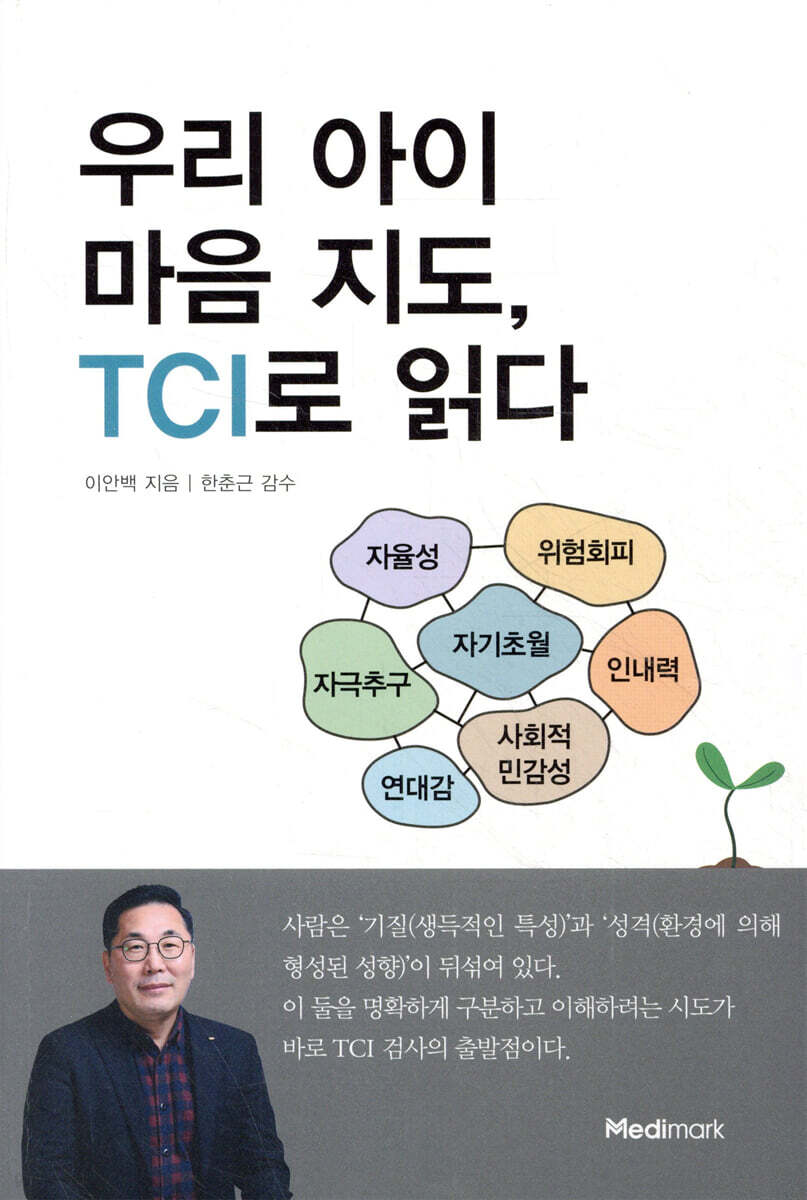
In particular, the seven core concepts of TCI, namely ‘stimulus seeking’, ‘risk aversion’, ‘patience’, ‘solidarity’, ‘autonomy’, ‘self-transcendence’, and ‘social sensitivity’, are explained through everyday examples, making it easy for even readers new to specialized knowledge to understand.
Above all, this book changes parents' perspectives.
It helps us see children as “beings to be understood” rather than “objects to be fixed.”
TCI scientifically proves that education begins with empathy, not instruction.
For parents who want to understand their children's minds and readers who want to reexamine the direction of their education, this book will provide both deep insight and practical wisdom.
If we compare temperament and personality to a car, it would be like this.
'Temperament' is the basic engine and performance of a car.
Some cars start off quickly and accelerate quickly, while others move slowly and steadily.
Personality is the way you drive the car.
The same car can run safely or speed dangerously depending on who is driving it.
The Value of TCI: Where Parental Observation Meets Science
Many parents say:
“Why does my child get angry so easily?”
“I have no perseverance and cannot concentrate.”
Although we observe children's behavior on a daily basis, there are limitations to scientifically analyzing where it comes from.
TCI is a tool that provides scientific language to these parents' concerns.
It helps us move beyond simple descriptions of behavior and understand the 'root causes' of that behavior.
Sociality isn't about being a 'good kid'.
A child with high social sensitivity (RD) is one who can read and empathize with others.
However, that sensitivity can easily lead to hiding oneself out of fear of being disliked or being rejected.
Conversely, children with low RD may have clear and confident thoughts, but may lack social consideration and emotional coordination.
Social sensitivity is not something to be fixed or evaluated, but rather a trait to be understood and coordinated.
Consideration is not oppression.
Raising cooperative children isn't simply about forcing them to "think of others first."
It's about giving children the opportunity to think for themselves about "Why is it important to help others?" and "What does it mean to live together?", and for parents to stay with them and seriously consider those questions.
A child who is considerate of others but does not ignore his or her own feelings, a child who is naturally warm without having to force himself or herself to be kind, such a child will grow up well without any special 'discipline'.
What that child needs is a model rather than words, empathy rather than rules.
Understanding personality and temperament, creating a foundation for living proactively.
Understanding a child's personality and temperament isn't simply about trying to guess what the child will be good at.
Rather, it is about laying the foundation to help children take the initiative in their own lives.
Some children are always exploring the world by trying new things, while others quietly dig deep into one thing.
Some children get their energy from relationships with people, while others find comfort in their own inner world.
In this way, each child lives with a different rhythm and in a different way.
"Reading Our Child's Mind Map with TCI" is a must-read book for parents concerned about the direction of their children's education.
Although there are numerous temperament and personality tests, the TCI stands out among them.
This is because it goes beyond simply dividing personality types and explains human behavior in a three-dimensional way by dividing it into two axes: ‘temperament’ and ‘personality.’
Temperament is the innate brain response tendency, while personality is formed through life experiences.
This book helps you understand 'why' your child's behavior through TCI.
A child who is distracted, easily bored, or overly cautious—all these behaviors reveal underlying brain structures and psychological motivations. The TCI is a compass that can decipher this complex mental map.
This book is not just a simple inspection guide.
It is a practical tool that helps parents understand their children as they are and develop educational strategies that are tailored to them.
In particular, the seven core concepts of TCI, namely ‘stimulus seeking’, ‘risk aversion’, ‘patience’, ‘solidarity’, ‘autonomy’, ‘self-transcendence’, and ‘social sensitivity’, are explained through everyday examples, making it easy for even readers new to specialized knowledge to understand.
Above all, this book changes parents' perspectives.
It helps us see children as “beings to be understood” rather than “objects to be fixed.”
TCI scientifically proves that education begins with empathy, not instruction.
For parents who want to understand their children's minds and readers who want to reexamine the direction of their education, this book will provide both deep insight and practical wisdom.
GOODS SPECIFICS
- Date of issue: August 20, 2025
- Page count, weight, size: 242 pages | 150*220*20mm
- ISBN13: 9791199326811
- ISBN10: 119932681X
You may also like
카테고리
korean


korean

![ELLE 엘르 스페셜 에디션 A형 : 12월 [2025]](http://librairie.coreenne.fr/cdn/shop/files/b8e27a3de6c9538896439686c6b0e8fb.jpg?v=1766436872&width=3840)


