

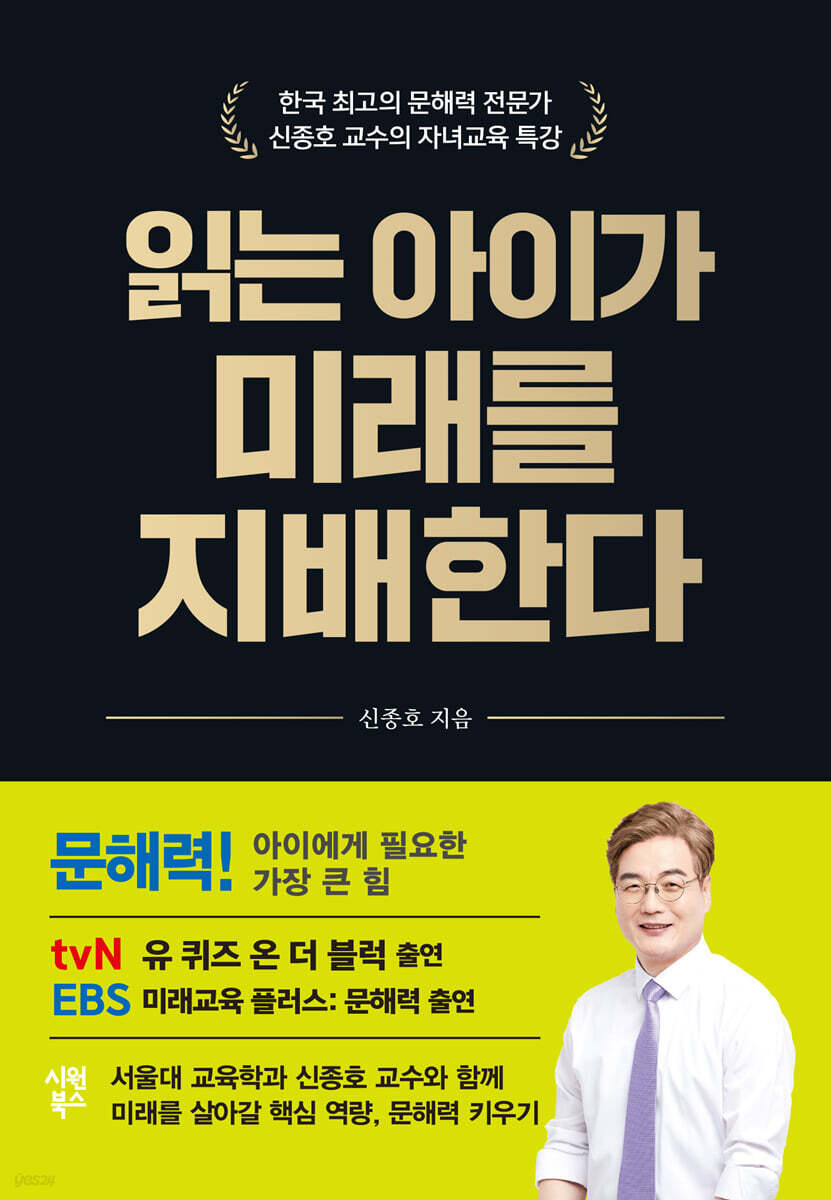
Children who read rule the future.
 |
Description
Book Introduction
Korea's top literacy expert
Professor Shin Jong-ho's special lecture on child education
The development of generative AI has made it possible to receive immediate assistance when we have questions. AI merely presents information, leaving it up to humans to discern the facts and make decisions.
While technology continues to advance, human ability to effectively understand and manipulate information is declining.
Rather, we blindly trust or passively accept AI, relying on the convenience of technology.
A high level of complex and three-dimensional ability is required to quickly and accurately grasp and judge information.
The issue of 'literacy' is becoming increasingly important these days.
Professor Jong-ho Shin of Seoul National University's Department of Education, who is Korea's top literacy expert and educational psychologist and appeared on EBS's "Future Education Plus: Literacy," published this book, "Children Who Read Rule the Future," to solve children's literacy problems.
Experts, including the author, unanimously say that the solution to the literacy problem lies 'in books.'
But to open a book, you have to cut through the temptations of countless distractions.
Instead of just entertaining video content and games, we desperately need opportunities for children to experience the "true charm of language and text."
Professor Shin Jong-ho personally titled this book, “Children Who Read Rule the Future,” to emphasize and spread the importance of literacy.
The author believes that children who read can become future leaders, and that literacy is no different from a survival kit.
This book will provide the most definitive and clear answers to what literacy is, why it is an essential skill for future society, and how to develop literacy in children.
Professor Shin Jong-ho's special lecture on child education
The development of generative AI has made it possible to receive immediate assistance when we have questions. AI merely presents information, leaving it up to humans to discern the facts and make decisions.
While technology continues to advance, human ability to effectively understand and manipulate information is declining.
Rather, we blindly trust or passively accept AI, relying on the convenience of technology.
A high level of complex and three-dimensional ability is required to quickly and accurately grasp and judge information.
The issue of 'literacy' is becoming increasingly important these days.
Professor Jong-ho Shin of Seoul National University's Department of Education, who is Korea's top literacy expert and educational psychologist and appeared on EBS's "Future Education Plus: Literacy," published this book, "Children Who Read Rule the Future," to solve children's literacy problems.
Experts, including the author, unanimously say that the solution to the literacy problem lies 'in books.'
But to open a book, you have to cut through the temptations of countless distractions.
Instead of just entertaining video content and games, we desperately need opportunities for children to experience the "true charm of language and text."
Professor Shin Jong-ho personally titled this book, “Children Who Read Rule the Future,” to emphasize and spread the importance of literacy.
The author believes that children who read can become future leaders, and that literacy is no different from a survival kit.
This book will provide the most definitive and clear answers to what literacy is, why it is an essential skill for future society, and how to develop literacy in children.
- You can preview some of the book's contents.
Preview
index
Introduction - A World Where We Can See But Not Read: The New Illiteracy Threatens Our Children's Future
Part 1.
A New Look at 21st Century Literacy
Chapter 1.
Literacy of the Past, Literacy of Today
· In the old days, it was enough to just know how to read and write.
· A deluge of information: A new literacy in the digital age
· The World Economic Forum defines literacy as "a core competency for future generations living in the 21st century."
· Literacy as a self-directed learning ability in the era of the half-life of knowledge and lifelong learning.
· In the zettabyte era, we must cultivate self-learning skills!
· Literacy: A Survival Kit for Future Society
Chapter 2.
Modern Society and the Literacy Crisis
· The disappearing intelligence and literacy of the future
· A turning point in knowledge: The crisis and challenge of deep thinking
· Paradox of the Digital Age: What We Lose in Return of Convenience
· In the age of video, smart devices are raising children!
· The threat of multitasking to literacy
Chapter 3.
Attention and concentration crisis
The 'Attention Economy' Threatens Our Children's Literacy
· The Age of Compression and Summary: The Threat of "Knowledge Fast Food"
· Quick skimming reading culture
· 15 seconds of temptation
· Aversion to long texts
· How should we respond to the challenges of literacy?
Chapter 4.
Literacy status by generation
Warning Signs of the Digital Age: Declining Teenage Literacy
· 11 hours of study a day, reading a book that can't even be read for 10 minutes
· I hate reading books so much!
· The joy of reading that is being killed by reading logs, and school reading for evaluation
· There are many books, but nothing to read?
· Adult literacy is also at risk; parents who can't even read the school newsletter
· Adults who don't read books are creating children who don't read books!
· Corporate concerns about the literacy of today's generation
Part 2.
Brain development and literacy
Chapter 1.
Critical period for brain development
· Golden time for the development of a child's brain and literacy: Ages 3-8
· Early literacy skills that influence a child's entire life
· Early literacy skills created together by parents
· The Horizon of Thought Created by Language: Vygotsky's Insights
· The practical story that Vygotsky gives us
Chapter 2.
Digital environment and the brain
· The Brain Changes: The Brain of Images, Popcorn Brain
· Blue brain stained with blue screen
· Save your child's brain from the digital storm!
Reading and Brain Development: What the Prefrontal Cortex Tells Us
Part 3.
Vocabulary and thinking skills
Chapter 1.
The importance of vocabulary
· Vocabulary crisis: The bricks of thought are crumbling.
· The 30 million word gap: The invisible line that divides our children's future.
· Children who are losing their emotions: The size of the heart determined by vocabulary
Chapter 2.
Vocabulary and Learning
· The Magic of Vocabulary: Discovering the Golden Key to Learning Success
· The Magic of Literacy: A New World Opened by a Single Word
· Learning gaps that begin with early vocabulary problems
Part 4.
Effective Reading Methods
Chapter 1.
In-depth reading
· Cognitive friction and deep reading
· Depth reading from the perspective of processing level theory
· Deep reading, the power to overcome knowledge illusions
· Create your own meaning, create effects
· Reading using the generative effect
· Reading through the question 'why'
Chapter 2.
Various reading strategies
· Read out loud slowly
· Repeated reading and expansion of thoughts
Crossover Reading: The Beginning of Creative Literacy
· Picky readers? Develop your thinking skills through immersive reading.
Chapter 3.
Reading Methods by Media
· Paper book or e-book?
· The Age of Diverse Reading Media: What About Audiobooks?
· Despite its limitations, the value of audiobooks is worth exploring further.
· Effective use of audiobooks, multimodal reading, and active listening
Part 5.
Literacy Education at Home
Chapter 1.
Creating a reading environment
· Our home becomes a library!
· How to Create a Smart Literacy Environment in the Digital Age
· Our family's digital detox
· Parents who read books create children who read books.
· "It's okay to say anything" to foster psychological safety
Chapter 2.
Reading instruction methods
· Is it a good book or a book you like?
· Guaranteeing freedom of choice in reading books
· The journey of reading becomes richer when we spend it together!
· The Bookshelf of Life: The Beginning of Our Children's Self and Literacy Journey
Chapter 3.
Creative Reading Cases
Elon Musk, a man born from a love of science fiction reading
· Einstein's childhood reading story
· An episode from the young Goethe's 'Interrupted Story'
· Another story about young Goethe, Playbox Play
· "My life is a daily cycle of question marks and exclamation points!" Lee Eo-ryeong's story
Concluding Remarks - Literacy: The Light That Brightens Our Children's Future
References
Part 1.
A New Look at 21st Century Literacy
Chapter 1.
Literacy of the Past, Literacy of Today
· In the old days, it was enough to just know how to read and write.
· A deluge of information: A new literacy in the digital age
· The World Economic Forum defines literacy as "a core competency for future generations living in the 21st century."
· Literacy as a self-directed learning ability in the era of the half-life of knowledge and lifelong learning.
· In the zettabyte era, we must cultivate self-learning skills!
· Literacy: A Survival Kit for Future Society
Chapter 2.
Modern Society and the Literacy Crisis
· The disappearing intelligence and literacy of the future
· A turning point in knowledge: The crisis and challenge of deep thinking
· Paradox of the Digital Age: What We Lose in Return of Convenience
· In the age of video, smart devices are raising children!
· The threat of multitasking to literacy
Chapter 3.
Attention and concentration crisis
The 'Attention Economy' Threatens Our Children's Literacy
· The Age of Compression and Summary: The Threat of "Knowledge Fast Food"
· Quick skimming reading culture
· 15 seconds of temptation
· Aversion to long texts
· How should we respond to the challenges of literacy?
Chapter 4.
Literacy status by generation
Warning Signs of the Digital Age: Declining Teenage Literacy
· 11 hours of study a day, reading a book that can't even be read for 10 minutes
· I hate reading books so much!
· The joy of reading that is being killed by reading logs, and school reading for evaluation
· There are many books, but nothing to read?
· Adult literacy is also at risk; parents who can't even read the school newsletter
· Adults who don't read books are creating children who don't read books!
· Corporate concerns about the literacy of today's generation
Part 2.
Brain development and literacy
Chapter 1.
Critical period for brain development
· Golden time for the development of a child's brain and literacy: Ages 3-8
· Early literacy skills that influence a child's entire life
· Early literacy skills created together by parents
· The Horizon of Thought Created by Language: Vygotsky's Insights
· The practical story that Vygotsky gives us
Chapter 2.
Digital environment and the brain
· The Brain Changes: The Brain of Images, Popcorn Brain
· Blue brain stained with blue screen
· Save your child's brain from the digital storm!
Reading and Brain Development: What the Prefrontal Cortex Tells Us
Part 3.
Vocabulary and thinking skills
Chapter 1.
The importance of vocabulary
· Vocabulary crisis: The bricks of thought are crumbling.
· The 30 million word gap: The invisible line that divides our children's future.
· Children who are losing their emotions: The size of the heart determined by vocabulary
Chapter 2.
Vocabulary and Learning
· The Magic of Vocabulary: Discovering the Golden Key to Learning Success
· The Magic of Literacy: A New World Opened by a Single Word
· Learning gaps that begin with early vocabulary problems
Part 4.
Effective Reading Methods
Chapter 1.
In-depth reading
· Cognitive friction and deep reading
· Depth reading from the perspective of processing level theory
· Deep reading, the power to overcome knowledge illusions
· Create your own meaning, create effects
· Reading using the generative effect
· Reading through the question 'why'
Chapter 2.
Various reading strategies
· Read out loud slowly
· Repeated reading and expansion of thoughts
Crossover Reading: The Beginning of Creative Literacy
· Picky readers? Develop your thinking skills through immersive reading.
Chapter 3.
Reading Methods by Media
· Paper book or e-book?
· The Age of Diverse Reading Media: What About Audiobooks?
· Despite its limitations, the value of audiobooks is worth exploring further.
· Effective use of audiobooks, multimodal reading, and active listening
Part 5.
Literacy Education at Home
Chapter 1.
Creating a reading environment
· Our home becomes a library!
· How to Create a Smart Literacy Environment in the Digital Age
· Our family's digital detox
· Parents who read books create children who read books.
· "It's okay to say anything" to foster psychological safety
Chapter 2.
Reading instruction methods
· Is it a good book or a book you like?
· Guaranteeing freedom of choice in reading books
· The journey of reading becomes richer when we spend it together!
· The Bookshelf of Life: The Beginning of Our Children's Self and Literacy Journey
Chapter 3.
Creative Reading Cases
Elon Musk, a man born from a love of science fiction reading
· Einstein's childhood reading story
· An episode from the young Goethe's 'Interrupted Story'
· Another story about young Goethe, Playbox Play
· "My life is a daily cycle of question marks and exclamation points!" Lee Eo-ryeong's story
Concluding Remarks - Literacy: The Light That Brightens Our Children's Future
References
Detailed image

Publisher's Review
Even as AI technology advances, the answer lies in books!
Books: The Perfect Tool for Developing the Human Brain
21st Century Literacy Emphasized by the OECD
The word 'literacy' is now used naturally throughout our society.
We often hear about the 'importance of literacy'.
But how many people can truly answer the question of what literacy is? The OECD defines literacy as follows:
The OECD emphasizes "new literacy in the digital age."
: To achieve their goals, develop their knowledge and potential, and participate in society.
Ability to understand, evaluate, and utilize various forms of documented text
Literacy goes beyond simply the ability to read and understand text.
It is an essential ability for survival, including 'development of individual knowledge and potential, goal achievement, and social participation.'
To achieve this ability, one must be able to 'understand, evaluate, and utilize various forms of documented text.'
In other words, the ability to understand, judge, and utilize ‘text’ must be very excellent.
Professor Jong-ho Shin of Seoul National University's Department of Education, author of the book "Children Who Read Rule the Future," also emphasizes that "literacy" is "a survival kit essential for living in the future society."
Why are books the most perfect tool for humans?
The answer to literacy education lies in the 'prefrontal cortex'!
It seems somewhat contradictory that the core competency needed by humans in the age of artificial intelligence is literacy.
Wouldn't jobs that can only be performed by humans, rather than being replaced by computer programming, information technology, or AI, be more advantageous for survival and adaptation in future society?
Professor Shin Jong-ho says that this question was the same in the 20th century.
When Edison invented the motion picture projector, which became the precursor to today's cinema, in the early 20th century, he predicted that "motion pictures will completely revolutionize our education system and replace most textbooks within 20 years."
But even after 100 years, textbooks have not disappeared.
No matter how much science and technology advance, the reason books never disappear and the power of text is still emphasized is none other than the 'principles of the human brain.'
Professor Shin Jong-ho does not simply advocate for 'books', an old and familiar medium, but says that the prefrontal cortex, the most important part of the human brain responsible for deep thinking, is most activated and develops when reading text in the form of a book.
In other words, the reason why books do not disappear even with the advancement of science and technology is because the human brain is most active when reading a book.
The most powerful tool that can maximize the prefrontal cortex, which is responsible for concentration and thinking skills, is a 'book'.
The simple truth that reading develops the human prefrontal cortex and allows humans to 'level up' most quickly and reliably is that accurately understanding this truth is the right answer and solution to competitiveness in the future society.
Based on these research results, Professor Shin Jong-ho presents specific directions and methods for literacy education in “Children Who Read Rule the Future.”
'Only I Level Up' in the book!
Let's realize the importance of developing children's thinking and empathy.
Curiously, the human prefrontal cortex does not respond at all when watching videos.
Why didn't video replace books even a century ago? Even today, a century later, with the explosive development of artificial intelligence, experts still emphasize "literacy" and emphasize "books." It's because of the truth of brain science, which remains unchanged unless the human brain is replaced by machines.
Of course, books and videos have different characteristics as media, and videos are easier to watch than books.
Needless to say, the game is fun.
Professor Shin Jong-ho explains that while videos and games, like fast food, stimulate the brain quickly by releasing dopamine as an immediate reward system, books, like healthy food, slowly release serotonin, which provides deep satisfaction and helps the brain develop.
Professor Shin Jong-ho, Korea's leading literacy expert and educator, emphasizes that "we need to shift the balance from digital brains to analog brains" to "enhance children's healthy brain development and learning abilities."
However, it is not that reading activities have not been emphasized to children at home, at school, and in society.
We have been striving to help children experience and enjoy reading through various related activities, ongoing reading campaigns, and programs, as well as through classroom instruction.
However, despite all the reading promotion activities and efforts, most children are more enthusiastic about YouTube videos and games than books and do not read books well, and when they become adults, their reading volume drops to a serious level.
As a result, some people misunderstand simple vocabulary that was used at a common level in the past, and even after entering the company, they have difficulty reading long documents and have difficulty understanding them properly.
Moreover, even though artificial intelligence has developed and we can easily and quickly obtain the information we want, we are often left behind because we cannot properly determine the truth of the information, leading to confusion or being unable to effectively utilize the information.
Professor Shin Jong-ho warns that children, so-called “digital natives,” are “paradoxically losing the most basic life skills.”
When children are skillfully using their smartphones and can't take their eyes off the screen, their brains are left without any important stimulation.
Professor Shin Jong-ho speaks of the most basic life skills, the core competencies for surviving in the future, and literacy, which the OECD also emphasizes, are not given automatically and require sufficient time and processes to "level up."
It's not just that the child's willpower is weak.
The author emphasizes that guiding children's prefrontal cortex development is something that schools, society, families, and parents must do.
Parents' Reading: The Invisible Power of Education!
A precious light that illuminates a child's future
Schools consider reading education important and are conducting evaluation activities such as submitting reading logs and reading reports.
However, educators warn that these assessment activities can have a negative impact on children by creating 'formal reading' and 'instrumental reading' that is focused on filling in numbers.
It ends up being reading for essays and self-introductions.
The best way to develop a child's prefrontal cortex is to help them read on their own.
To achieve this, it is necessary to stimulate the child's curiosity and interest in everyday life.
Professor Shin Jong-ho emphasizes, “The most powerful teacher in literacy development is the daily life of parents,” and “Children who grow up under parents who love books will naturally come to love books, and this will become a lifelong asset that enriches their lives.”
This is what the author calls the 'invisible power of education' and 'the greatest secret to literacy development.'
If you follow the reading methods suggested by the author, such as creating a natural reading environment, allowing your child to read books on topics or fields that they like, talking freely while reading and listening, making them feel safe that it's okay to make mistakes, and not stopping them when they become absorbed in one field of reading (unlike food, it's okay to be picky about reading!), and help your child develop a habit of reading books on their own, it will become a "strong support that protects our children."
Keeping in mind that books and reading will never disappear because they are embedded in our brains, let's take a step into "One Book," the most reliable and safe tool for nurturing literacy for a child's future.
Books: The Perfect Tool for Developing the Human Brain
21st Century Literacy Emphasized by the OECD
The word 'literacy' is now used naturally throughout our society.
We often hear about the 'importance of literacy'.
But how many people can truly answer the question of what literacy is? The OECD defines literacy as follows:
The OECD emphasizes "new literacy in the digital age."
: To achieve their goals, develop their knowledge and potential, and participate in society.
Ability to understand, evaluate, and utilize various forms of documented text
Literacy goes beyond simply the ability to read and understand text.
It is an essential ability for survival, including 'development of individual knowledge and potential, goal achievement, and social participation.'
To achieve this ability, one must be able to 'understand, evaluate, and utilize various forms of documented text.'
In other words, the ability to understand, judge, and utilize ‘text’ must be very excellent.
Professor Jong-ho Shin of Seoul National University's Department of Education, author of the book "Children Who Read Rule the Future," also emphasizes that "literacy" is "a survival kit essential for living in the future society."
Why are books the most perfect tool for humans?
The answer to literacy education lies in the 'prefrontal cortex'!
It seems somewhat contradictory that the core competency needed by humans in the age of artificial intelligence is literacy.
Wouldn't jobs that can only be performed by humans, rather than being replaced by computer programming, information technology, or AI, be more advantageous for survival and adaptation in future society?
Professor Shin Jong-ho says that this question was the same in the 20th century.
When Edison invented the motion picture projector, which became the precursor to today's cinema, in the early 20th century, he predicted that "motion pictures will completely revolutionize our education system and replace most textbooks within 20 years."
But even after 100 years, textbooks have not disappeared.
No matter how much science and technology advance, the reason books never disappear and the power of text is still emphasized is none other than the 'principles of the human brain.'
Professor Shin Jong-ho does not simply advocate for 'books', an old and familiar medium, but says that the prefrontal cortex, the most important part of the human brain responsible for deep thinking, is most activated and develops when reading text in the form of a book.
In other words, the reason why books do not disappear even with the advancement of science and technology is because the human brain is most active when reading a book.
The most powerful tool that can maximize the prefrontal cortex, which is responsible for concentration and thinking skills, is a 'book'.
The simple truth that reading develops the human prefrontal cortex and allows humans to 'level up' most quickly and reliably is that accurately understanding this truth is the right answer and solution to competitiveness in the future society.
Based on these research results, Professor Shin Jong-ho presents specific directions and methods for literacy education in “Children Who Read Rule the Future.”
'Only I Level Up' in the book!
Let's realize the importance of developing children's thinking and empathy.
Curiously, the human prefrontal cortex does not respond at all when watching videos.
Why didn't video replace books even a century ago? Even today, a century later, with the explosive development of artificial intelligence, experts still emphasize "literacy" and emphasize "books." It's because of the truth of brain science, which remains unchanged unless the human brain is replaced by machines.
Of course, books and videos have different characteristics as media, and videos are easier to watch than books.
Needless to say, the game is fun.
Professor Shin Jong-ho explains that while videos and games, like fast food, stimulate the brain quickly by releasing dopamine as an immediate reward system, books, like healthy food, slowly release serotonin, which provides deep satisfaction and helps the brain develop.
Professor Shin Jong-ho, Korea's leading literacy expert and educator, emphasizes that "we need to shift the balance from digital brains to analog brains" to "enhance children's healthy brain development and learning abilities."
However, it is not that reading activities have not been emphasized to children at home, at school, and in society.
We have been striving to help children experience and enjoy reading through various related activities, ongoing reading campaigns, and programs, as well as through classroom instruction.
However, despite all the reading promotion activities and efforts, most children are more enthusiastic about YouTube videos and games than books and do not read books well, and when they become adults, their reading volume drops to a serious level.
As a result, some people misunderstand simple vocabulary that was used at a common level in the past, and even after entering the company, they have difficulty reading long documents and have difficulty understanding them properly.
Moreover, even though artificial intelligence has developed and we can easily and quickly obtain the information we want, we are often left behind because we cannot properly determine the truth of the information, leading to confusion or being unable to effectively utilize the information.
Professor Shin Jong-ho warns that children, so-called “digital natives,” are “paradoxically losing the most basic life skills.”
When children are skillfully using their smartphones and can't take their eyes off the screen, their brains are left without any important stimulation.
Professor Shin Jong-ho speaks of the most basic life skills, the core competencies for surviving in the future, and literacy, which the OECD also emphasizes, are not given automatically and require sufficient time and processes to "level up."
It's not just that the child's willpower is weak.
The author emphasizes that guiding children's prefrontal cortex development is something that schools, society, families, and parents must do.
Parents' Reading: The Invisible Power of Education!
A precious light that illuminates a child's future
Schools consider reading education important and are conducting evaluation activities such as submitting reading logs and reading reports.
However, educators warn that these assessment activities can have a negative impact on children by creating 'formal reading' and 'instrumental reading' that is focused on filling in numbers.
It ends up being reading for essays and self-introductions.
The best way to develop a child's prefrontal cortex is to help them read on their own.
To achieve this, it is necessary to stimulate the child's curiosity and interest in everyday life.
Professor Shin Jong-ho emphasizes, “The most powerful teacher in literacy development is the daily life of parents,” and “Children who grow up under parents who love books will naturally come to love books, and this will become a lifelong asset that enriches their lives.”
This is what the author calls the 'invisible power of education' and 'the greatest secret to literacy development.'
If you follow the reading methods suggested by the author, such as creating a natural reading environment, allowing your child to read books on topics or fields that they like, talking freely while reading and listening, making them feel safe that it's okay to make mistakes, and not stopping them when they become absorbed in one field of reading (unlike food, it's okay to be picky about reading!), and help your child develop a habit of reading books on their own, it will become a "strong support that protects our children."
Keeping in mind that books and reading will never disappear because they are embedded in our brains, let's take a step into "One Book," the most reliable and safe tool for nurturing literacy for a child's future.
GOODS SPECIFICS
- Date of issue: March 28, 2025
- Format: Hardcover book binding method guide
- Page count, weight, size: 360 pages | 128*188*30mm
- ISBN13: 9791161509549
- ISBN10: 1161509542
You may also like
카테고리
korean


korean

![GQ KOREA Mark (Monthly): December [2025]](http://librairie.coreenne.fr/cdn/shop/files/8ef265dbbfbf186523ed75ba7319009d.jpg?v=1765340328&width=3840)


