

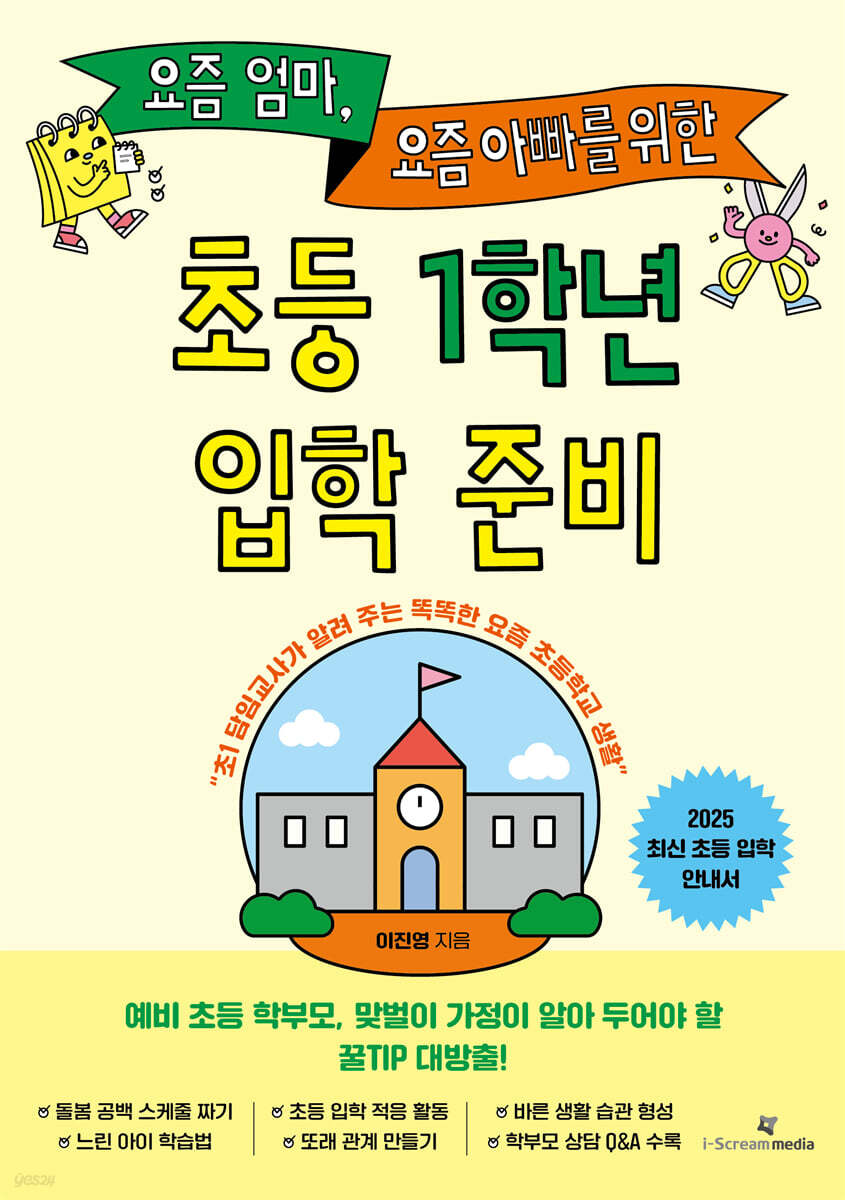
Preparing for first grade for today's moms and dads
 |
Description
Book Introduction
'My child's elementary school life is different from when Mom and Dad were together.
How should I prepare?'
Elementary School Admissions Encyclopedia for Prospective Elementary School Parents and Dual-Income Families
If you are a prospective parent preparing to send your small and young child to elementary school, you are bound to feel a sense of pride and excitement, but also a sense of anxiety and tension.
Especially for working parents, it is not easy to balance work and parenting during the first year of elementary school, as the child's entry into elementary school is called the "last cliff of a career break."
So, is it just a parent's greed to want to raise their child properly while maintaining their own life and also taking care of their child's school life?
Should a child's admission to school be a source of worry rather than anticipation for parents?
A guidebook for elementary school admissions for prospective parents and dual-income families with these concerns, "Preparing for 1st Grade Elementary School Admissions for Today's Moms and Dads," has been published.
The author, Jinyoung Lee, has been a teacher for 10 years and has a special background of teaching first graders for 7 of those years.
He studied the early adjustment activities of first-year elementary school students at the Graduate School of Education at Gyeongin National University of Education, and also lectured on the job training recommended to first-year teachers by the KERIS (Korea Education and Research Information Service) review committee. He is known as “Nyong-Teacher,” a “first-year specialist homeroom teacher,” among fellow teachers and many parents of younger students.
This book was written for busy and anxious mothers and fathers these days, and contains information on basic preparations for entering elementary school, as well as educational methods and school life information on key habits that children must develop during this period.
Expectant parents anxiously search for information on elementary education, but it is not easy to distinguish between the good and the bad.
The author takes readers on a sneak peek into the first year of school, sorting out what's important and what's not, what's urgent and what's not, while also sharing small but useful stories, such as things to keep in mind during the initial adjustment period in early March and tips for planning your after-school schedule.
How should I prepare?'
Elementary School Admissions Encyclopedia for Prospective Elementary School Parents and Dual-Income Families
If you are a prospective parent preparing to send your small and young child to elementary school, you are bound to feel a sense of pride and excitement, but also a sense of anxiety and tension.
Especially for working parents, it is not easy to balance work and parenting during the first year of elementary school, as the child's entry into elementary school is called the "last cliff of a career break."
So, is it just a parent's greed to want to raise their child properly while maintaining their own life and also taking care of their child's school life?
Should a child's admission to school be a source of worry rather than anticipation for parents?
A guidebook for elementary school admissions for prospective parents and dual-income families with these concerns, "Preparing for 1st Grade Elementary School Admissions for Today's Moms and Dads," has been published.
The author, Jinyoung Lee, has been a teacher for 10 years and has a special background of teaching first graders for 7 of those years.
He studied the early adjustment activities of first-year elementary school students at the Graduate School of Education at Gyeongin National University of Education, and also lectured on the job training recommended to first-year teachers by the KERIS (Korea Education and Research Information Service) review committee. He is known as “Nyong-Teacher,” a “first-year specialist homeroom teacher,” among fellow teachers and many parents of younger students.
This book was written for busy and anxious mothers and fathers these days, and contains information on basic preparations for entering elementary school, as well as educational methods and school life information on key habits that children must develop during this period.
Expectant parents anxiously search for information on elementary education, but it is not easy to distinguish between the good and the bad.
The author takes readers on a sneak peek into the first year of school, sorting out what's important and what's not, what's urgent and what's not, while also sharing small but useful stories, such as things to keep in mind during the initial adjustment period in early March and tips for planning your after-school schedule.
- You can preview some of the book's contents.
Preview
index
Prologue | Supporting the new beginnings of all families with first-grade elementary school students.
Chapter 1.
I'm about to enter elementary school.
Part 1.
My child is ready for school
1.
Seven Lifestyle Habits to Develop Before Entering School
2.
Developing motor skills before entering school ① Fine motor skills
Origami Creator Recommendations | Craft Creator Recommendations
3.
Developing motor skills before entering school ② Gross muscle exercises
4.
Should I learn Korean before entering school?
5.
Things you don't have to worry about practicing before entering school
Part 2.
Checklist for Parents Before Admission
1.
Must-Read Before Admission! Four Things to Do in February
Planning your after-school schedule
2.
Elementary school parents prepare their hearts
3.
Elementary School Preparation Tips: What to Buy, What Not to Buy, and How to Take It Slow
4.
elementary school student's school bag
Chapter 2.
My child is going to school now.
Part 1.
Elementary School Admission Procedures
1.
Choosing an elementary school
2.
School admission notice and preliminary summons
3.
How will my child be assigned to a class?
Part 2.
My child's school life
1.
Elementary school morning commute time
2.
Early March admission adjustment period
3.
First graders' schedule
4.
First graders in class
5.
Variables in school life that dual-income families should be aware of
Part 3.
Developing social skills for a pleasant school life
1.
Clean and tidy
2.
Say hello well
3.
Acknowledge each other
4.
How to say 'I'm sorry' and 'thank you' properly
5.
Look into each other's eyes and listen
Part 4.
Preview of School Life for Parents
1.
Preview elementary school events
2.
Is it necessary to join a parent group?
3.
What should I do in these cases of elementary school absences?
Chapter 3.
Hello! First grade curriculum preparation
Part 1.
Korean
1.
What will we learn?
2.
How can I help at home?
Recommended list of books included in Korean language textbooks
Part 2.
math
1.
What will we learn?
2.
How can I help at home?
Recommended teaching aids and board games to enhance math learning skills
Part 3.
Integrated curriculum
1.
What is an integrated curriculum?
2.
What will we learn?
3.
How can I help at home?
Recommended list of integrated curriculum textbooks and related books
Part 4.
Creative experiential activities
1.
What will we learn in a creative class without textbooks?
Chapter 4.
Mom and Dad, this is your first time being parents too.
Part 1.
Rules for a good life for elementary school students
1.
Dinner with conversation
2.
Housework education methods that foster children's independence
3.
How to Use Your Smartphone Wisely
4.
Economic education starting with pocket money
5.
Creating a learning space
6.
Please make sure to bring this
Part 2.
Parents' Concerns: ① I have a difficult relationship with my teacher.
1.
March, how much should I say about my child?
2.
How can I contact you?
3.
Can I buy coffee during parent-teacher conferences?
Part 3.
Parents' Counseling ② Is my child okay?
1.
He says he doesn't want to go to school.
2.
I often say it's not fun
3.
I don't think I have any friends at school.
4.
Keep hugging other friends
5.
Every morning is a war
6.
I heard that the child has trouble concentrating.
7.
We don't talk about school at all
Chapter 1.
I'm about to enter elementary school.
Part 1.
My child is ready for school
1.
Seven Lifestyle Habits to Develop Before Entering School
2.
Developing motor skills before entering school ① Fine motor skills
Origami Creator Recommendations | Craft Creator Recommendations
3.
Developing motor skills before entering school ② Gross muscle exercises
4.
Should I learn Korean before entering school?
5.
Things you don't have to worry about practicing before entering school
Part 2.
Checklist for Parents Before Admission
1.
Must-Read Before Admission! Four Things to Do in February
Planning your after-school schedule
2.
Elementary school parents prepare their hearts
3.
Elementary School Preparation Tips: What to Buy, What Not to Buy, and How to Take It Slow
4.
elementary school student's school bag
Chapter 2.
My child is going to school now.
Part 1.
Elementary School Admission Procedures
1.
Choosing an elementary school
2.
School admission notice and preliminary summons
3.
How will my child be assigned to a class?
Part 2.
My child's school life
1.
Elementary school morning commute time
2.
Early March admission adjustment period
3.
First graders' schedule
4.
First graders in class
5.
Variables in school life that dual-income families should be aware of
Part 3.
Developing social skills for a pleasant school life
1.
Clean and tidy
2.
Say hello well
3.
Acknowledge each other
4.
How to say 'I'm sorry' and 'thank you' properly
5.
Look into each other's eyes and listen
Part 4.
Preview of School Life for Parents
1.
Preview elementary school events
2.
Is it necessary to join a parent group?
3.
What should I do in these cases of elementary school absences?
Chapter 3.
Hello! First grade curriculum preparation
Part 1.
Korean
1.
What will we learn?
2.
How can I help at home?
Recommended list of books included in Korean language textbooks
Part 2.
math
1.
What will we learn?
2.
How can I help at home?
Recommended teaching aids and board games to enhance math learning skills
Part 3.
Integrated curriculum
1.
What is an integrated curriculum?
2.
What will we learn?
3.
How can I help at home?
Recommended list of integrated curriculum textbooks and related books
Part 4.
Creative experiential activities
1.
What will we learn in a creative class without textbooks?
Chapter 4.
Mom and Dad, this is your first time being parents too.
Part 1.
Rules for a good life for elementary school students
1.
Dinner with conversation
2.
Housework education methods that foster children's independence
3.
How to Use Your Smartphone Wisely
4.
Economic education starting with pocket money
5.
Creating a learning space
6.
Please make sure to bring this
Part 2.
Parents' Concerns: ① I have a difficult relationship with my teacher.
1.
March, how much should I say about my child?
2.
How can I contact you?
3.
Can I buy coffee during parent-teacher conferences?
Part 3.
Parents' Counseling ② Is my child okay?
1.
He says he doesn't want to go to school.
2.
I often say it's not fun
3.
I don't think I have any friends at school.
4.
Keep hugging other friends
5.
Every morning is a war
6.
I heard that the child has trouble concentrating.
7.
We don't talk about school at all
Detailed image

Into the book
I've seen that even if children don't eat well at first, they eventually adapt as they live with their friends and eat spicy food one by one.
Unless you are a student who cannot eat spicy food at all, you can grow up naturally while being exposed to it at school.
As a side note, first graders often brag about eating spicy food because they want to seem more mature.
“I also tried spicy chicken stir-fried noodles at that restaurant!”
“Shin Ramyun isn’t that spicy, right?”
Every year, without fail, I hear the kids' cute boasts about spicy food.
These are cute first graders who are inspired to try spicy food after hearing their friends' words.
--- p.20~21
However, elementary school is where children begin to stand on their own feet under the attention of adults.
As parents who have raised children know best, the more opportunities children are given and the more trial and error they experience, the more they can do.
It's important to allow yourself to make mistakes when you can.
--- p.22~23
Being able to open a milk carton yourself will allow you to confidently choose from a variety of milk carton-style beverages at the supermarket or convenience store.
It's hard to choose a drink that you can't drink yourself.
Having more choices and more things to do on your own will help build your child's self-esteem.
--- p.26
Many people these days say that children are too assertive, but the children I've observed only act stubbornly when they're comfortable with their parents.
Rather, there is a growing number of children who cannot speak up when they really need to say something or ask for help.
The same applies when teaching in the classroom.
There are children who, while coloring in the design on their worksheets, bring their worksheets to their homeroom teacher and keep their mouths shut.
He just stares blankly at me, so when I ask, “Why? What’s wrong?” he doesn’t say anything and just blurts out his study book.
It means that it is wrong and you want it again.
It would be great if you could come out and express your opinion through action.
Some children just sit still and wait without doing anything.
It's about silently watching the teacher realize that you're wrong.
(…syncopation…)
Now that you've heard this, you might be worried that your child might do the same. This can be improved with practice at home.
It's actually very simple.
Just pretend you don't know until the child expresses it.
--- p.69
Very rarely, there are children with dyslexia.
Dyslexia is a learning disability that causes significant difficulty in reading.
If you have dyslexia, you can see and write, but you cannot take dictation.
Also, it is difficult to read and understand alone, but if someone reads the same text next to you, you will understand.
The period when children with dyslexia become more evident is July and August.
Usually, students learn Korean intensively from March to May of the first year.
If this period has passed and it is now July or August and there has been no significant change in your child's reading and writing compared to before entering school, it is recommended that you consult with the homeroom teacher.
--- p.199
When observed in classrooms, many children have more difficulty with horizontal arithmetic, where the units and tens digits are not readily distinguishable, than with vertical arithmetic, where the units and tens digits are readily distinguishable.
Just by solving a few arithmetic problems involving vertical and horizontal addition, you will be able to calculate fluently without being restricted by format.
Unless you are a student who cannot eat spicy food at all, you can grow up naturally while being exposed to it at school.
As a side note, first graders often brag about eating spicy food because they want to seem more mature.
“I also tried spicy chicken stir-fried noodles at that restaurant!”
“Shin Ramyun isn’t that spicy, right?”
Every year, without fail, I hear the kids' cute boasts about spicy food.
These are cute first graders who are inspired to try spicy food after hearing their friends' words.
--- p.20~21
However, elementary school is where children begin to stand on their own feet under the attention of adults.
As parents who have raised children know best, the more opportunities children are given and the more trial and error they experience, the more they can do.
It's important to allow yourself to make mistakes when you can.
--- p.22~23
Being able to open a milk carton yourself will allow you to confidently choose from a variety of milk carton-style beverages at the supermarket or convenience store.
It's hard to choose a drink that you can't drink yourself.
Having more choices and more things to do on your own will help build your child's self-esteem.
--- p.26
Many people these days say that children are too assertive, but the children I've observed only act stubbornly when they're comfortable with their parents.
Rather, there is a growing number of children who cannot speak up when they really need to say something or ask for help.
The same applies when teaching in the classroom.
There are children who, while coloring in the design on their worksheets, bring their worksheets to their homeroom teacher and keep their mouths shut.
He just stares blankly at me, so when I ask, “Why? What’s wrong?” he doesn’t say anything and just blurts out his study book.
It means that it is wrong and you want it again.
It would be great if you could come out and express your opinion through action.
Some children just sit still and wait without doing anything.
It's about silently watching the teacher realize that you're wrong.
(…syncopation…)
Now that you've heard this, you might be worried that your child might do the same. This can be improved with practice at home.
It's actually very simple.
Just pretend you don't know until the child expresses it.
--- p.69
Very rarely, there are children with dyslexia.
Dyslexia is a learning disability that causes significant difficulty in reading.
If you have dyslexia, you can see and write, but you cannot take dictation.
Also, it is difficult to read and understand alone, but if someone reads the same text next to you, you will understand.
The period when children with dyslexia become more evident is July and August.
Usually, students learn Korean intensively from March to May of the first year.
If this period has passed and it is now July or August and there has been no significant change in your child's reading and writing compared to before entering school, it is recommended that you consult with the homeroom teacher.
--- p.199
When observed in classrooms, many children have more difficulty with horizontal arithmetic, where the units and tens digits are not readily distinguishable, than with vertical arithmetic, where the units and tens digits are readily distinguishable.
Just by solving a few arithmetic problems involving vertical and horizontal addition, you will be able to calculate fluently without being restricted by format.
--- p.215
Publisher's Review
“Mom, you don’t have to quit work.
The child is growing well and will grow well.
“Don’t worry too much.”
Reduces the anxiety of parents and increases the child's confidence
Practical advice from a first-grade teacher
Elementary school is an institution that fosters and expects children to develop autonomy and independence, and from this point on, children experience a variety of things and emotions they have never experienced before.
The author advises that children who do many things on their own have stronger self-esteem, and first informs prospective parents of things they can prepare at home to help their children adjust to first grade elementary school life.
If you look at the table of contents of this book, which consists of four chapters, you can see that each chapter is divided into a section for children and a section for parents.
The first chapter, "Preparing to Enter Elementary School," covers how to develop children's lifestyle habits and motor skills before entering elementary school, as well as Korean language education.
Elementary school is a place where first graders (ages 6-7) spend time with sixth graders, so the living environment is completely different from that of early childhood institutions.
This chapter provides ways to help your child adjust to the unfamiliar school environment while also assessing his or her developmental progress.
Next, the parent section includes a comprehensive list of things to check before school starts, including things to know in advance when planning your child's schedule after school and tips for choosing supplies.
The second chapter, "My Child, Now Going to School," addresses questions about elementary school admission procedures and school life in general.
It carefully addresses everything from questions about the preliminary assembly and school enrollment notice procedures and class assignments to, for working parents, how many annual leave days they should expect to use for future school events.
This chapter also discusses how to develop social skills, which are essential for children's enjoyable and successful school life, through classroom examples.
The third chapter, "Hello! Preparing for First-Grade Curriculum Learning," explores Korean, mathematics, integrated curriculum, and creative experiential learning classes following the introduction of the 2022 revised curriculum.
In this chapter, you will also find advice on how to check and support your child's learning progress at home around a certain month, and what to discuss with the homeroom teacher if your child seems to be lacking.
The fourth chapter, "Mom and Dad Are First-Time Parents Too," contains a collection of common concerns and advice from parents, along with rules for families with elementary school children.
The saying, "When a child is in first grade, the parents are also in first grade," is so famous that even parents find their first elementary school years unfamiliar, and they may feel a sense of distance from the kindergarten teacher and the elementary school homeroom teacher, or from the changes in their child's appearance.
In this chapter, we will consider their feelings and offer honest, objective, and sometimes empathetic and comforting advice, as if we were actually counseling first-year parents.
Before completing this book, the author supplemented and refined the content based on feedback from both parents and teachers.
This book, written by a professional teacher who has taught first grade for many years, with love for children, educational expertise, and a heart that connects home and the classroom, will serve as a reliable guidebook for prospective first grade parents on their way to elementary school.
This book is written for dual-income families who balance childcare and work, and for all parents who want to raise their children properly while cultivating their own lives.
Based on my extensive experience as a first-grade homeroom teacher, I've included tips for busy moms and dads these days to help them navigate the vast amount of elementary education information, as well as questions they may have about their children's schooling but find difficult to ask their homeroom teachers directly.
If parents' lives are right, children can look up to such parents and build their own lives.
I hope this book will serve as a letter of encouragement to parents who are worried about their children entering elementary school.
_From "Prologue"
Recommendations from readers who have read this book before
★★★★★ All parents sending their children to school for the first time will have the same feelings.
This book is a book that carefully collects and answers the small but difficult questions that no one has answered, leaving you to search for them one by one.
Parents tired of interpreting the school handouts, I highly recommend reading this! This is a warm, comfortable, and friendly admissions guide.
_Truly good**
★★★★★ I really liked it because it contained not only useful information but also wise solutions to difficult situations.
There are many helpful answers for parents of younger children who are concerned about their child's poor eyesight, such as seating arrangements or how to deal with arguments with classmates.
I highly recommend this book to anyone with children about to enter elementary school.
_Lets**
★★★★★ This book contains the experiences and philosophy of Teacher Nyong, who will help you solve the endless anxious thoughts of, "How will my child do well on his own when he starts school?"
_Moon1000***
★★★★★ The information I was curious about is written in an easy-to-understand manner.
I read it intently, without realizing how much time had passed, thinking, "I should teach this to my child before he starts school, I should support this."
_Yu*Mom
★★★★★ This is a book on preparing for elementary school entrance written by a current teacher, full of helpful information for prospective parents who are feeling overwhelmed by the prospect of their children entering school.
I am looking forward to and curious about the books that Teacher Nyong will write in the future.
_su**y
★★★★★ As a current teacher, I strongly recommend this book to parents.
It contains information that prospective first-grade parents may be curious about and information that first-grade homeroom teachers would like parents to know.
_ra**_ssam
★★★★★ I am a teacher, but this is my first time as a parent, and I realized that this is how I should treat my child when communicating with the homeroom teacher.
I hope it will be officially published soon so that it can have a positive influence on other parents.
_Latte****
The child is growing well and will grow well.
“Don’t worry too much.”
Reduces the anxiety of parents and increases the child's confidence
Practical advice from a first-grade teacher
Elementary school is an institution that fosters and expects children to develop autonomy and independence, and from this point on, children experience a variety of things and emotions they have never experienced before.
The author advises that children who do many things on their own have stronger self-esteem, and first informs prospective parents of things they can prepare at home to help their children adjust to first grade elementary school life.
If you look at the table of contents of this book, which consists of four chapters, you can see that each chapter is divided into a section for children and a section for parents.
The first chapter, "Preparing to Enter Elementary School," covers how to develop children's lifestyle habits and motor skills before entering elementary school, as well as Korean language education.
Elementary school is a place where first graders (ages 6-7) spend time with sixth graders, so the living environment is completely different from that of early childhood institutions.
This chapter provides ways to help your child adjust to the unfamiliar school environment while also assessing his or her developmental progress.
Next, the parent section includes a comprehensive list of things to check before school starts, including things to know in advance when planning your child's schedule after school and tips for choosing supplies.
The second chapter, "My Child, Now Going to School," addresses questions about elementary school admission procedures and school life in general.
It carefully addresses everything from questions about the preliminary assembly and school enrollment notice procedures and class assignments to, for working parents, how many annual leave days they should expect to use for future school events.
This chapter also discusses how to develop social skills, which are essential for children's enjoyable and successful school life, through classroom examples.
The third chapter, "Hello! Preparing for First-Grade Curriculum Learning," explores Korean, mathematics, integrated curriculum, and creative experiential learning classes following the introduction of the 2022 revised curriculum.
In this chapter, you will also find advice on how to check and support your child's learning progress at home around a certain month, and what to discuss with the homeroom teacher if your child seems to be lacking.
The fourth chapter, "Mom and Dad Are First-Time Parents Too," contains a collection of common concerns and advice from parents, along with rules for families with elementary school children.
The saying, "When a child is in first grade, the parents are also in first grade," is so famous that even parents find their first elementary school years unfamiliar, and they may feel a sense of distance from the kindergarten teacher and the elementary school homeroom teacher, or from the changes in their child's appearance.
In this chapter, we will consider their feelings and offer honest, objective, and sometimes empathetic and comforting advice, as if we were actually counseling first-year parents.
Before completing this book, the author supplemented and refined the content based on feedback from both parents and teachers.
This book, written by a professional teacher who has taught first grade for many years, with love for children, educational expertise, and a heart that connects home and the classroom, will serve as a reliable guidebook for prospective first grade parents on their way to elementary school.
This book is written for dual-income families who balance childcare and work, and for all parents who want to raise their children properly while cultivating their own lives.
Based on my extensive experience as a first-grade homeroom teacher, I've included tips for busy moms and dads these days to help them navigate the vast amount of elementary education information, as well as questions they may have about their children's schooling but find difficult to ask their homeroom teachers directly.
If parents' lives are right, children can look up to such parents and build their own lives.
I hope this book will serve as a letter of encouragement to parents who are worried about their children entering elementary school.
_From "Prologue"
Recommendations from readers who have read this book before
★★★★★ All parents sending their children to school for the first time will have the same feelings.
This book is a book that carefully collects and answers the small but difficult questions that no one has answered, leaving you to search for them one by one.
Parents tired of interpreting the school handouts, I highly recommend reading this! This is a warm, comfortable, and friendly admissions guide.
_Truly good**
★★★★★ I really liked it because it contained not only useful information but also wise solutions to difficult situations.
There are many helpful answers for parents of younger children who are concerned about their child's poor eyesight, such as seating arrangements or how to deal with arguments with classmates.
I highly recommend this book to anyone with children about to enter elementary school.
_Lets**
★★★★★ This book contains the experiences and philosophy of Teacher Nyong, who will help you solve the endless anxious thoughts of, "How will my child do well on his own when he starts school?"
_Moon1000***
★★★★★ The information I was curious about is written in an easy-to-understand manner.
I read it intently, without realizing how much time had passed, thinking, "I should teach this to my child before he starts school, I should support this."
_Yu*Mom
★★★★★ This is a book on preparing for elementary school entrance written by a current teacher, full of helpful information for prospective parents who are feeling overwhelmed by the prospect of their children entering school.
I am looking forward to and curious about the books that Teacher Nyong will write in the future.
_su**y
★★★★★ As a current teacher, I strongly recommend this book to parents.
It contains information that prospective first-grade parents may be curious about and information that first-grade homeroom teachers would like parents to know.
_ra**_ssam
★★★★★ I am a teacher, but this is my first time as a parent, and I realized that this is how I should treat my child when communicating with the homeroom teacher.
I hope it will be officially published soon so that it can have a positive influence on other parents.
_Latte****
GOODS SPECIFICS
- Date of issue: December 31, 2024
- Page count, weight, size: 344 pages | 488g | 148*210*21mm
- ISBN13: 9791159293818
You may also like
카테고리
korean


korean

![GQ KOREA Mark (Monthly): December [2025]](http://librairie.coreenne.fr/cdn/shop/files/8ef265dbbfbf186523ed75ba7319009d.jpg?v=1765340328&width=3840)


