

Five-year-old study habits
 |
Description
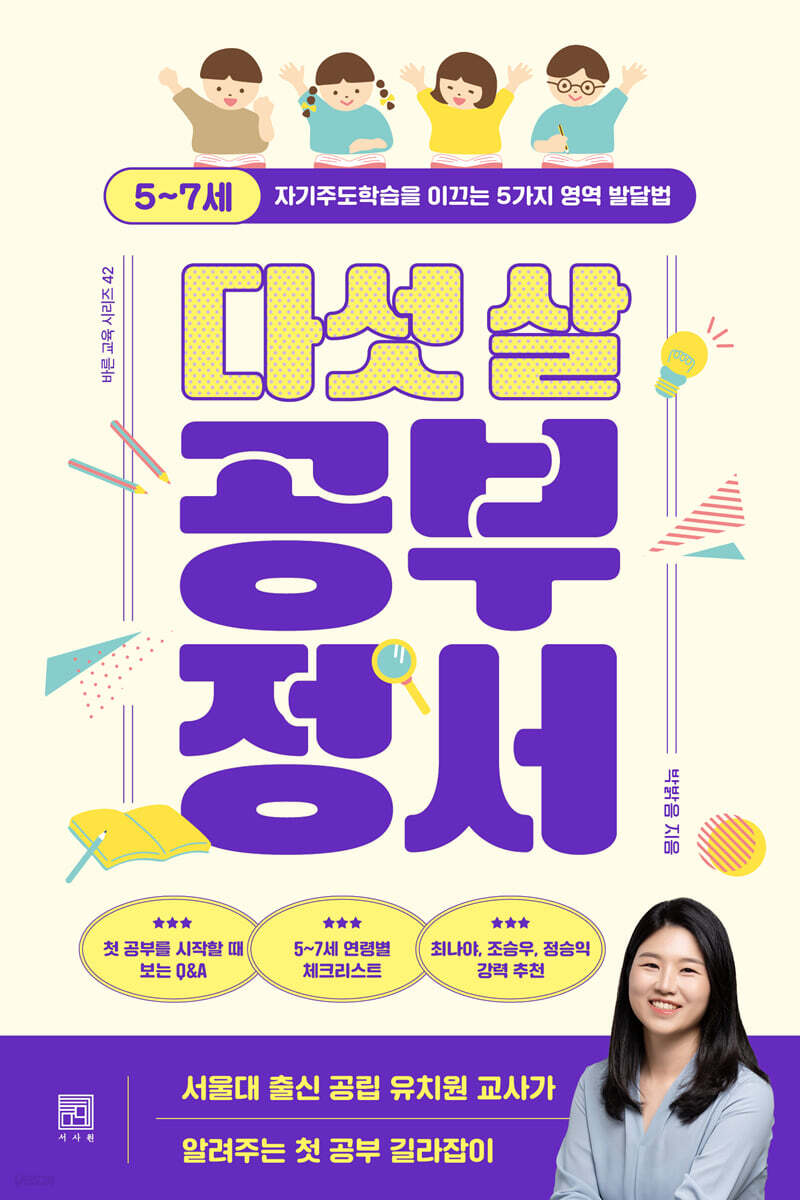
Book Introduction
"The right attitude toward studying should be developed between the ages of 5 and 7."
The power of the first study at age five to increase learning intelligence without private tutoring or pre-learning or early education!
There is a saying, '7-year-old exam'.
The 7-year-old entrance exam refers to the preparatory process that children go through before entering a famous private elementary school.
Some parents feel that one year is not enough to prepare for school, so they start preparing for school from the age of 5 or 6.
The academy industry, noticing this trend, quickly created a '7-year-old exam preparation program' and a '5-year-old exam preparation program', making parents feel uneasy by saying things like, 'You have to do this much to guarantee your child's place in kindergarten or school.'
It is said that most children who enter school through the exam program have lost their motivation to study.
Because of the extensive prior learning, they act as if they know all the class material and do other things or disrupt the class.
Or there are children who are so fed up with studying that they become discouraged and don't want to do anything.
What will the future be like for these children?
The saying that we live in an era of lifelong study is meaningless. Studying is perceived as something we don't want to do and is not fun, so we lose interest in studying even before the entrance exams are over.
Once the desire to study has been destroyed, it is difficult to recover, like trauma.
But children recover quickly.
So, before it's too late, let's teach children about the appropriate level of development for 5-7 year olds and establish a healthy study mindset accordingly.
This book contains methods to create the right study mindset in children based on the five areas of development, also known as the "Nuri Curriculum," which is the most appropriate educational method for the developmental process of 5-7 year-olds, established by the country's top child development and early childhood education experts.
I hope that parents will establish the right educational perspectives, including what kind of easy and comfortable study methods are suitable for the characteristics of early childhood.
The power of the first study at age five to increase learning intelligence without private tutoring or pre-learning or early education!
There is a saying, '7-year-old exam'.
The 7-year-old entrance exam refers to the preparatory process that children go through before entering a famous private elementary school.
Some parents feel that one year is not enough to prepare for school, so they start preparing for school from the age of 5 or 6.
The academy industry, noticing this trend, quickly created a '7-year-old exam preparation program' and a '5-year-old exam preparation program', making parents feel uneasy by saying things like, 'You have to do this much to guarantee your child's place in kindergarten or school.'
It is said that most children who enter school through the exam program have lost their motivation to study.
Because of the extensive prior learning, they act as if they know all the class material and do other things or disrupt the class.
Or there are children who are so fed up with studying that they become discouraged and don't want to do anything.
What will the future be like for these children?
The saying that we live in an era of lifelong study is meaningless. Studying is perceived as something we don't want to do and is not fun, so we lose interest in studying even before the entrance exams are over.
Once the desire to study has been destroyed, it is difficult to recover, like trauma.
But children recover quickly.
So, before it's too late, let's teach children about the appropriate level of development for 5-7 year olds and establish a healthy study mindset accordingly.
This book contains methods to create the right study mindset in children based on the five areas of development, also known as the "Nuri Curriculum," which is the most appropriate educational method for the developmental process of 5-7 year-olds, established by the country's top child development and early childhood education experts.
I hope that parents will establish the right educational perspectives, including what kind of easy and comfortable study methods are suitable for the characteristics of early childhood.
- You can preview some of the book's contents.
Preview
index
PROLOGUE _ To you who are at the starting line of your child's education
PART 1: Developing Self-Directed Learning Skills in 5-7 Year Olds
Every child is a natural learner
Every child is born with a desire to learn.
You must learn two things at all costs.
In the age of lifelong learning, five-year-olds' learning habits last until eighty.
Sowing the Seeds of Self-Directed Learning in Infants and Toddlers
Why Self-Directed Learning Is Important
Characteristics of children with high self-directed learning ability
Fun self-directed learning skills developed through play
Children's Study Emotions: What Parents Are Missing
"Mom's Education": Greedy, Ruining Everything
Only one a day?
Overconfidence or blind faith in the critical moment
A child's brain that has no time to be bored
A child standing at the starting line of a marathon without preparation
What Parents Need to Help Their Children with Study Emotions
Leveraging the unique strengths of mother-style education
Developing the power to go against your own desires
Effective intervention methods to maximize learning through play
The saying "physical strength is national power" is an old one. Now, "physical strength is learning power."
Challenge is my strength! Create the optimal challenge.
PART 2 Our children's first studies starting at ages 5 to 7
About the kindergarten curriculum
Curriculum implemented in kindergartens
The ultimate educational goal of kindergarten
Level up your child's learning with the kindergarten curriculum.
Living Healthy and Safely: Physical Exercise and Health Area
Developing Language Skills for Communication: Communication Area
Respecting yourself and caring for others: Social Relationships
Feeling Beauty and Enjoying Creative Expression: The Art Experience Zone
Explore with Curiosity: Nature Exploration Area
The most important basic habits in daily life
EPILOGUE _ The mindset we need to cultivate before starting our children's education
Appendix: Five Questions About Your Child's First Study
References
PART 1: Developing Self-Directed Learning Skills in 5-7 Year Olds
Every child is a natural learner
Every child is born with a desire to learn.
You must learn two things at all costs.
In the age of lifelong learning, five-year-olds' learning habits last until eighty.
Sowing the Seeds of Self-Directed Learning in Infants and Toddlers
Why Self-Directed Learning Is Important
Characteristics of children with high self-directed learning ability
Fun self-directed learning skills developed through play
Children's Study Emotions: What Parents Are Missing
"Mom's Education": Greedy, Ruining Everything
Only one a day?
Overconfidence or blind faith in the critical moment
A child's brain that has no time to be bored
A child standing at the starting line of a marathon without preparation
What Parents Need to Help Their Children with Study Emotions
Leveraging the unique strengths of mother-style education
Developing the power to go against your own desires
Effective intervention methods to maximize learning through play
The saying "physical strength is national power" is an old one. Now, "physical strength is learning power."
Challenge is my strength! Create the optimal challenge.
PART 2 Our children's first studies starting at ages 5 to 7
About the kindergarten curriculum
Curriculum implemented in kindergartens
The ultimate educational goal of kindergarten
Level up your child's learning with the kindergarten curriculum.
Living Healthy and Safely: Physical Exercise and Health Area
Developing Language Skills for Communication: Communication Area
Respecting yourself and caring for others: Social Relationships
Feeling Beauty and Enjoying Creative Expression: The Art Experience Zone
Explore with Curiosity: Nature Exploration Area
The most important basic habits in daily life
EPILOGUE _ The mindset we need to cultivate before starting our children's education
Appendix: Five Questions About Your Child's First Study
References
Detailed image

Into the book
Self-directed learning ability is not something that children suddenly acquire just by entering school.
Children who experience a variety of learning experiences appropriate to their age, developmental level, and individual characteristics during their early childhood years develop the seeds of self-directed learning in their minds.
If we help this seed take root and sprout, it will grow steadily and steadily as it enters the realm of academic study.
--- p.38
Through play driven by intrinsic motivation, children can experience strong self-confidence and a sense of accomplishment.
By connecting blocks as you wish, a wonderful road is created, and by drawing and painting as you wish, a beautiful castle is created. Through this process, you will come to realize that you are a person who can do anything, and a person who is cooler and more amazing than anyone in the world.
Children who have had these experiences frequently and repeatedly will try to approach and learn in their own way in learning situations.
This means that you are ready for self-directed learning to occur naturally.
--- p.47
It is safe to say that 'there is no longer a critical period in the field of learning.'
The important thing is to recognize that each child has different developmental differences and to find the right time for your child to learn well.
The right time can be discovered by closely observing the child's speech, behavior, play, and activities.
If we provide excessive learning stimulation based solely on blind faith in the critical period without considering our child's unique developmental pace and tendencies, it may become a critical period where learning does not occur, but rather a period where they turn their back on learning.
--- p.68
Don't rush children who are just beginning to learn, feel, and experience the world on their own to learn more quickly or to digest more.
Our children's lives are too precious and valuable to realize that after so much time has passed, they were ultimately useless.
--- p.77
One of the biggest things I've learned in kindergarten is that the kindergarten curriculum contains everything children need to learn at this age.
On the one hand, it's inevitable, as the people who designed this curriculum are some of the country's leading experts in early childhood education and child development theory, as well as field experts with many years of experience in kindergarten education.
They are the ones who know all too well what children need to learn to grow into healthy, independent adults.
Children who experience a variety of learning experiences appropriate to their age, developmental level, and individual characteristics during their early childhood years develop the seeds of self-directed learning in their minds.
If we help this seed take root and sprout, it will grow steadily and steadily as it enters the realm of academic study.
--- p.38
Through play driven by intrinsic motivation, children can experience strong self-confidence and a sense of accomplishment.
By connecting blocks as you wish, a wonderful road is created, and by drawing and painting as you wish, a beautiful castle is created. Through this process, you will come to realize that you are a person who can do anything, and a person who is cooler and more amazing than anyone in the world.
Children who have had these experiences frequently and repeatedly will try to approach and learn in their own way in learning situations.
This means that you are ready for self-directed learning to occur naturally.
--- p.47
It is safe to say that 'there is no longer a critical period in the field of learning.'
The important thing is to recognize that each child has different developmental differences and to find the right time for your child to learn well.
The right time can be discovered by closely observing the child's speech, behavior, play, and activities.
If we provide excessive learning stimulation based solely on blind faith in the critical period without considering our child's unique developmental pace and tendencies, it may become a critical period where learning does not occur, but rather a period where they turn their back on learning.
--- p.68
Don't rush children who are just beginning to learn, feel, and experience the world on their own to learn more quickly or to digest more.
Our children's lives are too precious and valuable to realize that after so much time has passed, they were ultimately useless.
--- p.77
One of the biggest things I've learned in kindergarten is that the kindergarten curriculum contains everything children need to learn at this age.
On the one hand, it's inevitable, as the people who designed this curriculum are some of the country's leading experts in early childhood education and child development theory, as well as field experts with many years of experience in kindergarten education.
They are the ones who know all too well what children need to learn to grow into healthy, independent adults.
--- p.109
Publisher's Review
It's not that I don't care about my child's future.
I'm putting off studying for the exam because I'm so interested.
The author, who graduated from Seoul National University's Department of Child and Family Studies and is currently a teacher at a public kindergarten, is also a mother of two children before becoming a teacher.
So I often get this question from parents of kindergarten children.
“What kind of studies do you teach your children?” The author’s children attend a public kindergarten and, outside of art school, spend a lot of time at the playground.
Also, I didn't plan what kind of studies I would have my child do.
When asked this question, the parent who answered said:
“I guess you don’t pay attention to your child’s education.”
Of course not.
The author is someone who has personally experienced how studying better than anyone else can be a huge advantage in life.
So, he is also a person who knows exactly how to make students study more.
The author says that, rather than studying for academic purposes, what children need to learn now is the experience of achieving their goals through their own efforts and the experience of learning and making it their own.
This is because only then can children take charge of their own lives.
A healthy study mindset does not start with what, when, or how a child studies, but with the attitude and understanding of education that parents have.
Some parents know this first and try to create a healthy study mindset in their children.
However, if you keep hearing things like golden time, advance learning, and early education, and that you need to teach your child English, Korean, and math right now, your educational views that you thought were right can be shaken.
I hope you will open this book and read it at times like that.
It will serve as a strong support for parents who want to establish eye contact with their children and create a healthy study mindset in their children with their own educational philosophy.
The desire of children to learn in order to survive,
It's a parent's job not to break it
When parents say, 'Studying is something you have to do for ○○,' they read '○○' as 'future.'
In other words, parents view education as a means to create a secure future.
But the child accepts studying as 'survival'.
That's understandable, as children can do very little on their own.
We instinctively realize that we must learn and master whatever it takes to survive.
If parents and children feel differently about the first steps toward studying, a healthy study mindset will lose its balance and become unstable.
Some people mistakenly believe that true learning is about sitting at a desk, reading a problem, and finding the answer.
This is not right.
Children's studies vary depending on their age.
The main content of learning in infancy is imitation, following the actions and words of parents.
As children become more imitative and able to move and speak more freely, they observe their friends, imitate their actions, and communicate verbally.
As they do this, they gradually stop playing alone and begin to learn how to become a member of society by encountering various people and numerous problematic situations.
This learning is primarily fostered through play.
Parents perceive play as a 'waste of time', but children actually use play as the foundation and foundation for learning.
Understanding how children learn through play is the first step toward creating a healthy learning mindset.
Through this book, we will learn about the developmental process of children aged 5 to 7, their inherent desire to study, and what parents say and do that harm their children's study habits during the developmental process.
5-7 years old, when the seeds of self-directed learning are sown.
Elementary school curriculum that fosters self-directed learning
If we shouldn't do the pre-learning that everyone else does, what should we teach children between the ages of 5 and 7?
The author, a child development expert and current kindergarten teacher, strongly believes that we must teach 'self-directed learning skills.'
What kind of "self-direction" can a child of this age demonstrate? Shouldn't self-direction be developed by the time they enter elementary school? That's wrong.
Self-direction isn't something you learn in school classes.
It's not a latent talent that suddenly appears.
Only when children experience various forms of learning in their early childhood can the seeds of self-directed learning sprout and flourish once they enter elementary school.
Infancy is a time when children's curiosity about the world is wide open.
Curiosity leads to a desire to discover and solve problems.
If children repeatedly discover and solve problems through play during their early childhood, they will develop self-directed learning skills without even realizing it.
Ultimately, if we support children's play and help them explore the world through play, they will develop self-directed learning skills.
This book states that children can develop three competencies through play.
If you want to know how play leads to self-direction and how self-direction affects a child's life, please read the text carefully.
Are children's studies and study habits only learned in educational institutions?
Why Educational Institutions and Families Must Work Together
Parents of elementary school children usually ask their children, “What did your teacher teach you?” and “Eat and do what your teacher tells you to do” when they get home from school, and help them with their schoolwork.
School education continues at home.
If that's the case, shouldn't the same be true for 5-7 year olds receiving education at educational institutions?
Our country's leading early childhood development experts have established the curriculum for all public kindergartens, including five areas that children aged 5 to 7 must acquire and develop: 'physical exercise and health,' 'communication,' 'social relationships,' 'artistic experience,' and 'nature exploration.'
This curriculum is commonly known as the ‘Nuri Curriculum.’
Each kindergarten in Korea sets its own lesson goals for each month, semester, and year based on this curriculum.
In other words, unless they attend a private educational institution, children learn and master this curriculum based on it.
So what if we put what we learned in kindergarten into practice at home? Because what children learn in kindergarten connects to what they do at home, they'll be unwavering and firmly committed to their assigned tasks.
This book provides theory and practical methods for teaching five areas of development at home in conjunction with educational institutions.
We hope that you will find this guide, which includes checklists and practical life tips for each age group, helpful in establishing an educational center for all ages 5 to 7.
I'm putting off studying for the exam because I'm so interested.
The author, who graduated from Seoul National University's Department of Child and Family Studies and is currently a teacher at a public kindergarten, is also a mother of two children before becoming a teacher.
So I often get this question from parents of kindergarten children.
“What kind of studies do you teach your children?” The author’s children attend a public kindergarten and, outside of art school, spend a lot of time at the playground.
Also, I didn't plan what kind of studies I would have my child do.
When asked this question, the parent who answered said:
“I guess you don’t pay attention to your child’s education.”
Of course not.
The author is someone who has personally experienced how studying better than anyone else can be a huge advantage in life.
So, he is also a person who knows exactly how to make students study more.
The author says that, rather than studying for academic purposes, what children need to learn now is the experience of achieving their goals through their own efforts and the experience of learning and making it their own.
This is because only then can children take charge of their own lives.
A healthy study mindset does not start with what, when, or how a child studies, but with the attitude and understanding of education that parents have.
Some parents know this first and try to create a healthy study mindset in their children.
However, if you keep hearing things like golden time, advance learning, and early education, and that you need to teach your child English, Korean, and math right now, your educational views that you thought were right can be shaken.
I hope you will open this book and read it at times like that.
It will serve as a strong support for parents who want to establish eye contact with their children and create a healthy study mindset in their children with their own educational philosophy.
The desire of children to learn in order to survive,
It's a parent's job not to break it
When parents say, 'Studying is something you have to do for ○○,' they read '○○' as 'future.'
In other words, parents view education as a means to create a secure future.
But the child accepts studying as 'survival'.
That's understandable, as children can do very little on their own.
We instinctively realize that we must learn and master whatever it takes to survive.
If parents and children feel differently about the first steps toward studying, a healthy study mindset will lose its balance and become unstable.
Some people mistakenly believe that true learning is about sitting at a desk, reading a problem, and finding the answer.
This is not right.
Children's studies vary depending on their age.
The main content of learning in infancy is imitation, following the actions and words of parents.
As children become more imitative and able to move and speak more freely, they observe their friends, imitate their actions, and communicate verbally.
As they do this, they gradually stop playing alone and begin to learn how to become a member of society by encountering various people and numerous problematic situations.
This learning is primarily fostered through play.
Parents perceive play as a 'waste of time', but children actually use play as the foundation and foundation for learning.
Understanding how children learn through play is the first step toward creating a healthy learning mindset.
Through this book, we will learn about the developmental process of children aged 5 to 7, their inherent desire to study, and what parents say and do that harm their children's study habits during the developmental process.
5-7 years old, when the seeds of self-directed learning are sown.
Elementary school curriculum that fosters self-directed learning
If we shouldn't do the pre-learning that everyone else does, what should we teach children between the ages of 5 and 7?
The author, a child development expert and current kindergarten teacher, strongly believes that we must teach 'self-directed learning skills.'
What kind of "self-direction" can a child of this age demonstrate? Shouldn't self-direction be developed by the time they enter elementary school? That's wrong.
Self-direction isn't something you learn in school classes.
It's not a latent talent that suddenly appears.
Only when children experience various forms of learning in their early childhood can the seeds of self-directed learning sprout and flourish once they enter elementary school.
Infancy is a time when children's curiosity about the world is wide open.
Curiosity leads to a desire to discover and solve problems.
If children repeatedly discover and solve problems through play during their early childhood, they will develop self-directed learning skills without even realizing it.
Ultimately, if we support children's play and help them explore the world through play, they will develop self-directed learning skills.
This book states that children can develop three competencies through play.
If you want to know how play leads to self-direction and how self-direction affects a child's life, please read the text carefully.
Are children's studies and study habits only learned in educational institutions?
Why Educational Institutions and Families Must Work Together
Parents of elementary school children usually ask their children, “What did your teacher teach you?” and “Eat and do what your teacher tells you to do” when they get home from school, and help them with their schoolwork.
School education continues at home.
If that's the case, shouldn't the same be true for 5-7 year olds receiving education at educational institutions?
Our country's leading early childhood development experts have established the curriculum for all public kindergartens, including five areas that children aged 5 to 7 must acquire and develop: 'physical exercise and health,' 'communication,' 'social relationships,' 'artistic experience,' and 'nature exploration.'
This curriculum is commonly known as the ‘Nuri Curriculum.’
Each kindergarten in Korea sets its own lesson goals for each month, semester, and year based on this curriculum.
In other words, unless they attend a private educational institution, children learn and master this curriculum based on it.
So what if we put what we learned in kindergarten into practice at home? Because what children learn in kindergarten connects to what they do at home, they'll be unwavering and firmly committed to their assigned tasks.
This book provides theory and practical methods for teaching five areas of development at home in conjunction with educational institutions.
We hope that you will find this guide, which includes checklists and practical life tips for each age group, helpful in establishing an educational center for all ages 5 to 7.
GOODS SPECIFICS
- Date of issue: November 5, 2024
- Page count, weight, size: 208 pages | 284g | 140*210*20mm
- ISBN13: 9791168223233
- ISBN10: 1168223237
You may also like
카테고리
korean


korean

![GQ KOREA Mark (Monthly): December [2025]](http://librairie.coreenne.fr/cdn/shop/files/8ef265dbbfbf186523ed75ba7319009d.jpg?v=1765340328&width=3840)


