

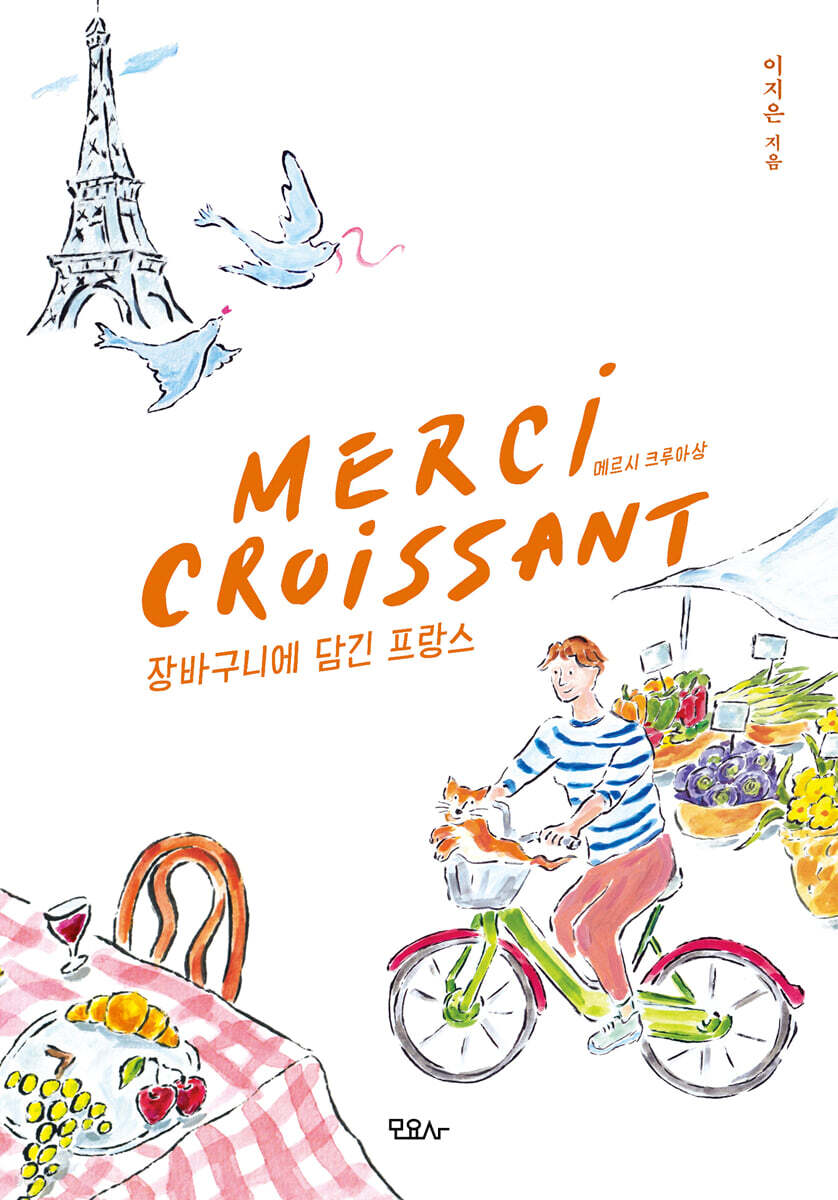
Merci Croissant
 |
Description
Book Introduction
Beautiful and elegant France discovered in the Parisian market!
Put today's France in your mouth, chew it, and savor it.
Merci, croissant!
The author, an art historian and decorative arts appraiser, has lived in France for over 20 years and has personally tasted and experienced delicious French food.
The author, who couldn't even say "bonjour," boldly decided to study abroad in France because of the croissant he received at Charles de Gaulle Airport after a long trip to Europe during his college years.
The crust crackles in your mouth, and the soft, buttery flesh is bursting with flavor.
As she slowly nibbled on a croissant, she suddenly thought that she would like to live in a country called France.
Six months later, the author returned to Paris, where she has lived ever since, studying the history of decorative arts, meeting and marrying a French man, and writing seven books on the cultural history of objects.
Life in France wasn't always easy.
Store clerks who would scold you for your poor French pronunciation, the complicated hospital system that would give you a headache if you got sick, and the careless government officials who would annoy you every time you had to extend your visa…
Nevertheless, the reason I couldn't leave this country and became attached to it was because of the delicious food in France.
It was because of the fresh ingredients that changed with the seasons, and the friendly merchants at the traditional market that I went to every day because it was only 3 minutes away from my house.
Even since two years ago, we have been running a program called 'Ji-eun Home Cooking' where we go to the market together and cook French home cooking together in our own kitchens.
This book is filled with vivid and witty food stories from the author, who is passionate about "food stories," who raises her voice in the presence of fresh ingredients and claps her hands in excitement when a delicious dish is served.
Put today's France in your mouth, chew it, and savor it.
Merci, croissant!
The author, an art historian and decorative arts appraiser, has lived in France for over 20 years and has personally tasted and experienced delicious French food.
The author, who couldn't even say "bonjour," boldly decided to study abroad in France because of the croissant he received at Charles de Gaulle Airport after a long trip to Europe during his college years.
The crust crackles in your mouth, and the soft, buttery flesh is bursting with flavor.
As she slowly nibbled on a croissant, she suddenly thought that she would like to live in a country called France.
Six months later, the author returned to Paris, where she has lived ever since, studying the history of decorative arts, meeting and marrying a French man, and writing seven books on the cultural history of objects.
Life in France wasn't always easy.
Store clerks who would scold you for your poor French pronunciation, the complicated hospital system that would give you a headache if you got sick, and the careless government officials who would annoy you every time you had to extend your visa…
Nevertheless, the reason I couldn't leave this country and became attached to it was because of the delicious food in France.
It was because of the fresh ingredients that changed with the seasons, and the friendly merchants at the traditional market that I went to every day because it was only 3 minutes away from my house.
Even since two years ago, we have been running a program called 'Ji-eun Home Cooking' where we go to the market together and cook French home cooking together in our own kitchens.
This book is filled with vivid and witty food stories from the author, who is passionate about "food stories," who raises her voice in the presence of fresh ingredients and claps her hands in excitement when a delicious dish is served.
- You can preview some of the book's contents.
Preview
index
Prologue
Merci, croissant
French Market User Manual
The Maestro of the Market | Plassier, Quentin Acun
Yeongdeok Crab and Mayonnaise | Fish Shop, Mare Bobo
Buy Trady | Bakery, Remy
Butcher's Special Recipe | Maison Guignard
Vegetable and Fruit Seasonal Store | Vegetable Stalls on Aligre Street
Good Coffee | Coffee Shop, Early Bird
A Bottle of Wine to Celebrate Life | Wine Shop, Côte Sud
Spring, Summer, Fall, Winter, and Cheese | Cheese Shop, Ardoin-Langley
When the Cold Wind Blows | Chicken House, Chapon Daligre
A Journey in a Mortar | Spice Shop, Sabah
O Sole Mio | Italian Grocery, Salvo, Madame Genier's Ritalien
Afternoon Radio | Vintage Shop, Maison Cuyère
How about an apéro? | Wine Bar, Le Baron Rouge
DIRECTORY
Merci, croissant
French Market User Manual
The Maestro of the Market | Plassier, Quentin Acun
Yeongdeok Crab and Mayonnaise | Fish Shop, Mare Bobo
Buy Trady | Bakery, Remy
Butcher's Special Recipe | Maison Guignard
Vegetable and Fruit Seasonal Store | Vegetable Stalls on Aligre Street
Good Coffee | Coffee Shop, Early Bird
A Bottle of Wine to Celebrate Life | Wine Shop, Côte Sud
Spring, Summer, Fall, Winter, and Cheese | Cheese Shop, Ardoin-Langley
When the Cold Wind Blows | Chicken House, Chapon Daligre
A Journey in a Mortar | Spice Shop, Sabah
O Sole Mio | Italian Grocery, Salvo, Madame Genier's Ritalien
Afternoon Radio | Vintage Shop, Maison Cuyère
How about an apéro? | Wine Bar, Le Baron Rouge
DIRECTORY
Detailed image
.jpg)
Into the book
I was shocked when I first went to the Aligre Market with my husband.
There was a France there that I had never known about, having only read books in the library.
This was today's France, which I could sense with my eyes, ears, and nose, not my head.
As I listened to the candid conversations between merchants and customers, hands on their waists, loudly discussing the price of vegetables, I felt a sense of liberation, as if something that had been weighing heavily on my heart had suddenly burst forth.
The vitality and vividness that cannot be expressed in neat and flawless octopus writing leaped up and down as if you could touch it.
--- p.18
It is a truly wondrous sight to see the bustling market in the morning disappear without a speck of dust in the afternoon as if it had never happened.
The stallholders are performing artists who pour their heart and soul into the performances that take place for exactly five hours a day, from 7 AM to 1 PM.
Wipe the zucchini one by one until shiny, and arrange the tomato stems in a row.
The skill with which he bundles red turnips and neatly places them in small baskets, and makes pyramids of lemons with their luscious leaves, is on par with that of a display expert at the Bon Marché department store.
--- p.19
My cooking, which involves chopping, frying, and boiling food in a small kitchen, is typical of the home-cooked meals that French people eat every day.
An ordinary meal, like a dinner table with grilled mackerel and soybean paste stew.
French home cooking contains many things that can be considered French.
It was this unique French charm that kept me glued to this country, starting with the croissants at Charles de Gaulle Airport.
French home cooking had hidden characteristics of French culture that I loved.
--- p.27
For the past two years, I have been running a program called 'Ji-eun Home Cooking' where we go to the market together and cook French home-cooked meals in our own kitchen.
Strictly speaking, 'Ji-eun Home Cooking' is not a cooking class.
I'm not a professional chef myself, and I don't have any fancy gourmet dishes.
What I really want to share through 'Ji-eun Home Cooking' is the lively speech of the market vendors, my French cooking teachers, the bustling movements of their bodies arranging vegetables, and the stalls that bloom brilliantly with each season.
There is a France here that is not found in the Louvre or the Eiffel Tower.
--- p.32
At Christmas, my mother-in-law takes out a silver platter and serves Pin de Clairs, long, concave cherries with fleshy seeds that have a subtle sheen.
So, my husband was shocked when he found a plastic bag full of oysters for the first time in his life at a Korean supermarket.
He couldn't leave the bag of oysters as if he couldn't believe it.
Wouldn't it have been a shocking and absurd experience, like a nephew who bumps into his aunt, who is incredibly wealthy and a hobbyist at a homeless shelter?
--- p.78
Tourists invariably buy only baguettes.
I don't know how many times I've wanted to meddle and say, "No, I should buy Tradi," and that this is the real deal.
But I hold back so as not to become a nosy middle-aged woman.
I try to pretend not to know, but I really, really want to tell you.
“Buy Trady.”
--- p.97
When their eyes met, Pascal raised his hand and greeted them.
A few people waiting in line glanced at me, wondering who would receive such a friendly greeting from a pooch.
In a French butcher shop, the butcher enjoys the authority of a specialist in his own domain.
The sight of him standing tall with a wooden cutting board and various knives lined up in a row is charismatic in itself.
Even though the line stretches all the way to the cheese shop next door on Sundays, everyone waits patiently for their turn, like a patient who has made a difficult appointment to see a specialist.
--- p.113
Even though we live in an era where smart farms are the trend, I still want to eat seasonal fruits and vegetables that are rooted in the ground and grown in the fresh air and wind.
I want to fully enjoy all four seasons.
I want to prepare a table with seasonal delicacies, saying, “You can only eat them at this time.”
It's so delicious that I want to wait for the season to disappear with regret.
--- pp.147~149
Josef, who offers coffee for 1 euro to the cleaners who come to clean the market with their garbage truck every noon, and Candice, who is always kind even while serving coffee in full gear, including a hat and underpants, during the long winter.
The affection and kindness of this couple who, on rainy days, wink at me and bring out Irish whiskey from the back of the store and pour me a glass.
That's my favorite coffee label.
--- pp.165~166
“I can’t believe I’m living a life where talking about food is part of my job,” Sophie says, folding her hands over her chest and making a prayer gesture as if in amazement.
At times like this, Sophie is like an innocent girl.
Perhaps that's why Sophie's cooking stories are so appetizing.
Whether it's wine or cooking, all the flavors in the world ultimately come from an attitude of praising life.
--- p.185
It is an unwritten rule of a proper chicken farm to pluck the feathers from the body beforehand, but not to cut off the head or feet before selling.
Because if you cut off the head and feet, this chicken and that chicken all look the same.
How many people can tell what kind of chicken it is just by looking at its flesh?
The French, who believe that you get your money's worth, believe that when you pay a lot of money for a good chicken, you should be treated accordingly.
I can only feel satisfied when I see with my own two eyes the glossy fur, sturdy paws, and handsome head.
The chicken feet and feathers that come with the chicken wrapped in several layers of paper can be described as the orange box, thick shopping bag, and brown ribbon that come with the Hermes bag.
It is a consideration to allow you to enjoy the pleasure of eating high-quality chicken while returning home and unpacking the package.
--- pp.220~221
In my opinion, the most ideal appearance of a grocery store owner is the face of a 'bonvivant'.
Bongbibang means a person who cherishes what he likes and enjoys life to the fullest.
A lively and vibrant expression, rich gestures, and a face filled with joy that laughs even at small things.
If the owner of Bongbibang finds happiness in eating and drinking, the taste will naturally come out, making you want to become a regular.
--- p.257
In France, the phrase “How about an apéro?” can be interpreted in several ways.
For example, if a man and a woman meet for the first time while jogging in the park, saying, "How about an apéro?" is a green light to get to know you better.
When you go on vacation with your family, the phrase "Apero is 7 o'clock" means that you can spend the day on your own, but see each other at 7 o'clock.
Between friends who haven't seen each other in a long time, "Let's have an aperona" is a warm suggestion to talk about life more candidly, and if you're a former enemy, it's a gesture of reconciliation to forget the past and start anew.
There was a France there that I had never known about, having only read books in the library.
This was today's France, which I could sense with my eyes, ears, and nose, not my head.
As I listened to the candid conversations between merchants and customers, hands on their waists, loudly discussing the price of vegetables, I felt a sense of liberation, as if something that had been weighing heavily on my heart had suddenly burst forth.
The vitality and vividness that cannot be expressed in neat and flawless octopus writing leaped up and down as if you could touch it.
--- p.18
It is a truly wondrous sight to see the bustling market in the morning disappear without a speck of dust in the afternoon as if it had never happened.
The stallholders are performing artists who pour their heart and soul into the performances that take place for exactly five hours a day, from 7 AM to 1 PM.
Wipe the zucchini one by one until shiny, and arrange the tomato stems in a row.
The skill with which he bundles red turnips and neatly places them in small baskets, and makes pyramids of lemons with their luscious leaves, is on par with that of a display expert at the Bon Marché department store.
--- p.19
My cooking, which involves chopping, frying, and boiling food in a small kitchen, is typical of the home-cooked meals that French people eat every day.
An ordinary meal, like a dinner table with grilled mackerel and soybean paste stew.
French home cooking contains many things that can be considered French.
It was this unique French charm that kept me glued to this country, starting with the croissants at Charles de Gaulle Airport.
French home cooking had hidden characteristics of French culture that I loved.
--- p.27
For the past two years, I have been running a program called 'Ji-eun Home Cooking' where we go to the market together and cook French home-cooked meals in our own kitchen.
Strictly speaking, 'Ji-eun Home Cooking' is not a cooking class.
I'm not a professional chef myself, and I don't have any fancy gourmet dishes.
What I really want to share through 'Ji-eun Home Cooking' is the lively speech of the market vendors, my French cooking teachers, the bustling movements of their bodies arranging vegetables, and the stalls that bloom brilliantly with each season.
There is a France here that is not found in the Louvre or the Eiffel Tower.
--- p.32
At Christmas, my mother-in-law takes out a silver platter and serves Pin de Clairs, long, concave cherries with fleshy seeds that have a subtle sheen.
So, my husband was shocked when he found a plastic bag full of oysters for the first time in his life at a Korean supermarket.
He couldn't leave the bag of oysters as if he couldn't believe it.
Wouldn't it have been a shocking and absurd experience, like a nephew who bumps into his aunt, who is incredibly wealthy and a hobbyist at a homeless shelter?
--- p.78
Tourists invariably buy only baguettes.
I don't know how many times I've wanted to meddle and say, "No, I should buy Tradi," and that this is the real deal.
But I hold back so as not to become a nosy middle-aged woman.
I try to pretend not to know, but I really, really want to tell you.
“Buy Trady.”
--- p.97
When their eyes met, Pascal raised his hand and greeted them.
A few people waiting in line glanced at me, wondering who would receive such a friendly greeting from a pooch.
In a French butcher shop, the butcher enjoys the authority of a specialist in his own domain.
The sight of him standing tall with a wooden cutting board and various knives lined up in a row is charismatic in itself.
Even though the line stretches all the way to the cheese shop next door on Sundays, everyone waits patiently for their turn, like a patient who has made a difficult appointment to see a specialist.
--- p.113
Even though we live in an era where smart farms are the trend, I still want to eat seasonal fruits and vegetables that are rooted in the ground and grown in the fresh air and wind.
I want to fully enjoy all four seasons.
I want to prepare a table with seasonal delicacies, saying, “You can only eat them at this time.”
It's so delicious that I want to wait for the season to disappear with regret.
--- pp.147~149
Josef, who offers coffee for 1 euro to the cleaners who come to clean the market with their garbage truck every noon, and Candice, who is always kind even while serving coffee in full gear, including a hat and underpants, during the long winter.
The affection and kindness of this couple who, on rainy days, wink at me and bring out Irish whiskey from the back of the store and pour me a glass.
That's my favorite coffee label.
--- pp.165~166
“I can’t believe I’m living a life where talking about food is part of my job,” Sophie says, folding her hands over her chest and making a prayer gesture as if in amazement.
At times like this, Sophie is like an innocent girl.
Perhaps that's why Sophie's cooking stories are so appetizing.
Whether it's wine or cooking, all the flavors in the world ultimately come from an attitude of praising life.
--- p.185
It is an unwritten rule of a proper chicken farm to pluck the feathers from the body beforehand, but not to cut off the head or feet before selling.
Because if you cut off the head and feet, this chicken and that chicken all look the same.
How many people can tell what kind of chicken it is just by looking at its flesh?
The French, who believe that you get your money's worth, believe that when you pay a lot of money for a good chicken, you should be treated accordingly.
I can only feel satisfied when I see with my own two eyes the glossy fur, sturdy paws, and handsome head.
The chicken feet and feathers that come with the chicken wrapped in several layers of paper can be described as the orange box, thick shopping bag, and brown ribbon that come with the Hermes bag.
It is a consideration to allow you to enjoy the pleasure of eating high-quality chicken while returning home and unpacking the package.
--- pp.220~221
In my opinion, the most ideal appearance of a grocery store owner is the face of a 'bonvivant'.
Bongbibang means a person who cherishes what he likes and enjoys life to the fullest.
A lively and vibrant expression, rich gestures, and a face filled with joy that laughs even at small things.
If the owner of Bongbibang finds happiness in eating and drinking, the taste will naturally come out, making you want to become a regular.
--- p.257
In France, the phrase “How about an apéro?” can be interpreted in several ways.
For example, if a man and a woman meet for the first time while jogging in the park, saying, "How about an apéro?" is a green light to get to know you better.
When you go on vacation with your family, the phrase "Apero is 7 o'clock" means that you can spend the day on your own, but see each other at 7 o'clock.
Between friends who haven't seen each other in a long time, "Let's have an aperona" is a warm suggestion to talk about life more candidly, and if you're a former enemy, it's a gesture of reconciliation to forget the past and start anew.
--- p.289
Publisher's Review
Cooking tips from French market vendors you won't find in any cookbook.
The author shopped every day at the Parisian traditional market 'Allière', which was established in the 19th century, and discovered the true taste of French home cooking that could never be found in French restaurants.
Unlike Korea, where you can eat kimchi stew and soybean paste stew both at home and in restaurants, in France there is a big difference between home cooking and restaurant food.
Home-cooked dishes like an d'hivos au jambonc, quiche, ratatouille, and sausage and potato puree are hard to find on regular restaurant menus.
This is because the French believe that they should get what they pay for, so they don't go to restaurants just to eat.
This book is filled with the author's grandmother and mother's secret recipes, hand-written and sent by her mother-in-law, as well as cooking tips from market vendors that you won't find in any famous cookbook, all told by French friends eager to share the true taste of French home cooking.
However, this is not a book that describes recipes in a serious manner.
Instead, it offers the fun of discovering the charm of French culture and the aesthetics of life that make France French through an ordinary meal.
The real France, not found in the Louvre or the Eiffel Tower, unfolds in the stalls of the market that are open every day.
A bouquet of artichokes, sparkling tomatoes, and asparagus as fresh as if just cut from the field, all carefully selected with the utmost care to cherish the ingredients they sell.
This is truly 'beautiful and elegant France,' says the author.
Things We Never Knew About France, the Land of Gastronomy
We often know France as a country of gastronomy, but is that really true?
Reading the author's writing, which subtly boasts that our country is at least one step ahead when it comes to seafood, makes me laugh.
My husband, looking for mayonnaise in front of the steaming Yeongdeok crab, and my mother, clicking her tongue at the sight of Brussels-style mussels in Paris.
Moreover, the episode where my husband, who had only ever seen oysters served on a silver platter, was so shocked when he saw whole oysters in a plastic bag in Korea that he couldn't leave the room was hilarious enough to make people burst out in laughter.
France is known as the land of bread, but did you know that even in France, there aren't many shops that make their own baguettes? These days, the standard for measuring the quality of a French bakery isn't the baguette itself, but the Traddi.
Tradi, short for 'Baguette Tradition', looks similar to a baguette, but by 'law' it must be made only with water, flour, yeast, and salt, and the kneading and baking must also be done on site where it is sold.
So, if you want to try a real baguette in France, you have to buy Tradi!
Paris is full of famous cafes that were hangouts for countless writers and artists, including Hemingway.
But what about the coffee? The author clearly states that it is disappointing.
They say Paris is a wasteland for coffee.
So, if you want to drink really delicious specialty coffee in Paris, go to a 'coffee shop' (even in France, where people are proud of their native language, coffee shops use English names) rather than a cafe.
But the white-cloaked chickens of Chapon Dalligre, which handles high-quality chickens of different breeds each season, the fresh meat chunks that Maison Guignard's butcher Pascal skillfully slices to order, the splendid cheese display of Hardouin-Langley with delicious cheeses from all over the country each season, and the street stalls artistically displaying various types of strawberries, asparagus, artichokes, tomatoes, and apricots - these are honestly so much that I'm jealous that they seem to show the very foundation and pride of French gastronomy.
A vivid story of life with the merchants of Aligre Market
In addition to the stories of delicious ingredients and the simple and delicious cuisine of French home cooking, the author's connection with the merchants of the Aligre market, who are also her cooking teachers, and their artisan passion are the most shining characters in this book.
The story of the author who became the envy of others after receiving a particularly kind greeting from the butcher Pascal; the story of Sophie, the owner of a wine shop who talks as fluently as a great writer when the topic of food comes up; the story of Cedric, the owner of a chicken shop who whispers that a native chicken has arrived as if revealing a big secret when a cold wind blows; the story of the kind couple at Early Bird, a coffee shop that serves coffee for 1 euro to the market cleaners…
All these stories are intertwined like warp and weft, creating a deliciously vivid and living story of French food that is hard to find in existing books or on the internet.
If you love French wine, bread, and cheese, or are interested in gastronomy, this is a must-read.
The author shopped every day at the Parisian traditional market 'Allière', which was established in the 19th century, and discovered the true taste of French home cooking that could never be found in French restaurants.
Unlike Korea, where you can eat kimchi stew and soybean paste stew both at home and in restaurants, in France there is a big difference between home cooking and restaurant food.
Home-cooked dishes like an d'hivos au jambonc, quiche, ratatouille, and sausage and potato puree are hard to find on regular restaurant menus.
This is because the French believe that they should get what they pay for, so they don't go to restaurants just to eat.
This book is filled with the author's grandmother and mother's secret recipes, hand-written and sent by her mother-in-law, as well as cooking tips from market vendors that you won't find in any famous cookbook, all told by French friends eager to share the true taste of French home cooking.
However, this is not a book that describes recipes in a serious manner.
Instead, it offers the fun of discovering the charm of French culture and the aesthetics of life that make France French through an ordinary meal.
The real France, not found in the Louvre or the Eiffel Tower, unfolds in the stalls of the market that are open every day.
A bouquet of artichokes, sparkling tomatoes, and asparagus as fresh as if just cut from the field, all carefully selected with the utmost care to cherish the ingredients they sell.
This is truly 'beautiful and elegant France,' says the author.
Things We Never Knew About France, the Land of Gastronomy
We often know France as a country of gastronomy, but is that really true?
Reading the author's writing, which subtly boasts that our country is at least one step ahead when it comes to seafood, makes me laugh.
My husband, looking for mayonnaise in front of the steaming Yeongdeok crab, and my mother, clicking her tongue at the sight of Brussels-style mussels in Paris.
Moreover, the episode where my husband, who had only ever seen oysters served on a silver platter, was so shocked when he saw whole oysters in a plastic bag in Korea that he couldn't leave the room was hilarious enough to make people burst out in laughter.
France is known as the land of bread, but did you know that even in France, there aren't many shops that make their own baguettes? These days, the standard for measuring the quality of a French bakery isn't the baguette itself, but the Traddi.
Tradi, short for 'Baguette Tradition', looks similar to a baguette, but by 'law' it must be made only with water, flour, yeast, and salt, and the kneading and baking must also be done on site where it is sold.
So, if you want to try a real baguette in France, you have to buy Tradi!
Paris is full of famous cafes that were hangouts for countless writers and artists, including Hemingway.
But what about the coffee? The author clearly states that it is disappointing.
They say Paris is a wasteland for coffee.
So, if you want to drink really delicious specialty coffee in Paris, go to a 'coffee shop' (even in France, where people are proud of their native language, coffee shops use English names) rather than a cafe.
But the white-cloaked chickens of Chapon Dalligre, which handles high-quality chickens of different breeds each season, the fresh meat chunks that Maison Guignard's butcher Pascal skillfully slices to order, the splendid cheese display of Hardouin-Langley with delicious cheeses from all over the country each season, and the street stalls artistically displaying various types of strawberries, asparagus, artichokes, tomatoes, and apricots - these are honestly so much that I'm jealous that they seem to show the very foundation and pride of French gastronomy.
A vivid story of life with the merchants of Aligre Market
In addition to the stories of delicious ingredients and the simple and delicious cuisine of French home cooking, the author's connection with the merchants of the Aligre market, who are also her cooking teachers, and their artisan passion are the most shining characters in this book.
The story of the author who became the envy of others after receiving a particularly kind greeting from the butcher Pascal; the story of Sophie, the owner of a wine shop who talks as fluently as a great writer when the topic of food comes up; the story of Cedric, the owner of a chicken shop who whispers that a native chicken has arrived as if revealing a big secret when a cold wind blows; the story of the kind couple at Early Bird, a coffee shop that serves coffee for 1 euro to the market cleaners…
All these stories are intertwined like warp and weft, creating a deliciously vivid and living story of French food that is hard to find in existing books or on the internet.
If you love French wine, bread, and cheese, or are interested in gastronomy, this is a must-read.
GOODS SPECIFICS
- Date of issue: June 4, 2024
- Page count, weight, size: 312 pages | 444g | 135*193*19mm
- ISBN13: 9788997066926
- ISBN10: 8997066927
You may also like
카테고리
korean


korean

![GQ KOREA Mark (Monthly): December [2025]](http://librairie.coreenne.fr/cdn/shop/files/8ef265dbbfbf186523ed75ba7319009d.jpg?v=1765340328&width=3840)


