

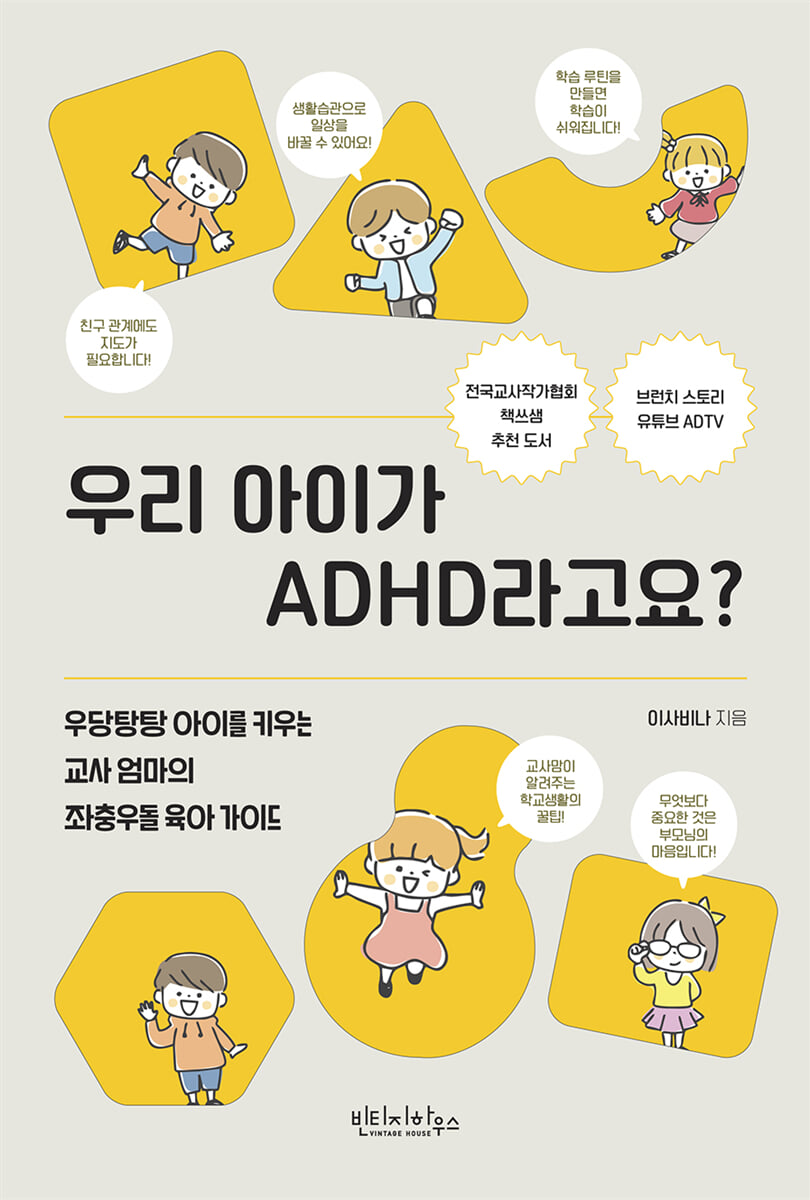
My child has ADHD?
 |
Description
Book Introduction
If you suspect your child may have ADHD… …
If you are concerned about your child's school life...
Here's a story from a teacher mom raising a child with ADHD!
A child who has difficulty concentrating and is easily distracted, a child who displays unusually unusual behavior, a child who does not listen to what others say…
If you suspect your child may have ADHD, pay attention to the story of a teacher-mom raising a child with ADHD. The prevalence of ADHD is said to be approximately 5-8%.
This means that one or two children per class may have ADHD. Considering the stigma surrounding ADHD in Korea, where it's often overlooked, the number is likely higher. The biggest challenge for children with ADHD is the difficulty they face in school.
Relationships with friends and academics are not easy.
"My Child Has ADHD?" is a book that provides tips on how to raise children with ADHD, based on the experience and insights gained from raising a child with ADHD by a middle school teacher with 12 years of experience.
And it delivers a message of courage and empathy to mothers raising children with ADHD, that their children can grow up well too.
If you are concerned about your child's school life...
Here's a story from a teacher mom raising a child with ADHD!
A child who has difficulty concentrating and is easily distracted, a child who displays unusually unusual behavior, a child who does not listen to what others say…
If you suspect your child may have ADHD, pay attention to the story of a teacher-mom raising a child with ADHD. The prevalence of ADHD is said to be approximately 5-8%.
This means that one or two children per class may have ADHD. Considering the stigma surrounding ADHD in Korea, where it's often overlooked, the number is likely higher. The biggest challenge for children with ADHD is the difficulty they face in school.
Relationships with friends and academics are not easy.
"My Child Has ADHD?" is a book that provides tips on how to raise children with ADHD, based on the experience and insights gained from raising a child with ADHD by a middle school teacher with 12 years of experience.
And it delivers a message of courage and empathy to mothers raising children with ADHD, that their children can grow up well too.
- You can preview some of the book's contents.
Preview
index
Recommendation
prolog
Chapter 1. ADHD, It Was You
1 What was bothering us was ADHD
2 If you suspect that your child may have ADHD
3. Prejudices that prevent early diagnosis
4 It's not too late for middle school and high school students.
5 What are the benefits of early diagnosis?
6 Do I really need to take the medicine?
Chapter 2.
Organizing your chaotic daily life
1. The only thing that solves everyday problems is habits.
2 Hyperactivity and impulsivity, what should we do?
3 I have ADHD so I can't help it, but can you please understand?
4 Beware of Addiction
5. Facing Side Effects of Medication in Daily Life with Children
6 Our Goals in Daily Life Fighting ADHD
Chapter 3.
So that school is no longer scary
1 What I Gain as a Mom: Call Phobia
2 Can I tell your homeroom teacher?
3 Tips for School Life from a Middle School Teacher
4 School violence, so as not to become a perpetrator or a victim
Chapter 4.
Don't give up on learning
1 Should I give up studying?
2. Learning for children becomes easier when you make it a routine.
3. Learning for children: This is difficult.
4 The most important thing in a child's learning is always the ending.
5 Why do I hate books?
6 Can my child also attend an academy?
7. Find where our children's strengths shine.
8 How should adolescent children study?
Chapter 5. Relationship Issues That Are More Difficult Because of ADHD
1. Social skills are paramount, and close coaching is crucial.
2 Parental coaching is more effective than any social skills class.
3 Children who have no best friends and cannot fit into a group
4 When ADHD and Anger Meet
Chapter 6. Being the Mom of a Child with ADHD
1. The relationship with the uncle is more frightening than the relationship with the son.
2. Surround yourself with supporters who will save you.
3 The one person who is most important to me
Chapter 7.
Nevertheless, only I
1. Attitudes you should not lose while raising a child
2 Separate your life from your child's.
3 How to keep myself going through the emotional turmoil
4 Don't Fall Into Comparison Hell
Epilogue
Acknowledgements
prolog
Chapter 1. ADHD, It Was You
1 What was bothering us was ADHD
2 If you suspect that your child may have ADHD
3. Prejudices that prevent early diagnosis
4 It's not too late for middle school and high school students.
5 What are the benefits of early diagnosis?
6 Do I really need to take the medicine?
Chapter 2.
Organizing your chaotic daily life
1. The only thing that solves everyday problems is habits.
2 Hyperactivity and impulsivity, what should we do?
3 I have ADHD so I can't help it, but can you please understand?
4 Beware of Addiction
5. Facing Side Effects of Medication in Daily Life with Children
6 Our Goals in Daily Life Fighting ADHD
Chapter 3.
So that school is no longer scary
1 What I Gain as a Mom: Call Phobia
2 Can I tell your homeroom teacher?
3 Tips for School Life from a Middle School Teacher
4 School violence, so as not to become a perpetrator or a victim
Chapter 4.
Don't give up on learning
1 Should I give up studying?
2. Learning for children becomes easier when you make it a routine.
3. Learning for children: This is difficult.
4 The most important thing in a child's learning is always the ending.
5 Why do I hate books?
6 Can my child also attend an academy?
7. Find where our children's strengths shine.
8 How should adolescent children study?
Chapter 5. Relationship Issues That Are More Difficult Because of ADHD
1. Social skills are paramount, and close coaching is crucial.
2 Parental coaching is more effective than any social skills class.
3 Children who have no best friends and cannot fit into a group
4 When ADHD and Anger Meet
Chapter 6. Being the Mom of a Child with ADHD
1. The relationship with the uncle is more frightening than the relationship with the son.
2. Surround yourself with supporters who will save you.
3 The one person who is most important to me
Chapter 7.
Nevertheless, only I
1. Attitudes you should not lose while raising a child
2 Separate your life from your child's.
3 How to keep myself going through the emotional turmoil
4 Don't Fall Into Comparison Hell
Epilogue
Acknowledgements
Detailed image

Into the book
I understand all too well why parents delay testing and hesitate to treat their children with medication.
However, after holding out for a year trying to get along with our family without medication, I realized something.
It is difficult to beat a child's ADHD without medication.
So now we've completely eliminated the option of avoiding drug treatment.
If you are hesitant about medication, I hope you will do everything you can as a parent to help your child feel more comfortable at school before doing so.
When you start drug treatment, various side effects may persist for about the first three months.
At this time, what is as difficult as the child's side effects is the anxious feelings of the parents watching them.
If you keep giving medicine and then not giving it, it will only increase the difficult time for both the child and the parents.
Therefore, drug treatment should be started when parents' anxiety about medication can be put behind them.
Please trust your doctor and start medication only when you are confident that it is the right path for you.
---From "Do I really have to take the medicine?"
The first is to count backwards when you want to stop hyperactivity.
Our children have slow attention spans, so even though they know intellectually that they should follow the behaviors their parents and teachers ask of them, they are unable to act 'right away, right away'.
But if you count down, your child's processing speed will increase.
When there is a time limit, it is easy to stop an action or switch to another action.
The important thing here is to count backwards.
Counting backwards can reveal a sense of urgency about reaching zero, prompting a quick correction in one's behavior.
On the other hand, when counting to 10, the child psychologically knows that there is an 11 and a 12, so it is difficult to switch attention.
If you keep counting numbers, your child will definitely show rebellion.
This problem can be solved by how you talk to your child.
It is expressed in positive terms rather than negative terms.
---From "What should we do about hyperactivity and impulsivity?"
Lastly, for children who have difficulty organizing at school, it would be a good idea to provide them with items that help them organize.
Organizing is about categorizing well.
Having some sorting baskets for your desk drawers and lockers will help you organize your items by sorting them rather than just shoving them in.
Also, a file bag to keep your worksheets organized is helpful.
The file bag is divided into several compartments like an accordion and has a handle so you can carry it like a bag and it won't spill out.
As you advance in grade level, the number of workbooks increases.
There are many middle school students who are not able to organize their worksheets.
When I tell students to take out their workbooks as soon as class starts, some students immediately take out the workbooks sorted by subject, while others take out all their textbooks from the drawer and look for their workbooks.
That's how you waste 5-10 minutes of class time.
A file bag can be a great help in organizing your child's worksheets.
---From "School Life Tips from a Middle School Teacher"
How can we help our children learn? Children with ADHD need different learning methods.
Because the characteristics of impulsivity, hyperactivity, and attention deficit are clearly handicaps for a child's learning.
These characteristics make it difficult to start learning and difficult to continue to complete it.
But there are ways to overcome the handicap.
It's all about automating your child's learning by making it a daily routine.
We don't think deeply about waking up in the morning, washing our faces, eating, brushing our teeth, and going to work.
I just do it naturally.
This is a routine, an automated daily activity.
That's why it's easy to start and easy to finish.
Learning can also be automated by making it a routine.
---From "Children's learning becomes easier when you make it a routine"
There are three things we must be mindful of when raising children.
It's my fault, the kid's fault, and the ADHD's fault.
'My fault' thinking that my child has ADHD because I tolerated his violence and hyperactivity too much, 'the child's fault' thinking that my life, which should be peaceful, has become miserable because of my child, and 'the ADHD's fault' thinking that all behaviors that are normal and easily disciplinary are all due to ADHD.
We must realize that we gain nothing from these three things.
Break free from these negative thoughts and think of one thing you did better than yesterday, one thing you did for your child, every day.
And please write it down.
You will feel a positive energy that you did your best today, and your self-esteem will increase as you realize that you have served your child well.
However, after holding out for a year trying to get along with our family without medication, I realized something.
It is difficult to beat a child's ADHD without medication.
So now we've completely eliminated the option of avoiding drug treatment.
If you are hesitant about medication, I hope you will do everything you can as a parent to help your child feel more comfortable at school before doing so.
When you start drug treatment, various side effects may persist for about the first three months.
At this time, what is as difficult as the child's side effects is the anxious feelings of the parents watching them.
If you keep giving medicine and then not giving it, it will only increase the difficult time for both the child and the parents.
Therefore, drug treatment should be started when parents' anxiety about medication can be put behind them.
Please trust your doctor and start medication only when you are confident that it is the right path for you.
---From "Do I really have to take the medicine?"
The first is to count backwards when you want to stop hyperactivity.
Our children have slow attention spans, so even though they know intellectually that they should follow the behaviors their parents and teachers ask of them, they are unable to act 'right away, right away'.
But if you count down, your child's processing speed will increase.
When there is a time limit, it is easy to stop an action or switch to another action.
The important thing here is to count backwards.
Counting backwards can reveal a sense of urgency about reaching zero, prompting a quick correction in one's behavior.
On the other hand, when counting to 10, the child psychologically knows that there is an 11 and a 12, so it is difficult to switch attention.
If you keep counting numbers, your child will definitely show rebellion.
This problem can be solved by how you talk to your child.
It is expressed in positive terms rather than negative terms.
---From "What should we do about hyperactivity and impulsivity?"
Lastly, for children who have difficulty organizing at school, it would be a good idea to provide them with items that help them organize.
Organizing is about categorizing well.
Having some sorting baskets for your desk drawers and lockers will help you organize your items by sorting them rather than just shoving them in.
Also, a file bag to keep your worksheets organized is helpful.
The file bag is divided into several compartments like an accordion and has a handle so you can carry it like a bag and it won't spill out.
As you advance in grade level, the number of workbooks increases.
There are many middle school students who are not able to organize their worksheets.
When I tell students to take out their workbooks as soon as class starts, some students immediately take out the workbooks sorted by subject, while others take out all their textbooks from the drawer and look for their workbooks.
That's how you waste 5-10 minutes of class time.
A file bag can be a great help in organizing your child's worksheets.
---From "School Life Tips from a Middle School Teacher"
How can we help our children learn? Children with ADHD need different learning methods.
Because the characteristics of impulsivity, hyperactivity, and attention deficit are clearly handicaps for a child's learning.
These characteristics make it difficult to start learning and difficult to continue to complete it.
But there are ways to overcome the handicap.
It's all about automating your child's learning by making it a daily routine.
We don't think deeply about waking up in the morning, washing our faces, eating, brushing our teeth, and going to work.
I just do it naturally.
This is a routine, an automated daily activity.
That's why it's easy to start and easy to finish.
Learning can also be automated by making it a routine.
---From "Children's learning becomes easier when you make it a routine"
There are three things we must be mindful of when raising children.
It's my fault, the kid's fault, and the ADHD's fault.
'My fault' thinking that my child has ADHD because I tolerated his violence and hyperactivity too much, 'the child's fault' thinking that my life, which should be peaceful, has become miserable because of my child, and 'the ADHD's fault' thinking that all behaviors that are normal and easily disciplinary are all due to ADHD.
We must realize that we gain nothing from these three things.
Break free from these negative thoughts and think of one thing you did better than yesterday, one thing you did for your child, every day.
And please write it down.
You will feel a positive energy that you did your best today, and your self-esteem will increase as you realize that you have served your child well.
---From "Attitudes You Should Not Lose While Raising a Child"
Publisher's Review
Singer Bibi confesses to having ADHD!! She was even bullied in school!!
School life and friendships.
Is there any way to overcome academic difficulties?
Recently, singer Bibi became a hot topic by confessing that she was diagnosed with ADHD.
Bibi, Ningning of aespa, Eun Jiwon, and Park Sohyun also confessed to having ADHD.
People who had previously postponed diagnosis due to prejudice against psychiatry and ADHD are now actively seeking treatment and seeking diagnosis at hospitals as adults to overcome their difficulties.
While the number of people seeking medical attention for adult ADHD is increasing, ADHD has been present since school days. The prevalence of ADHD is said to be approximately 5-8%.
This means that one or two children per class may have ADHD. Considering the stigma surrounding ADHD in Korea, where it's often overlooked, the number is likely higher.
As singer Bibi confessed, the biggest challenge for children with ADHD is that school life is difficult.
Because relationships with peers and academics are often challenging, severe cases often lead to bullying or depression. Is there a way for children suspected of or diagnosed with ADHD to thrive in school and overcome the challenges of peer relationships and academics?
"My Child Has ADHD?" is a book written by a middle school teacher with 12 years of experience raising a child with ADHD, based on her experience and the insights she gained from teaching. It provides tips on how to help children with ADHD adapt well to school life and overcome difficulties in friendships and academics.
The biggest obstacle is the prejudice against ADHD!
Help your children with courageous actions as parents!
A child who has difficulty concentrating and is easily distracted, a child who displays unusually unusual behavior, a child who does not listen to what others say…
If you suspect your child may have ADHD, I urge you to take courageous action to help them. The most effective way to help children with ADHD is to break free from the stigma surrounding psychiatry and the uncertain information online, and to ensure they receive early diagnosis and treatment.
And it is about helping children adapt well to school through a correct understanding of ADHD and appropriate discipline for children with ADHD.
If we start early diagnosis and treatment, our children can grow up well.
Although they may be a little different and develop a little later than others, understanding the characteristics of children with ADHD can help them succeed in school and academics. The author of "My Child Has ADHD?", a mother of a child with ADHD and a middle school teacher, shares her expertise on raising children with ADHD, drawing on her own experience and insights.
Stories that accurately understand the characteristics of children with ADHD, such as how to prepare for school life, how to study, and how to build relationships with friends, will help our children adapt well to school life.
School life and friendships.
Is there any way to overcome academic difficulties?
Recently, singer Bibi became a hot topic by confessing that she was diagnosed with ADHD.
Bibi, Ningning of aespa, Eun Jiwon, and Park Sohyun also confessed to having ADHD.
People who had previously postponed diagnosis due to prejudice against psychiatry and ADHD are now actively seeking treatment and seeking diagnosis at hospitals as adults to overcome their difficulties.
While the number of people seeking medical attention for adult ADHD is increasing, ADHD has been present since school days. The prevalence of ADHD is said to be approximately 5-8%.
This means that one or two children per class may have ADHD. Considering the stigma surrounding ADHD in Korea, where it's often overlooked, the number is likely higher.
As singer Bibi confessed, the biggest challenge for children with ADHD is that school life is difficult.
Because relationships with peers and academics are often challenging, severe cases often lead to bullying or depression. Is there a way for children suspected of or diagnosed with ADHD to thrive in school and overcome the challenges of peer relationships and academics?
"My Child Has ADHD?" is a book written by a middle school teacher with 12 years of experience raising a child with ADHD, based on her experience and the insights she gained from teaching. It provides tips on how to help children with ADHD adapt well to school life and overcome difficulties in friendships and academics.
The biggest obstacle is the prejudice against ADHD!
Help your children with courageous actions as parents!
A child who has difficulty concentrating and is easily distracted, a child who displays unusually unusual behavior, a child who does not listen to what others say…
If you suspect your child may have ADHD, I urge you to take courageous action to help them. The most effective way to help children with ADHD is to break free from the stigma surrounding psychiatry and the uncertain information online, and to ensure they receive early diagnosis and treatment.
And it is about helping children adapt well to school through a correct understanding of ADHD and appropriate discipline for children with ADHD.
If we start early diagnosis and treatment, our children can grow up well.
Although they may be a little different and develop a little later than others, understanding the characteristics of children with ADHD can help them succeed in school and academics. The author of "My Child Has ADHD?", a mother of a child with ADHD and a middle school teacher, shares her expertise on raising children with ADHD, drawing on her own experience and insights.
Stories that accurately understand the characteristics of children with ADHD, such as how to prepare for school life, how to study, and how to build relationships with friends, will help our children adapt well to school life.
GOODS SPECIFICS
- Date of issue: March 28, 2024
- Page count, weight, size: 311 pages | 152*225*19mm
- ISBN13: 9791189249847
You may also like
카테고리
korean


korean

![GQ KOREA Mark (Monthly): December [2025]](http://librairie.coreenne.fr/cdn/shop/files/8ef265dbbfbf186523ed75ba7319009d.jpg?v=1765340328&width=3840)


