

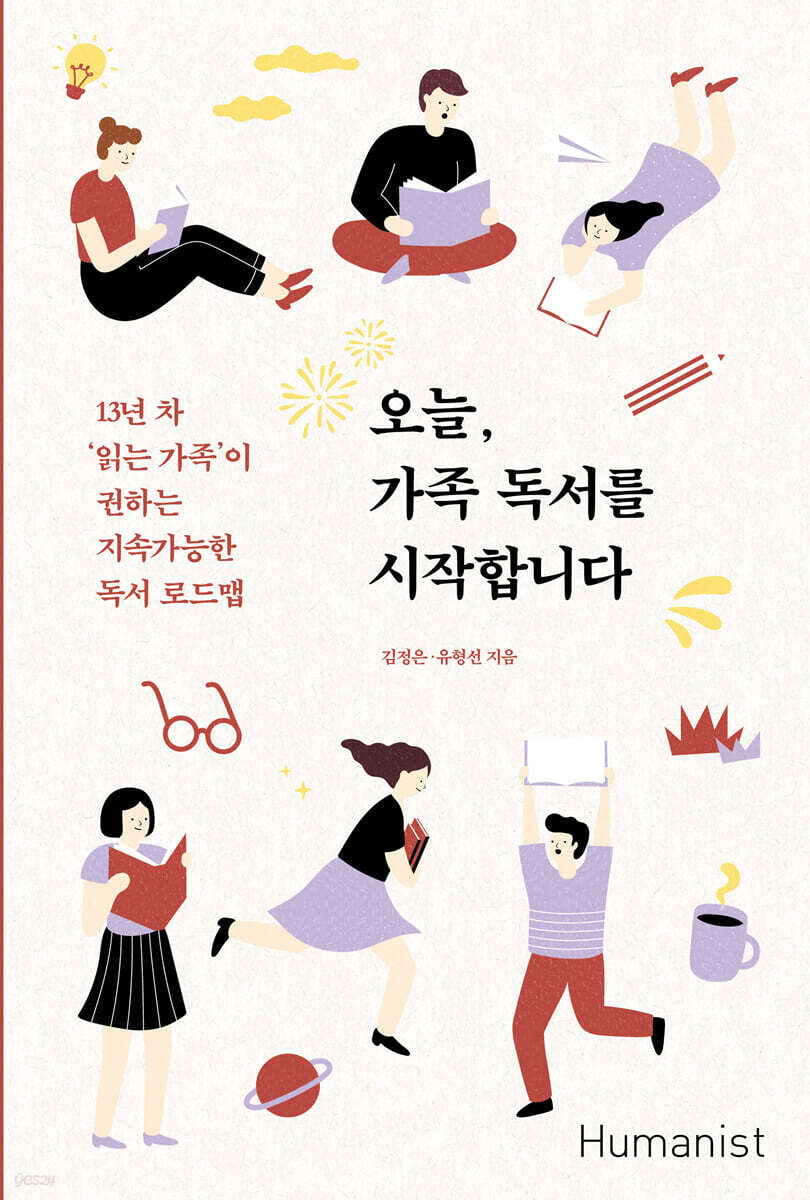
Today, we start family reading.
 |
Description
Book Introduction
- A word from MD
-
Growing into a family of readersA couple who raised their children to be 'readers' through family reading.
It contains the secrets of raising children to be voluntary and tireless lifelong readers by spending 13 years reading together every day.
A book that presents a sustainable reading roadmap that transforms families into educational communities.
November 17, 2023. PD Lee Joo-eun of Home Life
The whole family grows into ‘readers’
The Power of Family Reading
-Creating a tireless reading habit that's only possible with family
Everyone knows how important consistent reading is, but anyone who has actually tried to guide their child to read knows firsthand how difficult it can be.
Because children who read books without being told to, let alone having fun, mostly exist only in their imagination.
From preschool to early elementary school, many children seem to follow their parents' advice to some extent, but then suddenly lose interest and refuse to read. This is a process that many children go through.
Here, a couple found the answer to their worries through 13 years of 'family reading.'
The path they have taken proves that forming a child's reading habit is best accomplished by a family living together.
"Today, Family Reading Begins" is a sustainable reading roadmap compiled by a couple who are active as "family reading activists" for those preparing for family reading.
This book contains age- and subject-specific recommendations compiled through reading, lectures, and book club activities, so that it can be used as a reference for a child's long-term reading plan.
"Let's Start Family Reading Today" covers everything about family reading, connecting family members and helping them all grow into lifelong readers.
By following the author's guidance, who has personally experienced trial and error and understands the mind of a beginner better than anyone else, even non-experts will be able to easily attempt family reading.
The Power of Family Reading
-Creating a tireless reading habit that's only possible with family
Everyone knows how important consistent reading is, but anyone who has actually tried to guide their child to read knows firsthand how difficult it can be.
Because children who read books without being told to, let alone having fun, mostly exist only in their imagination.
From preschool to early elementary school, many children seem to follow their parents' advice to some extent, but then suddenly lose interest and refuse to read. This is a process that many children go through.
Here, a couple found the answer to their worries through 13 years of 'family reading.'
The path they have taken proves that forming a child's reading habit is best accomplished by a family living together.
"Today, Family Reading Begins" is a sustainable reading roadmap compiled by a couple who are active as "family reading activists" for those preparing for family reading.
This book contains age- and subject-specific recommendations compiled through reading, lectures, and book club activities, so that it can be used as a reference for a child's long-term reading plan.
"Let's Start Family Reading Today" covers everything about family reading, connecting family members and helping them all grow into lifelong readers.
By following the author's guidance, who has personally experienced trial and error and understands the mind of a beginner better than anyone else, even non-experts will be able to easily attempt family reading.
- You can preview some of the book's contents.
Preview
index
Preface: We are a family that makes each other dream.
Part 1: Family Reading Roadmap
Chapter 1: Why Family Reading?
The Time to Read as a Family: The Benefits of Family Reading
Chapter 2: Getting Started with Family Reading
Books that Open the Door to Family Reading│Family Reading Begins with "Delicious Books"
Chapter 3: Continuing Family Reading
Building a Family Reading Habit│How to Deal with Your Child's Reluctance to Read│Books to Help Keep Your Family Reading Together
Activity 1: Planning a Family Reading
Part 2 Family Reading How to Read?
Chapter 1: Reading a Picture Book
Reading 'Emotion Picture Books' that understand children's feelings│Reading 'Family Picture Books' that connect family members│Reading 'Friendship Picture Books' that help build relationships│Reading 'Growth and Coexistence Picture Books' that help children grow together
Chapter 2: Telling Old Stories
A time to learn the wisdom of our ancestors│A time to change old stories and create your own story│Reading old story picture books, traditional fairy tales, and Korean classics
Activity 2: Share a book story with the whole family
Part 3 Family Reading What to Read?
Chapter 1: Reading Children's Literature Together as a Family
Reading Focusing on Korean Children's Literature│Reading Focusing on Foreign Children's Literature
Chapter 2: Our Family Reading Children's Nonfiction Together
Read newspaper articles at the breakfast table every morning. │ Look up Korean dictionaries, encyclopedias, and guidebooks. │ Read informational books that teach about changes in body and mind. │ Read informational books about climate justice, zero waste, and veganism. │ What if you have a favorite subject? Read deeply about it.
Chapter 3: How to attract different children?
Children who hate literature are immersed in the world of literature. Children who hate non-literature are immersed in the world of non-literature.
Chapter 4: Using Everyone's Favorite Comic Books
High-quality comics that the whole family can enjoy together│Reading educational comics alone to strengthen vocabulary and build background knowledge
Activity 3: Reading and Sharing Children's Literature, Non-Fiction, and Comics
Conclusion: I will live with a child's heart.
Appendix: List of books suitable for family reading
Part 1: Family Reading Roadmap
Chapter 1: Why Family Reading?
The Time to Read as a Family: The Benefits of Family Reading
Chapter 2: Getting Started with Family Reading
Books that Open the Door to Family Reading│Family Reading Begins with "Delicious Books"
Chapter 3: Continuing Family Reading
Building a Family Reading Habit│How to Deal with Your Child's Reluctance to Read│Books to Help Keep Your Family Reading Together
Activity 1: Planning a Family Reading
Part 2 Family Reading How to Read?
Chapter 1: Reading a Picture Book
Reading 'Emotion Picture Books' that understand children's feelings│Reading 'Family Picture Books' that connect family members│Reading 'Friendship Picture Books' that help build relationships│Reading 'Growth and Coexistence Picture Books' that help children grow together
Chapter 2: Telling Old Stories
A time to learn the wisdom of our ancestors│A time to change old stories and create your own story│Reading old story picture books, traditional fairy tales, and Korean classics
Activity 2: Share a book story with the whole family
Part 3 Family Reading What to Read?
Chapter 1: Reading Children's Literature Together as a Family
Reading Focusing on Korean Children's Literature│Reading Focusing on Foreign Children's Literature
Chapter 2: Our Family Reading Children's Nonfiction Together
Read newspaper articles at the breakfast table every morning. │ Look up Korean dictionaries, encyclopedias, and guidebooks. │ Read informational books that teach about changes in body and mind. │ Read informational books about climate justice, zero waste, and veganism. │ What if you have a favorite subject? Read deeply about it.
Chapter 3: How to attract different children?
Children who hate literature are immersed in the world of literature. Children who hate non-literature are immersed in the world of non-literature.
Chapter 4: Using Everyone's Favorite Comic Books
High-quality comics that the whole family can enjoy together│Reading educational comics alone to strengthen vocabulary and build background knowledge
Activity 3: Reading and Sharing Children's Literature, Non-Fiction, and Comics
Conclusion: I will live with a child's heart.
Appendix: List of books suitable for family reading
Detailed image

Into the book
Through long-term family reading, relationships between family members have been restored, parents and children have more things to talk about, and the entire family has experienced growth.
My husband and I have faced financial hardships due to restructuring, strikes, and early retirement, but we have taken steps toward a new path and have begun to dream again.
The two children, who learned how to learn through reading without private tutoring, are also moving forward on their own paths.
--- From "Part 1, Chapter 1: Why Family Reading?"
When telling a story, unlike when reading a picture book, an active process takes place in the listener's mind.
The listener will have the experience of drawing a picture themselves.
If you draw pictures in your head while listening to a short story, you can practice reading a short story book, which naturally draws pictures in your head while reading a short text.
Then, finally, you can read short texts without pictures.
Telling old stories is meaningful in itself, but it also serves as a stepping stone to further elevate a child's reading level from picture books to written books.
--- From "Telling Old Stories, Part 2, Chapter 2"
I often get asked how to read to different children.
My older and younger children are four years apart.
Moreover, the two children's interests are clearly different.
Before we started reading together as a family, I never imagined that my two children's reading tastes would be so different.
To conclude, both separate reading and combined reading are necessary.
It is okay to read picture books and tell old stories in the same way.
However, children's literature and children's non-literature require a little more care and attention depending on the child.
My husband and I have faced financial hardships due to restructuring, strikes, and early retirement, but we have taken steps toward a new path and have begun to dream again.
The two children, who learned how to learn through reading without private tutoring, are also moving forward on their own paths.
--- From "Part 1, Chapter 1: Why Family Reading?"
When telling a story, unlike when reading a picture book, an active process takes place in the listener's mind.
The listener will have the experience of drawing a picture themselves.
If you draw pictures in your head while listening to a short story, you can practice reading a short story book, which naturally draws pictures in your head while reading a short text.
Then, finally, you can read short texts without pictures.
Telling old stories is meaningful in itself, but it also serves as a stepping stone to further elevate a child's reading level from picture books to written books.
--- From "Telling Old Stories, Part 2, Chapter 2"
I often get asked how to read to different children.
My older and younger children are four years apart.
Moreover, the two children's interests are clearly different.
Before we started reading together as a family, I never imagined that my two children's reading tastes would be so different.
To conclude, both separate reading and combined reading are necessary.
It is okay to read picture books and tell old stories in the same way.
However, children's literature and children's non-literature require a little more care and attention depending on the child.
--- From "How to attract different children in Part 3, Chapter 3"
Publisher's Review
This is my first time doing a reading guide…
- An easy and friendly guide for parents who are just getting started.
Reading books together as a family can be daunting not only for children but also for parents who are trying to teach reading for the first time.
Part 1 of this book introduces recommended books tailored to family reading, and then provides guidance on how to easily become a facilitator of family reading for parents who are unfamiliar with reading guidance.
Based on years of experience, we provide step-by-step answers to concerns that may arise during the beginning and progress of family reading, and guide you through the preparation stage, including setting a schedule and appointments for family reading, to create a concrete blueprint.
Additionally, we introduce ways to lower the barrier to reading and naturally immerse children in the world of books, such as stimulating curiosity and interest by eating snacks featured in books through 'Delicious Book Reading' and inviting children who are still unfamiliar with printed materials to the library as a play space.
It also includes practical advice to help you continue reading with your family without getting tired even after your child has become accustomed to reading.
Especially when a child refuses to read, instead of blindly forcing them to read, respect their refusal, examine their state of mind and reading environment, and thoughtfully guide them on how to convince them of the benefits of reading.
The included activity sheets and recommended reading list help family readers utilize this book more practically.
The activity sheet contains specific questions and activities to help parents who are unsure of how to discuss the book with their children after reading it together.
In addition, the appendix suggests broad and deep reading by introducing books suitable for family reading by topic and situation, along with reference books worth reading further.
My child is a picky reader,
How to prevent it?
- How to develop reading tastes and interests and become a balanced reader.
In parts 2 and 3, we introduce carefully selected reading tips and recommended books that take into account the child's growth and changes.
First, the picture books, organized into four themes of 'emotions', 'family', 'friendship', and 'growth and coexistence', convey the affection that cannot be expressed in words and connect family members.
It helps children who are experiencing group life for the first time in their lives build relationships and guides them to the joy of living together with others who are connected to them.
The author suggests that family reading, which serves as a bridge from picture books to storybooks, is telling old stories.
Rather than simply telling stories, we go one step further and suggest new ways to expand your appreciation, such as changing old stories to create your own stories, reading them in conjunction with other books, or reading old story picture books, traditional fairy tales, and Korean classics.
In the process, children will naturally learn about old stories and the changing values of today, and will be able to read books with greater interest by finding connections between their own situations and the stories.
How can we raise our children to be well-rounded readers who enjoy both literature and non-fiction? This is a question that every parent has likely asked themselves at least once.
The author has raised two children with completely different reading tastes and interests, and has accumulated the know-how to introduce the joy of literature to the older child who disliked literature, and to open the world of non-literature to the younger child who disliked non-literature.
Based on this, Part 3 selects core books ranging from Korean and foreign children's literature to non-fiction such as newspaper articles, dictionaries, guides, information books, and educational comics, and introduces reading guidance methods that will broaden children's tastes, as well as methods for reading deeply in areas of interest.
In particular, it covers Korea's representative writers and their genealogy in detail so that they can be used as references for literature education such as 'Reading Previous Works', and introduces information books that can breathe with today's issues such as the body and mind of adolescence, the climate crisis, and zero waste, so that children can learn important values for their growth and education.
“We are a family that makes each other dream.”
- The change in relationships brought about by reading a book for one hour on weekdays and talking about books for two hours on weekends.
Reading books together as a family is one of the healthiest ways to spend time with your family.
Reading, which allows family members to share their feelings and thoughts and communicate closely through books, can be an opportunity to strengthen their bonds.
When the author's family, who had been living apart from their children for a long time due to dual-income families, suddenly had to live together in one house due to unexpected crises such as restructuring, strikes, and early retirement, the couple's solution was family reading.
They say that by sharing stories centered around the books they read together, they were able to extend the conversation to even the little things in their daily lives.
Through family reading time, parents and children can get to know each other better and build a bond, which will enable them to have conversations even after their children reach adolescence and become high school students.
It goes without saying that these types of conversations not only strengthen family relationships but also provide opportunities for the entire family to grow together.
Through family reading, these families were able to discover their interests, expand their learning, and transform themselves in ways they desired, without the need for private education.
As this family's slogan suggests, "We are a family that makes each other dream," family reading helps overcome life's big and small crises and leads all family members to grow in a better direction.
In "Today, Family Reading Begins," the author encourages you to begin family reading now, using the family's journey as a guide.
- An easy and friendly guide for parents who are just getting started.
Reading books together as a family can be daunting not only for children but also for parents who are trying to teach reading for the first time.
Part 1 of this book introduces recommended books tailored to family reading, and then provides guidance on how to easily become a facilitator of family reading for parents who are unfamiliar with reading guidance.
Based on years of experience, we provide step-by-step answers to concerns that may arise during the beginning and progress of family reading, and guide you through the preparation stage, including setting a schedule and appointments for family reading, to create a concrete blueprint.
Additionally, we introduce ways to lower the barrier to reading and naturally immerse children in the world of books, such as stimulating curiosity and interest by eating snacks featured in books through 'Delicious Book Reading' and inviting children who are still unfamiliar with printed materials to the library as a play space.
It also includes practical advice to help you continue reading with your family without getting tired even after your child has become accustomed to reading.
Especially when a child refuses to read, instead of blindly forcing them to read, respect their refusal, examine their state of mind and reading environment, and thoughtfully guide them on how to convince them of the benefits of reading.
The included activity sheets and recommended reading list help family readers utilize this book more practically.
The activity sheet contains specific questions and activities to help parents who are unsure of how to discuss the book with their children after reading it together.
In addition, the appendix suggests broad and deep reading by introducing books suitable for family reading by topic and situation, along with reference books worth reading further.
My child is a picky reader,
How to prevent it?
- How to develop reading tastes and interests and become a balanced reader.
In parts 2 and 3, we introduce carefully selected reading tips and recommended books that take into account the child's growth and changes.
First, the picture books, organized into four themes of 'emotions', 'family', 'friendship', and 'growth and coexistence', convey the affection that cannot be expressed in words and connect family members.
It helps children who are experiencing group life for the first time in their lives build relationships and guides them to the joy of living together with others who are connected to them.
The author suggests that family reading, which serves as a bridge from picture books to storybooks, is telling old stories.
Rather than simply telling stories, we go one step further and suggest new ways to expand your appreciation, such as changing old stories to create your own stories, reading them in conjunction with other books, or reading old story picture books, traditional fairy tales, and Korean classics.
In the process, children will naturally learn about old stories and the changing values of today, and will be able to read books with greater interest by finding connections between their own situations and the stories.
How can we raise our children to be well-rounded readers who enjoy both literature and non-fiction? This is a question that every parent has likely asked themselves at least once.
The author has raised two children with completely different reading tastes and interests, and has accumulated the know-how to introduce the joy of literature to the older child who disliked literature, and to open the world of non-literature to the younger child who disliked non-literature.
Based on this, Part 3 selects core books ranging from Korean and foreign children's literature to non-fiction such as newspaper articles, dictionaries, guides, information books, and educational comics, and introduces reading guidance methods that will broaden children's tastes, as well as methods for reading deeply in areas of interest.
In particular, it covers Korea's representative writers and their genealogy in detail so that they can be used as references for literature education such as 'Reading Previous Works', and introduces information books that can breathe with today's issues such as the body and mind of adolescence, the climate crisis, and zero waste, so that children can learn important values for their growth and education.
“We are a family that makes each other dream.”
- The change in relationships brought about by reading a book for one hour on weekdays and talking about books for two hours on weekends.
Reading books together as a family is one of the healthiest ways to spend time with your family.
Reading, which allows family members to share their feelings and thoughts and communicate closely through books, can be an opportunity to strengthen their bonds.
When the author's family, who had been living apart from their children for a long time due to dual-income families, suddenly had to live together in one house due to unexpected crises such as restructuring, strikes, and early retirement, the couple's solution was family reading.
They say that by sharing stories centered around the books they read together, they were able to extend the conversation to even the little things in their daily lives.
Through family reading time, parents and children can get to know each other better and build a bond, which will enable them to have conversations even after their children reach adolescence and become high school students.
It goes without saying that these types of conversations not only strengthen family relationships but also provide opportunities for the entire family to grow together.
Through family reading, these families were able to discover their interests, expand their learning, and transform themselves in ways they desired, without the need for private education.
As this family's slogan suggests, "We are a family that makes each other dream," family reading helps overcome life's big and small crises and leads all family members to grow in a better direction.
In "Today, Family Reading Begins," the author encourages you to begin family reading now, using the family's journey as a guide.
GOODS SPECIFICS
- Date of issue: October 30, 2023
- Page count, weight, size: 204 pages | 392g | 152*225*13mm
- ISBN13: 9791170870654
- ISBN10: 1170870651
You may also like
카테고리
korean


korean

![GQ KOREA Mark (Monthly): December [2025]](http://librairie.coreenne.fr/cdn/shop/files/8ef265dbbfbf186523ed75ba7319009d.jpg?v=1765340328&width=3840)


