

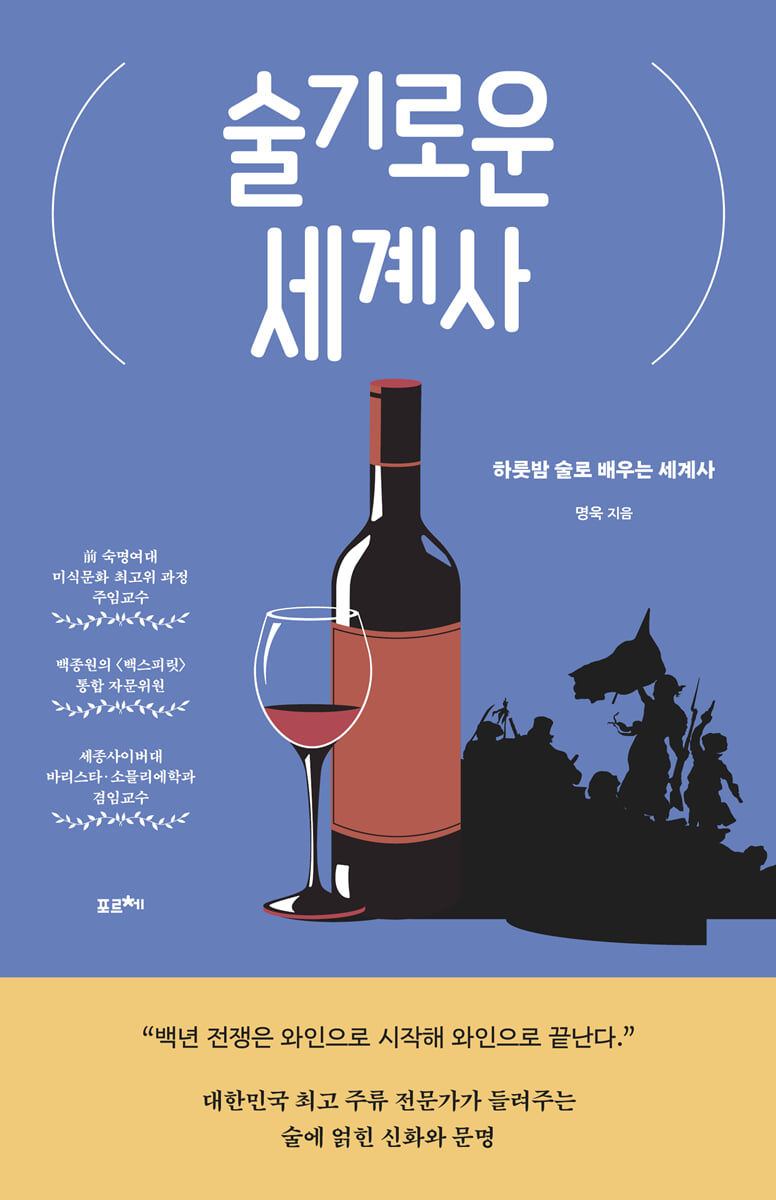
A drunken world history
 |
Description
Book Introduction
South Korea's top alcohol expert and alcohol humanities expert
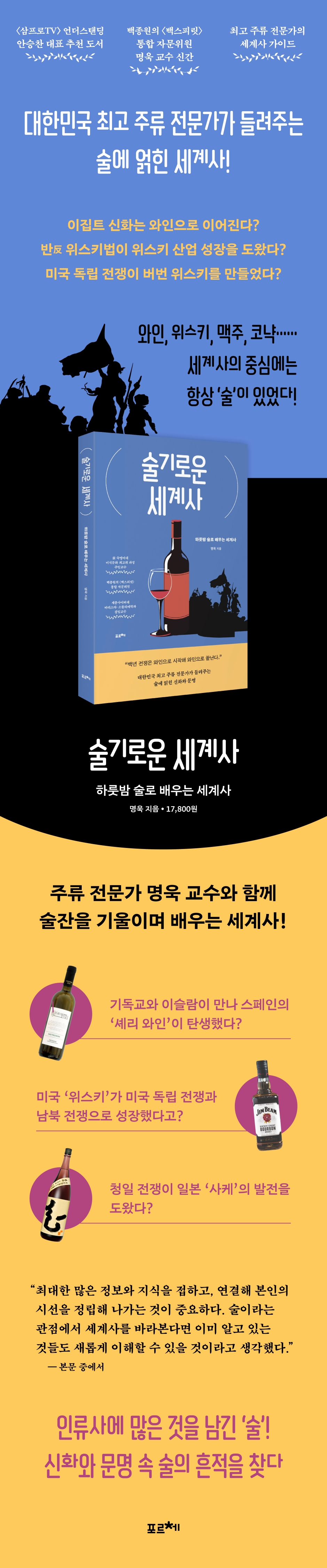
Let's learn about world history and culture at the same time while having a drink with Professor Myungwook!
A new perspective on world history that has never been seen before
The author, Professor Myungwook, is Korea's leading mainstream humanities expert and mainstream columnist.
The author has experience in mainstream broadcasting and lectures, including serving as an integrated advisor for Baek Jong-won's [Baek Spirit].
『A World History of Alcohol』 is a book that Professor Myeongwook has compiled interesting stories related to alcohol and the world history of alcohol.
Covering the history, mythology, culture, war, and industry of alcohol, this book tells the story of the historical events that occurred as alcohol was invented.
It explains how alcohol was made by type and how the flow of history changed with the birth of alcohol.
For readers who find world history difficult, it even includes interesting anecdotes related to alcohol.
Alcohol is a bridge connecting humanity and history, and is more closely connected to more events than we might think.
This book will allow readers to share and explore new perspectives on history.
This book is recommended to those who are interested in the history or mythology surrounding alcohol, and to readers who have been interested in world history but have been hesitant to take on the challenge because it seemed too difficult.
Let's learn about world history and culture at the same time while having a drink with Professor Myungwook!
A new perspective on world history that has never been seen before
The author, Professor Myungwook, is Korea's leading mainstream humanities expert and mainstream columnist.
The author has experience in mainstream broadcasting and lectures, including serving as an integrated advisor for Baek Jong-won's [Baek Spirit].
『A World History of Alcohol』 is a book that Professor Myeongwook has compiled interesting stories related to alcohol and the world history of alcohol.
Covering the history, mythology, culture, war, and industry of alcohol, this book tells the story of the historical events that occurred as alcohol was invented.
It explains how alcohol was made by type and how the flow of history changed with the birth of alcohol.
For readers who find world history difficult, it even includes interesting anecdotes related to alcohol.
Alcohol is a bridge connecting humanity and history, and is more closely connected to more events than we might think.
This book will allow readers to share and explore new perspectives on history.
This book is recommended to those who are interested in the history or mythology surrounding alcohol, and to readers who have been interested in world history but have been hesitant to take on the challenge because it seemed too difficult.
- You can preview some of the book's contents.
Preview
index
Prologue: The World of Alcohol: 5: The Art of Creating Our Society and Life
Alcohol Knowledge Self-Diagnosis Quiz 15
17 Things to Know Before You Toast
Chapter 1: The Making of Alcohol: Civilization and Myth
1.
Is this Silk Road junction the birthplace of wine? 22
2.
The Bible That Introduced Wine to the World 27
3.
The Epic of Gilgamesh, the first epic poem of mankind, which continues from beer, Part 33
4.
The Sumerian Goddess of Beer, Born from the Combination of Water and Healing 39
5.
Ancient Egypt's winemaking methods are depicted in 42 drawings.
6.
Egyptian Mythology Leading to Wine 47
7.
Phoenician Civilization, the Root of European Civilization 51
8.
Dionysus, the Greek god of wine who contributed to democracy 56
9.
Hippocrates, the creator of the first medicine, 64
10.
Winemaking Techniques from Greek Literature 69
11.
The heart of Roman wine is Greek and Carthaginian 74
12.
The Roman Emperor Who Persecuted Christianity Raised the Quality of Wine 77
13.
83 Reasons Why France Became the Center of Wine
14.
Wine Flows to the Monastery 89
Chapter 2: Drinking: War and Revolution
15.
The European Crusades that ushered in the dawn of whiskey, vodka, and cognac.
16.
The Black Death and Distilled Spirits 103
17.
106 Reasons Why Alcohol Is Prohibited in Islam
18.
The Hundred Years' War was a Wine War 109
19.
The French Duchy of Burgundy, which sold Joan of Arc 114
20.
118 French wines named after British generals
21.
The Netherlands, at the Heart of Bordeaux Wine 122
22.
The Dutch also contributed to the French cognac industry.
23.
Why Germany Became the Home of Beer 132
24.
The Dutch also contributed to the beer industry and the invention of the refrigerator.
25.
The Glorious Revolution: Social Problems Caused by Drinking 138
26.
A Fusion of Christian and Islamic Cultures: Spanish Sherry Wine 141
27.
Champagne, the drink of the French absolute monarchy 145
28.
Why Champagne Has Carbonation 149
29.
The French Revolution, sparked by wine, 153
30.
The Development of Bars, Leading a Civil Revolution 159
31.
Bourbon Whiskey: The American Revolutionary War 165
32.
American Whiskey: The Rise of the American Revolutionary War and the Civil War 168
33.
George Washington, the first president of the United States and a whiskey expert, 171
34.
The Transcontinental Railroad and the Civil War: Whiskey's Wings 175
35.
The ban on the slave trade lowered the value of American rum. 179
36.
World War I accelerates Prohibition in the United States 181
Chapter 3: Drinking: Industry and Culture
37.
The Scottish government, which had banned whiskey, reversed its stance to secure tax revenue.
38.
The Origins of Using Grains Other Than Barley in Whiskey 191
39.
The Anti-Whiskey Act of 197, which helped the whiskey industry grow.
40.
The Original Whiskey, Irish Whiskey 202
41.
205 Reasons to Put New Wine in New Wineskins
42.
The History of Thin Wine Glasses for Tax Savings 209
43.
The Sino-Japanese War Developed Japan's Sake Industry 213
44.
Why Japan Became Famous for Whiskey 217
45.
Korean cider imported by the Japanese 223
46.
Why Korea Didn't Make Whiskey 227
47.
Makgeolli and Pajeon, a History of Encouraging Snacks 231
48.
The History of Korean Soju 236
49.
Fake liquors like Captin Q and Napoleon 240, which grew during the Seoul Olympics.
50.
243 in the 1980s, when similar liquors were prevalent
51.
Soju, not soju, 'Dosoju' 248
52.
Potatoes, brought in through the new trade route, are reborn as a raw material for vodka. 251
53.
Why Russia Became the Home of Vodka 255
54.
The epitome of modernism: Bombju 260
Epilogue: Universal Human Values Discovered Through Alcohol 265
Reference 268
Alcohol Knowledge Self-Diagnosis Quiz 15
17 Things to Know Before You Toast
Chapter 1: The Making of Alcohol: Civilization and Myth
1.
Is this Silk Road junction the birthplace of wine? 22
2.
The Bible That Introduced Wine to the World 27
3.
The Epic of Gilgamesh, the first epic poem of mankind, which continues from beer, Part 33
4.
The Sumerian Goddess of Beer, Born from the Combination of Water and Healing 39
5.
Ancient Egypt's winemaking methods are depicted in 42 drawings.
6.
Egyptian Mythology Leading to Wine 47
7.
Phoenician Civilization, the Root of European Civilization 51
8.
Dionysus, the Greek god of wine who contributed to democracy 56
9.
Hippocrates, the creator of the first medicine, 64
10.
Winemaking Techniques from Greek Literature 69
11.
The heart of Roman wine is Greek and Carthaginian 74
12.
The Roman Emperor Who Persecuted Christianity Raised the Quality of Wine 77
13.
83 Reasons Why France Became the Center of Wine
14.
Wine Flows to the Monastery 89
Chapter 2: Drinking: War and Revolution
15.
The European Crusades that ushered in the dawn of whiskey, vodka, and cognac.
16.
The Black Death and Distilled Spirits 103
17.
106 Reasons Why Alcohol Is Prohibited in Islam
18.
The Hundred Years' War was a Wine War 109
19.
The French Duchy of Burgundy, which sold Joan of Arc 114
20.
118 French wines named after British generals
21.
The Netherlands, at the Heart of Bordeaux Wine 122
22.
The Dutch also contributed to the French cognac industry.
23.
Why Germany Became the Home of Beer 132
24.
The Dutch also contributed to the beer industry and the invention of the refrigerator.
25.
The Glorious Revolution: Social Problems Caused by Drinking 138
26.
A Fusion of Christian and Islamic Cultures: Spanish Sherry Wine 141
27.
Champagne, the drink of the French absolute monarchy 145
28.
Why Champagne Has Carbonation 149
29.
The French Revolution, sparked by wine, 153
30.
The Development of Bars, Leading a Civil Revolution 159
31.
Bourbon Whiskey: The American Revolutionary War 165
32.
American Whiskey: The Rise of the American Revolutionary War and the Civil War 168
33.
George Washington, the first president of the United States and a whiskey expert, 171
34.
The Transcontinental Railroad and the Civil War: Whiskey's Wings 175
35.
The ban on the slave trade lowered the value of American rum. 179
36.
World War I accelerates Prohibition in the United States 181
Chapter 3: Drinking: Industry and Culture
37.
The Scottish government, which had banned whiskey, reversed its stance to secure tax revenue.
38.
The Origins of Using Grains Other Than Barley in Whiskey 191
39.
The Anti-Whiskey Act of 197, which helped the whiskey industry grow.
40.
The Original Whiskey, Irish Whiskey 202
41.
205 Reasons to Put New Wine in New Wineskins
42.
The History of Thin Wine Glasses for Tax Savings 209
43.
The Sino-Japanese War Developed Japan's Sake Industry 213
44.
Why Japan Became Famous for Whiskey 217
45.
Korean cider imported by the Japanese 223
46.
Why Korea Didn't Make Whiskey 227
47.
Makgeolli and Pajeon, a History of Encouraging Snacks 231
48.
The History of Korean Soju 236
49.
Fake liquors like Captin Q and Napoleon 240, which grew during the Seoul Olympics.
50.
243 in the 1980s, when similar liquors were prevalent
51.
Soju, not soju, 'Dosoju' 248
52.
Potatoes, brought in through the new trade route, are reborn as a raw material for vodka. 251
53.
Why Russia Became the Home of Vodka 255
54.
The epitome of modernism: Bombju 260
Epilogue: Universal Human Values Discovered Through Alcohol 265
Reference 268
Detailed image
Into the book
The birth of Ninkasi, the goddess of beer, is a bit complicated.
Ninkasi's father is Enki, and his mother is Ninti, the goddess of healing.
Ninkasi was born from Enki, the father who ruled over water, and Ninti, the mother who was in charge of healing.
So maybe that's why drinking beer feels like it's healing.
--- p.40, from “The Sumerian Beer Goddess Born from the Combination of Water and Healing”
The Egyptian god of wine was Osiris, the son of Geb, the god of the earth.
Osiris is the god of agriculture, resurrection, and wine.
This is because he was the first to grow grapes and make wine from them.
Because he is a god associated with agriculture, his skin is said to be green.
In order to spread civilization and agriculture throughout the world, he is said to have left the government to his sister and wife, Isis.
Osiris ordered that beer be made by growing barley in areas where the climate and soil were not suitable.
As a result, he was recognized as a provider of food, and the people worshipped him.
For that reason, the Egyptian pharaohs boasted that they were the successors of Osiris.
--- p.47, from “Egyptian Mythology Leading to Wine”
Hippocrates used clean water and wine for disinfection when treating wounds.
And they made medicinal liquor by adding various medicinal herbs to wine.
At that time, before distilled liquor was invented, the only alcohol with a relatively high alcohol content was wine.
The alcohol in wine has a higher osmotic pressure than water, so it dissolves the ingredients of the medicinal herbs well, and when consumed, it is absorbed into the body faster than water.
At the same time, alcohol itself also acts as a diuretic and antipyretic.
This was the best we could do at the time, when there were no proper medicines (of course, you should never disinfect with wine these days).
--- p.66, from “Hippocrates, the creator of the first medicine”
Currently, the most expensive wine in the world is Romanee-Conti, which can easily cost tens of millions of won per bottle.
This wine is made in the Burgundy region, which has the largest number of special vineyards designated by the French government.
Although Bordeaux has a larger vineyard area, it has several small, premium vineyards.
In the Burgundy region, limited quantities are handcrafted to further enhance its value, producing some of the most expensive red and white wines.
There are also standards for the grape varieties used to make wine.
Red wine is made mainly from Pinot Noir, and white wine is made mainly from Chardonnay.
The simplicity of these varieties seems to be the story behind them, creating an image of a high-end brand.
--- p.83, from “Why France Became the Center of Wine”
The Crusades were started by Urban II, who was from the Abbey of Cligny in Burgundy, France.
As it turns out, the Crusades brought the culture of distilled spirits to Europe.
Scotland's Scotch whiskey, Eastern Europe's vodka, and France's cognac all originated when distillation techniques were introduced from the Middle East during the Crusades.
In the East, soju was introduced to Korea through Mongolia, and sorghum liquor was introduced to China.
How did the Middle East acquire this distillation technique? Interestingly, its roots lie in Greek philosophy.
--- p.98, from “The European Crusades That Announced the Beginning of Whiskey, Vodka, and Cognac”
The word champagne is the Anglicized name for the Champagne region of France.
It was originally called Champagne wine, but because this region is so famous for its wine, it is now called Champagne for short.
We usually pop this champagne toast when we have something to celebrate.
Why is that?
--- p.146, from “Champagne, the drink of the French absolute monarchy”
The United States produced and consumed a lot of rum until the Revolution.
So why doesn't the United States claim to be the rum nation? This is also connected to the American Revolutionary War.
The British Navy, which traveled the world at the time, always carried rum.
Originally they supplied beer, but after the sugar revolution, their attention turned to rum, which became cheaper.
Unlike fermented beverages such as beer, it did not spoil because it had a high alcohol content (over 40 degrees), was inexpensive, and was believed to be good for preventing scurvy.
However, because the alcohol content was so high, many problems, big and small, arose among the drunken sailors.
Ninkasi's father is Enki, and his mother is Ninti, the goddess of healing.
Ninkasi was born from Enki, the father who ruled over water, and Ninti, the mother who was in charge of healing.
So maybe that's why drinking beer feels like it's healing.
--- p.40, from “The Sumerian Beer Goddess Born from the Combination of Water and Healing”
The Egyptian god of wine was Osiris, the son of Geb, the god of the earth.
Osiris is the god of agriculture, resurrection, and wine.
This is because he was the first to grow grapes and make wine from them.
Because he is a god associated with agriculture, his skin is said to be green.
In order to spread civilization and agriculture throughout the world, he is said to have left the government to his sister and wife, Isis.
Osiris ordered that beer be made by growing barley in areas where the climate and soil were not suitable.
As a result, he was recognized as a provider of food, and the people worshipped him.
For that reason, the Egyptian pharaohs boasted that they were the successors of Osiris.
--- p.47, from “Egyptian Mythology Leading to Wine”
Hippocrates used clean water and wine for disinfection when treating wounds.
And they made medicinal liquor by adding various medicinal herbs to wine.
At that time, before distilled liquor was invented, the only alcohol with a relatively high alcohol content was wine.
The alcohol in wine has a higher osmotic pressure than water, so it dissolves the ingredients of the medicinal herbs well, and when consumed, it is absorbed into the body faster than water.
At the same time, alcohol itself also acts as a diuretic and antipyretic.
This was the best we could do at the time, when there were no proper medicines (of course, you should never disinfect with wine these days).
--- p.66, from “Hippocrates, the creator of the first medicine”
Currently, the most expensive wine in the world is Romanee-Conti, which can easily cost tens of millions of won per bottle.
This wine is made in the Burgundy region, which has the largest number of special vineyards designated by the French government.
Although Bordeaux has a larger vineyard area, it has several small, premium vineyards.
In the Burgundy region, limited quantities are handcrafted to further enhance its value, producing some of the most expensive red and white wines.
There are also standards for the grape varieties used to make wine.
Red wine is made mainly from Pinot Noir, and white wine is made mainly from Chardonnay.
The simplicity of these varieties seems to be the story behind them, creating an image of a high-end brand.
--- p.83, from “Why France Became the Center of Wine”
The Crusades were started by Urban II, who was from the Abbey of Cligny in Burgundy, France.
As it turns out, the Crusades brought the culture of distilled spirits to Europe.
Scotland's Scotch whiskey, Eastern Europe's vodka, and France's cognac all originated when distillation techniques were introduced from the Middle East during the Crusades.
In the East, soju was introduced to Korea through Mongolia, and sorghum liquor was introduced to China.
How did the Middle East acquire this distillation technique? Interestingly, its roots lie in Greek philosophy.
--- p.98, from “The European Crusades That Announced the Beginning of Whiskey, Vodka, and Cognac”
The word champagne is the Anglicized name for the Champagne region of France.
It was originally called Champagne wine, but because this region is so famous for its wine, it is now called Champagne for short.
We usually pop this champagne toast when we have something to celebrate.
Why is that?
--- p.146, from “Champagne, the drink of the French absolute monarchy”
The United States produced and consumed a lot of rum until the Revolution.
So why doesn't the United States claim to be the rum nation? This is also connected to the American Revolutionary War.
The British Navy, which traveled the world at the time, always carried rum.
Originally they supplied beer, but after the sugar revolution, their attention turned to rum, which became cheaper.
Unlike fermented beverages such as beer, it did not spoil because it had a high alcohol content (over 40 degrees), was inexpensive, and was believed to be good for preventing scurvy.
However, because the alcohol content was so high, many problems, big and small, arose among the drunken sailors.
--- p.179, from "Slave Trade Ban Lowers the Value of American Rum"
Publisher's Review
Check out the important points from each period with interesting episodes about alcohol!
A World History of "Rise, Development, Turn, and Tactics" Unraveled by Baek Jong-won's [Baek Spirit] Integrated Advisory Committee
Did you know that gin and tonic was born from malaria? Like many other drinks, gin and tonic also originated from medicinal sources.
In the 19th century, malaria was rampant in India, a British colony.
Quinine, an anti-malarial drug, tasted bad when taken alone.
At the time, the main alcoholic beverage supplied to British soldiers was gin, and the gin and tonic originated from mixing gin with soda water and quinine.
In this way, history is connected like a spider web, starting from a single event.
Sometimes the smallest thing can start a war, and sometimes a religion can revive a particular drink.
『A Tasty History of the World』 introduces interesting and informative anecdotes related to alcohol.
This book is full of interesting stories, such as why the Hundred Years' War was linked to wine and why alcohol was banned in Islam.
When you pursue fun, information follows.
If you follow the flow of the book and become familiar with it, you will be able to make drinking parties more enjoyable with your witty banter.
Recommended for anyone who has ever wondered how alcohol came to be or who wants to gain knowledge about important events in each period of world history.
The history of alcohol is world history!
A cross-disciplinary look at global trends, from history to the humanities.
If I have a friend who is having a hard time, I suggest they have a drink together.
This is because drinking alcohol allows us to share various stories that we normally wouldn't be able to share.
From personal concerns to deeply held stories, people can be heard candidly, and that's why the bar is always crowded.
Throughout history, there have been various pubs, which were mainly used as places where people of all kinds could gather and exchange opinions.
The development of the bar became the starting point for a civil revolution by encouraging conversation among the people.
The development of bars can be said to be connected to the development of democracy in that they served as a catalyst.
As you read 『A Drunken World History』, you will learn how alcohol has influenced the course of world history.
When you realize that seemingly unrelated drinks like wine and soju, beer and makgeolli, and soju and sorghum liquor have similarities, you can understand the interconnectedness of each culture.
The history of alcohol is connected to world history.
"A Tale of the World" is both informative and entertaining, with stories that are not limited to a single field.
Let's experience the value of history through the author's extensive knowledge and humorous remarks, who is passionate about alcohol.
A World History of "Rise, Development, Turn, and Tactics" Unraveled by Baek Jong-won's [Baek Spirit] Integrated Advisory Committee
Did you know that gin and tonic was born from malaria? Like many other drinks, gin and tonic also originated from medicinal sources.
In the 19th century, malaria was rampant in India, a British colony.
Quinine, an anti-malarial drug, tasted bad when taken alone.
At the time, the main alcoholic beverage supplied to British soldiers was gin, and the gin and tonic originated from mixing gin with soda water and quinine.
In this way, history is connected like a spider web, starting from a single event.
Sometimes the smallest thing can start a war, and sometimes a religion can revive a particular drink.
『A Tasty History of the World』 introduces interesting and informative anecdotes related to alcohol.
This book is full of interesting stories, such as why the Hundred Years' War was linked to wine and why alcohol was banned in Islam.
When you pursue fun, information follows.
If you follow the flow of the book and become familiar with it, you will be able to make drinking parties more enjoyable with your witty banter.
Recommended for anyone who has ever wondered how alcohol came to be or who wants to gain knowledge about important events in each period of world history.
The history of alcohol is world history!
A cross-disciplinary look at global trends, from history to the humanities.
If I have a friend who is having a hard time, I suggest they have a drink together.
This is because drinking alcohol allows us to share various stories that we normally wouldn't be able to share.
From personal concerns to deeply held stories, people can be heard candidly, and that's why the bar is always crowded.
Throughout history, there have been various pubs, which were mainly used as places where people of all kinds could gather and exchange opinions.
The development of the bar became the starting point for a civil revolution by encouraging conversation among the people.
The development of bars can be said to be connected to the development of democracy in that they served as a catalyst.
As you read 『A Drunken World History』, you will learn how alcohol has influenced the course of world history.
When you realize that seemingly unrelated drinks like wine and soju, beer and makgeolli, and soju and sorghum liquor have similarities, you can understand the interconnectedness of each culture.
The history of alcohol is connected to world history.
"A Tale of the World" is both informative and entertaining, with stories that are not limited to a single field.
Let's experience the value of history through the author's extensive knowledge and humorous remarks, who is passionate about alcohol.
GOODS SPECIFICS
- Date of issue: July 19, 2023
- Page count, weight, size: 272 pages | 474g | 145*224*17mm
- ISBN13: 9791192730639
- ISBN10: 1192730631
You may also like
카테고리
korean


korean

![GQ KOREA Mark (Monthly): December [2025]](http://librairie.coreenne.fr/cdn/shop/files/8ef265dbbfbf186523ed75ba7319009d.jpg?v=1765340328&width=3840)


