

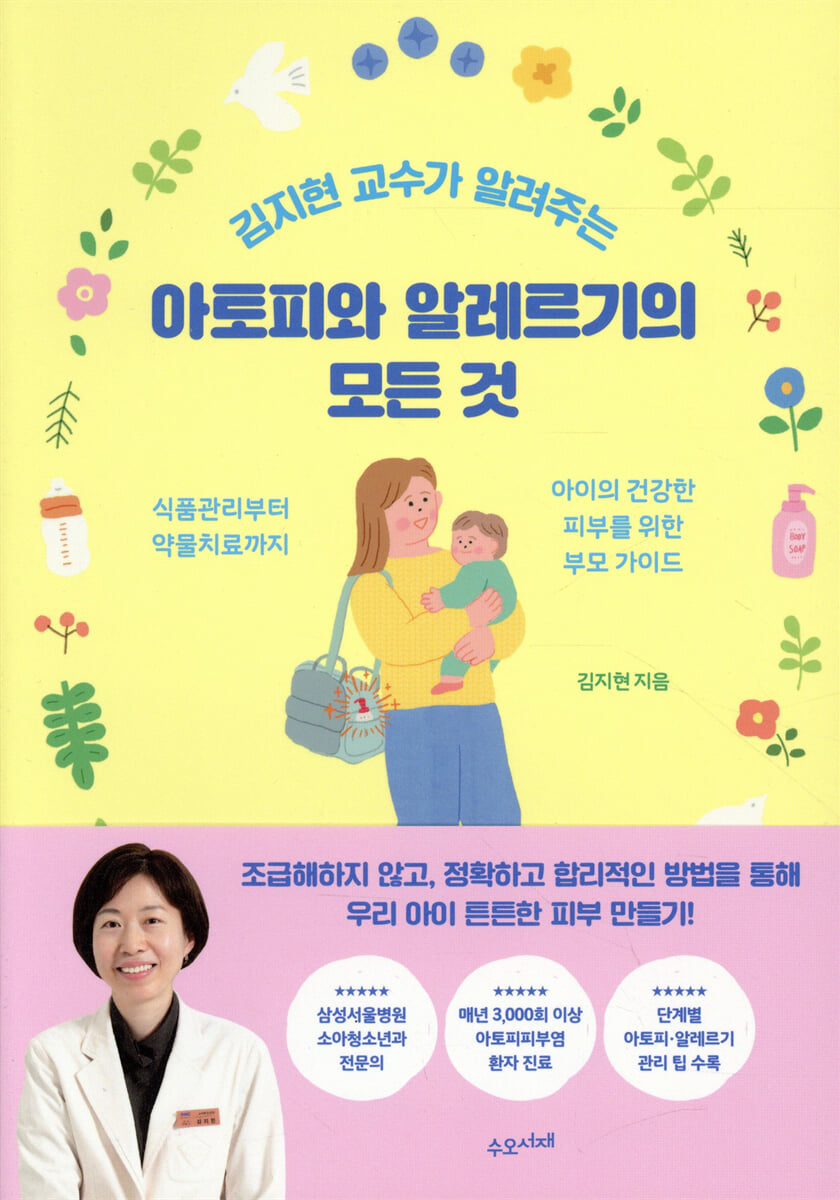
Everything You Need to Know About Atopy and Allergies, Explained by Professor Kim Ji-hyun
 |
Description
Book Introduction
“Does my child have atopic dermatitis or allergies?” “Should I avoid this food?” The number of children suffering from atopic dermatitis is increasing due to various environmental factors as well as genetic factors.
It is a common disease with a prevalence rate of 15-20% among newborns, and the number of cases in which it becomes severe continues to increase, but medically unverified incorrect information still circulates through various media.
Professor Ji-Hyeon Kim of the Department of Pediatrics and Adolescent Medicine at Samsung Medical Center, who sees and treats patients with atopic dermatitis more than 3,000 times a year, wrote this book to prevent children's health and the happiness of their families from being threatened by various incorrect common sense beliefs such as, "If you have atopic dermatitis, don't start giving your child solid food before 6 months" and "It's always better to avoid using steroids."
From food management to drug treatment, we present accurate information based on the latest research, as well as treatment cases of various patients we have met in our clinic.
This book, which covers the symptoms and causes of atopic dermatitis and allergies, as well as accurate treatment and management tips, will serve as a solid bible for your child's healthy skin, so that you won't be swayed by the flood of information.
It is a common disease with a prevalence rate of 15-20% among newborns, and the number of cases in which it becomes severe continues to increase, but medically unverified incorrect information still circulates through various media.
Professor Ji-Hyeon Kim of the Department of Pediatrics and Adolescent Medicine at Samsung Medical Center, who sees and treats patients with atopic dermatitis more than 3,000 times a year, wrote this book to prevent children's health and the happiness of their families from being threatened by various incorrect common sense beliefs such as, "If you have atopic dermatitis, don't start giving your child solid food before 6 months" and "It's always better to avoid using steroids."
From food management to drug treatment, we present accurate information based on the latest research, as well as treatment cases of various patients we have met in our clinic.
This book, which covers the symptoms and causes of atopic dermatitis and allergies, as well as accurate treatment and management tips, will serve as a solid bible for your child's healthy skin, so that you won't be swayed by the flood of information.
- You can preview some of the book's contents.
Preview
index
Prologue: Atopy: A Fight with an Ending
Chapter 1: The Secret Warehouse of the Atopic Clinic
The difference between atopy and allergy
Atopy, diagnosis and treatment using the five senses
When you change your mind, hope sprouts.
Atopy is like a spouse
Should I avoid feeding my baby eggs, milk, and meat?
Is there a specific way to properly apply moisturizer?
The pros and cons of pacifiers
Let's focus on temperature and humidity
Smart Bathing Tips for Honey Skin
Smart Laundry Life
Breastfeeding is not the answer
How does stress affect your skin?
New keyword, environment
Inflammation is the key to treatment - Steroids, let's use them wisely.
Understanding Atopic Dermatitis Prescriptions
Hospital User Manual
Chapter 2 What to eat and how to eat it
Allergies are confusing, with different tests and interpretations.
What should I do if my child has a food allergy?
I'm allergic to all foods
If I have a food allergy, will I never be able to eat anything for the rest of my life?
You're saying you're going to start with peanuts?
Is it hives or an allergy?
The fear of anaphylaxis
Is there a treatment that can change your constitution?
Organic and probiotics, is it okay?
Heavy metals and allergies
The patient is the teacher
5 Principles for Pregnant Women to Prevent Allergies
Chapter 3: Brave Parents Defeat Atopy
Feeling guilty is a no-no
Parenting that is 'rough' rather than 'perfect'
Atopic Clinic is a couple clinic, love and war
Mom's Parenting vs. Dad's Parenting
Let's practice letting go
A child who is absent-minded and friendless, could it be due to atopic dermatitis?
There is a mountain higher than atopy.
Parents who see far ahead win.
Preparation for puberty begins in infancy.
The world must change for children to survive.
Chapter 4: Baby Food for My Sensitive Child
A letter to mothers preparing baby food
7 Things to Remember When Feeding Your Baby Solid Food
Well begun is half done, early weaning
Go! Stop! When and how?
Postpartum depression followed by feeding depression
Mid-term weaning: Just remember this
Foods that should not be fed to children even if they are stoned
Babies who really don't eat, parents who want to cry
Mastering Late-Stage Weaning Food
Baby Food Q&A
References
Chapter 1: The Secret Warehouse of the Atopic Clinic
The difference between atopy and allergy
Atopy, diagnosis and treatment using the five senses
When you change your mind, hope sprouts.
Atopy is like a spouse
Should I avoid feeding my baby eggs, milk, and meat?
Is there a specific way to properly apply moisturizer?
The pros and cons of pacifiers
Let's focus on temperature and humidity
Smart Bathing Tips for Honey Skin
Smart Laundry Life
Breastfeeding is not the answer
How does stress affect your skin?
New keyword, environment
Inflammation is the key to treatment - Steroids, let's use them wisely.
Understanding Atopic Dermatitis Prescriptions
Hospital User Manual
Chapter 2 What to eat and how to eat it
Allergies are confusing, with different tests and interpretations.
What should I do if my child has a food allergy?
I'm allergic to all foods
If I have a food allergy, will I never be able to eat anything for the rest of my life?
You're saying you're going to start with peanuts?
Is it hives or an allergy?
The fear of anaphylaxis
Is there a treatment that can change your constitution?
Organic and probiotics, is it okay?
Heavy metals and allergies
The patient is the teacher
5 Principles for Pregnant Women to Prevent Allergies
Chapter 3: Brave Parents Defeat Atopy
Feeling guilty is a no-no
Parenting that is 'rough' rather than 'perfect'
Atopic Clinic is a couple clinic, love and war
Mom's Parenting vs. Dad's Parenting
Let's practice letting go
A child who is absent-minded and friendless, could it be due to atopic dermatitis?
There is a mountain higher than atopy.
Parents who see far ahead win.
Preparation for puberty begins in infancy.
The world must change for children to survive.
Chapter 4: Baby Food for My Sensitive Child
A letter to mothers preparing baby food
7 Things to Remember When Feeding Your Baby Solid Food
Well begun is half done, early weaning
Go! Stop! When and how?
Postpartum depression followed by feeding depression
Mid-term weaning: Just remember this
Foods that should not be fed to children even if they are stoned
Babies who really don't eat, parents who want to cry
Mastering Late-Stage Weaning Food
Baby Food Q&A
References
Detailed image

Into the book
About half of children with atopic dermatitis also have food allergies.
This is because if you have atopic dermatitis, skin barrier damage and immune system abnormalities become problems.
When food ingredients enter through a broken skin barrier, they can stimulate allergic immunity and cause hypersensitivity reactions.
This is the beginning of food allergies.
But not everyone reacts the same way.
Taking good care of your skin can help reduce food allergies.
---p.21 From "Chapter 1: The Secret Warehouse of the Atopic Clinic"
Even if your baby has atopic dermatitis, there is no need for breastfeeding mothers to restrict certain foods unless they have been diagnosed with a food allergy.
Although some restrictions are made as a preventative measure, restricting eggs, milk, and wheat does not prevent food allergies in breastfed babies.
---p.78 From "Chapter 1: The Secret Warehouse of the Atopic Clinic"
A good doctor doesn't just look at the patient's illness.
See a patient with an illness.
In chronic diseases, this perspective is really important.
Treatment that is too difficult for both parents and children is not suitable for managing chronic diseases such as atopy or allergies.
Because it is difficult to continue treatment for more than a few years, it is economically and practically burdensome.
If your child's doctor introduces less burdensome options, including side effects and financial burdens, and even provides explanations to reduce the psychological burden before starting treatment, then he or she is a doctor you can continue to trust and rely on.
---p.110 From "Chapter 1: The Secret Warehouse of the Atopic Clinic"
However, it is important to remember that delaying the introduction of solid foods or introducing allergens late is not a good idea.
Even introducing eggs or dairy products late can actually increase the risk of allergies in those at risk for allergies.
---p.145 From “Chapter 2 What and How to Feed”
If your skin condition is noticeably worsening every time you eat food containing food additives or fried foods, it is best to feed them as little as possible.
However, if the causal relationship is not clear, it is okay to allow people to eat it without any conflict.
---p.167 From “Chapter 2: What to Eat and How to Eat It”
The secret key to solving the problem is usually around the patient.
Even if doctors and parents haven't found the cause yet, they should thoroughly examine all possibilities, including the child's saliva, toys, indoor environment, moisturizers, and medications.
Once the secret is revealed, this patient becomes my teacher.
As you gain experience thinking about and solving new problems, you will be better able to find clues and solve the next patient's problem.
The young patients who come into my clinic are both patients and teachers to me.
So I'm always happy and grateful.
---p.178 From “Chapter 2: What to Eat and How to Eat It”
A parent's heart is filled with worry over even the smallest pimple that appears on the skin.
“Should I get an allergy test? What if it hurts when I get the blood drawn? What if the test comes out abnormal? My child won’t eat special formula, should I feed him this food? Should I do a provocation test? Can I get a puppy? What moisturizer should I use? What if it gets worse? Do I have to listen to everything the doctor says?” Endless worries lead to guilt.
---p.189 From “Chapter 3: Brave Parents Overcome Atopy”
The course of childhood allergies is commonly referred to as the 'allergic march' or 'atopic march'.
This means that as we age, existing illnesses get better and new illnesses develop.
When children are young, they mainly suffer from food allergies, gastrointestinal allergies, and atopic dermatitis, and as they grow up, they develop asthma and allergic rhinitis.
---p.
217 From “Chapter 3: Brave Parents Overcome Atopy”
Babies with atopic dermatitis or allergies are sensitive and may progress slowly to solid food.
At this time, there is no need to strictly divide the stages by the baby's months.
There is no problem with taking it slow for a month or two.
The weaning period can be thought of as a convenient way to divide the process of gradually transitioning to solid foods.
---p.240 From “Chapter 4 Baby Food for My Sensitive Child”
Occasionally, I meet mothers who only feed their children rice, meat, vegetables, and fruit.
He says he can't feed it to his child because he's afraid of developing an allergy.
However, unless you have been diagnosed with an allergy by a professional, there is no need to worry.
Eggs, wheat, and fish all need to be restricted before the stone.
Rather, feeding a variety of foods helps prevent allergies.
This is because when various foods enter the baby's intestines, substances that are beneficial to the immune system are created.
This is because if you have atopic dermatitis, skin barrier damage and immune system abnormalities become problems.
When food ingredients enter through a broken skin barrier, they can stimulate allergic immunity and cause hypersensitivity reactions.
This is the beginning of food allergies.
But not everyone reacts the same way.
Taking good care of your skin can help reduce food allergies.
---p.21 From "Chapter 1: The Secret Warehouse of the Atopic Clinic"
Even if your baby has atopic dermatitis, there is no need for breastfeeding mothers to restrict certain foods unless they have been diagnosed with a food allergy.
Although some restrictions are made as a preventative measure, restricting eggs, milk, and wheat does not prevent food allergies in breastfed babies.
---p.78 From "Chapter 1: The Secret Warehouse of the Atopic Clinic"
A good doctor doesn't just look at the patient's illness.
See a patient with an illness.
In chronic diseases, this perspective is really important.
Treatment that is too difficult for both parents and children is not suitable for managing chronic diseases such as atopy or allergies.
Because it is difficult to continue treatment for more than a few years, it is economically and practically burdensome.
If your child's doctor introduces less burdensome options, including side effects and financial burdens, and even provides explanations to reduce the psychological burden before starting treatment, then he or she is a doctor you can continue to trust and rely on.
---p.110 From "Chapter 1: The Secret Warehouse of the Atopic Clinic"
However, it is important to remember that delaying the introduction of solid foods or introducing allergens late is not a good idea.
Even introducing eggs or dairy products late can actually increase the risk of allergies in those at risk for allergies.
---p.145 From “Chapter 2 What and How to Feed”
If your skin condition is noticeably worsening every time you eat food containing food additives or fried foods, it is best to feed them as little as possible.
However, if the causal relationship is not clear, it is okay to allow people to eat it without any conflict.
---p.167 From “Chapter 2: What to Eat and How to Eat It”
The secret key to solving the problem is usually around the patient.
Even if doctors and parents haven't found the cause yet, they should thoroughly examine all possibilities, including the child's saliva, toys, indoor environment, moisturizers, and medications.
Once the secret is revealed, this patient becomes my teacher.
As you gain experience thinking about and solving new problems, you will be better able to find clues and solve the next patient's problem.
The young patients who come into my clinic are both patients and teachers to me.
So I'm always happy and grateful.
---p.178 From “Chapter 2: What to Eat and How to Eat It”
A parent's heart is filled with worry over even the smallest pimple that appears on the skin.
“Should I get an allergy test? What if it hurts when I get the blood drawn? What if the test comes out abnormal? My child won’t eat special formula, should I feed him this food? Should I do a provocation test? Can I get a puppy? What moisturizer should I use? What if it gets worse? Do I have to listen to everything the doctor says?” Endless worries lead to guilt.
---p.189 From “Chapter 3: Brave Parents Overcome Atopy”
The course of childhood allergies is commonly referred to as the 'allergic march' or 'atopic march'.
This means that as we age, existing illnesses get better and new illnesses develop.
When children are young, they mainly suffer from food allergies, gastrointestinal allergies, and atopic dermatitis, and as they grow up, they develop asthma and allergic rhinitis.
---p.
217 From “Chapter 3: Brave Parents Overcome Atopy”
Babies with atopic dermatitis or allergies are sensitive and may progress slowly to solid food.
At this time, there is no need to strictly divide the stages by the baby's months.
There is no problem with taking it slow for a month or two.
The weaning period can be thought of as a convenient way to divide the process of gradually transitioning to solid foods.
---p.240 From “Chapter 4 Baby Food for My Sensitive Child”
Occasionally, I meet mothers who only feed their children rice, meat, vegetables, and fruit.
He says he can't feed it to his child because he's afraid of developing an allergy.
However, unless you have been diagnosed with an allergy by a professional, there is no need to worry.
Eggs, wheat, and fish all need to be restricted before the stone.
Rather, feeding a variety of foods helps prevent allergies.
This is because when various foods enter the baby's intestines, substances that are beneficial to the immune system are created.
---p.263 From “Chapter 4 Baby Food for My Sensitive Child”
Publisher's Review
Symptoms and causes of atopy and allergies,
Accurate treatment and management tips
Professor Kim Ji-hyun will explain everything in detail!
★Samsung Seoul Hospital Pediatrics and Adolescent Medicine Specialist★
★Over 3,000 atopic dermatitis patients treated annually★
“Does my child have atopic dermatitis or allergies?”, “Should I avoid this food?” Parents start to worry when their child’s skin becomes even slightly reddish or rough.
Atopic dermatitis, which is caused by allergic inflammation, mainly occurs in infants and young children.
The number of children suffering from atopic dermatitis is increasing due to various environmental factors as well as genetic factors.
It is a common disease with a prevalence rate of 15-20% among newborns, and the number of cases in which it becomes severe continues to increase, but medically unverified incorrect information still circulates through various media.
Professor Ji-Hyeon Kim, who sees and treats patients with atopic dermatitis more than 3,000 times a year, wrote this book to prevent children's health and the happiness of their families from being threatened by various incorrect common sense beliefs such as, "If you have atopic dermatitis, don't start giving your child solid food before 6 months" and "It's always better to avoid using steroids."
Many parents feel guilty when their child is diagnosed with atopic dermatitis.
If only my child's skin could get better, I would spend hundreds of thousands of won to fix it right away.
Many commercial practices exploit the desperation of these parents, but no one takes responsibility when side effects or complications arise.
"Everything About Atopy and Allergies by Professor Jihyun Kim" helps you stay abreast of the information overload and take proper care of your child.
It will be a solid bible for your child's healthy skin, from the symptoms and causes of atopy and allergies to accurate treatments and management tips.
“A fickle mind is poison to the treatment of atopic dermatitis.
You must always remember that even if things get better, they can get worse again, and even if things get worse, they can get better again.
“Only then can you consistently manage chronic symptoms and gain the strength to actively treat acute symptoms.” - From the text
From food management to drug treatment
A Parent's Guide to Healthy Skin in Children
Caring for a child with atopy and allergies requires two to three times more energy than caring for a healthy child.
Washing, moisturizing, and finding and eliminating aggravating factors that come into contact with the skin is no easy task.
I spend all night searching the internet wondering if starting solids early is causing any problems, if I should get an allergy test, if it's okay to have a puppy, if steroids will cause side effects, and how far I should go with the doctor's advice.
Professor Kim Ji-hyun listens to each and every one of these guardians' questions and answers them.
Even in cases of severe atopic dermatitis, 70-80% of cases improve with general treatment.
Therefore, it is important to manage existing atopic dermatitis well in daily life to prevent the symptoms from worsening or lasting longer and to prevent new allergies from developing.
If you carefully examine your child's surroundings, including the toys they usually play with, the clothes they frequently wear, and their indoor environment, you can find the key to solving many skin problems.
Professor Kim Ji-hyun clearly explains what care and treatment a child needs and what rules to follow at home.
From food management to drug treatment, we help you set specific goals for each stage and consistently implement them to achieve complete recovery.
Without being hasty, through accurate and reasonable methods
Making our children's skin strong!
★Step-by-step atopic dermatitis? Allergy management tips★
The book consists of four chapters in total.
Chapter 1, “The Secret Warehouse of the Atopic Clinic,” explains what atopic dermatitis is and how to diagnose and manage it.
We introduce management methods based on the skin symptoms of children that many parents who visit the clinic are curious about.
You can learn about the types and usage of steroids, which are the core of inflammation treatment, the criteria for selecting a moisturizer, and the management methods to follow for a child's damaged skin barrier, such as temperature, humidity, fine dust, and environmental management that must be taken into account.
Chapter 2, “What and How to Feed Your Child,” explains how to feed children with food allergies and how to prevent allergies.
Many parents start blocking their child's food when their child's skin becomes slightly red or bumpy.
It provides intake guidelines to prevent arbitrary restrictions on various foods known to be common allergens, such as eggs, dairy products, and wheat.
This content is also helpful for children who have allergies or hives without any symptoms of atopic dermatitis.
Chapter 3, “Strong Parents Overcome Atopy,” contains advice on what kind of plans and mindset parents should have when raising children with atopy or allergies during the long treatment process.
Professor Ji-Hyeon Kim, who is also the mother of two sons with atopic dermatitis, sympathizes with the plight of guardians more than anyone else.
As it is a management that requires a lot of time and effort, psychological care for the child and guardian is also important.
We will also share successful treatment cases of patients we have met in our clinic, which will be of great help to parents who have exhausted their positive energy during the parenting process.
Chapter 4, "Weaning Food for My Sensitive Child," introduces Q&A on weaning food for each stage—early, mid, and late—and the essential weaning principles to follow.
Many babies develop symptoms of atopic dermatitis and food allergies before they turn one.
As weaning progresses, parents face many worries and headaches.
If you're struggling with baby feeding issues, you'll find many answers and tips in this chapter.
Accurate treatment and management tips
Professor Kim Ji-hyun will explain everything in detail!
★Samsung Seoul Hospital Pediatrics and Adolescent Medicine Specialist★
★Over 3,000 atopic dermatitis patients treated annually★
“Does my child have atopic dermatitis or allergies?”, “Should I avoid this food?” Parents start to worry when their child’s skin becomes even slightly reddish or rough.
Atopic dermatitis, which is caused by allergic inflammation, mainly occurs in infants and young children.
The number of children suffering from atopic dermatitis is increasing due to various environmental factors as well as genetic factors.
It is a common disease with a prevalence rate of 15-20% among newborns, and the number of cases in which it becomes severe continues to increase, but medically unverified incorrect information still circulates through various media.
Professor Ji-Hyeon Kim, who sees and treats patients with atopic dermatitis more than 3,000 times a year, wrote this book to prevent children's health and the happiness of their families from being threatened by various incorrect common sense beliefs such as, "If you have atopic dermatitis, don't start giving your child solid food before 6 months" and "It's always better to avoid using steroids."
Many parents feel guilty when their child is diagnosed with atopic dermatitis.
If only my child's skin could get better, I would spend hundreds of thousands of won to fix it right away.
Many commercial practices exploit the desperation of these parents, but no one takes responsibility when side effects or complications arise.
"Everything About Atopy and Allergies by Professor Jihyun Kim" helps you stay abreast of the information overload and take proper care of your child.
It will be a solid bible for your child's healthy skin, from the symptoms and causes of atopy and allergies to accurate treatments and management tips.
“A fickle mind is poison to the treatment of atopic dermatitis.
You must always remember that even if things get better, they can get worse again, and even if things get worse, they can get better again.
“Only then can you consistently manage chronic symptoms and gain the strength to actively treat acute symptoms.” - From the text
From food management to drug treatment
A Parent's Guide to Healthy Skin in Children
Caring for a child with atopy and allergies requires two to three times more energy than caring for a healthy child.
Washing, moisturizing, and finding and eliminating aggravating factors that come into contact with the skin is no easy task.
I spend all night searching the internet wondering if starting solids early is causing any problems, if I should get an allergy test, if it's okay to have a puppy, if steroids will cause side effects, and how far I should go with the doctor's advice.
Professor Kim Ji-hyun listens to each and every one of these guardians' questions and answers them.
Even in cases of severe atopic dermatitis, 70-80% of cases improve with general treatment.
Therefore, it is important to manage existing atopic dermatitis well in daily life to prevent the symptoms from worsening or lasting longer and to prevent new allergies from developing.
If you carefully examine your child's surroundings, including the toys they usually play with, the clothes they frequently wear, and their indoor environment, you can find the key to solving many skin problems.
Professor Kim Ji-hyun clearly explains what care and treatment a child needs and what rules to follow at home.
From food management to drug treatment, we help you set specific goals for each stage and consistently implement them to achieve complete recovery.
Without being hasty, through accurate and reasonable methods
Making our children's skin strong!
★Step-by-step atopic dermatitis? Allergy management tips★
The book consists of four chapters in total.
Chapter 1, “The Secret Warehouse of the Atopic Clinic,” explains what atopic dermatitis is and how to diagnose and manage it.
We introduce management methods based on the skin symptoms of children that many parents who visit the clinic are curious about.
You can learn about the types and usage of steroids, which are the core of inflammation treatment, the criteria for selecting a moisturizer, and the management methods to follow for a child's damaged skin barrier, such as temperature, humidity, fine dust, and environmental management that must be taken into account.
Chapter 2, “What and How to Feed Your Child,” explains how to feed children with food allergies and how to prevent allergies.
Many parents start blocking their child's food when their child's skin becomes slightly red or bumpy.
It provides intake guidelines to prevent arbitrary restrictions on various foods known to be common allergens, such as eggs, dairy products, and wheat.
This content is also helpful for children who have allergies or hives without any symptoms of atopic dermatitis.
Chapter 3, “Strong Parents Overcome Atopy,” contains advice on what kind of plans and mindset parents should have when raising children with atopy or allergies during the long treatment process.
Professor Ji-Hyeon Kim, who is also the mother of two sons with atopic dermatitis, sympathizes with the plight of guardians more than anyone else.
As it is a management that requires a lot of time and effort, psychological care for the child and guardian is also important.
We will also share successful treatment cases of patients we have met in our clinic, which will be of great help to parents who have exhausted their positive energy during the parenting process.
Chapter 4, "Weaning Food for My Sensitive Child," introduces Q&A on weaning food for each stage—early, mid, and late—and the essential weaning principles to follow.
Many babies develop symptoms of atopic dermatitis and food allergies before they turn one.
As weaning progresses, parents face many worries and headaches.
If you're struggling with baby feeding issues, you'll find many answers and tips in this chapter.
GOODS SPECIFICS
- Publication date: December 14, 2022
- Page count, weight, size: 292 pages | 422g | 148*210*18mm
- ISBN13: 9791190382908
- ISBN10: 1190382903
You may also like
카테고리
korean


korean

![GQ KOREA Mark (Monthly): December [2025]](http://librairie.coreenne.fr/cdn/shop/files/8ef265dbbfbf186523ed75ba7319009d.jpg?v=1765340328&width=3840)


