

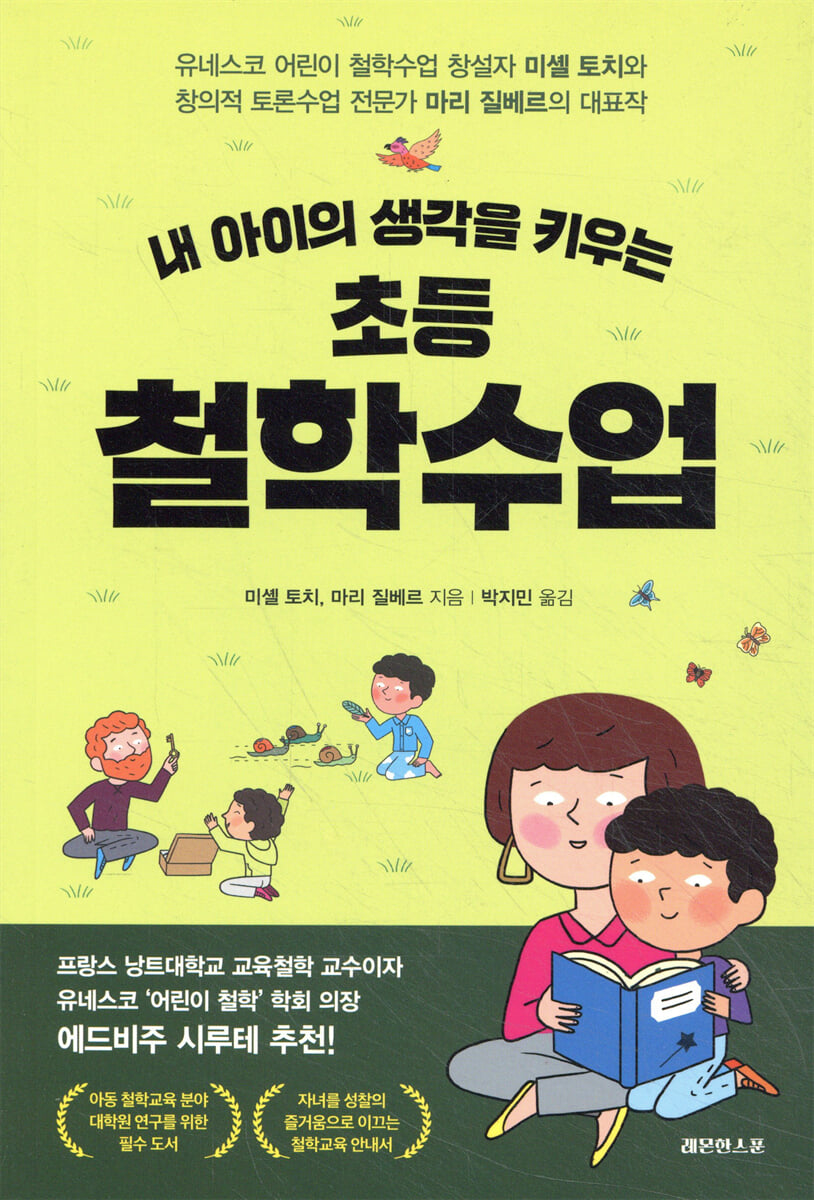
Elementary Philosophy Classes to Develop Your Child's Thinking
 |
Description
Book Introduction
Michel Torchi, founder of UNESCO Children's Philosophy Class
A masterpiece by Marie Gilbert, a creative discussion class expert
“Teach your child to think, ask questions, and seek answers.”
A must-read for parents who want their children to be happy, confident, and make sound decisions!
Young children are curious about all kinds of events and phenomena happening at school and in the world around them, as well as about their place in their family and community and their relationships with other people.
Parents have a responsibility to help their children develop the habit of asking questions, thinking, and finding answers to such questions.
This book, which seriously addresses children's questions, is designed for parents who want to lead their children into the world of philosophy.
By discussing philosophical questions with their parents, children learn the joy of reflection, acquire both freedom of expression and the rigor of logic, and gain the courage to overcome fear and face the world.
This book is divided into two parts: Part 1 is about how to teach philosophy, and Part 2 is about 15 discussion topics to help you explore the world of philosophy with your children.
First, PART 1 provides a detailed introduction to how to engage in philosophical discussions with children, including how to distinguish philosophical questions from other types of questions, when to discuss them with children, how to focus on reflection while maintaining freedom of expression, how to foster logical rigor, and how to deepen children's thinking.
Part 2, which takes up most of the book, is organized around the questions and concepts that children most frequently ask.
Rich examples, fairy tales, and quotes are a great help in approaching each topic and deepening reflection.
Parents and teachers can open the door to philosophy classes with their children by referring to the 15 topics presented here, including identity, love, emotions, school, differences, freedom, justice, truth, happiness, time, and living together.
Additionally, the 'Parents' Tips' at the end of each topic can help you recognize the importance of the topic and reflect on how to guide your child's thoughts and interests.
The 'Threads of Reflection' presented in question format can be adjusted to suit your child's stage of adaptation.
Even the most playful child can be engaged in a discussion that engages them and engages them with reason and imagination.
This book is an ideal alternative for embarking on a journey of reflection and discovering ourselves, others, and the world we all live in.
Key Point: Parents' Role in Creating a Happy Philosophy Class
★ Listen to your child's questions
★ Do not present the parent's perspective from the beginning
★ Do not answer on behalf of your child
★ Help your child find his or her own answers
★ Empathize with and share your child's experiences
★ Rephrase your child's opinion to encourage deeper thinking.
★ Stimulate your child's imagination through play and experimentation.
★ Creating a free and comfortable atmosphere for conversation
A masterpiece by Marie Gilbert, a creative discussion class expert
“Teach your child to think, ask questions, and seek answers.”
A must-read for parents who want their children to be happy, confident, and make sound decisions!
Young children are curious about all kinds of events and phenomena happening at school and in the world around them, as well as about their place in their family and community and their relationships with other people.
Parents have a responsibility to help their children develop the habit of asking questions, thinking, and finding answers to such questions.
This book, which seriously addresses children's questions, is designed for parents who want to lead their children into the world of philosophy.
By discussing philosophical questions with their parents, children learn the joy of reflection, acquire both freedom of expression and the rigor of logic, and gain the courage to overcome fear and face the world.
This book is divided into two parts: Part 1 is about how to teach philosophy, and Part 2 is about 15 discussion topics to help you explore the world of philosophy with your children.
First, PART 1 provides a detailed introduction to how to engage in philosophical discussions with children, including how to distinguish philosophical questions from other types of questions, when to discuss them with children, how to focus on reflection while maintaining freedom of expression, how to foster logical rigor, and how to deepen children's thinking.
Part 2, which takes up most of the book, is organized around the questions and concepts that children most frequently ask.
Rich examples, fairy tales, and quotes are a great help in approaching each topic and deepening reflection.
Parents and teachers can open the door to philosophy classes with their children by referring to the 15 topics presented here, including identity, love, emotions, school, differences, freedom, justice, truth, happiness, time, and living together.
Additionally, the 'Parents' Tips' at the end of each topic can help you recognize the importance of the topic and reflect on how to guide your child's thoughts and interests.
The 'Threads of Reflection' presented in question format can be adjusted to suit your child's stage of adaptation.
Even the most playful child can be engaged in a discussion that engages them and engages them with reason and imagination.
This book is an ideal alternative for embarking on a journey of reflection and discovering ourselves, others, and the world we all live in.
Key Point: Parents' Role in Creating a Happy Philosophy Class
★ Listen to your child's questions
★ Do not present the parent's perspective from the beginning
★ Do not answer on behalf of your child
★ Help your child find his or her own answers
★ Empathize with and share your child's experiences
★ Rephrase your child's opinion to encourage deeper thinking.
★ Stimulate your child's imagination through play and experimentation.
★ Creating a free and comfortable atmosphere for conversation
- You can preview some of the book's contents.
Preview
index
PART 1.
How to conduct philosophy classes with children?
CHAPTER 1: Giving Myself a Time for Reflection
CHAPTER 2 Inviting Logic into Your Home
CHAPTER 3: Following the Guide to Philosophy Class
PART 2.
What to discuss in philosophy class with your children?
CLASS 1 Identity Knowing myself and existing as myself
CLASS 2 Love: The Complete Experience Humans Can Enjoy
CLASS 3 Family: A fence that protects me and my first learning experience.
CLASS 4 School: A place where you can find the joy of learning and the fun of relationships.
CLASS 5: Managing Emotions: Fear, Anger, and Shame
CLASS 6 A mind filled with happiness and joy
CLASS 7 Differences Understanding each other's differences and developing an open mind
CLASS 8: Learning to Apologize and Forgive Instead of Blaming and Attacking Violence
CLASS 9 Freedom: A value that shines brighter when autonomy and responsibility come together.
CLASS 10 Rights and Obligations Dos and Don'ts
CLASS 11 The Power to Fight Against Injustice and Unfairness
CLASS 12 The right state of mind without truth or falsehood
CLASS 13 Conditions for living faithfully in the present moment
CLASS 14 Life Planning: What It Takes to Become a Responsible Adult
CLASS 15 Living Together: The Foundation for Your Own Happiness and Peace for All
How to conduct philosophy classes with children?
CHAPTER 1: Giving Myself a Time for Reflection
CHAPTER 2 Inviting Logic into Your Home
CHAPTER 3: Following the Guide to Philosophy Class
PART 2.
What to discuss in philosophy class with your children?
CLASS 1 Identity Knowing myself and existing as myself
CLASS 2 Love: The Complete Experience Humans Can Enjoy
CLASS 3 Family: A fence that protects me and my first learning experience.
CLASS 4 School: A place where you can find the joy of learning and the fun of relationships.
CLASS 5: Managing Emotions: Fear, Anger, and Shame
CLASS 6 A mind filled with happiness and joy
CLASS 7 Differences Understanding each other's differences and developing an open mind
CLASS 8: Learning to Apologize and Forgive Instead of Blaming and Attacking Violence
CLASS 9 Freedom: A value that shines brighter when autonomy and responsibility come together.
CLASS 10 Rights and Obligations Dos and Don'ts
CLASS 11 The Power to Fight Against Injustice and Unfairness
CLASS 12 The right state of mind without truth or falsehood
CLASS 13 Conditions for living faithfully in the present moment
CLASS 14 Life Planning: What It Takes to Become a Responsible Adult
CLASS 15 Living Together: The Foundation for Your Own Happiness and Peace for All
Detailed image
.jpg)
Into the book
Through philosophy classes based on reflection and discussion, children can learn, first, how to remain calm and objective, no matter how absurd the ideas that run rampant in society, and how to maintain peace of mind.
This is a skill that is absolutely necessary for today's youth generation.
Second, by experiencing freedom of thought, you will also be able to respect the freedom of thought of others.
In a world thirsty for harmony, we can cultivate an open attitude.
Third, love and harmony within the family increase as family members freely discuss and share new joys each time.
Enter the world of philosophy, thinking and conversing with your children.
You will find that this is the path to happiness every day.
---p.11 From the preface
Questions that keep coming back to me are fun.
Because it's about finding your way to personal exploration.
Parents should not "instill" ideas in their children, but simply provide milestones.
Such parents would be able to answer the following fundamental questions:
◇ What thoughts will I pass on to my children?
◇ When your child faces a question, how can you, as a parent, help them find their own answers?
Ultimately, the question, “Who am I?” is the first question we ask ourselves as parents.
This is because life is a place where I exist as myself, and education is a ‘reality’ that takes place in that place of life.
---pp.29-30 From "CHAPTER 1: Giving Myself a Time for Reflection"
While children are thrown into a world where everything is new and full of questions, parents are accustomed to a life where they no longer have questions.
Some of your child's questions may be embarrassing or difficult to answer.
Some questions are fun, but may not be taken seriously because your child is still 'young'.
But is there a specific "adult" question? Philosophical questions have no age limit.
---p.38 From "CHAPTER 2 Inviting Logic into the Family"
Above all, it is important to think about the connection between love and happiness.
Love fills our need for stability and acceptance and frees us from self-centeredness.
We also build relationships and work towards a common plan.
Love enriches both the giver and the receiver, providing a full human experience.
---p.101 From "'CLASS 2 Love' Help for Parents"
Let's talk about the secret to happiness.
◆ A Closely Hidden Secret - Two friends set out to find the secret of happy people.
First, I went to the palace where the king lived and found out that the king's cousin had gathered an army to seize power.
This time I went to the richest man and his servants were in tears.
The owner went bankrupt, sold the house, and fired the servants.
So this time I went to see an actress who is admired for her beauty.
But the actress had long since fallen ill and lost her beauty.
The two friends muttered:
“Where on earth should I go?”
◇ What are the three happinesses these two friends are seeking? Let's name them.
◇ Let's create a character who will reveal the secret to true happiness.
---pp.155~156 From "'CLASS 6 Happiness' A Clue to Reflection 2 - Does Perfect Happiness Exist?"
Let's talk about a time when you were violent.
◇ Thinking about it now, was it wrong or right?
◇ Do you think you won't see that kind of thing again?
◇ If you think so, how can you not show that kind of appearance?
◇ What should I do when I regret my violent actions toward someone?
This is a skill that is absolutely necessary for today's youth generation.
Second, by experiencing freedom of thought, you will also be able to respect the freedom of thought of others.
In a world thirsty for harmony, we can cultivate an open attitude.
Third, love and harmony within the family increase as family members freely discuss and share new joys each time.
Enter the world of philosophy, thinking and conversing with your children.
You will find that this is the path to happiness every day.
---p.11 From the preface
Questions that keep coming back to me are fun.
Because it's about finding your way to personal exploration.
Parents should not "instill" ideas in their children, but simply provide milestones.
Such parents would be able to answer the following fundamental questions:
◇ What thoughts will I pass on to my children?
◇ When your child faces a question, how can you, as a parent, help them find their own answers?
Ultimately, the question, “Who am I?” is the first question we ask ourselves as parents.
This is because life is a place where I exist as myself, and education is a ‘reality’ that takes place in that place of life.
---pp.29-30 From "CHAPTER 1: Giving Myself a Time for Reflection"
While children are thrown into a world where everything is new and full of questions, parents are accustomed to a life where they no longer have questions.
Some of your child's questions may be embarrassing or difficult to answer.
Some questions are fun, but may not be taken seriously because your child is still 'young'.
But is there a specific "adult" question? Philosophical questions have no age limit.
---p.38 From "CHAPTER 2 Inviting Logic into the Family"
Above all, it is important to think about the connection between love and happiness.
Love fills our need for stability and acceptance and frees us from self-centeredness.
We also build relationships and work towards a common plan.
Love enriches both the giver and the receiver, providing a full human experience.
---p.101 From "'CLASS 2 Love' Help for Parents"
Let's talk about the secret to happiness.
◆ A Closely Hidden Secret - Two friends set out to find the secret of happy people.
First, I went to the palace where the king lived and found out that the king's cousin had gathered an army to seize power.
This time I went to the richest man and his servants were in tears.
The owner went bankrupt, sold the house, and fired the servants.
So this time I went to see an actress who is admired for her beauty.
But the actress had long since fallen ill and lost her beauty.
The two friends muttered:
“Where on earth should I go?”
◇ What are the three happinesses these two friends are seeking? Let's name them.
◇ Let's create a character who will reveal the secret to true happiness.
---pp.155~156 From "'CLASS 6 Happiness' A Clue to Reflection 2 - Does Perfect Happiness Exist?"
Let's talk about a time when you were violent.
◇ Thinking about it now, was it wrong or right?
◇ Do you think you won't see that kind of thing again?
◇ If you think so, how can you not show that kind of appearance?
◇ What should I do when I regret my violent actions toward someone?
---p.187 From “Clue to Reflection on ‘CLASS 8 Violence’ 3 - Can One’s Violence Be Justified?”
Publisher's Review
Features of this book
1.
15 topics to explore the world of philosophy with your children.
2.
Rich examples of fairy tales, case studies, quotes, articles, etc. to help your child think, ask questions, and find answers.
3.
Presenting different levels of 'threads of reflection' to help you conduct philosophy classes tailored to your child's situation.
4.
'Going one step further' provides an opportunity to think more deeply about the topic.
5.
At the end of each chapter, we include a 'Parents' tip' that highlights the importance of the topic.
The joy of thinking and asking questions helps your child grow even further!
“Why don’t we live forever?” “Why isn’t doing whatever we want free?” “Why do wars break out?” “How do we know we love?” “Why do we feel shame?” “Do we always have to tell the truth?” Parents may be embarrassed or find it difficult to answer these questions from their children, but they can enter the world of philosophy with their children, introduce them to the joy of reflection, and help them ask questions and find answers for themselves.
Rather than forcing your child to give you answers, increase opportunities to hear your child's thoughts through questions and discussions.
Children who experience freedom of thought gain the strength to respect the freedom of others and to move forward in the world without prejudice.
The effort to think, ask questions, and find answers can have a real impact on a child's well-being.
A discussion format that focuses on questions allows participants to examine their own thoughts objectively, learn to categorize differing opinions according to their own standards, and cultivate flexibility and open-mindedness through the practice of listening to others' thoughts.
The joy of chatting with family makes the love and bond between family members fresh and strong.
I hope that through this book, many parents and children will enter the world of philosophy together and discover that "thinking is the joy of growing."
1.
15 topics to explore the world of philosophy with your children.
2.
Rich examples of fairy tales, case studies, quotes, articles, etc. to help your child think, ask questions, and find answers.
3.
Presenting different levels of 'threads of reflection' to help you conduct philosophy classes tailored to your child's situation.
4.
'Going one step further' provides an opportunity to think more deeply about the topic.
5.
At the end of each chapter, we include a 'Parents' tip' that highlights the importance of the topic.
The joy of thinking and asking questions helps your child grow even further!
“Why don’t we live forever?” “Why isn’t doing whatever we want free?” “Why do wars break out?” “How do we know we love?” “Why do we feel shame?” “Do we always have to tell the truth?” Parents may be embarrassed or find it difficult to answer these questions from their children, but they can enter the world of philosophy with their children, introduce them to the joy of reflection, and help them ask questions and find answers for themselves.
Rather than forcing your child to give you answers, increase opportunities to hear your child's thoughts through questions and discussions.
Children who experience freedom of thought gain the strength to respect the freedom of others and to move forward in the world without prejudice.
The effort to think, ask questions, and find answers can have a real impact on a child's well-being.
A discussion format that focuses on questions allows participants to examine their own thoughts objectively, learn to categorize differing opinions according to their own standards, and cultivate flexibility and open-mindedness through the practice of listening to others' thoughts.
The joy of chatting with family makes the love and bond between family members fresh and strong.
I hope that through this book, many parents and children will enter the world of philosophy together and discover that "thinking is the joy of growing."
GOODS SPECIFICS
- Publication date: November 30, 2022
- Page count, weight, size: 304 pages | 484g | 152*225*30mm
- ISBN13: 9791197781162
- ISBN10: 1197781161
You may also like
카테고리
korean


korean

![GQ KOREA Mark (Monthly): December [2025]](http://librairie.coreenne.fr/cdn/shop/files/8ef265dbbfbf186523ed75ba7319009d.jpg?v=1765340328&width=3840)


