

Spice Science
 |
Description
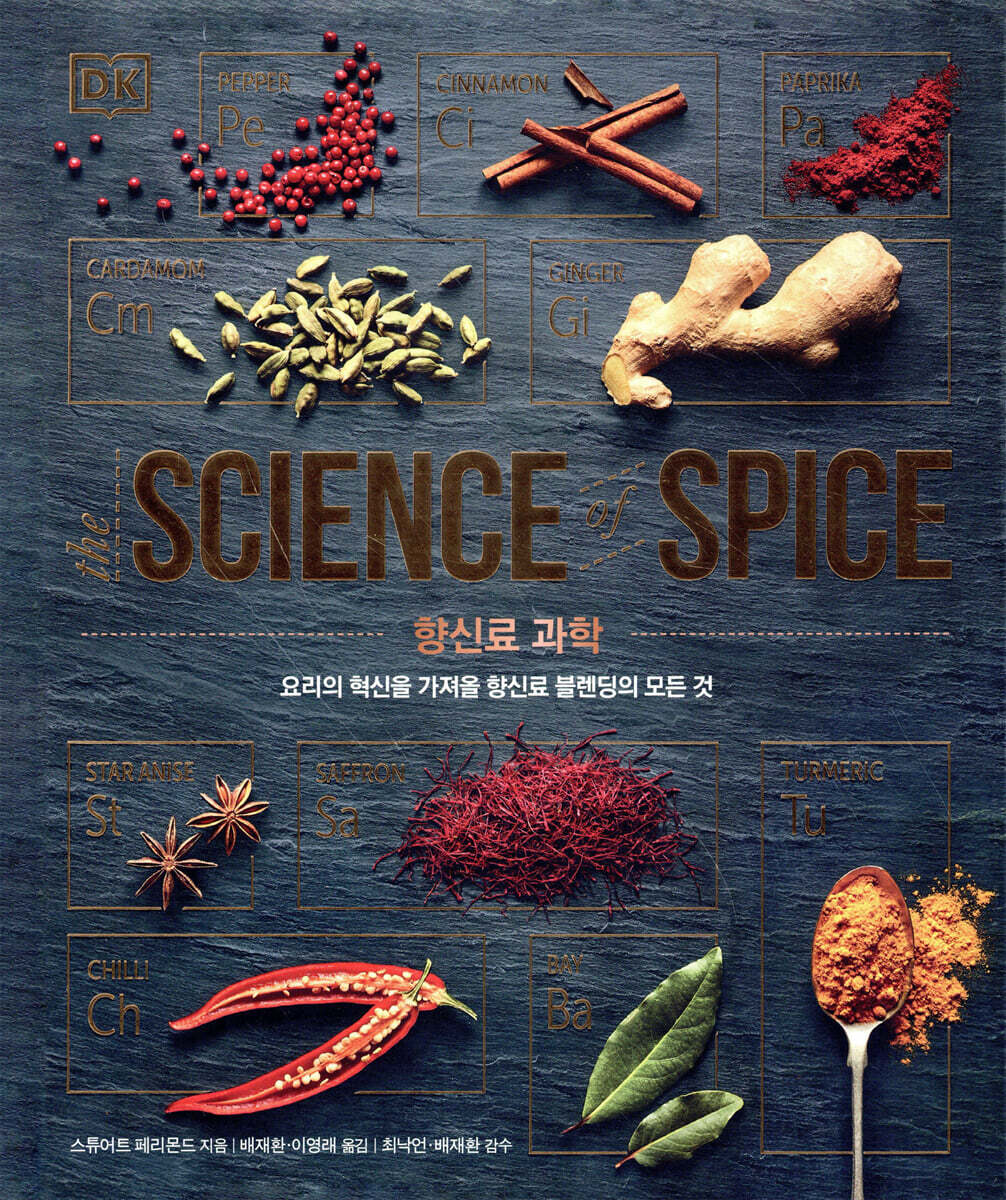
Book Introduction
The fascinating world of spices that captivate the taste buds of people around the world.
A new paradigm in food culture that awakens the senses
- Includes the periodic table of spices, blending know-how, and recipes for representative dishes from around the world.
A Guide to Blending Spices for Unique and Different Flavors
Everything about the scientific analysis and blending of spices!
Author of the international bestseller "The Science of Cooking"
Written by Stuart Perrymond!
Chinese-style steamed salmon flavored with chili peppers and star anise,
Chicken and eggplant biryani seasoned with seven spices,
West African peanut curry with Durban masala,
Asian rabe salad with curried duck and khao kua,
Sweet and Spicy Apple Pastry Rosette,
Spicy scallops cooked with saffron beurre blanc.
From ancient times to the present, mankind has been captivated by the allure of spices, which are called heavenly fragrances.
A spice widely used not only as a food ingredient but also as a medicinal ingredient.
Spices not only enhance the natural flavor of cooking ingredients, but also add new tastes and aromas, awakening all our senses.
This book explains innovative ways to use spices in an easy-to-understand way, based on scientific principles.
The author says, “Cooking without spices is like building an orchestra without strings,” and guides readers into the world of infinite imagination, flavors, and aromas of spices.
If you're looking to discover new flavor combinations that will spark your interest and enjoyment of cooking, open this book.
You can discover unique and different blends of spices that we never thought of.
A new paradigm in food culture that awakens the senses
- Includes the periodic table of spices, blending know-how, and recipes for representative dishes from around the world.
A Guide to Blending Spices for Unique and Different Flavors
Everything about the scientific analysis and blending of spices!
Author of the international bestseller "The Science of Cooking"
Written by Stuart Perrymond!
Chinese-style steamed salmon flavored with chili peppers and star anise,
Chicken and eggplant biryani seasoned with seven spices,
West African peanut curry with Durban masala,
Asian rabe salad with curried duck and khao kua,
Sweet and Spicy Apple Pastry Rosette,
Spicy scallops cooked with saffron beurre blanc.
From ancient times to the present, mankind has been captivated by the allure of spices, which are called heavenly fragrances.
A spice widely used not only as a food ingredient but also as a medicinal ingredient.
Spices not only enhance the natural flavor of cooking ingredients, but also add new tastes and aromas, awakening all our senses.
This book explains innovative ways to use spices in an easy-to-understand way, based on scientific principles.
The author says, “Cooking without spices is like building an orchestra without strings,” and guides readers into the world of infinite imagination, flavors, and aromas of spices.
If you're looking to discover new flavor combinations that will spark your interest and enjoyment of cooking, open this book.
You can discover unique and different blends of spices that we never thought of.
- You can preview some of the book's contents.
Preview
index
Getting Started · 6
Part 1: The Science of Spice · 8
What are spices? · 10
Spices and Flavor Compounds · 12
Periodic Table of Spice Elements · 14
Find and Mix Matching Spices · 16
Part 2: Spices of the World · 18
Middle East · 20
Africa · 30
South Asia · 38
Southeast Asia · 46
East Asia · 54
Americas · 62
Europe · 70
Part 3: Overview of Spices · 78
Sweet and mild phenol · 80
Warming Terpenes · 102
Aromatic Terpenes · 116
Earthy Terpenes · 126
Deeply Penetrating Terpenes · 130
Citrus Terpenes · 142
Sweet and Sour Mountain · 148
Fruity aldehydes · 160
Roasted Pyrazine · 164
Sulfur compounds · 172
A compound with a bitter taste · 180
Compounds with a unique flavor · 194
Part 4 Recipe
Chinese-Style Steamed Salmon with Chili Peppers and Star Anise · 92
Chicken and Eggplant Biryani with Seven Spice · 104
Ash with Zucchini, Feta Cheese, Dill, and Black Lime Harissa · 112
West African Peanut Curry with Durban Masala · 124
Asian Rab Salad with Curried Duck and Khao Kua · 140
Date, Tamarind Granita, and Pineapple Stew · 156
Black Sesame, Licorice, and Cardamom Ice Cream · 170
Sweet and Spicy Apple Pastry Rosettes · 182
Spicy Scallops Cooked with Saffron Beurre Blanc · 196
Filipino Spicy Adobo with Chicken and Pork · 208
World Spice Recipes · 210
Table of Spice and Flavor Compounds · 214
Index · 218
About the Author · 221
Acknowledgments · 223
Reviewer's Note, Translator's Introduction · 224
Part 1: The Science of Spice · 8
What are spices? · 10
Spices and Flavor Compounds · 12
Periodic Table of Spice Elements · 14
Find and Mix Matching Spices · 16
Part 2: Spices of the World · 18
Middle East · 20
Africa · 30
South Asia · 38
Southeast Asia · 46
East Asia · 54
Americas · 62
Europe · 70
Part 3: Overview of Spices · 78
Sweet and mild phenol · 80
Warming Terpenes · 102
Aromatic Terpenes · 116
Earthy Terpenes · 126
Deeply Penetrating Terpenes · 130
Citrus Terpenes · 142
Sweet and Sour Mountain · 148
Fruity aldehydes · 160
Roasted Pyrazine · 164
Sulfur compounds · 172
A compound with a bitter taste · 180
Compounds with a unique flavor · 194
Part 4 Recipe
Chinese-Style Steamed Salmon with Chili Peppers and Star Anise · 92
Chicken and Eggplant Biryani with Seven Spice · 104
Ash with Zucchini, Feta Cheese, Dill, and Black Lime Harissa · 112
West African Peanut Curry with Durban Masala · 124
Asian Rab Salad with Curried Duck and Khao Kua · 140
Date, Tamarind Granita, and Pineapple Stew · 156
Black Sesame, Licorice, and Cardamom Ice Cream · 170
Sweet and Spicy Apple Pastry Rosettes · 182
Spicy Scallops Cooked with Saffron Beurre Blanc · 196
Filipino Spicy Adobo with Chicken and Pork · 208
World Spice Recipes · 210
Table of Spice and Flavor Compounds · 214
Index · 218
About the Author · 221
Acknowledgments · 223
Reviewer's Note, Translator's Introduction · 224
Detailed image

Into the book
This book is the culmination of an ambitious project never before attempted, providing scientific and accessible principles for revolutionizing the use of spices.
However, we must not ignore the wisdom of our ancestors.
Because recipes that have been passed down for centuries are a precious culinary heritage.
This book explores traditional spices used in major regions and countries around the world, and introduces spice combinations and recipes recommended by top chefs specializing in different regional cuisines.
So that readers of this book can use the spice combinations of famous chefs as a foundation for creating new creations rather than starting from scratch.
The recipes presented here showcase some of these spice combinations, innovative suggestions that will bring unexpected twists to familiar dishes.
Whether you're an experienced cook or a complete beginner, I sincerely hope this book will inspire you to unleash your culinary talents.
Let's add a pinch or a ladleful of science to the process.
Let this guide open up a world full of new culinary delights.
If that happens, I guarantee your spices will never sleep in the dark again.
--- From "Starting"
Recently, methods for describing flavor and exploring taste using aromatic substances have been rapidly developing.
An example would be exploring the principles of combining ingredients through aromatic substances.
With hundreds of available ingredients and spices, the theory that ingredients with many similar aromatic compounds are more likely to go well together is being used to effectively discover new combinations, allowing for entirely new combinations.
As the use of aromatic substances has increased recently, future flavor technology will depend on how well we understand aromatic substances. This book is highly recommended as a starting point for studying such aromatic substances.
--- From "The Editor's Note - Choi Nak-eon"
We share the experience of turning our heads at the faint scent of cinnamon, not cinnamon, wafting from a cafe or bakery while walking down the street, or of being intoxicated by the aroma of curry that whets our appetites to the point of making our cheeks tingle, or the unforgettable aroma of dry rub from a barbecue restaurant.
The thing that connects the seemingly disparate experiences of many people is none other than spice.
I am confident that no other book on the subject of spices has ever presented such comprehensive and accurate information.
In particular, its practicality is truly unparalleled compared to other spice books published so far.
For chefs, spices are both saviors and challengers.
As a spice, their cuisine can push the boundaries of flavor, and this is something that must be conquered.
Now open your eyes.
And let's take a step towards a new world.
With The Science of Spice, spices are no longer unknown territory.
--- From "The Supervisor's Note - Bae Jae-hwan"
Learn about flavor compounds, flavor groups, and how to create unique spice blends as you understand the science of spices.
Spices are parts of plants that have a more concentrated flavor than most other ingredients used in cooking.
Herbs always come from the leafy parts, while spices are usually from the seeds, fruits, roots, stems, flowers, and bark, and are often dried and used.
However, some leaves with strong flavors, such as bay leaves or curry leaves, can be considered spices because they are used in cooking as a more powerful base flavoring rather than as a fresh flavoring additive.
--- From "Part 1: The Science of Spice"
Flavor compounds are small molecules that give each spice its unique taste.
When these molecules enter the mouth, they spread down the throat like vapor entering the nose, creating an experience similar to what the tongue feels.
Using the characteristics of shared compounds, spices were classified into 12 flavor groups.
Spices often pair well with each other because they share one or more flavor compounds.
The periodic table of spices and the scientific blending methods for each spice profile in this book are designed to help you properly understand spices as flavor compounds.
Here are step-by-step instructions to help you create your own unique spice blend using this information.
Step 1: Select your main flavor group.
We explore the science of two-step mixing.
Step 3: Choose your basic spices.
Adds 4 levels of complexity.
Explore key regions of the Spice World through ancient trade routes and modern maps, discover key spices in unique recipes, and recreate iconic combinations.
It covers the Middle East, which has been the center of the spice trade for thousands of years; Africa, which is as diverse as its vast land stretching from Casablanca to the tip of the Cape of Good Hope; South Asia, which has its own unique spice culture; Southeast Asia, where a revolution in cuisine occurred when Portuguese merchants brought in chili peppers; East Asia, which has had a great influence on the global spice trade to the point where it is today the world's fourth largest spice producing region; the American continent, which has a spice map formed by influences from all corners of Asia and Europe; and even Europe, which has a diverse cuisine but has few native spices and was introduced through the global spice trade.
However, we must not ignore the wisdom of our ancestors.
Because recipes that have been passed down for centuries are a precious culinary heritage.
This book explores traditional spices used in major regions and countries around the world, and introduces spice combinations and recipes recommended by top chefs specializing in different regional cuisines.
So that readers of this book can use the spice combinations of famous chefs as a foundation for creating new creations rather than starting from scratch.
The recipes presented here showcase some of these spice combinations, innovative suggestions that will bring unexpected twists to familiar dishes.
Whether you're an experienced cook or a complete beginner, I sincerely hope this book will inspire you to unleash your culinary talents.
Let's add a pinch or a ladleful of science to the process.
Let this guide open up a world full of new culinary delights.
If that happens, I guarantee your spices will never sleep in the dark again.
--- From "Starting"
Recently, methods for describing flavor and exploring taste using aromatic substances have been rapidly developing.
An example would be exploring the principles of combining ingredients through aromatic substances.
With hundreds of available ingredients and spices, the theory that ingredients with many similar aromatic compounds are more likely to go well together is being used to effectively discover new combinations, allowing for entirely new combinations.
As the use of aromatic substances has increased recently, future flavor technology will depend on how well we understand aromatic substances. This book is highly recommended as a starting point for studying such aromatic substances.
--- From "The Editor's Note - Choi Nak-eon"
We share the experience of turning our heads at the faint scent of cinnamon, not cinnamon, wafting from a cafe or bakery while walking down the street, or of being intoxicated by the aroma of curry that whets our appetites to the point of making our cheeks tingle, or the unforgettable aroma of dry rub from a barbecue restaurant.
The thing that connects the seemingly disparate experiences of many people is none other than spice.
I am confident that no other book on the subject of spices has ever presented such comprehensive and accurate information.
In particular, its practicality is truly unparalleled compared to other spice books published so far.
For chefs, spices are both saviors and challengers.
As a spice, their cuisine can push the boundaries of flavor, and this is something that must be conquered.
Now open your eyes.
And let's take a step towards a new world.
With The Science of Spice, spices are no longer unknown territory.
--- From "The Supervisor's Note - Bae Jae-hwan"
Learn about flavor compounds, flavor groups, and how to create unique spice blends as you understand the science of spices.
Spices are parts of plants that have a more concentrated flavor than most other ingredients used in cooking.
Herbs always come from the leafy parts, while spices are usually from the seeds, fruits, roots, stems, flowers, and bark, and are often dried and used.
However, some leaves with strong flavors, such as bay leaves or curry leaves, can be considered spices because they are used in cooking as a more powerful base flavoring rather than as a fresh flavoring additive.
--- From "Part 1: The Science of Spice"
Flavor compounds are small molecules that give each spice its unique taste.
When these molecules enter the mouth, they spread down the throat like vapor entering the nose, creating an experience similar to what the tongue feels.
Using the characteristics of shared compounds, spices were classified into 12 flavor groups.
Spices often pair well with each other because they share one or more flavor compounds.
The periodic table of spices and the scientific blending methods for each spice profile in this book are designed to help you properly understand spices as flavor compounds.
Here are step-by-step instructions to help you create your own unique spice blend using this information.
Step 1: Select your main flavor group.
We explore the science of two-step mixing.
Step 3: Choose your basic spices.
Adds 4 levels of complexity.
Explore key regions of the Spice World through ancient trade routes and modern maps, discover key spices in unique recipes, and recreate iconic combinations.
It covers the Middle East, which has been the center of the spice trade for thousands of years; Africa, which is as diverse as its vast land stretching from Casablanca to the tip of the Cape of Good Hope; South Asia, which has its own unique spice culture; Southeast Asia, where a revolution in cuisine occurred when Portuguese merchants brought in chili peppers; East Asia, which has had a great influence on the global spice trade to the point where it is today the world's fourth largest spice producing region; the American continent, which has a spice map formed by influences from all corners of Asia and Europe; and even Europe, which has a diverse cuisine but has few native spices and was introduced through the global spice trade.
--- From "Part 2: Spices of the World"
Publisher's Review
A special feast of spices that will reveal the essence of cooking!
Indulge in culinary delights with your own spices!
Open your eyes to the world of spices
When you travel abroad, you get to experience the unique and different flavors of that country.
I'm fascinated by the taste and want to try making it myself, but the truth is that the unique flavors of each country come from spices, so it's impossible to achieve a similar taste without specific spices.
Anyone with even the slightest interest in cooking has probably had this experience at least once.
Although it's easier to buy spices than it used to be, most foods are flavored with a variety of spices combined to create a unique flavor, rather than with just one spice. Therefore, it's important to understand the unique flavors, characteristics, and genealogy of spices.
It has been a long time since cooking has lost its borders.
We live in an era where, with just a little research, you can purchase any ingredients and spices you want.
This opens up an opportunity for not only professional chefs but also the general public to enter the rich world of cooking.
But aren't the spices you bought because of their exotic wonder and allure, now sitting on a kitchen shelf as mere decorations, having lost their usefulness?
The author of this book explains the chemical characteristics and blending of spices, as well as the humanistic history and regional characteristics of spices.
Even if you make a simple sauce using the traditional spices introduced here, you can create a dish that is much more flavorful and healthy than you imagined.
If you only know spices as ground black pepper or curry powder, it's time to open your eyes to the rich world of spices.
Adding Science to the World of Spice
Spices are made from the roots, bark, seeds, flowers, and fruits of plants, but it is rare to find a book that presents the scientific principles of adding new combinations to the original flavors to create unique dishes or sauces.
This book explores innovative ways to use spices, backed by science, and explains the principles in an easy-to-understand way.
In particular, we approach the world of spices in a more scientific and systematic way by introducing flavor compounds, small molecules that give each spice its unique taste.
Until recently, the only way to find the right spice blend was through trial and error.
Or perhaps personal experience, tradition, or a single intuition was the tool for combining spices.
But not anymore.
Scientific inquiry can foster culinary creativity.
This book introduces the periodic table of spices, divided into 12 spice groups.
The spice groups are as follows:
1.
Sweet and mild phenol
2.
Warming Terpenes
3.
Aromatic terpenes
4.
Earthy terpenes
5.
Deeply penetrating terpenes
6.
Citrus terpenes
7.
Sweet and sour mountain
8.
Fruity aldehydes
9.
Roasted Pyrazine
10.
sulfur compounds
11.
A compound with a bitter taste
12.
A compound with a unique flavor
The spice profiles in this book are organized by group, and each group is assigned a unique color for easy navigation.
Spices often combine well with each other because they share one or more flavor compounds.
The periodic table of spices and the scientific blending of each spice profile in this book will help you truly understand spices as flavor compounds.
If you're looking to discover new flavor combinations that will spark your interest and enjoyment of cooking, open this book.
You can discover unique and unusual spice combinations that we never thought of.
A Spice Story Richer Than Spices
This book is designed to provide a variety of information, from scientific spice combinations to the historical stories behind each spice.
It covers everything from the history of spices to where they are grown, how to combine flavor compounds, how to pair them in dishes, and how to creatively use them in the kitchen. You'll also discover unique and distinctive spice combinations and recipes from top chefs from each region.
Additionally, it is fun to learn about spices that you didn't know much about, such as the world's food culture and other uses for spices.
The traditional and innovative recipes in this book, featuring spices from around the world, will inspire new and creative dishes and delight both experienced and new cooks.
Are you ready to embark on a journey into the world of spices that will reveal the true essence of cooking?
Now, let's add some spices to our own dishes and create some unique and new dishes.
Indulge in culinary delights with your own spices!
Open your eyes to the world of spices
When you travel abroad, you get to experience the unique and different flavors of that country.
I'm fascinated by the taste and want to try making it myself, but the truth is that the unique flavors of each country come from spices, so it's impossible to achieve a similar taste without specific spices.
Anyone with even the slightest interest in cooking has probably had this experience at least once.
Although it's easier to buy spices than it used to be, most foods are flavored with a variety of spices combined to create a unique flavor, rather than with just one spice. Therefore, it's important to understand the unique flavors, characteristics, and genealogy of spices.
It has been a long time since cooking has lost its borders.
We live in an era where, with just a little research, you can purchase any ingredients and spices you want.
This opens up an opportunity for not only professional chefs but also the general public to enter the rich world of cooking.
But aren't the spices you bought because of their exotic wonder and allure, now sitting on a kitchen shelf as mere decorations, having lost their usefulness?
The author of this book explains the chemical characteristics and blending of spices, as well as the humanistic history and regional characteristics of spices.
Even if you make a simple sauce using the traditional spices introduced here, you can create a dish that is much more flavorful and healthy than you imagined.
If you only know spices as ground black pepper or curry powder, it's time to open your eyes to the rich world of spices.
Adding Science to the World of Spice
Spices are made from the roots, bark, seeds, flowers, and fruits of plants, but it is rare to find a book that presents the scientific principles of adding new combinations to the original flavors to create unique dishes or sauces.
This book explores innovative ways to use spices, backed by science, and explains the principles in an easy-to-understand way.
In particular, we approach the world of spices in a more scientific and systematic way by introducing flavor compounds, small molecules that give each spice its unique taste.
Until recently, the only way to find the right spice blend was through trial and error.
Or perhaps personal experience, tradition, or a single intuition was the tool for combining spices.
But not anymore.
Scientific inquiry can foster culinary creativity.
This book introduces the periodic table of spices, divided into 12 spice groups.
The spice groups are as follows:
1.
Sweet and mild phenol
2.
Warming Terpenes
3.
Aromatic terpenes
4.
Earthy terpenes
5.
Deeply penetrating terpenes
6.
Citrus terpenes
7.
Sweet and sour mountain
8.
Fruity aldehydes
9.
Roasted Pyrazine
10.
sulfur compounds
11.
A compound with a bitter taste
12.
A compound with a unique flavor
The spice profiles in this book are organized by group, and each group is assigned a unique color for easy navigation.
Spices often combine well with each other because they share one or more flavor compounds.
The periodic table of spices and the scientific blending of each spice profile in this book will help you truly understand spices as flavor compounds.
If you're looking to discover new flavor combinations that will spark your interest and enjoyment of cooking, open this book.
You can discover unique and unusual spice combinations that we never thought of.
A Spice Story Richer Than Spices
This book is designed to provide a variety of information, from scientific spice combinations to the historical stories behind each spice.
It covers everything from the history of spices to where they are grown, how to combine flavor compounds, how to pair them in dishes, and how to creatively use them in the kitchen. You'll also discover unique and distinctive spice combinations and recipes from top chefs from each region.
Additionally, it is fun to learn about spices that you didn't know much about, such as the world's food culture and other uses for spices.
The traditional and innovative recipes in this book, featuring spices from around the world, will inspire new and creative dishes and delight both experienced and new cooks.
Are you ready to embark on a journey into the world of spices that will reveal the true essence of cooking?
Now, let's add some spices to our own dishes and create some unique and new dishes.
GOODS SPECIFICS
- Date of issue: May 6, 2022
- Format: Hardcover book binding method guide
- Page count, weight, size: 224 pages | 988g | 220*260*22mm
- ISBN13: 9791191509274
- ISBN10: 1191509273
You may also like
카테고리
korean


korean

![GQ KOREA Mark (Monthly): December [2025]](http://librairie.coreenne.fr/cdn/shop/files/8ef265dbbfbf186523ed75ba7319009d.jpg?v=1765340328&width=3840)


