

Elementary Textbook Reading Skills
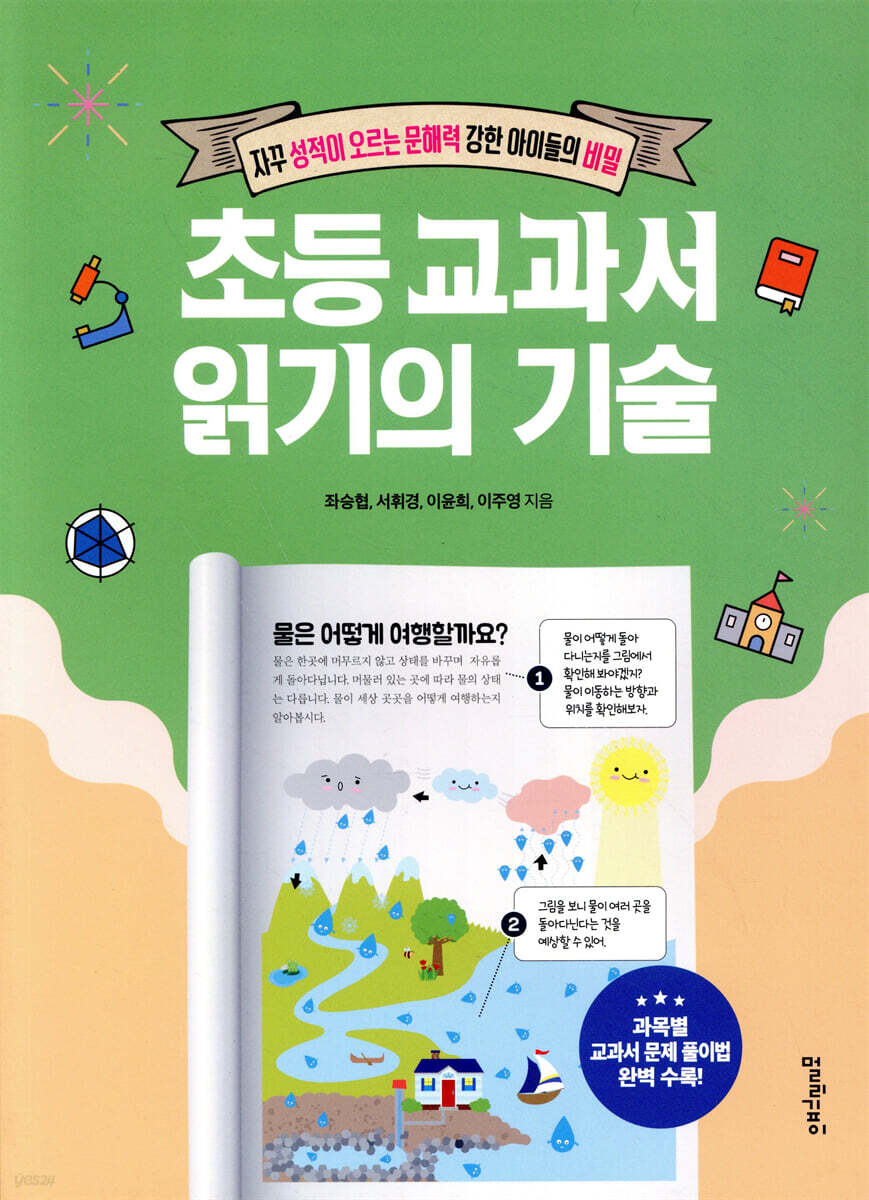 |
Description
Book Introduction
The second installment of the self-directed learning project, following "Elementary Note-Taking Skills"!
Even if you sit in class the same way and read the textbook properly, the study output of the children is different!
The common study secret of the top 0.01% of students who achieved perfect scores on the CSAT: textbooks! This textbook, compiled by Korea's leading scholars and concisely conceptualized by the nation's top scholars, is itself the culmination of cutting-edge education and educational psychology.
For elementary school students, who don't have national exams, the importance of textbooks is overwhelming! Therefore, the ChamSamSchool curriculum team has come together to compile a comprehensive guide to reading textbooks properly.
Even if you sit in class the same way and read the textbook properly, the study output of the children is different!
The common study secret of the top 0.01% of students who achieved perfect scores on the CSAT: textbooks! This textbook, compiled by Korea's leading scholars and concisely conceptualized by the nation's top scholars, is itself the culmination of cutting-edge education and educational psychology.
For elementary school students, who don't have national exams, the importance of textbooks is overwhelming! Therefore, the ChamSamSchool curriculum team has come together to compile a comprehensive guide to reading textbooks properly.
- You can preview some of the book's contents.
Preview
index
Preface - Reading textbooks is the starting point for all study.
PART 1: Everything You Need to Know About Reading Subject-Specific Textbooks
1.
The Korean language area, which improves reading skills and is the foundation of all subjects
01 Read while thinking about the branch of the text and what you will learn.
02 Find out the words you don't know
03 Read with appropriate spacing while thinking about the meaning.
04 When I read poetry, I picture it in my head.
05 Read while thinking about the main sentence and supporting sentences.
06 Read while thinking about the character's words and actions.
07 Read while understanding the writer's opinion.
2.
The area of mathematics where the ability to read text, pictures, shapes, symbols, and tables is important
01 Understand the flow of the textbook and read it.
02 Read and understand new math terms
03 Read and understand the pictures, symbols, and shapes used to explain the concept.
04 Read in connection with what you have previously studied.
05 Convert text and pictures into numbers and formulas
06 Read and understand the definition of shapes
07 Read while thinking about the conditions and concepts learned.
3.
Social areas where understanding concepts and data is important
01 Read while understanding the relationship between large and small units.
02 When looking up meanings in the Korean dictionary, read the Chinese characters as well.
03 Read the text and pictures together
04 Connect graphs and social concepts
05 Read the map while thinking about its meaning.
06 Read while thinking about the order of cause and effect.
07 Read while drawing a thinking map
08 Read the arrows
4.
A scientific field where understanding language and understanding changes in phenomena are important.
01 Gain background knowledge by looking through textbooks.
02 Think of basic scientific terms
03 Read while finding the central sentence
04 Read and understand the meaning of the terms.
05 Read by connecting text and pictures or photos.
06 Read by comparing and contrasting
07 Read and interpret tables and graphs
PART 2: Everything You Need to Know About Reading Subject-Specific Problems
Korean - Reading while thinking about the structure of the text
Korean - Read with appropriate spacing while imagining the image in your head
Math - Expressing Math Concepts with Pictures
Math - Recalling the definitions of mathematical terms
Social Studies - Finding the information needed for a problem by looking at the graph
Social Studies - Recall what you've learned before, draw a thinking map, and read the information on the map.
Science - Reading that connects real-life examples with scientific experiments
Science - Think of pictures or photos from textbooks
Acknowledgements
Textbook works and image sources
PART 1: Everything You Need to Know About Reading Subject-Specific Textbooks
1.
The Korean language area, which improves reading skills and is the foundation of all subjects
01 Read while thinking about the branch of the text and what you will learn.
02 Find out the words you don't know
03 Read with appropriate spacing while thinking about the meaning.
04 When I read poetry, I picture it in my head.
05 Read while thinking about the main sentence and supporting sentences.
06 Read while thinking about the character's words and actions.
07 Read while understanding the writer's opinion.
2.
The area of mathematics where the ability to read text, pictures, shapes, symbols, and tables is important
01 Understand the flow of the textbook and read it.
02 Read and understand new math terms
03 Read and understand the pictures, symbols, and shapes used to explain the concept.
04 Read in connection with what you have previously studied.
05 Convert text and pictures into numbers and formulas
06 Read and understand the definition of shapes
07 Read while thinking about the conditions and concepts learned.
3.
Social areas where understanding concepts and data is important
01 Read while understanding the relationship between large and small units.
02 When looking up meanings in the Korean dictionary, read the Chinese characters as well.
03 Read the text and pictures together
04 Connect graphs and social concepts
05 Read the map while thinking about its meaning.
06 Read while thinking about the order of cause and effect.
07 Read while drawing a thinking map
08 Read the arrows
4.
A scientific field where understanding language and understanding changes in phenomena are important.
01 Gain background knowledge by looking through textbooks.
02 Think of basic scientific terms
03 Read while finding the central sentence
04 Read and understand the meaning of the terms.
05 Read by connecting text and pictures or photos.
06 Read by comparing and contrasting
07 Read and interpret tables and graphs
PART 2: Everything You Need to Know About Reading Subject-Specific Problems
Korean - Reading while thinking about the structure of the text
Korean - Read with appropriate spacing while imagining the image in your head
Math - Expressing Math Concepts with Pictures
Math - Recalling the definitions of mathematical terms
Social Studies - Finding the information needed for a problem by looking at the graph
Social Studies - Recall what you've learned before, draw a thinking map, and read the information on the map.
Science - Reading that connects real-life examples with scientific experiments
Science - Think of pictures or photos from textbooks
Acknowledgements
Textbook works and image sources
Detailed image
.jpg)
Publisher's Review
"What's the secret to getting a perfect score on the CSAT? I focused on studying from the textbook!"
The textbook compiled by the best educational experts is the best concept book!
This one book contains the essence of textbook reading, chosen by the top 0.01% of students!
These days, with literacy emerging as the top learning keyword, books and private education programs designed to strengthen literacy are pouring out.
There are books that claim that memorizing thick vocabulary lists that are no different from a Korean dictionary without any context will improve literacy, and reading programs that curate lists of classics that are difficult even for adults to understand are also gaining popularity.
However, even after investing time and money, there are still many students who do not properly understand the teacher's explanations during class, and when asked to state the main point in one sentence after class, most of them mumble.
Why is this happening?
Every class period has learning objectives and learning activities that help students systematically understand those objectives.
The reason why textbooks are considered the best concept books is because they are literally concept explanations that present learning objectives and activities at a level that students can understand.
All classes are based on textbooks.
After completing various course activities, such as conducting experiments, reading passages and completing formulas, or sharing thoughts after reading a work, check whether you have properly understood the learning objectives by solving appropriate verification problems.
Are textbooks this systematically organized? Yes.
Many students neglect their textbooks because they think of them as mere supplementary tools for solving workbook problems. However, all assessments, including the CSAT, are ultimately structured to align with the goals presented in these textbooks.
Mastering the textbook perfectly is as important as solving dozens of workbooks.
《Elementary Textbook Reading Skills》(Muririgipi, 2021) is a book that comprehensively covers textbook reading methods, written by a group of teachers at Chamsaem School.
With basic academic skills already at rock bottom due to prolonged online classes, the authors agree that if there's one thing we need to solidify, it's how to read textbooks.
According to teacher Seunghyeop Jo, “the textbook itself is the best guide that shows the order and method of study.”
When I see children who can't focus in class, I see that they don't understand why this equation is being presented now, why the same experiment is being conducted twice at different times, and why there are unknown numbers on the contour lines.
Even among upperclassmen, it is said that there are many children who do not know what 'learning objectives' mean.
These kids spend most of their time in class unaware of what they are learning.
《Elementary Textbook Reading Skills》 provides step-by-step detailed guidance on how to check what you are learning, convert text into equations, read maps, and solve problems based on them.
Perhaps, after reading this book, many students will realize, 'So that's why tables and figures are presented like this.'
If you have children who have trouble concentrating in class, or who cannot clearly explain what they learned even after they have finished learning, let them read "The Art of Reading Elementary Textbooks."
You will be able to develop concentration and problem-solving skills that are incomparable to any class you have taken so far.
The power to create formulas, understand diagrams, maps, and read experimental results!
A textbook that truly awakens your study skills, providing a complete self-directed learning method!
In Unit 3, “Addition and Subtraction of Fractions,” in the first semester of the fifth grade, there is a problem that says, “Let’s find out how much sugar is left after using 1/2 cup of sugar from 3/4 cup.”
A child who properly understands the learning objective will understand exactly why there is 3/4 cup of sugar, not 3 or 4 cups.
Because the learning goal is to learn how to subtract fractions.
Even if they read the same passage, a child who does not understand the learning objective will not know why the problem condition of 3/4 cup is presented.
It is at this point that the difference between being able to focus on class and not being able to do so is determined.
Furthermore, it is a matter of whether or not the problem of subtracting 1/2 from 3/4 can be solved.
The book provides detailed guidance, presenting images of each page, with learning problems, activities to solve them, and the final problem to be solved after completing these activities in order.
Through this process, children primarily learn how to read textbooks, and secondarily, they properly develop a sense of systematic study, or 'study skills'.
Just by opening the textbook, checking the learning objectives, reviewing the assignments, and understanding why the questions were presented, you can see a clear difference in your study output.
Even if you sit down for the same amount of time, the reason why some people can solve problems while others don't even know why a particular problem is given is because of this 'textbook reading sense.'
The art of reading problems that will help you solve any problem!
A child who knows the type will solve the problem accurately and in a short time!
After learning 'Everything about reading textbooks by subject' in Chapter 1 of the book, you will learn 'Everything about reading problems by subject' in Chapter 2.
Chapter 2 presents representative problem types in Korean, mathematics, social studies, and science, and explains in detail why these problems were presented, why the corresponding graphs are provided for the problems, what clues are contained in the problems, and how to utilize the clues.
This kind of detailed type solving itself is of great help in improving not only thinking skills but also problem-solving skills.
Because simply knowing what the given passage is asking and how to use the clues provided to deduce the correct answer to the question can solve many problems in everyday life.
Whether reading a book, chatting with a friend, or even running an errand for their parents, a child who thinks about their goals and the clues to achieving them will acquire the thinking skills to complete tasks quickly and perfectly.
Through "Elementary Textbook Reading Skills," you will be able to properly develop the ability to understand goals, infer clues, and complete tasks on your own initiative.
Actual textbook images provided on all pages!
Everything you need to know about reading textbooks: Learn with detailed explanations, not vague explanations!
Tips for becoming a good textbook reader
1.
Be sure to look up any words you don't know.
2.
Infer the meaning of unknown terms by understanding their relationship to the preceding and following sentences.
3.
Read while understanding the relationship between the main and sub-units.
4.
Read while thinking about the main sentence and supporting sentences.
5.
Read the pictures and diagrams and connect them to the central concept.
6.
In math, we practice reading words and numbers as equations.
7.
Read it in connection with what you have learned previously.
The textbook compiled by the best educational experts is the best concept book!
This one book contains the essence of textbook reading, chosen by the top 0.01% of students!
These days, with literacy emerging as the top learning keyword, books and private education programs designed to strengthen literacy are pouring out.
There are books that claim that memorizing thick vocabulary lists that are no different from a Korean dictionary without any context will improve literacy, and reading programs that curate lists of classics that are difficult even for adults to understand are also gaining popularity.
However, even after investing time and money, there are still many students who do not properly understand the teacher's explanations during class, and when asked to state the main point in one sentence after class, most of them mumble.
Why is this happening?
Every class period has learning objectives and learning activities that help students systematically understand those objectives.
The reason why textbooks are considered the best concept books is because they are literally concept explanations that present learning objectives and activities at a level that students can understand.
All classes are based on textbooks.
After completing various course activities, such as conducting experiments, reading passages and completing formulas, or sharing thoughts after reading a work, check whether you have properly understood the learning objectives by solving appropriate verification problems.
Are textbooks this systematically organized? Yes.
Many students neglect their textbooks because they think of them as mere supplementary tools for solving workbook problems. However, all assessments, including the CSAT, are ultimately structured to align with the goals presented in these textbooks.
Mastering the textbook perfectly is as important as solving dozens of workbooks.
《Elementary Textbook Reading Skills》(Muririgipi, 2021) is a book that comprehensively covers textbook reading methods, written by a group of teachers at Chamsaem School.
With basic academic skills already at rock bottom due to prolonged online classes, the authors agree that if there's one thing we need to solidify, it's how to read textbooks.
According to teacher Seunghyeop Jo, “the textbook itself is the best guide that shows the order and method of study.”
When I see children who can't focus in class, I see that they don't understand why this equation is being presented now, why the same experiment is being conducted twice at different times, and why there are unknown numbers on the contour lines.
Even among upperclassmen, it is said that there are many children who do not know what 'learning objectives' mean.
These kids spend most of their time in class unaware of what they are learning.
《Elementary Textbook Reading Skills》 provides step-by-step detailed guidance on how to check what you are learning, convert text into equations, read maps, and solve problems based on them.
Perhaps, after reading this book, many students will realize, 'So that's why tables and figures are presented like this.'
If you have children who have trouble concentrating in class, or who cannot clearly explain what they learned even after they have finished learning, let them read "The Art of Reading Elementary Textbooks."
You will be able to develop concentration and problem-solving skills that are incomparable to any class you have taken so far.
The power to create formulas, understand diagrams, maps, and read experimental results!
A textbook that truly awakens your study skills, providing a complete self-directed learning method!
In Unit 3, “Addition and Subtraction of Fractions,” in the first semester of the fifth grade, there is a problem that says, “Let’s find out how much sugar is left after using 1/2 cup of sugar from 3/4 cup.”
A child who properly understands the learning objective will understand exactly why there is 3/4 cup of sugar, not 3 or 4 cups.
Because the learning goal is to learn how to subtract fractions.
Even if they read the same passage, a child who does not understand the learning objective will not know why the problem condition of 3/4 cup is presented.
It is at this point that the difference between being able to focus on class and not being able to do so is determined.
Furthermore, it is a matter of whether or not the problem of subtracting 1/2 from 3/4 can be solved.
The book provides detailed guidance, presenting images of each page, with learning problems, activities to solve them, and the final problem to be solved after completing these activities in order.
Through this process, children primarily learn how to read textbooks, and secondarily, they properly develop a sense of systematic study, or 'study skills'.
Just by opening the textbook, checking the learning objectives, reviewing the assignments, and understanding why the questions were presented, you can see a clear difference in your study output.
Even if you sit down for the same amount of time, the reason why some people can solve problems while others don't even know why a particular problem is given is because of this 'textbook reading sense.'
The art of reading problems that will help you solve any problem!
A child who knows the type will solve the problem accurately and in a short time!
After learning 'Everything about reading textbooks by subject' in Chapter 1 of the book, you will learn 'Everything about reading problems by subject' in Chapter 2.
Chapter 2 presents representative problem types in Korean, mathematics, social studies, and science, and explains in detail why these problems were presented, why the corresponding graphs are provided for the problems, what clues are contained in the problems, and how to utilize the clues.
This kind of detailed type solving itself is of great help in improving not only thinking skills but also problem-solving skills.
Because simply knowing what the given passage is asking and how to use the clues provided to deduce the correct answer to the question can solve many problems in everyday life.
Whether reading a book, chatting with a friend, or even running an errand for their parents, a child who thinks about their goals and the clues to achieving them will acquire the thinking skills to complete tasks quickly and perfectly.
Through "Elementary Textbook Reading Skills," you will be able to properly develop the ability to understand goals, infer clues, and complete tasks on your own initiative.
Actual textbook images provided on all pages!
Everything you need to know about reading textbooks: Learn with detailed explanations, not vague explanations!
Tips for becoming a good textbook reader
1.
Be sure to look up any words you don't know.
2.
Infer the meaning of unknown terms by understanding their relationship to the preceding and following sentences.
3.
Read while understanding the relationship between the main and sub-units.
4.
Read while thinking about the main sentence and supporting sentences.
5.
Read the pictures and diagrams and connect them to the central concept.
6.
In math, we practice reading words and numbers as equations.
7.
Read it in connection with what you have learned previously.
GOODS SPECIFICS
- Publication date: August 23, 2021
- Page count, weight, size: 240 pages | 640g | 188*257*13mm
- ISBN13: 9791191439076
- ISBN10: 1191439070
You may also like
카테고리
korean


korean

![GQ KOREA Mark (Monthly): December [2025]](http://librairie.coreenne.fr/cdn/shop/files/8ef265dbbfbf186523ed75ba7319009d.jpg?v=1765340328&width=3840)


