

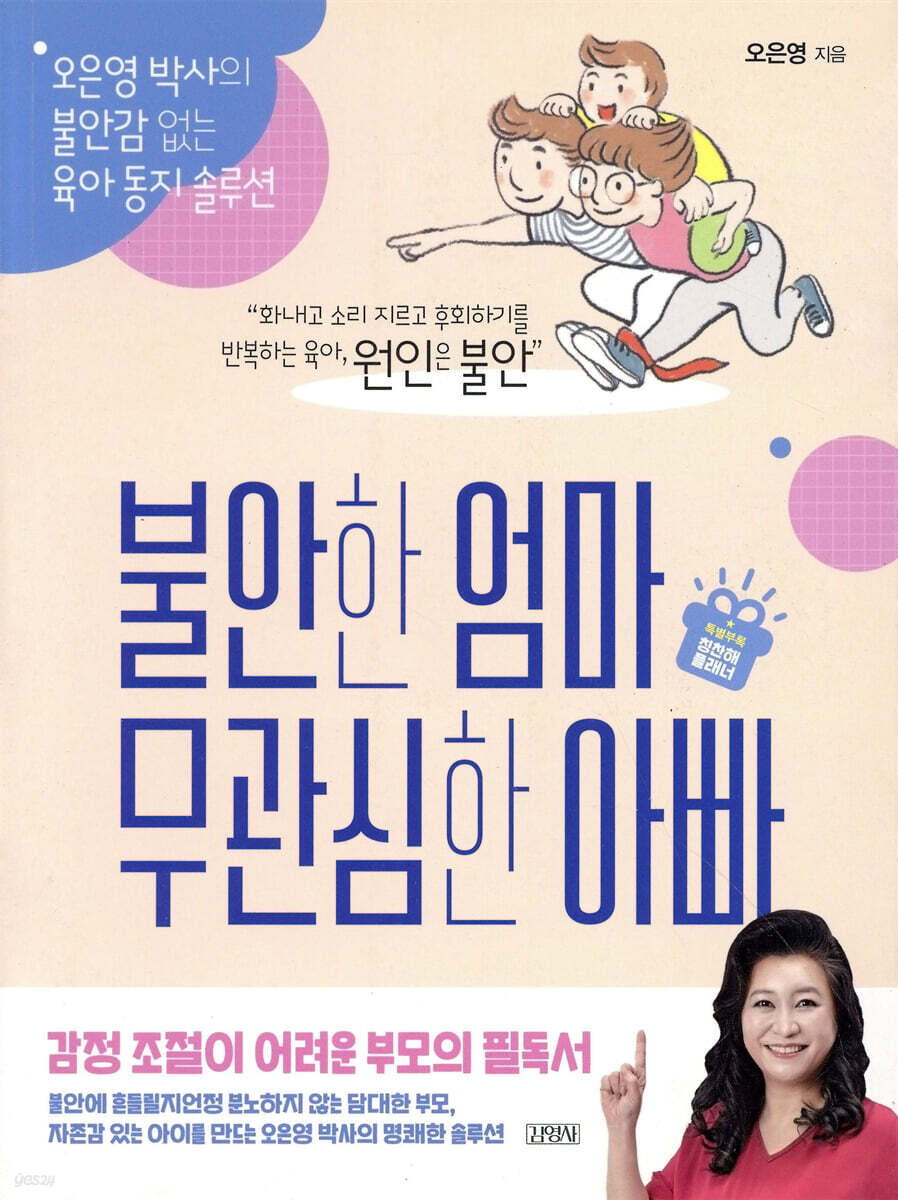
Anxious mom, indifferent dad
 |
Description
Book Introduction
A cover with added warmth through illustrations
Parenting: Repeatedly getting angry, yelling, and regretting: The cause is anxiety.
A courageous parent who is not angry but shaken by anxiety, raises a child with self-esteem.
A clear solution from national parenting mentor Dr. Oh Eun-young!
A mother who constantly nags her child while feeling sad when she thinks of him, and a father who is always strict with his child and gets angry first.
Why do parents feel anxious and fearful while raising their children? What problems do anxiety and fear cause in parenting? Addressing parental anxiety and fear is essential for children to be happy! Dr. Oh Eun-young's parenting A to Z covers everything from childcare to education, friends, character, health, and lifestyle habits, dispelling parents' seemingly uncontrollable anxieties.
A must-read for parents who struggle with emotional regulation! Moms who nag and nag their children at every opportunity, and dads who are indifferent to their children or quick to anger.
Why do parents always do this, knowing they'll regret it later? Dr. Oh Eun-young, known as the "national parenting mentor" and "god of parenting," says that parents' inability to control their emotions—getting angry, yelling, and feeling regretful—is due to their own anxiety.
And he sternly warns us that this anxiety creates conflict between couples and turns children into anxious people.
“Anxious parents cannot afford to respect their children.
The more anxious you are, the more you worry, and those worries just keep coming back to haunt you.
If you do that, your insides will burn out and only ashes will remain, and you will get angry like fire at anything.
They get angry because they don't know how to express their anxious feelings, and they get angry because their spouse doesn't help them resolve that anxiety.
Sometimes, we live in a state of constant anger because our anxieties collide with each other.
But the target is mostly my child.
“Ultimately, children often become objects of anger for their parents.”
"Anxious Mom, Indifferent Dad" helps mothers and fathers recognize the true nature of the anxiety that lies deep within their hearts and guides them on a path to happiness for both children and parents by wisely dealing with each stage of parenting.
For parents lost in the seemingly endless battle of parenting, this book is filled with clear insights from an expert, heartwarming advice from a seasoned mother, and countless clinical examples that readers can empathize with and apply to their own lives.
It provides clear answers to parenting concerns, including coaching on the most common concerns of modern parents and the wrong language habits that turn couples from parenting partners to enemies.
Parenting: Repeatedly getting angry, yelling, and regretting: The cause is anxiety.
A courageous parent who is not angry but shaken by anxiety, raises a child with self-esteem.
A clear solution from national parenting mentor Dr. Oh Eun-young!
A mother who constantly nags her child while feeling sad when she thinks of him, and a father who is always strict with his child and gets angry first.
Why do parents feel anxious and fearful while raising their children? What problems do anxiety and fear cause in parenting? Addressing parental anxiety and fear is essential for children to be happy! Dr. Oh Eun-young's parenting A to Z covers everything from childcare to education, friends, character, health, and lifestyle habits, dispelling parents' seemingly uncontrollable anxieties.
A must-read for parents who struggle with emotional regulation! Moms who nag and nag their children at every opportunity, and dads who are indifferent to their children or quick to anger.
Why do parents always do this, knowing they'll regret it later? Dr. Oh Eun-young, known as the "national parenting mentor" and "god of parenting," says that parents' inability to control their emotions—getting angry, yelling, and feeling regretful—is due to their own anxiety.
And he sternly warns us that this anxiety creates conflict between couples and turns children into anxious people.
“Anxious parents cannot afford to respect their children.
The more anxious you are, the more you worry, and those worries just keep coming back to haunt you.
If you do that, your insides will burn out and only ashes will remain, and you will get angry like fire at anything.
They get angry because they don't know how to express their anxious feelings, and they get angry because their spouse doesn't help them resolve that anxiety.
Sometimes, we live in a state of constant anger because our anxieties collide with each other.
But the target is mostly my child.
“Ultimately, children often become objects of anger for their parents.”
"Anxious Mom, Indifferent Dad" helps mothers and fathers recognize the true nature of the anxiety that lies deep within their hearts and guides them on a path to happiness for both children and parents by wisely dealing with each stage of parenting.
For parents lost in the seemingly endless battle of parenting, this book is filled with clear insights from an expert, heartwarming advice from a seasoned mother, and countless clinical examples that readers can empathize with and apply to their own lives.
It provides clear answers to parenting concerns, including coaching on the most common concerns of modern parents and the wrong language habits that turn couples from parenting partners to enemies.
index
first.
Why mom? Why dad?
1.
A worried mother and an indifferent father
- What if it goes wrong? vs. All kids are like that.
- Who is right, mom or dad?
- The root of worry and indifference is anxiety.
2.
Why would a mother worry about her child's problem?
- A mother's anxiety is an old instinct.
- Why are mothers more anxious these days?
Identity confusion, wondering "Who am I?" also contributes to anxiety.
At the root of anxiety are guilt, regret, and greed.
A 40-something mom trying to raise her child as a super kid, and a 30-something mom burning with jealousy.
3.
Why is Dad indifferent when it's my child's problem?
- A brain that processes only one thing at a time and a problem-solving instinct
- The essence of fatherly anxiety is stubbornness, avoidance, distrust, and wariness.
- A father in his 40s who struggles with communication, and a father in his 30s who finds multi-role burdensome.
- Changing Dad vs. Still Indifferent Dad
4.
A mother's worry and a father's indifference clash in front of the child.
- Anxious parents over-intervene or over-control their children.
- Parents' anxiety becomes children's anxiety.
- Acknowledging anxiety is essential for stable parenting.
* PLUS PAGE How anxious am I?
second.
Anxious Parents: Find Solutions for Each Conflict
1.
Child's education issues
① Children's textbooks and teaching aids: Do you really need them now? vs. Everyone else has already bought them for you.
② Early Childhood Education Institutions: Just let them have fun, why send them away already? vs. It's a parent's responsibility to provide good educational opportunities!
③ Elementary school grades: 80 points is enough, what's the fuss about! vs Should I send my child to an academy?
④ Moving for Education: Even kids living in the countryside are good at studying! vs. They say there's no better educational environment than Gangnam...
⑤ Private Education: What do you do at school and go to a private academy? vs. If you do that, only my child will become stupid!
⑥ Language training: Children who want to study will do well here too.
vs What are you talking about! You have to do everything you can.
⑦ When your grades suddenly drop: I figured it out when you weren't studying! vs. Why are you suddenly like this? Is something wrong?
⑧ When not studying: How did you raise your child to be like this? vs. Why on earth doesn't he study?
2.
Child's friendships
① When being bullied: Is this really bullying? Wasn't it just a kid playing around? vs. Is my child being bullied? How hard must it have been!
② When bullying a friend: You have nothing better to do, so you bully others? vs. There's no way you would do that!
③ When you have too many friends: What's wrong with having a lot of friends? It's okay! vs. They just hang out and don't study.
④ Loner: Loner? Why is that a problem? vs. How lonely must it be? I have to step up.
⑤ Bad friend: How pathetic.
Hanging out with a kid like that! vs What if I end up in a bad situation?
⑥ Opposite-sex friend: My precious daughter's boyfriend? No way! vs. Wouldn't that be polluting my precious son?
⑦ Fight with a friend: It's a fight between kids, so let's resolve it amicably.
vs. How would the child feel? How upset would he be?
3.
Child's character, health, and safety issues
① Corporal punishment: I have to teach them even if it means hitting them! vs. I hit the child! I shouldn't have hit them...
② Discipline: If you raise them like this, they won't be able to earn their own living! vs. If you don't nag them, they won't do anything properly!
③ When the child is sick: The child may be sick.
Go to the hospital! vs. Won't this lead to a serious illness?
④ Bad food: Other kids are eating it too, so just feed it to them! vs. No! I told you not to feed them that!
⑤ Appearance (obesity, height): Are you a mother? What is this child doing? vs. I can't even feed him properly, so I'm not a mother.
⑥ Picky eating: If they don't eat, don't give it to them.
We didn't have it in our time, so we couldn't eat it! vs. How could we not eat it? If we don't eat it, we won't grow tall.
⑦ Child safety (kidnapping, abduction, sexual assault): Aren't you being too overprotective? vs. What if something happens to your child while they're out alone?
⑧ Safety Accident: "It's okay, what could happen?" vs. "What if it happens to my child? I'm never sending them!"
4.
Various problems in daily life
① Problem with the parents of both families: What's the use of talking about something that won't even give an answer?
vs I can't believe I'm being treated like this... .
② Dual-income families and fathers' involvement in childcare: If you're that worried, just quit your job! vs. Am I neglecting my child too much?
③ Childcare: They're all similar, so why worry so much! vs. What are you talking about? You should leave your child in a better place!
④ Child's economic sense: The less money you give your child, the better.
vs. It would be pitiful if our child wasn't there.
⑤ When a child has a disability: Is it worthwhile to continue supporting them? vs. Is this my child's condition because of me?
* PLUS PAGE When Anxiety Meets Anxiety
Third.
Happy parents make happy children.
1.
To be a happy parent
- Motherhood, the mysterious instinct to protect children
- Father, prepare for evolution.
- My child has to do what I think and what I say?
- To change a child, approach with a humble attitude.
- Super Kids, the Scapegoat of Anxious Parents
2.
To become a happy couple
- Healthy couple communication techniques to reduce anxiety: listening and respect
- Filter the words of husband and wife through the translator of your mind.
- Dad, don't be anxious when you encounter unfamiliar territory.
- Mom, don't be overly proud of what you're doing well.
- Childcare and housework are the most noble labors.
3.
To become a happy person
- To avoid being swayed by anxiety, share the other person's anxiety.
If you don't recognize your anxiety, it will be passed on to your children.
- Trust my choice now.
- Always check the anxiety signals inside me.
* PLUS PAGE Psychological Codes to Abandon to Become a Good Parent or Spouse
Why mom? Why dad?
1.
A worried mother and an indifferent father
- What if it goes wrong? vs. All kids are like that.
- Who is right, mom or dad?
- The root of worry and indifference is anxiety.
2.
Why would a mother worry about her child's problem?
- A mother's anxiety is an old instinct.
- Why are mothers more anxious these days?
Identity confusion, wondering "Who am I?" also contributes to anxiety.
At the root of anxiety are guilt, regret, and greed.
A 40-something mom trying to raise her child as a super kid, and a 30-something mom burning with jealousy.
3.
Why is Dad indifferent when it's my child's problem?
- A brain that processes only one thing at a time and a problem-solving instinct
- The essence of fatherly anxiety is stubbornness, avoidance, distrust, and wariness.
- A father in his 40s who struggles with communication, and a father in his 30s who finds multi-role burdensome.
- Changing Dad vs. Still Indifferent Dad
4.
A mother's worry and a father's indifference clash in front of the child.
- Anxious parents over-intervene or over-control their children.
- Parents' anxiety becomes children's anxiety.
- Acknowledging anxiety is essential for stable parenting.
* PLUS PAGE How anxious am I?
second.
Anxious Parents: Find Solutions for Each Conflict
1.
Child's education issues
① Children's textbooks and teaching aids: Do you really need them now? vs. Everyone else has already bought them for you.
② Early Childhood Education Institutions: Just let them have fun, why send them away already? vs. It's a parent's responsibility to provide good educational opportunities!
③ Elementary school grades: 80 points is enough, what's the fuss about! vs Should I send my child to an academy?
④ Moving for Education: Even kids living in the countryside are good at studying! vs. They say there's no better educational environment than Gangnam...
⑤ Private Education: What do you do at school and go to a private academy? vs. If you do that, only my child will become stupid!
⑥ Language training: Children who want to study will do well here too.
vs What are you talking about! You have to do everything you can.
⑦ When your grades suddenly drop: I figured it out when you weren't studying! vs. Why are you suddenly like this? Is something wrong?
⑧ When not studying: How did you raise your child to be like this? vs. Why on earth doesn't he study?
2.
Child's friendships
① When being bullied: Is this really bullying? Wasn't it just a kid playing around? vs. Is my child being bullied? How hard must it have been!
② When bullying a friend: You have nothing better to do, so you bully others? vs. There's no way you would do that!
③ When you have too many friends: What's wrong with having a lot of friends? It's okay! vs. They just hang out and don't study.
④ Loner: Loner? Why is that a problem? vs. How lonely must it be? I have to step up.
⑤ Bad friend: How pathetic.
Hanging out with a kid like that! vs What if I end up in a bad situation?
⑥ Opposite-sex friend: My precious daughter's boyfriend? No way! vs. Wouldn't that be polluting my precious son?
⑦ Fight with a friend: It's a fight between kids, so let's resolve it amicably.
vs. How would the child feel? How upset would he be?
3.
Child's character, health, and safety issues
① Corporal punishment: I have to teach them even if it means hitting them! vs. I hit the child! I shouldn't have hit them...
② Discipline: If you raise them like this, they won't be able to earn their own living! vs. If you don't nag them, they won't do anything properly!
③ When the child is sick: The child may be sick.
Go to the hospital! vs. Won't this lead to a serious illness?
④ Bad food: Other kids are eating it too, so just feed it to them! vs. No! I told you not to feed them that!
⑤ Appearance (obesity, height): Are you a mother? What is this child doing? vs. I can't even feed him properly, so I'm not a mother.
⑥ Picky eating: If they don't eat, don't give it to them.
We didn't have it in our time, so we couldn't eat it! vs. How could we not eat it? If we don't eat it, we won't grow tall.
⑦ Child safety (kidnapping, abduction, sexual assault): Aren't you being too overprotective? vs. What if something happens to your child while they're out alone?
⑧ Safety Accident: "It's okay, what could happen?" vs. "What if it happens to my child? I'm never sending them!"
4.
Various problems in daily life
① Problem with the parents of both families: What's the use of talking about something that won't even give an answer?
vs I can't believe I'm being treated like this... .
② Dual-income families and fathers' involvement in childcare: If you're that worried, just quit your job! vs. Am I neglecting my child too much?
③ Childcare: They're all similar, so why worry so much! vs. What are you talking about? You should leave your child in a better place!
④ Child's economic sense: The less money you give your child, the better.
vs. It would be pitiful if our child wasn't there.
⑤ When a child has a disability: Is it worthwhile to continue supporting them? vs. Is this my child's condition because of me?
* PLUS PAGE When Anxiety Meets Anxiety
Third.
Happy parents make happy children.
1.
To be a happy parent
- Motherhood, the mysterious instinct to protect children
- Father, prepare for evolution.
- My child has to do what I think and what I say?
- To change a child, approach with a humble attitude.
- Super Kids, the Scapegoat of Anxious Parents
2.
To become a happy couple
- Healthy couple communication techniques to reduce anxiety: listening and respect
- Filter the words of husband and wife through the translator of your mind.
- Dad, don't be anxious when you encounter unfamiliar territory.
- Mom, don't be overly proud of what you're doing well.
- Childcare and housework are the most noble labors.
3.
To become a happy person
- To avoid being swayed by anxiety, share the other person's anxiety.
If you don't recognize your anxiety, it will be passed on to your children.
- Trust my choice now.
- Always check the anxiety signals inside me.
* PLUS PAGE Psychological Codes to Abandon to Become a Good Parent or Spouse
Detailed image

Into the book
Korean mothers feel a lot of guilt, regret, and greed when dealing with their children.
These three things cause mothers to feel anxious, and the one that causes the most anxiety is greed.
I am greedy and want my child to reach the places I want to have, achieve, and be.
People who are frustrated with not being able to study feel indescribably anxious when their children do not study.
It is a feeling of anxiety that comes from a fear that the child will become as unhappy as oneself, but it is also caused by not being able to properly separate oneself from the child.
People who did not have a good relationship with their parents become overly anxious and obsessed with the fear that their children will suffer and have difficulties like they did.
But all these desires arise from a lack of self-confidence.
This is because it is difficult for oneself to have the mindset of ‘this is enough’ or ‘this is enough’.
--- p.53
In the case of over-controlling fathers, they adopt a patriarchal and strict appearance to avoid revealing that they are fearful, weak, and anxious about the world.
Among patriarchal fathers, there are many who have a higher level of anxiety than expected.
By acting patriarchally and strictly, they compensate for their own insecurities.
They deliberately avoid being intimate and affectionate with the child in order to appear powerful.
I feel like saying things like, “Our Mincheol is really cool” makes me seem weak, so I try to restrain myself from praising my child.
Even though this child doesn't need to be treated strictly or harshly at all, instead of trying to persuade or explain to the child, you always take a forceful approach.
If this happens, the child will have low self-esteem, will not be able to develop autonomy, and will become someone who has difficulty expressing his or her own opinions. In other words, he or she will become discouraged.
On the outside, he is afraid of his father, but inside, he is filled with anger towards him.
Eventually, the child becomes angry, but is unable to express his or her feelings of anger because he or she is scared and afraid. He or she is always confused because his or her insides and outsides are different, and he or she acts anxiously about everything.
--- p.75
A child is like a bunch of grapes, some of which are small, some large, some unripe, and some ripe.
Some grapes are deep purple, while others are bright red.
All the grapes gathered together in one bunch are my child.
But our parents don't know that.
Instead of integrating all aspects of the child and accepting them as they are, they compare the child to many things around them, making a perfectly good child miserable.
If a child is not good at studying but has a good personality, you should evaluate him by saying, “He may not become a doctor or a PhD, but he will be evaluated as a good person no matter what he does.”
If your child is practicing hard but still not good at jumping rope, you should be able to tell them, “You’re not going to a jump rope competition, so that’s enough.”
This should not make the child feel inferior.
Actually, I wasn't good at dancing since I was little.
I still can't dance.
But these days, if their children can't dance, mothers send them to dance academies and even give them jump rope lessons.
Humans are like a bunch of grapes, made up of small parts that come together to form a whole.
But then he compares one grape to the color of an apple, another grape to the size of an orange, and another grape to the taste of a banana, and he tries to combine them all to make a child.
This way, the child has no sense of identity of his own.
--- p.346
Anxiety doesn't come from outside, it all comes from within me.
If you feel anxious because of that, then from then on you should turn your focus back to ‘me’.
I think about these questions: "What am I anxious about? When do I become anxious? What triggers my anxiety? What are my main methods of coping when I'm anxious?"
We need to look closely at the signs of anxiety, such as, 'I'm losing my temper, I'm speaking too carelessly, I'm nagging too much, I'm running away from problems.'
Just by looking at the anxiety properly, the anxiety is reduced to some extent.
The most dangerous situation when dealing with anxiety is when you don't know why you're anxious or what happens when you're anxious.
But if I know what anxiety is and how it changes me, that alone will make the anxiety lessen.
When anxiety is high, it is difficult for anyone to be happy.
Even in moments when we could be truly happy, we doubt our happiness because of anxiety.
If parents have high anxiety, the impact on their children can be devastating.
Because children learn unhappiness, not happiness, from their parents.
Children can learn their parents' anxious habits and grow up not knowing what happiness is.
There is no better education for a child than showing his or her parents happy.
These three things cause mothers to feel anxious, and the one that causes the most anxiety is greed.
I am greedy and want my child to reach the places I want to have, achieve, and be.
People who are frustrated with not being able to study feel indescribably anxious when their children do not study.
It is a feeling of anxiety that comes from a fear that the child will become as unhappy as oneself, but it is also caused by not being able to properly separate oneself from the child.
People who did not have a good relationship with their parents become overly anxious and obsessed with the fear that their children will suffer and have difficulties like they did.
But all these desires arise from a lack of self-confidence.
This is because it is difficult for oneself to have the mindset of ‘this is enough’ or ‘this is enough’.
--- p.53
In the case of over-controlling fathers, they adopt a patriarchal and strict appearance to avoid revealing that they are fearful, weak, and anxious about the world.
Among patriarchal fathers, there are many who have a higher level of anxiety than expected.
By acting patriarchally and strictly, they compensate for their own insecurities.
They deliberately avoid being intimate and affectionate with the child in order to appear powerful.
I feel like saying things like, “Our Mincheol is really cool” makes me seem weak, so I try to restrain myself from praising my child.
Even though this child doesn't need to be treated strictly or harshly at all, instead of trying to persuade or explain to the child, you always take a forceful approach.
If this happens, the child will have low self-esteem, will not be able to develop autonomy, and will become someone who has difficulty expressing his or her own opinions. In other words, he or she will become discouraged.
On the outside, he is afraid of his father, but inside, he is filled with anger towards him.
Eventually, the child becomes angry, but is unable to express his or her feelings of anger because he or she is scared and afraid. He or she is always confused because his or her insides and outsides are different, and he or she acts anxiously about everything.
--- p.75
A child is like a bunch of grapes, some of which are small, some large, some unripe, and some ripe.
Some grapes are deep purple, while others are bright red.
All the grapes gathered together in one bunch are my child.
But our parents don't know that.
Instead of integrating all aspects of the child and accepting them as they are, they compare the child to many things around them, making a perfectly good child miserable.
If a child is not good at studying but has a good personality, you should evaluate him by saying, “He may not become a doctor or a PhD, but he will be evaluated as a good person no matter what he does.”
If your child is practicing hard but still not good at jumping rope, you should be able to tell them, “You’re not going to a jump rope competition, so that’s enough.”
This should not make the child feel inferior.
Actually, I wasn't good at dancing since I was little.
I still can't dance.
But these days, if their children can't dance, mothers send them to dance academies and even give them jump rope lessons.
Humans are like a bunch of grapes, made up of small parts that come together to form a whole.
But then he compares one grape to the color of an apple, another grape to the size of an orange, and another grape to the taste of a banana, and he tries to combine them all to make a child.
This way, the child has no sense of identity of his own.
--- p.346
Anxiety doesn't come from outside, it all comes from within me.
If you feel anxious because of that, then from then on you should turn your focus back to ‘me’.
I think about these questions: "What am I anxious about? When do I become anxious? What triggers my anxiety? What are my main methods of coping when I'm anxious?"
We need to look closely at the signs of anxiety, such as, 'I'm losing my temper, I'm speaking too carelessly, I'm nagging too much, I'm running away from problems.'
Just by looking at the anxiety properly, the anxiety is reduced to some extent.
The most dangerous situation when dealing with anxiety is when you don't know why you're anxious or what happens when you're anxious.
But if I know what anxiety is and how it changes me, that alone will make the anxiety lessen.
When anxiety is high, it is difficult for anyone to be happy.
Even in moments when we could be truly happy, we doubt our happiness because of anxiety.
If parents have high anxiety, the impact on their children can be devastating.
Because children learn unhappiness, not happiness, from their parents.
Children can learn their parents' anxious habits and grow up not knowing what happiness is.
There is no better education for a child than showing his or her parents happy.
--- p.389
Publisher's Review
From childcare issues to education, friends, character, health, and lifestyle habits,
Dr. Oh Eun-young's Parenting A to Z: Dispelling Parents' Unanswered Anxiety
Mom and Dad got married because they loved each other to death, but after having a child, they started to clash over everything.
What exactly is wrong with them? What exactly is happening to them? Will the child truly be okay amidst this conflict between their parents? This book uncovers the problems of parents who, despite their shared goal of "for my child," struggle in different ways, creating conflict and finding solutions.
Is language training truly necessary for our child's future, as my wife says? Should I just dismiss the child's misbehavior as childish, as my husband says? Should I just sit by and watch my husband constantly scold my child at the dinner table? Will my picky eater be healthy? Is it safe to let my child wander alone in this harsh world? How much allowance should I give my child?
Let's stop being swayed by the subjective information of mothers around us and the advice of our bosses at work.
This book clearly diagnoses parenting problems that have not been answered anywhere else, and presents the most accurate answers.
From children's education to character, health, relationships with friends, economic sense, appearance, discipline, and corporal punishment, it contains answers to all the questions that Korean mothers and fathers are curious about.
Nagging mom, angry dad
Resolving anxiety and fear will make your child happy.
“Don’t get angry and don’t scold!”
Anxiety is an emotion essential to human survival.
A moderate amount of anxiety can effectively protect you and help you solve problems in a safe way.
However, excessive anxiety can make you overly tense or sometimes even cause you to attack others viciously.
If the parents' anxiety is severe, the situation becomes more serious.
Anxious parents use the wrong parenting styles called 'over-involvement' and 'over-control'. Over-involvement is the parenting style mainly used by worried mothers, and over-control is the parenting style of fathers who express their anxiety as indifference.
Over-involved mothers always prepare their children in advance to offset their own anxiety and want their children to behave as they expect and desire.
It's not that the child is anxious, but rather that the mother is anxious. If the mother over-intervenes in advance, the child will not be able to learn how to deal with crises on his own, and will not have the opportunity for adventure and challenge that are essential in life.
Over-controlling fathers adopt a strict attitude to hide their weaknesses, which can lead to children becoming discouraged, unable to develop autonomy, and ultimately growing up with low self-esteem.
Dr. Oh Eun-young says that, above all, the stability, peace, and courage of parents are the starting point of parenting.
It is explained that a child's heart must be respected by the parents, and that parents should never scold or get angry at the child, as this attitude has a great influence on the child's sociality and development.
If you are a parent, or a potential parent, it is crucial to identify which of your own behaviors are insecure and work to ensure they do not impact the parenting process or harm your child.
This book is a very reliable helper that helps parents find the anxiety hidden deep in their hearts and teaches them how to resolve and completely blow away that anxiety during the parenting process.
I highly recommend this to parents who are frustrated and at a loss due to their role as parents and their children's problems, and who have tried various methods but have not found an answer.
Dr. Oh Eun-young's Parenting A to Z: Dispelling Parents' Unanswered Anxiety
Mom and Dad got married because they loved each other to death, but after having a child, they started to clash over everything.
What exactly is wrong with them? What exactly is happening to them? Will the child truly be okay amidst this conflict between their parents? This book uncovers the problems of parents who, despite their shared goal of "for my child," struggle in different ways, creating conflict and finding solutions.
Is language training truly necessary for our child's future, as my wife says? Should I just dismiss the child's misbehavior as childish, as my husband says? Should I just sit by and watch my husband constantly scold my child at the dinner table? Will my picky eater be healthy? Is it safe to let my child wander alone in this harsh world? How much allowance should I give my child?
Let's stop being swayed by the subjective information of mothers around us and the advice of our bosses at work.
This book clearly diagnoses parenting problems that have not been answered anywhere else, and presents the most accurate answers.
From children's education to character, health, relationships with friends, economic sense, appearance, discipline, and corporal punishment, it contains answers to all the questions that Korean mothers and fathers are curious about.
Nagging mom, angry dad
Resolving anxiety and fear will make your child happy.
“Don’t get angry and don’t scold!”
Anxiety is an emotion essential to human survival.
A moderate amount of anxiety can effectively protect you and help you solve problems in a safe way.
However, excessive anxiety can make you overly tense or sometimes even cause you to attack others viciously.
If the parents' anxiety is severe, the situation becomes more serious.
Anxious parents use the wrong parenting styles called 'over-involvement' and 'over-control'. Over-involvement is the parenting style mainly used by worried mothers, and over-control is the parenting style of fathers who express their anxiety as indifference.
Over-involved mothers always prepare their children in advance to offset their own anxiety and want their children to behave as they expect and desire.
It's not that the child is anxious, but rather that the mother is anxious. If the mother over-intervenes in advance, the child will not be able to learn how to deal with crises on his own, and will not have the opportunity for adventure and challenge that are essential in life.
Over-controlling fathers adopt a strict attitude to hide their weaknesses, which can lead to children becoming discouraged, unable to develop autonomy, and ultimately growing up with low self-esteem.
Dr. Oh Eun-young says that, above all, the stability, peace, and courage of parents are the starting point of parenting.
It is explained that a child's heart must be respected by the parents, and that parents should never scold or get angry at the child, as this attitude has a great influence on the child's sociality and development.
If you are a parent, or a potential parent, it is crucial to identify which of your own behaviors are insecure and work to ensure they do not impact the parenting process or harm your child.
This book is a very reliable helper that helps parents find the anxiety hidden deep in their hearts and teaches them how to resolve and completely blow away that anxiety during the parenting process.
I highly recommend this to parents who are frustrated and at a loss due to their role as parents and their children's problems, and who have tried various methods but have not found an answer.
GOODS SPECIFICS
- Publication date: March 10, 2021
- Page count, weight, size: 404 pages | 141*230*24mm
- ISBN13: 9788934986690
- ISBN10: 8934986697
You may also like
카테고리
korean


korean

![GQ KOREA Mark (Monthly): December [2025]](http://librairie.coreenne.fr/cdn/shop/files/8ef265dbbfbf186523ed75ba7319009d.jpg?v=1765340328&width=3840)


