

Understanding Taiwanese Tea
 |
Description
Book Introduction
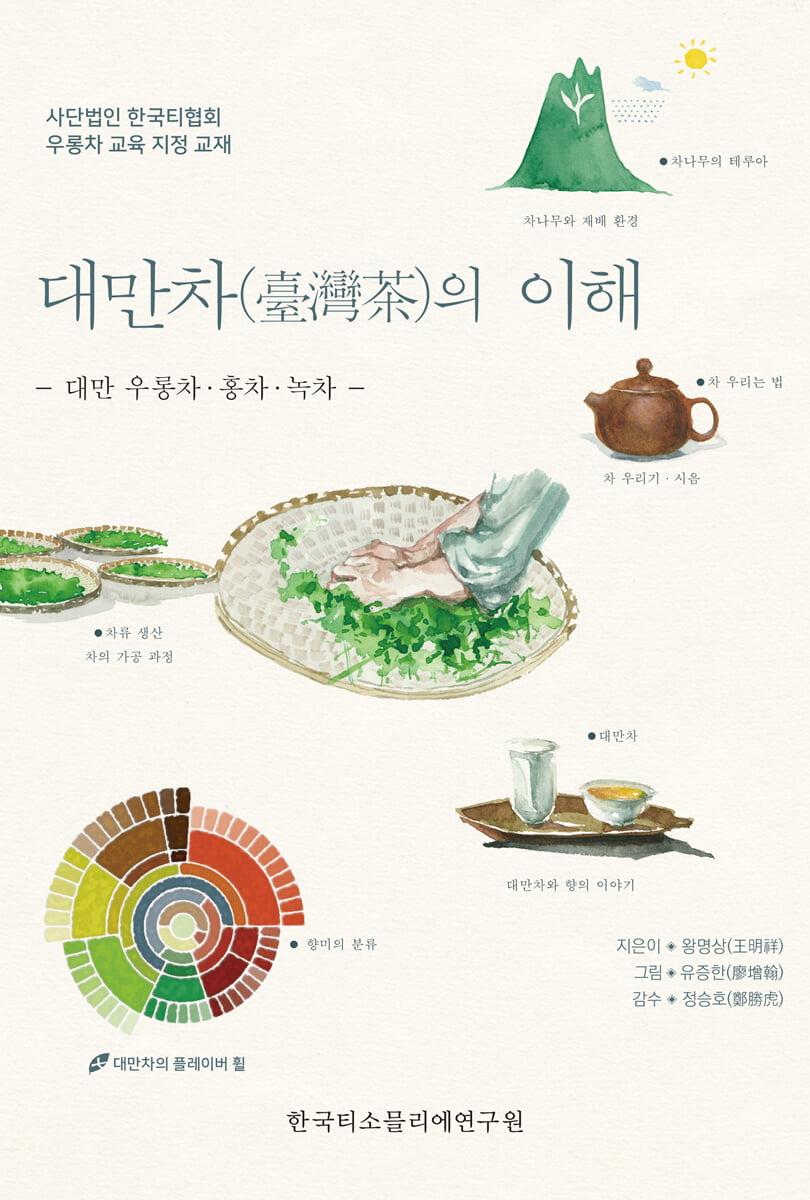
This book introduces, through pictures and diagrams, the tea tree varieties used to produce Taiwanese oolong tea, the flavor components contained in tea leaves, the differences in flavor components according to climate and environmental terroir, the complex processing process that has the characteristics of both green tea and black tea, and the changes in color, flavor, and taste of oolong tea according to oxidation level and roasting.
And in terms of tea, we introduce tools and their uses in various situations, and in terms of purchasing and storing tea, we explain how to distinguish the quality of tea, how to purchase it in the market, and the various factors that can spoil the quality of tea as a dried food, as well as how to store it properly to avoid such factors.
In particular, we introduce the characteristics of the three periods in which the taste of tea changes during storage, as well as methods for brewing and drinking tea as fresh as possible.
This book is expected to further expand the understanding of tea for those who are looking to delve into the world of color, aroma, and taste of tea, including oolong tea, amidst the growing interest in health today, or for those who are primarily interested in the world of tea's health benefits.
And in terms of tea, we introduce tools and their uses in various situations, and in terms of purchasing and storing tea, we explain how to distinguish the quality of tea, how to purchase it in the market, and the various factors that can spoil the quality of tea as a dried food, as well as how to store it properly to avoid such factors.
In particular, we introduce the characteristics of the three periods in which the taste of tea changes during storage, as well as methods for brewing and drinking tea as fresh as possible.
This book is expected to further expand the understanding of tea for those who are looking to delve into the world of color, aroma, and taste of tea, including oolong tea, amidst the growing interest in health today, or for those who are primarily interested in the world of tea's health benefits.
index
Prologue 1
Prologue 2
PART 1.
Astringent, Bitter, and Sweet Tea | Tea Trees and Terroir
● Tea tree, tea leaves, tea flowers, tea seeds
· Tea tree
· Tea leaves
· Tea flowers and tea seeds
· A multifaceted understanding of tea trees
● Varieties of tea trees mainly grown in Taiwan
· Tea tree varieties and their origins
· Cheongsim Oolong (?心烏龍)
· Table tea No. 12
· Four seasons of spring
· Cheongsimdaeyu (?心大?)
· Teacup No. 13
· Large leaf oolong
· Teacup No. 18
· Teacup No. 8
· Tie Gwan Yin (鐵觀音)
· Cheongsim Gamja (?心柑仔)
· Gyeongjihongsim (硬枝紅心)
● Flavoring components contained in tea leaves
The three main components that determine the flavor of tea
· Tea polyphenols -- the 'astringent taste' of tea
· Tein -- the 'bitter taste' of tea
Theanine -- the fresh "sweetness" of tea
· Sugar and pectin components - sweetness and smooth aftertaste of tea
· Sour and salty ingredients
· Directional components
· Other ingredients
● Tea leaf mesophyll structure
· Leaf tissue that retains flavor
· Differences in taste and texture depending on large-leaf and small-leaf varieties
● The adversity of the tea tree
· The flavor of tea changes depending on adversity.
_ Situation 1 Season and the taste of tea
_ Situation 2 Altitude and the taste of tea
_ Situation 3 Latitude and the taste of tea
The secret of honey fragrance
· Mouthwatering honey scent
● Differences in flavor components in sprouts and tea leaves
· Ingredients and flavors contained in each node of the stem
● Tea producing regions around the world
· Suitable growing conditions for tea trees
· Tea Notes∥Flavor Wheel
PART 2.
A fresh, sweet, and rich tasting tea!
| Tea classification and processing
● Introduction to tea classification and processing
· About the '6 Major Types of Tea'
_ Leaf picking
_ Forgery
_ Nangcheong (浪菁)
_ Mindful (? Twist)·Cut (? Cut)
_ Politics
_ Killing the Blue
_ Aktui (渥堆)
_ Minhwang (悶黃)
_ Dry
● Oxidation reaction of tea leaves
· A captivating flavor born from the oxidation process
_ Oxidation and post-fermentation
_ Oxidation
● The relationship between tea leaf oxidation and color, aroma, and taste
· Color change
· Change in scent
· Change in taste
● Hairy tea and refined tea
· The flavor of tea created through refining
_ Classification of mother tea
_ Pick out foreign substances
_ Roasting
_ Sound (?)/Adding fragrance
_ Blending
● Hongbae (roasting) of tea leaves
· Basic knowledge about roasting
· The relationship between the roasting of tea leaves and the color, aroma, and taste of oolong tea.
_ Weak red pear/raw tea/light roasting
_ Medium Red Pear/Semi-ripe Tea/Middle Roasting
_ Strong red pear/ripe tea/heavy roasting
● Tea Notes | Flavor Wheel
PART 3: The Aroma of Taiwanese Oolong Tea | Taiwan's Unique Oolong Tea
Distribution of Taiwanese specialty teas
· Taiwan's tea production ranking
● Green tea |
· Three Gorges Blue Snail Spring
● Flower-scented oolong tea
· Munsanpojong (Munsanpojong)
· Alpine oolong
· Gosan Geumhwon (高山金萱)
· Jade Oolong
· Four Seasons Spring Crow Dragon
● Sukhyang (熟香type) Oolong tea (烏龍茶類)
· Harbor tea
· Dongjeong Urong (East Peak Crow Dragon)
· Tieguanyin tea
● Fruit-flavored oolong tea
· White-haired crow dragon
· Taidong Hongyulong
● Black tea
· Flower lotus honey fragrance black tea
· Assam black tea
· Hongok Hongcha (Red Jade Tea)
· Taiwan's tea industry and Taiwanese tea flavor wheel
PART 4.
Concentration and texture of tea flavor | Tea brewing and savoring
● Method of steeping tea to extract flavor components
· Tea is our science
● Water temperature
· Changes in tea flavor depending on temperature
· Tea Notes | Water Temperature
● Leaching time
· Leaching time depending on temperature
· Tea Notes | Water Temperature and Steeping Time
● Water quality
· pH value and water hardness
Tea Notes | Water Quality
● Ratio of tea leaves and water
· Concentration of vehicles and cars
· Tea Notes | Water temperature, steeping time, and tea-to-water ratio
● We make tea with our tools and methods
· We have a pleasant experience with various types of tea.
_ Hot tea/Gongbuhopo (功夫壺泡)
_ Hot tea/cup or mug
_ Iced Tea/On the Rocks
_ Iced tea/cold brew
_ Various drinks including tea/iced milk tea
_ Iced fruit tea
● How to describe the taste and flavor of tea
· How to savor tea and describe its flavor
_ aroma
_ Overall taste/flavor
_ Mouth Feel
_ X factor
PART 5.
The Charm of Tea | Purchasing and Storing Tea
● Training to buy a car
· Experience tea through sight, smell, and taste
_ Visual observation
_ Olfactory experience
_ Taste evaluation
● 'Tea' is a dried food
· Factors that change the flavor of tea
_ moisture
_ sunlight
_ Oxygen
_ Fishy smell
_ temperature
● ‘Sinmi (new taste)’, ‘Jinmi (陳味)’, ‘Nomi (old taste)’
· Understanding the changing tastes of the seasons
_ Shin Mi-gi
_ Jinmigi (陳味期)
_ Nomigi (aging period)
● How to drink fresh or aged
How to store tea so that its flavor does not change
_ texture
_ Size of tea leaf container
_ Sealability
Prologue 2
PART 1.
Astringent, Bitter, and Sweet Tea | Tea Trees and Terroir
● Tea tree, tea leaves, tea flowers, tea seeds
· Tea tree
· Tea leaves
· Tea flowers and tea seeds
· A multifaceted understanding of tea trees
● Varieties of tea trees mainly grown in Taiwan
· Tea tree varieties and their origins
· Cheongsim Oolong (?心烏龍)
· Table tea No. 12
· Four seasons of spring
· Cheongsimdaeyu (?心大?)
· Teacup No. 13
· Large leaf oolong
· Teacup No. 18
· Teacup No. 8
· Tie Gwan Yin (鐵觀音)
· Cheongsim Gamja (?心柑仔)
· Gyeongjihongsim (硬枝紅心)
● Flavoring components contained in tea leaves
The three main components that determine the flavor of tea
· Tea polyphenols -- the 'astringent taste' of tea
· Tein -- the 'bitter taste' of tea
Theanine -- the fresh "sweetness" of tea
· Sugar and pectin components - sweetness and smooth aftertaste of tea
· Sour and salty ingredients
· Directional components
· Other ingredients
● Tea leaf mesophyll structure
· Leaf tissue that retains flavor
· Differences in taste and texture depending on large-leaf and small-leaf varieties
● The adversity of the tea tree
· The flavor of tea changes depending on adversity.
_ Situation 1 Season and the taste of tea
_ Situation 2 Altitude and the taste of tea
_ Situation 3 Latitude and the taste of tea
The secret of honey fragrance
· Mouthwatering honey scent
● Differences in flavor components in sprouts and tea leaves
· Ingredients and flavors contained in each node of the stem
● Tea producing regions around the world
· Suitable growing conditions for tea trees
· Tea Notes∥Flavor Wheel
PART 2.
A fresh, sweet, and rich tasting tea!
| Tea classification and processing
● Introduction to tea classification and processing
· About the '6 Major Types of Tea'
_ Leaf picking
_ Forgery
_ Nangcheong (浪菁)
_ Mindful (? Twist)·Cut (? Cut)
_ Politics
_ Killing the Blue
_ Aktui (渥堆)
_ Minhwang (悶黃)
_ Dry
● Oxidation reaction of tea leaves
· A captivating flavor born from the oxidation process
_ Oxidation and post-fermentation
_ Oxidation
● The relationship between tea leaf oxidation and color, aroma, and taste
· Color change
· Change in scent
· Change in taste
● Hairy tea and refined tea
· The flavor of tea created through refining
_ Classification of mother tea
_ Pick out foreign substances
_ Roasting
_ Sound (?)/Adding fragrance
_ Blending
● Hongbae (roasting) of tea leaves
· Basic knowledge about roasting
· The relationship between the roasting of tea leaves and the color, aroma, and taste of oolong tea.
_ Weak red pear/raw tea/light roasting
_ Medium Red Pear/Semi-ripe Tea/Middle Roasting
_ Strong red pear/ripe tea/heavy roasting
● Tea Notes | Flavor Wheel
PART 3: The Aroma of Taiwanese Oolong Tea | Taiwan's Unique Oolong Tea
Distribution of Taiwanese specialty teas
· Taiwan's tea production ranking
● Green tea |
· Three Gorges Blue Snail Spring
● Flower-scented oolong tea
· Munsanpojong (Munsanpojong)
· Alpine oolong
· Gosan Geumhwon (高山金萱)
· Jade Oolong
· Four Seasons Spring Crow Dragon
● Sukhyang (熟香type) Oolong tea (烏龍茶類)
· Harbor tea
· Dongjeong Urong (East Peak Crow Dragon)
· Tieguanyin tea
● Fruit-flavored oolong tea
· White-haired crow dragon
· Taidong Hongyulong
● Black tea
· Flower lotus honey fragrance black tea
· Assam black tea
· Hongok Hongcha (Red Jade Tea)
· Taiwan's tea industry and Taiwanese tea flavor wheel
PART 4.
Concentration and texture of tea flavor | Tea brewing and savoring
● Method of steeping tea to extract flavor components
· Tea is our science
● Water temperature
· Changes in tea flavor depending on temperature
· Tea Notes | Water Temperature
● Leaching time
· Leaching time depending on temperature
· Tea Notes | Water Temperature and Steeping Time
● Water quality
· pH value and water hardness
Tea Notes | Water Quality
● Ratio of tea leaves and water
· Concentration of vehicles and cars
· Tea Notes | Water temperature, steeping time, and tea-to-water ratio
● We make tea with our tools and methods
· We have a pleasant experience with various types of tea.
_ Hot tea/Gongbuhopo (功夫壺泡)
_ Hot tea/cup or mug
_ Iced Tea/On the Rocks
_ Iced tea/cold brew
_ Various drinks including tea/iced milk tea
_ Iced fruit tea
● How to describe the taste and flavor of tea
· How to savor tea and describe its flavor
_ aroma
_ Overall taste/flavor
_ Mouth Feel
_ X factor
PART 5.
The Charm of Tea | Purchasing and Storing Tea
● Training to buy a car
· Experience tea through sight, smell, and taste
_ Visual observation
_ Olfactory experience
_ Taste evaluation
● 'Tea' is a dried food
· Factors that change the flavor of tea
_ moisture
_ sunlight
_ Oxygen
_ Fishy smell
_ temperature
● ‘Sinmi (new taste)’, ‘Jinmi (陳味)’, ‘Nomi (old taste)’
· Understanding the changing tastes of the seasons
_ Shin Mi-gi
_ Jinmigi (陳味期)
_ Nomigi (aging period)
● How to drink fresh or aged
How to store tea so that its flavor does not change
_ texture
_ Size of tea leaf container
_ Sealability
Into the book
● Classification according to 'time of sprouting in spring'
Depending on the 'time when buds sprout in spring', tea trees can be divided into three types: 'early maturing', 'mid-maturing', and 'late maturing'.
These classifications are primarily intended to help growers consider tea tree varieties prior to planting them in the early stages of planning their tea gardens.
This classification allows tea plant growers to avoid having too many buds sprout simultaneously when producing spring tea, which would otherwise require excessive concentration of manpower in harvesting, and to avoid missing the golden time for tea production.
In Taiwan, the sprouting times of early-maturing, mid-maturing, and late-maturing varieties differ by 7 to 10 days depending on the rate at which temperatures rise each spring.
In general, early maturing varieties are less dependent on warm temperatures in spring.
This is because buds sprout when spring comes even in environments with low temperatures of about 5 to 8 degrees.
On the other hand, the Manseongjong species requires relatively higher temperatures.
Because sprouts only emerge in warm temperatures.
For example, in mountainous areas, most tea farms plant tea trees of the 'Cheongsim Oolong' and 'Daecha No. 12 Geumhwon' variety.
Although there is still a cold spell in the spring, when the warm spring comes, the tea trees of the Geumhwon variety, Daecha No. 12, a ‘mid-life variety’, will be the first to sprout new buds.
Therefore, in mountainous areas, the production period of Geumhwon Oolong tea is earlier than that of Cheongshim Oolong tea.
After the production of Geumhwon Oolong tea is completed, the tea leaves of the Cheongsim Oolong tea tree, a late-ripening variety, mature a few days later, so growers can proceed with the harvesting process sequentially.
--- From PART 1 "Tea: Astringent, Bitter, and Sweet Tastes | Tea Trees and Terroir"
● Cheongsim Oolong (?心烏龍)
Cultivars | Cultivars of Tea Tree
Nicknames: Cheongsim (?heart), Oolong (烏龍), Zhongzi (種仔), Zhongcha (種茶), Yeonji (軟枝), Jeongchong (正?)
'Qingxin Oolong (?心烏龍) is a variety imported from China, and is a shrub-type, small-leafed, late-maturing variety, suitable for the production of oolong tea.
Cheongsim Oolong is slightly smaller in appearance.
The buds are greenish-yellow in color and the tea leaves are thin and oval in shape.
The serrations on the edge are fine and dense.
The angle formed by the main vein and the lateral vein is acute.
The tea leaves are dark green in color and glossy.
Oolong tea, made by partially oxidizing tea leaves harvested from the Qingxin Oolong variety, has a refreshing floral scent reminiscent of elegant orchids and a subtle yet sweet flavor. It is the most popular tea in Taiwan and is also much loved by tourists.
Therefore, this variety accounts for about 61% of the total tea plantation area in Taiwan.
Among Taiwanese specialty teas, Wenshan Baozhong tea, Gaoshan Oolong tea, and Dongting Oolong tea are all produced from this variety of tea tree.
--- From PART 1 "Tea: Astringent, Bitter, and Sweet Tastes | Tea Trees and Terroir"
● Three main components that determine the flavor of tea
During the Three Kingdoms period (220-280), there was a peerless beauty who was praised by Cao Cao (155-220) for brewing tea with a strong and mild flavor.
The name of the beauty was Xiao Qiao (小喬), the wife of Zhou Yu (周瑜, 175-210), a famous general of the Wu state, and even her name is related to the classification of tea trees.
Even though people in the Three Kingdoms period could already taste the sweet taste of tea, the tea ceremony at that time was made by boiling herbs and controlling the timing and water temperature of the tea leaves.
Later, during the peaceful times of the Tang and Song Dynasties, the custom of drinking tea became very popular among literati and scholars.
In particular, literati of the Song Dynasty routinely performed 'tea making', 'incense burning', 'flower arrangement', and 'hanging paintings', and among these, tea making was considered the most important task.
In addition, the way Chinese people drink tea has evolved along with the changes in dynasties, but their interest in drinking tea and enjoying its taste remains unchanged.
Moreover, tea drinking has become a global issue these days.
Scientific research shows that the flavor of tea is primarily determined by the water-soluble components contained in the tea leaves.
These water-soluble components account for approximately 25 to 35 percent of the weight of dried tea leaves.
Among them, the three ingredients called 'tea polyphenol', 'caffeine', and 'theanine' play the most important roles, and are said to account for approximately 73% of the total water-soluble ingredients.
These three ingredients are not only very specific, but also trigger different flavors and textures.
Therefore, it is an important flavor component that constitutes the aroma and texture of tea.
Here, we will focus on introducing these three components.
--- From PART 1 "Tea: Astringent, Bitter, and Sweet Tastes | Tea Trees and Terroir"
● The secret of the mouth-watering honey scent
When faced with adversity, tea trees naturally produce bitter compounds to combat insect prey.
However, when an insect bites a tea leaf, the tea tree not only metabolizes the bitter-tasting compound, but also produces other compounds depending on the insect.
The alluring honey scent of the "White Tiger Oolong" (白毫烏龍), better known as "Oriental Beauty" and a Taiwanese oolong tea representing the three regions of Taoyuan County (桃園縣), Hsinchu County (桃竹縣), and Miaoyu County (苗栗縣), is closely related to the adversity experienced by these tea trees.
After the Dragon Boat Festival, Taiwan experiences a warm and humid climate.
During this period, numerous insects are active in the dimension.
Among them, there is a green insect the size of a sesame seed that jumps between tea leaves, and it is the small green leaf caterpillar (Jacobiasca formosana).
The green leaf borer is active during the warm and humid seasons of summer and fall, feeding on the tender leaves of new shoots.
● A captivating flavor born from the oxidation process
Many of the world's great foods and drinks develop their captivating flavors and aromas through aging, and tea is no exception.
Therefore, artisans and experts who produce tea determine the oxidation level (or fermentation level in the case of black tea or yellow tea) of the tea leaves throughout the tea processing process.
It activates the oxidation of tea leaves to change the contained components, creating rich and subtle flavors and colors in tea.
There are two main methods for creating tea flavor during the processing of the six major types of tea.
One is 'enzymatic oxidation', which uses 'polyphenol oxidase' contained in tea leaves to combine the contained component tea polyphenol with oxygen in the air, giving the tea a variety of flavors, aromas, and colors.
Another is the 'post-fermentation reaction', which promotes fermentation by using moist heat after the slaughtering process.
For example, post-fermentation (後發酵) is carried out by microorganisms during long-term storage of raw tea, black tea, and aged tea.
Since there is no action of oxidizing enzymes here, it is also called ‘non-enzymatic fermentation.’
--- From PART 2 "Fresh, sweet, and rich-tasting tea!"
● Basic knowledge about Hongbae (roasting)
Among the six major types of tea, oolong tea places particular importance on roasting.
In addition to refining the flavor of the 'mother tea', roasting can also create a sweet aftertaste, further enhancing the experience of drinking tea.
In the technical terminology used in flavor tasting, aftertaste is 'aftertaste'.
It is the taste sensation that lingers in the mouth after the tea has gone down the throat.
The flavor of oolong tea varies much more widely than other teas in terms of both roasting intensity and oxidation level.
In Taiwan, people enjoy producing and drinking high-quality oolong tea, and in this environment, a wide variety of local specialty teas have developed.
As with coffee, much research has been done on the relationship between roasting temperature and time in tea roasting.
However, compared to coffee beans, the roasting temperature that can be applied to tea leaves is relatively low, the roasting time is relatively long, and there is no limit to the number of roastings.
The roasting temperature applied to tea leaves is approximately 70 to 110 degrees.
When the temperature reaches or exceeds 120 degrees, the tea leaves change rapidly and become deteriorated.
And the roasting time can be several hours, and the number of roasting cycles can be repeated multiple times.
Tieguanyin, an oolong tea with a very strong flavor, is the result of repeated roasting and cooling processes.
Conversely, if the roasting temperature is low and the time is short, the degree of roasting is weak, so the color and flavor of the tea is similar to that of the mother tea.
When roasting at very high temperatures, two chemical reactions, the Maillard reaction and caramelization, occur in the tea leaves, significantly changing the taste and aroma of the tea.
First, the Maillard reaction is a process in which the free amino acids (theanine) and proteins in tea leaves form new flavor and melanin components due to the high temperature during roasting.
Meanwhile, the 'caramelization' reaction is the process in which the sugar in tea leaves changes its taste and aroma due to high temperatures and turns into a yellow-brown substance.
--- From PART 2 "Fresh, sweet, and rich-tasting tea!"
● Little knowledge about tea leaves
The main substances that change the flavor of tea through roasting are theanine, protein, and carbohydrates.
Caffeine and tea polyphenols are not significantly related.
However, some studies have shown that during the roasting process, caffeine evaporates, forming needle-like solids on the outside of the tea leaves, and as the roasting intensifies, these solids polymerize again, ultimately increasing the amount of caffeine that is leached out.
Ultimately, the sweet theanine, sugars, and caffeine all change during the roasting process.
As a result, oolong tea becomes sweeter and its bitterness increases slightly, and the aftertaste of 'hui-gam' becomes stronger.
--- From PART 2 "Fresh, sweet, and rich-tasting tea!"
● Strong red pear/ripe tea/heavy roasting
'Ripe tea' with strong roasting is oolong tea that has completely changed the original taste and aroma of 'mother tea'.
Similarly, in coffee roasting, the stronger the roasting, the darker the color, but the stronger the aroma.
In 'Sukcha', you can feel the deep flavor of roasting along with the 'chocolate scent' like milk chocolate or dark chocolate.
Sometimes you can also smell a sour and sweet aroma, like the smell of smoked plums from unripe plum trees.
The Northern Tea District's 'Wooden Fence Iron Guanyin' and 'Stone Gate Iron Guanyin' are Taiwanese specialty teas that belong to the 'aged tea' category.
--- From PART 2 "Fresh, sweet, and rich-tasting tea!"
● Jade Oolong (翠玉烏龍)
Cui Yu Oolong Tea/Green Jade Oolong Tea
●Variety|Taicha (Taicha) No. 13
●Production period|Spring, fall, winter
● Production area | Yilan Tea District, Pinglin Tea District, Nantou Tea District, etc.
●Leaf parts | Mature old leaves, single leaves, triple leaves, and open leaves
●Features of the manufacturing method|Spherical shape/Weakly oxidized oolong tea/Light roasted tea (raw tea)
'Chwiok', which is 'Daecha No. 13' and was named and announced in 1981 along with 'Daecha No. 12', is a variety that has excellent adaptability to the environment, has abundant production, and has a good tea flavor, so it is much loved in each producing region.
Today, it is cultivated in various tea fields at mid- to low-altitudes in Taiwan and is produced into various types of tea.
Among them, the lightly oxidized 'Jade Oolong' is the most representative.
‘Chwiok Oolong’, which has a low oxidation level, has a clear and transparent tea color with a light yellow tint.
In terms of fragrance, it has a strong scent of wild ginger flower, ash tree flower, and gardenia flower.
Today, it is deeply loved by oolong tea lovers who appreciate its strong floral aroma.
--- From PART 3 "The Fragrance of Taiwanese Oolong Tea"
● Three Gorges Blue Snail Spring
Sanxia Bi Luo Chun
●Variety|Cheongsim Potato (?心柑仔)
●Production period|Spring, winter
●Origin|New North Three Gorges Tea Area
●Leaf parts|Sprouts, single leaves, single leaves
●Features of the manufacturing method|Square shape/Non-oxidized green tea
* Shape: The shape of the tea leaves is long and thin.
'Sanxia Biluochun (三峽碧螺春)' is a non-oxidized green tea made by roasting and grinding soft tea leaves from the 'Qingxin Gamja (?心柑仔)' variety.
It is a local specialty tea representing the Three Gorges Tea District in the Xinbei region and the only green tea in Taiwan.
The tea leaves are bluish green with white spots, and are long and twisted in shape.
It is not known exactly when or where the 'Qingxin Gamja' tea tree, a variety found only in the Three Gorges Tea District, was first planted.
However, after the Second Opium War, the Qing Dynasty opened the port of 'Tanshuijin' in Yangchun City, Guangdong Province as a trading port and allowed foreign companies to advance into 'Tanshuijin'.
And numerous tea trees were planted on the mountain slopes of the Three Gorges Tea Town, upstream from the mouth of the Damsu River.
The history of tea production began in the Three Gorges Tea District.
At that time, British businessman John Dodd established 'Bosun Trading Company' and sold Taiwanese oolong tea overseas under the brand name 'Formosa Oolong'.
--- From PART 3 "The Fragrance of Taiwanese Oolong Tea"
● Munsanpojong (Munsanpojong)
Wenshan Pou Chong Tea
● Variety | Qingxin Oolong
● Production period | Spring, winter
● Production site | Tea fields such as Pyeongrim, Seokjeong, Mokchaek, Simgaeng, and Namhang
● Leaf parts | Mature old leaves, single leaves, triple leaves, open leaves
● Manufacturing method features | Rectangular/mildly oxidized oolong tea/light roasted tea (raw tea)
'Munsan Pojongcha' is a slightly oxidized oolong tea made from tea leaves of the 'Qingxin Oolong' variety, and is a specialty tea representing the Munsan tea district in Xinbei City.
The dried tea is long and curly in shape and has a deep emerald green color.
The Munsan Tea District includes several tea districts in Taipei City and Xinbei City.
The scope of the tea field is very wide, including the wooden fence and Namhang of Daebuk City, as well as the new store, Pyeongrim, Simgaeng, Seokjeong, and Seokji of Sinbuk City.
Today, the most famous tea is 'Munsanpojongcha' produced in Pyeongrim Tea District.
'North Pozhong' and 'South Dongzheng' represent Taiwan's 'one life, one ripe, one north, one south' oolong teas from the 1960s and 1970s.
'Bukpojong (北包種)' refers to the 'Cheonghyang-type (?香型)' Pojong tea with a fragrant floral scent produced in Pyeongrim Tea District.
Namdongjeong (南凍頂) refers to the 'Sukhyang-type' oolong tea produced by roasting at the Dongjeongsan Tea Garden in Namtu County.
_PART 3 From “The Fragrance of Taiwanese Oolong Tea”
● Enjoying and savoring tea
People often say, “If it doesn’t taste bitter or astringent, it’s not called ‘tea.’”
This is because bitter substances are the main flavor components originally contained in tea leaves.
If you lack patience and interest in steeping tea, try to steep it quickly by increasing the water temperature, or shorten or neglect the steeping time, not only will drinking tea become a pain, but you will also lose the rich body and balanced flavor of the tea.
So how do we create a tea with a wonderful balance of bitterness and sweetness, a flavorful and aromatic tea? Most people struggle to answer this question with confidence.
For this reason, some people learn the tea ceremony to experience the quiet beauty of life, while others begin to learn the tea ceremony to enjoy a deep sense of spiritual peace.
In fact, many people want to know more about tea, but hesitate to get started on the tea path.
Because people just want a cup of tea in their lives.
--- From PART 4 "Concentration and Texture of Tea Flavor"
● Concentration of vehicles and cars
If you brew a cup of tea too bland, it will be tasteless, and if you brew it too strong, the excessive bitterness will make drinking tea a less interesting experience.
Therefore, it is most important for us to have an appropriate concentration ratio when making tea.
This is common sense, whether we know how to drive a car or not.
However, people often do not have the expertise and confidence to know how much tea leaves to put in the teapot or teacup at the first step of brewing tea, so they often add tea leaves according to their mood or intuition at the time.
Unlike coffee's 'single steeping', tea is usually steeped multiple times.
However, although the steeping methods of tea and coffee are different, the mechanism by which a person senses whether a taste is strong or bland on the taste buds in the mouth is the same.
Therefore, if we consider the 'concentration ratio' in the case of a one-time extraction, and establish the 'amount of tea (g)' as a basic concept, it is relatively convenient for us to make tea.
Because next time you brew tea, regardless of the 'volume (mL)' of the teapot and teacup, if you estimate the number of times you will brew the tea or the total amount of tea (mL) to brew, and then add an appropriate amount of tea in grams (g), brewing tea will become relatively easy.
--- From PART 4 "Concentration and Texture of Tea Flavor"
How to savor tea and describe its flavor
If you look closely at the veins of each tea leaf, you will see that 'tea leaves are connected with much love.'
It seems to suggest that a great cup of tea can only be achieved through several stages of effort.
Certainly, the flavor and aroma components of tea leaves were first formed in the tea tree between heaven and earth, and are imbued with the love and care of those who cultivate the plants.
These ingredients then create increasingly darker and more attractive colors and aromas during the tea processing process.
To do this, the person making the tea needs sincerity and patience.
The tea produced through this process must be carefully brewed and savored by the drinkers, so that they can truly experience the aroma of the sweet dew born from the heavens, the earth, and people.
But how do we express what we feel when we drink a cup of tea? This requires a lot of training.
First, 'flavor' is divided into several parts such as 'scent', 'taste', 'texture', and 'body', and the scent is identified through the nose, the taste is felt through the taste buds on the tongue, and the texture or body is felt through the skin in the mouth.
This method of describing flavor can be applied equally to other brewed beverages and foods, not just tea.
Depending on the 'time when buds sprout in spring', tea trees can be divided into three types: 'early maturing', 'mid-maturing', and 'late maturing'.
These classifications are primarily intended to help growers consider tea tree varieties prior to planting them in the early stages of planning their tea gardens.
This classification allows tea plant growers to avoid having too many buds sprout simultaneously when producing spring tea, which would otherwise require excessive concentration of manpower in harvesting, and to avoid missing the golden time for tea production.
In Taiwan, the sprouting times of early-maturing, mid-maturing, and late-maturing varieties differ by 7 to 10 days depending on the rate at which temperatures rise each spring.
In general, early maturing varieties are less dependent on warm temperatures in spring.
This is because buds sprout when spring comes even in environments with low temperatures of about 5 to 8 degrees.
On the other hand, the Manseongjong species requires relatively higher temperatures.
Because sprouts only emerge in warm temperatures.
For example, in mountainous areas, most tea farms plant tea trees of the 'Cheongsim Oolong' and 'Daecha No. 12 Geumhwon' variety.
Although there is still a cold spell in the spring, when the warm spring comes, the tea trees of the Geumhwon variety, Daecha No. 12, a ‘mid-life variety’, will be the first to sprout new buds.
Therefore, in mountainous areas, the production period of Geumhwon Oolong tea is earlier than that of Cheongshim Oolong tea.
After the production of Geumhwon Oolong tea is completed, the tea leaves of the Cheongsim Oolong tea tree, a late-ripening variety, mature a few days later, so growers can proceed with the harvesting process sequentially.
--- From PART 1 "Tea: Astringent, Bitter, and Sweet Tastes | Tea Trees and Terroir"
● Cheongsim Oolong (?心烏龍)
Cultivars | Cultivars of Tea Tree
Nicknames: Cheongsim (?heart), Oolong (烏龍), Zhongzi (種仔), Zhongcha (種茶), Yeonji (軟枝), Jeongchong (正?)
'Qingxin Oolong (?心烏龍) is a variety imported from China, and is a shrub-type, small-leafed, late-maturing variety, suitable for the production of oolong tea.
Cheongsim Oolong is slightly smaller in appearance.
The buds are greenish-yellow in color and the tea leaves are thin and oval in shape.
The serrations on the edge are fine and dense.
The angle formed by the main vein and the lateral vein is acute.
The tea leaves are dark green in color and glossy.
Oolong tea, made by partially oxidizing tea leaves harvested from the Qingxin Oolong variety, has a refreshing floral scent reminiscent of elegant orchids and a subtle yet sweet flavor. It is the most popular tea in Taiwan and is also much loved by tourists.
Therefore, this variety accounts for about 61% of the total tea plantation area in Taiwan.
Among Taiwanese specialty teas, Wenshan Baozhong tea, Gaoshan Oolong tea, and Dongting Oolong tea are all produced from this variety of tea tree.
--- From PART 1 "Tea: Astringent, Bitter, and Sweet Tastes | Tea Trees and Terroir"
● Three main components that determine the flavor of tea
During the Three Kingdoms period (220-280), there was a peerless beauty who was praised by Cao Cao (155-220) for brewing tea with a strong and mild flavor.
The name of the beauty was Xiao Qiao (小喬), the wife of Zhou Yu (周瑜, 175-210), a famous general of the Wu state, and even her name is related to the classification of tea trees.
Even though people in the Three Kingdoms period could already taste the sweet taste of tea, the tea ceremony at that time was made by boiling herbs and controlling the timing and water temperature of the tea leaves.
Later, during the peaceful times of the Tang and Song Dynasties, the custom of drinking tea became very popular among literati and scholars.
In particular, literati of the Song Dynasty routinely performed 'tea making', 'incense burning', 'flower arrangement', and 'hanging paintings', and among these, tea making was considered the most important task.
In addition, the way Chinese people drink tea has evolved along with the changes in dynasties, but their interest in drinking tea and enjoying its taste remains unchanged.
Moreover, tea drinking has become a global issue these days.
Scientific research shows that the flavor of tea is primarily determined by the water-soluble components contained in the tea leaves.
These water-soluble components account for approximately 25 to 35 percent of the weight of dried tea leaves.
Among them, the three ingredients called 'tea polyphenol', 'caffeine', and 'theanine' play the most important roles, and are said to account for approximately 73% of the total water-soluble ingredients.
These three ingredients are not only very specific, but also trigger different flavors and textures.
Therefore, it is an important flavor component that constitutes the aroma and texture of tea.
Here, we will focus on introducing these three components.
--- From PART 1 "Tea: Astringent, Bitter, and Sweet Tastes | Tea Trees and Terroir"
● The secret of the mouth-watering honey scent
When faced with adversity, tea trees naturally produce bitter compounds to combat insect prey.
However, when an insect bites a tea leaf, the tea tree not only metabolizes the bitter-tasting compound, but also produces other compounds depending on the insect.
The alluring honey scent of the "White Tiger Oolong" (白毫烏龍), better known as "Oriental Beauty" and a Taiwanese oolong tea representing the three regions of Taoyuan County (桃園縣), Hsinchu County (桃竹縣), and Miaoyu County (苗栗縣), is closely related to the adversity experienced by these tea trees.
After the Dragon Boat Festival, Taiwan experiences a warm and humid climate.
During this period, numerous insects are active in the dimension.
Among them, there is a green insect the size of a sesame seed that jumps between tea leaves, and it is the small green leaf caterpillar (Jacobiasca formosana).
The green leaf borer is active during the warm and humid seasons of summer and fall, feeding on the tender leaves of new shoots.
● A captivating flavor born from the oxidation process
Many of the world's great foods and drinks develop their captivating flavors and aromas through aging, and tea is no exception.
Therefore, artisans and experts who produce tea determine the oxidation level (or fermentation level in the case of black tea or yellow tea) of the tea leaves throughout the tea processing process.
It activates the oxidation of tea leaves to change the contained components, creating rich and subtle flavors and colors in tea.
There are two main methods for creating tea flavor during the processing of the six major types of tea.
One is 'enzymatic oxidation', which uses 'polyphenol oxidase' contained in tea leaves to combine the contained component tea polyphenol with oxygen in the air, giving the tea a variety of flavors, aromas, and colors.
Another is the 'post-fermentation reaction', which promotes fermentation by using moist heat after the slaughtering process.
For example, post-fermentation (後發酵) is carried out by microorganisms during long-term storage of raw tea, black tea, and aged tea.
Since there is no action of oxidizing enzymes here, it is also called ‘non-enzymatic fermentation.’
--- From PART 2 "Fresh, sweet, and rich-tasting tea!"
● Basic knowledge about Hongbae (roasting)
Among the six major types of tea, oolong tea places particular importance on roasting.
In addition to refining the flavor of the 'mother tea', roasting can also create a sweet aftertaste, further enhancing the experience of drinking tea.
In the technical terminology used in flavor tasting, aftertaste is 'aftertaste'.
It is the taste sensation that lingers in the mouth after the tea has gone down the throat.
The flavor of oolong tea varies much more widely than other teas in terms of both roasting intensity and oxidation level.
In Taiwan, people enjoy producing and drinking high-quality oolong tea, and in this environment, a wide variety of local specialty teas have developed.
As with coffee, much research has been done on the relationship between roasting temperature and time in tea roasting.
However, compared to coffee beans, the roasting temperature that can be applied to tea leaves is relatively low, the roasting time is relatively long, and there is no limit to the number of roastings.
The roasting temperature applied to tea leaves is approximately 70 to 110 degrees.
When the temperature reaches or exceeds 120 degrees, the tea leaves change rapidly and become deteriorated.
And the roasting time can be several hours, and the number of roasting cycles can be repeated multiple times.
Tieguanyin, an oolong tea with a very strong flavor, is the result of repeated roasting and cooling processes.
Conversely, if the roasting temperature is low and the time is short, the degree of roasting is weak, so the color and flavor of the tea is similar to that of the mother tea.
When roasting at very high temperatures, two chemical reactions, the Maillard reaction and caramelization, occur in the tea leaves, significantly changing the taste and aroma of the tea.
First, the Maillard reaction is a process in which the free amino acids (theanine) and proteins in tea leaves form new flavor and melanin components due to the high temperature during roasting.
Meanwhile, the 'caramelization' reaction is the process in which the sugar in tea leaves changes its taste and aroma due to high temperatures and turns into a yellow-brown substance.
--- From PART 2 "Fresh, sweet, and rich-tasting tea!"
● Little knowledge about tea leaves
The main substances that change the flavor of tea through roasting are theanine, protein, and carbohydrates.
Caffeine and tea polyphenols are not significantly related.
However, some studies have shown that during the roasting process, caffeine evaporates, forming needle-like solids on the outside of the tea leaves, and as the roasting intensifies, these solids polymerize again, ultimately increasing the amount of caffeine that is leached out.
Ultimately, the sweet theanine, sugars, and caffeine all change during the roasting process.
As a result, oolong tea becomes sweeter and its bitterness increases slightly, and the aftertaste of 'hui-gam' becomes stronger.
--- From PART 2 "Fresh, sweet, and rich-tasting tea!"
● Strong red pear/ripe tea/heavy roasting
'Ripe tea' with strong roasting is oolong tea that has completely changed the original taste and aroma of 'mother tea'.
Similarly, in coffee roasting, the stronger the roasting, the darker the color, but the stronger the aroma.
In 'Sukcha', you can feel the deep flavor of roasting along with the 'chocolate scent' like milk chocolate or dark chocolate.
Sometimes you can also smell a sour and sweet aroma, like the smell of smoked plums from unripe plum trees.
The Northern Tea District's 'Wooden Fence Iron Guanyin' and 'Stone Gate Iron Guanyin' are Taiwanese specialty teas that belong to the 'aged tea' category.
--- From PART 2 "Fresh, sweet, and rich-tasting tea!"
● Jade Oolong (翠玉烏龍)
Cui Yu Oolong Tea/Green Jade Oolong Tea
●Variety|Taicha (Taicha) No. 13
●Production period|Spring, fall, winter
● Production area | Yilan Tea District, Pinglin Tea District, Nantou Tea District, etc.
●Leaf parts | Mature old leaves, single leaves, triple leaves, and open leaves
●Features of the manufacturing method|Spherical shape/Weakly oxidized oolong tea/Light roasted tea (raw tea)
'Chwiok', which is 'Daecha No. 13' and was named and announced in 1981 along with 'Daecha No. 12', is a variety that has excellent adaptability to the environment, has abundant production, and has a good tea flavor, so it is much loved in each producing region.
Today, it is cultivated in various tea fields at mid- to low-altitudes in Taiwan and is produced into various types of tea.
Among them, the lightly oxidized 'Jade Oolong' is the most representative.
‘Chwiok Oolong’, which has a low oxidation level, has a clear and transparent tea color with a light yellow tint.
In terms of fragrance, it has a strong scent of wild ginger flower, ash tree flower, and gardenia flower.
Today, it is deeply loved by oolong tea lovers who appreciate its strong floral aroma.
--- From PART 3 "The Fragrance of Taiwanese Oolong Tea"
● Three Gorges Blue Snail Spring
Sanxia Bi Luo Chun
●Variety|Cheongsim Potato (?心柑仔)
●Production period|Spring, winter
●Origin|New North Three Gorges Tea Area
●Leaf parts|Sprouts, single leaves, single leaves
●Features of the manufacturing method|Square shape/Non-oxidized green tea
* Shape: The shape of the tea leaves is long and thin.
'Sanxia Biluochun (三峽碧螺春)' is a non-oxidized green tea made by roasting and grinding soft tea leaves from the 'Qingxin Gamja (?心柑仔)' variety.
It is a local specialty tea representing the Three Gorges Tea District in the Xinbei region and the only green tea in Taiwan.
The tea leaves are bluish green with white spots, and are long and twisted in shape.
It is not known exactly when or where the 'Qingxin Gamja' tea tree, a variety found only in the Three Gorges Tea District, was first planted.
However, after the Second Opium War, the Qing Dynasty opened the port of 'Tanshuijin' in Yangchun City, Guangdong Province as a trading port and allowed foreign companies to advance into 'Tanshuijin'.
And numerous tea trees were planted on the mountain slopes of the Three Gorges Tea Town, upstream from the mouth of the Damsu River.
The history of tea production began in the Three Gorges Tea District.
At that time, British businessman John Dodd established 'Bosun Trading Company' and sold Taiwanese oolong tea overseas under the brand name 'Formosa Oolong'.
--- From PART 3 "The Fragrance of Taiwanese Oolong Tea"
● Munsanpojong (Munsanpojong)
Wenshan Pou Chong Tea
● Variety | Qingxin Oolong
● Production period | Spring, winter
● Production site | Tea fields such as Pyeongrim, Seokjeong, Mokchaek, Simgaeng, and Namhang
● Leaf parts | Mature old leaves, single leaves, triple leaves, open leaves
● Manufacturing method features | Rectangular/mildly oxidized oolong tea/light roasted tea (raw tea)
'Munsan Pojongcha' is a slightly oxidized oolong tea made from tea leaves of the 'Qingxin Oolong' variety, and is a specialty tea representing the Munsan tea district in Xinbei City.
The dried tea is long and curly in shape and has a deep emerald green color.
The Munsan Tea District includes several tea districts in Taipei City and Xinbei City.
The scope of the tea field is very wide, including the wooden fence and Namhang of Daebuk City, as well as the new store, Pyeongrim, Simgaeng, Seokjeong, and Seokji of Sinbuk City.
Today, the most famous tea is 'Munsanpojongcha' produced in Pyeongrim Tea District.
'North Pozhong' and 'South Dongzheng' represent Taiwan's 'one life, one ripe, one north, one south' oolong teas from the 1960s and 1970s.
'Bukpojong (北包種)' refers to the 'Cheonghyang-type (?香型)' Pojong tea with a fragrant floral scent produced in Pyeongrim Tea District.
Namdongjeong (南凍頂) refers to the 'Sukhyang-type' oolong tea produced by roasting at the Dongjeongsan Tea Garden in Namtu County.
_PART 3 From “The Fragrance of Taiwanese Oolong Tea”
● Enjoying and savoring tea
People often say, “If it doesn’t taste bitter or astringent, it’s not called ‘tea.’”
This is because bitter substances are the main flavor components originally contained in tea leaves.
If you lack patience and interest in steeping tea, try to steep it quickly by increasing the water temperature, or shorten or neglect the steeping time, not only will drinking tea become a pain, but you will also lose the rich body and balanced flavor of the tea.
So how do we create a tea with a wonderful balance of bitterness and sweetness, a flavorful and aromatic tea? Most people struggle to answer this question with confidence.
For this reason, some people learn the tea ceremony to experience the quiet beauty of life, while others begin to learn the tea ceremony to enjoy a deep sense of spiritual peace.
In fact, many people want to know more about tea, but hesitate to get started on the tea path.
Because people just want a cup of tea in their lives.
--- From PART 4 "Concentration and Texture of Tea Flavor"
● Concentration of vehicles and cars
If you brew a cup of tea too bland, it will be tasteless, and if you brew it too strong, the excessive bitterness will make drinking tea a less interesting experience.
Therefore, it is most important for us to have an appropriate concentration ratio when making tea.
This is common sense, whether we know how to drive a car or not.
However, people often do not have the expertise and confidence to know how much tea leaves to put in the teapot or teacup at the first step of brewing tea, so they often add tea leaves according to their mood or intuition at the time.
Unlike coffee's 'single steeping', tea is usually steeped multiple times.
However, although the steeping methods of tea and coffee are different, the mechanism by which a person senses whether a taste is strong or bland on the taste buds in the mouth is the same.
Therefore, if we consider the 'concentration ratio' in the case of a one-time extraction, and establish the 'amount of tea (g)' as a basic concept, it is relatively convenient for us to make tea.
Because next time you brew tea, regardless of the 'volume (mL)' of the teapot and teacup, if you estimate the number of times you will brew the tea or the total amount of tea (mL) to brew, and then add an appropriate amount of tea in grams (g), brewing tea will become relatively easy.
--- From PART 4 "Concentration and Texture of Tea Flavor"
How to savor tea and describe its flavor
If you look closely at the veins of each tea leaf, you will see that 'tea leaves are connected with much love.'
It seems to suggest that a great cup of tea can only be achieved through several stages of effort.
Certainly, the flavor and aroma components of tea leaves were first formed in the tea tree between heaven and earth, and are imbued with the love and care of those who cultivate the plants.
These ingredients then create increasingly darker and more attractive colors and aromas during the tea processing process.
To do this, the person making the tea needs sincerity and patience.
The tea produced through this process must be carefully brewed and savored by the drinkers, so that they can truly experience the aroma of the sweet dew born from the heavens, the earth, and people.
But how do we express what we feel when we drink a cup of tea? This requires a lot of training.
First, 'flavor' is divided into several parts such as 'scent', 'taste', 'texture', and 'body', and the scent is identified through the nose, the taste is felt through the taste buds on the tongue, and the texture or body is felt through the skin in the mouth.
This method of describing flavor can be applied equally to other brewed beverages and foods, not just tea.
--- From PART 4 "Concentration and Texture of Tea Flavor"
Publisher's Review
Understanding Taiwanese Tea
- Taiwanese oolong tea, black tea, green tea -
Korea Tea Association
Designated textbook for the Oolong Tea Education Course!
“Classified according to terroir, oxidation level, and roasting
“The various ‘forms’ and ‘flavors’ of ‘Oolong Tea’!”
The Mysterious Ingredients and Science Behind Tea's Flavor
“Oolong tea, which has not attracted much attention in the tea market,
Recently, a new market has been opened up based on ‘form’ and ‘flavor’!”
“It is a healthy tea that has the benefits of both green tea and black tea.
“Oolong tea is rapidly emerging as a new icon!”
“In Taiwan, known as the ‘Kingdom of Oolong Tea,’ we introduce the secrets of creating the highest-quality flavors, such as floral, aged, fruity, and mineral aromas, through different ‘oxidation levels’ and ‘roasting’ from tea trees grown in a unique terroir environment, as well as the science of the ingredients hidden in the color, aroma, and taste of various teas and the science of various health benefits through the science of tea infusion.
“For those new to the world of world-class flavored teas
“A guidebook from a Taiwanese tea expert!”
The global tea market has been growing steadily over the past decade, centered around black tea.
Recently, as interest in health benefits has become a global trend, in addition to the existing black tea and green tea, the sub-markets of pu-erh tea and oolong tea are also rapidly growing.
In particular, global market research firms are predicting that the market for oolong tea, which has not attracted much attention from people around the world, will grow significantly as it is now attracting deep interest from people in Korea and around the world, focusing on its ‘form,’ ‘flavor,’ and ‘health benefits.’
In terms of form, oolong tea is available in the market as 'leaf tea', 'powder', and 'tea bag'. In terms of health benefits, oolong tea has the benefits of both 'green tea' and 'black tea' due to being partially oxidized tea. In terms of flavor, it has two aspects: flavored 'blending' and 'plain', and is creating a big sensation in Asia and the Pacific Rim countries as well as in North America and Europe.
Meanwhile, the Korea Tea Sommelier Research Institute, which has been training tea sommeliers and tea blending experts for over a decade, is publishing 『Understanding Taiwanese Tea: Taiwanese Oolong Tea, Black Tea, Green Tea』 (original title: The Knowledge within The Flavor of Tea), which introduces the unique 'processing process' of various oolong teas from the producing area to a cup of tea, their 'forms' and 'flavors', and 'types of oolong tea' according to producing area and oxidation level.
This book introduces, through pictures and diagrams, the tea tree varieties used to produce Taiwanese oolong tea, the flavor components contained in tea leaves, the differences in flavor components according to climate and environmental terroir, the complex processing process that has the characteristics of both green tea and black tea, and the changes in color, flavor, and taste of oolong tea according to oxidation level and roasting.
We introduce the characteristics of various oolong teas by classifying them by scent, such as floral and aged scent, and tell you the secrets hidden in the flavor of tea through various scientific research results revealed in relation to the effects of extracting various flavor components such as bitterness, sweetness, and astringency according to the temperature in tea steeping science, the time, and the ratio of tea leaves to water, as well as theaflavins, thearubigins, tea polyphenols, caffeine, theanine, and minerals, tea pigments.
It also introduces Taiwanese black tea and green tea, which are not well known to people around the world, adding to the interest.
And in terms of tea, we introduce tools and their uses in various situations, and in terms of purchasing and storing tea, we explain how to distinguish the quality of tea, how to purchase it in the market, and the various factors that can spoil the quality of tea as a dried food, as well as how to store it properly to avoid such factors.
In particular, we introduce the characteristics of the three periods in which the taste of tea changes during storage, as well as methods for brewing and drinking tea as fresh as possible.
This book is expected to further expand the understanding of tea for those who are looking to delve into the world of color, aroma, and taste of tea, including oolong tea, amidst the growing interest in health today, or for those who are primarily interested in the world of tea's health benefits.
- Taiwanese oolong tea, black tea, green tea -
Korea Tea Association
Designated textbook for the Oolong Tea Education Course!
“Classified according to terroir, oxidation level, and roasting
“The various ‘forms’ and ‘flavors’ of ‘Oolong Tea’!”
The Mysterious Ingredients and Science Behind Tea's Flavor
“Oolong tea, which has not attracted much attention in the tea market,
Recently, a new market has been opened up based on ‘form’ and ‘flavor’!”
“It is a healthy tea that has the benefits of both green tea and black tea.
“Oolong tea is rapidly emerging as a new icon!”
“In Taiwan, known as the ‘Kingdom of Oolong Tea,’ we introduce the secrets of creating the highest-quality flavors, such as floral, aged, fruity, and mineral aromas, through different ‘oxidation levels’ and ‘roasting’ from tea trees grown in a unique terroir environment, as well as the science of the ingredients hidden in the color, aroma, and taste of various teas and the science of various health benefits through the science of tea infusion.
“For those new to the world of world-class flavored teas
“A guidebook from a Taiwanese tea expert!”
The global tea market has been growing steadily over the past decade, centered around black tea.
Recently, as interest in health benefits has become a global trend, in addition to the existing black tea and green tea, the sub-markets of pu-erh tea and oolong tea are also rapidly growing.
In particular, global market research firms are predicting that the market for oolong tea, which has not attracted much attention from people around the world, will grow significantly as it is now attracting deep interest from people in Korea and around the world, focusing on its ‘form,’ ‘flavor,’ and ‘health benefits.’
In terms of form, oolong tea is available in the market as 'leaf tea', 'powder', and 'tea bag'. In terms of health benefits, oolong tea has the benefits of both 'green tea' and 'black tea' due to being partially oxidized tea. In terms of flavor, it has two aspects: flavored 'blending' and 'plain', and is creating a big sensation in Asia and the Pacific Rim countries as well as in North America and Europe.
Meanwhile, the Korea Tea Sommelier Research Institute, which has been training tea sommeliers and tea blending experts for over a decade, is publishing 『Understanding Taiwanese Tea: Taiwanese Oolong Tea, Black Tea, Green Tea』 (original title: The Knowledge within The Flavor of Tea), which introduces the unique 'processing process' of various oolong teas from the producing area to a cup of tea, their 'forms' and 'flavors', and 'types of oolong tea' according to producing area and oxidation level.
This book introduces, through pictures and diagrams, the tea tree varieties used to produce Taiwanese oolong tea, the flavor components contained in tea leaves, the differences in flavor components according to climate and environmental terroir, the complex processing process that has the characteristics of both green tea and black tea, and the changes in color, flavor, and taste of oolong tea according to oxidation level and roasting.
We introduce the characteristics of various oolong teas by classifying them by scent, such as floral and aged scent, and tell you the secrets hidden in the flavor of tea through various scientific research results revealed in relation to the effects of extracting various flavor components such as bitterness, sweetness, and astringency according to the temperature in tea steeping science, the time, and the ratio of tea leaves to water, as well as theaflavins, thearubigins, tea polyphenols, caffeine, theanine, and minerals, tea pigments.
It also introduces Taiwanese black tea and green tea, which are not well known to people around the world, adding to the interest.
And in terms of tea, we introduce tools and their uses in various situations, and in terms of purchasing and storing tea, we explain how to distinguish the quality of tea, how to purchase it in the market, and the various factors that can spoil the quality of tea as a dried food, as well as how to store it properly to avoid such factors.
In particular, we introduce the characteristics of the three periods in which the taste of tea changes during storage, as well as methods for brewing and drinking tea as fresh as possible.
This book is expected to further expand the understanding of tea for those who are looking to delve into the world of color, aroma, and taste of tea, including oolong tea, amidst the growing interest in health today, or for those who are primarily interested in the world of tea's health benefits.
GOODS SPECIFICS
- Publication date: March 20, 2021
- Page count, weight, size: 260 pages | 488g | 152*224*14mm
- ISBN13: 9791185926612
- ISBN10: 1185926615
You may also like
카테고리
korean


korean

![GQ KOREA Mark (Monthly): December [2025]](http://librairie.coreenne.fr/cdn/shop/files/8ef265dbbfbf186523ed75ba7319009d.jpg?v=1765340328&width=3840)


