

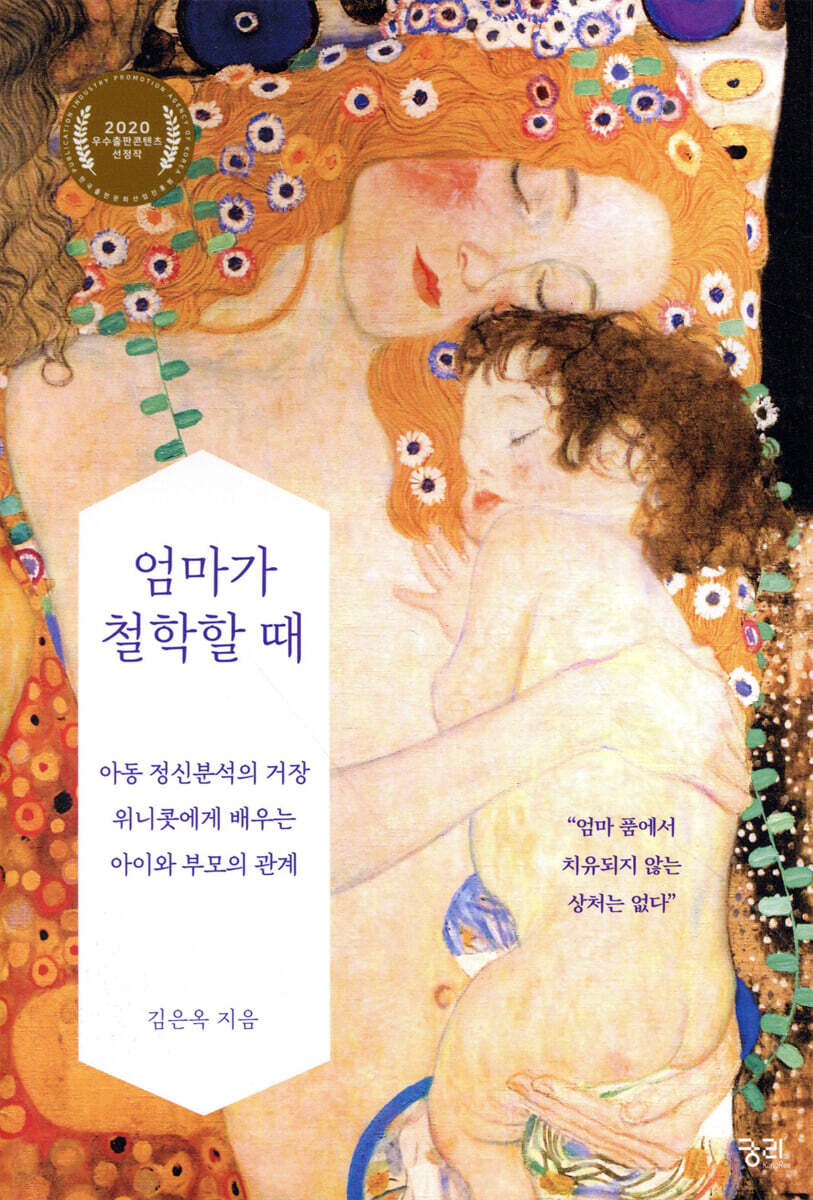
When Mom Philosophizes
 |
Description
Book Introduction
Books selected as excellent publication contents by the Ministry of Culture, Sports and Tourism
When Mom Philosophizes
“When parents philosophize, they grow together with their children.
“We can get one step closer!”
“I want to be a good mom/dad, too. Am I doing a good job as a parent?” This is a question that author Eun-ok Kim, who has been working as a parenting education specialist and psychological counselor for over 20 years, always hears from her clients.
What exactly is a parent, and what does it mean to raise a child well? To this end, the author published "When Mothers Philosophize," a book that explores the relationship between parents and children, drawing on the theories of child psychoanalysis giant Donald Winnicott (1896-1971).
When Mom Philosophizes
“When parents philosophize, they grow together with their children.
“We can get one step closer!”
“I want to be a good mom/dad, too. Am I doing a good job as a parent?” This is a question that author Eun-ok Kim, who has been working as a parenting education specialist and psychological counselor for over 20 years, always hears from her clients.
What exactly is a parent, and what does it mean to raise a child well? To this end, the author published "When Mothers Philosophize," a book that explores the relationship between parents and children, drawing on the theories of child psychoanalysis giant Donald Winnicott (1896-1971).
- You can preview some of the book's contents.
Preview
index
Entering
- Part 1 -
Lecture 1.
Introduction to Dependence
Lecture 2.
Absolute dependence period
3rd lecture.
Anxiety beyond imagination
Semifinals.
Hug
Lecture 5.
A mother who hugs her child and deals with his projections
- Part 2 -
Lecture 6.
Non-integrated experience
Lesson 7.
Integration of body and mind
Quarterfinals.
The ability to be alone
Lesson 9.
Omnipotent fantasy
Lesson 10.
attachment
- Part 3 -
Lesson 11.
Target homeostasis
Lecture 12.
About fantasy
Lesson 13.
About the intermediate target
Lesson 14.
Casting target
Lesson 15.
play
Round of 16.
Pathological separation and loss due to failure to experience the intermediate target
- Part 4 -
Lesson 17.
borderline personality disorder
Round of 18.
Mirror-reactive mom
Lesson 19.
False self and true self
Lesson 20.
Aggression
Lesson 21.
antisocial
Lesson 22.
Adolescence
Lesson 23.
Morality and attention
Going out
- Part 1 -
Lecture 1.
Introduction to Dependence
Lecture 2.
Absolute dependence period
3rd lecture.
Anxiety beyond imagination
Semifinals.
Hug
Lecture 5.
A mother who hugs her child and deals with his projections
- Part 2 -
Lecture 6.
Non-integrated experience
Lesson 7.
Integration of body and mind
Quarterfinals.
The ability to be alone
Lesson 9.
Omnipotent fantasy
Lesson 10.
attachment
- Part 3 -
Lesson 11.
Target homeostasis
Lecture 12.
About fantasy
Lesson 13.
About the intermediate target
Lesson 14.
Casting target
Lesson 15.
play
Round of 16.
Pathological separation and loss due to failure to experience the intermediate target
- Part 4 -
Lesson 17.
borderline personality disorder
Round of 18.
Mirror-reactive mom
Lesson 19.
False self and true self
Lesson 20.
Aggression
Lesson 21.
antisocial
Lesson 22.
Adolescence
Lesson 23.
Morality and attention
Going out
Into the book
“I have been providing play therapy for infants and children, adult psychological counseling, and parenting education based on modern psychoanalytic theory for over 20 years at the Freudian Psychoanalysis Distance Education Center.
I am influencing and integrating the human understanding and clinical experience I have gained throughout my life into the topic of parenting education, and I am influencing and integrating this with various people.
I really like children.
The ability to understand and love children has been a great help in treatment.
It was rewarding to see children's problem behaviors disappear and they adapt to life thanks to the special emotional bond they formed with their counselors.
There were children whose interpersonal skills and intelligence also improved.
Additionally, through adult counseling, I learned that trauma experienced in childhood can negatively impact adults as well.
“I’ve seen people who received psychotherapy continue to receive support after marriage and childbirth, siblings study together, and parents and children invest significant time in counseling and education to support their own growth, all of which have improved their quality of life.”
“Psychoanalysis and parenting education are about nurturing the inner child.
You must first look within yourself to see your child's.
If you put off your own things and look at your children's things, you will continue to get confused and will not be able to properly understand what kind of person you are.
Before analyzing others, you must first analyze yourself.
In psychoanalysis, it is rare to find a mental illness unrelated to developmental frustration.
The effort toward maturity must continue throughout one's life, until death.
Winnicott focuses particularly on human creativity.
There is a healing ability within humans, and the function to recover from the wounds of deprivation operates within us.
Creativity and self-healing abilities are formed especially in the first year of life when a baby is provided with a supportive environment.
That is, it develops when there is an environmental object that can replace the role of a good mother or a mother.”
“Children need time to just sit around and do nothing, time to do what they want to do.
You have to watch quietly.
But if there is no peace within the mother, she interferes with everything.
Winnicott said that you can predict a lot by looking at a mother holding her newborn baby.
When holding a child, the mother herself should be happy, but if she is anxious, she cannot fully relate to the child.
If a mother is holding her baby and breastfeeding, but is distracted by what to do next, it can be hurtful for the baby.
If a mother cannot comfortably accommodate her child's mind and body, the experience itself will damage the child's personality.
“A mother’s embrace is the first world a child encounters, and only when a child feels that it is a place worthy of being can life flourish.”
Winnicott believed that people with a false self would hold back on what they wanted to do or say.
It's about being too patient.
… … Winnicott says to someone who has had a hard time letting go of the false self, ‘You are fighting with yourself in life, and you win and you lose.
'Don't worry, the purpose of the fight is to control your destiny,' he consoled.
Life is always a new beginning, and the more we accept things as they are, the better.
Winnicott said that when someone sees the chaos within you for what it is, you feel comfortable in your own space and you establish order on your own.”
I am influencing and integrating the human understanding and clinical experience I have gained throughout my life into the topic of parenting education, and I am influencing and integrating this with various people.
I really like children.
The ability to understand and love children has been a great help in treatment.
It was rewarding to see children's problem behaviors disappear and they adapt to life thanks to the special emotional bond they formed with their counselors.
There were children whose interpersonal skills and intelligence also improved.
Additionally, through adult counseling, I learned that trauma experienced in childhood can negatively impact adults as well.
“I’ve seen people who received psychotherapy continue to receive support after marriage and childbirth, siblings study together, and parents and children invest significant time in counseling and education to support their own growth, all of which have improved their quality of life.”
“Psychoanalysis and parenting education are about nurturing the inner child.
You must first look within yourself to see your child's.
If you put off your own things and look at your children's things, you will continue to get confused and will not be able to properly understand what kind of person you are.
Before analyzing others, you must first analyze yourself.
In psychoanalysis, it is rare to find a mental illness unrelated to developmental frustration.
The effort toward maturity must continue throughout one's life, until death.
Winnicott focuses particularly on human creativity.
There is a healing ability within humans, and the function to recover from the wounds of deprivation operates within us.
Creativity and self-healing abilities are formed especially in the first year of life when a baby is provided with a supportive environment.
That is, it develops when there is an environmental object that can replace the role of a good mother or a mother.”
“Children need time to just sit around and do nothing, time to do what they want to do.
You have to watch quietly.
But if there is no peace within the mother, she interferes with everything.
Winnicott said that you can predict a lot by looking at a mother holding her newborn baby.
When holding a child, the mother herself should be happy, but if she is anxious, she cannot fully relate to the child.
If a mother is holding her baby and breastfeeding, but is distracted by what to do next, it can be hurtful for the baby.
If a mother cannot comfortably accommodate her child's mind and body, the experience itself will damage the child's personality.
“A mother’s embrace is the first world a child encounters, and only when a child feels that it is a place worthy of being can life flourish.”
Winnicott believed that people with a false self would hold back on what they wanted to do or say.
It's about being too patient.
… … Winnicott says to someone who has had a hard time letting go of the false self, ‘You are fighting with yourself in life, and you win and you lose.
'Don't worry, the purpose of the fight is to control your destiny,' he consoled.
Life is always a new beginning, and the more we accept things as they are, the better.
Winnicott said that when someone sees the chaos within you for what it is, you feel comfortable in your own space and you establish order on your own.”
--- From the text
Publisher's Review
Eunok Kim, a parent education counseling expert, explains in an easy-to-understand way
The story of Winnicott, a master of child psychoanalysis, and his theory of object relations: "A Good Enough Mother"!
“When parents philosophize, they can grow together with their children and become one step closer to them!”
“I want to be a good mom/dad, too. Am I doing a good job as a parent?” This is a question that author Eun-ok Kim, who has been working as a parenting education specialist and psychological counselor for over 20 years, always hears from her clients.
What exactly is a parent, and what does it mean to raise a child well? To this end, the author published "When Mothers Philosophize," a book that explores the relationship between parents and children, drawing on the theories of child psychoanalysis giant Donald Winnicott (1896-1971).
Winnicott was originally a pediatrician who saw 60,000 cases of children and their mothers over 40 years.
He is also known by the nickname 'Father of British Youth'.
He loved children, took in and raised war orphans, and worked extensively with social workers caring for children in difficult situations, dedicating his life to healing the hearts of children.
We also considered parent education, which teaches parents how to raise their children well and help them recover from pathology, to be very important.
Through years of research and consultation, the author has come to empathize with Winnicott's thoughts and philosophy.
“I learned through trial and error that I needed to help both mothers and children while mediating with those who were unable to psychologically support their children’s treatment.
To help the child, we must support the mother (parent).
Sometimes we treat the mother instead of the child, and the results are very good.
Although individual therapy is important, I believe that the personality changes that come from studying psychoanalytic theory together for several years are even greater.
The purpose of becoming aware of one's own mental world is to gain realistic expectations and reflections.
I, too, have been seeing clients for a long time based on my experience of being analyzed deeply, but no one can face the source of their suffering in a short period of time.
True growth happens over time.
“I believe that education is as important as counseling in expanding and refining the mind.”
“Facing without distortion and reflecting within relationships”
The first step in studying the mind for children and parents!
Books selected as excellent publication contents by the Ministry of Culture, Sports and Tourism
Above all, the author recommends that parents who are suffering from their children's problems and their own problems for which the cause is unknown and the solution is not in sight learn Winnicott's theory.
“This is a time to learn about object relations theory, which is widely recognized in the field of modern psychoanalysis, and in particular, the theory of British psychoanalyst Donald Winnicott, a key figure.
'Infancy', the root of all mental problems that Winnicott focused on, contains many precious 'relationship and existence elements' that are not easily perceived by people living with common sense.
To savor them in an orderly manner, I organized them by topic to identify the factors that promote or hinder mental development from the absolute dependence period, the first period of life, to the relative dependence period, when appropriate emotional and intellectual independence is formed.
“It focuses on the appearance of a healthy personality and helps to understand the causes and pathologies that occur when the emotional bond with the mother is damaged, using real-life cases.”
Author Eun-ok Kim received her master's degree in counseling psychology from the Catholic University of Korea Graduate School, and has been teaching parenting education and counseling for over 20 years at the Freudian Psychoanalysis Distance Lifelong Education Center (dreamfreud.com, formerly the Freudian Psychoanalysis Research Institute), using Winnicott's theories and techniques to treat mothers and children together.
The author has shared his expertise and knowledge gained through communication with many people, including parents, child psychologists, educators, and students seeking personal development, all of which are dedicated to their children's growth and treatment.
The text is presented in a total of 23 lectures.
In object relations theory, Winnicott's creativity is evident in the key concepts of absolute dependence, such as the embracing environment, the experience of a non-integrated state, the integration of body and mind, the ability to be alone, the anxiety of extinction caused by failure to embrace, and the intermediate object, as well as general concepts such as the true self, false self, aggression, antisociality, and morality.
As the lecture format is used, the writing is written in a soft, spoken manner so that readers can more easily approach and learn Winnicott's theories.
Dealing solely with psychoanalytic concepts can be difficult and heavy, so we are incorporating everyday stories and introducing related psychological content.
In particular, the author's honest stories from clients he has met and counseled are presented as clinical cases at appropriate places, allowing readers to think about them by applying them to their own situations.
“When I counsel people, I see people who are self-centered, long-winded, vague, and repeat specific content without meaning.
This is the child within you who is not yet fully developed, trapped in the stuffy words that function as an excretory system to relieve the thoughts and tension about the external world and external objects that have hurt you.
The ability to symbolize is developed when the mother digests the child's frustrating speech with her imagination, gestures, smiles, and language.
The ability to symbolize is developed only with the help of an interactive mother.
In order to escape from the state of fusion with the mother, the child creates an intermediate object that is not the mother but rather like the mother.
The intermediate object is the one and only, where I and the other are separate but united.
The degree of success or failure in mental development is often determined by the presence or absence of intermediate target experience.
“We deal with borderline personality disorder by addressing themes of pathological separation and loss as a result of the failure to create an intermediate object.”
"How can I become a good enough parent?" By faithfully reflecting on Winnicott's theories through this book, you will discover that the core essence of life, which we have overlooked, is contained within seemingly simple and easy truths. Furthermore, you will be able to break free from childish desires and find your own valuable self.
I hope that you can accept yourself as you are and grow with your children based on this.
The story of Winnicott, a master of child psychoanalysis, and his theory of object relations: "A Good Enough Mother"!
“When parents philosophize, they can grow together with their children and become one step closer to them!”
“I want to be a good mom/dad, too. Am I doing a good job as a parent?” This is a question that author Eun-ok Kim, who has been working as a parenting education specialist and psychological counselor for over 20 years, always hears from her clients.
What exactly is a parent, and what does it mean to raise a child well? To this end, the author published "When Mothers Philosophize," a book that explores the relationship between parents and children, drawing on the theories of child psychoanalysis giant Donald Winnicott (1896-1971).
Winnicott was originally a pediatrician who saw 60,000 cases of children and their mothers over 40 years.
He is also known by the nickname 'Father of British Youth'.
He loved children, took in and raised war orphans, and worked extensively with social workers caring for children in difficult situations, dedicating his life to healing the hearts of children.
We also considered parent education, which teaches parents how to raise their children well and help them recover from pathology, to be very important.
Through years of research and consultation, the author has come to empathize with Winnicott's thoughts and philosophy.
“I learned through trial and error that I needed to help both mothers and children while mediating with those who were unable to psychologically support their children’s treatment.
To help the child, we must support the mother (parent).
Sometimes we treat the mother instead of the child, and the results are very good.
Although individual therapy is important, I believe that the personality changes that come from studying psychoanalytic theory together for several years are even greater.
The purpose of becoming aware of one's own mental world is to gain realistic expectations and reflections.
I, too, have been seeing clients for a long time based on my experience of being analyzed deeply, but no one can face the source of their suffering in a short period of time.
True growth happens over time.
“I believe that education is as important as counseling in expanding and refining the mind.”
“Facing without distortion and reflecting within relationships”
The first step in studying the mind for children and parents!
Books selected as excellent publication contents by the Ministry of Culture, Sports and Tourism
Above all, the author recommends that parents who are suffering from their children's problems and their own problems for which the cause is unknown and the solution is not in sight learn Winnicott's theory.
“This is a time to learn about object relations theory, which is widely recognized in the field of modern psychoanalysis, and in particular, the theory of British psychoanalyst Donald Winnicott, a key figure.
'Infancy', the root of all mental problems that Winnicott focused on, contains many precious 'relationship and existence elements' that are not easily perceived by people living with common sense.
To savor them in an orderly manner, I organized them by topic to identify the factors that promote or hinder mental development from the absolute dependence period, the first period of life, to the relative dependence period, when appropriate emotional and intellectual independence is formed.
“It focuses on the appearance of a healthy personality and helps to understand the causes and pathologies that occur when the emotional bond with the mother is damaged, using real-life cases.”
Author Eun-ok Kim received her master's degree in counseling psychology from the Catholic University of Korea Graduate School, and has been teaching parenting education and counseling for over 20 years at the Freudian Psychoanalysis Distance Lifelong Education Center (dreamfreud.com, formerly the Freudian Psychoanalysis Research Institute), using Winnicott's theories and techniques to treat mothers and children together.
The author has shared his expertise and knowledge gained through communication with many people, including parents, child psychologists, educators, and students seeking personal development, all of which are dedicated to their children's growth and treatment.
The text is presented in a total of 23 lectures.
In object relations theory, Winnicott's creativity is evident in the key concepts of absolute dependence, such as the embracing environment, the experience of a non-integrated state, the integration of body and mind, the ability to be alone, the anxiety of extinction caused by failure to embrace, and the intermediate object, as well as general concepts such as the true self, false self, aggression, antisociality, and morality.
As the lecture format is used, the writing is written in a soft, spoken manner so that readers can more easily approach and learn Winnicott's theories.
Dealing solely with psychoanalytic concepts can be difficult and heavy, so we are incorporating everyday stories and introducing related psychological content.
In particular, the author's honest stories from clients he has met and counseled are presented as clinical cases at appropriate places, allowing readers to think about them by applying them to their own situations.
“When I counsel people, I see people who are self-centered, long-winded, vague, and repeat specific content without meaning.
This is the child within you who is not yet fully developed, trapped in the stuffy words that function as an excretory system to relieve the thoughts and tension about the external world and external objects that have hurt you.
The ability to symbolize is developed when the mother digests the child's frustrating speech with her imagination, gestures, smiles, and language.
The ability to symbolize is developed only with the help of an interactive mother.
In order to escape from the state of fusion with the mother, the child creates an intermediate object that is not the mother but rather like the mother.
The intermediate object is the one and only, where I and the other are separate but united.
The degree of success or failure in mental development is often determined by the presence or absence of intermediate target experience.
“We deal with borderline personality disorder by addressing themes of pathological separation and loss as a result of the failure to create an intermediate object.”
"How can I become a good enough parent?" By faithfully reflecting on Winnicott's theories through this book, you will discover that the core essence of life, which we have overlooked, is contained within seemingly simple and easy truths. Furthermore, you will be able to break free from childish desires and find your own valuable self.
I hope that you can accept yourself as you are and grow with your children based on this.
GOODS SPECIFICS
- Publication date: October 20, 2020
- Page count, weight, size: 356 pages | 616g | 152*224*21mm
- ISBN13: 9788958206828
- ISBN10: 8958206829
You may also like
카테고리
korean


korean

![GQ KOREA Mark (Monthly): December [2025]](http://librairie.coreenne.fr/cdn/shop/files/8ef265dbbfbf186523ed75ba7319009d.jpg?v=1765340328&width=3840)


