

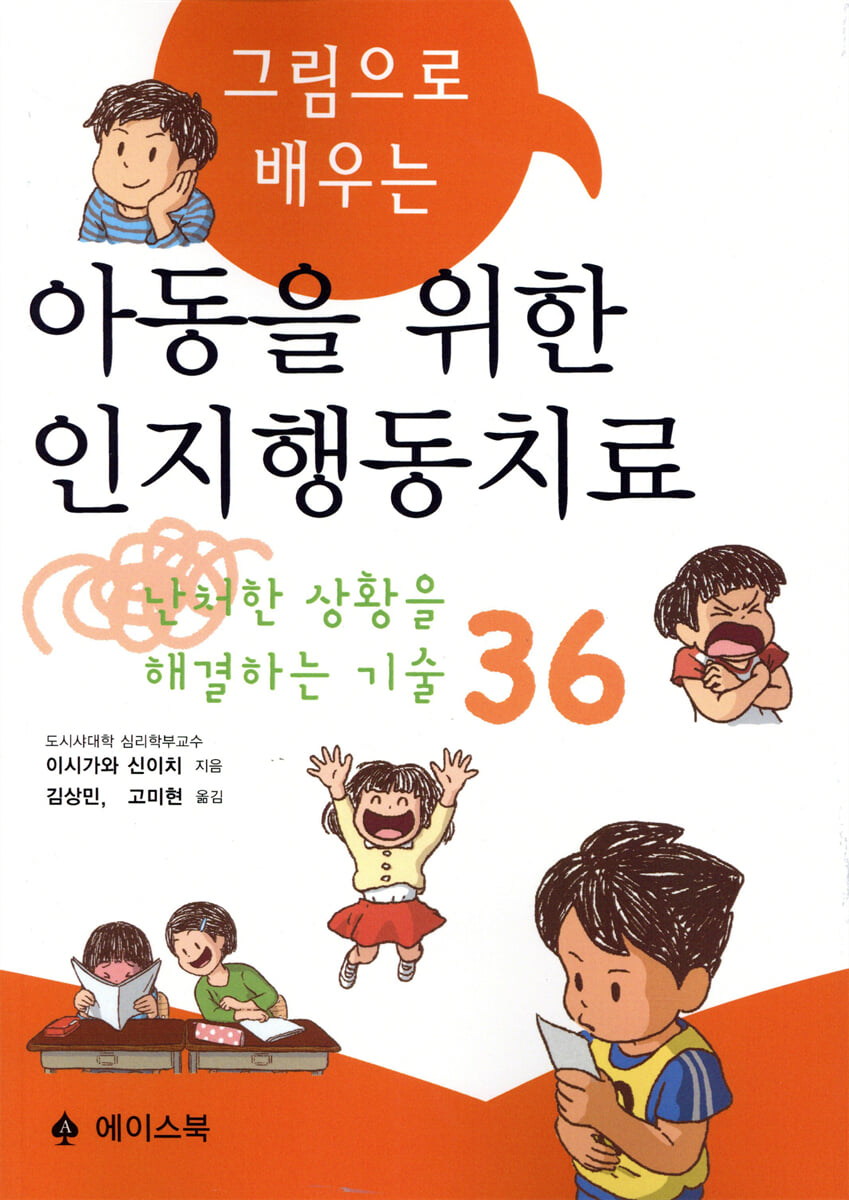
Cognitive Behavioral Therapy for Children Who Learn Through Drawing
 |
Description
Book Introduction
How do you feel now, holding this book in your hands?
Are you having a hard time?
There may have been something that made you anxious or depressed.
Are you finding yourself increasingly annoyed?
Maybe you're interested in the human mind or psychology, or maybe you're reading this book because a teacher or someone recommended it to you.
Everyone has their moments of awkwardness, sadness, and sometimes discouragement.
There is no one who thinks, “That will never happen to me!”
It's times like these that I hope you remember that this book is full of ideas to help you keep your body and mind healthy and enjoy life at school and at home.
Many of the methods introduced in this book are a compilation of growth strategies that many children around the world have tried so far.
As you can see from the title of the book, psychologists like us call this method [cognitive behavioral therapy].
You may see a lot of words that are a bit stiff and unfamiliar to your ears, but you will soon forget those thoughts when you see the content.
Because, many of the methods discussed in this book are things you already know, have heard of somewhere, or are only a little familiar with.
Best of all, none of the methods described in this book are difficult.
It's full of things you might want to try starting tomorrow.
There is no magic or sorcery involved in relieving stress.
The book's main feature is that it encourages consistent practice from a young age. It's designed so you can understand it even if you read it on your own.
I think these are things you can confidently tackle if you read the book carefully and then try it.
So, if you're trying to do it on your own, it's okay to try it on your own first.
Are you having a hard time?
There may have been something that made you anxious or depressed.
Are you finding yourself increasingly annoyed?
Maybe you're interested in the human mind or psychology, or maybe you're reading this book because a teacher or someone recommended it to you.
Everyone has their moments of awkwardness, sadness, and sometimes discouragement.
There is no one who thinks, “That will never happen to me!”
It's times like these that I hope you remember that this book is full of ideas to help you keep your body and mind healthy and enjoy life at school and at home.
Many of the methods introduced in this book are a compilation of growth strategies that many children around the world have tried so far.
As you can see from the title of the book, psychologists like us call this method [cognitive behavioral therapy].
You may see a lot of words that are a bit stiff and unfamiliar to your ears, but you will soon forget those thoughts when you see the content.
Because, many of the methods discussed in this book are things you already know, have heard of somewhere, or are only a little familiar with.
Best of all, none of the methods described in this book are difficult.
It's full of things you might want to try starting tomorrow.
There is no magic or sorcery involved in relieving stress.
The book's main feature is that it encourages consistent practice from a young age. It's designed so you can understand it even if you read it on your own.
I think these are things you can confidently tackle if you read the book carefully and then try it.
So, if you're trying to do it on your own, it's okay to try it on your own first.
index
How to Use This Book 12
4 Things to Know Before You Start 14
Column 1: Team collaboration is crucial in cognitive behavioral therapy. 22
1. Let's control our own moods 23
Step 1: Skills for Knowing Your Moods 24
Step 2: Techniques for Expressing Feelings 26
Step 3: Techniques for Measuring the Size of Your Mood 28
Step 4: Finding Fun Things to Do 30
Step 5: The Art of Understanding the Body-Mind Relationship 32
Step 6: Breathing Techniques for Relaxing Tension 34
Step 7: Relaxation Techniques for Muscle Exercise 36
Step 8: Relaxation Techniques Using Imagery 38
Step 9: The Art of Knowing Your Own Thoughts 40
Step 10: The Art of Understanding the Relationship Between Thoughts and Feelings 42
Step 11: Techniques for Generating Powerful Thoughts 44
Step 12: Knowing Your Weaknesses 48
Step 13: Technique for Creating Stairs of Difficulty (Strange) 52
Step 14: Taking the First Step 56
Column 2: The Effectiveness of Cognitive Behavioral Therapy 58
Challenge 59 with 2 friends
Step 15: Warm Talk Skills 60
Step 16: The Art of Asking for Help 64
Step 17: The Art of Saying No 68
Step 18: Problem Solving Techniques 74
Step 19: The Art of Generating Multiple Ideas 78
Step 20: The Art of Comparing Ideas 82
Step 21: The Art of Knowing Your Thought Habits 86
Step 22: Stress Resilience Skills (① Skills for Balanced Responsibilities) 90
Step 23: Stress Resilience Skills (②: Avoiding Extreme Thinking) 94
Column 3: Modify to fit your child's needs 97
Step 24: Stress-Resilience Techniques (③ Techniques for Considering Whether Your Thoughts Are Yours) 98
Step 25: Skills for Tackling Clumsy Tasks 102
Step 26: Climbing Stairs Little by Little Technique 106
Step 27: Practice Techniques 110
Column 4: Valuing Assessment 114
3. Awkward Situation! What should I do in this situation? 115
Situation 1: I am afraid of being separated from my mother.
116
Situation 2 I get really nervous when I speak in front of people.
120
Situation 3 I am worried about going to school.
124
Situation 4: I have a stomachache or headache even though I am not sick.
128
Situation 5: I feel unmotivated.
132
Situation 6: I am not confident.
136
Situation 7 You and your friend get into a fight.
142
Situation 8 I feel irritated for some reason.
146
Situation 9 You end up fighting without even realizing it.
150
Reference 156
157 For those working with children
4 Things to Know Before You Start 14
Column 1: Team collaboration is crucial in cognitive behavioral therapy. 22
1. Let's control our own moods 23
Step 1: Skills for Knowing Your Moods 24
Step 2: Techniques for Expressing Feelings 26
Step 3: Techniques for Measuring the Size of Your Mood 28
Step 4: Finding Fun Things to Do 30
Step 5: The Art of Understanding the Body-Mind Relationship 32
Step 6: Breathing Techniques for Relaxing Tension 34
Step 7: Relaxation Techniques for Muscle Exercise 36
Step 8: Relaxation Techniques Using Imagery 38
Step 9: The Art of Knowing Your Own Thoughts 40
Step 10: The Art of Understanding the Relationship Between Thoughts and Feelings 42
Step 11: Techniques for Generating Powerful Thoughts 44
Step 12: Knowing Your Weaknesses 48
Step 13: Technique for Creating Stairs of Difficulty (Strange) 52
Step 14: Taking the First Step 56
Column 2: The Effectiveness of Cognitive Behavioral Therapy 58
Challenge 59 with 2 friends
Step 15: Warm Talk Skills 60
Step 16: The Art of Asking for Help 64
Step 17: The Art of Saying No 68
Step 18: Problem Solving Techniques 74
Step 19: The Art of Generating Multiple Ideas 78
Step 20: The Art of Comparing Ideas 82
Step 21: The Art of Knowing Your Thought Habits 86
Step 22: Stress Resilience Skills (① Skills for Balanced Responsibilities) 90
Step 23: Stress Resilience Skills (②: Avoiding Extreme Thinking) 94
Column 3: Modify to fit your child's needs 97
Step 24: Stress-Resilience Techniques (③ Techniques for Considering Whether Your Thoughts Are Yours) 98
Step 25: Skills for Tackling Clumsy Tasks 102
Step 26: Climbing Stairs Little by Little Technique 106
Step 27: Practice Techniques 110
Column 4: Valuing Assessment 114
3. Awkward Situation! What should I do in this situation? 115
Situation 1: I am afraid of being separated from my mother.
116
Situation 2 I get really nervous when I speak in front of people.
120
Situation 3 I am worried about going to school.
124
Situation 4: I have a stomachache or headache even though I am not sick.
128
Situation 5: I feel unmotivated.
132
Situation 6: I am not confident.
136
Situation 7 You and your friend get into a fight.
142
Situation 8 I feel irritated for some reason.
146
Situation 9 You end up fighting without even realizing it.
150
Reference 156
157 For those working with children
Into the book
Have you ever experienced difficulties in your relationships with others in your life? Because I'm naturally introverted, I've often struggled at school, at work, and with my family.
But it was so hard to find ways to improve the situation.
In the end, I had no choice but to live through trial and error, adapting to the relationship.
While I was thinking about this, I was so happy to recently come across this book, and I believe that it will be helpful not only to adults but also to children in many difficult situations they face in their lives.
I started translating with the hope of helping children who, especially these days, struggle with interpersonal relationships from a young age and have few opportunities to meet people.
For example, let's think about a situation where you greet a friend on the street and they don't respond and just pass you by, or you go to a convenience store to buy a mask and the employee responds rudely to you even though you're meeting them for the first time.
Are those people really deliberately pretending not to know me and being unfriendly? It's not necessarily true.
What if a friend you met on the street passed you by without noticing your voice because it was too soft? What if a convenience store employee was repeatedly answering the same question dozens of times to customers looking for out-of-stock masks, repeating, "We don't have any!"?
If we think about it, we may be judging the situation based solely on the thoughts in our heads, which are not very helpful.
These cognitive errors can occur in anyone, but may be especially prevalent in young children and adolescent students.
I think cognitive behavioral therapy is about dividing cognitive errors into thoughts, situations, facts, and feelings, writing them down in detail, and practicing repeatedly to solve problems.
The author claims that this book was written for young children to be easy to understand, but I think it might be a bit difficult for them to understand depending on their level of comprehension.
So, if possible, it would be more helpful if your parents could be there with you.
While translating foreign books, I put a lot of thought into how to express aspects that differ from our own emotions. However, I would appreciate your understanding that the sentences may be unsmooth and lacking in some areas.
Finally, I would like to express my sincere gratitude to CEO Youngsoo Ko, who gave us the opportunity to translate despite our shortcomings, and to editor Inseon Cha, who worked hard on the long and arduous proofreading process.
May 0, 2020 Kim Sang-min and Go Mi-hyeon
But it was so hard to find ways to improve the situation.
In the end, I had no choice but to live through trial and error, adapting to the relationship.
While I was thinking about this, I was so happy to recently come across this book, and I believe that it will be helpful not only to adults but also to children in many difficult situations they face in their lives.
I started translating with the hope of helping children who, especially these days, struggle with interpersonal relationships from a young age and have few opportunities to meet people.
For example, let's think about a situation where you greet a friend on the street and they don't respond and just pass you by, or you go to a convenience store to buy a mask and the employee responds rudely to you even though you're meeting them for the first time.
Are those people really deliberately pretending not to know me and being unfriendly? It's not necessarily true.
What if a friend you met on the street passed you by without noticing your voice because it was too soft? What if a convenience store employee was repeatedly answering the same question dozens of times to customers looking for out-of-stock masks, repeating, "We don't have any!"?
If we think about it, we may be judging the situation based solely on the thoughts in our heads, which are not very helpful.
These cognitive errors can occur in anyone, but may be especially prevalent in young children and adolescent students.
I think cognitive behavioral therapy is about dividing cognitive errors into thoughts, situations, facts, and feelings, writing them down in detail, and practicing repeatedly to solve problems.
The author claims that this book was written for young children to be easy to understand, but I think it might be a bit difficult for them to understand depending on their level of comprehension.
So, if possible, it would be more helpful if your parents could be there with you.
While translating foreign books, I put a lot of thought into how to express aspects that differ from our own emotions. However, I would appreciate your understanding that the sentences may be unsmooth and lacking in some areas.
Finally, I would like to express my sincere gratitude to CEO Youngsoo Ko, who gave us the opportunity to translate despite our shortcomings, and to editor Inseon Cha, who worked hard on the long and arduous proofreading process.
May 0, 2020 Kim Sang-min and Go Mi-hyeon
---From the "Translator's Preface"
Publisher's Review
To my friends who have this book in their hands
How do you feel now, holding this book in your hands?
Are you having a hard time?
There may have been something that made you anxious or depressed.
Are you finding yourself increasingly annoyed?
Maybe you're interested in the human mind or psychology, or maybe you're reading this book because a teacher or someone recommended it to you.
Everyone has their moments of awkwardness, sadness, and sometimes discouragement.
There is no one who thinks, “That will never happen to me!”
It's times like these that I hope you remember that this book is full of ideas to help you keep your body and mind healthy and enjoy life at school and at home.
Many of the methods introduced in this book are a compilation of growth strategies that many children around the world have tried so far.
As you can see from the title of the book, psychologists like us call this method [cognitive behavioral therapy].
You may see a lot of words that are a bit stiff and unfamiliar to your ears, but you will soon forget those thoughts when you see the content.
Because, many of the methods discussed in this book are things you already know, have heard of somewhere, or are only a little familiar with.
Best of all, none of the methods described in this book are difficult.
It's full of things you might want to try starting tomorrow.
There is no magic or sorcery involved in relieving stress.
The book's main feature is that it encourages consistent practice from a young age. It's designed so you can understand it even if you read it on your own.
I think these are things you can confidently tackle if you read the book carefully and then try it.
So, if you're trying to do it on your own, it's okay to try it on your own first.
However, if you have an adult around you who can give you advice or a friend who can help you, this book will be even more helpful.
If you can do it with people around you, definitely give it a try.
The wonderful appearance you have will definitely change the way you use this book.
The important thing is that there is no one-size-fits-all [correct] answer to how to use this book or the problems it contains.
It may sound strange to those of you who are used to studying and taking tests in school, but you know your body and mind best.
Find your own usage method to see which one works best for you.
Lastly, if you like this book and find it helps you feel healthier both physically and mentally, I hope you'll recommend it to your friends and family.
There may be others besides you who need this book.
There are actually many more people struggling with various things than we think.
My greatest hope in writing this book is to share helpful techniques with as many children as possible to help them cope better with stress.
Shinichi Ishikawa
How do you feel now, holding this book in your hands?
Are you having a hard time?
There may have been something that made you anxious or depressed.
Are you finding yourself increasingly annoyed?
Maybe you're interested in the human mind or psychology, or maybe you're reading this book because a teacher or someone recommended it to you.
Everyone has their moments of awkwardness, sadness, and sometimes discouragement.
There is no one who thinks, “That will never happen to me!”
It's times like these that I hope you remember that this book is full of ideas to help you keep your body and mind healthy and enjoy life at school and at home.
Many of the methods introduced in this book are a compilation of growth strategies that many children around the world have tried so far.
As you can see from the title of the book, psychologists like us call this method [cognitive behavioral therapy].
You may see a lot of words that are a bit stiff and unfamiliar to your ears, but you will soon forget those thoughts when you see the content.
Because, many of the methods discussed in this book are things you already know, have heard of somewhere, or are only a little familiar with.
Best of all, none of the methods described in this book are difficult.
It's full of things you might want to try starting tomorrow.
There is no magic or sorcery involved in relieving stress.
The book's main feature is that it encourages consistent practice from a young age. It's designed so you can understand it even if you read it on your own.
I think these are things you can confidently tackle if you read the book carefully and then try it.
So, if you're trying to do it on your own, it's okay to try it on your own first.
However, if you have an adult around you who can give you advice or a friend who can help you, this book will be even more helpful.
If you can do it with people around you, definitely give it a try.
The wonderful appearance you have will definitely change the way you use this book.
The important thing is that there is no one-size-fits-all [correct] answer to how to use this book or the problems it contains.
It may sound strange to those of you who are used to studying and taking tests in school, but you know your body and mind best.
Find your own usage method to see which one works best for you.
Lastly, if you like this book and find it helps you feel healthier both physically and mentally, I hope you'll recommend it to your friends and family.
There may be others besides you who need this book.
There are actually many more people struggling with various things than we think.
My greatest hope in writing this book is to share helpful techniques with as many children as possible to help them cope better with stress.
Shinichi Ishikawa
GOODS SPECIFICS
- Publication date: June 25, 2020
- Format: Paperback book binding method guide
- Page count, weight, size: 160 pages | 182*257*20mm
- ISBN13: 9791195966967
- ISBN10: 1195966962
You may also like
카테고리
korean


korean

![GQ KOREA Mark (Monthly): December [2025]](http://librairie.coreenne.fr/cdn/shop/files/8ef265dbbfbf186523ed75ba7319009d.jpg?v=1765340328&width=3840)


