

Havruta 4-Step Study Method
 |
Description
Book Introduction
A learning method that combines Havruta and cognitive psychology
The purpose of most students' studies is to choose a stable career.
However, it is predicted that it will be difficult to make a living with just one job in the future.
In a society where even lawyers and doctors are being replaced by artificial intelligence, studying solely for grades cannot prepare for the future.
Therefore, we must also acquire the creative and critical thinking skills required in the era of the Fourth Industrial Revolution.
This book presents the 'Havruta 4-Step Study Method', which combines the results of cognitive psychology research on Jewish study methods that lead future society with remarkable results and effective study methods for improving grades.
According to research results in cognitive psychology, for successful learning, activities that involve retrieving what has been studied from memory are more effective than simple repetition. Representative retrieval methods include 'explaining' and 'writing from memory.'
The Havruta 4-step study method combines cognitive psychology with the Jewish practice of reading the Talmud from a young age and engaging in questioning and discussion as an adult. This method not only improves school grades but also fosters creative and critical thinking skills necessary for future society.
The purpose of most students' studies is to choose a stable career.
However, it is predicted that it will be difficult to make a living with just one job in the future.
In a society where even lawyers and doctors are being replaced by artificial intelligence, studying solely for grades cannot prepare for the future.
Therefore, we must also acquire the creative and critical thinking skills required in the era of the Fourth Industrial Revolution.
This book presents the 'Havruta 4-Step Study Method', which combines the results of cognitive psychology research on Jewish study methods that lead future society with remarkable results and effective study methods for improving grades.
According to research results in cognitive psychology, for successful learning, activities that involve retrieving what has been studied from memory are more effective than simple repetition. Representative retrieval methods include 'explaining' and 'writing from memory.'
The Havruta 4-step study method combines cognitive psychology with the Jewish practice of reading the Talmud from a young age and engaging in questioning and discussion as an adult. This method not only improves school grades but also fosters creative and critical thinking skills necessary for future society.
- You can preview some of the book's contents.
Preview
index
prolog
Chapter 1.
Comparing the study methods of Koreans and Jews
1.
Listening study vs. speaking study
Listening study without brain activity
Speaking study that awakens thought
2.
Memorization vs. Thinking
Studying by memorizing, taking tests, and forgetting
What do you think?
3.
Solo study vs. paired study
Competitive and independent study
Paired study
4.
Studying without Questions vs. Studying with Questions
A question that catches the eye
Questions are the learner's right
5.
Reliance on Private Education vs. Family-centered Education
Outsourced child education
Home-centered child education
Chapter 2.
The effectiveness of the Havruta study method
1.
Enhance self-directed learning skills
The importance of intrinsic motivation
Jewish self-directed study
Self-directed and parent-directed
2.
Activates the brain and improves thinking skills
Synapses and myelin that influence brain plasticity
Havruta made with a good brain
3.
Increases concentration
Havruta and Concentration
immersion
White noise to help you concentrate
Study Buddy and Concentration
4.
Makes you remember for a long time
memory mechanisms
Hippocampus, the workshop of memory
It's not the number of repetitions, but the repetition frequency that matters.
5.
Developing the core competencies of future talent
Jews Leading the Fourth Industrial Revolution
Competencies needed by future talents
4Cs: Core Competencies for Future Society
Chapter 3.
Effective study methods
1.
Easy Study Method - Repeated Reading
The problem with repeated reading
Why I prefer repetitive reading
2.
The Hard Way to Study - Retrieval Practice
desirable difficulties
Explain
Write from memory
Test it
Ask a question
3.
Increase metacognition
Metacognition is more important than memory
Metacognition that enhances self-directedness
How to Increase Metacognition
Havruta and Metacognition
Chapter 4.
Havruta 4-Step Study Method
1.
Step 1: Read aloud
Jewish reading
The study effect of reading aloud
Reading for memorization and comprehension
Reading aloud for children learning to read for the first time
Poetry recitation method
English reading method
How to read test questions
Reading aloud through a reading group
Reading aloud to help with proofreading
The practice of reading
2.
Explaining Step 2
Metacognition and Explaining
Explaining to a child
Teaching a friend in class
Explain the study method's steps
Explanation methods that enhance learning effectiveness
Who do you explain to?
3.
Step 3: Remember and write
Blank paper review method
How to write from memory
Summary and Class Diary
The effect of writing by remembering
How to Use Cornell Notes
4.
Step 4: Ask a Question
Why the question?
Talk with questions
How to create questions easily
Raphael's Question Model
The Scamper Question Method to Develop Creativity
Study questions by subject
Conditions for a good question
Self-introduction and questions
Chapter 5.
Havruta study model
Question-centered Havruta
Teaching a friend
Controversial Havruta
Exploration Activity Havruta
Comparative Havruta
Problem-making Havruta
Problem Solving Havruta
Epilogue
References
Reference broadcast
Reference newspaper
Chapter 1.
Comparing the study methods of Koreans and Jews
1.
Listening study vs. speaking study
Listening study without brain activity
Speaking study that awakens thought
2.
Memorization vs. Thinking
Studying by memorizing, taking tests, and forgetting
What do you think?
3.
Solo study vs. paired study
Competitive and independent study
Paired study
4.
Studying without Questions vs. Studying with Questions
A question that catches the eye
Questions are the learner's right
5.
Reliance on Private Education vs. Family-centered Education
Outsourced child education
Home-centered child education
Chapter 2.
The effectiveness of the Havruta study method
1.
Enhance self-directed learning skills
The importance of intrinsic motivation
Jewish self-directed study
Self-directed and parent-directed
2.
Activates the brain and improves thinking skills
Synapses and myelin that influence brain plasticity
Havruta made with a good brain
3.
Increases concentration
Havruta and Concentration
immersion
White noise to help you concentrate
Study Buddy and Concentration
4.
Makes you remember for a long time
memory mechanisms
Hippocampus, the workshop of memory
It's not the number of repetitions, but the repetition frequency that matters.
5.
Developing the core competencies of future talent
Jews Leading the Fourth Industrial Revolution
Competencies needed by future talents
4Cs: Core Competencies for Future Society
Chapter 3.
Effective study methods
1.
Easy Study Method - Repeated Reading
The problem with repeated reading
Why I prefer repetitive reading
2.
The Hard Way to Study - Retrieval Practice
desirable difficulties
Explain
Write from memory
Test it
Ask a question
3.
Increase metacognition
Metacognition is more important than memory
Metacognition that enhances self-directedness
How to Increase Metacognition
Havruta and Metacognition
Chapter 4.
Havruta 4-Step Study Method
1.
Step 1: Read aloud
Jewish reading
The study effect of reading aloud
Reading for memorization and comprehension
Reading aloud for children learning to read for the first time
Poetry recitation method
English reading method
How to read test questions
Reading aloud through a reading group
Reading aloud to help with proofreading
The practice of reading
2.
Explaining Step 2
Metacognition and Explaining
Explaining to a child
Teaching a friend in class
Explain the study method's steps
Explanation methods that enhance learning effectiveness
Who do you explain to?
3.
Step 3: Remember and write
Blank paper review method
How to write from memory
Summary and Class Diary
The effect of writing by remembering
How to Use Cornell Notes
4.
Step 4: Ask a Question
Why the question?
Talk with questions
How to create questions easily
Raphael's Question Model
The Scamper Question Method to Develop Creativity
Study questions by subject
Conditions for a good question
Self-introduction and questions
Chapter 5.
Havruta study model
Question-centered Havruta
Teaching a friend
Controversial Havruta
Exploration Activity Havruta
Comparative Havruta
Problem-making Havruta
Problem Solving Havruta
Epilogue
References
Reference broadcast
Reference newspaper
Detailed image
Publisher's Review
A study method that develops both school grades and future capabilities.
Today, our youth are expected to have both academic and practical skills.
However, although our studies can improve our grades, it is difficult to prepare us for the future society.
In our educational reality, studying for grades can never be taken lightly, so we cannot neglect school grades for the sake of developing the skills needed for the future.
There is no future that is not based on reality.
We need a study method that both improves school grades and equips us with the skills needed for future society.
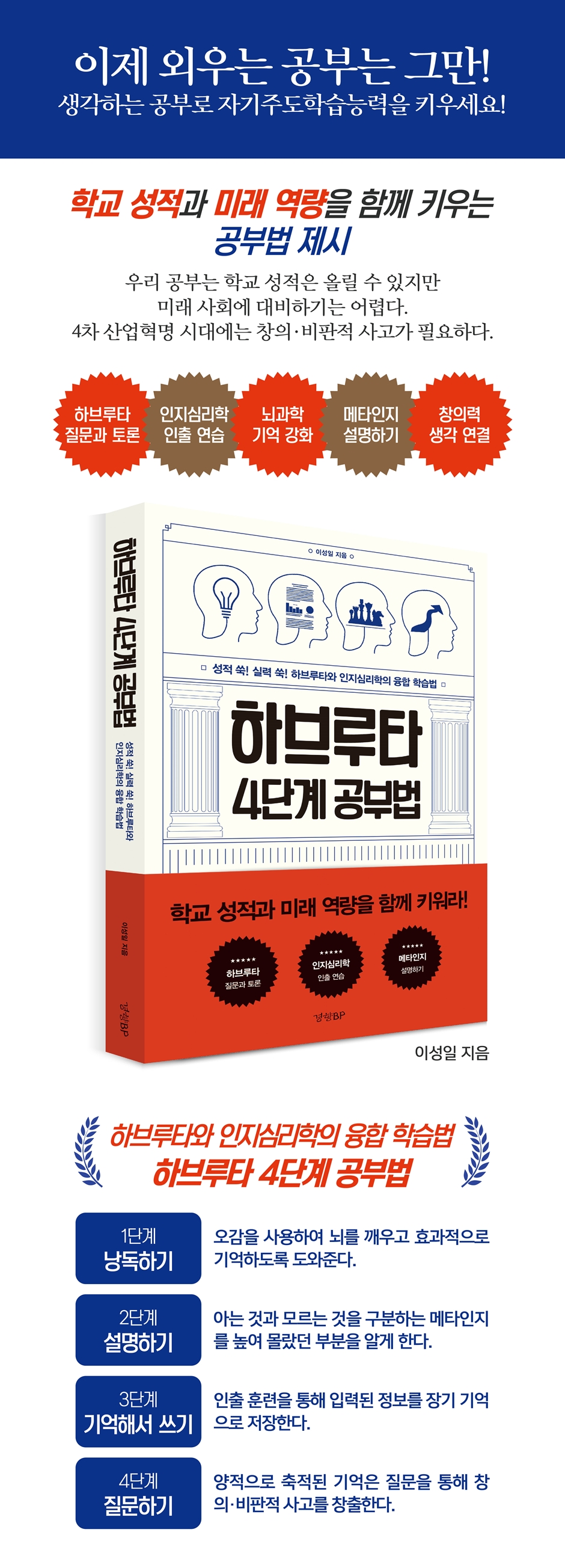
The Havruta 4-step study method is to study in the following order: 1. Read aloud - 2. Explain - 3. Memorize and write - 4. Ask questions. Studying that reflects both reality and the demands of the 4th Industrial Revolution era is done in the following order: 'Information input - Short-term memory - Long-term memory - Creative and critical thinking.'
Entering information is the beginning of learning and the first step toward memorization.
At this time, studying through reading awakens the brain and helps you remember effectively.
Information entered into short-term memory is stored in long-term memory through description and memorization.
Quantitatively accumulated memories bring about qualitative fusion of knowledge through questions, creating creative and critical thinking.
Therefore, this book will be helpful to students who want to acquire both academic performance for college entrance exams and the skills necessary for the Fourth Industrial Revolution, as well as to parents who wish to effectively support them.
Today, our youth are expected to have both academic and practical skills.
However, although our studies can improve our grades, it is difficult to prepare us for the future society.
In our educational reality, studying for grades can never be taken lightly, so we cannot neglect school grades for the sake of developing the skills needed for the future.
There is no future that is not based on reality.
We need a study method that both improves school grades and equips us with the skills needed for future society.
The Havruta 4-step study method is to study in the following order: 1. Read aloud - 2. Explain - 3. Memorize and write - 4. Ask questions. Studying that reflects both reality and the demands of the 4th Industrial Revolution era is done in the following order: 'Information input - Short-term memory - Long-term memory - Creative and critical thinking.'
Entering information is the beginning of learning and the first step toward memorization.
At this time, studying through reading awakens the brain and helps you remember effectively.
Information entered into short-term memory is stored in long-term memory through description and memorization.
Quantitatively accumulated memories bring about qualitative fusion of knowledge through questions, creating creative and critical thinking.
Therefore, this book will be helpful to students who want to acquire both academic performance for college entrance exams and the skills necessary for the Fourth Industrial Revolution, as well as to parents who wish to effectively support them.
GOODS SPECIFICS
- Date of publication: July 15, 2020
- Page count, weight, size: 259 pages | 474g | 152*225*16mm
- ISBN13: 9788969524065
- ISBN10: 8969524061
You may also like
카테고리
korean


korean

![GQ KOREA Mark (Monthly): December [2025]](http://librairie.coreenne.fr/cdn/shop/files/8ef265dbbfbf186523ed75ba7319009d.jpg?v=1765340328&width=3840)


