

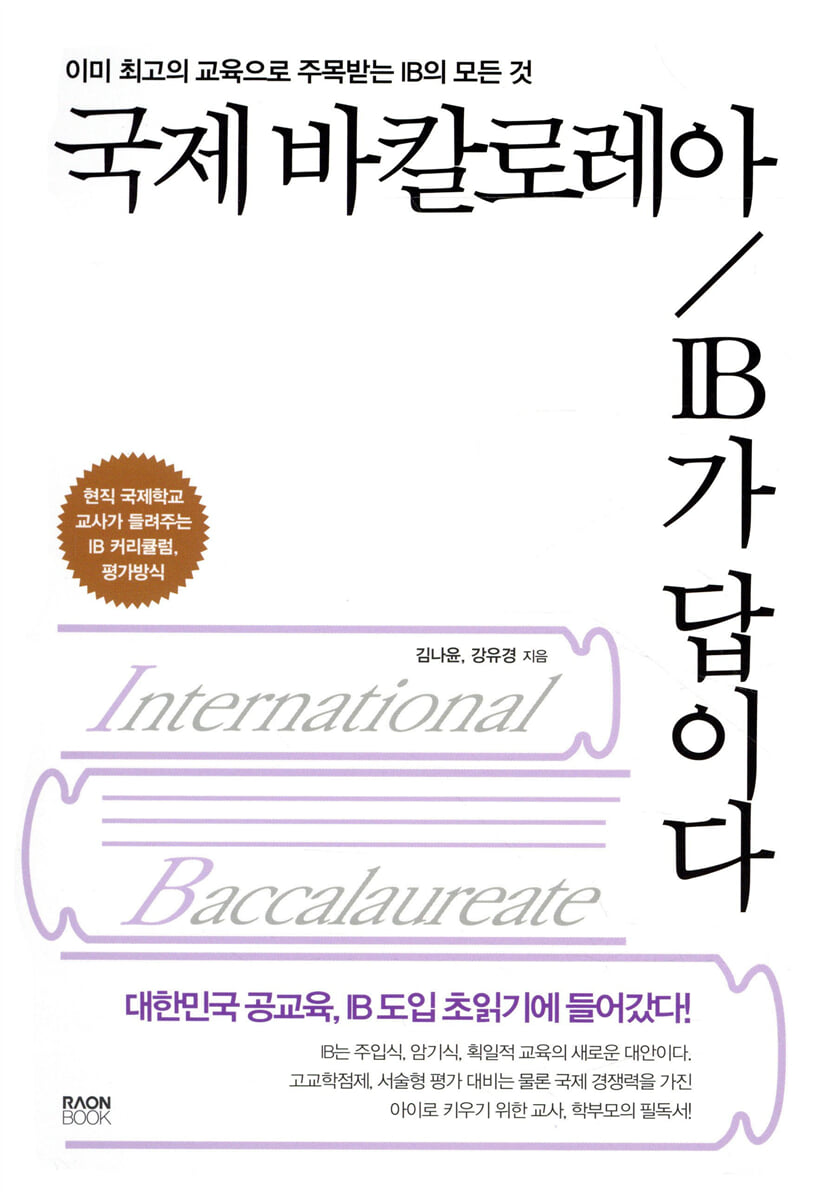
The International Baccalaureate (IB) is the answer.
 |
Description
Book Introduction
South Korea's public education system is on the verge of introducing the IB!
A must-read for raising children with international competitiveness, as well as for college entrance and career preparation.
The IB (International Baccalaureate) is an international standard curriculum developed and operated by the International Baccalaureate Organization (IBOC), a non-profit educational foundation, in 1968.
It first started in Switzerland in 1968 and has now become a popular curriculum with so few countries around the world that have not adopted the Baccalaureate IB curriculum.
As of 2019, there are 5,217 schools in 159 countries around the world implementing the IB, and Japan introduced the IB to public education in 2013.
In Korea, 13 schools, including international schools and foreign schools, are implementing IB education, and the Daegu and Jeju Offices of Education are working on introducing the Korean IB through agreements with the IBO.
What is the driving force behind the IB's global spread in such a short period of time? Its greatest strength lies in its project-based curriculum, where students actively engage in problem-solving rather than relying solely on textbooks.
A system that assesses holistic learning based on a fundamental approach to knowledge and internationally credible absolute evaluation, and a curriculum that cultivates diverse thinking, critical thinking, analytical skills, and creativity, provide students with a place where they can experience intellectual fulfillment and the joy of learning.
The two authors, who have taught children as international school teachers in China and India, introduce the entire IB curriculum in this book.
It also provides a comprehensive overview of what children learn and what challenges they face, why the IB education is absolutely essential for South Korea today, why it is the new learning method of the 21st century, and why it is a learning method that fosters children's happiness, enjoyment, and positive growth. It also includes 23 key tables that provide a clear overview of the IB curriculum, curriculum, and assessment methods.
A must-read for raising children with international competitiveness, as well as for college entrance and career preparation.
The IB (International Baccalaureate) is an international standard curriculum developed and operated by the International Baccalaureate Organization (IBOC), a non-profit educational foundation, in 1968.
It first started in Switzerland in 1968 and has now become a popular curriculum with so few countries around the world that have not adopted the Baccalaureate IB curriculum.
As of 2019, there are 5,217 schools in 159 countries around the world implementing the IB, and Japan introduced the IB to public education in 2013.
In Korea, 13 schools, including international schools and foreign schools, are implementing IB education, and the Daegu and Jeju Offices of Education are working on introducing the Korean IB through agreements with the IBO.
What is the driving force behind the IB's global spread in such a short period of time? Its greatest strength lies in its project-based curriculum, where students actively engage in problem-solving rather than relying solely on textbooks.
A system that assesses holistic learning based on a fundamental approach to knowledge and internationally credible absolute evaluation, and a curriculum that cultivates diverse thinking, critical thinking, analytical skills, and creativity, provide students with a place where they can experience intellectual fulfillment and the joy of learning.
The two authors, who have taught children as international school teachers in China and India, introduce the entire IB curriculum in this book.
It also provides a comprehensive overview of what children learn and what challenges they face, why the IB education is absolutely essential for South Korea today, why it is the new learning method of the 21st century, and why it is a learning method that fosters children's happiness, enjoyment, and positive growth. It also includes 23 key tables that provide a clear overview of the IB curriculum, curriculum, and assessment methods.
- You can preview some of the book's contents.
Preview
index
Prologue: Prepare for the Future with IB
Chapter 1: Korea is a small country! Let's give our children wings.
The Truth About South Korea: The World's Highest Academic Achievement for Youth
What if college dropout Steve Jobs had been born in Korea?
What's the real reason people want to be on time?
Don't wait for the Ministry of Education to do something.
What do Jeff Bezos, Larry Page, and Elon Musk have in common?
Silicon Valley talent is made at home.
Trends in Global Education: IB
Why did Japan's Ministry of Education introduce IB education?
Chapter 2 IB is an educational innovation!
The Essence of the IB and the Baccalaureate
Develop critical and creative thinking skills
The Meaning of Education Through the IB Primary School Curriculum
Developing a global standard education system and global teacher competency
The Role of Teachers in the IB Curriculum
IB scores are essential for admission to world-class universities!
After entering university, you will develop the qualities to pursue true academic studies.
Chapter 3: Happy Children with IB Education
A Look Inside the PYP Classroom
Children learning through the PYP exhibition
Experience of convergence education through STEM education
MYP Design Subjects Captivate Students
MYP Personal Project
DP Arts Subjects
Various CAS activities to help you find yourself and grow as a member of society
Experience the expansion of cognitive thinking skills through DP knowledge theory.
Chapter 4 What will you learn in IB?
DP curriculum
DP Non-Curricular Core Course
MYP curriculum
MYP Personal Project
PYP curriculum
PYP Exhibition
Teacher Contribution: Students I Met at an International School
Student Interviews: International School Students Speak Out
supplement
IB's elementary, middle, and high school curriculum
IB's 10 Learner Profiles
IB Curriculum Overview
Overview of DP's six subject groups
Key Features of DP Core Essential Areas
Assessment of DP core essential areas
Examples of essay topics and subjects related to creative experiential volunteer activities
Knowledge Theory and Essay Evaluation Criteria
Examples of subjects chosen by DP students
MYP Individual and Social Studies Courses
Individual and social studies across the IB curriculum
MYP Math Course Subject Examples
MYP Science Class Subject Examples
MYP Personal Project Components
MYP Individual Project Report Writing Format
MYP Individual Project Report Length
Source Material Evaluation Form for Writing an MYP Individual Project
Transdisciplinary themes in the PYP
IB Learning Assessment Concepts
List of official IB schools in Korea
Cambridge University's subject-specific requirements
Oxford University's subject-specific requirements
Trends in the number of schools introducing the IB program in Japan
Acknowledgments at the end of the book
Chapter 1: Korea is a small country! Let's give our children wings.
The Truth About South Korea: The World's Highest Academic Achievement for Youth
What if college dropout Steve Jobs had been born in Korea?
What's the real reason people want to be on time?
Don't wait for the Ministry of Education to do something.
What do Jeff Bezos, Larry Page, and Elon Musk have in common?
Silicon Valley talent is made at home.
Trends in Global Education: IB
Why did Japan's Ministry of Education introduce IB education?
Chapter 2 IB is an educational innovation!
The Essence of the IB and the Baccalaureate
Develop critical and creative thinking skills
The Meaning of Education Through the IB Primary School Curriculum
Developing a global standard education system and global teacher competency
The Role of Teachers in the IB Curriculum
IB scores are essential for admission to world-class universities!
After entering university, you will develop the qualities to pursue true academic studies.
Chapter 3: Happy Children with IB Education
A Look Inside the PYP Classroom
Children learning through the PYP exhibition
Experience of convergence education through STEM education
MYP Design Subjects Captivate Students
MYP Personal Project
DP Arts Subjects
Various CAS activities to help you find yourself and grow as a member of society
Experience the expansion of cognitive thinking skills through DP knowledge theory.
Chapter 4 What will you learn in IB?
DP curriculum
DP Non-Curricular Core Course
MYP curriculum
MYP Personal Project
PYP curriculum
PYP Exhibition
Teacher Contribution: Students I Met at an International School
Student Interviews: International School Students Speak Out
supplement
IB's elementary, middle, and high school curriculum
IB's 10 Learner Profiles
IB Curriculum Overview
Overview of DP's six subject groups
Key Features of DP Core Essential Areas
Assessment of DP core essential areas
Examples of essay topics and subjects related to creative experiential volunteer activities
Knowledge Theory and Essay Evaluation Criteria
Examples of subjects chosen by DP students
MYP Individual and Social Studies Courses
Individual and social studies across the IB curriculum
MYP Math Course Subject Examples
MYP Science Class Subject Examples
MYP Personal Project Components
MYP Individual Project Report Writing Format
MYP Individual Project Report Length
Source Material Evaluation Form for Writing an MYP Individual Project
Transdisciplinary themes in the PYP
IB Learning Assessment Concepts
List of official IB schools in Korea
Cambridge University's subject-specific requirements
Oxford University's subject-specific requirements
Trends in the number of schools introducing the IB program in Japan
Acknowledgments at the end of the book
Detailed image

Into the book
Many excellent educators in our country say that the essence of education is not the acquisition of knowledge, but growth through learning.
In other words, he emphasizes that the goal should be to help children discover their potential and possibilities as lifelong learners in a fun way, rather than forcing them into competition.
I would like to say that the curriculum that aligns with this purpose is the IB, which has recently begun to attract attention in the education world.
--- p.9
In the coming era of superhumanity, innovation in education must be preceded by a change in the consciousness of parents, the older generation raising their children.
The fence of home and family is where children's education begins before school.
No matter how well-educated a school may be with the latest curriculum and the best faculty, if a child cannot apply it in their lives, it is a dead education, and the gap between education and reality will only grow wider.
Therefore, in the coming era of the Fourth Industrial Revolution, the type of education that must be most avoided is education without practice, education that is focused on results and only involves acquiring knowledge.
--- p.37
Sometimes you can see signs for creativity training academies.
But is creativity truly something that can be learned at a private academy? Parents should seriously consider this question.
When asked why many children growing up in South Korea lack creativity, the first thing we can say is the overprotection of their parents.
Parental overprotection weakens children's brain power, making self-directed learning difficult and stifling creativity.
In other words, parents should not try to turn their children's brains on, but rather guide and wait for their children to have opportunities to engage in meaningful actions or immersion on their own.
Sometimes students say that studying is fun.
How can students be so addicted to studying? Study addiction is a kind of addiction to meaning.
The process by which humans create meaning involves finding connections between concepts they already know and new experiences. If students develop this desire, self-directed learning becomes possible.
--- p.75
Performing arts is a practical subject that encourages discovery in others through experimentation, presentation of ideas, and trial of new ideas.
We pursue the development of theatre and practical life skills through the building of creativity and collaboration.
It also provides students with opportunities to work as stage designers, directors, and performers, emphasizing the importance of working individually as well as collaboratively as part of an ensemble.
By providing opportunities to actively participate in the creative process, students can develop into artists who can express their own ideas.
The Performing Arts program encourages students to gain a deeper understanding of themselves, their communities, and the world through the process of researching, producing, preparing, presenting, and critically reflecting on plays, both as participants and as audience members.
Through the study of performing arts, students will become aware of their own personal and cultural perspectives and understand the diversity, processes, and production styles of theatrical performance.
You can also discover and engage with diverse forms of theatre across time, place, and culture.
--- p.150~151
The central question in epistemology is: 'How do we know that we know?'
With this as the goal of exploration, students are expected to complete approximately 100 hours of coursework over two years, critically reflecting on diverse ways of thinking across cultures.
Through this core course, students will learn the fundamentals of 'knowledge' and explore the theory of knowledge based on the seven questions below that can help them understand the basis of knowledge.
· Meaning: What does it mean?
· Evidence: What can be considered evidence?
· Certainty: How can you be sure?
· Perspective: How can we look at it?
· Limitations: What are the limitations?
· Value: Why is it valuable?
· Connection: How can they be similar or different?
In other words, he emphasizes that the goal should be to help children discover their potential and possibilities as lifelong learners in a fun way, rather than forcing them into competition.
I would like to say that the curriculum that aligns with this purpose is the IB, which has recently begun to attract attention in the education world.
--- p.9
In the coming era of superhumanity, innovation in education must be preceded by a change in the consciousness of parents, the older generation raising their children.
The fence of home and family is where children's education begins before school.
No matter how well-educated a school may be with the latest curriculum and the best faculty, if a child cannot apply it in their lives, it is a dead education, and the gap between education and reality will only grow wider.
Therefore, in the coming era of the Fourth Industrial Revolution, the type of education that must be most avoided is education without practice, education that is focused on results and only involves acquiring knowledge.
--- p.37
Sometimes you can see signs for creativity training academies.
But is creativity truly something that can be learned at a private academy? Parents should seriously consider this question.
When asked why many children growing up in South Korea lack creativity, the first thing we can say is the overprotection of their parents.
Parental overprotection weakens children's brain power, making self-directed learning difficult and stifling creativity.
In other words, parents should not try to turn their children's brains on, but rather guide and wait for their children to have opportunities to engage in meaningful actions or immersion on their own.
Sometimes students say that studying is fun.
How can students be so addicted to studying? Study addiction is a kind of addiction to meaning.
The process by which humans create meaning involves finding connections between concepts they already know and new experiences. If students develop this desire, self-directed learning becomes possible.
--- p.75
Performing arts is a practical subject that encourages discovery in others through experimentation, presentation of ideas, and trial of new ideas.
We pursue the development of theatre and practical life skills through the building of creativity and collaboration.
It also provides students with opportunities to work as stage designers, directors, and performers, emphasizing the importance of working individually as well as collaboratively as part of an ensemble.
By providing opportunities to actively participate in the creative process, students can develop into artists who can express their own ideas.
The Performing Arts program encourages students to gain a deeper understanding of themselves, their communities, and the world through the process of researching, producing, preparing, presenting, and critically reflecting on plays, both as participants and as audience members.
Through the study of performing arts, students will become aware of their own personal and cultural perspectives and understand the diversity, processes, and production styles of theatrical performance.
You can also discover and engage with diverse forms of theatre across time, place, and culture.
--- p.150~151
The central question in epistemology is: 'How do we know that we know?'
With this as the goal of exploration, students are expected to complete approximately 100 hours of coursework over two years, critically reflecting on diverse ways of thinking across cultures.
Through this core course, students will learn the fundamentals of 'knowledge' and explore the theory of knowledge based on the seven questions below that can help them understand the basis of knowledge.
· Meaning: What does it mean?
· Evidence: What can be considered evidence?
· Certainty: How can you be sure?
· Perspective: How can we look at it?
· Limitations: What are the limitations?
· Value: Why is it valuable?
· Connection: How can they be similar or different?
--- p.183
Publisher's Review
“Yesterday’s education cannot control the future!”
Discover education that fosters convergent future talents who will lead the new era.
The IB curriculum consists of the Primary Years Program (PYP) for grades 1-5, the Middle Years Program (MYP) for grades 6-10, and the Diploma Program (DP) for grades 11-12.
Each educational program is based on 10 learner ideals: 'inquirers, knowledgeable people, thinkers, communicators, principled and open-minded people, caring, challenging, balanced people, and reflective people', and is comprised of student-centered learning in which students take the initiative and lead.
The IB education seeks practical ways to revive students' lost activities and dream experiences that form the foundation of creativity. In IB classes, students spend their school years experiencing a variety of extracurricular activities, and through various experiences, they develop creativity and concentration.
The IB system, which aims to foster independent thinking and self-development based on transdisciplinary subjects, will reveal the essence of student-driven education, the nature of learning that our children will attend in the future schools and 21st-century education, and the direction that Korean education should take.
Chapter 1 tells the harsh reality of South Korea's education system, which ranks last in interest while achieving the highest academic achievement in the world, and the uncomfortable truth about an education system obsessed only with the College Scholastic Ability Test (CSAT). It points out that rather than waiting for the Ministry of Education to do something, the parent generation should face reality and instill in their children a passion for learning.
Chapter 2 describes how IB education began and how the IB program is evolving in educational settings around the world.
We also introduce the global standard education system, the role of teachers, and why the IB DP degree is welcomed by leading universities around the world.
Chapter 3 shows a classroom where IB education classes are conducted.
We present examples of classrooms where learning becomes play and cultural experiences, and where the scope of learning is expanded through various extracurricular activities such as exhibitions and design programs.
Chapter 4 specifically introduces the curriculum taught in the IB.
The high school curriculum's knowledge theory, short essays, creative experience volunteer activities, individual projects in the middle school curriculum, and individual exhibitions in the elementary school curriculum, which cannot be experienced in regular schools, clearly demonstrate the characteristics and strengths of the IB curriculum.
Discover education that fosters convergent future talents who will lead the new era.
The IB curriculum consists of the Primary Years Program (PYP) for grades 1-5, the Middle Years Program (MYP) for grades 6-10, and the Diploma Program (DP) for grades 11-12.
Each educational program is based on 10 learner ideals: 'inquirers, knowledgeable people, thinkers, communicators, principled and open-minded people, caring, challenging, balanced people, and reflective people', and is comprised of student-centered learning in which students take the initiative and lead.
The IB education seeks practical ways to revive students' lost activities and dream experiences that form the foundation of creativity. In IB classes, students spend their school years experiencing a variety of extracurricular activities, and through various experiences, they develop creativity and concentration.
The IB system, which aims to foster independent thinking and self-development based on transdisciplinary subjects, will reveal the essence of student-driven education, the nature of learning that our children will attend in the future schools and 21st-century education, and the direction that Korean education should take.
Chapter 1 tells the harsh reality of South Korea's education system, which ranks last in interest while achieving the highest academic achievement in the world, and the uncomfortable truth about an education system obsessed only with the College Scholastic Ability Test (CSAT). It points out that rather than waiting for the Ministry of Education to do something, the parent generation should face reality and instill in their children a passion for learning.
Chapter 2 describes how IB education began and how the IB program is evolving in educational settings around the world.
We also introduce the global standard education system, the role of teachers, and why the IB DP degree is welcomed by leading universities around the world.
Chapter 3 shows a classroom where IB education classes are conducted.
We present examples of classrooms where learning becomes play and cultural experiences, and where the scope of learning is expanded through various extracurricular activities such as exhibitions and design programs.
Chapter 4 specifically introduces the curriculum taught in the IB.
The high school curriculum's knowledge theory, short essays, creative experience volunteer activities, individual projects in the middle school curriculum, and individual exhibitions in the elementary school curriculum, which cannot be experienced in regular schools, clearly demonstrate the characteristics and strengths of the IB curriculum.
GOODS SPECIFICS
- Date of issue: May 21, 2020
- Page count, weight, size: 267 pages | 460g | 150*220*17mm
- ISBN13: 9791190820264
- ISBN10: 1190820269
You may also like
카테고리
korean


korean

![GQ KOREA Mark (Monthly): December [2025]](http://librairie.coreenne.fr/cdn/shop/files/8ef265dbbfbf186523ed75ba7319009d.jpg?v=1765340328&width=3840)


